

Final days of Ann Arbor police dispatch bring strong emotions
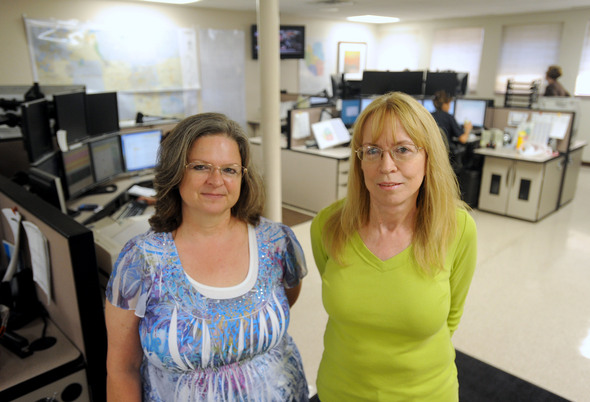
Retired Ann Arbor police dispatchers Anne Daws-Lazar, left, and Bobbie Santure, right, stand in the dispatch offices Thursday above the Ann Arbor Fire Department station on Fifth Street in Ann Arbor.
Angela J. Cesere | AnnArbor.com
It was like coming home.
The era of the city dispatch draws to a close Saturday. Beginning Sunday, the city will begin paying the county for dispatch duties - a debated agreement that was finalized in December.
Memories and emotions flooded some of the staff as the last week of operations came to a close.
The city of Ann Arbor agreed to pay $759,089 per year for the county to run the service. Both the city and county dispatch have been sharing the same space in a second-floor office above the Ann Arbor Fire Department since 2010 -- for which the county pays $12,520 per year to rent.
But with the move, the city is set to save about $500,000 per year by contracting the service out to the county - savings Ann Arbor city administrator Steve Powers has said would allow the city to hire more police officers.
The county dispatch has a staff of 17 and the city has a staff of 21. To fill out the department, the county has been hiring to fill out its ranks to 30 employees, including 10 part-time workers to take calls.
Of the eight city dispatchers the county is hiring, two are part-time and six are full-time positions. All of the city employees were given the opportunity to apply for the county jobs.
Lt. Spring Tremaine, who oversees the city's dispatch, will move into a new role Sunday as supervisor in the county-run dispatch center. She said she understands the strong emotions among her staff.
“You have people’s lives in your hands more than you realize,” Tremaine said.
For retired city dispatchers Anne Daws-Lazar and Bobbie Santure, both of Ann Arbor, they can only sum up their feelings about the transition in one word: “Sad.”
Daws-Lazar worked as a dispatcher from 1979 to 1985, and then from 1993 to 2002. Santure worked in the department from 1984 to 2002.
“Either you would come in and wipe out in the early days, or stay for a long time,” Daws-Lazar said.
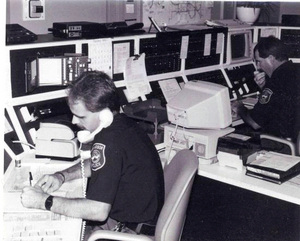
Ann Arbor Police officers Brian Jatczak and Steve Bruneau work the phones at city police dispatch, which was housed in the basement of city hall from 1963 to 2005. Both have retired from their jobs as dispatchers, Jatczak in 2011 and Bruneau in 2005.
Courtesy photo
The room had no windows, and had an elevated floor to keep the equipment off of the wires needed to power all of the equipment.
When the women started working there, there were no laws against smoking in the workplace. The close quarters made their clothes reek of cigarettes.
Daws-Lazar and Santure reminisced about the punch cards they would use to record information as they listened to calls. If it was particularly lengthy, they would keep scribbling from one card to the next.
At the end of the day, the cards would have to be transcribed.
At first, only officers worked in the dispatch room. Later, non-police officers were the primary staffers on the job.
“The skill set you need to dispatch is really different than what you need to be ‘out there,’” Daws-Lazar said.
Officers would walk through dispatch on their breaks, and there was a constant stream of people through the office, Daws-Lazar said.
“The police department is like a family,” Daws-Lazar said. “We all knew all of them.”
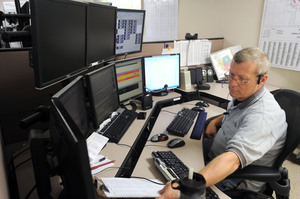
Ann Arbor police dispatcher Dave Williamson at work Thursday in the dispatch offices above the Ann Arbor Fire Department on Fifth Street in downtown Ann Arbor.
Angela J. Cesere | AnnArbor.com
He doesn't expect a big change in his job.
“A 911 call is a 911 call,” Williamson said. “A person screaming for help is a person screaming for help.”
People “are never calling on a good day,” Daws-Lazar said, and there’s a fine line when listening to a caller’s story.
There are some phrases that are burned into their memories - as well as some harrowing calls.
“We always said we were going to write a book,” Santure said.
Daws-Lazar said she still says “check and advise,” and Santure said there are badge numbers, phone numbers and codes will never go away.
A 151 meant there was a homicide or a gun. A 1-1 was a killing. Most of the dispatch codes have now been eliminated after 9/11 as a homeland security measure.
“It’s the big things I remember,” Daws-Lazar said, noting a 6 a.m. murder at a gas station convenience store on the busy Platt and Packard corner that got many calls from scared motorists.
Santure recalled a man who dialed 911 from his burning home. He couldn’t find a way out of the room he was in - and then the phone went silent.
The man never mentioned he had children, Santure said, and firefighters had to carry their bodies out of the house.
For Williamson, his worst day was when a firefighter was killed on Jackson and I-94. The radio traffic was “hectic,” he said. Those on scene kept asking for life flight - the helicopter wouldn’t fly in the wintry conditions - and the ambulance had a difficult time traveling on icy roads.
“It still hurts,” Williamson said.
As the number of police officers has decreased in the city, it’s become increasingly challenging for the dispatchers to determine where to mobilize units.
“You have to be more selective with how you use your resources,” Williamson said. “You have to think ahead, to what might happen.”
Still, Daws-Lazar said she hasn’t heard it all. The unusual, quirky callers also are particularly memorable.
There’s a man who called every day - and still does, Tremaine said - to ask for the “word of the day.”
Once, an elderly woman called because there was a giant snake in her apartment, Santure said. The woman managed to trap the snake under a trash can.
The dispatchers listen to people having heart attacks over the phone, and to families screaming in despair when they find their children dead, whether by suicide or from an accident.
Once the call is out of their hands, however, there’s no resolution for the dispatchers. The disconnect is hard for new employees to grasp, Daws-Lazar said.
The stressful calls, combined with life’s ups and downs, made the family-like relationships in amongst the city dispatchers even more important.
It did make dispatching officers to a potentially dangerous scene more difficult, Daws-Lazar said.
“You’re sending in people that are your friends,” she said.
There were potlucks, and special breakfasts on Sunday mornings at city dispatch. The road officers always knew they could get a good meal there, Santure said.
“You spend more time there than at home,” Daws-Lazar said.
The dispatch team, Williamson said, was like “an extension of your own family.”
Amy Biolchini covers Washtenaw County, health and environmental issues for AnnArbor.com. Reach her at (734) 623-2552, amybiolchini@annarbor.com or on Twitter.
Comments
CaiBrayMama
Sun, Jul 1, 2012 : 7:24 p.m.
Is this going to be updated to reflect the correct dates, or are we just going to go ahead and keep the incorrect information as is tradition by annarbor.com?
swcornell
Sun, Jul 1, 2012 : 2:09 p.m.
Please do write that book! And a screen play would be great too!
Snarf Oscar Boondoggle
Sun, Jul 1, 2012 : 5:01 p.m.
dispatcher monologues?
snoopdog
Sun, Jul 1, 2012 : 2:04 p.m.
The picture of the two retired dispatchers ( Anne and Bobbie) show them to be perhaps in their early fifties. Why has not a single person asked this question : " why on earth are they retired" and why are the taxpayers on the hook for paying folks this young to retire and hang out on the taxpayer dime for the next 40 years ? No wonder the average 911 call costs almost 40 bucks in A2 ! Good Day
stunhsif
Sun, Jul 1, 2012 : 11:03 p.m.
huh7891, read and believe, it says they are retired. ABO
huh7891
Sun, Jul 1, 2012 : 2:17 p.m.
Uuhhh...Anne wasn't retired...read the post from her son. Besides you can retire whenever you want so what's your point?
LuLzTrollFTW
Sun, Jul 1, 2012 : 12:39 a.m.
Less Police equals MORE FREEDOM! THANK YOU great recession!! (The same goes for Government in general...)
Snarf Oscar Boondoggle
Sun, Jul 1, 2012 : 5 p.m.
freedom, maybe; LICENSE, NO. check yourself ...
LuLzTrollFTW
Sun, Jul 1, 2012 : 4:44 p.m.
TL/DR
Tom Todd
Sun, Jul 1, 2012 : 12:53 p.m.
FDR froze some wages during the depression, and started social security, to help the older folks and keep the country from a real race to the bottom. America turned it around. I'm sure the rich were not happy a middle class was created and kids went to college.Now it appears we as a once great nation. We cannot wait for a return to depression era food,gas,housing,second and third classes, or are we already there? it really appears this nation is making sure there is a class of folks who will will not know gain-full employment in there lifetime and I,m not referring to the poor and welfare crowd. As for more freedom I see a lot of people who cannot handle that freedom,not talking about the poor criminals either.
Craig Lounsbury
Sat, Jun 30, 2012 : 9:10 p.m.
I found this in an earlier story. "According to information presented at Monday's meeting, the current cost per 911 call for the county is $16.18, while the same cost for the Ann Arbor Police Department is $39.63. Under the consolidated operation, the cost is estimated to be $17.37 per call." Those numbers are hard to ignore.
Craig Lounsbury
Sun, Jul 1, 2012 : 9:04 p.m.
If Ann Arbor dispatchers were answering 70% of the calls it would very much change the numbers. It would turn them on their heads. But why wouldn't Deputy Police Chief Greg Bazick have said as much when he provided the numbers he did to city council? And while I have no inside information i will add that in your previous post you warned "Dont beleive everything you're told by people who have a vested interest in making it look good for them."
aanonliberal
Sun, Jul 1, 2012 : 1:41 p.m.
Talking to the 2 people I know in there. It was actually the Ann Arbor dispatchers answering over 70% off all 911 calls since 2010. So if that is the case it may change the numbers
Craig Lounsbury
Sun, Jul 1, 2012 : 11:58 a.m.
The information was provided by Deputy Police Chief Greg Bazick of the Ann Arbor police. So that vested interest certainly wasn't served. All 911 calls are logged. The budget for the 911 service is public record. So the numbers are not hard to crunch. Washtenaw county dispatch handled 2/3 of the county and 3 times as many 911 calls with fewer people. Those are facts. So the question is whether someone who called 911 from within the city got better service than someone who called 911 from outside the city. Keeping in mind the phone rang in the same room in both cases.
aanonliberal
Sun, Jul 1, 2012 : 3:16 a.m.
Craig have you ever hears the phrase "garbage in, garbage out" I once had an econ and professor who could manipulate the numbers so it looked like he owes 5X the tax he really owed and then uaing the same "numbers "Then show hiw the feds owes him all of his salary plus a refund back. Dont beleive everything you're told by people who have a vested interest in making it look good for them.
Craig Lounsbury
Sat, Jun 30, 2012 : 10:49 p.m.
I don't know. But I am ready to hear what your thoughts are.
observer
Sat, Jun 30, 2012 : 10:44 p.m.
could it be only one side of the equation, Craig......
Fat Bill
Sat, Jun 30, 2012 : 8:35 p.m.
Consolidating 9-1-1 services does makes sense. Our little county is only is only 721 square miles; there is no reason police departments can't be coordinated through a single dispatch center. Picture a quiet spring weeknight, at 3 am. When everybody had their own comm center, you had multiple dispatchers waiting for a call in Ann Arbor, the Sheriff's Office, and Pittsfield Township, and at least one dispatcher in Chelsea, Saline, Milan, Ypsilanti, UMPD, and EMU. At least with consolidation, you have the opportunity to build a big center, keep staffing to what is needed, and when emergencies happen, then you spend the overtime. You also have the opportunity to completely professionalize the staff; dispatching is what they do, as opposed to a side job for records clerks, corrections staff, cops, etc. My only beef with the way this went down is that senior dispatchers were forced to retire or move on, thus losing years of relevant agency experience. Eventually, the combined center will be able to function properly; the staff will all eventually learn the nuances and geography for each agency served. The question is, what will happen leading up to that point? Will there be little annoyances, or will an officer's call for help be missed because the dispatcher is overwhelmed or too green? I had the opportunity, at age 22, to take a leadership role in consolidating seven 9-1-1 centers into one. The process was far more orderly, the opportunity to work in the consolidated center was considered an upgrade by most, and when the switch was thrown we had full staff ready to go. What we didn't have was a big turf war; the 9-1-1 agency was a stand-alone formed by interlocal agreement. Users had a had in the governance and operation of the center, but the employees didn't belong to any one government. This worked; this center celebrated it's 20th anniversary this past February.
Snarf Oscar Boondoggle
Sun, Jul 1, 2012 : 4:57 p.m.
w0w . claerheaded and concise ... and professional ... an we get y9ou out of retirement to assist aroun dhere? seems as if we could use some un-clouded judgement now and then, eh?
Fat Bill
Sat, Jun 30, 2012 : 8:37 p.m.
Users had a "hand" not a "had" jeez i wish we could touch up our own posts...
LXIX
Sat, Jun 30, 2012 : 6:33 p.m.
hese two women were your very first human responders . While some pork-wing DC folk brought you the Hee-Haw mentality of Homeland Security, and other nation-wasting ideas like the WTO and bank globalization, they will never be able to replace the intrinsic 'family value' of community connectivity. But that is the plan - to alienate you from YOUR local homeland's command & control. 1984 double-aspeak like change you can believe in. Countywide schools, bus service, dispatch. What next Ann Arbor? How about eliminating the 'foreign' investor-run planning deptartment instead? I don't suppose if The AA News knows whether these are busted CWA union jobs/pensions?
Fat Bill
Sat, Jun 30, 2012 : 6:16 p.m.
And unless they run across some retired dispatchers looking for part time worker...I can only guess how well part time calltaker staffing will work. When it is a career -level position, you are likely to attract more committed candidates. This isn't a telemarketing job; lives are actually at stake.
Ginger chase
Sat, Jun 30, 2012 : 6:53 p.m.
No Punjab, I said 2012 Fifth Ave, NOT 2002 Fifth Street.
Tony Lauderbaugh
Sat, Jun 30, 2012 : 6:26 p.m.
(In my best Indian Call Center voice) 911 operator Punjab, what is your emergency.
Fat Bill
Sat, Jun 30, 2012 : 6:18 p.m.
"work"...not worker....thumbs are way to big for my allegedly smart phone...
nickcarraweigh
Sat, Jun 30, 2012 : 6:02 p.m.
Between the part-time and full-time workers, the story is weak on describing how many dispatchers will be on duty under the new scheme compared to the old plan, so no conclusion is easily drawn. But it's hard to believe the city will spend $500,000 less and get better results. Seems to me dispatch services really belong on a list that includes eye surgery, sushi and body armor, where the cheapest possible choice is seldom the wisest pick.
eyesofjustice
Sat, Jun 30, 2012 : 5:53 p.m.
Cut more first response jobs while Ann Arbor employs the highest paid City Attorney in the State of Michigan Stephen Postema.......go figure? We shouuld not be suprised we have a huge urinal infront City Hall that cost 850k!
Basic Bob
Sun, Jul 1, 2012 : 6:56 p.m.
Postema is doing a great job creating victimless crimes and jobs for lawyers and corrections.
Tony Lauderbaugh
Sat, Jun 30, 2012 : 4:48 p.m.
Anne Daws-Lazar, my mother, worked dispatch right up until the end in 2012, not 2002. That is more than a little disrespectful considering the amount of energy she invested. She worked not only as a dispatcher, but also helped train and debrief fellow dispatchers. Her commitment, along with the commitment of all of the dispatchers, deserves more than what they got. An offer to apply for your old job at a lower pay comes as a smack in the face to the people with 20+ years of committed service to the City of Ann Arbor. I have a hard time coming up with words to express how disappointed I was with the way the city chose to handle this. I understand the necessity of cost saving measures, but putting a financial bottom-line above the careers of people who have helped save uncountable lives is simply wrong.
observer
Sat, Jun 30, 2012 : 10:42 p.m.
well said, I know your mother and have seen her work......which is the best.....
Ginger chase
Sat, Jun 30, 2012 : 4:32 p.m.
I would still like to know how many dispatchers are actually going to be TRAINED and ready to work come July 1st??? These articles keep saying how many the county would like to hire….blahh blahh blahh. I would like a million dollars, but that doesn't mean I am going to get it, no matter how hard I work at it. Last I checked Washtenaw County will have LESS trained dispatchers than the City of Ann Arbor had for one city. Are they counting their supervisors, part time call takers, and the people that are still in training to come up with 17 dispatchers. Just because someone is in the training process, doesn't mean they are going to make it, this job is not for everyone. Most people cannot handle being yelled at all day by citizens reacting to emergencies, working long hours, weekends, evenings, and holidays. My heart goes out to the County Dispatchers and the 6 Ann Arbor Dispatchers that had no choice but to transition with the county. They are going to be overworked and under appreciated even more than they were before. Working long hours & being understaffed in high stress field, doesn't do anyone any good. Especially not for the family these people have at home.
MRunner73
Sat, Jun 30, 2012 : 4:31 p.m.
Thanks-AA.com for the human element to the story. It makes the reality of it all that much worse. Downsizing and resizing will sink our culture, if it hasn't already.
observer
Sat, Jun 30, 2012 : 4:08 p.m.
Someone sold them out.....which is a shame for some hardworking and very nice people......who do a very thankless job.....
Basic Bob
Sun, Jul 1, 2012 : 7:17 p.m.
"Someone"... starts with the mayor and ends with the city council. They are elected by the citizens of Ann Arbor to run the city on their behalf. Powers, Postema, etc. are appointed by the mayor and city council. Ultimately, the voters sold them out.
Tru2Blu76
Sat, Jun 30, 2012 : 3:30 p.m.
"The county dispatch has a staff of 17 and the city has a staff of 21. To fill out the department, the county has been hiring to fill out its ranks to 30 employees, including 10 part-time workers to take calls."-- Oh but wait, our Governor and his Republican colleagues want to remind us that we can't afford such luxuries as fast contact with police and fire. What are these people doing all day long but talking on the phone?? Surely, Washtenaw County is advanced and wise enough to realize that 911 service should be privatized so that some rich investors can become even richer??!! Besides, as this article points out, now our beloved (Constitution destroying) Homeland Security is in charge so: what could go wrong??!! LOL! Well, the next time I call 911 to report a crime in progress, I'll be sure to know how to describe to the 911 dispatcher WHERE ON MAIN STREET the building in question is located. Because: that was exactly what I needed to do for the Washtenaw County dispatcher before she could understand WHERE to crime-in-progress was, uh, progressing. So that's how well this new "transition for the sake of economy" is working out, folks, the out-of-towner dispatchers know next to nothing about the city of Ann Arbor. AnnArbor.com: why didn't you tell us how much dispatchers are making now days? After all, you "might have heard" there's a jobless problem in Republican dominated Michigan.
Tom Todd
Sat, Jun 30, 2012 : 3:58 p.m.
the 99% don't have a chance anymore,the 1% are out for BLOOD.
leaguebus
Sat, Jun 30, 2012 : 3:47 p.m.
Mindless tax cutting strikes again and the states jobless percentage goes up again. Thought the Rickster and the Republicans are all about jobs. Oh, that's right, they need to sabotage the economy to defeat Obama. Good job Rick, you are doing your part.
Mr. Ed
Sat, Jun 30, 2012 : 2:32 p.m.
Bla Bla bla
racerx
Sat, Jun 30, 2012 : 2:32 p.m.
In March I had a fender bender with another car. The location was across from Varsity Ford. Called the dispatcher and he wasn't sure if the city of Ann Arbor Police should respond or Washtenaw County due to him not knowing if the location was Scio Township or City. Thankfully it wasn't an emergency.
justcurious
Sat, Jun 30, 2012 : 10:54 p.m.
That is nothing new. It has always happened. Calls must go to certain jurisdictions.
jns131
Sat, Jun 30, 2012 : 4:16 p.m.
Happened to us here. The incident happened in Ann Arbor, but yet near Ypsilanti. We were told we had to go to Ann Arbor because it happened in Ann Arbor not Ypsilanti. I agree, I hope things do go better for you.
Diane
Sat, Jun 30, 2012 : 1:36 p.m.
God Bless them all for such a fine job that they did. They DID make a difference in the lives of many people. THANK YOU.
Linda Peck
Sat, Jun 30, 2012 : 1:32 p.m.
I just want to say that I greatly appreciate the Ann Arbor Police Department and the dispatchers. I know they are working hard and do the best they can do. When I say our services are being eroded, I am referring to the lack of budget for adequate staffing. I say this from personal experience. There are not enough police officers and patrol cars in Ann Arbor and now we don't have a local dispatcher, either. Ann Arbor government has misplaced their priorities.
Matt Cooper
Sat, Jun 30, 2012 : 4:42 p.m.
Simply because they occupy the same office space, Sieben, doesn't mean they work together. Case in point: The HVA office and dispatch center used to be located within the sheriff dept. building, and yet they were two very distinct and seperate operations. I agree with Linda Peck. The less localised the service, the less service you will get. This consolidation took jobs away from A2, as if that's what the city needs right now is less jobs. They say the $500k they claim we will save will hire more street cops. I'm thinking the brainiacs on our city council might rather spend it building more silly public art displays for our viewing pleasure.
Sieben 7
Sat, Jun 30, 2012 : 3:04 p.m.
I don't know how you can say we don't have "a local dispatcher". Both the city and county dispatcher's have been working from the same location for at least a year and at least some of the county dispatchers are native Ann Arborites (just as some of the AAPD dispatchers are not). Perhaps what you mean is that AAPD no longer has dedicated (as in the sole responsibility) dispatchers. If the center is adequately staffed I'm not sure what difference that makes.
newsboy
Sat, Jun 30, 2012 : 1:20 p.m.
For english press 2, if this is a real emergency please try your call later.......
Basic Bob
Sun, Jul 1, 2012 : 6:47 p.m.
So only English speakers need police and fire protection?
jns131
Sat, Jun 30, 2012 : 4:15 p.m.
What is even scarier? Sometimes in NYC or LA or other big cities? You may have to have your call returned. Or on hold for 5 minutes or longer.
Fat Bill
Sat, Jun 30, 2012 : 1:14 p.m.
While there are many advantages to consolidating these similar positions, the process by which it was accomplished was rather humiliating for the ann arbor dispatchers who came over. In most police departments, there is a process for "lateral transfers", people with solid experience in the field would move into a pay grade that reflects their skill and ability. In this case, the Ann Arbor dispatchers had to start from scratch. As a former 911 dispatcher and supervisor in three different agencies, I can assure you that competent dispatchers can work anywhere with a map and a list of resources. This could have been handled as a merger, not a hostile takeover.
Snarf Oscar Boondoggle
Sun, Jul 1, 2012 : 4:48 p.m.
ummm , yeh, i am therfoer confused as to why ther was so much angst? seriously asked.
aanonliberal
Sat, Jun 30, 2012 : 12:57 p.m.
Absolutely tragic!!! Now the citizens of ann arbor will be calling a dispatcher who would most likely have been working 16 hours that day and the day prior. Critical calls the police of ceres all over the county will be heard by somebody who's had 6 hours of sleep in the last 48. Linda Peck hit it right on the head As someone who has called the police in the county and the city I can attest to the difference in customer service. Thank you for all your hard work And good luck to all the ann arbor police dispatchers.
eagleman
Sun, Jul 1, 2012 : 3:15 p.m.
aanonliberal, your analogy fails. Ann Arbor is a city, while Washtenaw is a county. They won' t be judged the same because they are different types of political entities. In having lived in Ypsilanti, Saline, and Ann Arbor, I can say that the quality of living in this county is pretty good. Chelsea, Saline, Dexter…these are great places to live. Eastern Ypsilanti not so much, but then that is a small portion of Washtenaw. You should try removing yourself from your Ann Arbor bubble and come visit other parts of this fine county. You will find that your current provincial view point to be absurdly ignorant.
Ginger chase
Sat, Jun 30, 2012 : 4:37 p.m.
To 48104...If you are a tax payer, maybe you should ask the city why they did not go with the proposal that would have SAVED them money to be in charge and not lay anyone off from either the county or the city resulting in dispatchers not being overworked because of understaffing you are going to get with the County? Yes, I would pay for better customer service if it meant my phone call was going to be answered quickly and not by someone that was falling asleep because they worked 16 hours in the last 2 days..
aanonliberal
Sat, Jun 30, 2012 : 3:37 p.m.
48104. Do u go to the Chop House and expect better or worse customer service? Same thing here. You pay for fast food you get food. These people are one of the major reasons Ann Arbor and NOT Washtenaw county is consistently a top place to live and play. You never regret paying a little extra for quality.
48104
Sat, Jun 30, 2012 : 2:39 p.m.
So you want to pay more in taxes for better customer service? Is that what you are saying?
SonnyDog09
Sat, Jun 30, 2012 : 12:49 p.m.
Look on the bright side: at least they didn't outsource the jobs to an Indian call center :-)
Homeland Conspiracy
Sat, Jun 30, 2012 : 6:19 p.m.
Yet
jns131
Sat, Jun 30, 2012 : 4:13 p.m.
Thanks for the laugh on that one. I can only imagine sending them to the wrong location.
Linda Peck
Sat, Jun 30, 2012 : 11:46 a.m.
This is another indication of the erosion of quality police protection in Ann Arbor.
snapshot
Wed, Jul 4, 2012 : 8:41 p.m.
Some folks are brainwashed to think any change that results in more efficientcy with fewer personnel is negative. Get over it and quit pecking reducing bureacratic wasted resources. City 21 employees, county 17......could students be responsible for increased manpower needed? Who pays that bill? I do.
jns131
Sat, Jun 30, 2012 : 4:12 p.m.
Actually it is not. It more of a help to make sure services are getting to where services are needed. Ypsilanti city and township use this and so does most of Washtenaw county. I love this idea of consolidating the whole thing. Makes for one even bigger family.
Diane
Sat, Jun 30, 2012 : 1:38 p.m.
to Tesla: we're talking about the A2 police dept, NOT taking away from the other police agencies!!!!
Tesla
Sat, Jun 30, 2012 : 12:29 p.m.
And your post is an insult to the hard working sheriffs and county dispatchers Linda.
huh7891
Sat, Jun 30, 2012 : 11:12 a.m.
Wow, sad is an understatement..seems like a family was torn apart. Thank you all for your service to the community.