

First phase of Fuller Road transit station project moves to Ann Arbor City Council for approval
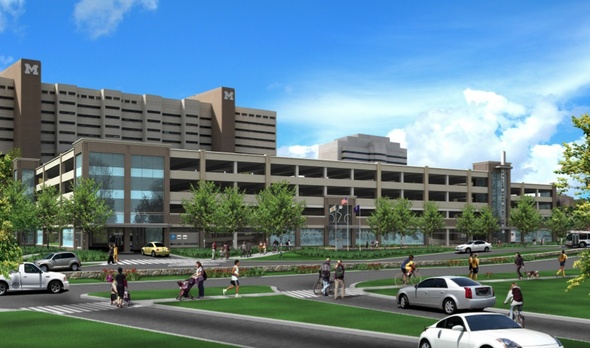
This is one of three renderings released this week showing what the first phase of a new transit station on Fuller Road in front of the University of Michigan Hospital would look like.
The first phase of a controversial transit station project on Fuller Road is headed to the Ann Arbor City Council for approval, following a 7-2 vote by the Planning Commission.
After much deliberation, planning commissioners decided late Tuesday night that the project — a partnership between the city and the University of Michigan — is in the city's long-term best interests. That decision came despite concerns from numerous residents who argued the project represents a nearly permanent repurposing of city parkland for what appears to be, at least for now, little more than a new parking structure for the university.
A philosophical debate over the protection of city parkland carried late into the night as an organized coalition of residents took to the podium to voice concerns.
"If the city establishes a parking structure at Fuller Park, then the city can do anything in any one of the parks that the people of the city of Ann Arbor love and have repeatedly supported with our tax dollars," argued Ann Arbor resident Rita Mitchell.
"Please don't violate the people's trust."
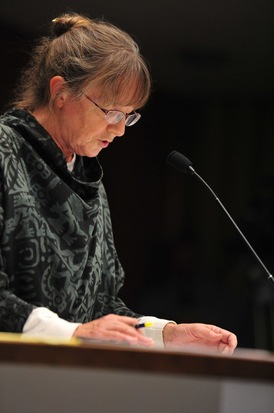
Ann Arbor resident Rita Mitchell addresses the Ann Arbor Planning Commission on Tuesday.
Ryan J. Stanton | AnnArbor.com
The city's charter requires any sale of public parkland to be approved by voters. Residents argued the city is circumventing the law by entering into a long-term agreement with U-M for a five-level, 977-space parking structure expected to stand for several decades.
The property is located on the south side of Fuller Road, east of East Medical Center Drive, and in front of the U-M Hospital — technically a part of Fuller Park.
"There's no park in Ann Arbor that requires parking for 1,000 cars," Mitchell said. "The plan is not part of a sustainable alternate transportation plan because it encourages people to continue to use their cars. There's talk of a train, but the likelihood of a train station ... seems limited."
In their defense, city officials point out the portion of Fuller Park in question was turned into a 250-space parking lot for U-M back in 1994.
"Quite frankly, it's been our assessment as staff that this is land that, for close to 20 years, has been used for parking," said Eli Cooper, the city's transportation program manager.
"As staff, we've been wrestling with this for a year and a half," he added. "It's a question of best interests of the community at large. And investing in this would be a paradigm shift where, instead of just building a parking structure, we're building a train and multimodal center."
Despite an admittedly modest Phase I plan, city officials envision the site being a major gateway to Ann Arbor in the future, complete with a new Amtrak station and bus and bike facilities.
Cooper estimated in April that the first phase of the project would cost $43 million. The university is paying for 78 percent of the total project costs.
Within Phase I, a 44-space surface parking lot is proposed adjacent to the parking structure. An additional 17 motorcycle spaces would be provided on the ground level of the structure. A total of 103 bicycle parking spaces also would be provided.
The parking structure has been designed to provide bus loading facilities on the ground level. The Phase I plan predicts 516 buses per day (56 AATA buses and 460 U-M buses).
Future phases could include additional bus platforms and more floors on top of the parking structure, as well as a pedestrian bridge over the railroad tracks connected to the hospital.
Residents who spoke at Tuesday's meeting urged city officials to consider alternate sites before taking away parkland. Ellen Ramsburgh, chairwoman of the Ann Arbor Historic District Commission, reminded city officials they should be careful stewards of the city's parks.
"Building on parkland is like eating the goose that lays the golden egg," she said, quoting a former member of the New York City Planning Commission. "We don't want to consume the goose. We want to feed it."
John Satarino, a former Parks Advisory Commission chairman, said it appears there may be deed restrictions on the property — intended to keep it forever preserved as open space — that the city isn't honoring.
"It's a land grab by the university," Satarino said. "I think that sets a bad precedent. And opposite of what people think, there's almost no protection for parkland. The city can do anything they want to, even violate their own rules."
Cooper said he believes all the proper legal work had been done, and the city attorney's office found no restrictions that would prevent the project from moving forward.
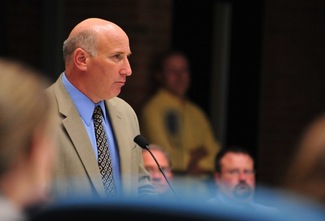
Eli Cooper, the city's transportation program manager, gives a presentation to the Ann Arbor Planning Commission on Tuesday.
Ryan J. Stanton | AnnArbor.com
Planning Commissioner Evan Pratt directly responded to concerns that the city's parks are under attack or at risk.
"The behavior that we see of investment in the city's parks system doesn't give me suspicion that we have a council that is looking to gut the parks system or, in fact, really take any invasive steps," he said. "I think if I saw council doing that, I would be in line with anybody else to find some other folks to represent my interests as a voter."
The two commissioners who voted against the project were Kirk Westphal and Erica Briggs. Briggs said she had a lot of concerns with the project, including lack of public process.
"It's not a particularly inspiring design," she added, arguing it doesn't incorporate any progressive design elements and doesn't adequately welcome visitors to Ann Arbor. "It's not one that makes me feel like, 'Wow, look at this project we can get ourselves behind.'"
The idea for an intermodal transit center spawned from the Mayor's Model for Mobility, which was introduced four years ago and was worked into the city's adopted transportation plan update last year. In August 2009, the City Council gave its approval to move forward with the conceptual design of the proposed facility on Fuller Road.
Cooper noted Southeast Michigan Council of Governments predictions show Ann Arbor growing as an employment center for the region and adding tens of thousands of new jobs by 2035. He said an intermodal transit center conveniently located along Fuller Road would help prevent traffic gridlock.
Fuller Road Station
The addition of a transit station there also would help with the proposed Ann Arbor-to-Detroit and Ann Arbor-to-Howell rail service projects, Cooper said.
"Many of you have heard of the Ann Arbor-to-Detroit project," he told commissioners. "It's my understanding that, as of Thanksgiving, there will in fact be an excursion train pulling out of Ann Arbor, heading to Detroit for the Thanksgiving Day Parade. So (there is) progress, although not as quick as we'd like to have seen."
Ryan J. Stanton covers government and politics for AnnArbor.com. Reach him at ryanstanton@annarbor.com or 734-623-2529.
Comments
Kai Petainen
Mon, Sep 27, 2010 : 4:32 p.m.
I'm confused. On the www.annarbor.com website, I found a link to this... http://www.michigandaily.com/content/report-highlights-benefits-midwest-high-speed-rail-project and that article talks about a report that highlights the benefits of a high speed rail project. but... i thought... they were building this transit station (in this article) supposedly for cars, buses and trains... and then I saw this in the other article... "The Ann Arbor Amtrak Station, a key stop on the Wolverine Line which runs from Detroit to Chicago, would receive funding to renovate its existing railway system and assist Ann Arbor residents with their commute." So.... if the Ann Arbor Amtrak Station is improving its spot... why is (another?) transit station being built a few blocks over? I'm confused. Or... is this just a fancy parking lot?
Emily Salvette
Sat, Sep 25, 2010 : 7:06 a.m.
Attempted Voice of Reason: I'm running for City Council in Ward 2 and am against this proposal. See the issues page of www.emily4a2.org
Kai Petainen
Fri, Sep 24, 2010 : 11:43 a.m.
I wonder. Correct me if I'm wrong, but this seems like a fancy parking lot that is being promoted by some by some fancy marketing? If it was a really a hub for transit and encouraging folks to come into Ann Arbor, then will they also build restaurants, bathrooms and souvenier shops for the tourists that come into town? Will they build those at the transit hub on like other cities do? Will they build those on the parkland? Or do people rush into the hospital cafeteria for food? If they don't build those services, then again, it sounds more like a parking lot. But, if they build that stuff, then where do they build it? And looking forward, 10, 20 years from now... is the University going to point out the convenience of a big parking lot and expand further into the park? After all, once you have a cement jungle, isn't it a bit easier to build more onto the cement jungle? Can they build more University buildings onto the surrounding parkland and integrate the central and north campus buildings with more buildings in the park? Can they buy out the swimming pool and convert that into something else? Will phosphoric acid cleaning agents be banned from that parking lot? Will there be a fueling station there (do major transit hubs have fueling stations?). Will there be systems in place to stop potential oil spills (on purpose or accidental) that could theoretically happen from the various transit vehicles? if the city is paying for a certain % of the building, do they also get a certain % of the gold/blue passes that occupy the lot?
krc
Fri, Sep 24, 2010 : 11:29 a.m.
Is this structure really going to be for the public only or will a part of it be for UMMC employees? When hired at UMMC you are given a choice of three parking situations. The closest (a blue tag) cost a huge amount which bought you a space in the structure next to the Cancer Center. The cheapest (orange, and a shuttle bus ride to a lot over off Glazier) the least expensive. Will there be employee parking here? UM picks the pockets of everyone. Whether or notthis structure is going to be on UM property, they should pay for all of it. After all, the part of the public (non-UM employees) who park in this structure are most likely going to be patients!
Lucifer Sam
Fri, Sep 24, 2010 : 12:07 a.m.
Hieftje is an employee of Mary Sue and is just following orders. Why should the U pay to park it's own employee's when the city will pay for it? UofM will spend Billions to expand its hospital facilities but, as usual, gets real cheap when it comes time to take care of the foot soldiers who actually get the work done (there is not enough parking for the expanded staff who will be occupying the new buildings.) That's were the city comes in! The city gave Google 400 free spots to park 200 employees (you would not want their Lexus's to get dinged by people opening doors now would you?) People like Pat Lesko tried to give people an alternative but the clueless are also content to keep getting sucker punched by this administration. Think it does not matter? How many cars will be ticketed/towed to make up the revenue that is used to subsidize Billion dollar entities the city just can't help enough?
Attempted Voice of Reason
Thu, Sep 23, 2010 : 11:38 p.m.
What I find interesting here is that both the supporters and the opponenents agree that this is not a transit station. It's a hospital parking garage. So lets be honest about the fact that we are proposing the "Fuller Hospital Garage" project to place said garage on City-owned land. It's not fair to call it a transit station project. Even if the train station came tomorrow, it would be a train station with 7 levels of hospital parking over it. But I think we all know that train or bus station will probably never come. Also, make no mistake: That pretty image shows 5 levels, but they're getting approval to go to nearly 100 feet. They'll make the decision to add the full height before it's even done with initial construction. That will place a garage about as high as the 4th & William structure just behind the sidewalk on Fuller Road. Also don't fool yourself if you think UM won't put a garage on Maiden Lane. They pushed this fake deal through the City in order to get free land. As soon as it's built, they'll build another on Maiden Lane. Don't believe me? Ask where in this current deal they are prohibited from any type of future construction on their land. You won't find it. To those who say "it's already parking, so what?" I'd like to build 100-foot high student rentals all the way up to your property line and say "so what - it was already residential." This project will build a 100 foot-high wall along Fuller Road and destroy the awesome biking/hiking corridor that is there now. Sure there's a parking lot now, but it's free parking for the soccer fields on evenings and weekends, so it's ancillary to park use. Even state parks have parking lots. The parking behemoth that's proposed will greatly degrade the character of what is now a pretty open field area. Some say the university needs a giant garage there to expand, and that's the best location. That's a valid argument - but to do that, we should follow the charter amendment and have a vote to decide whether to give the land away. Our Council and Mayor do NOT have the right to ignore voter will. My question to mayor and each council member: Are you voting for or against this thing? If you don't answer or say you don't know, I'll assume you're voting for it because you're a puppet of Hieftje (or you are Hieftje, and I already know where you stand on this). If you don't like this - vote the incumbants out in November. If you are a challenger opposed to this thing, please come public, and I (and others) will give you campaign donations. It is NOT to late to register as a write-in independent candidate. We'll get these jokers out and block this thing much more easily than with lawsuits. Council: If you want to keep your jobs, come out publicly against this now - or at least come out publicly in favor of a city-wide vote on parkland disposition. I will abide by the choices of my fellow citizens, if they are heard. So yeah...we're giving away part of our parkland to the University, then paying to help them build their monstrous garage, which will degrade the rest of Fuller Park, all in violation of voter will to have parkland disposition up for ballot vote. Hieftje and company needs to go.
5c0++ H4d13y
Thu, Sep 23, 2010 : 9:44 p.m.
Why push the motorcycle parking so far out? If anything they should create more spaces closer. My narrow self interests leads me to reject this plan! Seriously though the hospital is terrible at long term planning for transportation. The people making the decisions park in the exclusive gold lots and don't really know much about miserable it is taking the bus to work every day.
Marshall Applewhite
Thu, Sep 23, 2010 : 8:09 p.m.
The proposed station is lacking two key design elements....... 1. A grandiose fountain at the entrance. (IE one that coordinates colored lights with music at night) 2. Glass elevators. Make it happen, Ann Arbor City Council.
Kai Petainen
Thu, Sep 23, 2010 : 7:07 p.m.
$43 million. since it costs that much, can I presume that it will include the necessary things in place to avoid river contamination? we've had one petroleum spill very close to that area this year, we should take steps to avoid another one. lets learn from the mistakes and work together to improve ann arbor and the Huron River.
blahblahblah
Thu, Sep 23, 2010 : 7:01 p.m.
Speaking of river contamination. I was once caught in a thunderstorm while canoeing and took refuge under the Fuller Rd bridge just east of this site. The storm drain from Fuller Rd was on the east bank and was shooting brown dirty water into the river like a huge fire hose. In fact it shot out a racoon about 10 feet into the river. At first I thought it was a small dog. That was over 10 years ago so I am not sure if the Fuller Rd. drainage system has changed much since then.
Kai Petainen
Thu, Sep 23, 2010 : 6:14 p.m.
If this is built, then doesn't that mean that those that park further down Fuller right now, will just want to park closer to the hospital? And if so, then that means that they will be charged more money for parking? I presume they would be the first ones who would want to use the lot. Oh... and with that many vehicles next to the river, don't get me started on the theoretical possibility of spills from vehicles or cleaning procedures.
Macabre Sunset
Thu, Sep 23, 2010 : 5:12 p.m.
Tell that to Eli Cooper, who is quoted in this article. I know Wally's a boondoggle, and you may know that, and anyone who has read the commissioned report on Wally knows that. It probably would have to go directly to Fuller to have a chance of meeting the original projected ridership totals, not that meeting those totals would make the project even remotely financially viable. But how it would get there is a mystery. Maybe Cooper is a magician?
Rod Johnson
Thu, Sep 23, 2010 : 4:46 p.m.
@Sandy Castle: This is not the Mitchell Field parking lots--those are farther west on the other side of the river... @Macabre Sunset:... and this isn't the WALLY train, it's the East-West line train. It seems crazy to me, but WALLY won't even go here if I'm remembering the plan correctly.
Lokalisierung
Thu, Sep 23, 2010 : 3:49 p.m.
"Defacing this beautiful nature corridor/boulevard is not the only answer to the U's..." That's if you think this is a beautiful corridor, which i for one do not.
blahblahblah
Thu, Sep 23, 2010 : 3:46 p.m.
"Plus several of the posters are right in saying that the proposed location for the new structure is ALREADY a parking lot." Equating a 5 story 977 space parking garage to a 250 space surface lot is like saying we are just going to replace your neighbor's single story ranch with a five story condo development. Defacing this beautiful nature corridor/boulevard is not the only answer to the U's parking problems. There are enough bright minds there to find other viable solutions. Former Ann Arbor Parks superintendent (1919-1961) Eli Gallop is probably rolling over in his grave right now.
Ryan J. Stanton
Thu, Sep 23, 2010 : 3:35 p.m.
I'm hearing now that the project's approval likely will come up on Nov. 4, which is a special Thursday meeting after the Nov. 2 election.
Lokalisierung
Thu, Sep 23, 2010 : 3:33 p.m.
Thanks Ryan.
Django
Thu, Sep 23, 2010 : 3:14 p.m.
This structure is desperately needed. Consider the new Mott Children's Hospital at the UM Health System. It occupies what was once a parking lot. The new hospital is going to accommodate more patients which is going to require more employees. With one parking lot already removed for this growth, where are all of these new employees going to park? Once open, the new Children's Hospital will hopefully be the premiere health care facility in the nation. That adds prestige to the UofM and to Ann Arbor. You can't retain good, world class employees if parking is terrible (like it already is). Plus several of the posters are right in saying that the proposed location for the new structure is ALREADY a parking lot.
Ryan J. Stanton
Thu, Sep 23, 2010 : 3:02 p.m.
@Lokalisierung it's my understanding that the technical team is looking at bringing this to council for approval sometime in early November. Nothing is set in stone, though.
George Gaston
Thu, Sep 23, 2010 : 2:46 p.m.
The University's use of Fuller Park for parking dates back to 1993, when Fuller Road was realigned at the time of the V.A. Hospital expansion. The new road cut through a stand of trees that included some ancient Burr Oaks. In an effort to protect these Oaks, the University gave land so that the new road would bypass these trees. In exchange, the University said that it needed 250 temporary parking spaces through the end of 1995, while the new Cancer and Geriatrics Center was under construction. This two year "temporary" lease is now the foundation for the plan to build the Hospital a parking deck on the 3.+ acre footprint of this lot. It is a plan that will forever remove this property from our park system. It should also be noted that the proposal approved by the Planning Commission, and now coming before the Council for consideration, has grown to include all 10.+ acres of this parcel of park land.
townie
Thu, Sep 23, 2010 : 2:44 p.m.
All those buses already travel along Fuller and stop at the UM hospital, VA hospital and North Campus. We don't need a $43 million parking structure to serve as a glorified bus stop. Transfers between UM and AATA buses can already be made at several locations--especially on North University Street. You can't tell me that anyone is going to drive to Ann Arbor, park their car in that structure, and hop on an AATA bus. A UM bus up to North Campus or Pfizer maybe... Again, of what benefit is this ugly parking structure to the Ann Arbor taxpayers? (And folks, this is in the context of budget shortfalls where they are slashing police and fire positions, cutting basic services, and raising fees, and the future budgets only look worse.) We're already building a hugely expensive parking structure downtown, despite unproven need. If UM wants this, then demand a better design. Better yet, put it to a vote, and sell them the land (with the better design as a condition). If the vote fails, let them build a new parking structure where they're tearing down the old Kresge research buildings--or on the site of present Mott after they move out of there. This location is not the only option they have.
Lokalisierung
Thu, Sep 23, 2010 : 2:21 p.m.
@ James D'Amour Appreciate your comments and they do clear some things up. I personally am in favor of the selling/leasing of tons of parkland in this city, but I completely understand the opposite view. "How is it that UM paying 78% of the project cost for a project that is 100% to their benefit," "The Phase I plan predicts 516 buses per day (56 AATA buses..."
James D'Amour
Thu, Sep 23, 2010 : 2:12 p.m.
@Loka, and to Evan Pratt: The fact is as of today in the current Parks and Recreation Open Space Plan, the portion of city land south of Fuller Road adjacent to the hospital across the railroad tracks IS currently designated as parkland. The portion that is a paved parking lot has been leased by the university since the early 1990s. A paved parking lot is fairly easy to remove, relatively speaking, than compared to a 900+ parking structure built to last for many decades. This portion of Fuller Park may not be Bird Hills or Gallup, but a decades long lease, memorandum of understanding, however it is parsed constitutes a removal of parkland without a public vote by Ann Arbor residents, contrary to spirit if not letter of city ordinance. And that is at issue, and to Evan, my former colleague on the Planning Commission, this establishes a terrible precedent. It can be argued the same thing is happening with Huron Hills Golf Course with a long-term lease of public parkland to a private entity. This establishes the precedent of "de facto" parkland sale as a revenue source. Also, as others have pointed out, with Fuller we have to look at a bit longer perspective as to what this land was before the parking lot.
townie
Thu, Sep 23, 2010 : 2:03 p.m.
How is it that UM paying 78% of the project cost for a project that is 100% to their benefit, a benefit to the tax-payers of Ann Arbor? Because we might get a few bucks from some metered spaces that probably won't even cover our 22%? Why are those former soccer fields currently a parking lot? Because the City got the short end of the stick in a land swap for the re-aligned Fuller road east of the V.A. The City administration cannot negotiate its way out of a paper bag whether it is UM or a private developer and it is we, the taxpayers, who get hosed, time after time after time. If Council is determined to hose us again, then I would hope they would at least have the decency to commit some of our money towards a better-looking design.
Lokalisierung
Thu, Sep 23, 2010 : 1:27 p.m.
@ Ryan or Staff - Sorry if I missed it, but is there a date given as to when this will go before Council? Thanks.
Lokalisierung
Thu, Sep 23, 2010 : 12:51 p.m.
"the city is letting UM permanently erase parkland without ANY public benefit tradeoff," "Cooper estimated in April that the first phase of the project would cost $43 million. The university is paying for 78 percent of the total project costs."
LiberalNIMBY
Thu, Sep 23, 2010 : 12:47 p.m.
We won't know for another 5 or 10 years if this thing (if it's built) pans out as a "transit station." It would be great if it did. I would support it if there was some assurance, but right now it's a big gamble. But apparently we don't have time to wait for assurances. Let's be clear: the city staff is being directed to rush this through because council doesn't want the folks down on Maiden Lane burning torches at their doors. So instead of letting UM inconvenience the Lowertown neighborhoods (who should've known before buying their condos that UM can do ANYTHING they want with their land), the city is letting UM permanently erase parkland without ANY public benefit tradeoff, not even a lousy bike path that's been begged for for years. And you know that another 3 stories will be added onto this structure within a couple of years. You won't see that on the proposal, though -- just lots of trees and mothers with children sucking in the car exhaust. I hope council either kills this or bargains for significant public benefits. The only thing we're guaranteed right now is a major eyesore (I mean, gateway?).
Lokalisierung
Thu, Sep 23, 2010 : 12:43 p.m.
Boooo...I can't believe we're losing parkland...this is an Ann Arbor outrage! Oh wait, it's not a park? It's a parking lot and has been for 20 years?
Macabre Sunset
Thu, Sep 23, 2010 : 12:37 p.m.
So now they're saying the Wally boondoggle train could magically float across Ann Arbor and reach this station? Would that double the cost of that already-impossible project? At what point do sentient and responsible planners let go and admit it's a bad idea?
blahblahblah
Thu, Sep 23, 2010 : 11:53 a.m.
Adding all of this additional traffic (cars and buses) to the heart of the Huron River valley is an absolute shame. Commuter park and ride lots should be kept at the periphery of the city, not at the dead center. The "unfinished" border-to-border trail along the river is also a joke, especially when having to traverse Fuller Rd., which will only get worse with this new parking garage.
javajolt1
Thu, Sep 23, 2010 : 11:49 a.m.
Nice rendering. The hospital needs parking. Without the U of M there is no Ann Arbor. It doesn't look so bad. I think it should be approved. How about a roof garden to make everyone happy??
AA
Thu, Sep 23, 2010 : 11:17 a.m.
Let the intellectual elite make the decisions, not the taxpayers.
Stephen Landes
Thu, Sep 23, 2010 : 10:40 a.m.
The project as shown in the rendering is ugly. Beyond that, this project means we're going to have top funnel more cars into town, so the congestion along Plymouth and Geddes will be worse. If the U really needs more parking then use the space on the former Pfizer property and run their buses from there. As for this being a railroad station at some future date -- I simply don't believe that will ever happen. We have a terrible track record in this country in creating usable mass transit. Running a couple trains a day is not going to get people to switch out of their cars. We can't even crete a bus system that is reliable enough for people to use it in preference to personal transportation -- reliable in the sense that it is available 24/7 and doesn't take 4 times longer to get to a destination than driving yourself.
Sandy Castle
Thu, Sep 23, 2010 : 10:14 a.m.
Are they talking about the parking lot in front of Mitchell Field? If so, what would happen to the field?
townie
Thu, Sep 23, 2010 : 9:38 a.m.
This reminds me of the bland, ugly building first presented to the Regents for North Quad. In an almost unheard of rebellion, the Regents rejected that design and sent Mary Sue back to the drawing board. The resulting new design was a vast improvement. For me, that new North Quad building with it's detailing, courtyard, and classic collegiate theme has soothed my anger and sadness at the loss of the Frieze Building. This ugly box parking structure design provides no such consolation for anyone. Peter Pollack presented a far superior design suggestion that would have blended into the hillside and preserved some park-like ambience, but has so far been ignored. Over the past 20 years, Fuller Road has been transformed from a pleasant scenic drive through a park and campus setting along the river into "Parking Lot Alley." It's too bad that the City and UM both continue to neglect or outright ruin the urban interface with our most important natural feature--the Huron River. The City of Detroit has been trying for years to reclaim its riverfront at enormous expense. Why are we going in the opposite direction? And don't get me started on what terrible negotiators we have in City Hall--it is thanks to them that we have a parking lot there now.
Andy
Thu, Sep 23, 2010 : 8:41 a.m.
Ditto what DrD said. It's already a parking lot, people. Enough with the paranoia.
tredd
Thu, Sep 23, 2010 : 8:21 a.m.
DrD - that alternative was a typical U threat. All the city had to do was to not agree to alter any of the streets around the Maiden Lane location (note that we are doing major road alterations on Fuller in support of "Parkland") and the U would have folded. If we wanted to think about other alternatives, the U has this great open property on the old Pfizer property, and an (almost) updated cooridor from US23 and the Pfizer property. If we have the commitment as a city government we actually do have a bit of power in this equation with the U as long as we present reasonable alternatives. The U needs parking, put it at Pfizer and run the shuttle busses through North Campus, essentially an all U section of town. Seems reasonable to me.
Val
Thu, Sep 23, 2010 : 7:34 a.m.
We have a City Council that is doing their own thing as if we are stupid. They know better then we do. We have a bus system that no one rides even from Ypsilanti and Chelsea yet the City Council believes that the train will carry a ton of people from where to Ann Arbor. Lets see it will take a person 15 minutes to get to the train, 45 minutes to make to Ann Arbor and another 30 minutes to get work that is if everything goes well. A person can save themselves 45 minutes by driving even in a traffic jam. Oh, but the City Council knows best. A test of the system would be to run buses for a year and see how it works. Do you think we need a new Council one that will listen to the people? What about the bridge over State Street? What about our infra-structure that is crumbling? What about paying attention to the City?
a2grateful
Thu, Sep 23, 2010 : 7:29 a.m.
Nice park! What's the fuss about? Park your car... Enjoy the park... Then, drive home to the burbs for rest, relaxation, and nice low taxes... No problem here: Park on parkland... In fact, what a great name... Instead of Fuller Road Transit Center (yawn)... Call it "Parkland"...; ) Then we'll have no loss of parkland...
DrD
Thu, Sep 23, 2010 : 7:06 a.m.
I fully support the project because I am aware of the alternative. This is not about taking away parkland. Please go visit the location yourself! It's a parking lot. This parking structure was going to go on the non-park land that U of M owns between Wall St. and Maiden Lane. Now that was a worse alternative. My only reservation is that the current rendered design is sad and boring. The U of M hospital system looks artistic and breath taking right now with no obstruction when you approach it from Fuller. If there is a boring parking structure in front of it, the glamor is gone. So some of us hate it but all of us will have to deal with it once it's there. I suggest that we try to influence what it could look like by suggesting different ways we could disguise the block of cement. Here's my suggestion: 1: http://arthistorian.wordpress.com/2008/01/22/garage-aesthetics 2: http://www.bendheimwall.com/press/press_sanFran-4-2005.htm The articles are pretty inspiring too. Another option of the second link is to have the glass lite up at night: http://www.bendheimwall.com/project.cfm?project_id=98. Obviously I wouldn't choose the colors of a circus, but the structure design won a bunch of awards! Is ours aimed to win awards? I hope the design isn't locked in yet so we can add some Ann Arbor style.
SMAIVE
Thu, Sep 23, 2010 : 6:25 a.m.
"Cooper said he believes all the proper legal work had been done, and the city attorney's office found no restrictions that would prevent the project from moving forward." Well, we all know to whom the city attorney reports. So A2.com, how about an update to the article verifying there are no deed restrictions.
JHW426
Thu, Sep 23, 2010 : 6:23 a.m.
It sounds worse than just giving land to the U. It sounds like city residents are paying for 22% of the parking structure for them.
tredd
Thu, Sep 23, 2010 : 6 a.m.
I'm not a huge fan of just giving the land to the U, which in practical terms is what we are doing. I do appreciate that without the U, Ann Arbor would be Dexter, Chelsea at best. However, you (we) reap what we sow. How many of you that voted for the greenbelt tax (I didn't) ever anticipated that it would be used against us as an excuse to get rid of our parks? Keep voting for the incumbents, apparently you like what you are getting in return.