

Fuller Road Phase 1.1: Revised plan for transit center would accommodate trains in first phase
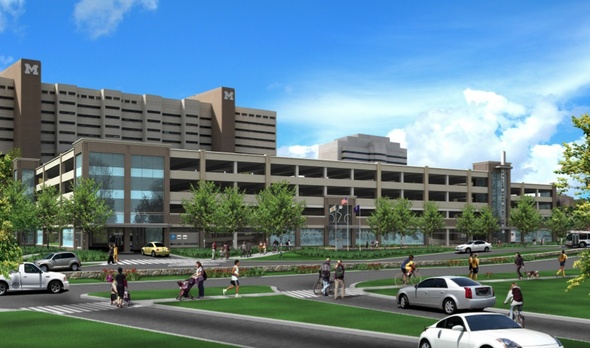
The plan for a parking garage along Fuller Road that was unveiled by the city last fall as part of the Fuller Road Station project. The plans are being revised to include accommodations for commuter trains in the first phase of the transit center project.
It's the latest sign — along with $2.8 million in federal funding awarded to the project this week — that dramatic changes could be in store for public transportation in Ann Arbor.
"We do have a set of plans now that would involve putting a commuter rail platform on the tracks," Mayor John Hieftje said.
City officials are calling the revised plan "Phase 1.1." The drawings were finished last week, and did not come in response to Monday's news of $2.8 million in federal grant money for work toward completing the Fuller Road Station, officials said.
Now, Ann Arbor officials say, it might not even be necessary to do the project in phases since the federal government appears to support funding a train station at Fuller Road. City officials are considering pushing forward with a bigger picture plan in one phase now.
"We're on a path to outline a Phase II project that supersedes this effort," said Eli Cooper, the city's transportation program manager. "Phase 1.1 may never get out of the starting blocks because the full project is going to be advanced."
In addition to a 300-foot rail platform, the revised drawings show waiting areas and restrooms integrated into the design of a parking structure to be built on the site.
The long-term plan
For the past several months, the project's first phase — which was approved by the Planning Commission in September and awaits City Council approval — has been criticized by some as being little more than a new parking structure for the University of Michigan.
However, the city's long-term vision for the area —along the south side of Fuller Road in front of the U-M medical campus — includes an intermodal transit center with accommodations for trains, bicycles, buses and pedestrians. It's been the plan up until now that a full-service train station would come in future phases.
The $43 million first phase, as approved by the Planning Commission, includes a five-level, 977-space parking structure with five built-in bus bays and 103 bicycle parking spaces.
The university has committed to paying for 78 percent of the costs and would have access to 78 percent of the parking spaces in the structure. Hieftje said the changes made to possibly accommodate trains in the first phase could add about $2 million in costs.

Eli Cooper, Ann Arbor's transportation program manager, talks about Fuller Road Station at a meeting last fall.
Ryan J. Stanton | AnnArbor.com
City officials estimate it could take another $20 million to $30 million to build a full-service train station along Fuller Road.
The $2.8 million grant announced Monday will fund a preliminary engineering and environmental study for the Fuller Road station.
Hieftje called that a "game changer." City officials consider the $2.8 million as seed money, and they remain confident the federal government is interested in funding future phases of the transit center project.
"It'll come in phases like that," Hieftje said. "And there's very good reason for us to expect that the larger phase, the total buildout, will be funded as well."
The announcement from the U.S. Department of Transportation also included $196.5 million for improvements of the railway between Dearborn and Kalamazoo that ultimately will allow speeds of up to 110 mph — up from the current 60 mph. Federal officials estimate that could reduce the travel time between Detroit and Chicago by at least 30 minutes.
Hieftje noted the $196.5 million to continue upgrades on the tracks between Detroit and Chicago comes on top of about $150 million awarded last fall. Unlike the latest award, the $150 million requires a match from the state, and local leaders are confident that'll happen.
Interim step vs. full-service station
Cooper stressed the new drawings showing an interim commuter rail platform at Fuller Road are solely part of the city's investigation regarding how to serve commuter trains.

John Hieftje
"What Amtrak needs in terms of rail platforms and stations is different from what a commuter service would offer, and that's a key distinction," Cooper said.
Cooper said the city's vision for Fuller Road remains building a full-service train station with a 900-foot-long rail platform. The interim platform would be about a third of that size.
But if it doesn't work for the city to move forward with a full-service train station right away, Ann Arbor officials say Phase 1.1 might be a good interim plan to accommodate future Ann Arbor-to-Detroit commuter rail service.
Carmine Palombo, director of transportation planning for the Southeast Michigan Council of Governments, said work continues on efforts to establish a commuter rail service between Ann Arbor and Detroit, with stops in Ypsilanti, at the Detroit Metro Airport and in Dearborn.
Palombo said the first two or three of potentially up to 24 used rail cars have been fully refurbished with the exception of seat restoration work. One of the reasons for the delay in getting a demonstration of the commuter rail service up and running, he said, is having to go through required testing and inspections, which is being done right now.
"We're hoping if everything works out with the cars, later this year we'll be offering event trains — like on the weekends to a Lions game or a Tigers game or the Henry Ford," he said.
Hieftje said many of the so-called high-speed rail improvements being funded by the federal government will help make commuter rail possible as well. But he said he tends to agree with those who say what's being proposed is not truly high-speed rail.
"I think some people are misled when we talk about high-speed rail," he said. "This isn't high-speed rail as in the European or Japanese high-speed rail, but 110-mph dependably is a whole lot faster than Amtrak has been going — on a smoothed-out track."
Ryan J. Stanton covers government and politics for AnnArbor.com. Reach him at ryanstanton@annarbor.com or 734-623-2529. You also can follow him on Twitter or subscribe to AnnArbor.com's e-mail newsletters.
Comments
deb
Thu, May 12, 2011 : 1:48 p.m.
This is a joke. It is a waste of tax payer money. If the U wants a new parking structure they should pay for it. Looking at the plan, how many parking spots the U gets, and how many parking spots are available at the old train station shows why. The city will only acquire about 60 additional spots then the currently available amount at the train station. Now they want to add a bus terminal to the same station, that should eat up the additional spot allotment pretty fast.??This is nothing more then a parking deck built for the U. ??As for a new rail (so trains can pass), couldn't we add one to where the station already is? Could we not look at making that station bigger? There is no reason for the city to build 700+ parking spots for the U. They have there own money and with 26,000 visitors a day, i am sure they can afford it. Why are these projects combined, other then to give the U land to build a large parking structure for the hospital? ??If we really want a new "terminal", tear down the old one, and build it in that spot, or another place where the city (and apparently national) taxpayers aren't subsidizing a parking lot for the U. This article shows at least 146 parking spaces near the old train station, and is one of the first things that come up whey you google "ann arbor amtrack parking." (<a href="http://www.marp.org/?p=868" rel='nofollow'>http://www.marp.org/?p=868</a> ) I do not believe that $10 million for 60 more parking spaces is a good idea. This station should not be built without looking into alternatives
Kai Petainen
Thu, May 12, 2011 : 1:30 p.m.
This might make for a great article on comparing the bottom line vs. behavior biases/social opinions. Norfolk Southern (NYSE:NSC) is a publicly traded company. It would be great to get a comment from the investor relations department as to what they think about this. Do they have any comment? What do they think about moving Amtrak from one spot to another and do they believe that it should come at the cost of losing police/fire officials and placing it near a river? They might not care -- but there are some investors who might. Some "social-responsible-type" investors might care? On the otherhand, I look at stocks from a numbers aspect. If the numbers are there, I like it. I don't look at the news. But, this might be a great stock to talk about, as it highlights a non-number based item that some might want to consider when looking at NSC. AnnArbor.com, being the media, should ask NSC for an opinion. With $488 million in cash and $6.75 billion in debt, I already see one red flag for NSC.
outdoor6709
Thu, May 12, 2011 : 1:29 p.m.
It was really hard to find this, but after spending more time reading the article than it took to find it, here is a quote from a report on the finances of rail service in Michigan. <a href="http://www.cato.org/pub_display.php?pub_id=10420" rel='nofollow'>http://www.cato.org/pub_display.php?pub_id=10420</a> Michigan's portion of the plan will cost more than $750 million. Proposed branches to Grand Rapids/Holland and Port Huron would bring the total above $1.5 billion, or $230 for every Michigan resident, plus more than $50 million per year in operating subsidies. Michigan taxpayers will get little return for any state funds invested in this project: The average Michigander will take a round trip on the trains once every 12 years.
braggslaw
Thu, May 12, 2011 : 1:17 p.m.
I am waiting for the new transwarp starship port or the new Great Lakes cruise-ship port... Similar waste of money.
Kai Petainen
Thu, May 12, 2011 : 12:47 p.m.
Is it $100 million or $43 million? $100 million: <a href="http://annarbor.com/news/28m-federal-grant-puts-stake-in-the-ground-for-100m-fuller-road-transit-center-in-ann-arbor/">http://annarbor.com/news/28m-federal-grant-puts-stake-in-the-ground-for-100m-fuller-road-transit-center-in-ann-arbor/</a>
Craig Lounsbury
Thu, May 12, 2011 : 1:01 p.m.
It doesn't matter Kai, they can just shake the old money tree till they have enough.
blahblahblah
Thu, May 12, 2011 : 12:34 p.m.
"Hieftje said the changes made to possibly accommodate trains in the first phase could add about $2 million in costs." So whose paying the $2 million additional costs for a train platform for a "commuter train service" that does not even exist and for which no identified funding source currently exists? "It'll come in phases like that," Hieftje said. "And there's very good reason for us to expect that the larger phase, the total buildout, will be funded as well." What "good reasons" exist? The $2.8 million award was money returned by FL, not some new federal mandate. This is shaping up to be even worse than the Broadway Bridge fiasco, waiting for the feds to save the day. Sorry those days are over.
dextermom
Thu, May 12, 2011 : 12:10 p.m.
There is NO reason why the first thing to be done is move Amtrak. I like Amtrak. I use Amtrak. I like it where it is - or at least in today's world with today's trains there is no reason to move it. I agree with belboz that this is really a parking structure for UM.
RUKiddingMe
Thu, May 12, 2011 : 12:02 p.m.
Outdoor6709: good question. They already have shown an incredible lack of justification for this. Watch the Q and A part of this meeting: <a href="http://a2govtv.pegcentral.com/player.php?video=d8702a5185a6d048ec57970dcfcce765" rel='nofollow'>http://a2govtv.pegcentral.com/player.php?video=d8702a5185a6d048ec57970dcfcce765</a> at 49:24, Eli says a 10-year old study showed "interest" in rail from Lansing to Detroit; not only is it ten years old, but it shows "interest", not that something was actually built and wound up working or generating revenue, etc. 52:45: Eli says Amtrak has 75 spots at the existing station, and MIGHT need t double it within the next 10 (might even be 20, I forget) years. So 40 million for 75 spots over DECADES 56:25: admits that funding was denied because ridership showed the project was not feasible (no justification). So they decided to do it anyway, to prove that they needed to do it. Thus, the "demonstration" project. It goes on and on in its criminal ridiculousness. I think they're just trying to see how much they can get away with before people actually do something. They're testing our apathy. The only thing more blatantly wasteful than this station, on top of all these other things they've done in the face of the budget crisis, is build an enormous fire pit in Liberty Square and burn piles of money. And with how far they've gone with this station, I'd imagine they could burn quite a bit before anyone actually says something. I can't believe this is actually going to happen and they're just totally getting away with it.
RUKiddingMe
Thu, May 12, 2011 : 11:45 a.m.
AnnArbor.com, you REALLY don't think it's worth it as a story by itself, or even some kind of mention in one of these existing articles, to find out if there's actually evidence that supports the SUDDEN and IMMEDIATE need for such incredibly optimistic rail improvements? Or why there's ZERO effort to improve the existing train station (you know, the one that's 200 yards down the street from this location that has a big unused lot right on the tracks next to it) instead of building a brand new one? I mean, REALLY? No one wants to know if anyone even did the smallest amount of work to see if improving an existing train station might be better than building a 70 MILLION DOLLAR waste of space? Maybe ask some avid bikers what they think of the biking accommodations proposed (because every biker I've spoken to thinks it's laughable to think any bikers are actually going to use this for anything)? How about getting some pictures of the bike racks around the hospital, which have a maximum of 3 bikes on them at any time? Maybe get some quotes from the officials involved as to what they believe the defense is for each aspect of this project? Or why 2.8 million for some reason gets us all excited about spending 70 million? Nothing worth writing about, in there anywhere, eh? With the budget crisis you have no problem reporting on, you have no inclination to ask questions about the justification for this? Really?
outdoor6709
Thu, May 12, 2011 : 11:36 a.m.
Mr Stanton, where can we find they "numbers that are growing quickly" and Mr Cooper cites? And why would a cost benifit analysis not be included in at least one of the stories? Maybe it could be a story all by itself. According to Congressman Dingel, there has been no long term financial study do to support the finances of the new slightly faster rail service. I am begining to think this project is the Field of Dreams for all of the areas politicians. If we build it I will get reelected.
belboz
Thu, May 12, 2011 : 11:34 a.m.
This is little more than a new parking structure for the University of Michigan.... "Amtrak doesn't have the capacity at its current Ann Arbor location to meet the demand that will come in future years." Well, if it is financially worth it to Amtrak, should they not spend $40 million to build a new station? And really, with the University in control of about 80% of the parking, is this really a sign that this project is truly a Train Station? More like a University Station..... And what demand is that? Who is taking the train from where? It would take me 30 minutes just to get to the train after parking. I'd rather just drive to Detroit. Chalk this Ann Arbor Train station up their with.... Skyline High School Library Parking Lot Ann Arbor City Hall Stadium Bridge Great examples of the local government spending taxpayer money with little accountability to how it benefits the taxpayer. I'm sure it is great fun as a city councilman, mayor, or manager to inflate their chest and talk about how they are working on such new and great projects that will modernize and change Ann Arbor. Building bridges, train stations, parking structures, city halls - all of that sounds so impressive. How about focusing on the basics. I go to our parks, schools, sports fields, look at our streets and wonder if their is anyone assigned to taking care of the things we already have, not worried about building new things with questionable demand.....
rsa221
Thu, May 12, 2011 : 11:30 a.m.
"The numbers already are growing quickly" Definitely agree with this. Recently visited Seattle and was impressed by the commuter rail. It was obviously popular with the locals, too. As a brief visitor (layover) I was able to pop into Seattle, from the airport, and enjoy a bakery, coffee shop, restaurant, bookstore, and another coffee shop (also known as spending tourist $ :) Perhaps this will happen with those marooned at Metro, especially if there is an advertisement campaign suggesting this option.
Awakened
Thu, May 12, 2011 : 11:56 a.m.
This train isn't going near metro airport. I agree a true metro train system would be ideal. But that isn't what they are building.
a2grateful
Thu, May 12, 2011 : 11:24 a.m.
On one hand: the sometimes 6-8 hour Amtrack commute, whereby the train sits motionless on the tracks for hours, has dissuaded many riders, including me. On the other hand: I wish City of Ann Arbor government officials actually worked on City of Ann Arbor problems and issues. Mr. Hieftje is excited about a new train platform. Good for him. He should find a job working in the regional transit industry. I would like a mayor and council that is excited about the quality-of-life platform for Ann Arbor citizens and taxpayers. It is clear that Ann Arbor city government has less and less to do with city issues. It has become a "platform" for special interests of those "governing," vs serving. Although this has been true in the past, the city provided decent services and infrastructure. The provision of basics is a thing of the past. However, the idea is older than train transport.
Craig Lounsbury
Thu, May 12, 2011 : 12:58 p.m.
well stated, If i could i would log in under 362 different names and vote you to the top.