

Ann Arbor area's high gas prices inspire getDowntown Commuter Challenge participants to take the plunge
For the first time, gasoline prices topped the list of reasons cited by participants in Ann Arbor’s getDowntown Commuter Challenge program.
No wonder: May gas prices averaged more than $4 a gallon in Ann Arbor, according to Gasbuddy.com, after weeks of fluctuations caused by weather and local refinery problems.
The Commuter Challenge program this year compiled preliminary survey results from participants, who said environmental concern was their second reason for joining. Last year, environmental concern was No. 1, with gas prices at No. 2.
In all, 1,817 people participated this year, down a little from 1,848 last year.
However, more companies joined the program this year, which is held every May to encourage people to use alternate and greener commuting methods. Program director Nancy Shore said 192 companies signed up, an increase from 164 last year.
Shore said the rainy spring also might have contributed to a rise in bus commutes among program participants.
“It might have been the weather we had,” Shore said. “But we saw a 26 percent increase in bus usage over last year.”
Chris White, manager of service development at the Ann Arbor Transportation Authority, said that while ridership numbers for the AATA service area were up from last May, there are many factors involved.
“Weather effects ridership, but it’s not at simple relationship,” White said. “It’s not just ‘it rains, we get more riders.’ ”
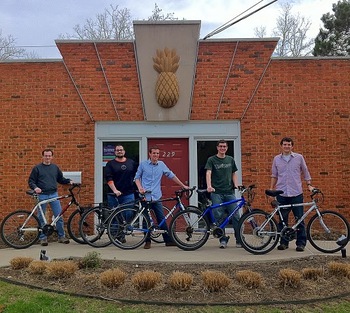
A team of bike commuters from Ann Arbor software company Nutshell CRM. From left: Don Sherry, Andrew Sardone, Andy Fowler, Chris Dzombak and Flavio daCosta.
Courtesy of Nutshell CRM
According to White, ridership was up 8 percent (to 19,129 riders) over last May on the average weekday, but part of that change can be attributed to last May’s fare increase.
“Every time we increase fares, there tends to be a dip in ridership,” White said.
The AATA does not plan to increase fares at all this year, according to spokeswoman Mary Stasiak.
Part of getDowntown’s mission is to change commuting behavior. Shore compared the task to quitting smoking.
The commute “can be very habit forming,” she said. “That’s why we make the challenge a month long, one month is much more habit forming than one week. We saw that half of the people who participated in previous years made good changes in their daily commute.”
Ann Arbor-based software company Nutshell CRM participated in the challenge for the first time this year.
Andy Fowler, lead developer and a self-proclaimed avid biker, said that it was the “fun factor” and health benefits that led him to get involved. Fowler said he biked or walked to work every day during May, and he was proud of the level of involvement at Nutshell.
“At least everyone at our company had at least one green commute by the end of May,” Fowler said. “There were people who used to drive to work almost every day and really changed their behaviors thanks to this challenge.”
According to Shore, getDowntown has also seen an increase it its other programs this year, such as its go!passes, which are limited-use bus passes companies can buy for employees to ride AATA buses.
“Many of the companies using go!pass are restaurants and shops downtown,” Shore said. “Thanks to the increase in food and retail in the downtown area, we’re seeing our highest participation in the program since we started in 2000.”
According to AATA's White, go!pass ridership in May was up 32 percent (to 55,849 rides) from the previous year, and has been moving steadily up for the past seven months.
Ben Freed is a summer intern at AnnArbor.com. You can reach him by email at benfreed@annarbor.com or by phone at (734)-623-4674. Follow him on Twitter @BFreedInA2.
Comments
Carole
Wed, Jun 8, 2011 : 11:48 a.m.
Good, good, good. Maybe with less of us purchasing gas, better for environment and less "coins" in the big oil companies pockets.