

Good news and bad news: Property taxes in Ann Arbor are going down
The city of Ann Arbor plans to mail out 2010 property assessments and taxable value notification letters today, informing thousands of property owners what they hope to hear: Taxes are going down.
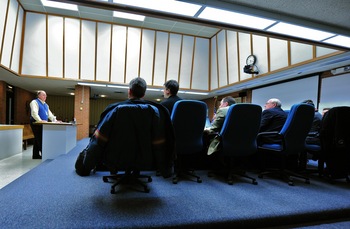
City Administrator Roger Fraser discusses the city's budget challenge with the City Council at a recent meeting.
Ryan J. Stanton | AnnArbor.com
But city officials say what may come as good news to taxpayers is bad news for the city of Ann Arbor. The fact that property tax revenue is starting to decrease for the first time in years is part of the reason the city is facing multimillion-dollar budget deficits.
City Assessor David Petrak says the new assessments show an overall 4.2 percent decrease in taxable value. That equates to a 4.2 percent decrease in tax revenue to the city for the 2010-11 fiscal year, provided the millage rate doesn't change.
The Consumer Price Index - a measure of inflation and deflation - for the 2010 taxable value in Michigan is -0.3 percent. That means almost every property owner will see the taxable value decrease this year by at least three-tenths of a percent.
Properties that have taxable values close to the assessed value and are located in a declining market may see even greater tax savings.
Property owners unhappy with their assessments can appeal them before the city's board of review from March 15-18, Petrak said.
Tom Crawford, the city's chief financial officer, said all city funds are being affected by the economy and will be hurt by the resulting decline in property taxes. In a recent report to the Ann Arbor City Council, Crawford projected a $4 million drop in property taxes, spread across all city funds next year. Some will hit the general fund, parks, solid waste and streets.
The City Council already has worked to trim millions from the budgets for this year and next year. The city's administration, in a series of budget impact sheets, recently stated a $5.2 million shortfall remains to be addressed in the general fund for the 2010-11 fiscal year that starts in July.
The latest version of the city's budget shows the city expects to receive $86.1 million in general fund revenue for 2009-10, about $10 million more than it expects to have available next year.
The budget impact sheets for 2010-11 show $76.15 million in general fund revenue and $81.35 million in expenses, which need to be trimmed by $5.2 million absent any new revenue streams. The city was given hope earlier this week that it could close $2 million of that gap by negotiating a new parking agreement with the Downtown Development Authority.
DDA Executive Director Susan Pollay said she thinks the city's tax base could be much healthier than it is right now.
"Frankly, we get the size government we're willing to pay taxes on - and the development we're willing to have - and that's I think what's going on," she said. "We keep resisting new development. We don't like new development. We fight them. But the good side to them is they bring new tax dollars, and it seems that we only discuss that part of it once a year with budget. "
The city's administration recently provided the City Council with a report that showed approving new development doesn't always increase the tax base. The report lists 41 projects approved by the City Council since 2000 that either haven't started or have stalled. That includes high-rise office buildings, restaurants, retail businesses, warehouses, condos, town homes, apartments, and even a medical office building, a church and a bank.
The city's total taxable value grew from $3.1 billion to $4.9 billion during more prosperous years, from 2000 to 2009. During that time, the city's tax rate dropped from 17.13 to 16.78 mills.
In all, however, the total amount of taxes paid by Ann Arbor property owners grew from 58 mills to 59.3 mills when including non-city taxes, such as those for schools, libraries, the county and Washtenaw Community College.
General fund revenues from taxes grew from $48.2 million in fiscal year 2006-07 to a forecasted $52.03 million for 2008-09. The general fund budget this year shows tax revenues going down for the first time to $51.5 million, and dipping further to $49 million in projections for 2010-11.
Officials say the city's struggles with growth in the tax base are due, in part, to poor market conditions. But they also blame two state laws - Headlee and Proposal A - which have joined forces to keep property taxes contained.
The city has the voter-approved authority to levy up to 7.5 mills for general operations, but Headlee and Proposal A effectively have reduced that amount little by little each year - now whittled down to 6.17 mills. A Headlee override, if approved by voters, would suspend state law and reset the bar to 7.5 mills, which the city's administration has said could raise $6.1 million.
Each of the city's millages are at levels lower than their voter-approved amounts because of Headlee. The city levies a total of 16.8 mills for city services, even though 19.1 mills have been approved by voters.
The levy for employee benefits has dropped from 2.5 to 2.06 mills, as has the public transit millage, which funds the Ann Arbor Transportation Authority. The city's refuse collection tax has declined from 3 to 2.47 mills.
The street repair millage has dipped only slightly from 2 to 1.99 mills. Lastly, the city's parks maintenance and acquisition millages - two separate levies that are reported jointly in the budget - have been reduced from 1.6 to 1.57 mils.
With the jobs of police officers and firefighters on the line, some have wondered why the city can't ask voters to agree to restore the general operating millage to 7.5 mills - with the promise of lowering other millages by 1.33 mills - so there's no net tax increase. Crawford says there may be a way to ask that question on a ballot, but it's his understanding the state requires items to be put on separately and not contingent on others.
Pollay said the city should be concerned it has had limited growth as a community. She said the promise of generating new tax revenues isn't the only reason to approve new development, but it should be considered.
In addition to declining property tax revenue, the city is losing millions of dollars from investment income. The city also is experiencing reduced demand for services, which is causing millions more in lost revenue. Meanwhile, state shared revenue is declining, and the city has seen a decrease in revenue from traffic citations with about two dozen fewer officers on the streets writing tickets.
Petrak said the loss of Pfizer - the city's largest taxpayer with a taxable value of $238 million in 2008 -Â took away 4.86 percent of the city's tax roll. Pfizer paid the city $4.1 million and the county $1.3 million in taxes in 2008.
Ryan J. Stanton covers government for AnnArbor.com. Reach him at ryanstanton@annarbor.com or 734-623-2529.
Comments
Christina H Aprill Kamen
Thu, Apr 8, 2010 : 2:42 p.m.
I am afraid, I do not sympathize with City Hall over the loss of revenue. Perhaps if the good Treasurer, the Tax Assessors Offices, and the Board of Review, stopped giving out Property Tax Poverty Exemptions to residents who are receiving Social Security and Pension plan payments that exceed the poverty income levels to qualify for this exemption. The city would have some money!
AlphaAlpha
Sun, Mar 14, 2010 : 2:53 p.m.
A old debate trick to attack an opponent on a personal level instead of debating the facts; the trick is usually employed when one cannot effectively support their position. Many observers tend to marginalize those who employ such tactics. Keeping the discussions fact based will benefit the community.
snapshot
Wed, Mar 10, 2010 : 9:06 p.m.
Moose, that would make you a potholder?
Moose
Tue, Mar 9, 2010 : 2:36 p.m.
@snapshot Pot, meet kettle.
snapshot
Mon, Mar 8, 2010 : 8:54 p.m.
AA---a 4% permanent reduction. I was not aware of that fact and if true then I would only recommend another 3% in my across the board 7% reduction in all city employee comp plans. Thand you for your acceptance of the right to voice my opinion openly and without fear of reprisals but have you noticed there seems to be some folks with serious control and perspective issues on this post. Name calling, distortions, and an air of self ordained importance. It happens when they can't establish a credible arguement to defend their position. It is the arrogance of ignorance.
No Answers Just Opinions
Mon, Mar 8, 2010 : 4:47 p.m.
"Do you have the time, to listen to me whine, about nothing and everything all at once. I am one of those melodramatic fools, neurotic to the bone no doubt about it." Basket Case, Billy Joe Armstrong, Green Day
aaman
Mon, Mar 8, 2010 : 2:30 p.m.
@old west sider That's what the Headlee amendment is all about. If it hadn't been for that amendment everyone would have been paying MUCH higher taxes the last 15-20 years.
Old West Sider
Mon, Mar 8, 2010 : 1:56 p.m.
Isn't this just wonderful State equalized Value for us goes down 4,000 and our Taxable Value goes down 294.. Bucks
Moose
Mon, Mar 8, 2010 : 10:15 a.m.
Alphax2 "Speaking in terms of averages will suffice." Yeah sufficient for you to spin to fit your premise. Those average are heavily skewed by the large increase in the numbers of high wage and perk managers and administrators over the last 10 years. 32 employees making more than $100k and many more earning more than $75. Until Alphax2 steps up and tell us in which side of the total wage and benefit national average that you fall your spin of statistics is little more than making the statistics fit the premise. When the economy comes back will you be the first in line to restore wages to public workers that constantly and historically lag behind the private sector? Or will you continue the race to the bottom for all working people's wages until they match those of the global average?
Mick52
Sun, Mar 7, 2010 : 11:32 p.m.
I agree with Bruno and Snapshot and sympathize with AACity12. Union contracts are a big part of this problem. Over the years the police and fire contracts have become extremely generous. Ryan Stanton wrote an article last week that detailed the health care benefit, that is fare more generous than most. The defined benefit pension plan is a burden too. They have to be changed. Sure some of the decision were ordered at arbitration. The city should have done layoffs then. Kudos to the FD for trying, the city show no gratitude. AAFD and AAPD are excellent departments. But just as it is occurring throughout the country, absent reductions, layoffs are probable.
Useless
Sun, Mar 7, 2010 : 10:05 p.m.
Isn't the 59.3 mills listed in the article for Non-Homestead? Wouldn't actual property owners that inhabit their homes as a primary resident be more in the 45 - 46 mills range?
AACity12
Sun, Mar 7, 2010 : 11:36 a.m.
Snapshot - Get your facts correct. It is a permanant 4+% paycut. No sunset clause, no experiation date. That paycut will last through every firefighters carrer and retirement. I respect your opninion and your right to voice it, but get the facts correct.
jondhall
Sun, Mar 7, 2010 : 8:03 a.m.
Point of article was property taxes decreased 4.2 % do you "think" that is all the value the average homeowner lost? Where is the government by the people for the people at? A Condo we own went down 11.2% so it appears someone is really getting much less. The value of the condo went sown 20.3 % we can appeal all the property values. Let's do it!
John Q
Sat, Mar 6, 2010 : 11:49 p.m.
"And JohnQ why does it matter? We all have opinions, we all have the freedom to voice them, and we all have the right to vote." It matters because it's clear that the same people using a so-called national standard to claim that city employees are overpaid and overcompensated are unwilling to apply the same standard to themselves. That's the mark of a hypocrite. You know nothing about any of the people you are attacking but you're willing to tell them that they get paid too much and that they don't deserve the benefits that they get. What kind of coward attacks people like that but isn't willing to subject them self to the same standard? Back to the original questions, which are simple and easy to answer: 1. Are you paid more than the "national standard for civilian employees"? 2. If your pay and benefits exceeds that number, do you consider yourself "overpaid" and "overcompensated"?
snapshot
Sat, Mar 6, 2010 : 5:37 p.m.
I don't understand the FD accusations of the city "operating in bad faith". the way I saw it unfold is 1. there's a funding shortage. 2. layoffs were necessary. 3. fire dept and others were notified. 4. fire dept tried to prevent cuts. 4. city said no. 5. city sent out layoff notices to 13 firefighters. 6. FD came up with a temperary reduction in comp plans to save 13 jobs until July. Where is this "bad faith" accusation coming from? It seems the city has been pretty straight forward. Just because the FD doesn't "agree" doesn't mean the city is operating in bad faith. This is the kind of union stuff that has turned me against unions. And JohnQ why does it matter? We all have opinions, we all have the freedom to voice them, and we all have the right to vote. Whoever the unions support, I'm voting the opposition and I know a whole lot of folks who are doing the same thing. If I was a union leader, I wouldn't make union support public knowledge in all these elections coming up. I'm out to end union domination and dependency. Is that a "bad faith" position?
AlphaAlpha
Sat, Mar 6, 2010 : 12:53 p.m.
Probably there is no need to get personal. Speaking in terms of averages will suffice. Data show: city workers earn substantially more than their government peers, and twice what private workers earn. This is the key fact that needs to be addressed.
The Picker
Sat, Mar 6, 2010 : 12:26 p.m.
AAcity, How many miles on those Fire trucks? Hasn't ongoing maintenance been carried out over the years? I thought firefighters loved thir trucks!
iceman
Sat, Mar 6, 2010 : 11:48 a.m.
Quit wasting our tax dollars on greenbelt property we can't use!
John Q
Sat, Mar 6, 2010 : 10:31 a.m.
"I'm a working stiff and not an elitist, or member of a protected class. How about you?" I'm not sure what your definition is of "an elitist" or "member of a protected class" but I'm sure I don't meet either. Still waiting for you to answer the questions.
AACity12
Sat, Mar 6, 2010 : 9:14 a.m.
Thats not what I said. I said the union is there to protect the union membership. Without the union the cities spending would be done on the backs of the employees. If you want to build a new city hall don't build half of it and then expect your employees to all take a paycut to pay for the rest. They need to control their spending and not expect the employees to pay for their pet projects. The union is also there to look out for the safety of the firefighters as well as the citizens. Things like dangerous police and fire staffing levels, firefighters riding around in 25 year old ladder trucks that barely work, things like that. I read the article about city employee compensation. Fraser cut 300 employees already and expect the 700 left to pick up the slack. If you want your people to work twice as hard you need to pay for it. Fraser wants to make people work more and do it for less. Up to a point thats fine. But after years and years of cuts and cuts its now a tough sale.
Awakened
Sat, Mar 6, 2010 : 9:11 a.m.
@bruno uno. If I read an earlier article correctly all the Union contracts expired in 2009 except AFSCME. Fire settled for six months (until July) but is negotiating on that. So pretty much everyone is at the table. Correct me if I'm wrong. The bad faith the city showed with Fire will make settling those contracts harder. My question is whether that is done on purpose to focus anger at the unions rather than the spending practice of city hall. While it is clear that unions must cut in the 6% range. How can you expect them to do so when you have just demonstrated that it WONT save jobs. The city has no choice now but to layoff 6% of the workforce. And since they won't cut adminstrators and supervisors they will have to cut line staff 10+%. The citizens will have to suffer decreased services or increased taxes. They've already taken the other choices away. Look behind the curtain.
jondhall
Sat, Mar 6, 2010 : 8:38 a.m.
"They" want to repeal the "Headlee Amendment" the same "they" also want to repeal your "Constitution". Do not give them the "power" take your country back. Speak out and loud, do not let the special interest tear this country apart! Attend your local meetings, attend City Council if you live in the city, do not let the special interests take your country! Spend, Spend, Spend, when America is bankrupt and we are, who is going to take care of the rest of the world? China they gave a coll million to Haiti! Hoe generous they are is Europe taking care of anyone? Europe is filling their own pockets, look at a world map they have islands all over the world, go figure that one out? America, be damn proud of her we take care of everyone! It will be very sad day when China can no longer loan us money so we can give it to Haiti. Time for a TEA Party yet? Or is it time to buy another Toyota? You decide your grand kids can't at this time! What you sow you leave them, be a proud grand parent, or a very proud parent! Give me Liberty or give me..........
bruno_uno
Sat, Mar 6, 2010 : 12:19 a.m.
aacity12- get off the firetruck and come back down to reality.
bruno_uno
Sat, Mar 6, 2010 : 12:15 a.m.
unions....what ca we do to get you to come to the table... begging you, please- ann arbor taxpayer
snapshot
Fri, Mar 5, 2010 : 11:02 p.m.
Uh, forgot John Q, did you want fries with that?
snapshot
Fri, Mar 5, 2010 : 10:47 p.m.
John Q, I'm a working stiff and not an elitist, or member of a protected class. How about you?
John Q
Fri, Mar 5, 2010 : 10:40 p.m.
"How could you possibly think we could believe such garbage that unions will protect taxpayers from overspending in light of what has just been disclosed with Ann Arbor union employees being overcompensated.' Like you Snapshot? Still waiting for you to put your wage and benefits up against that national average. Are you over paid and over compensated?
snapshot
Fri, Mar 5, 2010 : 7:38 p.m.
AAcity12, so now you're saying the unions are protecting the taxpayer from overspending? What? I guess your union hasn't been doing a very good job at that task. Like Trump says. You're fired! I can see how the auto unions protected their employers. Now they're on the taxpayers payroll. Yeah, those unions really protected us. You union guys must think that if you say it enough, it will be true. Not. Taxpayers aren't stupid. How could you possibly think we could believe such garbage that unions will protect taxpayers from overspending in light of what has just been disclosed with Ann Arbor union employees being overcompensated.
AACity12
Fri, Mar 5, 2010 : 5:52 p.m.
Sorry Bruno but the time for unions is now. Without the contracts the city would continue to spend and spend and do it on the backs of the city employess. Without the unions, management would continue to take from the employees pay, and trim budgets till they got to things that were dangerous to employees and citizens. They should have considered this before they built the Wheeler center in Pittsfield, before they built the Heiftje City hall and should consider this before they dig underground for parking.
bruno_uno
Fri, Mar 5, 2010 : 5:20 p.m.
perhaps i sound like a broken record but....should the unions open up the contracts so we can deal with this crisis? time to face reality unions, your time has passed.
MyOpinion
Fri, Mar 5, 2010 : 4:01 p.m.
Did I read that the tax notices will be going out today and that we can appeal them 10 days from today? That doesn't give us much time to react does it?
belboz
Fri, Mar 5, 2010 : 3:57 p.m.
I hear you about AATA, but all I said was that it should be part of the process for reducting costs - not eliminated. What is funny - though - is that fares would have to be increased by tenfold for riders to bear 100% of the cost. This means, people would have to pay at least $300 per month for the Flex Pass. Essentially, the lease of many cars. I don't think it is unreasonable to evaluate the millage associated with AATA, and ways have riders share more of the cost. Just because we have millages at a certain rate - determined years ago - doesn't mean it has to stay that way.
pragmatic
Fri, Mar 5, 2010 : 3:18 p.m.
Parks and mass transit are not luxuries but necessities in keeping this town a beautiful and desirable place to live and visit. All the city needs to do is decrease spending by 6%. Couldn't this be done by spreading the pain and requiring every department to cut spending by 6%. Eliminate jobs and privatize where possible(parks maintenance, tree cutting, garbage pick up). I work for the city and trust me, while we do good, high quality work, we are definitely overstaffed. We should all be more accountable to our employers, you the taxpayers.
AlphaAlpha
Fri, Mar 5, 2010 : 3:16 p.m.
"The idea that the majority of Ann Arbor voters now want to ditch all of those millages and approve a new millage structure with no limits on how those tax dollars should be spent is nothing more than fantasy land thinking. There's no way Ann Arbor voters are going to go for such a plan or have any desire to drop funding for priorities like AATA or parks. " Agreed. Tax increases during recessions are unpopular; reductions in city spending is the solution. There seems to be a reluctance by current city leaders to suggest reduced spending. This needs to change, and quickly. Though user fees could be increased dramatically, ultimately, expenditures need to be reduced. A more plausible solution which the customers -voters- will support is nominal compensation reductions for city workers. BLS and city figures show our city workers earn much more than other government workers for similar tasks. Irrespective of the DDA, a compensation reduction of 6% will balance the budget now, without any layoffs. A compensation reduction of 12% would even allow the city to hire about 75 new workers. Hiring would be a nice change; so would no new taxes. A two tier pay plan for new hires will likely be needed as well; new hires could be paid wages competitive with national averages. With these changes, the retirement plans already in place would likely not require any revisions. And, city workers could continue to enjoy compensation levels that are much higher than the national average.
David Bardallis
Fri, Mar 5, 2010 : 2:53 p.m.
Headline should read "Good news and good news." But don't worry, more petty nuisance bans like using a cell phone in a car will probably be turned into new cash cows for politicians who can't live within our means. Expect more of that kind of nonsense.
jcj
Fri, Mar 5, 2010 : 2:21 p.m.
a2grateful I agree what one man can do another can undo. Just look at what they are doing to the constitution!
Tom Joad
Fri, Mar 5, 2010 : 1:58 p.m.
City growth was fueled by the scam mortgage and housing bubble that sent millions of Americans over the cliff. They enjoyed the largess accorded to them by unsustainable real estate mania. Just tighten your bootstraps and be prudent with the resources you have, which is significant.
RU4A2
Fri, Mar 5, 2010 : 1:20 p.m.
OK, now maybe my house will sell now that property taxes will go down. But wait, who would want to live in a town where the city administrator wants to cut police and fire protection.
a2grateful
Fri, Mar 5, 2010 : 1:15 p.m.
John Q: "There's no way Ann Arbor voters are going to go for such a plan or have any desire to drop funding for priorities like AATA or parks." Hmmm... Where certain paths lead, the same paths lead away... Don't underestimate voter resolve in times of idiotic a2 government leadership...
a2grateful
Fri, Mar 5, 2010 : 1:09 p.m.
A wise sage once told me, "It is not how much money you make, it is how you use the money you make." Obviously this person had nothing to do with government, especially in a2; )
snapshot
Fri, Mar 5, 2010 : 1:01 p.m.
The article doesn't bring up the City Charter requirement that city pensions be fully funded through property taxes. The current rate for city pensions on our property tax bills is 2.1 and it can be increased due to those declining investment revenues. The fact that this council operates without ethics guidelines or an ethics review procedure is one of the problems with its fiscal management. Some of these folks play dual roles in city, county, commitee, and DDA positions and have relationships that may be considered conflict of interests in other cities that have ethics guidelines and review procedures. This budget issue is a systemeic problem resulting from a lack of accountability,not just an economic downturn. Was not the new police station turned down by voters and leadership found a way to circumvent the electorates wishes while still committing taxpayer funds? This article reflected the attitude of our leadership to seek out additional revenues to fund city expenses (read as inflated employee and project costs)at taxpayer expense. It's seems strange to me that a city income tax isn't being presented as a definite voter proposal while a Headlee override seems to be the leadership revenue raising choice, putting more financial burden on property owners. It seems to me that a city income tax designed to fill the budget gap of 5.2 million would provide needed funding and a more equitable distribution of the city cost burdens. Why there needs to be so much discussion as to whether or not to put it on the ballet is beyond me. Just do it and let the voters decide. It seems leadership is paying lip service to cost reductions while trying to figure out ways to manipulate the voters into voting for property tax increases. Crawford's comment that a tax increase contingent upon a decrease may not be allowed should be investigated thoroughly and not just assumed or guessed to be accurate.
John Q
Fri, Mar 5, 2010 : 1 p.m.
It's clear some of the local wing nuts see the current budget crisis as a chance to get a "do over" on these millages. All of the millages being levied were approved by the voters at one time or another, many of them with strong voter support. Voters approved those with the restrictions on how those could be used. The idea that the majority of Ann Arbor voters now want to ditch all of those millages and approve a new millage structure with no limits on how those tax dollars should be spent is nothing more than fantasy land thinking. There's no way Ann Arbor voters are going to go for such a plan or have any desire to drop funding for priorities like AATA or parks.
jcj
Fri, Mar 5, 2010 : 12:49 p.m.
Peg Where have you been the last few years?? With the unemployment rate at 10% where would revenues have gone if we relied solely on an income tax? I can't back this up but I suspect we would not be much different than now. Someone do the math for me.
Kris Palmer
Fri, Mar 5, 2010 : 12:02 p.m.
Let's start trimming some money from city worker salaries and benefits packages -- and yes from the City Council too. It's ridiculous that during times of economic need throughout the state, Ann Arbor city officials are wondering how to make ends meet. Do what the rest of us do - pay for your own benefits, and while you're at it, why don't you do something to give established companies and corporations a reason to consider Ann Arbor? Susan Pollay has it right - our representatives cannot continue to discourage development and then think they are magically going to have money in the coffers. I'm not the sharpest pencil in the box, but I can understand why professional developers don't want to service the Republic of Ann Arbor - too many rules, restrictions and "city officials" in the mix here.
Regular Voter
Fri, Mar 5, 2010 : 11:58 a.m.
Blowback on Rollback. Is that a bumper sticker? If we don't have a huge field of council candidates with which we can throw all these bums out in August then we deserve more years listening to out of touch, self serving, greedy people sticking their hands in our wallets. Ms. Pollay is one of those highly compensated superfluous officials at the DDA who just cost us 40 plus percent more in benefits over last year with no adult supervision. Commercial property values are down approximately 40 percent since the top; residential real estate is down approximately 30 percent during the same period. Jobs have been lost and incomes are down. Are we not tired of being poked and prodded for more by these boorish incompetents. Enough is enough. The next elected official who suggests a Headlee rollback will experience voter blowback, will they not? Ms. Pollay you have brass and like our schoolyard bully city administrator are past due for an attitude adjustment. The new council and mayor if it has any connection dealing with our reality will be replace you both with fresh responsive public professionals at half the cost. Better yet, abolish the DDA altogether. Wake up and smell the coffee Ann Arbor. Take a walk up and down South University from East U to Forest and back, on foot, look in the empty, filthy, blighted storefronts, count how many there are, walk on the crumbling sidewalks and litter. Now picture that spreading toward downtown. Higher taxes and continuing on our current path will speed this spreading decay.
Act2
Fri, Mar 5, 2010 : 11:55 a.m.
I think it is about time property taxes went down. It has been so frustrating to see the assessment decline and the taxes go up. If we go to a straight city income tax, then we will really need to slash property taxes.....otherwise many of us won't be able to afford to live here in Ann Arbor, and if the people leave....there will be noooo tax base. I don't want to see people lose their jobs....but there is wasted money in most bureaurocracy.....lets cut the waste before we cut people's livlihoods and expect taxpayers to continue to fund aspects of budgets that could well be trimmed.
Old West Sider
Fri, Mar 5, 2010 : 11:34 a.m.
I agree Peg...There are untold thousand who enjoy all of the privledges and benefits of working in AA but live elsewhere. Let's have a vote but only full time reidents should be allowed to vote not U of M students.or temporary residents
belboz
Fri, Mar 5, 2010 : 11:32 a.m.
Where do I get my information regarding AATA? The City of Ann Arbor website. The city collects 16.8 total mills, of which AATA receives 2.06. That is actually slighly over 12% of 16.8 of all money that the city receives from the taxpayer. I look at it as one big bucket - 16.8 mills - regardless of how the buckets break down. As an aside, the total budget of AATA is over $22 million. Yet, riders only pay $2 million. That is what I mean by AATA not being a self-sustaining proposition. I didn't say get rid of it, but tax dollars are tax dollars and all areas should be a part of the budget crunch. http://www.theride.org/pdf/financials%202008%20for%20web.pdf
peg dash fab
Fri, Mar 5, 2010 : 11:14 a.m.
Property tax FAIL. As we have seen (and continue to see), property values are volatile. It would make a lot more sense to move to a City income tax.
glenn thompson
Fri, Mar 5, 2010 : 10:20 a.m.
A very good article. I goes beyond the usual reporting to actually include material to challenge the official position. One point about some of the comments on the greenbelt millage. Most of the money has already been spent, so there isn't as much here as might be believed. You see, when the millage was passed our Council said "lets not wait 30 years to get the money, we can borrow against the future revenue and spend it now. And so they did. This is the type of fiscal planning that is the real cause of the City's fiscal problems.
jcj
Fri, Mar 5, 2010 : 9:50 a.m.
I guess I just don't drive around town much. I do live in town. I don't remember the last time I saw someone pulled over in Ann Arbor. I suspect the ones doing the most complaining (whining) are the ones with a few points on their license!
voiceofreason
Fri, Mar 5, 2010 : 9:34 a.m.
I would like to Cosign the comment by Top Cat.
jondhall
Fri, Mar 5, 2010 : 9:24 a.m.
Amazing we go from Taxes to Tickets, hum must be some correlation there, ah yes there is all a form of taxation. As for property taxes not being a fair tax, there is no tax that is fair to all. Talk all you want but property value shave went down more that 4.2% and the taxes have not. There is a reason the "people" voted for the "Headlee Amendment", just like some voted for Obama, you reap what you sow! Some people think the bigger the government the better I think the opposite, I do not need the government that makes the problems trying to solve them. The Clinton's gave every heart beat a loan, that is why we are where we are today. Bush did no better,that is why we will be having a "Tea Party". This is not about Democrats or Republicans it is about "less government" not more.
Vivienne Armentrout
Fri, Mar 5, 2010 : 9:24 a.m.
I don't know where belboz gets the information that 10% of city money goes to the AATA. AATA has a separate millage of about 2 mills that the city administrator is pleased to include as part of the general city budget, but it is actually a separate authority that uses a lot of grant funding to maintain its operations. It is also a critical function of our public sector and important to our long-term survival as a community.
Aware
Fri, Mar 5, 2010 : 9:21 a.m.
Just remember to attend the cousel meetings when they talk about these issues. If you don't address city counsel face to face your opinion means nothing!!!. The people who want parks, golf courses and other non-essential items are there and they get what they want..
Top Cat
Fri, Mar 5, 2010 : 9:02 a.m.
We can quibble about revenue from traffic violations and point fingers in partisan bickering. The reality is that the current credit crisis is both national and internation in scope will take time to work itself out. The city will have at best a flat and most likely a declining revenue stream. Citizens are struggling and tapped out and cannot pony up more. City government is going to have to right size and live within its means. The current elected officials are clearly not up to the task.
a2grateful
Fri, Mar 5, 2010 : 9 a.m.
DDA Executive Director Susan Pollay: "Frankly, we get the size government we're willing to pay taxes on - and the development we're willing to have - and that's I think what's going on." The most glaring flaw of a2 City government, whether mayor, council, DDA, etc., is its pre-economic-collapse thinking. The jobs are gone. The easy-money loans are gone. Homes have plummeted (or continue to plummet) in value. Taxes need to reflect this. City budgets need to reflect this. City government redesign needs to be based on a five- to ten-year revenue decline. That is, unless, someone in City government, patents a viable method of cold fusion, with proceeds deposited into City coffers. (Now that's the type of energy commission that would be useful... : ) Here's a message for Ms. Pollay: We are not willing to pay for underground parking to subsidize private windfall real estate development in a market segment that has crashed... Especially at the expense of the local hotel market, which is operating at the lowest occupancy in the past 20 years. Your continued pre-bubble mindset will spell the end of DDA, and is a great threat to the viability of future downtown. Disagree? Look at three decades of US Census population statistics for a2 population. Look at three decades of SEMCOG population projections for a2 population. What... not much difference? There will never be enough taxes to support current government structure. Folly time is over.
RUKiddingMe
Fri, Mar 5, 2010 : 8:57 a.m.
Stop planning new unnecessary structures. Stop paying IT so much, get some bids from other companies. Stop buying land to add to this useless and overpriced "green belt." Stop paying for studies on extravagant pie-in-the-sky projects that would be over the top even if they COULD be useful, but are clearly not even that anyway (like high speed rail from Detroit to Ann Arbor to Howell; give me a break, that's beyond insane right now). Put every non-essential to city operation millage up to a vote to end that program or not. There's all your money.
Hunterjim
Fri, Mar 5, 2010 : 8:52 a.m.
Two points; I hope all this anger/energy is focused at the polling booths when these folks are up for reelection, second: I hope someone new will step up and run for office who is willing to bring these issues to a vote before City Council. With out these two things happening we will keep complaining in the forums and it will be business as usual.
limmy
Fri, Mar 5, 2010 : 8:43 a.m.
Property tax is not a good type of tax. It doesn't reflect a person's income. It also doesn't reflect use of services. I would much prefer a city income tax to property taxes. It's time to tax everyone in the city, not just the ones that live there.
Freemind42
Fri, Mar 5, 2010 : 8:42 a.m.
johndhall- Typical Republican philosophy: do everything to can to weaken the government and then point at how it doesn't work. How can you call this Mr. Obama's recession? 1. it's started while President Bush was still in office. 2. it is the result of conservative ideology running our market sector that dates back to the Reagan years. 3. the Recession has goten BETTER not worse since Obama took office. If you're going to play politics with something like this and try to blame Democrats for the mess that Republicans made you should probably know the facts first.
Freemind42
Fri, Mar 5, 2010 : 8:37 a.m.
KJM you're exactly right on that. Just this morning I saw someone who felt they were too important to wait at the light. At the intersection of Madison and Main they pulled into the parking lot of the Japanese Auto Shop from Madison and then pulled right out onto main. Bad drivers are one of my biggest pet peeves.
jondhall
Fri, Mar 5, 2010 : 8:37 a.m.
4.2 % Decrease someone is living with their head in the "sand", property values are down way more than that in the City of Ann Arbor. Let us get real, time to cut out the Defined benefit plans for all City workers, that means the Assessor gets cut also! Private enterprise has already done that, municipal workers are not exempt from this Obama recession! Get that monkey off the back of the tax payers, same old thing not planning that is what leads to this happening. Plan, save, save plan, figure out there is not free lunch, Uncle Sam does not solve all problems, learn to live and not live off the government! Ask me how I really feel. May God Bless this mess, unlike some so called reverend said in Chicago.
Freemind42
Fri, Mar 5, 2010 : 8:34 a.m.
Ann Arbor, as well as every other city, could easily balance their books if they did one thing. Remove religious institutions from their tax-free bubble and treat them like what they really are: for-profit institutions.
DagnyJ
Fri, Mar 5, 2010 : 8:23 a.m.
"The city's administration recently provided the City Council with a report that showed approving new development doesn't always increase the tax base. The report lists 41 projects approved by the City Council since 2000 that either haven't started or have stalled. That includes high-rise office buildings, restaurants, retail businesses, warehouses, condos, town homes, apartments, and even a medical office building, a church and a bank." Umm, a church being built does NOTHING to increase the tax base. I see new luxury homes going up on Geddes. So when things get built they DO increase the tax base. It's kind of stupid to say unbuilt development is somehow part of our tax problem. Yeah, no kidding. So maybe we should be looking at other ways to trim costs. Or maybe we should sell the golf course right near those fancy new homes on Geddes. I bet something would be built there to increase tax revenue.
townie
Fri, Mar 5, 2010 : 8:17 a.m.
"We keep resisting new development. We don't like new development. We fight them." Ms. Pollay and the DDA Board: According to city planning records, 41 projects have been APPROVED in Ann Arbor since 2000 but were never built, most due to lack of financing. Instead of trying to blame those who oppose INAPPROPRIATE development for the declining tax base, perhaps you and your DDA board should be finding ways to help these APPROVED projects get financed and built. Instead, you keep giving the City all of your DEVELOPMENT money to balance its budget, then you turn around and push for unnecessary projects like a monstrous city hall addition, an underground parking structure, and a conference center that will only add to the City's debt load (and deficit). If you are looking for a villain here, look in the mirror.
The Picker
Fri, Mar 5, 2010 : 8:04 a.m.
These people don't get it! When are they going to quit gaming the taxpayers? They keep trying to twist and turn the words, the actions, the revenue sources, as if we're a bunch of children. Face it, its time to shrink the gov't. Headlee was voted in to help the taxpayer, not the political class. Talk of changing it should get them fired!
KJMClark
Fri, Mar 5, 2010 : 7:44 a.m.
"Traffic laws were passed to make the streets safer for drivers" Um, No, traffic laws were passed to make the public roads safer for the public - including motorists, cyclists, and pedestrians. Every day I'm out on the roads, I see dozens of citations I wish the police were there to write; tailgating, dangerous passing, illegal lane changes, failing to yield to pedestrians, driving in bike lanes, etc. We have a long way to go in this state before our roads are as safe as they should be. We really ought to move to camera enforcement.
AlphaAlpha
Fri, Mar 5, 2010 : 7:36 a.m.
Evidence suggests we are in the early years of a credit collapse induced period of deflation. City officials should expect several years of declining revenue. Expect them soon to be 'surprised' by a worsening deficit. They need enact spending reforms immediately.
DagnyJ
Fri, Mar 5, 2010 : 7:29 a.m.
Time for the council to grow up and start cutting nonessential services. Trim the IT budget, trim park budget, stop buying new parks, let voters decide to repurpose money. Hold the line on police and fire expenses. and cut the crap...like enough of the cell phone ban, and the bike baloney, and the green this and that. We are in something of a crisis. Snap out of it!
DagnyJ
Fri, Mar 5, 2010 : 7:23 a.m.
Right on. It's time to give the taxpayers the opportunity to repeal or repurpose millages. Voters can decide. Put it on the ballot. Greenbelt, all of it. And get rid of the golf courses!
belboz
Fri, Mar 5, 2010 : 7:14 a.m.
The Land Aquisition Mileage should be put before the voters to repeal if we are going to talk about voter measures. It is a luxury - and right now - luxries should be dropped. And, if the city would give some serious look at the other mileages for reduction - and put that before the voters - then perhaps there may be some people willing to make some adjustments to the general fund mileage. A greater effor across all fronts is warranted before looking to the tax base. Show a full, proactive effort across all mileages. The general fund mileage is only 40% of money collected. Why more discussion on the other 60% is not part of the discussion is amazing to me. 12% of all money collected by the city of Ann Arbor goes to Employee Benefits? 10% goes to AATA? Clearly, AATA is not a viable system when the city has to pay 10% of all money received to public transportation. Raise the rates. How about a refuse rate reduction since we spent millions on making the recycle system more efficient. Or, was it not really that much of an improvement after all? Just a cozy way to spend money. Right now, any tax increase is rhidiculous. I have no warm fuzzy that the city has aggressively pursued budget savings across 100% of the milleages.
ronaldduck
Fri, Mar 5, 2010 : 6:21 a.m.
The article says that the city has seen a decrease in revenue from traffic citations. Traffic laws were passed to make the streets safer for drivers. When did it change from that to a revenue stream. I'm sure I'm not the only one who has noticed the police writing more tickets for infractions that would have garnered a warning in the past.