

Michigan business leaders: Net impact of dwindling state higher education funding 'undeniable'
When Domino's Pizza CEO J. Patrick Doyle attended the University of Michigan the total cost was roughly $6,000 a year.
Three decades later, it costs a Michigan native $26,000 a year to attend U-M. And while Doyle, now a multi-millionare, may be able to stomach the expense, he says many middle- and lower-class families "have been through an extraordinary economic challenge" in recent years and are slowly losing the ability to send their kids to college without becoming saddled in debt.
Doyle, other Michigan business leaders, university and college system presidents and higher education experts convened in Lansing on Monday to discuss the state of higher education in Michigan and brainstorm ways the state can remain competitive and affordable despite long-term funding losses.
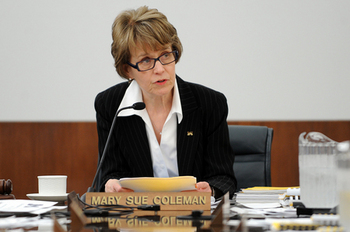
Mary Sue Coleman
"The changes here were more dramatic than in most states," Doyle said. "Between 2005 and 2010 Michigan experienced the third-largest decline in the nation for state support in higher education."
"The net impact is undeniable: The decline in state support for public universities has shifted the cost" of education to families, he continued.
In fact, from 2002 to 2011 state appropriations for Michigan's 15 public universities, when adjusted for inflation, declined $4,000 per student as tuition increased $3,500 per student, according to a Business Leaders for Michigan analysis.
Gov. Rick Sndyer's 2012-13 budget proposal allots $1.4 billion of the state's $48.2 billion fiscal 2012-13 budget to higher education, up $36 million, or 3 percent, from the $1.34 billion fiscal 2011-12 allotment. The governor proposes that the $36 million increase be tied to a formula that recognizes universities for increasing graduation rates, the number of degrees awarded in critical skill areas, the number of Pell Grants awarded to enrolled students and tuition restraint.
U-M is slated to receive roughly $272.7 million in appropriations next year, down from the $368 million in state appropriations in 2002. That year $1.85 billion was allotted to higher education.
Grand Valley University President Thomas Hass told conference attendees that largely because of dwindling state support "there's no doubt about it," many lower- and middle-class families have been "priced out of education."
What U.S. President Barack Obama called "skyrocketing tuition" when he visited U-M in January to give a speech on college affordability must end if Michigan expects its economy to fully recover from a decade of auto industry and manufacturing decline, conference facilitators said.
"We need a long-term commitment to investing in this critical economic asset," Doyle said, explaining that companies will remain in Michigan only if the workforce remains talented. "Every company wants access to the very best talent. And when those jobs come they also create jobs for people without degrees."

Dominos CEO Patrick Doyle
Photo courtesy of Domino's
U-M President Mary Sue Coleman noted that many of the 70,000-plus job openings in Michigan require an advanced degree and many "are going begging" because there's not enough qualified graduates to fill the spots.
"We need to acknowledge the economic pain that people are dealing with," Coleman said. "Until the last decade or so you could go out of high school and get a job. (Now) that's not possible."
Michigan State University, Wayne State University and U-M spend $1.9 billion annually on research. A BLM analysis found that Michigan's 15 public universities contribute $40 billion to the state's economy and roughly 12 percent to the state's GDP.
So what keeps industry in Michigan? BLM leaders say it's the talented researchers and innovative leaders produced by local universities.
"There's many other places for Dow and other companies to go build plants," said William Weideman, chief financial officer of Dow Chemical Company. "What will keep manufacturing here in the United States is the innovation, is the technology."
If that output stops, Michigan can expect the exodus of Industry the state has experienced in the past few decades to continue, Wiedeman said.
Hunter Rawlings III, president of the Association of American Universities, said colleges "are in some ways very wealthy institutions" and "it's not surprising when people sometimes get upset when they see the imbalance between their situation and these universities."
"We have to get past this kind of antipathy we see," he said. "The real enemy is not within the states. It's other states and countries that are competing with us."
Coleman agreed, saying the U.S. risks losing its place as a leader in higher education.
"Governments are pouring billions and billions of dollars into their education systems," she said. "They are absolutely committed to catching up."
Kellie Woodhouse covers higher education for AnnArbor.com. Reach her at kelliewoodhouse@annarbor.com or 734-623-4602 and follow her on twitter.
Comments
djacks24
Tue, May 8, 2012 : 8:26 p.m.
"Coleman agreed, saying the U.S. risks losing its place as a leader in higher education. "Governments are pouring billions and billions of dollars into their education systems," she said. "They are absolutely committed to catching up."" So UM accepting foreign students over US students that are just as qualified to attend UM is going to keep us a world leader and keep jobs here?
A2 rulz x2
Tue, May 8, 2012 : 6:01 p.m.
Fantastic article, Ms. Woodhouse!
clownfish
Tue, May 8, 2012 : 12:57 p.m.
Business leaders agreeing with the "Marxist" president? Does that make them "anti-American" and "anti-business"?
catfishrisin
Tue, May 8, 2012 : 3:24 p.m.
"Marxist" president? You really are a clownfish.
Rork Kuick
Tue, May 8, 2012 : 12:51 p.m.
Kellie Woodhouse: It's really not fair to say how 36 million more will be spent by the state on higher education this year, without saying how much it dropped last year. People might get the wrong impression about our elected officials. Was it a 213 million dollar cut last year?
Joel A. Levitt
Tue, May 8, 2012 : 11:48 a.m.
I fear that this is another of short-sighted-Governor-Snyder's chickens coming home to roost. If by next May his policies have not brought new businesses and employmment to Michigan, it will be time to recall him.
Ed Kimball
Tue, May 8, 2012 : 1:54 p.m.
Certainly it will mean it's time to replace him by 2014.
ChelseaBob
Tue, May 8, 2012 : 10:55 a.m.
The state is spending $6500 per student (including grad and undergraduate). That's a lot of money. Then the students kick in 26,000 or more. And that's not enough? I love U of M and want it's academic excellence to continue, but there will have to be major changes if it is to survive. The next 5 years will see the fast rise of internet schools and expansion of community colleges as more cost effective ways of delivering education. Cutting costs not begging for more state money is what's needed.
Ed Kimball
Tue, May 8, 2012 : 1:53 p.m.
The question is not whether $32,500 per student is enough. It's whether we want those who can't afford the $26,000 to get a higher education.
Ryan Bowles
Tue, May 8, 2012 : 10:54 a.m.
I think the key sentence is 'In fact, from 2002 to 2011 state appropriations for Michigan's 15 public universities, when adjusted for inflation, declined $4,000 per student as tuition increased $3,500 per student, according to a Business Leaders for Michigan analysis.' $3500 is a huge tuition increase, and yet the net funding to universities has gone down.
Jimmy Olsen
Tue, May 8, 2012 : 2:01 a.m.
Someone please tell me how much have professor salaries gone up in relation to tuition ? Administraton salaries. How about benefits? Really, every department (thiefdom) needs their own IT department, etc. On and on. tell me how throwing more state money at higher education will be spent....salaries and benefits.....seems like the smart kids that are accepted to the U, can figure that out. Check out the salaries here... http://www.collegiatetimes.com/databases/salaries/university-of-michigan-ann-arbor-2010 Being the "leaders and best" doesn't mean giving away the farm.
Ron Granger
Tue, May 8, 2012 : 1:17 a.m.
They say the people who sold "buggy whips" just couldn't understand the changing market either. Higher education is going online. Spending $30K a year to sit in crowded lecture halls is going the way of the buggy whip.
Ed Kimball
Tue, May 8, 2012 : 1:52 p.m.
Maybe, but when I taught online I found that the student does not get the same quality of experience that my classroom students got. The ability to interact directly with the instructor and classmates is a valuable experience that does not occur nearly as well or as often online. Online can be useful for providing information, but education is a lot more than just acquiring information.
snoopdog
Tue, May 8, 2012 : 1:06 a.m.
The bigger question which no one thus far has asked is, " why has college tuition grown yearly at 3 to 4 times the rate of inflation the past 10 plus years " ? State funding is not the problem, it is out of control unchecked spending by these institutions that is out of control , period. No longer do any of my donations go to my alma mater, that money is given to those that spend my money wisely like the Salvation Army. Good Day
Kafkaland
Tue, May 8, 2012 : 12:06 a.m.
@trespass: It's always easy to blame increasing administrative costs for the high cost of education, and as far as I can tell, there isn't anyone in academia who wouldn't want to focus all recsources on education and research, instead of administration. Unfortunately, much of the increase in administrative costs is due to increased complinace requirements. The public, as represented by their elected representatives in Congress and the state legislature, wants more accountability, and imposes rules and reporting requirments to enforce this. And satisfying these ever-incresing requirements costs money. Examples include a provision in the America Competes Act that everyone who works pon a federally funded research project, down to the temporary dishwasher, is trained in research ehtics, in classes no larger than 20 studnets / employees, for enough sessions to equal a credit hour. Or the Cleary Act, that requires a lot of tracking oand notification of campus crime, which requires a substantial infrastructure. And there are many more, down to arcane accounting rules or federal drug-free workplace certifications. And the Michigan legislature is no better: the stem cell reporting requirements (that are still fought over as likely unconstitutional) require that essentially every embryonic stem cell that's used in a lab is reported to the state - again at considerable expense as someone has to do the tracking accounting and reporting. So, when you blame increasing administrative cost, please look at where they may be incurred.
trespass
Tue, May 8, 2012 : 12:40 p.m.
Research ethics requirements came into being because Universities were failing to investigate reseaarch fraud on their own. The Clery act came into being because Universities were covering up crimes on campus because they thought they would tarnish the image of the University. Just look at the recent cover up of child pornography at UM Hospital. The University hires a great many administrators to "game" the system to make more money or avoid regulations. In addition, you have jobs created to pay back people for political favors done for the University. Look at how President Coleman created a new top administrator position for their joint institute with Shanghai Jiao Tong University. Then they gave the position to former State Representative Pam Byrnes. Look at the expense of having multiple luxury boxes at the football stadium to smooze politicians and donors. It is still the responsibility of the Board of Regents to make sure the University administration controls the University budget rather than just asking for more and more money.
average joe
Tue, May 8, 2012 : 10:19 a.m.
I can agree that when the government requires more oversight, costs usually go up. However, take your 'America competes act'- are you saying that it is wrong for the government to require "provisions" in order to have 'free' money? Are they just to hand it over? Or the costs associated with the Cleary act- Do we really believe that in this age of electronics it is that difficult to "track & notify" , and that it requires "substantial infrastructure"?
trespass
Mon, May 7, 2012 : 11:06 p.m.
If the impact is undeniable then why don't businesses and millionares pay a little more taxes to support higher education. Instead they want the middle class to pay. Why not ask President Coleman to control her budget. The Board of Regents is full of millionares and business people. They should know how to control a budget but they are conned by President Coleman to think that any cut will affect the quality of education. There are many administrative costs that are going up faster than instructional costs and have nothing to do with the quality of education. We need qualified Regents who know how a University runs.
Rork Kuick
Tue, May 8, 2012 : 12:39 p.m.
I want the rich to foot more of the bill, yes. I do somehow feel that part of the money they made is thanks to others in the community like workers, and tax payers paying for roads, education, fire and police and such - the rich do not make big money in a vacuum. Right now we have flat income taxes in Michigan. That needs fixing.
Susie Q
Mon, May 7, 2012 : 11:43 p.m.
Trickle down has been the Republican mantra since 1980 when Reagan was running for president. He said he'd cut taxes and that the ensuing wealth would trickle down to the masses. GHW Bush called it voodoo economics then and was proved correct. The tax cuts happened, but the wealth did not trickle down. Now, instead of trickle down, it is called the "job creators". Well, they had BIG tax cuts during the Bush 2 years and how'd that work out. Worst recession (depression) since the 1930's. If tax cuts automatically created jobs, then there would not have been massive unemployment at the end of Bush 2.
james
Mon, May 7, 2012 : 11:27 p.m.
I thought everyone was supposed to pay their "fair share"? This is the mantra of the Democratic party. Yet, when anyone talks about raising taxes on anyone except the very rich, there are literally riots in the streets. Just be honest. You want the rich to foot the bill for everyone. You somehow feel they don't deserve the money they made. This is funny because not only do the rich pay more than anyone else in taxes (> 50% of the US population never paid federal income taxes last year), but they create jobs, which then adds even more tax revenue to the government (somehow, everyone seems to forget this).
xmo
Mon, May 7, 2012 : 10:40 p.m.
I know college is important but does everybody really need a 4 year degree? "many lower- and middle-class families have been "priced out of education."" There still are a lot of technical jobs that go unfilled and not many people know about.
greg, too
Tue, May 8, 2012 : 4:43 a.m.
MikeB, Bill Gates dropped out of college and started a business in his garage. Not sure what that has to do with beauty school.
MikeB
Tue, May 8, 2012 : 12:51 a.m.
My motto, "Do what the rich people do" Bill Gates don't tell the kids to go to beautician school does he? H
mtlaurel
Tue, May 8, 2012 : 12:26 a.m.
That's false to think any kid who wants to and has the motivation/skills "ought" not go to college. Kids should aim high with their goals/aspirations/education...what kind of person says,"just do something to get by." No wonder this country can't lead any more.
greg, too
Mon, May 7, 2012 : 11:08 p.m.
I am in the upper ed world and I agree with xmo. We see students every day that are not prepared or able to complete their degrees....but the schools and financial aid firms will gladly take their money. As long as their are lenders, no one is every priced out of education. There will always be a bank or financial firm who would love to give you money based upon floating interest rates and extortionary finance charges. Community colleges are a good resource for people who want to get specific skills towards getting a career. Cheaper, more hands on and usually more specific, and it gets you into the work force and into your career faster.
Mr. Me
Mon, May 7, 2012 : 10:25 p.m.
Michigan budget leaders: Net impact of dwindling business payrolls on state revenues 'undeniable'