

Humane Society marks 50th animal abuse guilty verdict
The Humane Society of Huron Valley’s Animal Cruelty Investigation and Emergency Rescue team recently marked its 50th guilty verdict since the end of 2009.
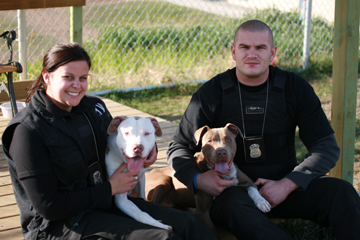
Elise Ramsey and Matt Schaecher are part of the Animal Cruelty Investigation and Emergency Rescue team at HSHV.
Photo courtesy of HSHV
The animals were left with no care and in deplorable condition,s with several inches of feces covering the floor of the house. On Oct. 14 of last year, HSHV served a warrant and animals taken from the house were sick and emaciated with scalds on their body from living in waste. Several of the animals died, but the rest have since been adopted.
Executive Director Tanya Hilgendorf said the house had to be condemned and later demolished. Richards was found guilty of a misdemeanor on May 3 and will be sentenced June 14.
Hilgendorf said the milestone is significant and partially due to the new leadership of Matthew Schaecher, director of Animal Cruelty Investigation and Emergency Rescue. Washtenaw County now has the highest animal cruelty prosecution rate of any county in Michigan.
“We investigate yearly about 500 suspected cases of animal abuse and neglect,” she said. “The work we put into that is quite extraordinary because we are the police officers, the detectives and the ambulance service.”
In 2011, the organization investigated 450 reports. The organization has received 144 reports so far this year. In total, there are five people on the team who investigate cruelty.
Hilgendorf said punishment for cruelty ranges from fines to possible jail time.
Eric Rutley was the first individual given jail time as a result of animal cruelty in Washtenaw County after he was found guilty of beating his girlfriend’s 5-month-old puppy, Brownie, nearly to death with a tire iron.
Rutley received a two- to four-year prison sentence in 2010 and it was reported that Washtenaw County Circuit Judge David Swartz said he would have issued more time if state guidelines had allowed. Swartz also ordered Rutley to pay $8,335 in restitution incurred for Brownie’s care.
Hilgendorf said solving animal cruelty cases is important not only for the animals but the community as well. She said research has shown there is a link between those who commit acts of violence against animals and other violent criminal acts such as rape, assault, child abuse and murder.
In 2004, Rutley, was convicted of criminal sexual conduct, assault and delivery of marijuana to a minor. Before that, Rutley was convicted of stabbing a man in the chest with an ice pick, according to court records.
“We’ve always known it academically,” Hilgendorf said. “These are rather unsavory people.”
Hilgendorf said the cases of Richards and Rutley demonstrates how prosecutors and judges have begun to take animal cruelty seriously.
“If we didn’t have cooperation and equal concern from the other professionals, we would be accomplishing very little,” she said.
Hilgendorf also credits increased “aggressiveness” against animal cruelty for the spike in cases being resolved.
“I think it really started with us becoming more aggressive and building those relationships because if we don’t build the case and bring it the prosecutor’s desk, nothing happens,” she said. “It started with our own sense of wanting to protect animals and send a strong message that animal cruelty is illegal and inhumane.”
The community also plays a large part in the ability of HSHV to not only prosecute but to locate individuals.
“What is really important is that it really is a community effort,” Hilgendorf said. “It is our community of donors that pay for our investigators; it is not tax dollars. We rely on people to make reports. They are the eyes and voices of the animals and we also get assistance from the Sheriff’s Department.”
Hilgendorf said reports come in ranging from people who left their animals outside in extreme heat to actual physical abuse. She said HSHV is still seeing a number of dog fighting instances in the area.
HSHV puts forth as much of its resources as it can into save lives, but sometimes it’s too late. In 2011, 1,018 dogs and cats were euthanized. Thirty-eight percent had serious behavioral issues, 57 percent had serious medical illnesses and the remaining 5 percent were euthanized because there were not enough resources to help them at the time.
“There are times when really their life is in jeopardy and they have injuries they can't survive from,” Hilgendorf said. “If they’ve been treated badly and their temperament is ruined, we might have to put them down.”
When examining how many animals are saved, HSHV has the highest save rate and number in the state of Michigan with 4,651 animals that were either adopted, reunited, or transferred to other facilities or organizations.
“We focus on trying to save them and get them into happy homes,” Hilgendorf said. “This community really embraces the idea of helping and being a part of a rescue. People don’t see the animal as ruined. We promote them as survivors.”
On June 1, HSHV will have a free ice cream social from 4 p.m. to 6 p.m. at its location at 3100 Cherry Hill Road to celebrate the work of the cruelty team.
Comments
kay
Fri, Jun 1, 2012 : 2:35 a.m.
Brownie has had to have major surgery, have his leg amputated, and barely survived the cruelty he was exposed to. In time he may have to have a second leg amputated because of the torture he endured. I am so glad his attacker is paying the price for such a cruel act. Sweet little Brownie has been adopted by an amazing couple. They love him immensely and he is beautiful. Thanks to them Brownie knows love and peace and calm. Thank you HSHV.
jns131
Sun, May 27, 2012 : 2:38 p.m.
Now let us support our people in Lansing to get the Puppy Mill Act enacted. This way the HS can continue doing good work making sure people don't abuse those who can't defend themselves. The petition is on line thru ASPCA.. Thank you for keeping us up to date.
Terrin
Sun, May 27, 2012 : 12:46 p.m.
Now if people could stop running animals over purposely when the driver's life is not in jeopardy (I've seen it), which is also cruel and generally illegal.
Robert Hughes
Sat, May 26, 2012 : 8:16 p.m.
Let's bring the compassion we feel towards pets to all animals.
Dog Guy
Sat, May 26, 2012 : 7:14 p.m.
I had no idea that HSHV had a special ops team and that this team was carving notches. I feel more secure knowing that they are out there protecting the streets of petville.
Arnold R.
Sat, May 26, 2012 : 5:59 p.m.
I appreciate the work that the Humane Society of Huron Valley perform. That being said, Ms. Hilgendorf's comment about knowing "academically" the "link between those who commit acts of violence against animals…" The link does not exist as Ms. Hilgendorf would suggest. "An analysis of 354 cases of serial murders found that nearly 80% of the perpetrators did not have a known history of cruelty to animals.The connection between school shooting and animal cruelty is even more tenuous.In 2004, a joint task force of the U.S. Secret Service and Department of Education undertook a thorough examination of the psychological characteristics of the perpetrators of thirty-seven school shootings.The researcher found that only five of the shooters had a history of animal abuse..'Very few of the attackers were known to have harmed or killed an animal at any time prior to the incident." "Can we conclude that childhood animal cruelty causes later violence?.. A. Arluke, a sociologist at Northeastern University, came up with an innovative way to test the graduation hypothesis.They compared the criminal records of individuals who had been convicted of animal abuse with a group of law-abiding citizens from the same neighborhoods...Their results did not support the graduation hypotheses.." "Patterson-Kane and Piper analyzed the results of two dozen research reports of childhood cruelty among extremely violent men...and males with no history of violence...They found that 35% of the violent offenders had been childhood animal abusers-but so had 37% of the males in the normal control group." "S. Goodney Lea studied the backgrounds of 570 young adults, 15% of whom had a history of animal abuse.She found that children who got in fights, lied habitually, used weapons, or set fires did tend to become violent adults.Animal cruelty, however, did not predict later aggressive behavior." From Some We Love, Some We Hate, Some We Eat by Herzog.
Major
Sat, May 26, 2012 : 7:39 p.m.
I reject your reality and insert my own....through my life, I've known some that have abused animals, they are ALL violent people, domestically and otherwise. You can spin the lies..I mean statistics, anyway you want, but the truth still prevails...abuse an animal, you are a scum bag that is headed NOWHERE but jail!!! Apparently the HSHV will see to it...didn't know they're so aggressive...Now THATS a humane society!! More donations coming their way from me!!! (Not to be confused with the deceptive HSUS)
Junne
Sat, May 26, 2012 : 5:46 p.m.
It's syrious when too much feeces results in a decision to demolish the home. No living thing should have to live that way. I am so glad there are enforceable laws in Washtenaw County. When I read about Brownie, a puppy caught in the crossfire of a domestic problem and nearly beaten to death – what kind of a person would do that? Judge David Swartz, in my opinion, is right for wanting to give more jail time… and thank you Katrease Stafford of Ann Arbor News for pointing out the previous ice pick stabbing conviction – what a horror.
bedrog
Sat, May 26, 2012 : 3:30 p.m.
If there was ever a justification for 'putting down" a mammal it'd be the multiple offense perp cited in this article... he sounds like pure evil! Good work HSHV.