

Knock on bronze: Contractor hopeful sculpture in front of Ann Arbor city hall soon will work
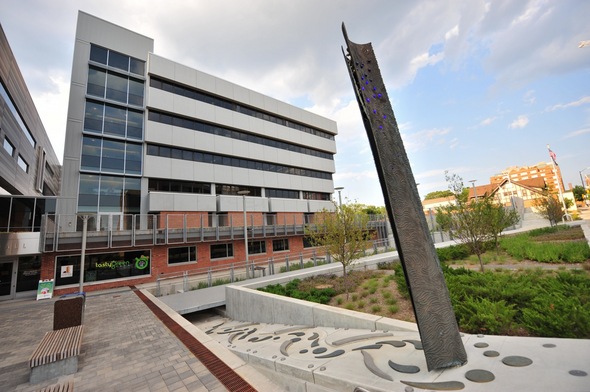
The $750,000 Herbert Dreiseitl water sculpture in front of Ann Arbor's city hall. Some days it works and water flows. Some days it doesn't. Contractor Jim Fackert has been working out the bugs.
Ryan J. Stanton | AnnArbor.com
"I've been here a whole bunch of times. I haven't really counted them," said Fackert, a custom electronics and lighting control specialist with Hamburg-based CAE Inc.
The $750,000 public art piece, which the city commissioned German artist Herbert Dreiseitl to complete, has been controversial from the start. But the fact that it has been malfunctioning since it was installed last September has opened to the door to even more criticism.
Fackert was back again on Tuesday to install a new pump system in hopes of getting water running down the face of the bronze sculpture as originally intended.
He said cigarette butts and other trash littered in front of city hall had been clogging the old pump system, and that's why some people might have noticed a lack of flow. Beyond that, drought conditions are partly to blame since the system is designed to run off rainwater.
Of the $750,000 the city spent on the public art installation, less than $150,000 actually went to Dreiseitl, who farmed out much of the work locally. Fackert's company was subcontracted for $150,000 to do the lighting and water technology for the piece.
AnnArbor.com: As the expert on the ground who knows more about this sculpture than most people, what can you tell me is going on here?
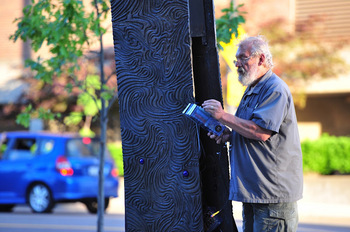
Jim Fackert works to fix a few bugs with the circuit boxes to the sculpture's blue glass orbs on June 12. More recently he's been tweaking the pump system for the water.
Ryan J. Stanton | AnnArbor.com
The plan was that the sculpture would use rainwater, and if we had a drought and there was no rain and the sculpture ran out of water, it would stop and then start again when rain started falling. There's some discussion about whether that should be changed. I know the arts council is discussing it and the City Council and the mayor are discussing it. If it hadn't been for this drought, the sculpture would have been functioning.
AnnArbor.com: But there have been other issues with the sculpture's electrical and plumbing components, correct?
Fackert: It's a complex piece of plumbing and electronics and our design for the main flow way, the part that slopes down and has a large volume of water flowing down, has been working whenever there's rain. But there's also water that's supposed to flow out around the pearls and down the face of the bronze sculpture itself, and that part we've had trouble with.
Our original design had six little miniature pumps to pump water up into the sculpture so we could control the flow, and it worked really well until the system accumulated cigarette filters and clay and all sorts of stuff — trash from the plaza. There's cigarette butts everywhere. They get in the sculpture, they get in the channels, they break up. And these little tiny fibers were plugging up the tiny pumps. So after struggling with that, and a few tries at addressing the fiber issue, we decided to change the system. We decided that last week. We just put in a single, more powerful pump in the reservoir to push water to the pearls, and today we're putting in a manifold with adjustment for each pearl's flow. And since our individual little pumps didn't work, couldn't handle the trash, we're putting in this manifold and we're getting the pumps in place and wired for the pearls. And the manifold, I'm just finishing up, so that should be working today, and I believe that's going to be a reliable system that will keep the face flow flowing.
We haven't had any trouble with the main flow except we had some electrical issues early on, but those were resolved pretty quickly.
AnnArbor.com: So you're confident you can get this thing working and we'll have a fully functioning sculpture in short order?
Fackert: Yeah, 100 percent. And then the question is whether it should flow when it's raining or not, because everybody wants to see it run and wonders what's wrong if it isn't running, and I'm sorry for that. I think we'll have it running reliably soon, and then the city will have to make the decision whether the sculpture should mirror the weather conditions and be dry when it hasn't rained for a couple of weeks or whether it should be recharged by city water.
AnnArbor.com: But it was by design originally that it would mirror the weather patterns and it would not be running when it's not raining?
Fackert: Yeah. Well, it's got a 3,000-gallon reservoir and it can run about two weeks without any rain, and the Friday before last we had a half inch of rain and that was adequate to fill the main and reserve tanks for the sculpture. It didn't put a dent in the rain garden, but it filled the sculpture, and then the sculpture ran for two weeks on that water. And now it's running because this morning we had maybe a quarter inch of rain or less and that put about 1,000 gallons in the sculpture tanks, which would get it through four or five days.
AnnArbor.com: How many times have you had to come out here and tinker with this sculpture since it's been installed?
Fackert: I've been here a whole bunch of times. I haven't really counted them. As I said, it's a complex piece and there's the face flow, the base flow, managing the water levels in the reservoirs, and it's taken some time to get it all tuned up and running right. But I'm pretty confident that the remaining issue, which is keeping the face flow running reliably, will be resolved — knock on bronze.
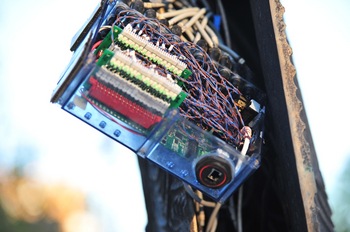
"It's a complex piece of plumbing and electronics," Fackert says of the Herbert Dreiseitl sculpture.
Ryan J. Stanton | AnnArbor.com
Fackert: Some of them say they're going to miss me when I'm gone because I'm a regular fixture. I say I'll miss them, too, and I hope it's soon. But I've gotten pretty much really positive views and comments about the sculpture. I've had a few people come by and just look at the whole thing and say, 'Why are we wasting our money on art? Why are we wasting our money on pretty gardens? Why are we wasting our money on fancy buildings when all this stuff needs to be done?' But for the most part, people really enjoy it — they really like the sculpture.
I've had several people come by who were in town and came to this site specifically because they knew the Dreiseitl sculpture was here and wanted to see it and were excited to see it. And I've had a number of artists come by and just talk about the concept of public art and funding and the nature of the piece. I've really enjoyed talking with people about the piece, because art is supposed to be controversial. Art is supposed to make people think, and I think this is a beautiful piece. And I think really when people are talking about it, it's doing its job.
It's making people think about this drought. What are we going to do about this drought? What are we going to do about no water? The sculpture is focusing the City Council and other political discussion and general conversation about the water issue.
AnnArbor.com: So it's serving its purpose then?
Fackert: Yeah, and it will continue to. I just really enjoy the piece and I'm happy to have been a part of making it function and I think it's something the city will be proud of for decades and decades to come. We can be proud of it now. It's still in the tune-up stage, but it's still beautiful. It's still standing tall. The bronze is incredible. The water flow down the slopes is really neat and fun. People enjoy just sitting at the benches and listening to the water flow.
AnnArbor.com: As a contractor for this project, when you're out here tuning this up, is that on your dime or the city's dime?
Fackert: I'm a subcontractor to the main contractor on the sculpture. I did the water and lighting, and I did it on a contract basis, so I'm here working on essentially my dime until it works. The city hasn't paid anything beyond contract at all for I don't think any phase of the sculpture or rain garden, so people shouldn't see dollar signs leaving the city coffers if they see me working here.
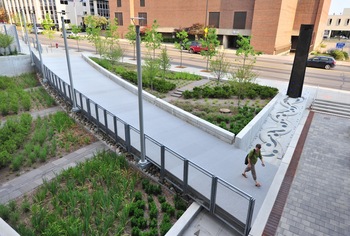
Council Member Margie Teall, D-4th Ward, observed a lack of water flowing from the sculpture Monday night.
Ryan J. Stanton | AnnArbor.com
Fackert: Since the beginning of spring, I don't know what the percentage would be. Over the month of June, the base flow worked as it was planned for probably 95 percent of the time. The pearl flow worked intermittently because we kept having these clogging issues, and we tried to figure out what was going on and figure out a solution. We tried a solution, it would work for a week, and then we'd have clogging issues again, so we've just been making revisions and modifications, trying to solve the problem. And in the end, the solution was to redesign the system. And it has stopped flowing for several days on occasion because of no water. If I hadn't been filling the tanks probably every week or two while I was working on it in May, it probably would have only worked for about a third of May with the available water. Even April showers didn't come in enough quantity to keep this sculpture going 100 percent of the time, but this is an anomaly. It's unfortunate that the sculpture is done and the rain stops.
AnnArbor.com: Based on a conversation you and I had before, I know you believe Ann Arbor residents should be very proud to have a work by Herbert Dreiseitl in their community. Remind me why you think that is and why we should feel that way.
Fackert: Herbert Dreiseitl is a world-renowned sculptor and planner. His larger company does major water management features in major cities all over Europe and all over the world. They're currently building 60 parks in Singapore, a multibillion-dollar project to manage water — and not send it down the river so they have drought later and flooding downstream.
When we were talking about the sculpture, he said early on he did some sculptures with water involved and he decided that was his mission — to build art that interfaced with water and brought people and water together, and he's built over 500 sculptures around the world. It brings people, the environment and art together, and it makes people aware of water and the issues, just as this sculpture is now making us aware of the drought.
Ryan J. Stanton covers government and politics for AnnArbor.com. Reach him at ryanstanton@annarbor.com or 734-623-2529. You also can follow him on Twitter or subscribe to AnnArbor.com's email newsletters.
Comments
Sandy Hanert
Sat, Jul 14, 2012 : 4:32 p.m.
I so appreciate Brian's positive comments. And I want to add the perspective from an expert on Public Art from "The Importance of Public Art": By Christie Gross, eHow Contributor Public art brings people together. Public art serves two primary functions: It provides a tool for economic revitalization and creates community identity. It helps shape the quality of life for people in a community by offering a form of expression that embodies a community's spirit. It represents a sense of community pride and brings people together. Moreover, public art attracts people to a community who bring a broad array of talents and experiences, further enriching it. We should be thankful we have a visionary contractor such as Jim Fackert in our community. Sandra Hanert, local artist Read more: The Importance of Public Art | eHow.com http://www.ehow.com/about_6715852_importance-public-art.html#ixzz20cCPp1Un
Elaine F. Owsley
Mon, Jul 9, 2012 : 2:39 p.m.
Better yet, get a refund from the artist (?) and the contractor.
CynicA2
Sat, Jul 7, 2012 : 10:48 p.m.
Maybe we could rent a couple gravel trains from a local gravel hauler, fill them with cigarette butts, and bury the scrap metal/urinal thing in them - a giant mountain of butts would look far better than what's there now, and would usefully repurpose all those butts. Then, maybe bronze the whole thing. A great monument to Hieftje-ism, and cost-effective, too!
Mick52
Fri, Jul 6, 2012 : 9:20 p.m.
It's designed to run on rain water? This is a joke right? How embarrassing this thing is/has been.
julieswhimsies
Sat, Jul 7, 2012 : 9:42 p.m.
It will be fixed. It will be beautiful I do not drink.At.All. We have AC that keeps us quite comfortable.
Brad
Sat, Jul 7, 2012 : 12:35 p.m.
So then you must think that this art is a success. This outsourced, overpriced, gimmicky, hardly-ever-working piece of art. OK, the hot weather has made you delirious and/or you are currently drinking heavily.
julieswhimsies
Fri, Jul 6, 2012 : 11:53 p.m.
Wow. I have never seen so many negative comments about ANY public art, in any city in which I have lived. Okay. So it's beastly hot out there...or else every poster on this blog is hung over.
Bryan Magnuson
Fri, Jul 6, 2012 : 7:55 p.m.
I wonder if any of the largely anonymous commenters have ever been tourists before? Haven't they ever gone to another city and sought out the public art? Where is the outrage about the people who throw cigarette butts and other litter? I have generally stopped reading comments because they are so negative, but felt the need to provide some balance.
Elaine F. Owsley
Mon, Jul 9, 2012 : 2:42 p.m.
Being in Paris, Rome, London, Monaco, Athens, Cancun, or wherever would not improve this thing.
julieswhimsies
Sat, Jul 7, 2012 : 9:45 p.m.
Thank you, Bryan. Some people just never get out.
David Cahill
Fri, Jul 6, 2012 : 6:37 p.m.
The Dryseitl project has been cursed from the beginning. The Public Arts Commission was supposed to have bylaws to operate. It didn't until after this project was approved. The Commission was supposed to use an open bidding process. There wasn't one. Instead, the chair of the Commission was convinced by Dreiseitl that it was a great project. She, and a handful of self-appointed people who should have known better, then sold the project to Council. Now the darn thing still isn't working. The design didn't account for the fact that there would be trash in the plaza? Unbelievable. And is the walkway beside the structure handicap-accessible? Can the City get a refund?
DJBudSonic
Fri, Jul 6, 2012 : 8 p.m.
You sure hate this sculpture, don't you? Was your wife one of the ones who "got sold on it" on council? How did she vote?
Jim
Fri, Jul 6, 2012 : 5:44 p.m.
I noticed this earlier: http://www.annarbor.com/community/community_wall/city_hall_water_sculpture_broken/ As of today (Friday, July 6) there is some water coming out of the LEDs, but most of it is still coming out of the base. I don't think this was the intention. Since the artist abrogated his responsibility in getting the thing working practically, I'd argue that a few things could be tweaked with the sculpture to make it more interesting: 1. The LEDs are barely visible during the day. Should they even be on during the day? A photocell could allow for the LEDs to turn on when it is dark or overcast. 2. Why not make the sculpture more interactive? The flashing pattern of the lights could change based on viewers interacting with the sculpture in different ways. Proximity sensors in the water garden could allow the viewers to change the pattern based on the places they visit in the garden. It might be fun to discover what behavior causes the new patterns to appear. Since they already have complicated electronics driving the thing, it would not be hard to add these changes. 3. The water flow should be proportional to the tank volume. That way the sculpture can communicate drought level (over the past few weeks) by its behavior. 4. In general, the more dynamic, interactive, and novel the behavior of the sculpture, the more attractive, engaging, and appreciated it will be by the Ann Arbor public. It's problematic that the artist didn't see the intriguing possibilities of a dynamic piece, rather than a slab of metal draining water over a set of monotonously blinking lights.
bhall
Fri, Jul 6, 2012 : 5:20 p.m.
Why can't smokers take personal responsibility to dispose of their garbage properly? They should be ashamed!
Mick52
Fri, Jul 6, 2012 : 9:24 p.m.
I sort of had the same thought, but then considered A2 is basically smoker free. Go to other cities in SE Michigan and you will see a stark difference. If this thing was not designed to defray a little clogging from even cigarettes, how is it going to run on leaves and miscellaneous litter?
DonBee
Fri, Jul 6, 2012 : 4:57 p.m.
abc - Check out this about Mr. Fackert - http://www.plsn.com/gear/7972-parnelli-visionary-award-winner-jim-fackert.html or www.youtube.com/watch?v=j-I0WSNtQZM Mr Fackert is an icon in his industry, and was hired primarily to get the lighting working right - to my knowledge the lights have always worked right. He is quite an individual as you would see if you met him at the Maker Faire or at one of the concerts that his lighting equipment makes possible or any live theatre in the area - they all use his stuff. Most of the concert lighting effects were pioneered by Mr Fackert and his company.
abc
Fri, Jul 6, 2012 : 5:08 p.m.
DonBee I did check out some of that, thanks. That's how I realized that Mr. Fackert was not just a workerbee at the company. I guess I think that if you are interviewing someone who is an industry pioneer that you offer to the audience his resume in some way so that we can consider that resume when we hear what he or she has to say.
abc
Fri, Jul 6, 2012 : 4:26 p.m.
When I first read this article I was impressed that Mr. Fackert was so knowledgeable about the sculpture and so confident with the system. I was also struck that he was also familiar enough with Mr. Dreiseitl's work to be conversant in the number of projects Mr. Dreiseitl has in a small city-state in SE Asia. I thought this was very impressive for an "electronics and lighting control specialist with Hamburg-based CAE". Mr. Fackert is not just a worker at CAE; he is the founder and president of the business. For me at least, reading this back and forth became very different when I understood that the cheerleader-in-chief for the company that accepted a contract to build the inner workings for this sculpture, which is not working quite so well, was being interviewed.
Davidian
Fri, Jul 6, 2012 : 3:48 p.m.
I laugh out loud every time I see that monstrosity.
Goober
Sat, Jul 7, 2012 : 11:24 a.m.
I cry knowing how much of our money was used to buy it.
Kitty O'Brien
Fri, Jul 6, 2012 : 3:47 p.m.
Looks and works like a piece of junk. Who ever suggested this "art" installation should be fired.
Ron Granger
Fri, Jul 6, 2012 : 3:22 p.m.
This seems poorly engineered for on-going reliability and maintainability. Is that plastic enclosed electronics module really exposed to the elements? Are the design documents - schematics, etc - on file with the city? It looks like a hodge podge of point to point wiring that would be extremely difficult to repair. For the cost involved, there should be spare assemblies - not just spare parts. That module in the picture should have at least one spare that is full functional. Just swap it out. What kind of connectors are they using? They should be appropriate for the task. Modern automotive connectors are quite good and fairly reasonably priced. But in 10 years you may not be able to buy compatible replacement connectors. There need to be spares. Custom PCBs are cheap. The solution should be engineered with fabricated PCB's and standard headers, with standard cables. This should probably be using ribbon cable internally. The plastic box should be a proven meta design, with proper o-rings. The plastic is not going to last long if exposed to Michigan's climate extremes of 100F+ and -40F. What is the plan if that box leaks and corrodes? What if someone steals it? Whenever you design a piece of electronic art intended to last for decades, at this level of expense, the question of how to replace the control assemblies should be part of the RFP. As I said before, the art commission was far too inexperienced to spend this much cash so soon. They violated their own charter's restrictions on spending limits - by several multiples. They made a similar mistake and charter violation with the piece of art they are installing in the secure area. A piece of art that can't be reasonably viewed by the public who paid for it. Their actions are going to risk the loss of support even from people like me who support the program. The non-public installation is enough for me to ask whether we need a referendum on the out of control art program.
ArgoC
Fri, Jul 6, 2012 : 6:54 p.m.
I would feel a lot better about your post, Ron, if you weren't raising questions that have already been answered or if your questions didn't assume things were done wrong. I hope you are not raising these questions just for the sake of increasing bad feelings.
Ron Granger
Fri, Jul 6, 2012 : 3:10 p.m.
A large percentage of cigarette smokers can't be bothered to properly dispose of the fiber cigarette butts. So, time to ban smoking on public property. Want to smoke? Smoke in your car or in your home.
Greg
Fri, Jul 6, 2012 : 2:55 p.m.
Let me get this straight, A outdoor water feature that can't hadle any trash, lack of rain or even refilling the containers when it should. What rocket scientists designed and purchased this trash. $750,000 - the public got raped.
Deb Anderson
Fri, Jul 6, 2012 : 2:44 p.m.
Instead of being an art critic here, I'll simply criticize the voters of Ann Arbor who voted in the very people who approved of and justified funds that were used to pay for this monstrosity and that doesn't even cover the cost of making it work properly. You all got exactly what you deserve, LOL!
annarbor28
Fri, Jul 6, 2012 : 2:36 p.m.
This looks like a piece of metal trash that needs to be removed. I am not defending smokers, but they probably think it is much safer to throw their butts into something with water in it (when there is water) than in a wastebasket, or litter on the ground. So this is a cigarette receptacle. People throw all kinds of things into fountains, anyway, the builder should have known that. The really stupid thing was to not just have local artists design and submit projects. thus helping out everyone, and supporting the many fine local artists and artisans. Even if they did want to get this "Thing" removed, it's tied up in international law. Why do you all keep reelecting these people???
julieswhimsies
Fri, Jul 6, 2012 : 11:45 p.m.
Do smokers think?...or care at all what they do with their vile trash?
Tru2Blu76
Fri, Jul 6, 2012 : 2:28 p.m.
Of course it's taking months to work: water... is so complicated. Besides, to have a water reservoir pool big enough to contain all the water in the Great Lakes would make it 95,000 square miles with a depth of 207 feet, so of course we're short of water for this fountain. And the big bonus coming from all this: we now have a new problem we can blame smokers for.
Kai Petainen
Fri, Jul 6, 2012 : 1:22 p.m.
I noted the art controversy in this Forbes blog..... http://tinyurl.com/76zx8my
Sooze
Fri, Jul 6, 2012 : 1:07 p.m.
Come on you clever people: read the article. 1-The sculpture needs rainwater to run and we are in a drought (that means it has not been raining much lately). 2-The sculpture's pumps are clogged with cigarette butts and other trash (that means people are tossing stuff into "the urinal" and then blaming the artist because it gets clogged.) If things so right it will be fun to watch, so put your butts in the can!
julieswhimsies
Fri, Jul 6, 2012 : 11:43 p.m.
Thank you, Sooze.
Mick52
Fri, Jul 6, 2012 : 9:28 p.m.
Well, maybe it happens but I have never, ever heard of an outdoor fountain that runs on rain water. Maybe they have them in Oregon, Washington and in the Amazon. But here?
Angry Moderate
Fri, Jul 6, 2012 : 1:54 p.m.
And why doesn't the sculpture look like the drawings that were given by the artist before the City paid for it?
Goober
Fri, Jul 6, 2012 : 1:21 p.m.
No one thought about trash clogging the pump system when it was planned and designed? We have to remember and realize that the sculpture is in a public area; subjected to all of the public elements which includes trash. The design is not robust for exposed elements. Also, no one thought about how a possible drought would affect the aesthetics and function? Bad design!
John S. Armbruster
Fri, Jul 6, 2012 : 12:47 p.m.
What a farce.
Mike58
Fri, Jul 6, 2012 : 12:39 p.m.
I think if we start to view this million dollar piece of "art" as a highly funtional ash tray then we can all be happy.
average joe
Fri, Jul 6, 2012 : 11:28 a.m.
So it's the cigarette butts fault, and not some other type of butt from city hall.......... Who would have thought there would be cigarette butts near a public walkway.
Goober
Fri, Jul 6, 2012 : 1:23 p.m.
Maybe even a few doobie butts.
pluto77
Fri, Jul 6, 2012 : 4:16 a.m.
Total waste of money....that would have been enough to pay 1/6th of Fred Schmid's Fire Cheif pension. What a shame.
bunnyabbot
Fri, Jul 6, 2012 : 3:48 a.m.
we all missed the obvious comment! Public Art Fail
Stephen Landes
Fri, Jul 6, 2012 : 2 a.m.
I just had supper in the back garden of Dominick's behind the Law School. Duplicating that garden/fountain and inviting food cart owners to take up station there would be far more useful, provide a much nicer gathering place, and cost LESS. We could even make a little money by charging a minimal fee for food carts so the number could be managed. By the way, why do we need a rain garden? I can understand this in a location that has combined sewers as the potentially high flow rate drives waste water treatment costs. We have no such system here. There seems to be no reason to mitigate the rate of storm water flow on a routine basis that a rain garden could handle. From the photos the whole thing looks dangerous. One slip on that wet inclined surface and you could find yourself under the sidewalk at the bottom! (See the first photo in the article) Didn't the city attorney or safety office or planning commission look at that?
say it plain
Fri, Jul 6, 2012 : 2:24 a.m.
Love it; it's already a lawsuit in planning lol, never mind that it's nasty-looking and non-functioning. Please AA.com, get some statements from City Hall about the safety and/or ADA non-compliance or something?! Pretty please? It truly does look like a danger for the visually challenged, the walking in winter, the not paying attention. Comments from City Hall on how this simply isn't true?!
Daniel Piedra
Fri, Jul 6, 2012 : 1:56 a.m.
Pertaining to Mr. Facket, at least the City Bureaucracy can boast that they have created a private sector job. Still, $750,000 for that "sculpture" is simply absurd. And let's not water down the word "absurd" (no pun intended); this is simply absurd!
Arboriginal
Fri, Jul 6, 2012 : 1:28 a.m.
The thing that kills me is that the end product is not what was presented in the renderings. The concrete slab was supposed to have a serpentine channel that the water would snake down. The slab looks CHEAP like a child's pegboard! Add to it the exposed wiring and you have been boondoggled fellow Arborites!
Lewanster
Fri, Jul 6, 2012 : 12:42 a.m.
Interesting that there is not one positive comment about this piece of art. Actually, I sat here for a few minutes trying to think of what to call it. I didn't want to call it art.
Mick52
Fri, Jul 6, 2012 : 9:31 p.m.
Only an artist can decide is something dumb looking is art. No matter how stupid something is, if a person who has been designated an artist made it, it is art.
E Claire
Fri, Jul 6, 2012 : 4:56 p.m.
@Brad - FART (although I think a fart may not stink as badly as this thing does)
Angry Moderate
Fri, Jul 6, 2012 : 1:15 p.m.
The Guy C. Larcom Memorial Urinal
Brad
Fri, Jul 6, 2012 : 12:34 p.m.
A combination of a FAIL and art. If there were only some way to combine those words.
Frustrated in A2
Fri, Jul 6, 2012 : 12:33 a.m.
I hope the city kept the receipt so they can get their money back and not just an in store credit!
Peter Baker
Fri, Jul 6, 2012 : 12:30 a.m.
I'm FOR the 1% for public art and I still think this was a waste, mostly of opportunity. The scale is completely wrong for such a large plaza on a wide street, and a city that prides itself on LEED certified buildings should know better than to put in a water fountain. And seriously, blue orbs that twinkle? Did they buy this from the lawn ornament people at Art Fair?
Linda Peck
Fri, Jul 6, 2012 : 12:25 a.m.
If I was the Mayor and City Council, I would have this thing removed immediately. Sometimes you just have to make the tough decisions and cut your losses. That is what I would do.
Mick52
Fri, Jul 6, 2012 : 9:32 p.m.
Yeah let's put it in the skateboard thing at Vets Park.
DJBudSonic
Fri, Jul 6, 2012 : 12:21 a.m.
Can someone get a total spending breakdown for this project? So far we have 150 k to the artist, 150 k to CAE for controls and pumps, where did the 500k or so remainder go? This article states local resources, who got it? I'm going to go out a limb and guess it went to additional engineering and contracting payments for the justice center construction team.
julieswhimsies
Fri, Jul 6, 2012 : 11:36 p.m.
DJ. Yes. There is a local bronze caster...several, in fact.
DJBudSonic
Fri, Jul 6, 2012 : 7:57 p.m.
Not according to this article I have to wonder where the money went? Is there a bronze caster in Ann Arbor I don't know about?
thinker
Fri, Jul 6, 2012 : 12:49 a.m.
Wasn't it $750 K to the artist?
tommy_t
Thu, Jul 5, 2012 : 11:56 p.m.
This article should have appeared in the Entertainment Section - it just keeps getting better.
Skyjockey43
Thu, Jul 5, 2012 : 11:27 p.m.
I can't wait until some of Ann Arbor's notorious, and grammatically challenged taggers set their sights on this $750,000 monument to government waste. Anybody stop and think maybe all those cigarette butts were less of an issue of carelessness and more of a statement?
The Picker
Thu, Jul 5, 2012 : 11:15 p.m.
This is just the beginning. Sooner or later Jim Frackert is going to declare victory and cut and run. Then what? This thing is a Rube Goldberg with so many complicated flaws in its design and implementation, that the taxpayers of Ann Arbor will be getting soaked on this one for years to come. Additionally, what is the electric usage to run these pumps, perhaps a water powered option may have been a more ecologically friendly choice. Too bad no one was thinking of the future.
julieswhimsies
Fri, Jul 6, 2012 : 11:34 p.m.
This man is one of the most famous artists in the world. He doesn't need to "cut and run"
Ron Granger
Thu, Jul 5, 2012 : 11:11 p.m.
Haven't we spent a bunch of money on security cameras for that government building? Why can't they be used by the police who work there to record and ticket the scofflaw cigarette butt absconders?
annarbor28
Fri, Jul 6, 2012 : 2:40 p.m.
Is it illegal to put cigarette butts into what looks like a piece of trash? Are there signs that say: "no butts"?
whojix
Thu, Jul 5, 2012 : 11:11 p.m.
A bike lane around a fire pit fueled by 1% of the yearly budget would be a more fitting piece of art to put in front of city hall.
utownie
Thu, Jul 5, 2012 : 11:08 p.m.
How much energy can the entire system consume? Jim says he replaced the miniature pumps with one large pump. Sounds like there is also a large pump for the 3,000 gallon reservoir, and lots of controls. Of course the rain garden isn't working and is requiring water. Nearly $1 million and it is not environmentally sustainable? By the way, how much energy does the underground parking structure consume? The ventilation fans are huge and there is no natural light like an above ground structure. Are the lights on all the time?
Diane
Thu, Jul 5, 2012 : 10:53 p.m.
Saw this the other day for the first time. What a disappointment. Couldn't believe you actually paid for this contraption.
Lets Get Real
Thu, Jul 5, 2012 : 10:42 p.m.
The local guy gets hosed. The design from the "world reknown" water management expert and scullpture stinks. He hires a local guy to do all the hard work. And, when the design doesn't funtion as billed, it is the local guy who has the integrity to come back again and again to make it work - without further compensation. The German? No where to be found, having abscounded with the cash. Not the Public Art Committee's finest hour. Come to think of it - when was their finest hour? I say no more on my dime. Go find the rich benefactors who will fund these frivolous projects for a naming opportunity.
whale11
Thu, Jul 5, 2012 : 10:35 p.m.
Put three or four ash trays near-by.
Riverman
Thu, Jul 5, 2012 : 10:03 p.m.
Yes indeed, smokers are a careless lot. Butts go flying when they finish. If we threw pop cans away like they do butts, we would get ticketed quickly.
Alan Goldsmith
Thu, Jul 5, 2012 : 9:49 p.m.
ADA lawsuit? Interesting option.
Wehrwolf
Fri, Jul 6, 2012 : 10:25 p.m.
Oh lord don't even start....let's waste more of our taxpayer money fighting a ridiculous ADA lawsuit...
Katherine Griswold
Thu, Jul 5, 2012 : 9:37 p.m.
Water would be nice, but I am more concerned with safety and the process that led to a walkway in front of city hall that is not compliant with federal Americans with Disability Act (ADA) law. In two areas near the fountain, including the "bridge" in the photo, the walking surface ends with a drop off of almost two feet. A person with a visual impairment has no indication that the walking surface ends. In addition, it creates a risk for anyone in a wheel chair, in a stroller, or just not paying close attention.
thinker
Fri, Jul 6, 2012 : 12:46 a.m.
How deep is it? Is it safe for kids?
Stephen Landes
Thu, Jul 5, 2012 : 9:24 p.m.
I've designed a few water features in my time -- they were called waste water treatment plants. I can tell you that nothing labeled "miniature" is going to function for long with an outdoor system susceptible to contamination. That plan was absurd from the beginning. What this also brings up is the source of the contamination: cigarette smokers seem to me to be a careless lot when it comes to properly disposing of their trash. I see way too many cigarette butts flipped out of car windows, dropped on curbs and in parking lots, and just simply missing the collection points completely. Maybe those smoking around city hall should be a bit more concerned about what happens to their trash.
jcj
Thu, Jul 5, 2012 : 9:11 p.m.
If it recycles the water which I assume it would. How much water could it take to fill the tsank? The tank should not have to be that big. 'They're currently building 60 parks in Singapore" I hope the design is better than this one! What a joke. Build something that doesn't work and then use double talk to make excuses! I would not trust this guy with a 6th grade science project!
Carole
Thu, Jul 5, 2012 : 9:11 p.m.
$850,000 for a sculpture that does not work -- rain, or no rain, excuses or no excuses, I believe is way out of order in light on more important things that need to be achieved in the city. But, then again this is government at it's best.
ArgoC
Fri, Jul 6, 2012 : 6:50 p.m.
Sorry, must've missed it. Where did you get the $850,000 number?
xmo
Thu, Jul 5, 2012 : 9:01 p.m.
We could have had an American or Michigan or even an Ann Arbor Artist design something for Ann Arbor City Hall but the Art Commission had to go to Germany! The Ann Arbor Art Commission is nothing but an "ELITE" commission designed to spend our tax dollars on something they think we should have because we are too dumb! Thanks Voters of Ann Arbor for Voting without Thinking!
Brian Kuehn
Thu, Jul 5, 2012 : 9 p.m.
These type of issues should be recalled when voting in the Democratic primaries in August. Think to yourself which incumbent council members have steadfastly supported the "Percent for Art" and tacitly approved the various installations (non-working fountain, Justice Center art that requires one to be screened through security). Is this a pattern of questionable fiscal policy decisions or are they insignificant blips on an otherwise stellar performance? If we are not happy with the results coming from City Council, we need to get to the polls and vote.
DNB
Thu, Jul 5, 2012 : 9:05 p.m.
That's right, Brad...I hope my 4th ward citizens remember Margie Teall is the cheerleader for 2% for art.
Brad
Thu, Jul 5, 2012 : 9:02 p.m.
And let's especially remember the one up for reelection this year who is disappointed that is isn't TWO PERCENT for art. No, seriously.
bunnyabbot
Thu, Jul 5, 2012 : 8:52 p.m.
what a joke for an incredible hunk of junk
julieswhimsies
Fri, Jul 6, 2012 : 11:22 p.m.
I suspect the critics of this piece of art all have lawn ornaments in their yards, that they tell you is ART...or a deer head hanging over their mantles and call this ART...Oh. Wait. A decapitated deer head on the wall is considered to be a trophy.
Thomas Jones
Thu, Jul 5, 2012 : 8:46 p.m.
what a joke! 9/11 had a ton of scrap metal they could have use! FREE! and saved jobs of Police and Fire Shame on AA GOVT
Arborcomment
Thu, Jul 5, 2012 : 9:22 p.m.
Agree Thomas, I posted this further up the chain and then saw your comment: http://glenburnie.patch.com/articles/photos-911-memorial-remembrance-in-millersville#photo-7473445 From A2 (county) in Maryland. What could have been.
Goober
Thu, Jul 5, 2012 : 8:28 p.m.
After looking at the pictures and seeing the circuit boards exposed to the weather, I can see it now. In a year or two, when the art breaks down again, the city will either hire a technician full time to keep the art working or pay the original source for service calls. What a waste of money! Just like the AA Big Dig.
Basic Bob
Fri, Jul 6, 2012 : 3:22 p.m.
I'm sure the circuit boards are in a rainproof box. Just like traffic controls, electrical substations, roller coasters, and the Hoover Dam. All of which are more complicated and critical. Perhaps we can install pedal-powered water wheels for all the Luddites. They're far more reliable.
Go Blue
Thu, Jul 5, 2012 : 8:27 p.m.
As with everything in purchasing, if it doesn't work, return it. We want our money back. This sculpture has been a sore spot from the beginning and the survey asking if the city should waste yet more money to keep water running to it is unacceptable. LIke the rest of the world, learn from mistakes. Its time that the taxpayers vote on expenditures like this considering its the taxpayers that fund it!
Forever27
Thu, Jul 5, 2012 : 8:36 p.m.
if you want taxpayers to vote on this type of thing, you need to live in a village or town. I'm all for public art. I have no problem with the city spending money to beautify the area. I do take issue with the fact that the choices made seem to be done with little input from the citizens and even less consideration for whether it is even a good purchase in the first place (i.e. it actually functioning the way it should).
leezee
Thu, Jul 5, 2012 : 8:25 p.m.
I think you forgot the poll answer option of: I'd rather never see it again because every time I do, my face gets hot with anger.
Craig Lounsbury
Thu, Jul 5, 2012 : 8:13 p.m.
what sort of warranty does this thing have? Because at some point down the road something will go wrong again. Once repairs are on the tax payers dime what bucket does the money come out of?
say it plain
Thu, Jul 5, 2012 : 8:19 p.m.
that's a *great* question! gotta be the percent-for-art, no?! Better not be the streets maintenance or somesuch! Or included in the water and sewer somehow lol... Or will it come from parks maintenance? Because maybe the city can empty the trash cans and ashtrays near by this thing more often, to prevent the clogging? Mr. Stanton makes it sound like the local smokers are tossing their butts directly into the fountain, though, hmm, maybe we need to hire a security detail as well!? This art will continue to spur local job creation it seems!
Goober
Thu, Jul 5, 2012 : 8:07 p.m.
Unfortunately, no one is responsible or accountable for wasting our hard earned tax money on this 'white elephant'. In private business, we either would have purchased something with a proven history, held someone accountable or responsible or not wasted the money as there was not a value to the business or clients. I guess a local government does not have to follow these simple business rules.
Angry Moderate
Fri, Jul 6, 2012 : 1:51 p.m.
Forever27, Wall Street was bailed out by the government. It's hardly "private business."
Forever27
Thu, Jul 5, 2012 : 8:12 p.m.
If wall street is to be any indication about accountability, I'd say that your comparison is pretty far off.
YpsiLivin
Thu, Jul 5, 2012 : 8:03 p.m.
New fountain = Morton Salt: When it rains, it pours.
thinker
Fri, Jul 6, 2012 : 12:44 a.m.
Oh, darn, it's bronze, isn't it? We COULD add salt if it were iron and rust it to death!
Stephen Landes
Thu, Jul 5, 2012 : 9:25 p.m.
Nice :)
Bertha Venation
Thu, Jul 5, 2012 : 8:03 p.m.
Geez, Louise... All that $$ and the darned thing doesn't even work? I want my money back!!
Dr. Libert
Thu, Jul 5, 2012 : 7:45 p.m.
Yeah! I don't like it too! Stuff makes me so mad!
Forever27
Thu, Jul 5, 2012 : 7:48 p.m.
especially stuff that costs $750,000 that doesn't properly function.
Madeleine Borthwick
Thu, Jul 5, 2012 : 7:43 p.m.
I've seen I-beams that looked better.
Arborcomment
Thu, Jul 5, 2012 : 10:18 p.m.
Wow! Would the "thoughtful" person that voted down care to comment, or just hide behind your thumb?
Arborcomment
Thu, Jul 5, 2012 : 9:20 p.m.
These do: http://glenburnie.patch.com/articles/photos-911-memorial-remembrance-in-millersville#photo-7473445 From A2 (county) in Maryland. Sigh.
arborani
Thu, Jul 5, 2012 : 7:38 p.m.
Sadly, I think the $750,00 has already gone bye-bye.
arborani
Thu, Jul 5, 2012 : 7:42 p.m.
Sorry, $750,000. Can't type today.
arborani
Thu, Jul 5, 2012 : 7:37 p.m.
* . . .alreadY*
G2A2K
Thu, Jul 5, 2012 : 7:34 p.m.
You have got to be kidding that this thing doesn't work. If Herbert Dreiseitl is such a world renouned scuplter and planner with experience in water management, why doesn't this work then? It would seem to be a fairly simple projet. Half-way through the year and they can't figure it out? What a joke...
motorcycleminer
Thu, Jul 5, 2012 : 7:32 p.m.
Thats what you get when the inmates run the asylum...good job Ann Arbor voters..between that and the 5th ave bombshelter you threw anmost 60 million $$$ down the crapper....
Brad
Thu, Jul 5, 2012 : 7:28 p.m.
Just another fiasco that will have no accountability. Like having 5th Ave closed for two years.
Angry Moderate
Fri, Jul 6, 2012 : 1:07 p.m.
Wasn't it more like 3 years? And just wait for the bus station--excuse me, "transit center"--construction to get started.
BOBBY
Thu, Jul 5, 2012 : 7:23 p.m.
why don't we just give this piece of scrap metal back to Jim and use the $750k to hire back some of the cities Police officers and Firefighters
BOBBY
Thu, Jul 5, 2012 : 7:47 p.m.
@ Arborani: Even if Hieftje finds his receipt for this thing he can't exchange it? the sad thing is that i was asking myself this back when ANNARBOR.COM had a poll on which piece of art would look best in the city hall building. Everyone was concerned with making everything pretty, less concerned a few articles down they were already cutting the police force, which helps keep the city safe and looking pretty.
arborani
Thu, Jul 5, 2012 : 7:36 p.m.
Sadly, I think the $750,000 has alread gone bye-bye..
CobraII
Thu, Jul 5, 2012 : 7:22 p.m.
Maybe we could recycle it & stop the bleeding!!!
John of Saline
Thu, Jul 5, 2012 : 7:54 p.m.
Metal thieves likely have the same idea.
eyesofjustice
Thu, Jul 5, 2012 : 7:22 p.m.
Can we get a refund? That money should not have been wasted on a huge urinal that does not flush!
Brad
Thu, Jul 5, 2012 : 7:20 p.m.
"The sculpture is focusing the City Council and other political discussion and general conversation about the water issue." Yeah, sure it is. I think someone has been out in the sun too long. And how many bugs can something that pumps a little water and runs some blinky-blue-lights have? That's some fine programming there.
Basic Bob
Fri, Jul 6, 2012 : 3 p.m.
After all, programming can prevent pumps from sucking in debris... NOT. As one of my mentors explained to me, you can't make honey out of dog droppings.
Forever27
Thu, Jul 5, 2012 : 7:09 p.m.
wait, you're telling me that we spent nearly $1 million on this monstrosity and it doesn't even work?! smh
julieswhimsies
Fri, Jul 6, 2012 : 11:07 p.m.
I'll second that...but would consider A2.com bloggers far from journalists. I mean they are all adorable...and appear to be very young, with a few exceptions.
say it plain
Thu, Jul 5, 2012 : 8:31 p.m.
Okay, thanks for the 'clarification'. It still does beg the question of why the piece is titled "...hopeful...soon will work", though. Because, you know, that implies strongly that it *currently does not*. Which, even given the story details, is a reasonable conclusion. Unless you can tell us how the smokers in question are aiming for the pumps in an effort to cause malfunctioning. As much as we might wish otherwise, in the world as it stands, people smoke on public plazas. Apparently according to some observers there is a lot of trash flying around there besides. Beyond the pale for plaza trash? That's my question now lol, tales about tiny fibers clogging tiny pumps notwithstanding...
Jimmy McNulty
Thu, Jul 5, 2012 : 8:22 p.m.
Yeah, apparently it's OK for them to be snarky, but heaven forbid one of us unwashed masses tries that....
Ryan J. Stanton
Thu, Jul 5, 2012 : 8:21 p.m.
Our comment moderator wanted me to rephrase my original response encouraging Forever27 to read down through the rest of the story. I'm sorry if it came across as snarky. Didn't mean it that way. I was just pointing out that the contractor mentions in the story that the water sculpture actually works until there's no more rainwater (by design) or until smokers clog up the pumps with their cigarette butts.
say it plain
Thu, Jul 5, 2012 : 8:09 p.m.
Ooh, wait, and Mr. Stanton's initial reply seems to be gone, without even a trace "A comment that violated AnnArbor.com's conversation guidelines was removed"! Cool, reporters have a "delete post" option apparently! That would be nice for mere commenters too. I realize that an 'edit' feature might be too much to ask for, but comment systems like yahoo's for instance has a simple delete feature, which allows you to delete and repost if you'd like to edit a post (or if you think better of posting in the first place ;-) )
say it plain
Thu, Jul 5, 2012 : 7:48 p.m.
I never hang at this "public square" @djm12652, so I don't catch the ciggie butts and puke chunks, mmm, what a great idea it was then to install a sculpture whose functioning depends on clear pump parts! Maybe we can just say, hey, citizens, the pumps won't work if you don't stop littering, so let's think about *that* as a problem, look, see, the art created controversy around the idea of gross public behavior! The cigarette butts come not from city hall employees on smoke breaks then, but others? And are these the same people who are blowing chunks into the fountain? And are these partying students or homeless people? Are these levels of littering the same as existed there before the new plaza and artwork were installed, or has there been an unforeseen increase? All questions a reader may pose to AA.com staff, so perhaps the condescension can cease and the extra reporting on the scene at City Hall may begin?!
RonC
Thu, Jul 5, 2012 : 7:46 p.m.
Ryan was condescending? Probably just trying to fit in.
Forever27
Thu, Jul 5, 2012 : 7:46 p.m.
"Knock on bronze: Contractor hopeful sculpture in front of Ann Arbor city hall soon will work" so is this headline intentionally misleading in order to garner more clicks? Or, is it just terribly misinformed writing? Also, if the thing continuously gets clogged, I would call that malfunctioning. Or, in other words, IT DOESN'T WORK.
bhall
Thu, Jul 5, 2012 : 7:44 p.m.
What's sarcastic or condescending about a succinct, truthful response from the reporter? Geez. Some people....
djm12652
Thu, Jul 5, 2012 : 7:31 p.m.
lest we forget the puke chunks, as well as the other trash seen frequently just a blowing around city hall...I don't think Ryan was being sarcastic...as much as condescending...
say it plain
Thu, Jul 5, 2012 : 7:30 p.m.
ouch, how unprofessional a comment from staff lol...
Forever27
Thu, Jul 5, 2012 : 7:27 p.m.
Ryan, I did read the story. But thanks for that sarcastic response from a member of the staff of annarbor.com! I always appreciate your journalistic pedigree and clear level of professionalism!