

Meningitis update: Latest Michigan death is 78-year-old Washtenaw County woman
Editor's note: This story has been updated to clarify that the woman who died at St. Joseph Mercy Hospital was treated before the fungal meningitis outbreak was discovered.
A 78-year-old Washtenaw County woman has died from fungal meningitis, state health officials confirmed Tuesday, bringing the death toll to three in Michigan from the outbreak linked to a batch of contaminated steroids.
The announcement comes as four new cases, including the death, were confirmed Tuesday afternoon by state and national health officials. The total number of fungal meningitis cases in Michigan now stands at 25, including the deaths.
Related articles
- Meningitis update: Ypsilanti pain clinic did not receive contaminated steroid shots
- 19 of 21 meningitis cases in state being treated at Ann Arbor hospitals
- Man whose wife died of fungal meningitis: 'I've lost my best friend'
- 1 of 2 Michigan meningitis deaths occurred at University of Michigan Hospital
- 2 Michigan deaths linked to growing fungal meningitis outbreak, officials say
- St. Joseph Mercy hospital treating 6 meningitis cases linked to contaminated steroid
One of the two deaths reported Monday occurred at the University of Michigan Hospital, a spokesman said Monday. It's not clear where the other patient died.
Meanwhile, Michigan Pain Specialists in Brighton announced Tuesday that clinicians there treated about 875 patients between Aug. 7 and Oct. 2, with lots of the contaminated steroids from the New England Compounding Center in Framingham, Mass. Two of the three patients who died were treated at the facility, according to a statement.
The facility is instructing its patients who were treated with injections between those dates to go to the emergency room at St. Joseph Mercy Hospital in Superior Township if they are experiencing any of the following symptoms: Fever, new or worsening headache, sensitivity to light, increasing pain, redness or swelling at the injection site and stiffness of the neck.
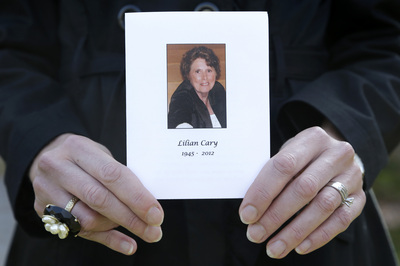
Jill Bloser, 43, of Charleston, S.C., holds a photo of her mother from a memorial service Tuesday in Howell. Lilian Cary, 67, of Howell Township, died Sept. 30 from fungal meningitis.
Paul Sancya | The Associated Press
In Michigan, four facilities received shipments of the contaminated steroid, including Michigan Pain Specialists in Brighton.
A number of physicians that practice at St. Joseph Mercy Ann Arbor also privately practice at the Brighton facility, said Dr. Lakshmi Halasyamani, chief medical officer for St. Joseph Mercy.
Any pain injections the physicians may have given were administered at the Brighton facility, Halasyamani said.
"We at MPS express our deepest sorrow regarding this tragedy and are greatly saddened that some of our patients have been affected. ... Our primary concern is patient safety," the clinic said in a statement. "All injections were administered in a sterile environment under strict protocols. We had no reason to believe the medication we administered was tainted."
Hospitals in the Ann Arbor area have treated the majority of the fungal meningitis cases in Michigan linked to the nationwide outbreak connected to the batch of contaminated steroids.
“We continue to admit patients that we suspect may be connected,” Halasyamani said.
The patient who died after treatment at St. Joseph Mercy Hospital died in hospice care after not responding to treatments for bacterial meningitis, Halasyamani said. The patient was admitted to St. Joe before hospital doctors were aware of the fungal meningitis outbreak, Halasyamani said.
“The fungi that are being isolated are very rare to cause human meningitis,” Halasyamani said. “Our collective medical experience nationally is very limited. This is a type of meningitis almost no one nationally has ever cared for.”
Halasyamani said doctors at St. Joseph Mercy are reaching out to national experts for guidance.
Meningitis is the inflammation of the tissues surrounding the brain and spinal cord. Fungal meningitis is rare and is not contagious.
Patients could only contract meningitis from the contaminated steroid if it was an epidural administered for back pain. Patients who suspect they may have received such injections of the contaminated steroid should seek evaluation immediately, Halasyamani said.
Patients who received injections of the contaminated steroid for joint pain are only at risk for a fungal infection and do not require emergency evaluation. The notification for those patients is still ongoing, health officials said.
The University of Michigan Health System is continuing to treat one patient whose illness is linked to the fungal meningitis outbreak, said Pete Barkey, director of public relations for the health system.
The patient was admitted last week, Barkey said. The number of cases at the health system has not increased as of Tuesday, Barkey said.
One of the deaths in Michigan occurred at the U-M hospital in late September, Barkey said Monday. Though U-M would not identify the person that died, the Associated Press reported Lilian Cary, 67, of Howell Township died Sept. 30 from fungal meningitis at the U-M hospital.
The third person who died is a 56-year-old Genessee County woman.
Amy Biolchini covers Washtenaw County, health and environmental issues for AnnArbor.com. Reach her at (734) 623-2552, amybiolchini@annarbor.com or on Twitter. The Associated Press contributed to this report.
Comments
BhavanaJagat
Wed, Oct 10, 2012 : 7:05 p.m.
The Risks of Steroid Treatment : It is unfortunate to read about the death of this 78-year-old lady who died of Bacterial Meningitis following the Steroid Therapy. It is stated that this elderly patient had failed to respond to drugs used to treat her bacterial infection. In elderly population there is always this risk associated with an immune system function that may not be optimal. Antibiotics used in treating infections work better if the patient has an immune function that is in good shape. Her failure to respond to antibiotics that may have been used is shaped by her exposure to Steroid Therapy prior to the onset of this infection. Her story suggests that she got this bacterial infection and its virulence got aggravated by the suppression of her immune system by the Steroid Therapy. I would continue to seek answers for the use of Steroids in such elderly patients.
Milton Shift
Wed, Oct 10, 2012 : 12:08 a.m.
Clearly, regulation is the problem.