

Michigan's texting ban takes effect today: Will it reduce crashes?
Eastern Michigan University student Sarah Kennedy admits she texts on her iPhone while she drives.
But starting today, texting while driving is illegal and could cost her $100 if she’s caught - a fact the 19-year-old is less than thrilled about.
“They could say you’re texting when you’re really not,” Kennedy said. “It’s going to be ridiculous to enforce.”
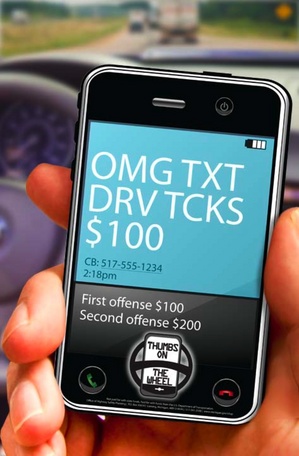
To encourage awareness and compliance with the new law that bans texting while driving, the Michigan Office of Highway Safety Planning launched a "Thumbs on the Wheel" campaign that features billboards, public service announcements and posters like this one.
Photo courtesy of the Michigan Office of Highway and Safety Planning
Marijane Sweeney, 56, on the other hand, is thrilled with the statewide measure. The Ann Arbor resident has four grown children - and their texting habits drive her crazy.
Sweeney, who doesn’t text and drive, said she think younger people don’t realize the danger they put themselves and others in on the road when they text.
“I think it’s fabulous,” she said of the law.
As police agencies across the state prepare to enforce the new measure, many questions have arisen - such as whether drivers can text at red lights and how officers can prove a driver was texting.
Whether the law will be easy to enforce - and whether it translates into fewer crashes - remains to be seen.
The law says reading, typing or sending a text or e-mail on any wireless two-way communication device behind the wheel is illegal, with a few exceptions for law enforcement and other first responders.
Texting and driving is a civil infraction that carries a first-time $100 fine and $200 in fines for subsequent violations.
To get the word out on the texting ban, officials at the Michigan Office of Highway and Safety Planning have launched a “Thumbs on the Wheel” advertising campaign.
Billboards are already up, posters have been distributed and public service announcements will run on cable and local stations from July through August, said Anne Readett, communications manager for the agency, which has received federal funds to run the campaign.
At the Michigan State Police post in Ypsilanti, a poster on the door reads: OMG TXT DRV TCKT $100.
That poster prompted one man who walked into the station to lament his teenager daughter sent 8,300 texts last month - and spent only 12 minutes actually talking to her friends, Michigan State Police Trooper Todd Etue said.
Etue he frequently sees both teens and adults texting on the highways, often with “both hands on their cell just going bananas,” while they drive with their knees. He said it isn’t unusual for these drivers to illegally cruise along in the left lane or perhaps pass on the right, so distracted they don’t notice his squad car trailing behind.
That kind of behavior on the roads causes accidents, Etue said.

Sarah Kennedy, 19, of Ann Arbor, doesn't approve of the new ban on texting while driving.
Lon Horwedel | AnnArbor.com
State crash data shows 947 people were using cell phones at the time of a crash in 2009, although that data doesn’t differentiate in those instances whether a driver was texting or talking at the time of the accident. A total of 290,978 crashes were reported statewide last year.
The new state law doesn’t outlaw some cell phone behavior - including talking or reading publications on a wireless device. Drivers also can still look at directions on a GPS device if it’s affixed to the vehicle.
And texting is only illegal while the vehicle is moving, the law states.
Like the seat belt law, enforcement will be visual, Etue said.

Ann Arbor resident Marijane Sweeney, 56, favors the statewide measure but wonders whether it will reduce crashes.
Lon Horwedel | AnnArbor.com
He and other officials anticipated police likely will issue the new citations primarily following accidents. But they also say crackdowns on texting and driving may get the point across.
“I will almost guarantee that just like ‘Click it or Ticket,’ they’ll put someone standing on the corner, with officers waiting down the road, and they’ll call it over the radio, ‘Hey, blue Chevy, four-door, female driver texting,” Etue said. Law enforcement agencies can’t subpoena cell phone records if the ticket is challenged in court, unless a separate criminal element like drunken driving was involved in the stop, Etue said.
Officers can ask drivers to show their phone when they’re pulled over, but the driver must consent.
State bans on texting and driving have been gaining steam in recent years.
Michigan is the 28th state to ban texting while driving in the last three years, said Jonathan Askins, spokesman for the Washington, D.C.-based Governors Highway Safety Association. The nonprofit represents the interests of state highway safety agencies and counts the Michigan Office of Highway Safety Planning among its members. The District of Columbia also has a ban in place.
In anticipation of the statewide ban, the Ann Arbor City Council put a more comprehensive local ordinance banning cell phone use in vehicles in the city on hold.
Ann Arbor Mayor John Hieftje said he’d like to see the local measure tabled permanently.
Texting while driving
“I don’t think we need to bring it up again now that the state has taken some action,” Hieftje said. “I’ve always felt it should be a state action, rather than a local action.”
The purpose of the statewide ban, lawmakers and police say, is to reduce accidents resulting from distracted driving. But whether bans are effective has been debated at the state and national level.
A January study by the Arlington, Va.-based Insurance Institute for Highway Safety called into question the effectiveness of bans on handheld cell phone use while driving, though it did not specifically study texting while driving.
The study showed no impact on vehicle accident levels in four U.S. jurisdictions that carry bans on handheld cell phone use while driving, said organization spokesman Russ Rader.
While cell phones clearly distract drivers, the data showing whether the laws address the problem is less conclusive, he said.
Other studies have linked texting and cell phone use while driving with car crashes.
The National Safety Council released a study in January that blamed 28 percent - or 1.6 million - crashes a year on drivers using cell phones and texting.
Juliana Keeping is a reporter for AnnArbor.com. Reach her at julianakeeping@annarbor.com or 734-623-2528. Follow Juliana Keeping on Twitter
Comments
Lucky Duck
Sun, Jul 18, 2010 : 7:04 p.m.
Will it reduce crashes? Yes.
walker101
Sun, Jul 4, 2010 : 5:48 a.m.
Think cell phones aren't dangerous while driving? Read this link, just one of many that are being posted new every day. As a former safety investigator for a large utility in California we had a large reduction of minor and some major incidents while employees were banned from cell use while driving. www.operationstop.com/teendriversandcellphones.shtml
KJMClark
Sat, Jul 3, 2010 : 8:45 a.m.
Kathryn has it right. Driving is a privilege. If you have to take your attention off of driving the car to do something, you shouldn't be doing it. I know it's a bummer to have to sit there and drive without anything fun to do, but that's life. Really, the fine should start at $100 and one point on your license, and rise for repeat offenders. Something like $500 for the second offense within two years, $1000 for the third, and revoke your license for the fourth. If you look at the methodology of those IIHS studies, you won't be as impressed. Their method of counting motorists doing things like texting and using a cellphone is to have people stand on street corners and look for the behavior. Their earlier study on cellphone use found a huge reduction in cellphone use in states that banned cellphone use while driving, but very little reduction in crashes. The problem? They didn't look for people using hands-free cellphone equipment. So people who went out and got a bluetooth headset (or even a plug-in for that matter) and jabbered and crashed away just as much, were counted in their study as not using a cellphone. I would expect a minor decrease in crashes from this. That's because the people who would do it in the first place don't understand how dangerous they are and aren't really responsible enough to have a driver's license yet. They'll just put a tv in the car, read a book, or do something else to deal with the boredom. Some people seem to need to crash a few times before they realize they're not in a video game, cars really are dangerous, and it's *really* expensive to get in a crash. It's too bad we can't put them on a track and let them get it out of their system somewhere other than the public roads.
KathrynHahn
Fri, Jul 2, 2010 : 3:17 a.m.
Back when I took "drivers ed" we learned to drive with *gasp* two hands on the wheel. Driving was a privilege earned, not a right. It seems like as we've gained technology, people are too "bored" to just drive, they must be in constant contact with friends/social networking etc... Personally I like the quiet time in my car when I don't have to answer the phone. If my cell does ring, if it seems important enough I'll pull over in the first available place, distracted driving is deadly driving.
Katie
Thu, Jul 1, 2010 : 9:49 p.m.
The fine is not enough, anyone ticketed for this should have to pay progressively higher insurance rates as well. Anyone that thinks that they can text and drive safely, needs to drive behind themselves to see the real truth. Hope they ban anything but hands free use of a phone behind the wheel. Nothing you have to say, or anyone has to say to you is that important.
Jon Saalberg
Thu, Jul 1, 2010 : 8:57 p.m.
Here is an article that describes how texting is more dangerous than driving under the influence: Texting Article
LaMusica
Thu, Jul 1, 2010 : 7:52 p.m.
Moon--I think that's a good idea. Not only make it a fine, but increase the penalty when you hurt someone, just like construction workers. Bill--so glad to hear you are recovering from this. Speedy recovery and well wishes!
Skeet
Thu, Jul 1, 2010 : 6:26 p.m.
it will reduce crashes because the people who text all of the time will be forced to pay attention or pay money. You really can't show proof that you weren't reading a text, so the judges are not going to let you off of this one. If you are going to be in the car for a while, just pull over when your phone starts playin' Boom Boom Pow and you will have nothing to worry about!
garrisondyer
Thu, Jul 1, 2010 : 4:20 p.m.
JSA is on the right track here. A few friends of mine got $200 tickets for jay-walking in california a few days ago. Did it affect our decisions on whether to jay-walk or not for the rest of the weekend? You bet it did! Having a high price tag on the ticket is the key here, if the goal is to curb the behavior. I personally think it's a great idea to ban texting, although I'm skeptical on how it will be implemented.
Bob Needham
Thu, Jul 1, 2010 : 3 p.m.
(comment removed because of a personal attack)
treetowncartel
Thu, Jul 1, 2010 : 2:28 p.m.
Does this apply to boating?
Macabre Sunset
Thu, Jul 1, 2010 : 12:59 p.m.
When I first started driving, MADD was a brand new organization. It grew enormously very quickly, which in the days before Algore invented the internet was quite unusual for a grassroots organization. Before MADD, we had these same discussions over drunk driving. In the same manner many of you claim you can text and drive safely (the deaf woman, Dreama's, comments are horrifying), people claimed they could hold their liquor and drunk-driving laws wouldn't help in the slightest. We used to have the drunk weave - you see a car weaving on the road at an odd speed, which meant the occupant had just left a bar. Now we have the cell weave. This does seem to be an illustration of the nanny state in action, though. Maybe MADD is partially to blame. Rather than banning cell use while driving or alcohol use while driving, we should have a law that states if you cause an accident and your BAC is over.08 or you were using your cell phone, then the accident should be considered gross negligence and subject to criminal penalties. In other words, if there is an accident and the police officer suspects distracted driving, then cell records could be accessed, the same way we test blood alcohol content today when drunk driving is suspected in an accident.
Moonmaiden
Thu, Jul 1, 2010 : 12:58 p.m.
Marvin, Marvin, hope you're not on the night shift now... Bill, you really have my sympathy; I hope you do fully recover. Your story in an excellent example of what can happen. we've now heard from the deaf, can the blind be far behind? Ironyinthe sky2 said it very well and JSA made an excellent point that the fine should be significant - $1,000 is a good start, but how about raising it to $10,000 if someone is injured (same philosophy as with highway workers)? It depresses me to see so many people defending the practice. Get well, Bill!
Bill
Thu, Jul 1, 2010 : 12:36 p.m.
I was hit while riding my motorcycle in March, by a 22 yr old girl texting on her phone. I'm still recovering, but I'm alive and in one piece. It was almost a headon collision as she came into my lane and didn't even try to serve back, I turned to get off the road and she hit me in the front corner. I'm thankful to be alive, she's thankful she was able to finish her text. Classic excuse "I didn't see him", "I didn't even know what I hit". Could it be because she wasn't even looking at the road? Duh. It bothers me that we can accept an excuse like that.."Oh well, she didn't see him, that makes it ok." SHE CAME ALL THE WAY INTO MY LANE! ALMOST KILLED ME! Because she didn't know what she hit, she continued on till her tire went flat....left me in the ditch. I do think a $100 fine is too low, I would prefer we hang them from the nearest tree...
Marvin Face
Thu, Jul 1, 2010 : 11:20 a.m.
I don't see the big deal. I'm texting this while driving right now and nothi Sent from my iPhone
JSA
Thu, Jul 1, 2010 : 11:06 a.m.
Let's make it a $1,000.00 fine. That might encourage the offenders to stop. I'm tired of have to dodge self centered drivers texting and talking on their cell phones and oblivious to the conditions on the road.
Dreama
Thu, Jul 1, 2010 : 10:56 a.m.
I also use my hands to communicate with my daughter while driving. What is the difference between signing and texting? They are the same because the deaf people know how to driving because their visions are reliable.
Dreama
Thu, Jul 1, 2010 : 10:49 a.m.
I do not approve the law! I have been texting while driving for almost 10 years. Have I ever once crashed because of it? Never. I absolutely am offended by this. They allow the people to continue to use their cell phone while I can't text to communicate with my daughter's dad or friends? I am profoundly deaf and can't make any phone calls. Statistics show that Deaf drivers are actually safer drivers then hearing drivers. They did not aware that the deaf drivers have better visions. They are more observant and aware of the things going on around them.
David Bardallis
Thu, Jul 1, 2010 : 10:49 a.m.
My thought is it will either have no effect or possibly cause more problems, because now people who are fiddling with their phones will be further distracted by also trying to keep an eye out for a cop car. I have a problem with this because my phone is also my navigation tool. Will I get pulled over for looking at the map on my phone because some cop now thinks I'm "texting"? As usual, the nanny state mentality will just create more hassles while not solving the problem it believes it is addressing. Another bad law.
amazonwarrior
Thu, Jul 1, 2010 : 10:42 a.m.
One can only hope that the new law will reduce the accident rates. But, if people want to continue texting while driving, they will figure out a way to do it and not get caught. I have seen numerous ADULTS texting while driving, so lets not single out the teenagers and twenty-somethings we see glued to these gadgets. The worst incident I think I have seen was two guys on the expressway, with the DRIVER texting and his passenger steering the car! If that wasn't an accident looking for a place to happen, I don't know what is. Good luck to the law enforcement agencies trying to enforce this new law.
RobRoy
Thu, Jul 1, 2010 : 10:31 a.m.
This law is almost impossible to enforce consistently--it's designed to generate revenue. Frankly, there shouldn't be ANY phone use while driving...texting or speaking. They all impair your ability to focus while driving. Unlike one of the posters here, I don't think teens are being unfairly piled on here. There is a reason why car insurance rates for that age group are higher than most--they are involved in more car accidents. @Eyeheart2--I agree -- people who say "um" or "like" should be cited...lol
uawisok
Thu, Jul 1, 2010 : 10:29 a.m.
Texting while driving is irresponsible, if you cause an accident and someone get seriously injured you are now liable for $$ damages and negligent homocide if death occurs. That will bring jail time, driving is a huge responsibilty and should be taken seriously!!
Hmm
Thu, Jul 1, 2010 : 10:01 a.m.
In one word, no.
Larry White
Thu, Jul 1, 2010 : 9:56 a.m.
It is my experience that it is the attentive driver avoiding cell phone users that reduces accident. Are there fewer drunk drivers on the road because it is illegal? Those who respect the law will observe it.
Kristin Judge
Thu, Jul 1, 2010 : 9:46 a.m.
Read my blog about this topic from yesterday. http://kristinjudge.wordpress.com/ There is a video that will haunt you for a long time if you have any compassion at all. Don't think the new law matters? Here is a statistic from the NTSB: Chairman Deborah Hersman of the National Transportation Safety Board had this to say in a press release about the problem, The number of people killed by drivers distracted by the use of electronic communications device is equivalent to a major aviation accident every week. Our country would not accept that kind of a toll in airliner deaths, why should we tolerate it when it happens in ones and twos on our roadways?
V-Rex
Thu, Jul 1, 2010 : 9:41 a.m.
Some people will stop because of the law, but since all of the people texting are engaged in risky behavior and most of them know it, most will continue to text. It will make a very small difference. The law should be national and should be directed toward communications providers. Most of these high content devices have GPS location and navigation. The system could easily be programmed to disable any device moving faster than walking speed (5 or 6 miles per hour). We have the technology, but the providers have the stronger lobby. As usual, we do not ask the right questions about solving our problems.
justcary
Thu, Jul 1, 2010 : 8:49 a.m.
Crashes will continue with slight reductions. Anyone who has paid attention to the research (Legislators have NOT or are pretending they haven't) knows that talking with people not in the vehicle is a wholly different matter than talking with someone who is with you, and is a serious handicap equivalent to driving under the influence. Just maybe they'll get buy-in on this, and can go for the harder pill to swallow: a ban on phone use in cars. Hands free or not. So am I voluntarily ceasing to talk on my phone in the car? Yes if family is in the car; no if I'm alone. Anyone who has talked with me on the phone knows my catch-phrase, "hangongottadrive" and they wait for me to get to a clear area.
marzan
Thu, Jul 1, 2010 : 8:34 a.m.
I'm very happy about this ban. Hopefully it will serve as a wakeup call that texting while driving is totally unacceptable. You have to take your eyes off the road for a long time to text. People should push to make it socially unacceptable too.
LaMusica
Thu, Jul 1, 2010 : 8:21 a.m.
EyeHeart: :) I was hoping that was the case.
SonnyDog09
Thu, Jul 1, 2010 : 8:07 a.m.
The headline states that the law bans "texting", which I always assumed meant actually typing a text message on your phone. But, the article states that simply reading a text message or email on your phone is also against the law. I can see checking the log on the phone to see whether I sent a message, but how do I prove that I did not read a message on my phone?
meetchro
Thu, Jul 1, 2010 : 8:01 a.m.
I think it's at least a step in the right direction. I can't count the number of times I've almost been side swiped, rear ended or hit head on by a driver texting. Only my alertness saved me. Whether or not we can see results...we'll have to wait and see. Here's a question: The law says you cannot text/email, etc. while the vehicle is moving. Does that mean that one can text/email at a stop light/sign? Or do they mean the vehicle must be parked, not simply idling? I know all CDL holders are not allowed to text/email at all (even while at a stop light) while in their vehicle or risk a fine upwards of $2,000...
lumberg48108
Thu, Jul 1, 2010 : 7:57 a.m.
Walking EMU's campus and downtown Ypsi on a daily basis I have already come to terms with the fact a 20-something co-ed is going to kill me as she texts while I walk with proper direction from the street signals? Why do I know this? Cause it happens almost every day!!! I dodge, duck and weave as they focus on their phone, oblivious to their surroundings. They nearly cause a crash from behind and from the front - and when you dare point out to them they should focus on the road - they retort with a nice F-U... My only request, when one kills me and they run home to daddy and daddy tells us how they are a "good girl" who learned her lesson and should not do jail time... TOO LATE! Now is the time parents should be telling teens that they should focus on the road - with the same emphasis we used to curtail drunk driving 20+ years ago... Folks - its just a matter of time before I am killed by one of these teens or early 20s female drivers...
xmo
Thu, Jul 1, 2010 : 7:54 a.m.
I think that they should ban radios, children,pets,food,drinks, navagation systems and passengers in a car because they cause distractions which could cause accidents! Just think how many accidents we could stop if we stopped driving altogether? A little food for thought!
Soothslayer
Thu, Jul 1, 2010 : 7:44 a.m.
Anything that distracts the driver from their task is very dangerous. Unfortunately texting is only a small part of self inflicted driver distraction I witness on a daily basis. I'm guessing a main reason officers get when interviewing drivers of crashes is "I didn't see (the car slowing down, the light was red, the stop sign, the car pulling out, etc)" and I must believe them. The probably didn't see it because they were looking and paying attention elsewhere. This is the tip of the iceberg.
LaMusica
Thu, Jul 1, 2010 : 7:34 a.m.
EyeHeart, I hope you're being sarcastic, otherwise that is quite a gross overgeneralization. Also...here's a study that found that adults text more than teens: http://tinyurl.com/2e45feu.
Forever27
Thu, Jul 1, 2010 : 7:24 a.m.
multiple studies have shown that texting while driving is MORE dangerous than driving drunk.
Forever27
Thu, Jul 1, 2010 : 7:21 a.m.
@Dave66, I have a question for you, if you realize that the government needs more money, why are you opposed to having it come from you? You are a citizen and are an equal beneficiary of government services, what makes you so special as to not have to help fund the services?
Rasputin
Thu, Jul 1, 2010 : 7:11 a.m.
Common sense is an oxymoron.
Rasputin
Thu, Jul 1, 2010 : 7:09 a.m.
Yes, it will. At first, most will skirt the law and just ignore it, but if the Police crack down and actually enforce the law, it will be a wake up call for most. Texting, while a serious temptation for us all, will cause you to crash your vehicle sooner or later. It is just a matter of time and if you're unlucky, you'll hit a person or an animal. Please, enforce this law!
Jon Saalberg
Thu, Jul 1, 2010 : 7:03 a.m.
What this comes down to is common sense, which many people do not have. Driving a car is the purpose of driving a car. Sounds simple, yet many people talk on cell phones, text, smoke, or eat while driving. Better yet, some do more than one of these at a time. I find it appalling when I see someone talking on a phone and smoking at the same time - who's holding the steering wheel? If you don't want to contribute to the revenue enhancement stream, don't text while driving.
LaMusica
Thu, Jul 1, 2010 : 6:48 a.m.
I doubt it will make a difference since people will still do it, even if they get tickets. People who get speeding tickets still speed. I just think it's sad this had to be a law, and common sense isn't enough...should I barrel down the road at 60mph in a 1000 lb hunk of metal and bother to watch the road? No way, I just HAVE to see what my friend just texted me! *smh*
GoblueBeatOSU
Thu, Jul 1, 2010 : 6:44 a.m.
It'll raise more money for the man, except from me. I don't have text capabilities on my phone so the man can't get me on this one.... "The purpose of the statewide ban, lawmakers and police say, is to reduce accidents "....that is nice to say...but it is all about raising revenue and taking money from the little guy.
ironyinthesky2
Thu, Jul 1, 2010 : 6:18 a.m.
No, it won't make a dfference. This law is as necessary as one that would require us open our eyes while driving. Those who have to be told will not get it.
Dave66
Thu, Jul 1, 2010 : 6:09 a.m.
My prediction is that it will have no effect whatsoever. People who are stupid and irresponsible enough to text while driving aren't going to let a little thing like a new law stop them. People who weren't texting before are still going to be not texting. So... No effect. It just opens up a new revenue stream for the state because now they can write a few tickets. I suppose that's OK. The government needs more money, and I don't care how they get it as long as it's not from me.
walker101
Thu, Jul 1, 2010 : 6:07 a.m.
I believe the 19 year old, she has plenty of experience... It should of been mandatory that anyone in any motor vehicle accident would have to show proof that the phone was in use or not if in the vehicle.
dading dont delete me bro
Thu, Jul 1, 2010 : 5:28 a.m.
"Will it reduce crashes?" nope.