

Residents react to proposed cell phone ban in Ann Arbor
Sally Vermaaten doesn’t drive but thinks the Ann Arbor City Council is heading in the right direction with its plan to ban motorists from texting or using handheld cell phones while behind the wheel.
"As a pedestrian, I've nearly been run over by several people on their phones as they're trying to turn right," said Vermaaten, a University of Michigan graduate student. "It sounds like it could be a mechanism for deterring people (from situations like those)."
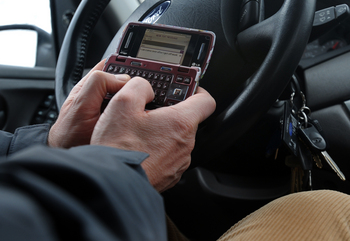
Using your cell phone while driving in Ann Arbor may soon cost you $125 under a proposed ban working its way through City Council.
Lon Horwedel | AnnArbor.com
The City Council on Tuesday approved the first reading of a new city ordinance that would impose a $125 fine on people ticketed for using cell phones and similar devices while driving or bicycling. The measure still requires final approval and will come before the council again in March.
"This is a major public safety issue, and I think we've all experienced at one time or another while driving, seeing somebody else who wasn't paying attention because of their cell phone," Council Member Stephen Rapundalo, D-2nd Ward and the sponsor of the bill, said Tuesday.
In addition to chatting on a handheld cell phone or texting, the ban would apply to punching in an address on a global positioning system or using the Internet, among other activities. The ban would not apply to hands-free devices, such as phones with Bluetooth headsets. It would also not be be illegal to use handheld devices during emergencies.
Around town Wednesday, the reaction was mixed.
"I think people can pay attention to what they're doing and talk at the same time," said Greg Grieco, an Ann Arbor resident. "Cell phone use I could probably live with, but texting is out of the question."
Ann Arbor resident Sylvia George said she agrees with the ban - not the fine.
"I think $125 is too steep - you're going to be targeting a lot of kids," George said. "But do I think people should drive while texting? Oh no."
"Talking on the phone is bad, too - especially in a city."
As for using a GPS device? "I don't know how much concentration a GPS takes. I haven't used one," she said.
Ann Arbor resident David Widmayer said the ban fails to address the larger problem: distracted driving.
"Demonizing electronic devices is just one way to create an illusion of safety without actually reducing the number of accidents," he said.
There has been much debate nationally and at the state level on the issue.
A recent study by the Arlington, Va.-based Insurance Institute for Highway Safety has called into question the effectiveness of bans on handheld cell phone use while driving.
The study, released Jan. 29, showed no impact on vehicle accident levels in four U.S. jurisdictions that carry bans on handheld cell phone use while driving, said the organization's spokesperson, Russ Rader.
The study by the Highway Loss Data Institute, an affiliate of the IIHS, compared insurance claims for crash damage in New York, the District of Columbia, Connecticut and California before and after such bans.
"We have found no effect on crashes in those place since they enacted handheld cell phone bans for drivers," Rader said.
"There are still a lot of things we don't know," he said. "But I think the summary of where the research is now, is that clearly, drivers are distracted by phone conversations, and certainly by texting and driving. The question is whether any of these laws are going to be effective at addressing the problem."
The IIHS, a nonprofit funded by automobile insurance agencies to find ways to reduce crashes, has not conducted studies on texting while driving, he said.
On Jan. 12, the nonprofit National Safety Council released a study that blamed 28 percent - or 1.6 million - crashes a year on drivers using cell phones and texting.
The Washington, D.C.-based Governors Highway Safety Association is encouraging states to pass bans on texting while driving instead of bans on talking with a handheld device while driving, given the recent research that questions the effectiveness of those bans.
The organization, a nonprofit that represents the interests of state highway safety agencies, discourages cities from passing their own bans. It counts the Michigan Office of Highway Safety Planning among its members, said Jonathan Adkins, the group's spokesman.
"We don't advocate for cities to pass their own laws," Adkins said. "It's very hard to enforce. You don't have money to do any education or paid media around the law, and typically the laws don't have much impact. It's better to have a state-wide initiative."
A batch of seven bills are circulating the state Legislature that address either texting or talking on cell phones or using electronic devices while driving, said Anne Readett, communications manager at the Michigan Office of Highway and Safety planning.
Currently, six states, the District of Columbia and the Virgin Islands have passed laws prohibiting all drivers from talking on handheld cell phones while driving, and 19 states, the District of Columbia and Guam have passed bans on texting while driving, according to data from the GHSA. A host of local jurisdictions have their own bans on handheld cell phone use and/or texting, while eight states have laws that prohibit local jurisdictions from passing such laws.
Ann Arbor Mayor John Hieftje told the City Council on Tuesday that it shouldn't rely on the state to solve the problem.
"If anyone had the idea of waiting for the state to do something on this, all we have to do is take a look at what happened with smoking," Hieftje said.
Staff reporter Ryan Stanton contributed to this report. Juliana Keeping covers higher education for AnnArbor.com. Reach her at julianakeeping@annarbor.com or 734-623-2528.
Comments
The Old Moose
Wed, Mar 3, 2010 : 9:51 p.m.
Please read the following short article on the ARRL.org web site: National Safety Council Responds to ARRL: No Evidence of "Significant Crash Risks" While Operating Mobile http://www.arrl.org/news/stories/2009/09/11/11067/?nc=1 The article also gives a couple of links to the text of the National Safety Council response and a Policy Statement issued by the ARRL, which includes sample language for any cell phone ban being considered by legislative bodies. It seems the major distractor in cell phone conversations is the simultaneous full-duplex nature of the call, where you are listening for interruptions by the caller while you are talking, and vice versa. Two-way radio communications (taxicab, CB, police/fire, etc) are all conducted in half-duplex. You press the push-to-talk switch and during the time you are talking, you do not have to deal with interruptions from the other end. I guess it is one less multi-task you have to deal with, but this may explain why going hands-free for cell phone conversations in some jurisdictions has not reduced related traffic accidents and deaths.
Snarf Oscar Boondoggle
Mon, Feb 22, 2010 : 3:32 a.m.
i made an earlier commment that i now wish to revise. i said ban texting, maybe; ban cell phones, no. as i re-read my commment it became more clear to me that texting is far too much of a distraction, while -moving- than should be acceptable. so, ban texting. as for cell phones, they can be used both stopped and moving w/o that much distraction IFF there is a competent and mature user behind the wheel. cops would need to 'profile' the driver (in motion) to warrant effecting a stop. cops 'profile' driving/drivers all day/night long. they can filter out the dum-dums on a case by case basis.
KJMClark
Sun, Feb 21, 2010 : 9:53 a.m.
This is a great idea, and long overdue. It really ought to be a national ban, since this problem applies nationwide. There's a fairly obvious explanation for the IIHS study results, and the IIHS themselves point out the answer - people simply switched to hands-free phones. Other studies point out that the phone conversation is the majority of the distraction, so switching to hands-free phones shouldn't result in a big change in crashes, even though they saw a big decrease in people holding phones while driving. Check their website - they have no idea when someone is using a hands-free phone. Their survey of phone use has people standing at intersections looking for people with a cellphone in their hand while they're driving. And don't expect to find information on cellphone use in crash data either. Unless there's a place to code that on the form, it won't get coded, and even then the person driving would have to admit that they were doing it. Otherwise the police would have to ask the phone company for their records after the fact. It most certainly should apply to bicyclists. It really ought to apply to pedestrians while crossing streets as well. It's already illegal for bicyclists to carry anything that makes them have a hand off the handlebars. Anyone who needs to make or take a phone call should pull over until they're done.
snapshot
Fri, Feb 19, 2010 : 5:40 p.m.
Lots of disagreement with this law, which I agree with based upon my driving experience. I would also recommend higher insurance rates and a declaration on the insurance app as to cell phone use when driving. Any accident or moving violation would require a check of recent cell phone use. A discount would apply for us non cell users. There's plenty of incompetant, discourteous, and otherwise distracted drivers on the road as it is, particularly those that just don't think traffic laws apply to them. Why add to the eating, make up, drinking, radio, etc. which are unsafe practices also but throw in a phone call and you run out of body parts to accommodate all those tasks. What's going to be a surprise for all you phone users is that black box you don't know your newer vehicle has that will tell the exact time and speed of your vehicle at the time of the accident. That way authorities can check your cell records including recordings of the conversations. In a serious accident, I wouldn't want to be a cell user under those conditions.
Jack Gladney
Fri, Feb 19, 2010 : 3:30 p.m.
So can I read a paper map while driving in Ann Arbor? What about obese people who have to eat while driving (major distraction)? What about women who put on make up while driving (major distraction)? What about changing radio stations or CDs while driving (major distraction)? The revenue possibilities are endless. How about hiring traffic cops just to monitor traffic lights in a town where a yellow/red light is just a suggestion?
Griffen
Fri, Feb 19, 2010 : 2:34 p.m.
@ RoboLogic, Not quite! GPS is for people who are environmentally conscious and refuse to drive aimlessly around a city comprised of confusing one way streets wasting gasoline!
Go Blue
Fri, Feb 19, 2010 : 9:19 a.m.
Is anyone paying attention to the logic (or lack of)? Reduce the police staff and add more laws for the remaining few to try and enforce? The police cannot even keep up with the rampant speeding in A2. The posted speed limit has come to mean at least 10 mph higher and that is going slow. Try crossing a street. Just try driving the speed limit or slightly over it - you all but get run over. If the police cannot even make the streets safer why on earth do they need yet another law to try and enforce? Yet again something to distract from the critical issues they have to contend with and another side issue for council to try and distract citizens attention away from far more important issues.
Paul
Thu, Feb 18, 2010 : 8:35 p.m.
There is no need for a cell phone ban. It's ridiculous that the police are going to waste their time with this sort of thing as budget cuts are reducing patrols. Ann Arbor cannot legislate an end to the lack of common sense that seems to define the people who reside in the People's Republic of Ann Arbor, and who think they're entitled to talk on their cell phones all day long. I can imagine the 15th District Court wasting value resources to entertain whining from people who violate the cell phone ban and end up in front of the Magistrate. Michigan already has plenty of laws that address the behavior being discussed with the cell phone ban. Careless Driving has been on the books for decades. MCL 257.626b defines careless driving as; "A person who operates a vehicle upon a highway or a frozen public lake, stream, or pond or other place open to the general public including an area designated for the parking of vehicles in a careless or negligent manner likely to endanger any person or property, but without wantonness or recklessness, is responsible for a civil infraction." That is what the police need to enforce. If someone drives badly and their driving is likely to endanger others, enforce existing laws. What will Ann Arbor ban next, listening to the radio?! The police don't need to waste their time with these petty issues. It's ironic that the city made famous for condoning dope smoking makes war on cell phones.
stunhsif
Thu, Feb 18, 2010 : 8:23 p.m.
@jcj, my threat of not coming into A2 to do business is anything but a hollow threat. I live between A2 and Saline. When I dine out I frequently go to A2 as well as Saline,Ypsilanti and the new restaraunt in Milan. Rather than shop at Meijer in A2, I will shop at Meijer in Ypsi or Walmart in Saline. Saline,Ypsi and Milan are all within a stones throw. This passes and my entertainment dollars and grocery dollars go anywhere but A2. I never go downtown A2 anymore because parking is a joke!
RoboLogic
Thu, Feb 18, 2010 : 8:15 p.m.
While we are at it.....GPS is for dummies who cant find their way.
jcj
Thu, Feb 18, 2010 : 6:35 p.m.
stunhsif Give me a break! Do you expect anyone to believe that you will drive to Dexter? Chelsea? Ypsilanti? Saline? to do your shopping because you would be afraid of getting caught on your phone?? I sure hope this doesn't pass because the city could not stand the exodus of law abiding folks like you! Another hollow threat.
Awakened
Thu, Feb 18, 2010 : 6:25 p.m.
Maybe next week they can pass a law banning people who don't cover their mouths when they cough or sneeze. How many people have been injured this way. Think of the loss of productivity! Its like an epidemic. $125 tickets would discourage this behavior.
stunhsif
Thu, Feb 18, 2010 : 5:46 p.m.
If this passes A2 will have one less person along with his family that will spend money in the city. I live on the outskirts of A2 and will not risk getting a ticket because I am on my phone. The city will lose more tax money than it raises in giving out tickets. Dumb dumb proposal.
Ryan D
Thu, Feb 18, 2010 : 4:03 p.m.
At minimum, this needs some adjustments: (1) It shouldn't apply to bikers. The potential harm caused by a bike vs a car/trunk/etc running off the road is significantly different. Cars could hurt a lot of people. If a bicycle goes off the road they are more then likely to just hurt themselves in the crash. (2) It needs to be careful so as not to preclude the use of GPS navigation. For example, I regularly use my smartphone's GPS map to navigate around other cities (and would expect visitors to Ann Arbor to do the same). It would be easy for enforcement officers to confuse the use of a GPS map with a phone call or sending a text message. This would lead to either to upset people or to an unnecessary negative influence on helpful technology.
a2cents
Thu, Feb 18, 2010 : 3:49 p.m.
It may be messy, but Darwin will take care of cyclists using phones & players while pedaling (joggers & peds, similarly). Larger vehicles on the other hand are a threat to all. Just encountered a distracted-driver incident this afternoon, thankfully no injuries. A year ago my truck was tail-ended by a woman who admitted she was on her phone (blamed me because I was sitting at a light behind other vehicles... $3500 damage, only metal & plastic harmed) Imagine: sitting behind a vehicle on a bicycle waiting for a light to change (the bike lanes end at major intersections) when...
Lokalisierung
Thu, Feb 18, 2010 : 3:18 p.m.
"I believe the AAPD can enforce traffic on the central campus streets. So the situation could arise where an AAPD officer could write this citation on a street on campus where a UMPD officer couldn't, since its a city ordinance and UMPD does not enforce AA ordinances." Well UofM deosn't own any roads does it? I would think just private roads that lead to parking lots
Mick52
Thu, Feb 18, 2010 : 2:55 p.m.
Thanks, Ed. I just wonder if the AAPD has noted it as an issue. I have heard much about how dangerous texting is. I guess my main concern is local governments instituting laws like this that are confusing to citizens where an activity can be legal or illegal between jurisdictions. In A2, I believe the AAPD can enforce traffic on the central campus streets. So the situation could arise where an AAPD officer could write this citation on a street on campus where a UMPD officer couldn't, since its a city ordinance and UMPD does not enforce AA ordinances.
bunnyabbot
Thu, Feb 18, 2010 : 2:37 p.m.
as far as the GPS thing goes, when I plug my GPS in (garman nuvi) it has a disclaimer that comes on the screen that I have to hit agree to con't (it says I will not use it while I am operating a vehicle) well DAH. I enter the address I want before I get out of the driveway/parking space. However, I do glance at it while driving sometimes or have had to adjust the volume while driving, I have to have it louder on the freeway than in the city. as far as the phone goes I have a habit of silencing my phone when I get in the car and then turning the ringtone back on whenever I have arrived somewhere, therefore the temptation is not there. while I agree that cellphones are a huge distraction to many while driving I think this is mainly about being a cash grab for the city.
Griffen
Thu, Feb 18, 2010 : 2:28 p.m.
"Ann Arbor Mayor John Hieftje told the City Council on Tuesday that it shouldn't rely on the state to solve the problem." Finally! Someone realizes the real issue with Michigan. If we wait for the state to take care of things. The only people left in Michigan will be retirees and those folks too poor to move. Enough is enough!
treetowncartel
Thu, Feb 18, 2010 : 2:25 p.m.
Thanks Julianna! I think the state law that has been penned makes it a secondary offense. Also, next time you talk to him you might suggest a re-write. As written, the law is to vague and ambiguous to stand up to a Constitutional challenge.
Atticus F.
Thu, Feb 18, 2010 : 2:22 p.m.
If given a choice, I would rather not live in a police state! Next, they will be setting up cameras at all of the intersections and mailing people triffic tickets under the guise of public safety. You might also want to note that alot of people who get into accident try to blame it on their cell phone as if this absolves them from responsability.
garrisondyer
Thu, Feb 18, 2010 : 2:19 p.m.
While I in no way feel absolutely "connected" to my cell phone (I can live without one no problem!), I really feel this law would be infringing on my right (yep, I said right) to use it, safely, and at the same time drive my car. To me, texting while driving is not safe, so I understand the reason for the discussion, but to deny someone the right to use their own telephone for its original purpose is going too far in my opinion. If, though, someone is using their cell phone while they cause an accident, their ticket price should automatically triple (at least!). This allows safe "driving while talking", and punishes people using their freedom dangerously. And, as has been already stated, this is already covered in existing traffic laws by the "careless driving" laws. This is my opinion. I really hope cell phones are not entirely banned from use while operating a car. Texting, yeah, that should be cause for "careless driving" tickets.
Juliana Keeping
Thu, Feb 18, 2010 : 2:14 p.m.
Treetown, I spoke with the city attorney Stephen Postema yesterday. It would be a primary offense.
jb82
Thu, Feb 18, 2010 : 2:06 p.m.
Maybe Ann Arbor should ban driving on the north side of town all together. There are a lot of bad drivers up there.
Mick52
Thu, Feb 18, 2010 : 1:34 p.m.
I would like to know how many accidents the AAPD has identified as being caused by texting/phone calls before this is undertaken as a safety measure or solution to a problem. Also, who has the burden of proof? If I am riding my bike and listening to music through my iPhone, must an officer prove I am not speaking on the phone or is it enough my earphones are in. I know its not good to be listening to music on the bike, and I rarely do it, but I have on occasion. I have no problem with a ban on texting but not on phone calls. But how does an officer prove you are texting. This law may make people hold the phone down, out of sight, and therefore create a more dangerous situation. I agree with The Picker. Why is city council wasting time on this when there are real issues to work on. This should be handled at the state level anyway. When cities do this the typical driver can pass from one jurisdiction to another and not be aware of a ban like this. There should be requirements for signage, as common as speed limit signs, when a city passes a law that is contrary to behavior allowed by state law. State action would assure consistency in all jurisdictions.
Jim Walker
Thu, Feb 18, 2010 : 1:18 p.m.
A hands-free rule for voice communications is not effective to improve safety, and recent studies show NO safety value for hands-free laws. Holding the phone or dialing it carefully at a safe time are NOT the danger points. The danger is the mental distraction because the person on the other end of the call has no idea how intense the driving environment is at that time. This is the reason the National Safety Council asked every state in January 2009 to pass a cell phone use ban by drivers. There needs to be some exceptions for legitimate business use, such as the taxi dispatcher directing the cab to the next call, but normal use by most people needs to be banned. Don't look for an effective law on voice communications from Lansing, because lobbyists for the phone companies and some car companies will prevent any effective law from passing.
treetowncartel
Thu, Feb 18, 2010 : 1:17 p.m.
Does anyone know if this is a primary or secondary offense? Individuals don't need maps or GPS in Ann Arbor anymore now that they have those revolutionary way finding isgns.
Local
Thu, Feb 18, 2010 : 1:10 p.m.
Please, read the ordinance yourself--it is less than one page long. It does not define what "hands free" means. If it is taken literally (which it would have to be, absent other information) it means can-not-touch-with-hands-unless-parked. It does not exclude in-car AM/FM radios, CD players or MP3 players. It does not make allowances to tapping your ear to answer a call. That means only in-car, 100% voice activated systems (for all features, including dialing, volume change, radio controls etc) would be legal. Virtually all after market "hands free" devices can't be used in any practical fashion as the ordinance is currently written. So called "hands free" Bluetooth ear buds need to be touched to operate...touch them when in motion (like to answer a call) and you are violating this ordinance. For that matter, change your radio station or volume and you are violating the ordinance. Even using steering wheel-mounted volume controls would be technically a violation. This is nuts. Please, write an ordinance that means what you intend! Define "hands free".
TruthInNews
Thu, Feb 18, 2010 : 1:04 p.m.
unTRUTH: People driving while using cell phones is a problem in Ann Arbor. TRUTH: Pedestrians walking across the street with no regard to traffic or their own safety is a problem. Pedestrians need to learn not to jaywalk so often in Ann Arbor. Now thats the TRUTH!
jcj
Thu, Feb 18, 2010 : 12:41 p.m.
DrBob "Texting at a red light is no different than eating a french fry. Both are safe." I would like to know where you got your doctorate? There is no way you can equate the two! And here we go with the police conspiracy! I have no problem tapping into the funds of stupid drivers to beef up the revenues. If you have a problem obey the law!!! I have been driving for 45 years and have been stopped about 3 times. And every time I was in the wrong1 BUT I did not whine that they were invading my privacy!
Watching
Thu, Feb 18, 2010 : 12:33 p.m.
I think it is a mistake to include GPS devices in the ordinance. My car has a built in GPS device that starts whenever the car does. While using it to find a destination I sometimes make minor adjustments. The process is no more distracting than changing radio stations.
DrBob
Thu, Feb 18, 2010 : 12:18 p.m.
One of the worst distractions in a vehicle is driving with children in the car. Causes all kinds of fatal accidents. It, too, is a public safety issue. I think we should ban driving with more than one child, and especially all carpools for kids' programs. We need to protect the children especially. That's how ridiculous these arguments are. I've nearly been hit several times by people who have been fumbling around with MAPS trying to navigate their way around town. I'd much rather they had a GPS or a cell phone giving them directions. At least then they'd be looking up and not down. The way to address this is to wait for good research and then fund an education campaign on what works best to be safe. Texting at a red light is no different than eating a french fry. Both are safe. And texting might mean that you can let people know you're running late instead of speeding through traffic and cutting people off trying to get somewhere on time. Let's not forget this also gives police a justifiable reason to pull _anyone_ over. "Oh, it looked like you might be on a cell phone." That kind of invasive police activity for revenue is pretty grim.
jcj
Thu, Feb 18, 2010 : 12:09 p.m.
I do see talking on a cell as a problem. However texting while driving should be criminal! This is so stupid I doubt that you would get many of these idiots to admit they do it. I don't know how easy it would be to prove someone was texting. They do not normally hold the apparatus up high enough for an officer to see. While we are at it how about the idiots that have their dog on their lap while driving?? I hope some of those idiots read this and defend their actions!
rayjay
Thu, Feb 18, 2010 : 11:38 a.m.
If this is done with a common sense approach, it may be a good idea. Detractors aside, it IS a public safety issue. I would prefer to see this addressed at a statewide level, but that seems unlikely. I'm not sure the AA City Council can approach it (or anything) in a sensible manner.
Juliana Keeping
Thu, Feb 18, 2010 : 11:15 a.m.
John, Here are more details from the ordinance. The below rules don't apply if the devices/cells are being used hands free. So, while a GPS can be used hands free, you could be pulled over for holding and looking at a GPS map (such as on an iPhone) or punching in an address. The rules also don't apply during emergency situations. Matt, Police officers, firefighters and operators of emergency vehicles also are exempt from the ban. More detail: The ordinance bans motorists and bicyclists in Ann Arbor from using "any device" to do any of the following: Talk to or listen to another person. Create, send, transmit, read or listen to a text message, verbal message, oral message or electronic message. Leave a recorded message. Create, send, transmit, review, read a map or other image, whether or not the image or map includes or is accompanied by written or oral messages. Use the Internet. The ordinance bans any devices that can be used to perform any of the above functions, including but not limited to: Any object commonly known as a mobile, wireless, cellular, cell, analog, or digital telephone or phone. Any type of computer. Any instrument used to obtain directions for a route to travel between two or more locations, or used to obtain other information related to locations along a route of travel, including but not limited to any equipment commonly known as a global positioning system or GPS.
libertyordeath
Thu, Feb 18, 2010 : 11:13 a.m.
I agree texting while driving can be dangerous, though, what about those that have the keys memorized? It is much like typing on a computer keyboard. Eyes, are not needed, its all muscle memory. Some users need only one hand to text. Most people drive with one hand as is. My point is, these ordinances are well intended, but often blanket everyone, and infringe on the rights of those who are safe while driving and texting/talking. Concerted efforts, as others have pointed out, to teach safe driving is much more effective. Greater awareness of your surroundings, use of blinkers etc!
samshoe
Thu, Feb 18, 2010 : 11:12 a.m.
All of those blue tooth manufacturers will just make a little more money and we will still have distracted drivers on the road. It is a stupid ordinance, since most people don't even have a clue where the city limits begin and end. And aren't there little pockets of Pittsfield Township in the city too. Again, just a really dumb plan.
Matt Damon
Thu, Feb 18, 2010 : 11:03 a.m.
I hope the rule applies to police officers. Who are they talking to anyway?
JW
Thu, Feb 18, 2010 : 10:44 a.m.
I think that the $125 fine is appropriate even for the "kids." It has to be a large fine to grab their attention--otherwise getting fined will be another way to get a good laugh in their group.
wln15
Thu, Feb 18, 2010 : 10:01 a.m.
Texting while driving is not comparable to eating, smoking, changing a radio station, or even talking on a cell phone. Every time I'm behind someone that takes forever to take off at a green light - Geez, they're texting! Often times, I will see a car on the expressway that keeps veering slightly or changing speeds....Guess what they're doing?? texting!
John
Thu, Feb 18, 2010 : 9:19 a.m.
I just read the article and see that GPS systems could also be banned. However, on Channel 4, WDIV, this morning in their story, we were told the GPS would be permitted. Which is it?
Phoasti Flunies
Thu, Feb 18, 2010 : 9:19 a.m.
We already have a traffic regulation that cover this, careless driving. We don't need another. MCL 257.626b defines careless driving as; "A person who operates a vehicle upon a highway or a frozen public lake, stream, or pond or other place open to the general public including an area designated for the parking of vehicles in a careless or negligent manner likely to endanger any person or property, but without wantonness or recklessness, is responsible for a civil infraction."
katie
Thu, Feb 18, 2010 : 9:08 a.m.
Great idea!!!!! Whenever someone nearly sideswipes me or is driving stupidly, I notice that they are very, very likely to be talking on a cell phone. Let them get Bluetooth if they want to do this. A few bucks for them to pay or someone's life? Do they really not want to take that kind of responsibility? What's so hard about that? Texting while driving is just downright stupid. End of story.
TheGerman
Thu, Feb 18, 2010 : 9:02 a.m.
"I think $125 is too steep - you're going to be targeting a lot of kids," George said. "But do I think people should drive while texting? Oh no." That's why the fine would be appropriate. Kids can't drive properly as it is. We don't need them on their phones while driving. But I think it should be more of a case by case thing. A cop has to see you on your phone first anyways, so why not change it so that it only affects those people who actually let it affect their driving?
seldon
Thu, Feb 18, 2010 : 8:57 a.m.
As much as I hate to see drivers holding cell phones up to their faces, research seems to show that banning them doesn't actually make us safer. So to the poster yammering on about protecting pedestrians: that isn't what this is about. It won't, apparently, which is kind of weird.
RoboLogic
Thu, Feb 18, 2010 : 8:54 a.m.
I quote from the article... "I think people can pay attention to what they're doing and talk at the same time," said Greg Grieco, an Ann Arbor resident. "Cell phone use I could probably live with, but texting is out of the question." Greg, some people can do both at the same time, but others are lousy at it and a danger to us all. We cannot implement a law just for them. The law has to apply to all equally to be fair. Get a bluetooth and adapt; you will be just fine. I support it as a state law as well. I am so sick and tired of inattentive drivers and the number of near misses I have had in the last year, that I have installed a DVR and 4 micro cameras in my vehicle. If I am involved in an accident that boils down to he said-she said, I am going to court armed to the teeth with video. I got the idea 10 years ago when a saw a police video show featuring an Ann Arbor Police cruiser that was hit by a drunk driver that had ran a red light. The drunk had the nerve to try to sue the City of Ann Arbor saying the Police Officer ran the red light. The video saved the day and the drunk backed down. Back then, the cost of the equipment was cost prohibitive...now its affordable.
ann arbor girl
Thu, Feb 18, 2010 : 8:42 a.m.
Ann Arborites want a walkable city - distracted drivers work against this. Any and all tools to protect pedestrians should be utilized - including policies prohibiting texting and talking on the phone while driving. The bloggers arguing against this are essentially saying that pedestrians shouldn't be protected - and are probably the same people who oppose having the police monitor areas where drivers are known to blow through intersections without stopping at stop signs or driving above the speed limit. Pedestrians always lose when we have distracted or impatient drivers - thank you City Council for doing what you can to help protect us.
Rebecca
Thu, Feb 18, 2010 : 8:42 a.m.
I agree that $125 is alot of money for kids, but I don't agree that texting is the same as eating in the car. I can pop a french fry in my mouth at a red light and still see what I'm doing, but texting needs BOTH hands and eyes, nothing is that important that it can't wait until you've stopped the car.
and256
Thu, Feb 18, 2010 : 8:41 a.m.
This is freakin stupid. Just another way to get in our personal lives and our wallets.
Bob
Thu, Feb 18, 2010 : 8:36 a.m.
We dont need new laws that punish all people with cell phones. Just to add money to the city bank roll. Enforce the laws we already have. If you are not paying attention while driving. It is called careless driving and carries more penalties than the 125 dollor fine of this proposal. We dont need news laws enforce the ones we have!
The Picker
Thu, Feb 18, 2010 : 8:12 a.m.
City council has time for this? A total distraction from the real problems that they were elected to address. A2.com has also proved what a shill for the city administration, it is with such a biased coverage of this non-issue. Is A2.com an arm of city govt.? Get to work on the real problems and quit baiting these impressionable reporters.
ez12c
Thu, Feb 18, 2010 : 8:02 a.m.
The city will be raising a lot of cash and hatred for the police at the same time.
DagnyJ
Thu, Feb 18, 2010 : 7:56 a.m.
Yes, I agree. Eating and driving is just as bad as texting. Also, I know of several accidents caused by drivers changing radio stations or music while driving. I think we should ban radios and MP3 players in cars.
sh1
Thu, Feb 18, 2010 : 7:46 a.m.
Just 5-10 years ago we were all able to get along without having a phone applied to our ears. I think this is a reasonable proposal.
skigrl
Thu, Feb 18, 2010 : 7:01 a.m.
Are they going to ban eating while driving and smoking while driving? Seems that these are equally as dangerous. If we are trying to make Ann Arbor a safer place, perhaps we should look at all unsafe driving practices.
Dave66
Thu, Feb 18, 2010 : 6:54 a.m.
We need a better Poll. This one says, "Should the City Council ban the use of cell phones while driving in Ann Arbor? Yes, it's dangerous No, it's not a problem" What about a less pejorative response, like "Yes it's a problem that needs to be addressed, but this bill is bad."
Bruce Amrine
Thu, Feb 18, 2010 : 6:45 a.m.
According to my other newspaper, the St Ignace News, both the Michigan house and senate have passed state bills banning texting while driving, and the Governor has promised to sign it into law. This should be done at the state level, not on a patchwork basis at the local level. City council should confine its activities to the local level. We've got issues enough to deal with.
fbx3
Thu, Feb 18, 2010 : 6:31 a.m.
It's time for Ann Arbor to show some real leadership, not jump on the bandwagon for a law that is not bearing results according to the 4-state study. This sounds like a cash-grab to me - local government getting involved in an activity that should be managed at the state or national level. Want to implement real safety measures? How about tagging the red-light runners in front of our schools (Washtenaw & St.Francis intersection for one)?