

New Pioneer High program to help students achieve a 2.0 GPA
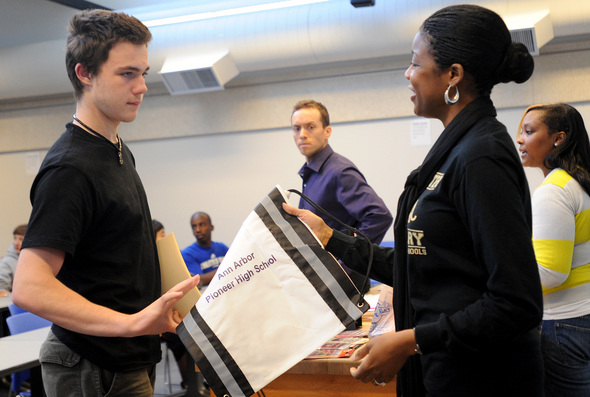
Rising Scholars coordinator Madeline Micou, right, hands Pioneer sophomore Austin Merrick a tote bag as a prize for raising his GPA by at least 0.1 during the past week.
Angela J. Cesere | AnnArbor.com
The goal is to equip students with the skills necessary to increase their GPAs to at least 2.0 by the time they graduate.
Each Friday, in place of one of their regular classes, about 65 struggling freshmen through juniors at PHS gather together for Seminar, a program designed to motivate and educate the school’s at-risk population.
But the approach is unlike other academic-focused organizations — think team huddle on the football field, with Pioneer’s administrators as the quarterbacks, tossing footballs filled with study skills and personal accountability.
Just like athletes, these players need to come prepared. If they show up without their “uniforms” (planners) or fail to follow instructions to complete a play, they are “benched.”
Pioneer Principal Michael White said inside the Seminar classroom, the kids are part of an academic team, where teamwork and encouragement of all teammates is highly stressed.
The approach, White said, is very relatable for students in the Seminar program.
“A lot of the kids in this room, they resort to athletics or a club because it makes them feel worth it. They shirk on academics because they don’t have the confidence,” White said. “The main deal in here is to make the kids more whole, to help them get into college and to give them the skills to compete with the rest of their peers on an equal level.”
Many kids don’t realize they can get in to a four-year college with a 2.0 GPA and a decent ACT score, White said.
The Seminar program began at the start of Pioneer’s third quarter, at the half-way mark of the 2011-12 school year, and already students are increasing their GPAs, he said.
Every Friday, Pioneer administrators arrange for a guest speaker to visit. Speakers have ranged from teachers within the district’s family, such as Madeline Micou of the Rising Scholars program, to Clayborne Green, academic counselor for football at the University of Michigan.
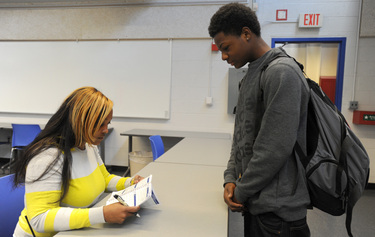
Pioneer High School ninth-grader Dayvon Steen, right, has his planner checked over by community assistant Taryn Reid during the Pioneer Seminar program. Students have to keep track of homework and work done in class in their planners in an effort to bring up their GPAs.
Angela J. Cesere | AnnArbor.com
At sign-in, students must present their planners — and show usage — to administrators. If a student forgets his or her planner, he or she is given a detention.
“We teach them skills, such as how to budget their time and to keep track of their assignments, that was a skill we taught them. So if we’ve taught it, we expect it to be carried out. And there are consequences,” White said.
White, an ex-drill sergeant in the U.S. Army Reserves, has a reputation for being tough on students.
“I tell the students I’m going to be a lot harder on them out there (in school) than I am in here (in Seminar),” he said, adding he tells his 2.0 kids he better not see them in his office. “In here, we’re teaching them to take control of their academics and their behaviors. And out there is where they’re supposed to be working it.”
Freshman Kameron Stephens said even though White is tough, he is a “great guy and he really cares, so he’s good motivation for me.”
Dayvon Steen, also a freshman, said he wants to be a botanist someday, but before the seminar program and White’s harping on GPA, he didn’t care about his GPA or know how to calculate it.
“This is a good program. I’m learning a lot about how to study,” he said.
The students calculate their grades each week at the end of the Seminar period. Those students who have achieved an increase of 0.1 or greater to their GPAs are rewarded and congratulated by an administrator. Those who increase their GPAs by 0.3 or more also receive pizza during lunch the following week.
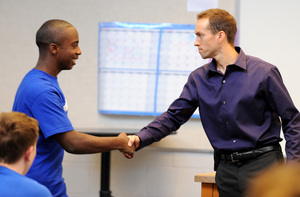
Pioneer math teacher and interim 10th-grade principal Robert Klemmer, right, congratulates freshman Errol Kelsey after he raised his GPA.
Angela J. Cesere | AnnArbor.com
He said teaching the kids to check their grades regularly was a big step. Many of the juniors didn't even know their Power School online passwords. He said most of the Seminar students do not have parents at home asking about their grades.
Although White holds his students to high standards, he holds his teachers accountable as well and asks for the teens' help in keeping their teachers sharp.
“If you have a teacher that refuses to help you the way you need to be helped, bring it to our attention,” he tells the kids.
He said he knows from his years as an educator that "too often teachers have blinders on" and feel pressured to squeeze in the curriculum — often not thinking about the children they could be leaving behind.
He said there has been a building-wide push to improve teachers' focus on student-centered learning. He said one of the first skills the Seminar students were taught was identifying the type of learner they are.
"Teachers need to teach in accordance with how students learn," White said. "We wanted the kids to be able to say to teachers, 'I'm visual' or 'I'm auditory' or 'I'm a social group learner' if they aren't picking up the material so teachers can better work with them."
The Seminar program will start at the beginning of the school year in 2012-13. White said seniors were not included this year because it would have been too late for them to drastically increase their GPAs. But he hopes to have some seniors participate next year, he said.
Staff reporter Danielle Arndt covers K-12 education for AnnArbor.com. Follow her on Twitter @DanielleArndt or email her at daniellearndt@annarbor.com.
Comments
joe.blow
Sat, May 19, 2012 : 2:41 a.m.
Why not spend extra money and effort on all those with a 3.5GPA or higher, they've worked hard and earned it. Spending money and time on them will almost certainly go towards further education and achievement.
Tony Livingston
Sat, May 19, 2012 : 12:09 p.m.
Trust me there is plenty already spent on the top performers. Take a look at exactly who is on the sports teams, upper bands and orchestras, and in many of the school programs like DECA. It not just hard work that has gotten them there either. It is parent resources.
Macabre Sunset
Sat, May 19, 2012 : 6:06 a.m.
Sorry, we must not allow students to excel. It makes the others feel bad.
Michigan Man
Sat, May 19, 2012 : 2:21 a.m.
I have been under the impression that the smartest people in the nation live in/come from Ann Arbor. This article seems to suggest a different story?
microtini
Sat, May 19, 2012 : 2:04 a.m.
They'd never need a program like this at Skyline; they've got Mastery Learning there. Students just keep retaking failed assessments until they pass.
downunder
Sat, May 19, 2012 : 1:43 a.m.
Don't you know that Mr White is leaving? He was approved for a principal job in the Chicago suburbs for next year.
Macabre Sunset
Fri, May 18, 2012 : 7:04 p.m.
I'm glad to see this group appears to be color-blind. But why are we calling it a "gap" rather than a program designed to help struggling students? Grading is either done on some sort of curve, or it's essentially meaningless. One objection, though, from White's comments. I don't think it's a good idea to label students or have them label themselves as "visual", "auditory", etc. Good teachers use various methods. And sometimes a particular method doesn't work for a particular student in one lesson, but that method might be the best method for a later lesson. Students shouldn't be encouraged to shut themselves off arbitrarily.
MjC
Fri, May 18, 2012 : 7:03 p.m.
The students highlighted in this article should be so proud of their accomplishments!! I know how hard it is to struggle in school when the world around you seems to be falling apart and you're just trying to survive another day (a lot of people don't get it). So, good for you and any program that can help a student in Ann Arbor gets my vote of approval.
northside
Fri, May 18, 2012 : 8:48 p.m.
Interesting that out of all the comments so far, only 2 or 3 offer positive support for the students and their efforts. Most of the rest put forth the usual whining by the endless supply of self-proclaimed experts in education.
EyeHeartA2
Fri, May 18, 2012 : 5:30 p.m.
"Many kids don't realize they can get in to a four-year college with a 2.0 GPA and a decent ACT score, White said." Many kids also don't realize they will be saddled with an unmanagable student loan with a degree from a marginal university in a sketchy major if they go in with a 2.0 HS GPA. Before I get accused of whatever, let's hear it from the peanut gallery if they made this combo work? Show of hands: 2.0 HS GPA=> to college degree => good job. State your year of HS graduation. The GPA inflation is so out of hand that this needs to be considered as well.
northside
Fri, May 18, 2012 : 10:08 p.m.
Oops: 'high' in both places was meant to be 'high school.' Perhaps that was a Freudian slip as to why some friends didn't do so well earlier in life.
northside
Fri, May 18, 2012 : 8:47 p.m.
I know plenty of people who went from a low high GPA to success later in life. Their reasons for struggling in high varied: some partied too much, some were bored by high school, others came from rough family situations.
Dr. I. Emsayin
Fri, May 18, 2012 : 5:20 p.m.
Mr. White is a principal who walks his talk. He does not waste students' time - if they are called or sent to see him, he makes sure they are on task and that they will commit to remaining on task. My kids say there is rarely a student who dislikes him, though parents often find his tough love off-putting when they and their children are called to task. He is an intelligent person. Pioneer will have a task at hand when they need to find a replacement for him. He brings a wide range of skills and academic knowledge to the job from what I hear.
hail2thevict0r
Fri, May 18, 2012 : 5:16 p.m.
If you aren't getting at least a 2.0 in high school there are likely problems greater than just the schooling. I think there needs to be more programs focused on helping kids with out of school problems rather than just assuming that something within the system is wrong.
Danielle Arndt
Fri, May 18, 2012 : 5:13 p.m.
In case there is some confusion, the Rising Scholars program and the new Seminar program at Pioneer High are two separate programs. Rising Scholars is in place at each of the three comprehensive high schools, whereas Seminar is just at Pioneer and began mid-year. The Rising Scholars program, started in 2009-10, is for "economically disadvantaged and underserved students who, through grade point averages and test scores, have shown academic promise." It helps them to challenge themselves to attend top colleges and universities. So slightly different missions. This article on AAPS News shares more about Rising Scholars: http://news.a2schools.org/rising-scholars-lifts-students-grades-expectation-for-college/. Hope you found this information helpful.
Commoncents
Fri, May 18, 2012 : 4:50 p.m.
Buy them apple products quickly!
almightydanish
Fri, May 18, 2012 : 4:43 p.m.
"The Seminar program began at the start of Pioneer's third quarter, at the half-way mark of the 2012-13 school year, and already students are increasing their GPAs, he said." Don't you mean the 2011-2012 school year?
Danielle Arndt
Fri, May 18, 2012 : 6:35 p.m.
Yes, thank you for pointing this out. It has been corrected.
annarboral
Fri, May 18, 2012 : 3:01 p.m.
So the first thing you do to help struggling students is have them miss a class every Friday. How does that classwork get made up? If students want to improve then they should be willing to participate in an extra curricular program just like students who choose to participate in sports. I'm tired of the name "achievement gap". How about a "bad teacher gap"? Aren't our very highly paid teachers supported by a $50 million technology program supposed to know how to teach & motivate their stuents?
Billy Bob Schwartz
Fri, May 18, 2012 : 11:07 p.m.
...If they attend class, have food in their bellies, have some sort of peace and sense of security in their lives (including and most especially at home), have family that supports the schools and speaks well of school and teachers, encourages kids to work and do as well as they can, etc., etc., etc. Teachers do not raise our children. Parents do. Teachers do not provide moral education. Parents do. Teachers do not feed and clothe and protect and encourage kids around the clock. Parents do. Get my drift? The teacher gets your kid along with 35 or more other kids for less than an hour, maximum 5 days a week, during the school year. Figure it out. 30 kids for sixty minutes means each kid gets two minutes a day from a teacher. That's generous, because many days the teacher doesn't have the kids, as they are getting royally meaped, etc. Okay, that's all. Teachers have kids for a very short period of their lives, and it's ridiculous to blame them for not raising good, productive, successful kids in that much time. Pullllleeeeeze!
GoNavy
Fri, May 18, 2012 : 2:23 p.m.
I didn't even think it was possible to "earn" a sub-2.0 GPA in today's environment of grade inflation. Instead of focusing our attention on chronic underachievers, we should be directing funds into cultivating our best and brightest.
jns131
Fri, May 18, 2012 : 5:19 p.m.
The problem is Michigan Dept of Ed. They require 4 years of math and et all. If you are flunking math? You can kiss graduating good bye because you will never make it up if you can't afford summer school. Kind of a sad reality isn't it?
KeepingItReal
Fri, May 18, 2012 : 2:33 p.m.
The problem is that if we don't educate them now, we will certainly pay later on at the tune of what is now $30,000 a year to incarcerate. It seems this whole business of educating kids today is so complicated that I feel for teachers who are sincere in their desire to educate our youth but has to put up with some much "other" stuff.
red9seven
Fri, May 18, 2012 : 2:16 p.m.
This is sad. As a teacher, it's apparent to me that people don't realize that students excel or not because of what happens at home. What expectations do parents set for their children? We know what these are for teachers. Teachers can make a difference, especially in the AP programs, but not nearly as much as demanding parent/parents. Programs like this may raise self-esteem and even get some healthy competition going between challenged students, but the dominant predictor of success is what students do outside of class.
apples
Sun, May 20, 2012 : 1:10 p.m.
The higher the expectation the higher the outcome!I understand it's easier to teach the AP courses than others. If you are a teacher certainly you've heard about students who succeed despite the odds.
fjord
Fri, May 18, 2012 : 5:02 p.m.
This is a crucial point that is too often lost in any discussion of the public education system. Teachers can only do so much. If parents have not prepared their children to learn and instilled in them a love of reading, a sense of curiosity, and at least a basic level of personal discipline, that child is far less likely to succeed in school.
GeeWhiz
Fri, May 18, 2012 : 2:09 p.m.
We all want individuals to succeed in life. It is also good to teach them good study habits. However, the GPA of any random population of students will always follow the bell curve. Studies have shown that the average GPA has increased over time (http://www.gradeinflation.com/). If teachers choose to shift the median of the bell curve (grade inflation) to make students "feel" better, does that necessarily make students at the bottom of the bell curve any better academically speaking?
GeeWhiz
Fri, May 18, 2012 : 3:17 p.m.
Wrong GoNavy. The bell curve represents the shape of a two-parameter exponential (Gaussian) distribution with a given mean and standard deviation. You can choose to normalize it, e.g., IQ has a mean of 100 and standard deviation of 15 but the curve itself has nothing to do with normalization. You may also want to google the "central limit theorem" - the probabilistic basis of the bell curve.
GoNavy
Fri, May 18, 2012 : 2:25 p.m.
GPA's only follow a bell curve if the distribution of grades is normalized.
Chuck Warpehoski
Fri, May 18, 2012 : 1:56 p.m.
"Freshman Kameron Stephens said even though White is tough, he is a "great guy and he really cares, so he's good motivation for me." This strikes me as a core concept. There is a lot of scholarship on the achievement gap that shows that many at-risk students need to know that a teach cares about them before they will care what the teacher has to teach. White's balance of high and clear expectations with a concern for his students is an important combination.
ESprout
Fri, May 18, 2012 : 1:51 p.m.
While the onus is on the student to perform, it's the responsibility of the teachers and faculty to give the students the opportunity to succeed. While this program seems to push for higher academic achievement, the standard and perception of success is far too low. "If you have a teacher that refuses to help you the way you need to be helped, bring it to our attention..." I have a better Idea: If a teacher refuses to help a student for whatever reason - FIRE THEM! If they're not willing to do their job, there are plenty of talented, young, energetic teachers just waiting to get hired! (Did anyone catch that?? The use of they're, their and there all in one sentence...correctly...maybe that should be the stepping stone for bridging the achievement gap...BOOM) Anyhow, most teachers work hard, but there are plenty of teachers that, for lack of a better word, suck and are doing the children a disservice. Let's raise the bar for teachers and knock the entitlement attitude out of students, and reward both for, not reaching mediocrity, but for achieving greatness!
GoNavy
Fri, May 18, 2012 : 2:27 p.m.
"While the onus is on the student to perform, it's the responsibility of the teachers and faculty to give the students the opportunity to succeed." Which the community does by ensuring millions of dollars are made available on a yearly basis to fund free K-12 education for every citizen in the United States.
Silly Sally
Fri, May 18, 2012 : 2:05 p.m.
I did, Right on!!! Others have confused the three, using "their" instead of "they're, short for "they are". "Their" is the possessive, meaning ownership. Talk about a need for education, far too many on this blog mess this up. They would say "...far to many..." instead of "too" the list goes on. The sad thing is some of the younger "ediitors" do as well. So sad, and NOT silly.
Silly Sally
Fri, May 18, 2012 : 1:24 p.m.
"Rising Scholars coordinator"? I burst out laughing at such a silly name. Then I was sad at spending a lot of money for this position and for all of these other administrators such as a gap administrator. Principal White was spot on when he said, "Teachers need to teach in accordance with how students learn," That whole paragraph is the most important part of the article and what he is doing at the school besides discipline.
northside
Fri, May 18, 2012 : 8:50 p.m.
The schools are making a sincere effort to reach students who have struggled and all you've got to offer are belittling comments? Nice.
ViSHa
Fri, May 18, 2012 : 12:51 p.m.
These types of programs seem like practical ways to help with the achievement gap. Imagine how many more teachers could have been hired for this with the money spent on the Glenn Singleton/PEG consulting contract. And why is it that the PEG contract is never mentioned for the chopping block, is AAPS locked into it?
Susie Q
Sat, May 19, 2012 : 2:40 p.m.
I am not sure, but I do not believe the Glen Singleton outfit is doing any more work with AAPS.
thecompound
Fri, May 18, 2012 : 1:30 p.m.
At least this is a way to give out pizza that doesn't violate state law.
redwingshero
Fri, May 18, 2012 : 12:45 p.m.
As much as I appreciate the fact that the school is trying to boost students confidence and help equip them to do better in school, this is a troubling issue. We ask schools to feed our children, discipline them and now encourage them. As a parent, this is kind of a disturbing social commentary. Parents should be the frontline to help encourage their children to do well. It's sad that these kids are not getting it from their own homes.
thecompound
Fri, May 18, 2012 : 3:02 p.m.
I agree with both of you, but since being an academically irresponsible parent isn't against the law, as a society, we can't just let these kids flounder. It stinks and drains the system, but a kid can't choose his/her parents. If anything, maybe this program will help break a cycle.
KeepingItReal
Fri, May 18, 2012 : 1:39 p.m.
I agree with you. As I followed the story regarding Roberto Clemente, the thing that stood out most is that the school seems to function more as a surrogate parent for many of the students as opposed to an academic institution. Parents have the primary responsibility to make sure their students are prepared for school. In many ways, the teachers spend more time discipline some students than they do teaching. I would prefer that teachers spend the majority of their time teaching
Floyd
Fri, May 18, 2012 : 12:44 p.m.
I sense that one of the expected "discussion arcs" for this piece was something along the lines of "how much AA schools is again wasting on these nonsense programs." If this is the case, there is some chain-yanking going on, given the fact that there is no reporting of the cost of the program in dollars or the human personnel allocation (which one commenter seems to suggest is different in each building). Why not give Ann Arbor schools a call to find out the cost of the program? Why not look it up? This is a story whose unspoken lede is about financial and human resources. This makes me worry that the stories on this website are deliberately designed to inflate the response from readers by omitting key information. The other possibility is that a key aspect of this story - I would say the fundamental aspect - was omitted because of bad writing. I torture myself regularly by promising not to read this site but then coming back because, alas, they have the scoop.
smokeblwr
Fri, May 18, 2012 : 12:43 p.m.
It is good to see at-risk kids learning good study habits, but the quote in the article that states a student can get into a four year college with a 2.0GPA and low ACT score and portrays that as a good thing is part of what is wrong with our education system. Too many kids think getting to college will solve their problems, when in fact for most students who struggle with basic concepts in high school they have no business going to college unless they want to come out of it with a massive amount of debt and a degree that won't get them a decent paying job. What are the high schools doing to ensure America has a future supply of skilled tradespeople? Hands-on work is not menial labor if you are good at it. Some kids just aren't interested in book-learnin' and probably shouldn't be encouraged to mortgage their future on four or five years of college. Auto shop, plumbing, electrical, carpentry skills....these are all part of life and a good living can be had if you can do them well. Stuff even nerds should learn.
fjord
Fri, May 18, 2012 : 4:48 p.m.
Wow. Some distressingly elitist attitudes expressed here. GPA + ACT is a guarantee of neither success NOR failure in college. Some of the best, most hard-working college students were mediocre students in high school but found a passion for a subject and possessed the will and determination to work hard and earn a degree. By contrast, some of the worst, laziest college students sailed through high school with high grades and scored well on the ACT and/or SAT — but they never developed the study habits that would serve them well in college, and were too concerned with "partying" to keep up with their classes. A blanket statement such as "No student with a 2.0 GPA and a low ACT score should be attending college, period" is short-sighted and ignorant, plain and simple.
redwingshero
Fri, May 18, 2012 : 3:32 p.m.
@GoNavy-Is a 2.89 HS GPA and a 20 on ACT to low to attend college? I flunked out my freshman year of college, but turned my life around. Graduated with honors for my Bachelors and completed an MBA program. Not all are in the same boat. I do believe that high schools should advtertise more about trade schools.
PhillyCheeseSteak
Fri, May 18, 2012 : 2:45 p.m.
AAPS Administrators don't value skilled trades either. The wing at Pioneer H.S. that housed these programs were mostly converted to regular classroom space quite a few years ago (and now houses the Rec & Ed offices). And Skyline H.S. was built without any such space. Too bad.
GoNavy
Fri, May 18, 2012 : 2:29 p.m.
No student with a 2.0 GPA and a low ACT score should be attending college, period. It's a testament to our money-hungry system that such "students" (I hesitate to call an individual who can't clear 2.0 a "student") are accepted, and even sought after by college recruiters.
Mike
Fri, May 18, 2012 : 1:29 p.m.
Kids are not encouraged by counselors to enter skilled trades, they're all pushed to go to college. Many do, get degrees that won't get them a job, and work at a pizza store while $50K in debt, while the counselor gets a cost of living increase and complains they have to contribute to their health care plan.......
dotdash
Fri, May 18, 2012 : 12:15 p.m.
Good luck to all. Everyone should feel a part of some academic endeavor; I'm glad these kids have another chance to do so.
Mike
Fri, May 18, 2012 : 11:31 a.m.
We need more principals like Mr. White. I think it should be required that in order to be a principal you should have been a drill instructor. That's what a lot of these kids are missing; respect for others and discipline. Once they put their 20 in with the Marines they should be reassigned to a school...........
jns131
Fri, May 18, 2012 : 10:21 p.m.
Mine was not. It was based on fact. But then again this on line place tends to disagree with me at an alarming rate.
Tony Dearing
Fri, May 18, 2012 : 5:26 p.m.
A comment was removed because it contained a personal attack, and another comment was removed because it was based on speculation. Comments in reply were removed because the comments they were directed at are no longer published.
PhillyCheeseSteak
Fri, May 18, 2012 : 2:40 p.m.
As a parent, I was a bit put off by Mr. White's narrow focus on creating a 'Safe and Secure' environment at Pioneer, which before his tenure, was severely lacking for the students there. I thought Pioneer needed to try some creative programs/projects especially considering what Skyline is doing. However, my son has a completely different perspective and greatly admires Mr. White. Even though my son was not an academically 'good' student, he developed a nice relationship with Mr. White and enjoys going back to Pioneer to visit with him.
Stephen Lange Ranzini
Fri, May 18, 2012 : 11:14 a.m.
Could someone please explain to me what do the 9th, 10th, 11th and 12th grade principals do? Why are they needed?
Stephen Lange Ranzini
Mon, May 21, 2012 : 3:27 a.m.
Susie Q: I am asking these questions because I really don't know the answers, and I appreciate your response however I have to admit I didn't fully understand what you wrote. I think what you are saying is that there are 8 administrators at Pioneer and Huron: "Now, there are two assistant principals, a head principal and an athletic director at Pioneer and Huron." Isn't there also a 9th grade, 10th grade, 11th grade and 12th grade principal also? Or, is there another arrangement? Wouldn't all that add up to 8 "principals" in total for each high school? Now what about Skyline or Community? What do they have? Do you know?
Susie Q
Sat, May 19, 2012 : 2:36 p.m.
Mr Ranzini, You are misinformed. There are not six class principals at each comprehensive high school. When people read your comments I am sure some actually believe them. Four years ago there were 4 grade principals at each high school, in addition to the "head" principal and the athletic director, who is also an administrator. Now, there are two assistant principals, a "head principal and an athletic director at Pioneer and Huron. Now, I am sure a case can be made for even fewer administrators, but the total number is four, not six. Additionally, these principals now have to evaluate every teacher, every year, which has been an big increase in their responsibility.
Stephen Lange Ranzini
Sat, May 19, 2012 : 4:25 a.m.
@MjC: Are six really needed in each high school? The Principal, Assistant Principal and four grade Principals makes six.
MjC
Fri, May 18, 2012 : 7:01 p.m.
I'm not in the academic world, but I would like to assume that our high school principals are responsible for teacher evaluations, performance, and professional growth; provides leadership for planning, development, and implementation of the curriculum; developing and enforcing appropriate regulations and policies; supports student achievement and growth - and is a visionary who can implement new needed technology to enhance the educational experience of students, staff, and the school's entire community... seriously do we need to go on? These high schools are HUGE and they are not going to run without someone steering the massive ship and being an advocate for the school. I think you already know this.
MIKE
Fri, May 18, 2012 : 5:44 p.m.
So Bunny, would it be safe to say they're assistant principals that make a principals salary?
bunnyabbot
Fri, May 18, 2012 : 1:10 p.m.
because, for example the student population at pioneer is large. Basically the class "principals" are like grade supervisors who report to the principal.
Stephen Lange Ranzini
Fri, May 18, 2012 : 11:47 a.m.
@Mike: I don't know any, hence why I am asking.
Mike
Fri, May 18, 2012 : 11:29 a.m.
Trust me their needed, just ask them
cinnabar7071
Fri, May 18, 2012 : 11:01 a.m.
I would think you could get a 2.0 gpa by just showing up and paying attention. Maybe the bar isn't low enough.
northside
Fri, May 18, 2012 : 8:39 p.m.
Such dignified words of support for students who have struggled in school and are trying to do better.
Blazingly Busy
Fri, May 18, 2012 : 10:37 a.m.
Rising Scholars has been in place for 3 years. It is at Pioneer, Huron and Skyline. Pioneer does seem to be the favorite of the program though.
Danielle Arndt
Fri, May 18, 2012 : 5:11 p.m.
Busy, the Rising Scholars program and the new Seminar program at Pioneer High are two separate programs. Rising Scholars is in place at each of the three comprehensive high schools, whereas Seminar is just at Pioneer and began mid-year. The Rising Scholars program is for "economically disadvantaged and underserved students who, through grade point averages and test scores, have shown academic promise." It helps them to challenge themselves to attend top colleges and universities. So slightly different missions. This article on AAPS News shares more about Rising Scholars: http://news.a2schools.org/rising-scholars-lifts-students-grades-expectation-for-college/. Hope you found this information helpful.