

Newcombe Clark claims property owners are potentially defrauding city of Ann Arbor out of millions
Newcombe Clark dropped a bombshell during an Ann Arbor City Council candidate debate Monday night, publicly alleging certain property owners in town are defrauding the city of large sums of money by exploiting legal loopholes.
"This is where I'm not going to make any friends in my profession," said Clark, a commercial real estate broker and 5th Ward candidate, in response to a question about the city's budget.
A few weeks ago, Clark said, he and a colleague ran some numbers on the back of a bar napkin and identified about $4.5 million in taxable value unaccounted for — and he believes that's just the tip of the iceberg. He said there could be 10 times that amount, and the additional taxes owed on the properties could number in the seven-figure range.
"These are people that have exploited some loopholes that unfortunately still exist in our system to move some properties around without paying the true taxes due," he said, not naming any names. "Now, if myself and another colleague in the commercial real estate industry can identify $4 million on just the back of a napkin, who knows what's out there."
The passage of Proposal A in 1994 placed limits on yearly property tax increases in Michigan, but the taxes are supposed to be uncapped when a transfer of ownership occurs.
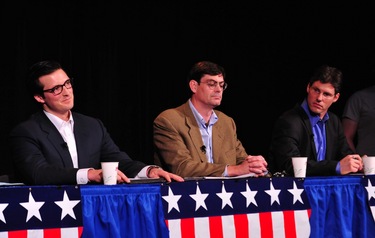
From left to right, Newcombe Clark, John Floyd and Carsten Hohnke engage in a debate Monday night hosted by the League of Women Voters.
Ryan J. Stanton | AnnArbor.com
Clark said some of the larger property owners in town are buying up limited liability companies, or LLCs, whose assets include real property. But because closing on an LLC doesn't require recording a transfer of deed with the county, the city assessor's office doesn't find out about the transfers through typical mechanisms — and the taxes, in many cases, end up not being uncapped.
"There is a provision that was closed by the state Supreme Court a few years ago that prohibited the transfer of commercial assets in LLCs, basically not uncapping them when the LLCs sell," Clark said. "Our assessors do a great job, but often only hear about these LLC transfers when it hits the paper, or just by dumb luck sometimes."
City Assessor David Petrak said Clark is right.
"We pretty much know it's happening," Petrak said, referencing two cases in recent years involving Signature Villas Apartments LLC and Burlington Property LLC, where the city found out about a transfer of upper-level LLCs, uncapped the taxes, and then was sued by the companies. In both cases, the decision to uncap the taxes was upheld in court.
Around the time of the lawsuit, Clark worked for Oxford Commercial, whose owner was a managing partner for Burlington Property LLC.
"The problem is, we have no way of knowing about it," Petrak said of other LLC transfers that may be flying under the radar. "Newcombe has been in the commercial end of the business, so he may know for a fact that some of these happen. We don't."
Clark suggested Monday night that, with some special hired help and his expertise on council, the city could go after some of those property owners and return a large sum of money to the city. Petrak said for now, the city has adopted a practice of asking to see documentation of who owns the property when hearing about property transfers into an LLC.
Petrak said if a focused effort led to a mass uncapping of taxes, it could end up triggering a Headlee rollback and lower the millage rates for other taxpayers. But in that situation, the city may not see a large increase in tax revenue.
He noted that the problem is happening all across Michigan, not just in Ann Arbor.
Clark, who is running as an independent, is challenging incumbent Carsten Hohnke, D-5th Ward, for his council seat, along with Republican John Floyd, an accountant.
The other contested council race — other than the mayoral race — in the Nov. 2 general election is the 2nd Ward matchup between Democratic incumbent Tony Derezinski and Libertarian challenger Emily Salvette.
All five candidates appeared side-by-side during Monday's debate, hosted by the League of Women Voters of the Ann Arbor Area. It was aired live on CTN and taped for rebroadcast.
"I'm running because I think it's bad we have only one party ruling our city," said Salvette, state chairwoman of the Libertarian Party of Michigan. "All 11 members of City Council are Democrats, and that's how it's been for a while. That's not good for democracy."
Salvette, a part-time administrative employee for the University of Michigan School of Public Health, said she believes in limited government and low taxes.
"Government should focus on basics: protecting people from violent crime and providing public infrastructure like roads and water," she said. "Then government should step back and let people go about their business."
Salvette said the city needs to do something about "rich benefit packages" and bring city employee costs in line with the private sector.
"There are plenty of voters in Ward 2 who think city government is too big, spends too much money, and is pursuing very ill-advised projects," she said.
Derezinski, a former state senator and retired municipal attorney with a master of laws degree from Harvard, said the last two years have been tough for the city, but he's optimistic.
"Ann Arbor is just ripe with possibilities," he said. "I refuse to attack city government. I think we can make it better by good planning, by thinking of where we want to be in 25 years from now, and then together with a common vision working toward that goal."
Floyd agreed that one-party rule in Ann Arbor isn't working.
"Asking probing questions with good will is our part-time council's job," he said. "Our current council's culture seems to discourage probing questions, period."
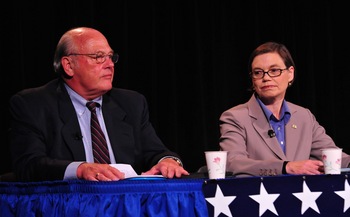
Democratic incumbent Tony Derezinski takes on Libertarian challenger Emily Salvette Monday night in the LWV candidate debate.
Ryan J. Stanton | AnnArbor.com
Floyd criticized the city for considering privatizing a portion of the Huron Hills Golf Course without a vote of the people. Hohnke responded there are no plans to lease any land at Huron Hills to developers or build anything new.
"There have been some discussions by city staff who understand the operations of golf at Huron Hills very well to say, 'Hey, there might be some utility in making the front nine a driving range instead of making it a full 18-hole golf course,'" he said.
Derezinski also addressed the Huron Hills issue.
"What the city has done so far is just to put out a request for proposals to see how we can manage it better," he said. "In fact, the RFP is very specific. That is aimed at management of the golf course as a golf facility, and I think we have to make that inquiry, particularly in tough times, to see if there's a way that we can do it better."
Clark, who has made a commitment to run for one term only and donate his council pay to charity, said he has concerns about the parking structure the city is partnering with the University of Michigan to build on Fuller Road. He said the city doesn't have the best track record in running parking decks. He also said he has concerns about its location, and it's not clear how it will connect to downtown and become an asset for more than just U-M.
Floyd also criticized the Fuller Road project — billed as an "intermodal transit station" — questioning the city's hopes of seeing a train station there anytime soon.
"Well, I think that someday we may have rockets flying to other planets from that center, so I think we should call it the 'interplanetary transit center,'" he said.
Floyd and Salvette both said the project should go to a vote of the people.
"If we have a rule that parkland can't be sold without a vote of the people, and we go into a long-term lease — which is essentially a sale for all intents and purposes for us who are here today — I think that's not playing by our rules," Salvette said.
Hohnke defended the project.
"I think a multimodal transit station replacing a rather large, cracked, asphalt parking lot that's been there for 20 years would be a significant improvement," he said. "And to have the university spend about 75 to 80 percent of the money to build it, and then use funds that we leverage from the federal government through grants to pay for the rest to provide the city of Ann Arbor with an asset ... I think it's exciting."
The incumbents agreed a major challenge facing the city is delivering quality services. Both said economic times have forced the council to make painful cuts.
"Like all other municipalities across the country, we're facing continued increases in employee benefit costs that are putting extraordinary strains on our ability to continue delivering the services that we all want to see delivered as a community," Hohnke said, mentioning regional collaboration and leveraging technology as ways to make city government more efficient.
Hohnke also said the city needs to address its pension liabilities.
"As we go forward — and the cost to our pension system of the downturn in the market in late 2008 gets amortized over the next five years — we have some serious ground to make up," he said. "As of the end of the last fiscal year, we were about 90-94 percent fully funded in our pension system, but that's going to go down over the next five to 10 years."
Clark said he would bring his professional expertise to council.
"What I think I can bring in the short-term is an understanding of our main source of revenue, which is our tax revenue from our real estate," he said. "What I've seen working in real estate for the past 10 years has been a city that has spent as the bubble has grown, and now we're going to have to figure out how to get that back in line."
Floyd said providing basic services in the current economic climate is a top priority, but the city's debt impedes its ability to provide services.
"What I can bring to the table to help resolve this is partly from my experience as an economist, an accountant and a public policy analyst," he said.
"We've already closed one fire station and we've already sent about half our police force home," Floyd said. "As much as I hate to say this, because we use the parks all the time, we might need to let the grass grow a little longer before we cut it, rather than further cut public safety."
Hohnke said Floyd's statements about reductions in the police force and closing of a fire station need to be put into proper context, because those cuts didn't happen recently.
"I wasn't around for it, but a lot of the police thing was driven by the fact that the U of M implemented its own police force in the mid '90s and brought 50 to 60 cops with them," he said. "So there was less of a need to police the U of M campus, and there was also a lot of funding from Clinton's 100,000 COPS (initiative) that went away."
Salvette said the city is living beyond its means and taking on too much debt.
"I don't always want to use government to solve every problem, so it's not going to grow under my watch. And that's my biggest asset that I bring to the table," she said.
"We're spending at an unsustainable level," she added. "We have to get our city costs under control and the biggest area where we need to control it is probably in our employee costs, and we have to look hard at those union contracts."
Ryan J. Stanton covers government and politics for AnnArbor.com. Reach him at ryanstanton@annarbor.com or 734-623-2529.
Comments
Roadman
Fri, Oct 1, 2010 : 8:03 p.m.
Yes, John Floyd is a fine City Council candidate.
Somewhat Concerned
Fri, Oct 1, 2010 : 6:18 p.m.
Nice grandstanding by a politician. He knew about this for a long time but waited to bring it up until he could spring it as part of his campaign to get on the Council (and get his rejected development projects approved).
pbehjatnia
Thu, Sep 30, 2010 : 7:25 p.m.
@stuartbrown-bingo! We do need to stop just straight ticketing.
Stuart Brown
Wed, Sep 29, 2010 : 6:45 p.m.
Oh yes, I forgot to mention that straight ticket voters can still split their votes. Democrats can vote straight ticket and still vote for Steve Bean who is an Independent and John Floyd who is a Republican. John should do well this November since Rick Snyder is at the top of the ticket. People in this town should get wise and stop the automatic pulling of the plunger for the dim bulb Democrat at the bottom of the ticket. John Floyd is far more in touch with the values of most Democrats in this town than Carsten Hoenke!
Stuart Brown
Wed, Sep 29, 2010 : 6:33 p.m.
My hats off to "Duke Nuk'em" Clark for exposing this one. It has been common knowledge that one way to avoid high assessments on commercial property was by LLC'ing the property and transferring ownership in the LLC. Buildings last for years and outlive their original owners; since Headlee or 1978, assessments on commercial real estate have not kept pace with inflation. Larry Kestenbaum even stated that that was a hidden intended purpose by the original backers of the Headlee Amendment. Apparently, this use to be a legal way to avoid taxes; but no longer. The fact that this new way of generating revenue has not been aggressively pursued is in contrast to the aggressive enforcement of parking violations and traffic laws. In my mind, it is a reflection that, indeed, this town is run by and for developers, the public be damned. The recent ban on porch couches is widely understood to be more about maintaining property values than about safety; the trend continues. Why are voters in this town so willing to give Hieftje a pass time after time? The voters in this town never have a clue until their particular ox is being gored, and then it is too late. Anybody is better than Hieftje and has merry clowns on council! Vote for Steve Bean and John Floyd in November!
Bob Needham
Wed, Sep 29, 2010 : 2:11 p.m.
(off-topic comment removed)
leaguebus
Wed, Sep 29, 2010 : 2:08 p.m.
There is gold to be mined from the LLC's. I wonder why someone in the city Assessors Office didn't start going through the transfers after winning the Burlington case? Too much to do? Too many toes to step on? Thanks to Mr Clark for blowing the whistle on this problem.
Speechless
Wed, Sep 29, 2010 : 12:56 p.m.
Well, what's up with the city's presumed Don't Ask & Don't Tell policy on LLC transfers? How are we to 'assess' this? Thus far, the silence emanating from council members and the administration has been deafening. My ears hurt. If you are an individual or business entity of means, does LLC get you TLC?
Roadman
Wed, Sep 29, 2010 : 12:47 p.m.
There is no fraud. Tax avoidance is not tax evasion. Tax avoidance is smart advice by CPAs and lawyers that save clients money. If the Michigan Legislature wanted to ban this type of "loophole" they could of.
javajolt1
Wed, Sep 29, 2010 : 11:42 a.m.
Why do the photos and the "NC" BRANDING logo on his website remind me of the movie "V for Vandetta". Its awfully doggone slick. I guess politics (and real estate for that matter)is all about self promotion. A good reason to be squeamish about both of them. http://www.nukethe5th.org/article.php?itemID=16
Blackbird
Wed, Sep 29, 2010 : 11:13 a.m.
I am very eager to see annarbor.com's followup story on all of this. What has been the fallout from this incident?
M-Fan
Wed, Sep 29, 2010 : 11:11 a.m.
Please, someone explain how anyone who has watched the AA Council over the past 8 - 10 years can claim they are liberal. Sure, they take up so-called liberal causes whenever they won't effect their own relationships with developers, the DDA, the U of M, etc. None of those relastionships are in any way liberal, as in putting the people (residents) 1st.
RayA2
Wed, Sep 29, 2010 : 11:01 a.m.
Another blatantly obvious example of the wealthy having the political power to avoid what the other 99.9% of us have to pay to support schools, libraries, roads, environmental protection, etc. For those of you who still hold the illusion that you have anything near a chance to be one of the.01%, think again.
Seasoned Cit
Wed, Sep 29, 2010 : 10:17 a.m.
Newcombe is talking about commercial real estate. What about residential? I recently noted when at an open house for a $600.000+ home in a neighborhood of $150-200,000 homes, that due to some assessor's formula..the McMansion was paying property taxes based on the neighborhood..not on the value of the house.. Seemed to me the City was getting the short end of the deal there.
bugjuice
Wed, Sep 29, 2010 : 9:19 a.m.
Hieftje is a realtor. I wonder how much he knows about LLC's and their ability to obscure the money trail to limit their taxes? I hope someone asks him his thoughts about this question at the next mayoral debate.
PersonX
Wed, Sep 29, 2010 : 8:40 a.m.
One could argue that some members of council are too close to special interests, which is now, unfortunately, the accepted stuff of politics, but as far as I know we now have something new: a candidate who IS the special interest.
Pjohn3
Wed, Sep 29, 2010 : 7:43 a.m.
Better get your broom Newc, cause the only job your gonna have in this town is sweeping it. Immaturity + bravado = professional suicide.
BornNRaised
Wed, Sep 29, 2010 : 6:55 a.m.
Hey Carsten, you were around for the cutting of 4 people in the FD, and you were also here for electing not to fill any of the vacant PD positions. Try another lie.
MI-expatriate
Wed, Sep 29, 2010 : 1:30 a.m.
This is a firestorm obviously, but in support of Clark, who jeopardizes their career and income before they finally understand the full picture and can draw the right conclusions? I'm thinking that someone thoroughly disgusted with the status quo might decide they have had enough before acting. Ann Arbor should take note of these allegations.
Jim Clarkson
Tue, Sep 28, 2010 : 10:30 p.m.
I see Clark as a showboat, even on his own webpage he states he is only going to run for one term. He just so happens to be running against one of the people that turned down his development project. http://www.nukethe5th.org/article.php?itemID=16 I bet he would only serve long enough to approve his project if he could. And if he has known about these loopholes for a long time why did he wait until now to let anyone know about them. Certainly does not convince me of his commitment to the City of Ann Arbor.
PersonX
Tue, Sep 28, 2010 : 10:20 p.m.
Let us not forget why Mr. Clark decided to run for council: he was angry that the Moravian project was not approved. That was his sole reason for running, and now he will come up with other issues, but they are all secondary; he made it all very clear when, in a peeve, he announced his intention to consider a run. The merits of the Moravian are beside the point at this moment. This is a cynical self-serving special interest candidacy. If he wins, he takes out one vote that would potentially be cast against the next incarnation of at least two projects he is involved with; he would have to recuse himself, but it would still take out a potentially negative vote. It is fascinating that, as has been observed, he chose to stay quiet about this issue until now. It is also telling that a story about a candidate's forum focuses only on him for the headline and concentrates on this one "revelation." This is hardly balanced reporting...
tlb1201
Tue, Sep 28, 2010 : 10:09 p.m.
While Briegel and Heardoc and others were arguing over partisan talking points and clogged-up the whole discussion, several people actually raised some good issues that were sort of buried. Seems like the same sort of thing that is happening with much of our government! Shame on you guys! LLC's, Corporations, Limited Partnerships, Trusts, etc have been used for property ownership for a long time for a variety of reasons. One advantage of those forms of ownership is that it is easy to transfer ownership of the entity between multiple partners or new investors, family members, heirs, etc. Instead of having to transfer every individual asset that the entity owns every time there is a change in the ownership of the entity, whether it is a small portion or the whole thing, shares of the "company" that owns the actual assets are exchanged. There is nothing dishonest or sinister about that - unless it is used to break laws and illegally avoid taxes. That practice should be no secret to those in the city administration and assessment business. My question is why they have not done more to follow up on it and enforce it sooner. Have they possibly ignored the practice to the detriment of the other taxpayers? I hope not! Selective enforcement would not be good at all, if it was being done. Gorc is absolutely right about transfer taxes. There is no deed that is recorded when LLC or corporation shares change hands. Filing a deed triggers payment of the transfer tax that the state and county collect based upon the sales price on the deed or transfer affidavit. The state and county are potentially losing tax revenue if the same law that applies to the caps on the taxable value also applies to the transfer tax. Anyone know anything about that?
Cendra Lynn
Tue, Sep 28, 2010 : 9:56 p.m.
For shame, Carsten! You know full well that the police cuts had nothing to do with the creation of the UM police force. When Chief Daniel Oates came in the fall of 2001, he was asked to make a one-time 5% cut in the department budget as a condition of being hired. Then he was ordered to do the same every subsequent year. He finally told Roger Fraser that he would not do that again, that staffing had been cut to the bare bones, and resigned. We lost the best Chief we ever had, and you have let Fraser and cronies continue to make so many cuts that we are now severely understaffed. If there are two crime emergencies in the city at once, the department will have to choose which one to respond to, such as the day we had a murder at Blockbuster at Stadium and Jackson, and a bank robbery at Stadium and Packard. You also know that there are many additonal monies hidden in the City budget that could be use for police, fire, the Stadium bridge.... You WERE around for many of these cuts and you continue to support them. You are and have been part of the problem.
pbehjatnia
Tue, Sep 28, 2010 : 9:23 p.m.
I laugh at comments in re Newcombe being self-serving. What do you think Hohnke is? A saint? Please. Hohnke is as self-serving as it gets. He is trying to become a career politician. You know, kind of like our current mayor. In fact, I would wager that Hohnke will be our next mayor. If we don't wake up, Hohnke will be the next mayor of Ann Arbor employed by the University of Michigan. At least Newcombe had a point of new interest to present and not the tired council speak drooling out of Hohnke's mouth.
javajolt1
Tue, Sep 28, 2010 : 8:54 p.m.
I agree. If Newcome Clark has been in real estate for many years and has known about this abuse, why does he wait until now to blow the whistle? Seems odd. If you're going to make these claims at what amounts to a press conference, you need to do more than make an allegation. You need to prove it by naming names. Does he think he's done us a favor by bringing this up? Perhaps, but the venue/forum is self-serving. Why didn't he bring this up when he was a DDA committee member or in one of the many other opportunities he's had to save the taxpayers of this city money? It may be true...but I smell politics, too.
Gorc
Tue, Sep 28, 2010 : 8:02 p.m.
If someone else knows could you please answer this question....does selling a commercial property in the form of an LLC avoid paying a transfer tax? And does that transfer tax go to the state, not the city or township it is in?
demistify
Tue, Sep 28, 2010 : 8:02 p.m.
I find it deplorable that so many of the posts concentrate on questioning Clark's motives rather than on the serious avenue of tax evasion that he has exposed; apparently they care more about shooting down his candidacy than about the welfare of the community. Now that the issue is in the open, what matters is that something be done about it. The Council needs to take a break from sanctimonious resolutions and buckle down to solving problems that directly affect Ann Arbor.
Gorc
Tue, Sep 28, 2010 : 7:51 p.m.
The fact the someone buys a LLC and the main asset in that LLC is a commercial property in order to minimize property taxes is not new news. If I remember correctly this may have been reported in the Ann Arbor News at the height of the property bubble. When the new owner purchases a commerical property in this manner it does not obsolve them of property taxes. It typically keeps the taxes at the same level of the previous owner. The same LLC owns the same property and it does not trigger a new property assessment for techincally a new property owner. I would imagine this stragey does not work in a down real estate market. I would also guess that the new owner would want a new assessment in a down real estate market in order to take advantage of a lower assessment.
st.julian
Tue, Sep 28, 2010 : 7:11 p.m.
Newcombe Clark has his own self interest at heart. His conpet of public interest is to build what he wants, where he wants, when he wants, with every tax break he can get.
Speechless
Tue, Sep 28, 2010 : 7:07 p.m.
"... The city is run by the far left wing of the democratic party. These people know taxes better than anyone as they are the ones who believe in taxation.... This exposes the far left for what it is and what it is not...." Well, I'd betcha the LLC-related tax cheats are mostly GOP-voting biz folk.
David Briegel
Tue, Sep 28, 2010 : 6:59 p.m.
Heardoc, Keep citing your stats. You leave out many inconvenient facts. I should have stated more clearly and accurately that that top % doesn't pay what they should pay if the laws were fairly written and they were as honest as the middle class. Focus on the honest, decent people from the 40th thru the 95th percentile. What do they earn? What do they pay? How do they stretch the rules and cheat? Are they punished with unemployment, foreclosure and bankruptcy? How have they done in the last 30 yrs? What does your top 2% earn? This group of people are NOT wage earners. Most have never earned a wage in their entire life! How have they done the last 30 years? Now explain the disparity! Ask an honest, patriotic capitalist like Warren Buffett. It is obscene that he pays a lower rate than his secretary. Why should the rate at the TOP be lower than the middle?? Statistics don't lie but liars know how to use them!
Chase Ingersoll
Tue, Sep 28, 2010 : 6:42 p.m.
As much as I think everyone in general is paying taxes that are too high, the deck is stacked against the small owner or investor and in favor of the large investor and this is a prime example. Placing high value real estate in a Corporate or Trust entity is standard operating procedure for top level investment managers who employ the best real estate attorneys that money can buy. Chicago had this problem with Illinois Land Trusts (I think the story is that Abe Linclon was the attorney that developed theses.) that owned some of the largest buildings downtown. Of particular note was Chicago real estate owned by interests owned by the Kennedy's. Eventually Illinois codified an exception into it's land trust statute and transfer of real estate statute to capture the taxes on these sort of real estate transfers and ultimately the assessed valuations. Part of the larger picture is that the lower assessments result in higher profits to the Corporations or ultimate beneficiaries, so what does the State care, because it is the one that is going to capture the income taxes. So the state and the municipalities are definitely on a different page here. Also - I am left wondering how it affects the depreciation. Does the new LLC get to begin the depreciation all over again, and is that reflected on the LLC's income reporting. Also, how would this be handled in the case of a transfer as in an estate or divorce proceeding. It was told to me 15 years ago that in (Hong Kong or was it Taiwan) that assessement was done by "self assessment". The owner assessed the property himself and paid the tax according. The "catch" was that at any time the government could come in and take the property from the owner and pay the owner the value that the owner had assessed his/her property.
Heardoc
Tue, Sep 28, 2010 : 6:36 p.m.
@speechless The city is run by the far left wing of the democratic party. These people know taxes better than anyone as they are the ones who believe in taxation and revenue collection as it is their way to power. This exposes the far left for what it is and what it is not. If this group was really out for the little guy, why would City assessor Petrak not want to uncover the tax dodgers-- especially if this would mean lower taxes for home owners? That is because they do not care about the little guy -- just themselves and their pet projects (that are funded with our tax dollars) that are deceptively cloaked and packaged in a way so you think they are trying to help you when in fact they are not going to help you at all. this is so funny -- it exposes the far left for what it is: an extreme group that will do anything it can to gain your money through taxes so as to spend the money on their priorities rather than you spending your money on your own priorities.
zags
Tue, Sep 28, 2010 : 6:30 p.m.
because Newcombe Clark is completely self serving in his "bomb shell". Where was his altruism when he was selling real estate?
Speechless
Tue, Sep 28, 2010 : 6:22 p.m.
"... [City Assessor] Petrak said if a focused effort led to a mass uncapping of taxes, it could end up triggering a Headlee rollback and lower the millage rates for other taxpayers. But in that situation, the city may not see a large increase in tax revenue." Umm... does this imply that the city administration won't pursue LLC-related tax underpayments more aggressively because it would mainly lower rates for honest taxpayers rather than provide the city with a lucrative money stream? As a result, is it then considered a waste of staff time to bring about some tax relief to the public at the expense of business cheaters? ------------ Although not on the Newcombe the candidate bandwagon, I'm struck by the several ad hominem attacks directed at him for bringing up tax cheating via LLC transfer. This obnoxious business practice apparently falls below the public radar, with the city keeping quiet about it as well. So, when Clark calls attention to it, some jump out of the woodwork go after him with character attacks and insinuations, instead of the demanding an end to the cheating.
Heardoc
Tue, Sep 28, 2010 : 6:22 p.m.
@Dagny Cities do many things but the fact that a small minority might not like a particular idea or function-- there are others that put great value in the item. You some how wonder why the city has a golf course (actually two). It is called livability. Like parks, sidewalks and water/sewer service. Not everyone utilizes all the city has to offer but without these things the city would be boring and unlivable. Why do you wonder -- is this a difficult concept?
DagnyJ
Tue, Sep 28, 2010 : 6:14 p.m.
I still want to know why the city is in the golf course business.
Heardoc
Tue, Sep 28, 2010 : 6:14 p.m.
@DavidBriegel If these are legal -- absolutely. Cayman islands, Mexico, Canada-- if I can save a buck and keep it in my pocket, rather than yours or anyone else's, then I am going to do just that.
Heardoc
Tue, Sep 28, 2010 : 6:11 p.m.
@David Briegel I think you have your facts wrong here-- The top 2% of earners pay approx 60% of the taxes. The bottom 50% pay less than 10% of the taxes. You keep stating "only little people pay taxes". This is totally incorrect. Might try to look at facts first prior to making such a statement. It is the large wage earner that pays the taxes in this country--no little people. Please use facts in your arguments in the future.
David Briegel
Tue, Sep 28, 2010 : 6:05 p.m.
Heardoc, You probably like those offshore Cayman Island accounts. The hired hands of the wealthy write the rules. They aren't smart. But the poor guy that pays his taxes is sure stupid!
mc zacharias
Tue, Sep 28, 2010 : 6:04 p.m.
The headline states "Newcombe Clark claims...". Claims? You've entered the big time, young man. Name names.
Heardoc
Tue, Sep 28, 2010 : 6 p.m.
To all the comments on "paying your fair share of taxes" The is no such thing as a fair tax or a "fair share" of taxes. It appears that those that speak of "fair share" do not use loopholes themselves. Do you own a house and reduce your taxable income via interest payments? Are you paying your fair share? For those that rent and are on welfare and send their children to public schools with free lunches-- are you paying your fair share? What these property owners did was use their head and apply the rules that the government set out and came out ahead -- that is called working smarter not harder. Nothing improper here other than a few extremists on the left that think that the money you earn belongs to the government first and you third or fourth.
David Briegel
Tue, Sep 28, 2010 : 5:58 p.m.
Here's a News Flash. Rich People Don't Pay Taxes!! Blame the whistleblower! It's always the fault of the little guy. Never the noble business person. NEVER. All this while the little guy is being bankrupted and foreclosed. Only little people pay taxes!
zags
Tue, Sep 28, 2010 : 5:52 p.m.
Good luck in your new career in a new city Mr. Clark. You most certainly burned a thousand bridges in real estate! Maybe you move to the Gulf and take on the oil companies!
townie
Tue, Sep 28, 2010 : 5:45 p.m.
"Newcombe has been in the commercial end of the business, so he may know for a fact that some of these happen. We don't." Yes, it sounds like Clark has been very much aware of this loophole for some time, and so intimate with it's abuse, that he was able to identify $4.5 million worth of capped taxable value on a bar napkin. So why didn't he report it sooner? Is this tax dodge not also potentially hurting the DDA's revenues, where Clark is on the board? Why hasn't he revealed this scam as part of his "altruistic" service as a member of that board? Now that he's running for political office, he suddenly wants to play whistle-blower?
treetowncartel
Tue, Sep 28, 2010 : 4:03 p.m.
Hmmm, I smell Lafeyette Coney islands from Detroit wafting westerly over the city of Ann Arbor. Doesn't Barbara McQuade live in Ann Arbor?
demistify
Tue, Sep 28, 2010 : 3:44 p.m.
It is remarkable that Clark, an outsider not drawing a salary as Council member, was able to identify a substantial failure of the city to collect taxes it should receive, while the incumbent, Hohnke, was too busy worrying about a law in Arizona and a mosque in Tennessee to have time for such dull details in Ann Arbor. Oh yes, he did pay attention to something in his home town, how to trip up a developer acting within his rights (which further reduces tax revenues).
SemperFi
Tue, Sep 28, 2010 : 3:14 p.m.
The previous suggestions for hiring an investigator(paid from monies recouped) and offering an amnesty program to bring property owners in line have merit. If Nuke'em Clark is correct, he's probably wise in choosing a new career.
David Briegel
Tue, Sep 28, 2010 : 3:10 p.m.
Only little people pay taxes!
AA
Tue, Sep 28, 2010 : 3:05 p.m.
I have known about this for years, and millions is just the tip of the iceburg. Why do you think the rich get richer? Because they outsmart us and take advantage of all the loopholes. Some of Ann Arbors biggest real estate owners (and many are on local boards, some even as board or association presidents) have taken advantage of this for many, many years. Many double dip also with their University of Michigan connections. Nothing will change. These people have so many back room deals going on in this city THEY cannot even keep track of them. I would especially scrutinize builders and their associations with many city entities. Ann Arbor has always been corrupt. This may be news to you, but not to my third generation Ann Arbor family and peers.
Blackbird
Tue, Sep 28, 2010 : 2:59 p.m.
Let's see the napkin. And let's know exactly who is responsible before we all start casting suspicion and blame around. A city-wide investigation is unnecessary. Name the parties who are to blame, show us the evidence (beyond the napkin) and start from there. Name names. Get specific. Otherwise, you've created a mess. If my business were unnecessarily investigated because of some political games, then the end result would be: I wouldn't vote for Newcombe Clark. Name names! Immediately!
LBH
Tue, Sep 28, 2010 : 2:50 p.m.
@Marcus, don't forget "unpatriotic", interfering with the "free market", and "dangerous to our children". Spooky doomsayer overlay voice should be used when reading this message.
Oregon39_Michigan7
Tue, Sep 28, 2010 : 2:43 p.m.
Once again while (most) individuals pay our fair share of taxes, on time, and 100% of what we owe, businesses are exploting us. Anytime someone tries to hold businesses accountable it's labeled "Job Killing".
LBH
Tue, Sep 28, 2010 : 2:43 p.m.
Perhaps the city could set up a contractor position to ferret out these types of property transfers. It could be a minimum wage position with additional compensation in the form of a percentage of total dollars of additional collected taxes for property transfers they discovered. Or, maybe just offer up reward money. If you bring one to light that can be confirmed and is successful, you will receive a percentage.
Somewhat Concerned
Tue, Sep 28, 2010 : 2:33 p.m.
Clark is angry because he is a real estate salesperson. He can't pocket a commission if an LLC is bought but he can if the property is sold. When you buy an LLC, you buy not just the property it owns, you take over all its debts and other potential obligations. Buying an LLC and buying a piece of property are different actions with different consequences, including commissions or no commissions to Newcombe Clark.
Basic Bob
Tue, Sep 28, 2010 : 2:18 p.m.
Myself guesses it's not tax evasion until the assessor finds out.
Trepang674
Tue, Sep 28, 2010 : 2:03 p.m.
Collecting taxes from those that owe is not raising taxes...lets just keep that in mind. Everybody pays their fair share and we all benefit...so - knock it off you snakes.
ShadowManager
Tue, Sep 28, 2010 : 2:01 p.m.
I think someone oughta look into the financing behind the "underground" parking lot next to the library...there's no reason that 5th avenue needed to be shut down for over a year for that wasteful project.
Bob Martel
Tue, Sep 28, 2010 : 1:58 p.m.
If Newcombe is right (and I suspect that he is) it would pay for the City to hire someone to research ownership changes for all the property LLC's in the City. The State of Michigan does keep track of changes in LLC Members (i.e., owners) and I believe that this information is publicly available. While the job would be tedious, I would sort the list and start with the largest taxpayers and work my way down the list to the point of diminishing returns. Since the Supreme Court decision, this is out and out fraud and, in addition to making restitution of the taxes, interest and penalties owed, I would imagine that there would be jail time involved. Let's first offer some form of amnesty program and see what that reveals!
Brian Bundesen
Tue, Sep 28, 2010 : 1:58 p.m.
I'd say these claims are definitely worth investigating further. With Mr. Clark on the front lines of the commercial real estate world, I would think he has real credible knowledge of this type of behavior. I compliment him on risking biting the hand that feeds him to bring these issues to light.
xmo
Tue, Sep 28, 2010 : 1:49 p.m.
If the property owners broke the law, go after them legally but don't say that these business people are not paying thier share of taxes unless you have evidence. Sounds like a good story for a reporter ad the city attorney!
Blackbird
Tue, Sep 28, 2010 : 1:24 p.m.
It is probably important to name names here, otherwise there is bound to be a lot of suspicion thrown towards all sorts of property owners. Who exactly is breaking the law? We need to know more specifics, otherwise it makes a lot of people look bad.
b master b
Tue, Sep 28, 2010 : 1:15 p.m.
Newcombe is not even a broker, he is a salesperson you may want to correct that because there is a big difference between the two
b master b
Tue, Sep 28, 2010 : 1:10 p.m.
Newcombe is not even a broker, he is a salesperson you may want to correct that because there is a big difference between the two
kraiford12
Tue, Sep 28, 2010 : 1:10 p.m.
@john of saline As for myself, I find myself wondering why out of all that information you commented about word choice? I'll keep my personal thoughts to myself, though I myself find your comment odd.
John of Saline
Tue, Sep 28, 2010 : 12:54 p.m.
"Now, if myself and another colleague in the commercial real estate industry can identify $4 million on just the back of a napkin, who knows what's out there." Why do people say "myself" when "I" or "me" is the appropriate word?