

Standoff over: Details on the new University of Michigan nurses contract
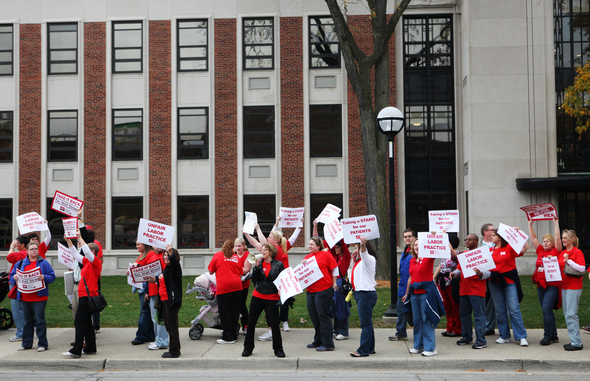
More than 400 nurses and supporters showed up to take part in a rally at Liberty Plaza in downtown Ann Arbor to march to the University of Michigan Hospital and protest Oct. 12.
Jeff Sainlar I AnnArbor.com
Oppenheim led the U-M Professional Nurse Council and Michigan Nurses Association in seven months of tense contract negotiations with the U-M Health System. During that time, the MNA met with UMHS officials more than 50 times and held three large-scale protests criticizing UMHS for wanting to cut back overtime allowances and benefits.
But as U-M nurses decried proposed cutbacks, university officials lamented a tough budget year that put the health system $23.5 million in the red and included the completion of a $754 million children's and women's hospital. At a September Board of Regents meeting U-M’s Executive Vice President for Medical Affairs Ora Hirsch Pescovitz called the fissure between the two parties "significant."
Negotiations between the two groups became so unravelled that over the summer the MNA filed a complaint with the Michigan Employment Relations Commission regarding UMHS's conduct during contract negotiations. Additionally, a state appointed mediator had to intercede during negotiation meetings starting in August due to their heated nature.
In early October, the nurses began discussing a strike.
The standoff left relations between the nurses and their employer strained, but resulted in a series of significant compromises that were finalized on Sunday when a contract, which runs until June 30, 2014, was officially ratified by a 2 to 1 margin. The nurses had been working without a contract since June 30.
The contract extends benefits to more than 4,000 nurses.
"We were able to do some things that no other work groups at the university have done," Oppenheim said of the contract. "If we hadn't had the activism of our members then the only thing we could have done was just agree to whatever was brought to us in the initial proposals."
The contract, according to UMHS, raises health system costs associated with nurses pay and benefits 3.5 percent per year.
In statement, UMHS implied that the difficult negotiations had not permanently strained its relationship with the nurses.
"We are pleased that we have come to this agreement after months of good faith negotiations," Margaret Calarco, UMHS chief of nursing, said. "We look forward to continuing to provide quality patient care by the highest caliber nurses in the country."
Oppenheim said the "professional relationship" between the nurses and their employer is still intact, despite the lengthy and heated negotiations.
But it is clear that some tension remains.
"I'm not saying that it's good, what the university has done," Oppenheim said of a few unwelcome changes in the contract.
Key agreements in the contract include:
- Nurses will receive a 3 percent pay increase in 2012 and 2013 and a 4 percent increase in 2014. That's a significant difference from UMHS's desired 2 percent increase for each of the three years, Oppenheim said. The increase means that most nurses will make between $5 and $10 additional per hour by the end of the three-year contract. The wage change does not apply to nurse practitioners.
- In 2013 and 2014, Nurses will pay 30 percent of their health insurance premiums, up steeply from the current level of 15 percent. UMHS will pay the remaining 70 percent. However, that 30/70 ratio also includes prescriptions, physician visits and other procedures. "People will pay 30 percent of all their healthcare costs," Oppenheim explained. U-M began shifting healthcare costs to employees at each of its three campuses in 2010.
- Nurses lost eight hours of paid time off per year, but got restructured sick leave allowances. After two years with UMHS, a nurse may take six months of approved paid sick leave and six months of sick leave at half pay. That's a significant change from current allowances, which don't grant more than ten weeks of fully paid extended sick leave. Under the old contract, nurses with less than five years at UMHS received 24 days of paid time off each year.
- The contract includes new language that supports uninterrupted lunch breaks. Nurses skip their lunches "all the time, routinely" under current conditions, Oppenheim said. "Obviously if people don't get to eat that's going to impact their care," she added. The contract also gives nurses more control over patient scheduling.
- The agreement clarifies that members of MNA must pay dues even if no paycheck is received.
- The contract also mandates that UMHS will assist a nurse abusing prescription drugs in finding rehabilitative treatment. It states that if a nurse is believed to be stealing medication, a thorough investigation must take place before that nurse is discharged.
Kellie Woodhouse covers higher education for AnnArbor.com. Reach her at kelliewoodhouse@annarbor.com or 734-623-4602 and follow her on twitter.
Comments
kay
Thu, Nov 10, 2011 : 3:17 a.m.
These and all nurses deserve every "penny" they make---wish I could say every "dollar" they make ---but they could never be paid enough for what they do.
Jeff Gaynor
Thu, Nov 10, 2011 : 1:09 a.m.
David Frye: Thanks for defending my integrity - math and otherwise. (I am a math teacher, and was momentarily mortified when my math was criticized.) a2zoo explains the $5-10 raise as being due to a step increase, which was not mentioned in the article. When I started my career, nursing and teaching - both highly skilled and constantly demanding jobs - were at the bottom of the rankings, in terms of status and salary. Only through strongly advocating for their profession and their patients or students - and yes, through unions (check the salaries of teachers in non-union states) - have they managed a somewhat decent living. And I do know that it's nowhere near $100,000/year.
15crown00
Wed, Nov 9, 2011 : 5:56 p.m.
can u feature that hospital without nurses?each side did what it took to get the deal done. COMPROMISE.
rosewater
Wed, Nov 9, 2011 : 5:11 a.m.
Don't know many nurses at the U making $100,000 a year and I've been there a long time.
Polyjuce123
Wed, Nov 9, 2011 : 2:58 a.m.
Just remember, the nurses won all of these perks because they were interested in "taking a stand for their patients".
Polyjuce123
Thu, Nov 10, 2011 : 3:01 a.m.
@ Chelsea Old news you bring....the nurses chose to strike and if patient care was interrupted it would have been their fault (remember they were fighting for "their patients"). I'm not sure how YOU missed the giant elephant that is in the room, the one of superiority, negativity and down right lack of respect for the "common" person that chooses to comment on this story. Maybe you should enlighten yourself and review some of the past commentary left by nurses upset with just basic questions from the public, their responses were nothing less than disgusting. Of course UMHS would want to settle to, because they knew they the nurses would put patient care in peril over the lining of their pockets. Ask yourself, does anything really outlined in the literature of the agreement lead you to believe that these nurses are moral for holding signs that portray patients at UMHS as being in peril? Its sick, disgusting and they should be ashamed. Amen.
Chelsea8226
Wed, Nov 9, 2011 : 7:24 p.m.
Polyjuce123- Maybe you are just upset because your work isn't meaningful and you aren't able to take a stand for anyone? The University's press release stated, "We value our nurses highly, as they play a crucial role in the quality and safety of care we provide at UMHS. UMHS is pleased that we have come to this agreement. We look forward to continuing to recruit and retain the highest caliber nurses in the country." It appears the University has seen how a work stoppage could have affected patient care at UMHS, how is it possible you keep missing the mark? Nonetheless, it is settled and it seems both sides are happy. So why do YOU still have an opinion about this topic?
David Frye
Wed, Nov 9, 2011 : 2:56 a.m.
Jeff Gaynor's math is absolutely correct. Please re-read his comment: it is a critique of the article, not the nurses. If a nurse near the top of pay scale makes $40 an hour, then after three raises (3%, 3%, and 4%) he/she will be making $4 an hour more. So a nurse at the bottom of the pay scale would make an additional $2 or $3 per hour. Yet the article states that "most nurses will make between $5 and $10 additional per hour." That seems like a mistake at best, an inflammatory statement at worst. And at the very least it calls for clarification.
KatiGal
Wed, Nov 9, 2011 : 1:24 a.m.
And I think of some of the clerical staff who make the place run, who are making half of what the nurses make and maybe have a couple of kids to support. They were supposed to be happy with a 3% increase and have to pay for parking and more of their insurance. Maybe they should unionize. But, I DO support the nurses. They do an awesome job.
Ruth Spalding
Wed, Nov 9, 2011 : 12:36 a.m.
@ Jeff, you can't do math, sir. My mother is a nurse who has worked for the University for quite some time, which means she is one of the highest earners there. With this negotiated raise, she will make $43 an hour, which is less than the bottom number you quote. Remember, these people SAVE YOUR LIFE when you show up in places like the ER. I have no problem paying people well whom I may need to rely on, like nurses, doctors, med techs, to save my life. (But biased, my mother is a nurse).
David Paris
Tue, Nov 8, 2011 : 11:49 p.m.
I like how the poll results are so far, a dead heat at 1/3 each. That's how the results of a good negotiating process should be split. A valiant effort by all, thank you!
David Paris
Tue, Nov 8, 2011 : 11:45 p.m.
Congratulations Nurses and UMHS for coming to an agreement- That's The MICHIGAN Difference!
David Briegel
Tue, Nov 8, 2011 : 11:42 p.m.
You naysayers are correct of course and it is all the fault of the Nurses. Those saintly administrators physicians and corporate health care suppliers have absolutely nothing to do with it. And that is the most delusional statement anyone could ever make!
PLGreen
Tue, Nov 8, 2011 : 11:20 p.m.
@ Mike, you are right, you should become unionized. Unions built the middle class. Union bashing is destroying the middle class.
SalineGrandma
Tue, Nov 8, 2011 : 10:56 p.m.
I don't even make $10 hour and I certainly can't afford to pay for health insurance. The nurses, who do a fantastic job, will soon have nobody to take care of. The insurance companies are paying for less and less. Companies are continuing to increase health costs, if not dropping insurance altogether. Soon, the only people who will be able to afford health care are the very poor who get it free, the very rich who don't care what it costs, and the health care professionals. Take care of yourself or...
Jeff Gaynor
Tue, Nov 8, 2011 : 10:38 p.m.
"Nurses will receive a 3 percent pay increase in 2012 and 2013 and a 4 percent increase in 2014... The increase means that most nurses will make between $5 and $10 additional per hour by the end of the three-year contract." This 10% raise means that U-M nurses are now making $50-100/hour - the equivalent of $100,000-$200,000 for a full year equivalent salary (40 hours x 50 weeks). I tend to doubt this, but perhaps I'm wrong.
proudnurse
Wed, Nov 9, 2011 : 3:46 p.m.
I work at the U, could you pleas point me in the direction of these jobs that are paying $50-100 an hour (100-200k per year)??? I'd LOVE one of those positions! I've been a nurse there for 9.5 years and make less than 60k per year! Or better yet, maybe you should retake your high school math class!
rosewater
Wed, Nov 9, 2011 : 5:05 a.m.
How many nurses do you know at the U making $100/hour?
a2zoo
Wed, Nov 9, 2011 : 1:02 a.m.
You are totally wrong!!!! Let me show you the math!! Let's say a nurse is making $40.00/hour (near the top of the pay scale) and gets a 3% raise. 40x.03=$1.20=$41.20, the 2nd year another 3%. 41.20x.03=$1.24=42.44/hour and the final year a 4% raise. $42.44 x .04=$1.70/hour=$44.14/hour. This is hardly $50.00-$100.00/hour and far from $100,000-$200,000/hour. It actually comes out something like this for a nurse that works three 12 hour shifts per week. $44.14x36=1589.04x52=$82,630.08. Do not even know how you came up with your figures. This example is for someone at the upper end of the pay scale. The nurses at the lower end of the pay scale will see increases of close to $5-$10/hour because of step increases, but the will still not be near the top of the pay scale at the end of the contract. So, I am glad you tend to doubt your figures, because they are dead wrong.
Ruth Spalding
Wed, Nov 9, 2011 : 12:38 a.m.
Oops, figuring out the comment system. See comment below for a math check.
Mr. Ed
Tue, Nov 8, 2011 : 9:58 p.m.
I support the Nurses and they deserve even more. The small pay raises with not off set the cost of 30 % for Health Care. Thank you for skipping lunches and holding your bladder to care for the sick.
xmo
Tue, Nov 8, 2011 : 9:16 p.m.
"Big Medical" screws the common people again! Forget Wall Street, These nurses in time of trouble go out of their way to make us pay more for health care. With care givers like this who needs Dr. Kevorkian!
Mike
Tue, Nov 8, 2011 : 9:04 p.m.
And the cost of health care continues to rise..........while the rest of us continue to lose our jobs, insurance, and take pay cuts. I guess we should alll become unionized and collapse the entire system............
David Briegel
Tue, Nov 8, 2011 : 11:45 p.m.
And you will take out your personal problems on those who are your neighbors and not the Oligarchs that are destroying everything that we hold dear! Sad...
Randy Parrish
Tue, Nov 8, 2011 : 8 p.m.
Some other hospitals contracts are based on what UofM does.
dougfroma2
Tue, Nov 8, 2011 : 7:40 p.m.
How does this compare to other hospitals in southeast Michigan?
David Briegel
Tue, Nov 8, 2011 : 6:30 p.m.
And now the Union bashing may commence! Especially all those that will never, ever go to UMHS for their health care needs. Especially that boy from Chicago!