

One year after passage of Ann Arbor's pedestrian safety ordinance, most motorists aren't following law
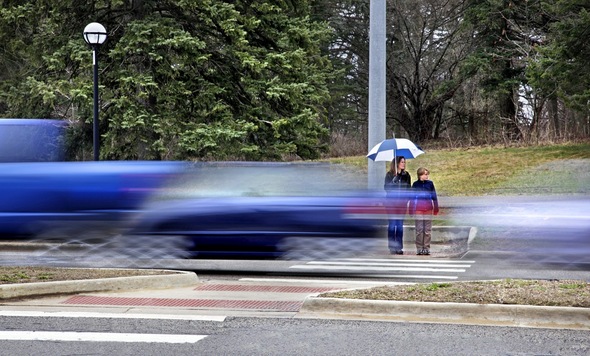
Ann Arbor residents Erica and Pike Briggs struggle to get motorists to stop for them at a crosswalk on Plymouth Road. A year after the passage of Ann Arbor's pedestrian safety ordinance, most motorists are not following the law and stopping for pedestrians at crosswalks.
Courtesy of Aaron Kiley
The overwhelming majority of Ann Arbor motorists still whiz by as pedestrians stand at the edge of city crosswalks, waiting for a break in traffic so they can cross safely.
That's a situation the Ann Arbor City Council hoped to mitigate by adopting what was considered a landmark ordinance in July 2010 that clarified the obligation of motorists to yield to pedestrians at crosswalks — even if the pedestrian hasn't yet entered the crosswalk. State law only requires motorists to stop for a pedestrian already in a crosswalk.
The ordinance was intended to foster a new kind of share-the-road culture in Ann Arbor, and city officials acknowledged it would take time to educate motorists about the new law.
But a year later, the message hasn't gotten through yet.
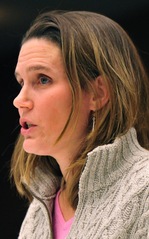
Erica Briggs
The WBWC was the driving force behind the ordinance change last year, and the group now is launching a campaign to increase awareness of the law.
The pedestrian safety ordinance states that when traffic control signals aren't in place or aren't in operation, drivers must stop and yield to every pedestrian not only within a crosswalk, but also pedestrians approaching a crosswalk. Under the previous ordinance, pedestrians had to enter the crosswalk to require motorists to stop.
Now, the penalty for not stopping for pedestrians approaching a crosswalk is a $100 fine and two points on a driver's license.
Briggs said the WBWC will soon launch a campaign to educate drivers, with the help of a $6,000 grant from the Michigan Department of Community Health and $2,500 from the Downtown Development Authority. Thomson Reuters, one of the area's largest employers, also has helped out with $500 worth of in-kind donations for educational materials that the coalition plans to distribute, while the city is making a $1,000 in-kind donation as well.
"Obviously, we're working with a small grant, so it's not going to be some massive education campaign," Briggs said. "But kind of how we're approaching it this summer is to try to reach out to the Top 10 employers out there, working with the University of Michigan and Thomson Reuters and a number of other large employers in town, to make sure their employees are educated about the new ordinance."
The WBWC hopes to reach 25,000 drivers through printed materials, presentations to community groups, information disseminated to employers, radio interviews and other media, as well as education of fleet operators and portable electronic signs at crosswalks.
Additionally, the WBWC is working with the police department, which plans to conduct targeted enforcement at three locations between July and September, Briggs said.
"It's important obviously that police are enforcing this new law and letting folks know that you can get ticketed for not stopping at crosswalks when people are waiting," Briggs said. "So this summer, if people are stopped, they're more likely to get a warning than actually get ticketed, but then moving into ticketing probably in the fall."
Getting the word out
One of the hallmarks of a walkable community, Briggs said, is when you come to a crosswalk, a car promptly stops for you.
"You wouldn't ask your child to go step in front of a moving car to get a car to stop for you at a crosswalk. You're not going to do that yourself," she said. "And so people need to understand you need to stop when you see somebody waiting at a crosswalk."
But are Ann Arbor motorists doing that?
A recent study by the WBWC looked at what's actually happening at different crosswalks throughout the city and whether motorists are stopping for pedestrians. On Plymouth Road, the stop rate was 1.7 percent of 635 vehicles that passed by on a Friday morning.
On Stadium Boulevard, the stop rate was 1.1 percent of 517 vehicles that passed by on a Monday morning. On Liberty Street at Virginia, the stop rate was 8 percent of 301 vehicles that passed by around lunch time on a Monday. On Main Street, between William and Liberty, the stop rate was 5.3 percent of 604 vehicles that passed by on a Monday morning.
Briggs said she isn't disheartened by the fact that it's been a year and the pedestrian safety ordinance hasn't caught on yet — she knows it will take time.
"It's probably going to take years to get where we want to be because we're retraining people on how to drive, and the police obviously are being cut back, so enforcement is harder than ever," she said. "And they're going to take a number of years to get crosswalks designed the way that we see them designed in some places like Boulder, but it has to start someplace."
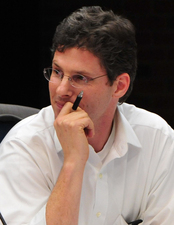
Carsten Hohnke
Jones noted he stopped for a pedestrian at a crosswalk recently and it caused a lot of commotion and he almost wound up being rear-ended by the driver behind him.
"We've got a lot of work that needs to be done," he said of educating the community about the ordinance. "And that work is in progress."
Council Member Carsten Hohnke, D-5th Ward, acknowledged the city is limited in its resources, so he's excited to see the WBWC stepping up to help get the word out about the pedestrian safety ordinance. He was one of the law's sponsors last summer, along with Mayor John Hieftje.
"It's perfectly understandable that not everybody would have seen the message yet, but I think there's certainly been a focus on it," Hohnke said. "We'd always love to have bigger budgets, but I think there's been quite a bit of output with the modest budget we have. There has been signage on AATA buses, keychains and posters educating around the ordinance."
In June 2009, Hohnke and Hieftje co-sponsored a resolution acknowledging that educating pedestrians, bicyclists and motorists is an essential part of making sure streets, sidewalks, crosswalks and bicycle lanes are used safely.
The resolution authorized spending up to $10,000 for development and implementation of a non-motorized safety education outreach program. Specifically, it directed transportation funds the city receives from the state — known as Act 51 dollars — to go toward development of a safe system of on-road bicycle lanes.
Hohnke said this will be the third year in a row that the city has dedicated $10,000 in Act 51 funds to non-motorized transportation initiatives, and a large chunk of that money is going toward educating the public about the pedestrian safety ordinance now.
According to Hohnke, there are talks of launching a yard sign campaign in which residents who live near crosswalks could agree to host signs on their property, carrying messages about crosswalk safety and best practices for following the pedestrian safety ordinance.
He also said there were two targeted police enforcement efforts last fall — one at Seventh and Washington and another at Ann and Fifth Avenue.
Rethinking crosswalks
Beyond enforcement and education, Briggs said the WBWC is working with the city on a new crosswalk design process, looking to communities like Seattle and Boulder for inspiration.
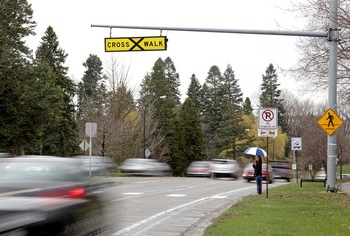
Even when signs are clearly in place, getting motorists to stop for pedestrians at a crosswalk is a formidable task.
Courtesy of Aaron Kiley
"Our crosswalks are not designed in a way to communicate to people what they're supposed to do," Briggs said.
"One thing we found is it's pretty easy to identify a crosswalk when it has a sign above it that says 'crosswalk,' but that's not what every crosswalk looks like," she said. "So a lot of folks aren't even necessarily sure what a crosswalk is, and then even if they do know what a crosswalk is, they need that reminder on the road that says 'stop for pedestrians.'"
Briggs said the city's engineers are amenable to working with the WBWC to develop design guidelines and target four or five crosswalks this summer for minor improvements.
Nearly 800 people recently took part in an online survey hosted by the WBWC that sought to determine what local drivers know about crosswalks.
Most actually said they know they're supposed to stop for pedestrians at crosswalks, but Briggs said that's not reflected in practice, and many survey respondents offered excuses for why they don't stop. Some said they're worried they could be rear-ended, some said they're worried a pedestrian might be hit by another car that doesn't stop, and some simply said they think pedestrians should have to wait for vehicular traffic to pass.
“I know I should stop; but I succumb to the prevailing behavior of not stopping," one respondent wrote. “There are no indications that I must stop, simply that there is a crosswalk," another said, suggesting a need for better signage.
“Waste of gas to accelerate back to speed," said another survey respondent. "They're walking, so they're obviously not in a hurry.”
The majority of respondents said they would support better crosswalk design and education for motorists to enhance pedestrian and driver safety.
Briggs said the problem isn't as dire on neighborhood streets, but rather on larger arterial roads like Plymouth, Packard, Washtenaw, Huron and Stadium.
"And in those cases, what the research is showing is needed is treatments like the HAWK signal that we see at Third and Huron," she said. "And there are other signals that are not quite at that level, but they're pedestrian-activated that alert drivers there's a pedestrian there."
Ryan J. Stanton covers government and politics for AnnArbor.com. Reach him at ryanstanton@annarbor.com or 734-623-2529. You also can follow him on Twitter or subscribe to AnnArbor.com's e-mail newsletters.
Comments
DaLast word
Mon, Sep 19, 2011 : 8:14 p.m.
I would like someone to define "approaching" for me. Are we talking 10 feet, 25 feet? 50? What? and what if I can't stop safely with out throwing my dog from the rear seat to the front? This rediculous law nurtures a culture of irresponsibility. I had a woman step off the curb in front of me the other day and she just assumed that I would stop...She bet her life on it actually. It won't be long before this is in the courts and this is overturned.
swcornell
Sat, Aug 6, 2011 : 1:01 p.m.
I'm not sure I get what this new law is? Since I was a child there has been a state law giving pedestrians the right of way in any cross walk. I was taught that if the intersection is busy with cars then just lift your arm and point across the cross walk before stepping out. Why would Ann Arbor need to create a law to supersede state law?
Crawford Milling
Tue, Jun 28, 2011 : 11:30 a.m.
Demonstrate CIVIL DISOBEDIENCE folks, they can't write everyone a ticket, and if you do get one, fight it in court! Make it the city's headache to enforce, not yours to obey. These tickets won't be upheld in appeals to county or state courts as these courts follow State laws.
Crawford Milling
Tue, Jun 28, 2011 : 11:17 a.m.
While we're at it, let's reverse all of the city's RAILROAD CROSSINGS and make TRAINS have to stop for waiting CARS, and fine the railroads big bucks when they don't stop. Absurd? Analogous.
bunnyabbot
Tue, Jun 28, 2011 : 4:59 a.m.
enforce the jaywalking laws. this should make the city a pretty penny from all the tickets they could write.
Peter Baker
Tue, Jun 28, 2011 : 7:59 p.m.
Enforce the traffic laws, the city will make even more.
KJMClark
Mon, Jun 27, 2011 : 9:51 p.m.
Check it out - here's a Chicago crosswalk sting operation report: <a href="http://theexpiredmeter.com/2011/06/crosswalk-enforcement-sting-set-for-downtown-wednesday-night/" rel='nofollow'>http://theexpiredmeter.com/2011/06/crosswalk-enforcement-sting-set-for-downtown-wednesday-night/</a> - and the website is an anti-parking ticket advocacy website. Their quote: "Drive safe. Give pedestrians the right of way. Not only is it the law, but it's the right way to drive. And to top it off–you avoid getting a ticket." Here's one from Spokane, WA: <a href="http://www.spokesman.com/stories/2009/feb/19/council-hears-complaints-on-crosswalk-enforcement/" rel='nofollow'>http://www.spokesman.com/stories/2009/feb/19/council-hears-complaints-on-crosswalk-enforcement/</a> - A councilmember there said, ""If you do the crime, you're going to get a ticket. Thank you for enforcing the law."" Geez, if you do a search on Google for the exact phrase "crosswalk enforcement", you get over 10,000 hits. California, Washington, New Jersey, New York, Kansas, Arkansas, Missouri, Oregon, Indiana, etc. Many, many hits for Chicago, both City of Chicago and Chicago area news media.
Sara
Mon, Jun 27, 2011 : 6:49 p.m.
So if I stop on Plymouth Rd at 8:15am or 5:30pm to let a pedestrian go by, will the city pay to fix my car when I get rear-ended?
John B.
Mon, Jun 27, 2011 : 11:08 p.m.
No, the person that rear-ends you will be at fault, as always.
Crawford Milling
Mon, Jun 27, 2011 : 5:33 p.m.
Hello! The POLICE don't even stop at the crosswalks, why should anyone else. And the city seems to forget who pays the majority of the city's taxes; the MOTORISTS. Well see what happens when a 42-wheel dirt hauler slams my little Honda into a mother and her child in a crosswalk. I'll see the entire city council and the WBWC in a Lansing courtroom when this happens, as a class-action with the victim's family and the trucking company's attorneys. This will be a CIVIL SUIT worth MILLION$! That's 10,000 crosswalk tickets per million. The city will NEVER make that up.
a2giacomo
Tue, Jun 28, 2011 : 10:49 p.m.
I would politely challenge your assertion that the motorists pay the majority of the city's taxes. Certainly those that drive cars do pay taxes, but the majority of taxes to any municipality are paid by property owners, and many of the motorists who are upset about this ordinance are in fact commuters who don't pay a dime to the city.
leezee
Mon, Jun 27, 2011 : 5:04 p.m.
I have to agree that this is a bad law. I live near Plymouth Road and travel it frequently. I am also and avid walker and have no problem navigating the crosswalks and have no expectation that cars will stop for me to cross. If there is a median to get to in the center, you should be a savvy enough walker to wait for one side to clear, walk to the median and wait for the other side to clear. If you are familiar with Plymouth Road, you may also notice that many of the drivers around there are students from other countries who reside in the area. Many have little experience driving and demonstrate very poor driving skills. That, along with the expectation that drivers make sudden stops on such a busy road, is just a recipe for disaster.
Woman in Ypsilanti
Mon, Jun 27, 2011 : 4:43 p.m.
I always have to laugh at these discussions because people seem to take sides (either driver or pedestrian) almost immediately. And then that seems to keep anyone from having a real discussion. But come on folks, drivers as a general rule don't want to run over pedestrians and pedestrians certainly don't want to get run over. Obviously, we have to have a system that is known and practiced by everyone. We clearly do not have that here. I see a few flaws in the current city ordinance but with some tweaking, I think that we could have an ordinance that is workable for both pedestrians *and* drivers. 1. Drivers may have a hard time seeing pedestrians on the sides of wide, busy streets. When I drive, my attention is on the road in front of me and since I drive on the right side of the road, I am able to easily notice pedestrians waiting to cross on the right side of the road. But when I am on a four or five lane road like Washtenaw or Huron, my attention is simply not on the sidewalk on the far left hand side of the street. The solution is to have pedestrian "islands" in the middle of the street. That also prevents the need to have all traffic in both directions stopped all at once. 2. It is difficult to know the intentions of pedestrians waiting at cross walks. Just this morning, I stopped for a woman who was standing at the cross walk. I thought she was waiting to cross the street but as she didn't notice that I had stopped and was just chatting away on her cell phone, I soon realized that she was just standing near a cross walk. Someone earlier mentioned a signal that pedestrians could give motorists to indicate their intentions. I would find it very helpful if the ordinance were rewritten to require an established signal from pedestrians (perhaps pointing to the other side of the street?)
UncleMao
Mon, Jun 27, 2011 : 4:41 p.m.
Why can't we just install catapults to launch pedestrians over busy roads? Cannons maybe? Think outside the box a little.
JSA
Mon, Jun 27, 2011 : 4:03 p.m.
It was a stupid ordinance in the first place as it was never going to be observed motorists. Making laws that are not going to be observed is an exercise in futility no matter what special interest groups like the WBWC. For that matter what is a member of the WBWC doing on the planning commission in the first place. Conflict of interest maybe?
Mick52
Mon, Jun 27, 2011 : 3:47 p.m.
It is not working because it was a dumb idea in the first place and implemented to either assure failure or to generate significant funds from fines. What A2 has done is create a local ordinance that conflicts with state law. To do this properly, the city should put in a street light at these crossings for pedestrians to enable a stop light like on Huron St. I suppose that is too expensive. That's too bad. You cannot expect drivers, particularly drivers from out of town to know this ordinance. Any publicity campaign will be fruitless it will not extend to enough drivers. Also when you drive and when you are taught to drive you are supposed to keep your eyes on the road and not be scanning off the road to see if any pedestrians are "approaching" a cross walk. There are some common sense applications being done that A2 could learn from. In Dexter Village there is a cross walk downtown. On weekends and when there are events, the villages puts signs on the roadway reminding people of the state law that they must yield to people in the cross walk. There is a seriously dangerous aspect to this law. On a roadway with two lanes in the same direction, such as on Plymouth or Stadium. A vehicle in the curb lane or perhaps two or three, can stop for a pedestrian. The first stopped driver waves the person to proceed and when they cross the second lane, a vehicle traveling that cannot see the pedestrian could continue and strike the pedestrian. I have seen this happen. Sometimes two lanes will stop and a vehicle in the middle left turn lane continues and causes a collision. That is what this requires a signal, to get all lanes stopped. I have lived here over 30 years. I have crossed all these streets and never have had to wait an unusual amount of time to safely cross a street simply by waiting for the traffic to clear. This is example of an ordinance passed by people who have no idea of traffic flow or traffic conditions. Dumb idea and no need for it.
Roadman
Mon, Jun 27, 2011 : 3:30 p.m.
A primary consideration that both pedestrians and drivers must keep in mind is to exercise due care when approaching crosswalks. Do not assume that the other guy is paying attention.
Erica Briggs
Mon, Jun 27, 2011 : 3:07 p.m.
WBWC's response continued... A few commenters have wondered what the term "approaching" means. When the city adopted this new ordinance, they modeled it after one used in Boulder, Colorado. Rather than making up new language, the city attorneys recommended adopting an ordinance that had been used and enforced successfully for 18 years in Boulder. It is my understanding that the police will be interpreting "approaching" as someone waiting to cross at the crosswalk. Regarding the fear of being rear-ended. The key to stopping safely is to look for crosswalks, watch for pedestrians & slow gradually. If you are past a safe stopping distance, you do not need to slam on your breaks and stop. That would be dangerous and also illegal. Think about your driving behavior at traffic lights. Sometimes when we see that yellow light we continue through the intersection because stopping would be unsafe, but typically we have time to stop. If you're watching for pedestrians at crosswalks, chances are you will have time to slow gradually and avoid the possibility any accidents. On multi-lane roads, a couple of cars may drive past you, but you will find that another motorist will quickly stop. Enjoy the few seconds this has taken out of your day to congratulate yourself on helping to make Ann Arbor a more livable community. Feel free to contact WBWC (info@wbwc.org) with any other concerns you may have. ~Erica Briggs WBWC Board Member <a href="http://www.wbwc.org" rel='nofollow'>www.wbwc.org</a>
Erica Briggs
Mon, Jun 27, 2011 : 3:06 p.m.
It's great to see such a lively discussion around crosswalks. I'd like to address some of the frustration with some general comments. Many of the commenters have pointed to a need for improved crosswalks (like the HAWK signal at 3rd/Huron) on busier roads like Plymouth. They are 100% correct. When motorists are traveling quickly along a corridor, a crosswalk that has a pedestrian activated signal is ideal. The problem is that the ideal engineering solutions on busy roads are often expensive. We are working with the city engineering staff to develop crosswalk design guidelines that will help to address this problem, but implementation will take time and additional resources. In the meantime, it is important to have increased education and enforcement. Many commenters seem to wonder if this law is necessary at all. Why can't pedestrians just wait?! There's not the much pedestrian traffic on high-volume streets anyway, right? Part of the reason you don't see many people crossing at mid-block crosswalks on busy streets, is because high-volume roads deter pedestrians. They aren't designed to be a walkable environment. Furthermore, many people who might like to cross are unable to make it across. Children, the elderly, individuals with disabilities. Prior to the HAWK signal being installed at 3rd and Huron, seniors at the YMCA had to be taxied across the street to exercise at the Y. Preschoolers at the Y were forced to walk blocks out of their way to cross at a signal to get to the park further down 3rd street. Individuals in wheelchairs could not cross there. When motorists are required to stop for someone waiting, busy streets no longer become unpassable moats in our community. Walkability is a key ingredient in making livable, vibrant cities. Comment to be continued... ~Erica Briggs WBWC Board Member <a href="http://www.wbwc.org" rel='nofollow'>www.wbwc.org</a>
Mark
Mon, Jun 27, 2011 : 2:50 p.m.
It would be far safer to have a pedestrian bridge over streets with high traffic volume and higher speeds. The crossing on Packard near Cobblestone Farm is terrible. Kids run across there because cars don't stop, creating the possibility of a fall. Four-lane roads should not have crossings where there is not already a stop light. That's inviting disaster of being rear-ended, or someone swerving to avoid you and hitting the pedestrian!
KJMClark
Mon, Jun 27, 2011 : 1:40 p.m.
Links for the previous three quotes: What Every Driver Must Know, section 9: <a href="http://www.michigan.gov/documents/SOS_WEDMK_9_Sharing_the_Road_158271_7.pdf" rel='nofollow'>http://www.michigan.gov/documents/SOS_WEDMK_9_Sharing_the_Road_158271_7.pdf</a> Michigan Uniform Traffic Code: <a href="http://www.michigan.gov/documents/UTC_50201_7.pdf" rel='nofollow'>http://www.michigan.gov/documents/UTC_50201_7.pdf</a> (Rule 702) MCL 257.659: <a href="http://legislature.mi.gov/doc.aspx?mcl-257-649" rel='nofollow'>http://legislature.mi.gov/doc.aspx?mcl-257-649</a>
KJMClark
Mon, Jun 27, 2011 : 1:32 p.m.
So, everyone was taught to yield to pedestrians, since everyone is supposed to have read, and been tested on, what's in "What Every Driver Must Know." The Ann Arbor ordinance is actually almost exactly the wording recommended by the State Police. And the Michigan Legislature decided in the law for "yield" signs that they had to use the word "approaching" to get the point across. So if you're coming up to a yield sign, that almost never has any traffic to yield to, and you realize that this time there's a garbage truck approaching from the side, at a pedestrian speed, but approaching, does that mean most of these commenters would feel free to ignore the yield sign? Is the state law stupid because you have to read the garbage truck driver's mind? Or is it different because the garbage truck is bigger and might makes right?
KJMClark
Mon, Jun 27, 2011 : 1:23 p.m.
The problem here is that many people have intentionally forgotten what they were taught in driver's ed, and think "yield" means something different when it applies to crosswalks. What Every Driver Must Know, p102: "As a driver, watch out and always yield the right-of-way to people walking, jogging, biking, crossing a street in the middle of a block, or darting from between parked vehicles. Watch for them when entering a street from a driveway or alley, at stop signs, traffic signals, roundabouts, crosswalks, and intersections." Michigan State Police recommended Uniform Traffic Code: "(1) When traffic-control signals are not in place or are not in operation, the driver of a vehicle shall yield the right -of-way, slowing down or stopping if need be to so yield, to a pedestrian crossing the roadway within a crosswalk when the pedestrian is on the half of the roadway on which the vehicle is traveling or when the pedestrian is approaching so closely from the opposite half of the roadway as to be in danger, but a pedestrian shall not suddenly leave a curb or other place of safety and walk or run into a path of a vehicle that is so close that it is impossible for the driver to yield." Michigan law, MCL 257.649(4): "(4) The driver of a vehicle approaching a yield sign, in obedience to the sign, shall slow down to a speed reasonable for the existing conditions and shall yield the right of way to a vehicle in the intersection or approaching on another highway so closely as to constitute an immediate hazard during the time the driver would be moving across or within the intersection. However, if required for safety to stop, the driver shall stop before entering the crosswalk on the near side of the intersection or, if there is not a crosswalk, at a clearly marked stop line; but if there is not a crosswalk or a clearly marked stop line, then at the point nearest the intersecting roadway where the driver has a view of approaching traffic on the inters
KJMClark
Mon, Jun 27, 2011 : 8:28 p.m.
Mick, my point is in the next post. I ran out of room in the comment since I was quoting relevant facts instead of opinions. The point is that yes, you did learn all of this in driver's ed, if you were paying attention; the city ordinance is basically the same as the State Police recommendation; and if the city can't use the word "approach" why aren't all of you up in arms that the state legislature uses the work "approach" when talking about yielding? Why don't you just admit you don't care what the word yield means, you're not going to yield to a pedestrian because you don't want to? That's what all of these arguments boil down to.
Peter Baker
Mon, Jun 27, 2011 : 6:51 p.m.
The city might have felt that because most people don't even follow the state laws, they had to go further.
Mick52
Mon, Jun 27, 2011 : 3 p.m.
Not sure what your point is. These are what the state law says. The city law is not the same. What the city is proposing is not what is taught in drivers ed.
Stuart Brown
Mon, Jun 27, 2011 : 12:47 p.m.
This law is disturbing on so many different levels: 1) many posts here plus the comment by the police chief himself have made it clear that the law actually puts both motorists and pedestrians in physical danger; 2) that a law like this could make its way on to the books from this council and mayor shows just how broken the current leadership has become. It is to the credit of the police that they have refused to enforce this law but it would be helpful if citizens stepped up and demanded that this law either be scrapped or rewritten--any law that puts oneself and/or other people's safety at risk when followed should be disobeyed; do I need to repeat that? Is that not common sense? Laws like these are supposed to improve the quality of life not make things worse! Instead, we have a council and mayor that never even conceived of, much less considered, all the chaos and danger they were subjecting the public to. It is particularly ironic that Carsten Hohnke, a man who claims to have a Ph.D in engineering from MIT, didn't see any of this coming and appears to be clueless as to basic laws of physics (2-4 tons of mass goes over 100-200 lbs of person quite easily). The comment from the councilman about the lack of resources was particularly rich given that he has to know that there is a $28 million dollar surplus in the streets repair fund along with surpluses in other financial buckets the city keeps that could be used to address the issue of pedestrian safety while not putting motorists at risk as well. Other posters on this thread have nailed it, you can't expect to stop traffic on a busy main commuting artery without traffic lights--but that would cost money and so the councilman is not interested. The same councilman is also not interested in preserving a fire department that can respond to house fires fast enough to save lives. The drivel coming out of this administration is simply beyond incompetent and truly grotesque.
MrBeasley
Mon, Jun 27, 2011 : 11:58 a.m.
One of the big problems with this law is that many of the city's bus stops have cross walks at them. It is impossible to tell if people are waiting at the curb for the bus, or to cross the street. I don't see how this law can exist without moving either the bus stops or the cross walks.
KJMClark
Mon, Jun 27, 2011 : 1:27 p.m.
Yes - that is a problem. They should be sure to put the bus stops near, but not *at* the crosswalk. Some of the marked crosswalks on Plymouth have this problem. But the one I'm thinking of has a special ADA-compliant handicap ramp dropping from the sidewalk to the crosswalk, since the sidewalk is higher than the roadway. Not sure how to fix that problem, since someone in a wheelchair trying to get on a bus would need to use a ramp like that to get down to where the bus picks up.
Phillip Farber
Mon, Jun 27, 2011 : 11:35 a.m.
Europe Stifles Drivers in Favor of Alternatives <a href="http://www.nytimes.com/2011/06/27/science/earth/27traffic.html?_r=1" rel='nofollow'>http://www.nytimes.com/2011/06/27/science/earth/27traffic.html?_r=1</a>
deb
Mon, Jun 27, 2011 : 5:20 p.m.
nor are our streets 1000 years old. (I do not care about indian trails because those did not take shape with stone buildings)
deb
Mon, Jun 27, 2011 : 3:14 p.m.
not europe. we are not joining with canada and mexico to start the north american union either
snapshot
Mon, Jun 27, 2011 : 5:40 a.m.
This law is so bizzare. Only in Ann Arbor would officials change state law governing established pedestrian traffic laws. The state laws governing crosswalks does not relieve the pedestrian waiting for clear traffic before entering the crosswalk. Only then does traffic stop to allow a safe crossing. This new law tries to make mindreaders out of drivers to anticipate pedestrian movements. Even the police chief thought he would be rear ended. This law is bad, bad, bad, and the city needs to repeal it and stay with the state law which requires the pedestrian to only enter the cross walk when it safe and free of traffic. Then vehicles must stop to allow safe passage. What a mess Briggs has created with her idealistic and unreasonable lobbying to change established traffic laws and years of driving habits. This is a tragedy and I would think that Briggs and officials should be held personally liable for any deaths or injuries resulting from the created confusion and false sense of security given to pedestrian. The jobs of officials only allow immunity when they have performed reasonably within the scope of their responsibilities. Changing state law upon which drivers exams are given and passed is NOT within their scope of responsibility. This city is out of line, out of order, and out of it's mind thinking they can change driving habits tosuit their own agendas. If you are pedestrian, look both ways and ensure it's safe to enter the crosswalk. Don'tlet these silly officials cost you your life by legislating an illegal law giving a pedestrian a false sense of security.
Mick52
Mon, Jun 27, 2011 : 3:04 p.m.
Troy did it too. During the ruckus about texting, Troy put an ordinance on the books for "distracted driving." Thus in Troy an officer can ticket a driver for anything the officer deems is "distracting" like eating, drinking, or any other activity other than driving. Another dumb idea that will trap people simply driving through that have no idea of a change in traffic law.
breadman
Mon, Jun 27, 2011 : 2:54 a.m.
Just Friday June 24th! HAWK light came on at Huron and Chapin, now I was in the left lane and this guy was in the right lane. The couple crossed heading towards the YMCA side and the guy in the right lane went right on passed the red light after the couple passed the right lane he was in. Now a law Officer was around to ticket for the red light running. I have had my drivers license for just about 35 years drove big truck and still no tickets. So a HAWK light or no HAWK in the State book for driving rights means.... Must stay stopped on a red light until gone, not then the person is out of the lane your in.
Jon Saalberg
Mon, Jun 27, 2011 : 1:41 a.m.
This ordinance doesn't stand a chance of being even remotely successful, when people have a hard time remembering to stop for a RED LIGHT at the newly installed signal at Chapin and Huron. I have used this particular signal to get across Huron, and it works, but definitely gives pause to pedestrians, joggers, and bicyclists, who wonder whether approaching traffic will, indeed, recognize the presence of the traffic lights. I haven't had a problem with the light, but I have seen one rear ender, and one near accident at this light. No light - no stopping. Just ask anyone trying to get across Washington and South Seventh, at the clearly marked crosswalk. At other crosswalks not as clearly marked - good luck.
Carl
Mon, Jun 27, 2011 : 12:35 a.m.
I was crossing in front of NYPD downtown and a aata bus driver honked right at me as I was crossing, as if I didn't have the right of way.
John B.
Mon, Jun 27, 2011 : 11:04 p.m.
Philly: NYPD is a pizza place....
Mick52
Mon, Jun 27, 2011 : 3:07 p.m.
I think Carl had the right of way if he was in the street. Traffic has to yield to a pedestrian in the roadway. State law. No need for a crosswalk or intersection unless the state has a new jaywalking law.
PhillyCheeseSteak
Mon, Jun 27, 2011 : 2:12 p.m.
Were you crossing in front of the NYPD in Ann Arbor? Or perhaps the AAPD?
grye
Mon, Jun 27, 2011 : 1 p.m.
Unless you were in a crosswalk or at an intersection, you did not have the right of way.
leaguebus
Mon, Jun 27, 2011 : 12:34 a.m.
Just start writing tickets. Word of mouth will work much better than any funded program. Plus the city will be getting much needed revenue at the same time. Cut down on the speed traps and do more crosswalk enforcement. Oh, by the way, I always stop for pedestrians because I ride a bike daily and see how many drivers that don't stop at crosswalks.
tim
Mon, Jun 27, 2011 : 12:28 a.m.
Not a smart law--- Cars are bigger than people , like my drivers ed trainer said back in the day " you can be dead right, but you can be right- dead" everyone please be careful.
dae
Mon, Jun 27, 2011 : 12:02 a.m.
Problem is, and I might be guilty of this myself, is that most people don't even know this ordinance exists - especially those of us from out of town. If AA really wanted to people to stop for pedestrians, then they should come up to downtown Brighton. There are elevated cross walks (kinda like an enlarged speed bump) with cat's eye flashing lights in the pavelment, and pedestrian signs with flashers as well. A pedestrian comes up to the sign, pushes the button to initiate the lights, and traffic stops. The other idea is, instead of hanging crosswalk signs, how about a regular traffic signal. These days, signals can run on solar power so AA can do this and be green too!
Alvan
Sun, Jun 26, 2011 : 11:51 p.m.
As someone who drives in Ann Arbor, and walks in Ann Arbor, I must say, I am all for protecting pedestrians AND drivers. Who decides what "approaching" is? If I get a ticket for driving through the crosswalk because a person is dawdling in the sidewalk, would a pedestrian get a ticket for NOT crossing at a crosswalk? Everyone could stand to benefit from common sense. Lets ticket drivers who disobey the law (good luck informing everyone from out-of-town, of which there are plenty), AND ticket pedestrians who choose to not use a crosswalk. Maybe this would bring things closer to a balance? Maybe?
grimmk
Sun, Jun 26, 2011 : 11:13 p.m.
I get that this is a law. I lived near Plymouth Rd where a pedestrian was killed by a hit and run. They reduced the speed to 35 and added that new crosswalk. Here is where it all fails. Most people, on average, will drive 5 miles OVER the speed limit. Going on that strain of logic, most people will also flaunt the stopping for pedestrians at a crosswalk ordinance. Not everyone will obey it. Thus, as others have said, accidents will ensue. We have to find this balance between pedestrian safety and driver safety. As a pedestrian you need to take responsibility for your own safety and assume no car will stop for you. You will not win out in a car fight. I see people crossing the middle of Washtenaw all the time, instead of going to the nearest corner. It boggles my mind. I see lots of people at night walking around in dark clothing. I scares me as a driver. And I fully believe that bicycles should be on the SIDEWALK and NOT the road. Too often I have to pull out into the on-coming lane to avoid them as there are not bikes lanes on every road.
Brad
Sun, Jun 26, 2011 : 10:19 p.m.
City Council - please note the comments here. They're running like 9:1 against your poorly thought out ordinance. That being the case, exactly who are you supposed to be representing?
Brad
Mon, Jun 27, 2011 : 7:17 p.m.
So then exactly one of your examples is from someone who claims to be leaving/left. One. The others are from people who may decide to leave later due to just this type of pandering to a small but loud minority.
Mick52
Mon, Jun 27, 2011 : 3:12 p.m.
I left. For this sort of thing. But I still frequent A2. Drive and walk there. Spend money there. So I have every right to write that this is a stupid ordinance that does not make sense. Lived and frequent AA for over 30 years. I have crossed all these streets and have never had to wait long at all. Never long enough to frustrate me. I guess I don't consider myself so important that I think other have to stop and wait for me. If its not a problem it does not need a fix. It is just so ludicrous to make drivers evaluate people "approaching a crosswalk."
Peter Baker
Mon, Jun 27, 2011 : 2:53 p.m.
Just a few: "I think I'll just avoid going to Ann Arbor." "Just another reason to not go anywhere near the peoples republic of Ann Arbor. Stay away, stay very far away." "Just another reason I will be moving out of this city in the near future...." "This law only applies in the People's Democratic Republic of Ann Arbor. " "Another reason I will not be frequenting Ann Arbor anymore."
Brad
Mon, Jun 27, 2011 : 1:38 p.m.
"Many"? Which article are you reading again? Sorry, but you're in a small minority.
Peter Baker
Mon, Jun 27, 2011 : 1:38 a.m.
And many of them also talk about leaving or having left this city, and how much they dislike it, so why give so much credence to their opinion?
bunnyabbot
Sun, Jun 26, 2011 : 9:48 p.m.
Not all the people driving around town are from a2. As far as I know motor laws are done on the state level and different states laws are pretty similar to others to keep things running smoothly. Not everyone will nor will you get a good chunck of drivers who know of a city ordinance. Furthermore, how is this enforced? can people get a ticket? if so, I bet it can be fought on the grounds that it isn't a state level driving law that you learn in drivers ed or that is widely advertised in a campaign to inform all drivers.
bunnyabbot
Tue, Jun 28, 2011 : 5:07 a.m.
motor vehicle laws are laws, which are done on the state level which you learn about it drivers ed, when a new motor vehicle law is inacted the state puts a lot into an advertising campaign to inform the public, this campaign also lasts a good while to make sure it reaches the widest audiance. A city ordinance just isn't going to be known to a wide population. Should we stop for pedestrians, yes, obviously. The ordinance however is flawed, some crosswalks are in poorly planned areas (like the above picture). My point simply was that the city has no business passing what amounts to a motor vehicle law and then expecting people to magically know it when they cross into the republic of a2. Additionally if they can't afford to have police enforcing the pedestrian (jaywalkers) ordinances who the heck is going to be able to write tickets for this?
John B.
Mon, Jun 27, 2011 : 11:01 p.m.
Ignorance of the law is (still) no excuse, sorry.
Mick52
Mon, Jun 27, 2011 : 3:20 p.m.
Right if the city wanted this to work, they should have put up stop lights like on Huron near the Y. Local govts should not be able to pass laws that conflict with state law or if they do they are so well identified that anyone present would know about the difference. When the state passed the broader CCW law, UM passed an ordinance banning firearms on campus even by people holding a CCW. How is anyone supposed to know that? When you are following behavior approved by the state, a local govt should not be able to take that away from you at least without significant communication so that people are aware of it.
rayjay
Sun, Jun 26, 2011 : 8:51 p.m.
As usual, pedestrians and cyclists are nuisances to these posters and should stay out of their way. Any ordinance or law that may inconvenience these privileged drivers is deemed a waste. Maybe if you put your cell phone down and paid better attention it would be a little easier to slow down or stop
Mick52
Mon, Jun 27, 2011 : 3:23 p.m.
I walk and I cycle and I am among those who think this law is dumb and an obvious failure. Furthermore, I don't need it. When I bike and walk I follow all traffic laws and never have had a problem crossing any street.
Joslyn at the U
Sun, Jun 26, 2011 : 9:03 p.m.
well if we have to look so should you. What makes you any more priveledged? answer=nothing
Joslyn at the U
Sun, Jun 26, 2011 : 8:46 p.m.
Correct me if I am wrong but are we not taught as children to LOOK BOTH WAYS BEFORE YOU CROSS? hmmm? lol just saying ya know?
Pika
Sun, Jun 26, 2011 : 8:34 p.m.
This works in Colorado because it is state wide, well posted and known by almost everyone. I'll bet very few of the average drivers in Ann Arbor are very aware of this law. It should be POSTED BETTER. At least signs at the city boarders. I'm sorry to say that I think this law is wishful thinking poorly applied. I would agree with it if it were advertised. Like every crosswalk (or at least most) should have a sign which says: *WARNING! VEHICLES ARE REQUIRED TO STOP FOR PEDESTRIANS AT CROSSWALKS CITY WIDE."
Mick52
Mon, Jun 27, 2011 : 3:26 p.m.
I think California has it too. Some years back I visited there and once your foot hit the roadway, all traffic immediately stopped. Works well as a state law, but folly at the local level. I agree with you about the signs, but this ordinance includes people who are even "approaching cross walks" making drivers guess, I guess.
mireader
Sun, Jun 26, 2011 : 7:27 p.m.
Other communities in Michigan that expect drivers to stop for pedestrians clearly label the crosswalks that way, many times with a stop sign in the middle. Ann Arbor expects drivers to stop for pedestrians and still has caution signs. I agree with the commenters that say it's difficult to tell whether someone is waiting for the bus, loitering on the sidewalk, or intends to cross the street, especially if the person is staring off into space in the other direction. Pedestrians should be more clear with body language that they are waiting to cross the street.
Cathie
Sun, Jun 26, 2011 : 7:22 p.m.
First I have heard of this law...make it effective only during the school year.
tommy_t
Sun, Jun 26, 2011 : 7:09 p.m.
1 dead driver is worth 2 dead in the crosswalk. Put up crossing lights for heaven sake.
Mick52
Mon, Jun 27, 2011 : 3:30 p.m.
I have no problem with tickets issued for people running a red light but not for a violation of this ordinance. A 15h District court judge could get more votes for dismissing tickets under this ordinance because it is too vague and conflicts with behavior allowed by the state. The stop light needs to be required in the ordinance.
leaguebus
Mon, Jun 27, 2011 : 12:27 a.m.
I would start to vigorously in force this law. Instead of speed traps, sit at these crossings and write tickets. Word will get around really quickly when the $100's start rolling in.
leaguebus
Mon, Jun 27, 2011 : 12:25 a.m.
Must be careful what you ask for. I cross daily at the crosslight on Huron and third. Many either do not stop on red or just run the red.
Matt Sussman
Sun, Jun 26, 2011 : 6:41 p.m.
There's a brand new bike path down Platt Road in Pittsfield Township, and I constantly see bicyclists continue to use the road.
Mick52
Mon, Jun 27, 2011 : 3:35 p.m.
Right Leaguebus. It has been proven that driving on a sidewalk, or on this type of path, is more dangerous that driving on the roadway. Often vehicles have to cross a sidewalk, or bike path to be able to see well. And bikes with higher speed are much more difficult to spot than people walking. Often it is a design issue. However cycling on the Platt path does give a cyclist the added safety of not being struck from behind. But then the cyclist has to take all the responsibility at crossing any driveway or street that crosses the path.
leaguebus
Mon, Jun 27, 2011 : 12:22 a.m.
Obviously you don't bike. If people were better drivers I would use the path. But people don't look for bikes doing 20mph on the path and They block it trying to enter the road from driveways or side streets. But they usually see me when I ride in the street. Again I say, who suffers most when a car and bike collide? Not the car. That is why I rarely ride on sidewalks. Call them bike paths if you must, but they are sidewalks.
Macabre Sunset
Sun, Jun 26, 2011 : 6:38 p.m.
Tom, California has a culture where pedestrians are aggressively ticketed for crossing outside of a crosswalk and against a light. Be careful what you wish for. California would also never place crosswalks like the one across Plymouth and the one across Washtenaw near Platt. That's inviting tragedy.
gild
Sun, Jun 26, 2011 : 6:34 p.m.
It might help if Ann Arbor pedestrians ever bothered to watch where they're going.
A2transplant
Sun, Jun 26, 2011 : 6:11 p.m.
Dear A2 League of Concerned Pedestrians: please stop launching an ideological and abstract war on your rights to walk across the street. Rather, do so in a manner that would actually achieve results....engage in black & white thinking. Speak in language that drivers comprehend and can readily respond to...like "stop lights" and "traffic signals." You belong on the sidewalk. Cars belong on the street. Your money would be more wisely spent by installing crosswalk signals that control traffic lights. It's what the rest of America does when they discover intersections that are too busy for pedestrians to cross unaided. Case closed. But, no...A2 wants to spend so much time & energy scolding drivers for not predicting what pedestrians are going to do next. Yes, there are reckless drivers (there will always be reckless drivers), but on the other hand, there are also reckless pedestrians. As one who wears both hats on a daily basis, I see more pedestrians take matters into their own hands and blindly walk into the street, without the right of way, and without any regard for personal responsibility. Spend your money on clear cut signals that will actually help matters on the road. You're only perpetuating the 'problem' and creating more of a divide within.
deb
Sun, Jun 26, 2011 : 9:23 p.m.
omg, you would have to walk an extra mile??????
grye
Sun, Jun 26, 2011 : 6:59 p.m.
The issue comes when the distance between intersections with traffic signals is 1/2 mile or more. There needs to be crossing areas inbetween them. Putting the crosswalks along Plymouth Road was needed to allow pedestrians to safely cross. Better signage is needed and/or flashing yellow lights to warn drivers to yield to pedestrians would help.
Tom Joad
Sun, Jun 26, 2011 : 5:55 p.m.
California has a culture of crosswalk safety and compliance. Ann Arbor touts itself as a sophisticated town but it is far behind in driver awareness and regard for crosswalks. The argument about being rear-ended is specious. The car behind you would be 100% at fault. He or she is required by law to maintain a safe distance and be ready to stop. AAPD needs to vigorously enforce crosswalk violations with sting operations that slap people hard in the wallet. I guarantee if enough people get ticketed word will spread like wildfire and people will drive more prudently. You only drive at the behest of your insurance company and 2 points and moving violation will definitely show up when your insurance is renewed.
Mick52
Mon, Jun 27, 2011 : 3:40 p.m.
Is the reason it works in CA because it is state law? The problem here is that the city has made illegal what is allowed by state law. Sure you could start ticketing people and that might get the word out, but it won't spread outside the city. Minus proper signage, its blatantly unfair to drivers to know such a law is in place
Macabre Sunset
Sun, Jun 26, 2011 : 5:55 p.m.
This is a stupid, dangerous law. I hope it's challenged by the first people ticketed. You can apparently challenge speed limits based on percentage of compliance. This is the equivalent of changing the speed limit on I-94 to 30 mph and expecting people to comply. Pedestrians mostly seem to understand, and avoid eye contact until they think it's safe to cross.
Macabre Sunset
Sun, Jun 26, 2011 : 7:37 p.m.
grye, it's a bad law if you have to risk death or serious injury to follow it. I wouldn't much care about who gets the ticket if I'm rear-ended at 45 mph.
deb
Sun, Jun 26, 2011 : 7:14 p.m.
i say error on the side of common sense. it is a lot easier to for a person to stop walking, then it is for a person to stop an automobile.
grye
Sun, Jun 26, 2011 : 7:01 p.m.
The ordinance is a good one and if it causes rear end collisions, then the tailgating driver should be ticketed. Error on the side of the pedestrian. They will always lose if hit by a car.
nowayjose
Sun, Jun 26, 2011 : 5:47 p.m.
I'm sure the police really care about enforcing this law for counsil now, with layoffs pending
Mick52
Mon, Jun 27, 2011 : 3:43 p.m.
1. AAPD officers are intelligent 2. They should know this law makes not sense 3. They are the ones who will take the heat from a driver who is following state law and could in no way image an ordinance like this could exist.
BernieP
Sun, Jun 26, 2011 : 6:29 p.m.
1 - Our law enforcement officers are professionals. 2 - see #1.
Tom Joad
Sun, Jun 26, 2011 : 5:40 p.m.
In California there is a culture of pedestrian crosswalk safety that has evolved. Michigan is obviously way behind in that culture. The argument for not stopping for fear of being rear-ended is specious to say the least. The car behind you will be 100% at fault. They are required to maintain a safe distance and be prepared to stop. If they fail to stop it is their fault, not yours. Your duty is to pay attention to the road ahead and if someone is in the crosswalk or wants to cross, you STOP.
Lemmy Caution
Sun, Jun 26, 2011 : 5:33 p.m.
I'm all in favor of encouraging walking and bicycling. From a libertarian pov, it's even in my interest to stop the car at stopwalks. As someone who pays for health insurance, my premiums go up due to larger numbers of people who don't get enough exercise (walking, biking). More walkers and more bikers = lower premiums = more freedom for me to spend my earnings on preferred activities. Anyone against govt health care should be a VERY dedicated cross-walker observer. I think ignorance is a problem: many drivers just don't know better. I think entitlement is a problem: many drivers selfishly resent pedestrians' desire to share the public space of the road. I think fear is a problem: many drivers are afraid of being rear-ended. Speeds on Plymouth, for example, are too fast. Speeds on State St, however, are not the problem. I think enforcement is a problem: more tickets should be given out. Or have cops sitting in car nearby as a warning. It works on the highways, where everyone goes to the legal speed limit or lower when a patrol car is sitting there watching/clocking us. In time, we will learn.
PaulS
Sun, Jun 26, 2011 : 5:31 p.m.
Back in the day my kids went to "safety town". I don't know if this program is still being run for kids entering kindergarten but here is some of what the 5 year olds were (and still are) being taught: For a busy road, walk down to the corner with a traffic light, wait for the pedestrian "do not walk" to change to "walk" look both ways and proceed to walk across to the other side. For a road with stop signs. Go to the corner, look both ways and only cross when the traffic is clear. Why don't we just follow the principles we teach our 5 year olds? Is crossing the street that difficult?....only in Ann Arbor!
PhillyCheeseSteak
Mon, Jun 27, 2011 : 1:58 p.m.
Paul, these pedestrian crosswalks are placed where there is a great distance between intersections with traffic lights and/or stop signs. For example, there's a pedestrian crosswalk on Packard in mid-way between Platt Rd. and the Eisenhower/Packard split, which is close to 1 mile. If you were walking would you go to either of those intersections, which could be almost a mile out of your way, to cross? Although this is a busy section of road, it is also in a neighborhood area and there are many children and people using the crosswalk to get to the library, pool, park, places of business, or to cross to/from an AATA bus stop.
CountyKate
Sun, Jun 26, 2011 : 5:29 p.m.
From all the comments, this law sounds unenforceable and dangerous to pedestrians and vehicles alike. What happens if the car is rear-ended while a pedestrian has just stepped in front of it? The pedestrian could still be killed. I think I'll just avoid going to Ann Arbor. It's simpler than trying to figure this law out.
John B.
Mon, Jun 27, 2011 : 10:55 p.m.
CK; We won't miss you a bit. In fact, this law might weed out a lot of the inconsiderate and accident-causing motorists, if we are lucky.
KJMClark
Mon, Jun 27, 2011 : 4:48 p.m.
Except that you're supposed to stop more than three feet from the crosswalk. You know, if you stop right at train tracks and someone rear ends you, you could be hit by a train. Except that you're supposed to stop farther back than that.
melissa
Sun, Jun 26, 2011 : 5:24 p.m.
It would help if there weren't so many horrible pedestrians out there. You see them constantly walking in front of traffic, not crossing at crosswalks. Walking in front of cars when they don't have the right of way - and they don't even look at you. This is especially bad around campus and downtown. I agree with several other posters - the information has not been relayed that you must yield to pedestrians, the signage is inconsistent - and how about teaching these lessons every time you need your license or plate renewed? On Plymouth Road where that crosswalk is is where a pedestrian was hit and killed, and while that is sad - perhaps one shouldn't cross the road at night, dressed in black. And while you're at it - teach people about these roundabouts you installed.
Peter Baker
Sun, Jun 26, 2011 : 7:31 p.m.
While you're at it, let's crack down on all the horrible drivers out there. The ones that drive 45 in a 30, that don't come to full stops at stop signs, the ones that tailgate on the highway, the ones doing all sorts of incredibly dangerous activities.
deb
Sun, Jun 26, 2011 : 5:15 p.m.
"Erica Briggs, a city planning commissioner and board member for the Washtenaw Bicycling and Walking Coalition." It is now obvious why the city ordinances and decisions have been decided in certain ways. I have to wonder about the conflict of interest in this case. Is it ethical to be a board member on a group that lobbies the committee/public overseeing group that you are a part of?
KJMClark
Mon, Jun 27, 2011 : 4:47 p.m.
Now you're an ethics expert? She's on the Planning Commission - it's City Council that writes ordinances.
BHarding
Sun, Jun 26, 2011 : 5:15 p.m.
Wow. So many comments! I have to agree that the Plymouth Rd. crosswalk is hugely dangerous as is, should just spend the money to put up a pedestrian-activated traffic light. After dark, it is treacherous there, pedestrians don't seem to realize that the cars can't see them until practically on top of them. To those who think Michigan drivers are natural-born killers, I'd like to say the rush hour drivers are usually from out of town. People come a long way to appointments at the Hospital, and to classes on campus. Every town can make their own ordinances and this more than confusing to someone from another town. Notice that there are many out-of-state plates, too. We don't have even half the police we'd need to enforce these crosswalk ordinances, so stoplights are the reasonable solution. Everyone understands stoplights, no education needed.
shepard145
Sun, Jun 26, 2011 : 4:41 p.m.
Will be telling to see how Council responds when their dangerous, amateurish "traffic engineering" ordinance results in "ordinance followers" avoiding the $100 file and slamming on their brakes in traffic!! I hope the families of those killed, paralyzed, maimed or otherwise permanently injured drivers make their appointments with Council to speak their 3 minutes at the next available meeting. Since unlike traffic engineers, who have civil engineering degrees in this specialty, the families can come in and help the Council become more educated "legislative traffic engineers" one broken body at a time. Lets even create a certificate!! After 10 families of the dead or critically injured lecture Council, they've had a total of 30 minutes of instruction and each Council Member gets a CERTIFICATE OF FAILED LEGISLATIVE TRAFFIC ENGINEERING and a stainless steel plack with their names on it welded to the outside of the new (and hideous) Justice Center. ....another monument to their fine judgement! ...but otherwise yea, It's good to make it easier to mindlessly stroll across 45mph highways........
beeswing
Sun, Jun 26, 2011 : 4:35 p.m.
I remember years ago touring the small historic towns around Boston. I was quite amazed that as I stepped towards a crosswalk the cars would actually stop and allow me to cross. I thought to myself 'How wonderfully civilized these people are here!'. When I read about the crosswalk law being enforced in A2 I was pleased as I have had a number of unpleasant incidents as a pedestrian just trying to get across a street at a four way stop or right allowed on red intersections where I had the walk signal. Drivers seem overly aggressive even when I am pushing a child in a stroller which I often am. As a driver myself I have always tried to be thoughtful of pedestrians and so the other day as I drove towards town on Liberty where the speed limit is 35 shortly before it turns to 30 I stopped for a pedestrian at the x-walk. I was going the speed limit at the time and slowed to a stop easily enough but the driver behind me had a problem stopping in time and had to pull into the opposing lane. Why? Because one, he/she was probably annoyed I was driving the speed limit and was following too closely in an attempt to "nudge me along and two, they were not paying attention. I agree x-walks on streets like Plymouth need to be more well thought out but people need to be more courteous towards pedestrians, less bullying and arrogant. It really is the civilized thing to do!
deb
Tue, Jun 28, 2011 : 1:33 a.m.
and I am not debating that. the ticket is following too close. What I am stating is that the law does not make the roads safer, in fact the law makes it more dangerous for pedestrians and vehicles alike.
John B.
Mon, Jun 27, 2011 : 10:52 p.m.
Deb, it's the law: If you rear-end another vehicle, it's your fault.
deb
Sun, Jun 26, 2011 : 10:02 p.m.
And this ordinance was made to create a safer way around ann arbor. People are not even aware of the bright red stop signs when they are driving, or cars approaching when they are driving. This law just creates the opportunity for more accidents. Yes it does matter if they could see the pedestrian or not, because then they have some sort of sign that the car in front of them may stop. Furthermore, stop signs and other signs must be placed in a certain area of the curtilige, unlike pedesterians who may appear from anywhere, so that drivers can see them.
beeswing
Sun, Jun 26, 2011 : 5:32 p.m.
Doesn't really matter, Deb, if they could see the pedestrian or not. As a driver you should be enough aware and in enough control of your car and far enough away from the car in front of you to safely stop on a street like Liberty if say something like a child darts out into the road.
deb
Sun, Jun 26, 2011 : 5 p.m.
it could also be that they never saw the pedestrian, because your car was in the way, so they had no idea why you stopped
Fredric
Sun, Jun 26, 2011 : 4:24 p.m.
If this is the law, why are the police not enforcing it. I have seen many Police cars hiding behind trees, signs, what ever to catch speeders. Maybe a big push to go after and enforce this law might be a worthwhile endevor! Might even save someone's life in the process. I know that the officers are pushed from the top as to what the priority is. Maybe the Chief needs to discuss this law and put a little push behind it. IF not a priority with the boss, it is not going to get done!!
peg dash fab
Sun, Jun 26, 2011 : 4:24 p.m.
Every time I drive north on Division past Community High, I fear some student will pop out in front of the school, where there is a marked crosswalk. It is impossible to see anyone trying to cross because of the tight spacing of the parked cars along the west side of the street. The crosswalk at the south end of the Broadway bridge is another hazard, as Division swoops down then curves onto the bridge, leaving pedestrians in a blind spot. Of course, anyone driving in this town knows that high school and college students think they are immortal so we drive accordingly when transiting the ghettos.
bern
Sun, Jun 26, 2011 : 4:15 p.m.
In Germany there are many "Zebra Stripes" for pedestrian traffic. They are enforced, and the traffic (and pedestrians) know about and use them appropriately. However, on the other side of the coin, I don't recall any being used on streets like Plymouth Road. They are rational about where Zebra Stripes are used for pedestrian traffic. For example, none on Plymouth Road (use traffic signals). On State between North and South University: Perhaps 2 Zebra Stripes, and enforce jay walking regs so people only cross at those spots, etc. None at the exit ramps of traffic circles. None where traffic is so fast or heavy that a bridge or light serves better and more safely.
clara
Sun, Jun 26, 2011 : 4:10 p.m.
I have seen bicyclists on Packard also cut off pedestrians trying to cross in a posted cross walk. And just this past Friday, I stopped on E Huron at a cross walk but a U of M bus almost ran over the pedestrian trying to cross and another pedestrian thought I stopped to turn.
wlinsenbigler
Sun, Jun 26, 2011 : 3:40 p.m.
How much time and money have been wasted already on making and enforcing this stupid law? What a waste, now they are even trying to regulate walking? If you cannot cross the flippin street without getting ran over then I say Darwin is to blame. Humans have lived many years without help crossing the street. It's simple, if there are cars coming, do not cross. When there are no cars coming, cross. I bet more money was spent on the time and resources needed to pass this law as it would take to keep sports in our public schools for a year or two.
Mike
Sun, Jun 26, 2011 : 3:33 p.m.
Who came up with this ordinance? Two points and a $100 fine? For not slamming on the brakes on Plymouth and Washtenaw Avenue because someone is standing by the crosswalk. How about some personal responsibility on the part of the pedestrians and require them to walk to the nearest traffic controlled intersection and cross safely? Or if you have to have crosswalks in a certain location then make them traffic controlled walks. This law makes about as much sense as reducing the traffic flow on Stadium between Pauline and Seventh, creating potential accidents and traffic jams on a daily basis. Maybe one of the so-called traffic engineers should propose closing down roads that have pedestrians crossing them. Based on what I see and hear around this town that's probbably next, except the revenue generation would be lost...............
Vincent Behm
Sun, Jun 26, 2011 : 3:16 p.m.
Why can't they install a light and a simple signal button pedestrians can push to activate the light to cross, programmed with enough time for a pedestrian to cross then traffic can resume. I for sure wouldn't no that the sign means stop because someones waiting on the side of the road esp if i were just passing through. Makes no sense to me
Kent2525
Sun, Jun 26, 2011 : 3:05 p.m.
Just another reason to not go anywhere near the peoples republic of Ann Arbor. Stay away, stay very far away.
KJMClark
Mon, Jun 27, 2011 : 8:55 p.m.
I agree with Peter, I'd just as soon we attract law-abiding people who care about about everyone's safety, not just their own. Nice straw man there Deb. Saying that it should be safe for people to walk is not the same as saying people should only walk. I just drove my son to Toledo and back. My wife is going to drive him to a climbing gym in a few minutes. Guess what? I still think our roads should be safe for pedestrians to cross. Does that make me some kind of car-hater?
EyeHeartA2
Sun, Jun 26, 2011 : 7:48 p.m.
"I am looking to attract forward-thinking, considerate, respectful people of all stripes." Somebody put you in charge of recruiting when I wasn't looking?
Peter Baker
Sun, Jun 26, 2011 : 7:27 p.m.
And I still don't get what was so arrogant about saying Ann Arbor should be able to do better than other cities that already have great walking/biking cultures.
Peter Baker
Sun, Jun 26, 2011 : 7:26 p.m.
Nope, you're right, I am looking to attract forward-thinking, considerate, respectful people of all stripes. Not people that already seem to hate Ann Arbor and what I feel it stands for.
EyeHeartA2
Sun, Jun 26, 2011 : 5:18 p.m.
Evidently, this is not a problem for Peter. As I mentioned in the first arrogant post, it is very telling. Seems to be playing out that way. No surprises here.
beeswing
Sun, Jun 26, 2011 : 4:56 p.m.
So Peter desires Ann Arbor to be an attractive town but is selective enough to not encourage those who use such terms as "People's Republic of Ann Arbor" and this is a problem?
deb
Sun, Jun 26, 2011 : 4:05 p.m.
Peter, one of your above posts talks about attracting people to the city, now you make a complete 180 with that statement. If you are really serious about attracting people to this town, wouldn't you want a solution that fits well with everyone, not just yourself. I have avoided trying to make comments in response to you, because most of your comments on this post are your own personal experiences, and lead me to believe that you think people should just walk everywhere. Your comments do little to weigh both sides of the issue
wlinsenbigler
Sun, Jun 26, 2011 : 3:42 p.m.
If you cannot cross the street without laws to help you, I'd rather you were not in the city of Ann Arbor anyhow.
tdw
Sun, Jun 26, 2011 : 3:30 p.m.
Kent... I've avoided Ann Arbor when ever possible for over 30yrs.( ever since I could drive )
Peter Baker
Sun, Jun 26, 2011 : 3:08 p.m.
You won't be missed.
JMA2Y
Sun, Jun 26, 2011 : 3:03 p.m.
I read last year when it was passed that drivers stop when pedestrians have stepped off the curb into the crosswalk or are crossing not when they are standing on the corner. How is one supposed to understand, in the nano second as they approach and begin to pass a crosswalk at 45 mph or more, what is the intent of the pedestrian at the corner? I stop when I see them step off the curb or in the crosswalk, not just because they are standing on the corner. And indeed, it is impossible in a two lane road such as Plymouth, to stop in one lane while the other lane keeps going. The pedestrian cannot cross so the driver might as well keep going. For streets such as Plymouth, they need crossiing lights like the one on Huron past Ashley, before Seventh I believe. I think a pedestrian pushes a button, a light comes on to tell drivers to stop.
grye
Mon, Jun 27, 2011 : 1:07 p.m.
If you stop and the others don't, you have obeyed the law. Nothing wrong with that. Eventually the other lane will slow down and stop since you have obviously have stopped for a reason. I do agree that a flashing light to warn drivers would be very effective. Doesn't need to be a solid red.
peg dash fab
Sun, Jun 26, 2011 : 4:28 p.m.
I slow down (and stop) any time I see a pedestrian on the curb at a crosswalk (unless I'm texting or wolfing down a Big Mac, of course). Sometimes they notice and choose another place to hang out.
deb
Sun, Jun 26, 2011 : 3:01 p.m.
If this is what we need ann arbor police to do, giving people tickets for not obeying a ridiculous ordinance that asks you to read someones mind (most of the time,) then lay them off.
deb
Sun, Jun 26, 2011 : 2:54 p.m.
This will probably be a pain to enforce. I wonder if the officer writing a ticket for it will have to get the pedestrians statement, who the officer believed was about to use the crosswalk, that the pedestrian was actually about to use that crosswalk? Without evidence of that, this seems like a very fightable ticket. Think about it. If a pedestrian is at a crosswalk, that gives the option of going several different directions; right, left, straigt, or backwards. It will be extremely hard to prove without the pedestrians statement. Ridiculous law, that is a pain too enforce. Good job elected city officials. I like the fact that you were swayed by your own urban planner who is head of the walking and bicycle group. Now it all makes sense on why you pass the laws that you do, and those laws end up painting a bike and an arrow in the middle of S. Seventh (has anyone else noticed that there if you hug the center median line that your passenger side tires still run over what is supposed to be the bike lane markers?)
deb
Mon, Jun 27, 2011 : 5:17 p.m.
i think the majority of our population in ann arbor would love to see officers doing this. (sarcasm) We would be crying for more police cuts, if all the officers were doing were crossing streets. Sounds like a bad joke Why did the ann arbor police officer cross the street?
KJMClark
Mon, Jun 27, 2011 : 4:44 p.m.
Oh, no. Actually it's very easy. Set up a sting with two officers, one with a cruiser and one on foot. Preferably the officer on foot is *not* in uniform. The officer on foot picks a time, say every ten minutes. When the time is up, the officer starts walking from the sidewalk toward the crosswalk. When they get to the gutter pan, they stop and check to see if they can cross. If anyone is too close to stop, the officer waits until they pass. Then the officer starts walking. Anyone who does not stop is then ticketed by the officer in the cruiser. When that officer is done writing the ticket, they wait a few minutes then do it all over again. To be fair, the first few times they do this they should put up "Crosswalk Enforcement Operation Ahead" signs. Here's an article from Portland on how it works: <a href="http://eastpdxnews.com/general-news-features/crosswalk-%E2%80%98enforcement-missions%E2%80%99-aim-to-save-lives/" rel='nofollow'>http://eastpdxnews.com/general-news-features/crosswalk-%E2%80%98enforcement-missions%E2%80%99-aim-to-save-lives/</a> And as I recall it, Erica was living in Germany when they passed the ordinance change.
InterestedReader
Sun, Jun 26, 2011 : 2:51 p.m.
"And in those cases, what the research is showing is needed is treatments like the HAWK signal that we see at Third and Huron," she said. "And there are other signals that are not quite at that level, but they're pedestrian-activated that alert drivers there's a pedestrian there." I saw this for the first time this week and was surprised but I did stop at the flashing red, the pedestrian had already crossed and it took me a second to understand but I did stop. Spend some of the money and put flashing yellow to red lights at crosswalks that have multiple lanes like Plymouth.
Bob Carlin
Sun, Jun 26, 2011 : 2:50 p.m.
It's good to make walking easier. If the council wants to do something that would be effective right away, just prohibit right turns on red in the central part of the city. While it was a well intentioned attempt by council, it's not a good idea to place laws on the books which are not enforced. The potential for law suits and selective enforcement arising from the pedestrian safety law make the law a poor choice by council.
loves_fall
Mon, Jun 27, 2011 : 6:56 p.m.
And also, if peds see the blinking red hand, they better not decide to enter the road. My pet peeve is peds who fail to obey their sign but expect drivers to follow the rules.
beeswing
Sun, Jun 26, 2011 : 6:06 p.m.
I was once crossing Washtenaw Ave at Hill, on the walk signal, while holding the hand of my young child. A driver, wanting to make a right on red onto Washtenaw from Hill, was just inches from my child as we were making our way through the intersection. I was absolutely furious but my fury soon turned to delight as there just so happened to be a cop car behind the impatient driver and soon there was a lovely flash of blue lights. Ah, what a satisfying moment it was! I sort of hate all the "no turn on red signs" too but the problem is so many drivers think it is their god given right to turn without stopping even when there are pedestrians trying to cross. If there is a pedestrian at all in the intersection a driver should wait until they are well out of the way too, none of that trying to beat them to the street or brushing up against them.
wlinsenbigler
Sun, Jun 26, 2011 : 3:48 p.m.
Hhahahahahahahahahahah. I disagree, you should be able to turn right on red anywhere you go. If you cannot cross the street without help then you should stay on your block or in your house.
Mike
Sun, Jun 26, 2011 : 3:36 p.m.
It wastes fuel to sit there idling and increases carbon emissions and global warming; I mean climate change. So you're proposing we hasten the demise of the planet by eliminating turns on red lights?
amlive
Sun, Jun 26, 2011 : 2:47 p.m.
This is just one of the silliest head-in-the-clouds attempts at a law I've ever seen. It fails in far too many ways to possibly list.
Mike
Sun, Jun 26, 2011 : 3:37 p.m.
Their head are certainly somewhere.................
shepard145
Sun, Jun 26, 2011 : 2:46 p.m.
Pandering is right. This is what happens when laymen political hacks insert themselves into traffic engineering issues they know nothing about in order to coddle some group who refuses to cross at an intersection (follow the law themselves!), sometimes in the middle of the night ....and sometimes pay the price. So they come up with foolish, unworkable nonsense and make it OUR PROBLEM........or there's a $100 fine! They take our money because in the tree seconds approaching the intersection we can't figure out what ridiculous nonsense they've cooked up in Council Chambers this week. We need NAMES! Who proposed this idiotic solution and when are they up for re-election!?
peg dash fab
Sun, Jun 26, 2011 : 4:31 p.m.
Tell you what, shepard. How about if you run for council on a platform that proposes to make traffic laws more hazardous to those pesky pedestrians and to make this town hostile to human-powered mobility. I'll bet you would top what'shername's landslide defeat in the last mayoral election! Or perhaps you could take the situation in hand ... you know, the "Dexter" approach ...?
Les Gov
Sun, Jun 26, 2011 : 2:45 p.m.
""Most people are not aware that there's been a change in the ordinance. Most folks are just not aware that they're supposed to be stopping at crosswalks,"".......HOW FUNNY.....PERHAPS IT STARTS WITH HOW THE AA COPS DRIVE!! When I'm in the middle of a cross walk and some AA cop races through the walk close enough to me that I can reach out and hit his car with my hand.....I say there is a problem with how the AA cops drive. This so called law was designed to be nothing more than another way for the City to raise revenue through tickets.
loves_fall
Mon, Jun 27, 2011 : 6:54 p.m.
Yeah, the AA cops are a bit hypocritical when it comes to traffic enforcement -- no big surprise. I once got a ticket from them for something I see them do ALL the time... I hope they appreciate my complaints in to the station every time I catch them in the act. Something tells me no one has been ticketed yet, besides citizens.
peg dash fab
Sun, Jun 26, 2011 : 4:33 p.m.
I agree: the AA police should be the first ones to obey the law, yet I have seen them cruise past mothers with baby carriages waiting on the island to cross Plymouth Rd. Baby carriages!
ron
Sun, Jun 26, 2011 : 2:44 p.m.
This is the first I've heard of this insane law. Asking traffic to stop on a major heavily congested street like Stadium or Washtenaw is incredibly dangerous. Suppose I am driving down Stadium and I stop at a crosswalk because someone is "approaching" it and the other 3 lanes do not stop? I see a huge number of accidents unless everyone - including the large number of out-of-towners who visit, follow the law. It will do nothing but snarl already congested streets and may in fact lead to pedestrian deaths when the pedestrian walks in front of my stopped car only to be run down by a vehicle in one of the other 3 lanes who did not stop. Enough with this kind of ill conceived rule making. Erica needs to find something better to do with her time.
CincoDeMayo
Sun, Jul 3, 2011 : 2:16 a.m.
No, often people just race around you. I once stopped at Packard and Platter for a blind person using a cane (also a state law). Chaos and a lot of horn blowing ensued....
peg dash fab
Sun, Jun 26, 2011 : 4:35 p.m.
In my experience, if one lane stops, others follow suit. Be a good citizen by setting an example and obeying the law.
xmo
Sun, Jun 26, 2011 : 2:31 p.m.
They tried to outlaw booze and it failed, now they try to make us yield to walkers and it will fail. Stop making stupid laws and wasting money trying to educate us!
deb
Mon, Jun 27, 2011 : 7:01 p.m.
This law fails to make things safer. I will just rely on the statements of the police chief in the article to show the hazards it creates
Peter Baker
Mon, Jun 27, 2011 : 6:58 p.m.
Are you arguing for my point deb? Because you're right, endangering others should be outlawed, like not yielding for pedestrians.
deb
Mon, Jun 27, 2011 : 3:10 p.m.
wouldn't be a problem if we still had booze outlawed. that was part of the reasoning of doing it pete, because you didnt just hurt yourself
Peter Baker
Mon, Jun 27, 2011 : 3:18 a.m.
Pretty sure that's still outlawed.
deb
Sun, Jun 26, 2011 : 9:19 p.m.
wrong again pete. ever hear of drunk driving?
Peter Baker
Sun, Jun 26, 2011 : 3:12 p.m.
Outlawing booze failed because you were only hurting yourself. Road safety is about protecting everybody.
deb
Sun, Jun 26, 2011 : 2:21 p.m.
$10,000 x 3yrs =$30,000, spent, this "will be the third year in a row that the city has dedicated $10,000 in Act 51 funds to non-motorized transportation initiatives, and a large chunk of that money is going toward educating the public about the pedestrian safety ordinance now." Maybe put that money into building a raised crossing on Plymouth.
KJMClark
Mon, Jun 27, 2011 : 4:31 p.m.
So people who don't want to obey the law aren't happy? What's new? $30,000 wouldn't even pay for the engineering work. ADA-compliant raised crossings are a fortune.
deb
Sun, Jun 26, 2011 : 7:11 p.m.
i dont think the majority of the commentors believe this is a reasonable traffic law, and by looking at the dissenting comments regarding the law it is far from "completely" reasonable. If it was completely reasonable there would be no debate about it. So, maybe clarify your statement as to "this is what I believe to be completely reasonable."
peg dash fab
Sun, Jun 26, 2011 : 4:38 p.m.
Exactly, Mike, as so many of the comments here illustrate. The common sense solution to the problem is for drivers to drive defensively and obey the law, not to decry a completely reasonable traffic law that improves pedestrian safety.
Mike
Sun, Jun 26, 2011 : 3:38 p.m.
Common sense is all too uncommon in this town.
deb
Sun, Jun 26, 2011 : 2:47 p.m.
i know my solutions are too easy to work in a town like this.
SonnyDog09
Sun, Jun 26, 2011 : 2:34 p.m.
You must be new here. This is Ann Arbor that we are talking about. Why, the consultants alone on a project for a pedestrian bridge would cost more than $30K.
Jacob Bodnar
Sun, Jun 26, 2011 : 2:20 p.m.
This has to be one of the dumbest ordinances I've ever heard of, and for it to be a $100 fine and two points is absolutely outrageous. Quite honestly it's dangerous for the person trying to cross. What if you're on a four lane road, the car closest to the cross walk stops, but the car coming the same direction in the other lane doesn't. The pedestrian has begun crossing, and the car coming in the other lane can't see them because they're blocked by the other car. The pedestrian gets hit. Seems to me this is absolutely too dangerous on many different levels. Pedestrians can be patient and wait for traffic to clear, or go to the nearest traffic light if they really can't wait.
Tintin Milou
Sun, Jun 26, 2011 : 8:50 p.m.
Sure. And the driver on the second lane thinks: "Why the hack has the first car stopped! What a stupid driver. He probably had stalled the engine!" I hope people are a bit on the ball when driving. And I really like your idea about going to the nearest traffic light. Packard is a brilliant example where you have traffic lights all over the place, making pedestrians spoilt for choice!
peg dash fab
Sun, Jun 26, 2011 : 4:40 p.m.
Or drivers can watch the road in front of them and exercise caution when they approach a crosswalk. Why is that so hard?!?
bearlab
Sun, Jun 26, 2011 : 2:11 p.m.
This is maddening. On one hand we have MDOT and law that says that drivers know best when comes to setting driving speeds (the 85% rule) so we are encouraged to ignore posted speeds to make legal higher speeds that improve traffic flow. But now AA says traffic flow is not most important but rather pedestrian safety is, so we must come to a dead stop even if we even think that a person might just possibly want to cross.... a dead stop, that clearly risks motorist safety due to being rear ended. I am in favor of helping pedestrians safely cross but also want motorist safety to be at its highest level and you can not have that when there is ANY question to the motives of either party. In my mind road safety and driving habits have steadily eroded over the years and these laws do nothing to to improve it. We need laws and rules that make the stop-go actions to the absolutely clear to all parties involved and we need these laws and rules to be enforced. The few suggestions that I would make would be: If laws and rules are not going to be rigorously enforced then don't put them on the books. Driving tests should be enhanced so that you have to really know the rules to pass.. driving is not a right, it is a privilege New laws should not be allowed unless they include provisions for driver re-education ... no surprises
John B.
Mon, Jun 27, 2011 : 10:43 p.m.
Stupid is as stupid does....
Mike
Sun, Jun 26, 2011 : 3:41 p.m.
The stop and go driving will increase the carbon emmissions and cause us to be out of compliance with EPA mandated levels of ozone. This will hasten global warming (Is that still around or has it become climate change?) and cause us all to be destroyed by heat and drought or cold and floods depending upon who you ask. Where is Al Gore when we need answers to tough problems like this?
deb
Sun, Jun 26, 2011 : 2:03 p.m.
We put in roundabouts so that we waste less gas, yet we want people to stop indiscriminately at different points in the road for someone to walk across it, who is using no fuel at all, this seems at odds with that above thinking
KJMClark
Tue, Jun 28, 2011 : 2:19 a.m.
Um, go back and look at your link. It's a website, a decent, informative website, but not a study. There's no hypothesis, no methods, no research, no analysis, no conclusion. They don't even cite the source of that 30% statistic, which is from the IIHS (I saved you the trouble and looked it up for you.) IIHS cites a (real) study on small intersections, probably replacing four-way stops. Roundabouts probably do improve fuel economy by 30% over low-volume four-way stop controlled intersections. To wrap up, we put in roundabouts to improve traffic flow, with a side benefit in some cases of reduced fuel consumption. We encourage safe pedestrian trips in small part because that saves even more fuel. You said yourself the pedestrian trips use no fuel at all.
deb
Tue, Jun 28, 2011 : 1:31 a.m.
overrules? No, they are both scientific studies KJM. This is not like in law where higher courts overrule smaller ones. If you wanted to make an analogy to law this would be closer akin to a battle of the experts
KJMClark
Mon, Jun 27, 2011 : 8:46 p.m.
So I tried the phrase you suggested, "gas efficiency of roundabouts" and Google gave me 0 (as in none) hits. If you meant without the quotes, you don't understand how Google works either. That you'd think a webpage from a state DOT overrules a 2009 study from the Transportation Research Board shows that you don't understand how transportation research works either. Intersection efficiency is *not* the same as automobile efficiency. Transportation engineers balance a lot of kinds of efficiency when designing an intersection, but typically they're trying to maximize the efficiency of flow, not of overall gas mileage of the motor vehicles using the intersection. When we talk about car efficiency, though, the vast majority of people mean fuel efficiency. Do you understand the differences?
deb
Mon, Jun 27, 2011 : 5:14 p.m.
kjm- you realize that in your writing you imply efficient does not also cover fuel efficient. A sentence later, you tell me to get a more efficient car. Geez Kjm- dont you understand anything? Here is a study from the minnesota department of transportation <a href="http://www.dot.state.mn.us/roundabouts/" rel='nofollow'>http://www.dot.state.mn.us/roundabouts/</a> Look on the left side. Guess what type in "gas efficency of roundabouts" in google and you get about 480,000 results. I bet some say they are efficient and some say they are not. "Most of these roads existed long before anyone used gas" Thats awesome, but they have now changed in order to accommodate the automobile
KJMClark
Mon, Jun 27, 2011 : 4:24 p.m.
Geez Deb, do you understand how anything works? The main reason to put in a roundabout is because they're more efficient at moving moderate amounts of traffic safely than a stop or signal-controlled intersection. Here's a Transportation Research Board study that shows that roundabouts are *not* more fuel efficient in a lot of cases: <a href="http://pubsindex.trb.org/view.aspx?id=881196" rel='nofollow'>http://pubsindex.trb.org/view.aspx?id=881196</a>. They may be more fuel efficient than a four-way stop with equal, moderate traffic on all four legs. The primary goal of expressways is safe, fast, efficient travel. The primary goal of the other roads is safe, accessible, travel. Local roads are supposed to provide safe access. If you want to save fuel, get a more efficient car, carpool, take the bus, ride a bike or walk. Most of these roads existed long before anyone used gas.
Will Warner
Sun, Jun 26, 2011 : 1:56 p.m.
As the interplay of pedestrians and motorists unfolds in real-time, the pedestrians and motorists react instinctively in ways that make sense in the situation. Unfortunately, what makes sense is often the opposite of what the law requires. Ergo, people don't obey the law.
Roadman
Mon, Jun 27, 2011 : 9:27 p.m.
I agree, Will. And that is where safety issues come into play and pedestrians hurt.
T. Rhodes
Sun, Jun 26, 2011 : 1:52 p.m.
In Ontario, a pedestrian stands at the curb and points to the other side of the road. Didn't anybody think of that?
Mike
Sun, Jun 26, 2011 : 3:46 p.m.
So if he's pointing out something on the other side of the road, we should stop? Maybe a special hand sign that can be taught to everyone in drivers education would work better. Or maybe you carry an orange hat with you and put it on signifying that you want to cross. It could have a solar powered light on top of it that would flash so you cpuld be seen at night. What will we do for night time crossings. The government could mandate that drivers purchase night vision equipment................I know; my ideas sound even less credible than this law, maybe..............
wlinsenbigler
Sun, Jun 26, 2011 : 3:45 p.m.
When I am driving I point straight ahead. Why is crossing the street such a big issue?
BernieP
Sun, Jun 26, 2011 : 2:02 p.m.
Interesting, how do they hail the bus then?
conservative
Sun, Jun 26, 2011 : 1:50 p.m.
Another fine example of taxes dollars being wasted on something that will not benefit the majority of those that pay them. Just another reason I will be moving out of this city in the near future....
John B.
Mon, Jun 27, 2011 : 10:40 p.m.
Please don't let the door hit your posterior on the way out!
a2roots
Sun, Jun 26, 2011 : 1:50 p.m.
The wbwc and non-motorized transportation plan seem to dictate what occurs on our roads and sidewalks these days. These crossing are going to get people killed both in and out of cars. Far too many motorists drive in Ann Arbor that are not here every day. They have no clue what they are to do at these crossings. Getting the message out is a waste of money. It would be interesting to know how many accidents have occurred at these crossings. I would also like to know what other cities these crosswalks are being used in. I have travelled extensively and cannot recall encountering them.
BernieP
Sun, Jun 26, 2011 : 6:26 p.m.
Free your mind and the rest will follow. --- En Vogue Seriously, those two routes are two of the most economically viable in Michigan's largest city. How do we expect to begin to grow if we do not recognize "what works" in our state?
a2roots
Sun, Jun 26, 2011 : 2:12 p.m.
Not exactly the safest place to stop nor a destination spot.
BernieP
Sun, Jun 26, 2011 : 2:01 p.m.
Take a day trip to Detroit. Drive from 8mile and Livernois, south to Davison, make a left onto the Davison to the Lodge. Those two stretches have at least two midblock pedestrian crossings each where the speed limit is at least 35mph. Not saying they are safe or effective, just saying that within Michigan this isn't an Ann Arbor only phenomenon.
GreektownDave
Sun, Jun 26, 2011 : 1:50 p.m.
"The pedestrian safety ordinance states that when traffic control signals aren't in place or aren't in operation, drivers must stop and yield to every pedestrian not only within a crosswalk, but also pedestrians approaching a crosswalk." Surely the writers of this ordinance, being from the town which heralds the University of Michigan, had the intelligence to include in its' parameters the legal definition of "approaching". Since a person who is walking toward a cross-walk which is twenty-five yards away from them can in fact be said to be "approaching" it, without a legal explanation to clearly define at what distance from said crosswalk a person falls into the category of one who is "approaching" it, the ordinance obligates every motorist to look down the side-walks for a distance exceeding five car-lengths and stop to wait for a pedestrian to walk those five car-lengths, plus traverse the cross-walk, before proceeding. NOT including such a legal definition of what distance constitutes "approaching" would suggest its' authors and supporters were severely lacking in common sense. As anyone who has ever witnessed the disembarking of a school bus loaded with today's teens can attest, at the snail's pace which most of those self-centered individuals move, waiting for person's of that ilk to plod seventy-five feet down the side-walk and across the street can be a very long time.
Cindy O'Brien
Sun, Jun 26, 2011 : 1:43 p.m.
Requiring vehicles to stop for pedestrians on cross walks or approaching cross walks will cause traffic accidents, especially on major streets. The article claims that drivers will need to be educated on this new law, and that will make it safe. I disagree. There are enough drivers who travel these streets who live outside the target area who will not be educated. All it takes is one driver not knowing the new law to cause a traffic accident. It is akin to someone who brakes for animals running across the street. Very dangerous. The safest solution is to put in a stop light -- all drivers nationwide are trained through life experience and driver's education to stop for stop lights. Not so with local requirements for stopping for a pedestrian standing at a cross walk. As a matter of fact, pedestrians are required to wait at a crosswalk at a stoplight until the light clears them to walk. So, there are conflicting rules which are confusing to drivers and pedestrians. Another safe option would be to build a bridge over the busy street. Safety must come first, and requiring drivers to stop for pedestrians when they are not at a stoplight is unsafe, which negates the whole reason for the law. In this case, drivers, other vehicular passengers and pedestrians are all at greater risk of injury and death. Bad law...
loves_fall
Sun, Jun 26, 2011 : 1:39 p.m.
I think there are a lot (too many) crosswalks, at least in some areas, to give peds the right-of-way whenever they want to cross. It's fine if there's just one or two people crossing together, but when there's a fairly steady stream of people crossing a couple of seconds apart, it's really problematic. More systems like the one on Huron should be put in place to facilitate fair use of the road for both cars and peds. Also, there is some pedestrian element to why cars don't follow the law; namely, the people who stand and wait for traffic to clear even when traffic is trying to slow/stop for them. Is it still breaking the law if the pedestrian told you to do it?
Lauren
Sun, Jun 26, 2011 : 1:30 p.m.
A sign with a stick figure walking isn't a good indication that it's the law to stop. I think a good start with that new budget would be to make signs that notify drivers of the law and penalty. I do agree that Plymouth Rd is not a reasonable place for every motorist to stop for pedestrians. At 40mph it is usually more reasonable for the pedestrian to wait for traffic to clear than for drivers to stop
UM Rocks
Sun, Jun 26, 2011 : 1:27 p.m.
Why can't they put a HAWK light on Plymouth Road?
Eric Anderson
Sun, Jun 26, 2011 : 1:26 p.m.
I agree. For a small side street, the crosswalk may be sufficient, but if you want a multi-lane road or highway like Plymouth Rd. to stop, you need to coordinate all the cars to stop. You can't expect all the cars to notice a pedestrian standing on the side of the road and expect them to coordinate a stop among themselves. A signal of some sort is required.
Adam Jaskiewicz
Sun, Jun 26, 2011 : 1:25 p.m.
I no longer stop if there's a lot of traffic. Tried it a few times. Nearly got rear-ended a few times, and a few times have had someone zip past me and through the crosswalk WHILE someone is walking in front of my car. One girl had to jump back in front of me to avoid getting clipped. It's more dangerous to both the pedestrians and myself if I stop. Put up a HAWK, or a pedestrian bridge.
spm
Sun, Jun 26, 2011 : 1:48 p.m.
I've had the same problem when I stopped for pedestrians on Plymouth and everyone in the other lane just kept moving past us making it impossible for him to get across. Even the person behind me changed lanes just to drive past the pedestrian! That street needs the HAWK system just like the one on Huron by the YMCA. It's very frustrating to obey the law and watch everyone else ignore it thereby making it completely useless.
Peter Baker
Sun, Jun 26, 2011 : 1:18 p.m.
This is more than anything a cultural issue. I've lived in areas where yielded to pedestrians was a normal, natural part of the driving experience. Motorists knew to yield as crosswalks when it was safe to do so, and pedestrians did far less jay walking because they knew they could cross safely at the marked crosswalk (which were plentiful). The comments in this article tell me we're a long way away from convincing anyone that this is anything but an affront on drivers ability to get anywhere they want as fast as possible. Until there is a concerted effort on all sides to convince people that foot traffic has every bit as much of a right as cars to get where they're going safely (I can't believe I even had to say that), we'll never be seen as anything but a car-crazed fend-for-yourself culture.
KJMClark
Mon, Jun 27, 2011 : 1 p.m.
A2Roots - they are in place in all 50 US states. The crosswalk markings are part of the Manual for Uniform Traffic Control Devices, put out by the Federal Highway Administration. The yielding to pedestrians in crosswalks are part of the Uniform Vehicle Code. In most other places, they don't necessarily need the word "approaching", because most people get that it's part of what it means to "yield".
shadow wilson
Sun, Jun 26, 2011 : 6:24 p.m.
You readily expose your bias with the phrase .."Car crazed culture"... this is a stiupid law for this reason : it mandates that the vehicle driver must yield to pedestrians approaching a marked crosswalk.....what is approaching? how far away is considered approaching? what if as mentioned there are other vehicles behind the 1st vehicle? The law also states that cars must yield to pedestrians in the walkway.That makes perfect sense to me. One thing I know is growing up in A2 there was no law like this yet I am certain there were no more car/pedestrian accidents than there are now.We relied on our good sense to not cross when a car was coming and had either the right of way or a green light; we waited until it was obviously safe and clear to cross. I believe this is a reflection of the car is evil agenda being foisted upon us. And that is very curious to me as the car is one of the great inventions ever and the industry is responsible for so much of our quality of life including giving likely hundred of millions of dollars to the UM over time.
Peter Baker
Sun, Jun 26, 2011 : 2:55 p.m.
And you're right, there is no universal implementation of methods, my point was that it takes knowledgeable and willing drivers and pedestrians to make this all work. Clearly it's happening elsewhere, and I think we can handle it as well.
Peter Baker
Sun, Jun 26, 2011 : 2:54 p.m.
Off the top of my head; Boulder, Portland, San Francisco, Berkeley, Seattle, Olympia, Madison, Deluth, Columbus, Pittsburgh, Chattanooga, Chicago, Oakland. All cities that we're competing with for "best of" whatever.
a2roots
Sun, Jun 26, 2011 : 1:56 p.m.
Please name where these are in place. There is no universal implementation of these such as traffic lights so they are only a tragedy in waiting.
Peter Baker
Sun, Jun 26, 2011 : 1:31 p.m.
If waiting 30 seconds was the only problem, I don't think we'd even be having this conversation.
Brad
Sun, Jun 26, 2011 : 1:27 p.m.
Sure pedestrians are entitled to get around safely. They just might have to wait an additional 30 seconds here and there to do that. Just like the motorists do. I do quite a bit of walking and I just don't see what the big problem is.
Waterdipper
Sun, Jun 26, 2011 : 1:17 p.m.
I have tried to "obey" this law on Plymouth Rd. What has happened each time is, I stop, the cars behind me stop, but the cars in the next lane keep going. So I sit, stopped in the middle of Plymouth Rd while traffic keeps flowing in the next lane over, until the pedestrian reaches the edge of that lane. One time I stopped and the pedestrian signaled me to keep going...if I stopped & the pedestrian signals me to keep going, am I violating the law if I then proceed? The new overhead signs on Plymouth Rd are quite visible well in advance of reaching the crosswalk, but many crosswalks around the city are not well marked and not very visible until you're almost on top of them. This ordinance needs to be combined with clear signage that alerts drivers at approaches to crosswalks, and all crosswalks need to be more clearly visible. So, I'm willing to stop if I can. However, I really don't know how to interpret the part of the ordinance that is described as "drivers must stop and yield to every pedestrian not only within a crosswalk, but also pedestrians approaching a crosswalk." How close should a pedestrian be to be considered "approaching" a crosswalk? That is not the same as "a pedestrian at a crosswalk". If I see a crosswalk and see a person standing at the edge of a crosswalk, I'm pretty sure I understand that the likely intent of that person is to cross, and I'll stop if I can. But if I see a crosswalk and I see a person walking in the direction of the crosswalk, especially a mid-street crosswalk, how close does the pedestrian have to be to be considered "approaching" the crosswalk....5 feet, ten feet, 7.5 feet????? That part of the ordinance seems overly vague and I wonder if it would stand-up in court? City Council could have done better.
She who shall not be named
Sun, Jun 26, 2011 : 1:16 p.m.
There has not been any campaign, that I am aware of, to educate people that these are crosswalks and that you are required by law to stop at them. Excepting an article in this paper, there has been nothing. How about this? Get out the Avery labels and stick information to the outside of the water/tax bills, etc... Get old school with your marketing tactics! It isn't that hard to make people aware of something, if you are actually trying to make them aware of something!
KJMClark
Mon, Jun 27, 2011 : 12:56 p.m.
From "What Every Driver Must Know", p102: "As a driver, watch out and always yield the right-of-way to people walking, jogging, biking, crossing a street in the middle of a block, or darting from between parked vehicles. Watch for them when entering a street from a driveway or alley, at stop signs, traffic signals, roundabouts, crosswalks, and intersections." If you learned to drive in Michigan, you learned all this. It's astounding how much willful ignorance builds up about driving. Sorry "She", I'm more talking about all the other comments here. I agree that we clearly need more education. It's just frustrating how quickly people replace the laws with their personal desires.
Peter Baker
Sun, Jun 26, 2011 : 1:20 p.m.
100% agreed. I'm amazed anyone's surprised that people aren't following the new law, other than one article a year ago, there's been no enforcement, no notification, no nothing.
BernieP
Sun, Jun 26, 2011 : 1:13 p.m.
Up with Rights to Walk !!! Up with Priviliges to Drive (Responsibly) !!!
Philip Semenuk
Sun, Jun 26, 2011 : 1:11 p.m.
Build handicapped accessible bridges over the road at the busy crosswalks. No tickets, no problem.
Waterdipper
Sun, Jun 26, 2011 : 1:25 p.m.
Sorry, I hit submit by accident. So again... Except cost to build. Not that I'm saying it isn't a good idea, just that the problem will be cost and practicality. It's possible the city looked at that alternative and concluded it is too expensive. Especially when such overhead crossing would have to be accessible, so would require elevators or very long turn-back ramps.
Waterdipper
Sun, Jun 26, 2011 : 1:19 p.m.
Except cost to build.
mtlaurel
Sun, Jun 26, 2011 : 1:09 p.m.
build some walking bridges that go up over the street...State and South U., Plymouth Rd. There is no resolution to this...what are you going to spend on signage and cops? just cumbersome and not a good solution as you have a constant infusion of outsiders coming into town. An arced walk bridge is fairly obvious as to it's intention-don't have to think too much. It's hard as a motorist-the car is moving and suddenly you are supposed to account for the thoughts of someone on the side of the intersection...the other way is to close off some of these campus and town streets to motorists entirely-it's horrible trying to drive around there anyway..and the student living zones seem to be moving west of State St. which means MORE students filling up those intersections. When I was a student living in a dorm on the "hill" we had a bridge over Washtenaw-never remember any concerns about dealing with traffic. the planners of this town are somewhat creating this debacle with their approval of the growth of these structures and their "density" fantasy.
CincoDeMayo
Sun, Jul 3, 2011 : 2:03 a.m.
There used to be a walking bridge over Plymouth Rd., but further south at Baron. They removed it only about seven years ago or so. Always wanted one at Nixon as a kid crossing from Northward IV to the Plymouth Mall.
Joseph Lewis
Sun, Jun 26, 2011 : 1:04 p.m.
I like the first photo; some kind of wheel-less ghost cars streaking by.
fred altenbernt
Sun, Jun 26, 2011 : 1 p.m.
This law makes a lot of sense, stop for a pedestrian on a major street or highway, with cars doing the speed limit is asking for trouble big time. Is this law even legal or some PC bull that makes a minority of the people feel better. Yes, I can see the cops wanting to write tickets for this law. And when this law causes accidents, who will be accountable? You want safe crosswalks? Install lights or an overhead bridges for them to get across the street. Look at this law again and see if it makes sense. Driving has enough hazards with looking ahead, behind, what is going on beside you, plus what is going on in your car to stop at legal speed for a pedestrian. Can already see the lawsuits.
Peter Baker
Sun, Jun 26, 2011 : 1:11 p.m.
"Install lights or an overhead bridges for them to get across the street. Look at this law again and see if it makes sense." Look at every crosswalk in town and see if that makes sense.
Brad
Sun, Jun 26, 2011 : 12:44 p.m.
With a compliance rate that low people are telling you that your ordinance is not reasonable. It's the people of Ann Arbor telling you that it needs to go.
Barb
Mon, Jun 27, 2011 : 7:38 p.m.
'I'm curious how that logic extends to every other law we've deemed necessary. "People aren't following the rules, so let's get rid of the rules."' I'm with you but that seems to be the mentality. That's why some streets are getting their speed limits raised too. Apparently people aren't observing the currently posted speeds? Raise the limit! I oive that logic - not.
Mike
Sun, Jun 26, 2011 : 3:51 p.m.
Kind of like legalizing marijuana for anyone who wants, er "needs" it.
Peter Baker
Sun, Jun 26, 2011 : 2:50 p.m.
How is that arrogant? Are we not competing with those cities for companies, jobs and people?
EyeHeartA2
Sun, Jun 26, 2011 : 2:07 p.m.
"Surely we can do better than Berkeley, Austin, Madison and others." Why? What an arrogant comment. Very telling, however.
Peter Baker
Sun, Jun 26, 2011 : 1:23 p.m.
I think people aren't following the rules because they either don't know about them or are consciously ignoring them. I've lived in plenty of other places with far more strict pedestrian laws, and they're doing just fine. Surely we can do better than Berkeley, Austin, Madison and others.
Brad
Sun, Jun 26, 2011 : 1:19 p.m.
I think people aren't following them largely because they create potential danger for both pedestrians and motorists. Who exactly is this "we" that would deem that "necessary"? And what are they thinking??
Peter Baker
Sun, Jun 26, 2011 : 1:02 p.m.
I'm curious how that logic extends to every other law we've deemed necessary. "People aren't following the rules, so let's get rid of the rules."
Fred Crothers
Sun, Jun 26, 2011 : 12:40 p.m.
Sorry people but the only way the public is going to stop is to put up a LIGHT triggered by the pedestrian to STOP! We're a culture that needs to see a stop light to stop. Unless you are going to post an officer there for a "crossing guard" the majority of motorists won't stop no matter how much you want it to happen.
BernieP
Sun, Jun 26, 2011 : 12:37 p.m.
On Plymouth Rd, a potential solution is to knock down the speed limits to 30mph where it currently is 35, and down to 35 where it is 45. I wouldn't advocate any limit lower than 30mph on that major thoroughfare. Will it take longer to slip in or out of downtown? Yes, but what? Two minutes on a drive from US23 to the Broadway Bridge? The ordinance does account for "safe stopping" distances. Cold comfort though looking to that allowance once an accident occurs. As far as comments about being able to cross anywhere, even outside of crosswalks... yes this is the case in the ordinances, but very dangerous indeed.
BernieP
Tue, Jun 28, 2011 : 5:15 p.m.
The speed limit for Plymouth Road IS thirty miles per hour for the between Barton Drive and Maiden Lane / Moore Street. It's thirty five up the hill til you reach Huron Parkway. Extending that 35 mph limit to Green Road covers most all of residential areas that are proximate to Plymouth Road from US-23.
Hmm
Mon, Jun 27, 2011 : 4:52 p.m.
Making the speed limit LOWER is about the worst idea I have heard yet. They are already too slow as it is, God help us if we have to do 30 mph on Plymouth Rd of all places!
Mike
Sun, Jun 26, 2011 : 3:54 p.m.
Close Plymouth Road down! That's the only way to assure complete compliance and safety for those who want to cross the stret at a non-controlled crossing. Once high speed rail is in place we won't need raods anymore.
BernieP
Sun, Jun 26, 2011 : 1:10 p.m.
I assume you infer to the one that allows raising the speed limits if the majority "safely" drive at a speed higher than the limit. It may be a good point that the two state laws conflict with each other, but the "safely" bit must include the safety of pedestrians asserting their freedom to walk.
Some Guy in A2
Sun, Jun 26, 2011 : 12:49 p.m.
Reducing the speed limits? Really? Not only does that create an even more unsafe situation by creating a bigger gap between the "80%" and those that actually go the limit, but it is also a violation of the State's speed limit law.
A2comments
Sun, Jun 26, 2011 : 12:31 p.m.
When the police chief points out he almost got rear-ended, that shows you the danger this ordinance creates. On Plymouth, I think the fancy new crosswalk near Georgetown is in a 45 mph zone, not 35 as someone stated. I don't understand how the city can create and enforce its own traffic laws, including points, without excessive signage. I see a court challenge coming...
grye
Sun, Jun 26, 2011 : 12:26 p.m.
I walk to work and use the Plymouth Road crossing. Only 3 times have vehicles stopped. Even if I am in the crosswalk, cars will move to the other lane. Something needs to be done to enforce this ordinance. The signs at the crosswalks on Plymouth Road give no indication that cars must yield to the pedestrians. The signs at the traffic circles provide this information. I have suggested to the city that the traffic circle signs be posted at the other locations. Hasn't been done yet. In addition, many drivers do not know of the city ordinance. This will take time through enforcement and message display boards posted on key arteries.
grye
Sun, Jun 26, 2011 : 7:04 p.m.
That is not my concern. The signage clearly warns the drivers to yield to the pedestrian. Same signs need to be at crosswalks on major streets.
bern
Sun, Jun 26, 2011 : 4:02 p.m.
On Geddes (and perhaps elsewhere) there are crosswalks across the exit pathway of the traffic circles. This is a disaster asking to happen. If a car does stop in this strategic location, the entire traffic circle comes to a stop and a rear end collision somewhere in the circle is almost guaranteed. This design is insanity. Putting a cross walk in the entry pathway of the circle where drivers are already prepared to stop makes sense.
Andrew Jason Clock
Sun, Jun 26, 2011 : 12:23 p.m.
Clearly, members of A2 city council have never driven in their own city. If this law was followed by motorists to the letter, most city traffic would be at an utter standstill at all times. The corner of State and South U comes immediately to mind; during the school year it is a constant stream of pedestrians. If all motorists at on State followed this law to the letter, cars would be lined up back to I-94 and all the way to Depot street. If you really want to protect pedestrians, issue tickets to J-walkers and people riding bicycles on the sidewalk, as most of the reckless actions I've seen come from those groups, not motorists. And this is coming from someone who rides the bus and walks 90% of the time I come to A2. Oh, and put a signal in at State and South U.
deb
Mon, Jun 27, 2011 : 3:08 p.m.
kjm- my point about thirty seconds, is that you probably believe that there are more people on it then there are because it takes they are on it for a longer amount of time. A car would cover the same distance in about a second or two, therefore that area may look like it is not garnering as much use. Be rational, the most widely used area is probably a place where people enter or exit the city. Like the state street 94 ramps.
KJMClark
Mon, Jun 27, 2011 : 12:45 p.m.
Deb, that bridge carries many thousands of pedestrian trips a day, even in summer. What difference does it make how long it takes to cross it??? Do you understand how traffic engineers measure volume? The engineers pick a particular point on the road and measure the amount of traffic that passes that point. For a volume study, it makes no difference whatsoever how fast the traffic is going, how long it will take traffic to travel between two points on either side of the place their measure, etc. All they care about is how much traffic passes that point. The 14' is a cross-section, that happens to be a common freeway cross-section. If you think of the bridge as the width of one lane of road, my point is that that bridge carries more traffic (since every pedestrian trip is a form of traffic), than most other lanes in the County.
deb
Sun, Jun 26, 2011 : 7:07 p.m.
ban cars from state street? ridiculous. I worked in times square and nyc didn't feel the need to ban cars from there, and there are a lot more cars and people in that area.
Tintin Milou
Sun, Jun 26, 2011 : 3 p.m.
Ban car traffic all together from that part of State Street. It's ridiculous how dangerous that place is, with all the cars parking on the street thereby blocking the view of both motorists and pedestrians.
deb
Sun, Jun 26, 2011 : 3 p.m.
kjm, no way is the ccrb the most used traffic area, dont forget it probably takes people 30 seconds to walk that, and for at least 4 months of the year there are no students. The highest traffic probably occurs at state street near 94, where everyone enters and exits the city.
KJMClark
Sun, Jun 26, 2011 : 12:52 p.m.
Well, if pedestrians outnumber the people in the cars, we'd be moving a lot more traffic if we give the pedestrians more right of way, wouldn't we? Funny how we only count trips when they're by car. And before too many people snicker, here's the definition of "Traffic" in Michigan (MCL 257.69): ""Traffic" means pedestrians, ridden or herded animals, vehicles, street cars and other conveyances either singly or together while using any highway for purposes of travel." What's the highest traffic 14' of public thoroughfare in Washtenaw County? I'd bet it's the pedestrian bridge in front of CCRB on the UM campus.
Susan Montgomery
Sun, Jun 26, 2011 : 12:17 p.m.
It IS a state law . From <a href="http://www.miwats.org/wats/leftside/pubpresn/brochures/pedestrian.pdf" rel='nofollow'>http://www.miwats.org/wats/leftside/pubpresn/brochures/pedestrian.pdf</a> The Michigan Motor Vehicle Code Section (MMVC) 257.612 (ii) states: ...The vehicular traffic shall yield the right of way to pedestrians lawfully within an adjacent crosswalk and to other traffic lawfully using the intersection. • Bicyclists have the same rights and rules as motorists and must also yield to pedestrians lawfully in the roadway. • Pedestrians have the right-of-way when actively crossing in an un-signalized crosswalk
grye
Sun, Jun 26, 2011 : 12:27 p.m.
The State law only addresses intersections, not other crosswalks at non-intersection locations.
Jamie Riddle
Sun, Jun 26, 2011 : 12:17 p.m.
A lot of people don't live in Ann Arbor, they just have to travel there, so they don't know about this ordinance. My problem with a law like this is on a busy street such as Plymouth Rd. if I abide by the ordinance, there is a high probability that the person behind me isn't paying attention, doesn't know about the ordinance, or they don't see a traffic control signal telling them to stop so therefore I would probably get rear-ended trying to abide by the ordinance. I guess Ann Arbor figures that is okay though, we would rather deal with motor vehicle accidents than to make our precious pedestrians wait for an extra two minutes for a clearing in the traffic. I understand that the safety of pedestrians should be on top, but these people need to use common sense when making ordinances like this. I drive a semi, and if I were to come around that curve on Plymouth Rd. and see someone "approaching" the crosswalk it would be kind of hard to stop, but I'm sure that the city of Ann Arbor police would make sure that they pulled me over and gave me a ticket for the $100 and two points on my license. If the city wants people to stop at each and every single crosswalk, install traffic control signals, that's the only way it is going to happen.
KJMClark
Sun, Jun 26, 2011 : 11:31 p.m.
Except for the "approaching" part, which is the common sense definition of "yield", the rest of the ordinance is almost verbatim the state police recommended crosswalk ordinance, which has been adopted in most cities, towns, and villages (and many townships) in Michigan. That ordinance (the state police version) is based on Uniform Vehicle Code, and shows up in most states' laws. As noted before, the city *can't* put up traffic signals wherever they want. You can only put up traffic signals if the situation meets the required warrants.
Peter Baker
Sun, Jun 26, 2011 : 1:26 p.m.
I believe the city wants people to stop SAFELY at each and every single crosswalk. If you can't stop safely, don't stop, obviously. But at most speed limits, in most places, there's not much of an excuse.
Wolf's Bane
Sun, Jun 26, 2011 : 12:03 p.m.
The problem is that most of Ann Arbor pedestrians don't observe any traffic laws. Now factor in that most are completely unaware of the pedestrian ordinance including the vast population of transient college students in A2 and you can see why are streets are such a mess! It's nobody's fault, but I think that the only way to fix this problem is to hold pedestrians and drivers responsible for their actions equally. I bet if the AAPD were enforce the jay walking ordinances AND the pedestrian safety ordinance equally that within a few years our problems would be solved. Word would get out that the AAPD means business and our city coffers would be full.
Wolf's Bane
Mon, Jun 27, 2011 : 12:56 p.m.
If we have ordinances and laws that are not enforced, then they should be removed from the books. We have an ordinance that states that dogs need to be on leads and that the owners must clean up after their pets. Walking around A2, it is clear that not all play by the rules. So, ticket them or remove the the ordinance.
Matt Phillips
Mon, Jun 27, 2011 : 11:24 a.m.
I understand there are a lot of people that jaywalk, so we should appreciate those that cross at designated walkways. I can understand that a large sign that says Yield to Pedestrians means i have to stop, so why wouldn't everyone else understand? I also realize that there are roads such as Plymouth and Washtenaw where the cars are moving really fast, so some sort of light system would work better in those areas.
Joslyn at the U
Sun, Jun 26, 2011 : 8:58 p.m.
How can you expect AAPD to perform this wonderfully small task when they are already understaffed and getting theyre throat cut by city council?
cinnabar7071
Sun, Jun 26, 2011 : 11:59 a.m.
Maybe they should just pass another law saying we have to obey the first law.
Joslyn at the U
Sun, Jun 26, 2011 : 8:56 p.m.
hahahaha thats funny :)
diagbum
Sun, Jun 26, 2011 : 11:55 a.m.
"the penalty for not stopping for pedestrians approaching a crosswalk is a $100 fine and two points on a driver's license." Wow! 2 points seriously? I will be taking my day in court if I receive one of these citations... How come Ann Arbor always seems to think they need to reinvent the wheel with these types of ordinances? Doesn't State law trump local ordinances anyhow?
KJMClark
Mon, Jun 27, 2011 : 12:35 p.m.
MJSteklak - what are you responding to? Diagbum - you should try crossing a street somewhere *other* than downtown. The state law *only* talks about crosswalks at signed and signaled intersections. If you think that means it covers all intersections, you don't understand how laws work in the US. You have the right to do anything you want, unless we pass a law that says you can't. So in general, you all need to go to Plymouth, Stadium, or Washtenaw to one of the long sections without an intersection and try to cross the street, from about 8am to 8pm, twice a day for a month. Pretend you're walking to work, walking to buy groceries, or walking with your kid to school.
Joslyn at the U
Sun, Jun 26, 2011 : 8:55 p.m.
every pdestrian I see in A2 acts as if they have bumpers. Dont look like they feel unsafe to me. Seems to me this law is the result of some crying whiney people with noth more creative to do than create un needed laws. Maybe council should concentrate on Not WASTING money instead of laying off cops and firefighters. Im with you on this "DIag" . its a load of malarkey in my opinion.
MJSteklac
Sun, Jun 26, 2011 : 7:33 p.m.
Unless State law specifically prohibits a home rule municipality from passing a local law that is more restrictive than state law, then home rule cities like Ann Arbor can pass an ordinance like this. Note the similar circumstances in Troy where they adopted a distracted driver ordinance that is far more restrictive than Michigan law.
diagbum
Sun, Jun 26, 2011 : 4 p.m.
Also your statement, "Ann Arbor's ordinance is modeled after ones on the west coast where pedestrians feel safe crossing streets." is a matter of opinion. I have lived in Ann Arbor for over 30 years and never have I not felt "safe" crossing the street. I don't believe anyone who drives downtown on a regular basis could honestly state that pedestrians are "afraid" to cross the streets of Ann Arbor. In my experience pedestrians cross wherever they please, most by simply throwing up there hand, palm facing outwards showing the international sign language for stop.
diagbum
Sun, Jun 26, 2011 : 3:45 p.m.
Just to clarify - I am pro yielding ROW to pedestrians, and do so on a regular basis when driving in downtown Ann Arbor. I have in the past argued that HAWK systems are more appropriate for X walks similar to the crossing on Plymouth, and at Washtenaw near Platt. My only objection is that it is a 2 points infraction. I have 0 points on my license and I think it would be really lame to pay higher insurance rates for the next couple of years, because of a difference of opinion, between myself and a AAPD LEO, as to a pedestrians intention of crossing the road at this particular second or the next. And what are you talking about when you say "There is no state law about mid-block crosswalks."? If there is a law about X walks then it covers ALL X walks! Why on Earth would we need a law specific to "mid-block crosswalks"?
KJMClark
Sun, Jun 26, 2011 : 12:29 p.m.
1. There is no state law about mid-block crosswalks. 2. Ann Arbor's ordinance is modeled after ones on the west coast where pedestrians feel safe crossing streets. 3. The only difference between Ann Arbor's ordinance and the one in effect in the rest of the country and most Michigan cities and townships is that in Ann Arbor, you have to yield to a pedestrian who's on the sidewalk ramps waiting to cross. Most other places they have to yield to a pedestrian in the crosswalk. However, since the sidewalks are the edges of the road right of way, in some places the crosswalk is defined as that part of the road right of way that crosses the road and connects sidewalks on opposite sides of the road. So this might already be the law in other states, without them specifically saying that motorists have to yield-stop-remain stopped for a pedestrian waiting to cross. You could argue that this is the case in Michigan. MCL 257.10(b) (definition of "cross-walk") says: "(b) Any portion of a highway at an intersection or elsewhere distinctly indicated for pedestrian crossing by lines or other markings on the surface." Highway is defined as (MCL 257.20): "Highway or street" means the entire width between the boundary lines of every way publicly maintained when any part thereof is open to the use of the public for purposes of vehicular travel." You could argue that "the boundary lines" refer to the road right-of-way boundaries. I'm sure courts have gone back and forth over exactly what that means.
SonnyDog09
Sun, Jun 26, 2011 : 11:44 a.m.
"And yet, strangely, people in other states have no problems stopping for pedestrians." I think that is part of the problem. This law only applies in the People's Democratic Republic of Ann Arbor. It is the height of arrogance to believe that you can make a special law that applies only within the reality distortion field that envelopes Ann Arbor, and expect all of the commuters and visitors to the republic to know the "special rules." If this was a state law or a national law, then everyone would know the rules.
Peter Baker
Sun, Jun 26, 2011 : 2:48 p.m.
I get that they're two separate laws, but I'd be happy to see people adhering to either of them, the state one is hardly any more enforced or followed.
deb
Sun, Jun 26, 2011 : 2:12 p.m.
No its not state law because ann arbors law is " a landmark ordinance [passed] in July 2010 that clarified the obligation of motorists to yield to pedestrians at crosswalks — even if the pedestrian hasn't yet entered the crosswalk." The state law refers to "pedestrians lawfully within." Those are two different things
SonnyDog09
Sun, Jun 26, 2011 : 1:54 p.m.
I would refer Peter Baker to the title of the article, which concern's "Ann Arbor's Pedestrian Safety Ordinance", which is not state law.
Peter Baker
Sun, Jun 26, 2011 : 12:59 p.m.
Seriously SonnyDog09, I'd say the height of arrogance falls on you; it IS state law.
KJMClark
Sun, Jun 26, 2011 : 12:34 p.m.
Susan, except that MCL 257.612(c)(ii) refers to "Vehicular traffic facing a steady red signal" - ie. that's for signalized intersections. (<a href="http://legislature.mi.gov/doc.aspx?mcl-257-612)" rel='nofollow'>http://legislature.mi.gov/doc.aspx?mcl-257-612)</a>
BernieP
Sun, Jun 26, 2011 : 12:21 p.m.
In addition to Susan M's response, I have seen some "new" HAWK like crosswalks in Detroit. A drive from south on Livernois from Eight Mile to I-94 or on Davison between Livernois and the Lodge you will two or three in each stretch.
Susan Montgomery
Sun, Jun 26, 2011 : 12:16 p.m.
It IS a state law . From <a href="http://www.miwats.org/wats/leftside/pubpresn/brochures/pedestrian.pdf" rel='nofollow'>http://www.miwats.org/wats/leftside/pubpresn/brochures/pedestrian.pdf</a> The Michigan Motor Vehicle Code Section (MMVC) 257.612 (ii) states: ...The vehicular traffic shall yield the right of way to pedestrians lawfully within an adjacent crosswalk and to other traffic lawfully using the intersection. • Bicyclists have the same rights and rules as motorists and must also yield to pedestrians lawfully in the roadway. • Pedestrians have the right-of-way when actively crossing in an un-signalized crosswalk
KJMClark
Sun, Jun 26, 2011 : 11:40 a.m.
No one should be surprised - the police don't enforce it. It's a misdemeanor - punishable by up to 90 days in jail - to drive a motor vehicle in a bike lane, but people do that all the time too, because the police don't enforce that either. The places where people stop for pedestrians waiting to cross are places that enforce those laws.
foobar417
Sun, Jun 26, 2011 : 11:35 a.m.
And yet, strangely, people in other states have no problems stopping for pedestrians.
CincoDeMayo
Sun, Jul 3, 2011 : 1:48 a.m.
Thanks deb! Your comment applies to so many conversations we have in Ann Arbor!!!
aawolve
Mon, Jun 27, 2011 : 5:23 p.m.
I was amazed when I visited California, and saw a jaywalker ticketed.
Andy Poli
Mon, Jun 27, 2011 : 3:36 p.m.
I was amazed when I moved to California and saw that motorists stopped at the crosswalks. This was huge to me because, at ten years old, I could go to places even if I had to cross a busy road. But this only worked because my parents knew that cars would stop. In Ann Arbor, I've seen parents drive their kids to nearby places just to avoid having them cross a busy street - just because crosswalks are ignored. If these parents could safely let their kids walk across busy streets after school, their cars would be off the road and out of the way as most commuters drive home and driving would be quicker and easier for them.
a2roots
Sun, Jun 26, 2011 : 4:54 p.m.
@deb...go girl, you are on the path
deb
Sun, Jun 26, 2011 : 3:32 p.m.
Kjm, thats the problem, we should not be in a competition with these other cities. We should be doing what is best for ann arbor, not just doing what someone else did because "were in competition." We need to be doing the things that are best for our city, in this state. Not what was best for another city 1000 miles away, in a different state, under different economic circumstances. They have different problems, and situations then we do. We need to look at thinks that are best at attracting people, stopping brain drain and bringing (good and stable) businesses to our area. Just because boulder installed an amphitheater doesnt mean we need to also. I am also sick of comparisons to madison and boulder when it seems helpful to someones point, and then comparisons to saginaw and flint when they are against an idea. We should not compare as much and should be looking inward. Think of the old sports analogy, "were going to play our game"
a2roots
Sun, Jun 26, 2011 : 3:03 p.m.
@max & kjm...Believe it or not I have travelled extensively throughout the states and been to every city you mention Max. Bottom line outside of Boulder and Portland these crossings are few and far between in most locations and unlikely to be found on arteries that have speed limits much beyond a crawl. By the way if Boulder is so appealing as a model I would think Ann Arbor would be a ghost town due to all the people relocating there.
deb
Sun, Jun 26, 2011 : 2:45 p.m.
Take a trip to e.lansing, a college town actually in michigan, and on the busy roads, such as grand river or Saginaw, you will see pedestrian crossings with islands and proper signage, or overhead pedestrian bridges. I do not have to go to another state to see this. If this is what we need ann arbor police to do, giving people tickets for not obeying a ridiculous ordinance that asks you to read someones mind (most of the time), then lay them off.
KJMClark
Sun, Jun 26, 2011 : 2:37 p.m.
A2roots - you should try traveling a bit more. Deb - believe it or not, I have been to every one of our fifty states and two foreign countries. There are some states, and places within various states, where you're right. But on balance, foobar's right. Go the places we're in competition with for "best places to yada-yada" and more often than not you'll find that people take the stopping for pedestrians thing seriously. They're militant about it in Boulder and Portland.
Maxwell
Sun, Jun 26, 2011 : 2:34 p.m.
"the only place I have ever seen anything remotely similar to what is in place here is in Florida" Really? You must either fly to Florida or never get off the freeway until you get there. Marked crosswalks are everywhere. Memphis, Chicago, New Orleans, NYC, Lansing, even Jackson (Michigan) to name a few.
deb
Sun, Jun 26, 2011 : 2:32 p.m.
wow foobar your knowledge of the other states is amazing. where did you get that from
a2roots
Sun, Jun 26, 2011 : 2:07 p.m.
Yet, strangely, the only place I have ever seen anything remotely similar to what is in place here is in Florida in communities where there is a lot of foot traffic near beaches where the road separates you from the beach destination.
1bit
Sun, Jun 26, 2011 : 11:19 a.m.
"On Plymouth Road, the stop rate was 1.7 percent of 635 vehicles that passed by on a Friday morning." The "study" was clearly designed to achieve the worst-case scenario results. Plymouth road is a major thoroughfare for commuters into town. There is not a huge amount of pedestrian traffic crossing Plymouth road. Ergo, if a car unexpectedly stops on Plymouth road, you're at risk for creating an accident. Getting rear-ended is not an "excuse", it is a reality. I'm all for better crosswalks that would be safe for pedestrians and motorists. A few painted lines on a major artery doesn't work well.
1bit
Sun, Jun 26, 2011 : 12:06 p.m.
I stop too and almost get all the time. Stopping during rush hour is more perilous. If you think your brake light will save you from getting in an accident, then good luck with that - you've clearly never been rear-ended.
KJMClark
Sun, Jun 26, 2011 : 11:44 a.m.
That's funny. When I stop for pedestrians while driving our car or truck on Plymouth, it's not a problem. There's this thing called a "brake light" that does wonders for alerting people that you're going to stop. The real problem is the number of people who really think that a crosswalk means that's the only place pedestrians may cross, and the pedestrians have to yield to any motorist traffic. That is, people from SE Michigan still living in the 50s.
Linda Peck
Sun, Jun 26, 2011 : 11:10 a.m.
Seems this whole thing was not well thought out. I agree that there are busy places such as Plymouth Road where stopping the flow of traffic is dangerous, and probably needs a stop light rather than an unlighted sign. It is not safe to put up a yellow flashing light, even, and expect people to stop without a lot of re-education.
KJMClark
Sun, Jun 26, 2011 : 11:46 a.m.
The education wouldn't take much, "Here's your ticket." They can't, by law, put up a stoplight, unless it meets warrants. They should probably put up some HAWK signals on roads like Plymouth.
Chase Ingersoll
Sun, Jun 26, 2011 : 11:10 a.m.
Who are the people that passed this ordinance and to whom were they pandering this time? It is to them that the tickets should be written.
Jake C
Mon, Jun 27, 2011 : 4:05 p.m.
Looks like they were "pandering" to people who like to cross a street on foot without having to play a game of Frogger with their lives.
KJMClark
Sun, Jun 26, 2011 : 11:20 p.m.
Deb, the ordinance says "approaching or within a crosswalk". If you're at a "Yield" sign, do you only yield for another car when it's in the intersection in front of you? Yes, it's the same thing. You're supposed to yield to other roadway users who are in the intersection or approaching close enough to potentially be a problem. The ordinance is just spelling out what yielding means, since so many motorists don't get it.
deb
Sun, Jun 26, 2011 : 2:05 p.m.
this says you must stop for a pedestrian who "may" enter a crosswalk, therefore its ridiculous
KJMClark
Sun, Jun 26, 2011 : 12:08 p.m.
Actually, this is the law in about quarter of the states at this point. The others, with the exception of Michigan, make it clear that you must yield to a pedestrian in a crosswalk, stopping if necessary to so yield. That's the model language in the Uniform Vehicle Code and is also the model ordinance used in the rest of Michigan. Why is Michigan so backward? Because we pander to the auto industry and the "motorists rule" mindset. We've even taken the doublespeak step of declaring "vehicle" to only mean "motor vehicle"; George Orwell would be proud. Everywhere else in the English speaking world, a "vehicle" is a device for transporting people or goods. Bicycles are vehicles. Skateboards are vehicles. Wheelbarrows are vehicles. But not in Michigan. If you've grown up in Michigan, you've been given an "education" the communists would have admired - except that it came from the auto industry. My wife, who grew up Ohio, is continually astounded at the way people in Michigan think about roads.
TinyArtist
Sun, Jun 26, 2011 : 10:52 a.m.
"Jones noted he stopped for a pedestrian at a crosswalk recently and it caused a lot of commotion and he almost wound up being rear-ended by the driver behind him." This sentence sums up one reason why even crosswalk-aware drivers might fail to stop: it is too dangerous to do so under certain conditions. Downtown streets and residential zones with low traffic speed and volume are the only areas where this law makes sense. The speed and volume of traffic on Plymouth Road and other major arteries make this pedestrian safety law dangerous to both pedestrians and complying motorists.
YpsiLivin
Mon, Jun 27, 2011 : 12:20 a.m.
KJMClark, please do a little more research on how no-fault insurance works in Michigan. No-fault insurance laws were designed to keep both individuals and insurance companies out of court. Under no-fault insurance laws, insurance companies assume the full responsibility for the payouts to their insured parties. They do not recover their "costs" from other insurance companies. The whole idea behind no-fault insurance was to REMOVE insurance claims from the courts. One exception to no-fault coverage is for damage done to a parked, unoccupied vehicle. In that case, it's considered property damage (as opposed to collision damage) and the responsible party's insurance company gets to foot the bill. Perhaps you can cite sources that say otherwise?
Alvan
Sun, Jun 26, 2011 : 11:29 p.m.
Forgive my grammatical errors, I'm typing this on my smartphone, the guy in front of me keeps stopping, and this coffee is abnormally hot.
Alvan
Sun, Jun 26, 2011 : 11:27 p.m.
Wow, all this talk about insurance. So what if you only have liability insurance on your car? You do something right by obeying a (in my opinion) silly law, and the person behind you hits you, because they are talking on their phone with a cup of hot Starbuck's in their hand. The wording of state law indicates that you must retain control of your vehicle. Someone hits you, you hit a ped....hmmm, this could be really bad for you, on two counts. How do they sort that out? My thoughts are to put crosswalks at lighted intersections and not in the middle of major thoroughfares, drivers expect crosswalks at intersections, not in the middle of the block. Perhaps there should be a law passed requiring the use of common sense?
bunnyabbot
Sun, Jun 26, 2011 : 10:06 p.m.
car insurance doesn't always cover the rental of a car should yours wind up in the shop for a week. (mine doesn't) If you have a deductible you have to pay for it and then go after (and wait) for the person that hit you to pay you back for it. Your insurace company may or may not make those phone calls for you. Like others have said, injury to your person can screw you up for a long time, passangers as well. The crosswalks ordinance is greatly flawed and not known to the majority of people including a great portion of non townies.
A2transplant
Sun, Jun 26, 2011 : 6:17 p.m.
Yes, roads were built so that drivers could drive on them. Otherwise drivers would be hanging out on the sidewalks as well. Only in Ann Arbor....
KJMClark
Sun, Jun 26, 2011 : 2:31 p.m.
Ypsilivin, you just don't know how that system works. Yes, under no-fault, your insurance company pays you for your damages and their insurance company pays them for their damages. There's nothing preventing your insurance company from going after their insurance company after the fact, and my understanding is that that is exactly what happens, well after the fact, though you never hear about it.
YpsiLivin
Sun, Jun 26, 2011 : 12:48 p.m.
"and your insurance company sues theirs for your damages." Not from around here, huh? The no-fault insurance you pay means that insurance companies don't sue insurance companies, and the other person's insurance company doesn't pay your claim, except in very limited circumstances. Your insurance company fixes your car. The other person's insurance company fixes theirs. End of story.
1bit
Sun, Jun 26, 2011 : 12:12 p.m.
"If the idiot behind you rear-ends you, they get a ticket, their insurance rates go up, and your insurance company sues theirs for your damages." You should rethink this logic as it could be extrapolated into things I doubt you intend. Additionally, the odds are that you are stopped at a crosswalk for a reason - a person is probably in walking in front of you. If you get rear-ended, there's a reasonable chance the pedestrian gets injured or killed. But maybe a ticket or change in insurance rates makes that all better...
steve h
Sun, Jun 26, 2011 : 12:11 p.m.
yeah kjmclark, and you get injured and can't go to work, so you lose your job, can't pay the house payment, get foreclosed, go on welfare, etc. and what about the precious children in the car? what happens if they get hurt? it's not just about insurance
KJMClark
Sun, Jun 26, 2011 : 11:53 a.m.
As in, many motorists think that roads are motorist-only facilities. The more motorists, the more they think that way. The areas with the crosswalks on Plymouth have a 35mph speed limit. That's not high speed. This is not difficult. If you are too close to the crosswalk to safely stop when a pedestrian approaches, you go through. If you have time to safely stop, you stop. If the idiot behind you rear-ends you, they get a ticket, their insurance rates go up, and your insurance company sues theirs for your damages.
Wrangler
Sun, Jun 26, 2011 : 10:52 a.m.
It's very difficult to know a pedestrian's intention. Most people standing near the street are waiting for the bus. How about making it illegal to loiter near a cross walk? If the city wants to spend money on this, they could make the cross walk signs all the same, and in the same relative place (not randomly placed on the side of the road, in the bushes etc.). To express they're intent to cross, a pedestrian could press a button, causing the sign to flash (warning all drivers in the area, not just the SUV blocking everyone else's view of them). If the city wants to make money on this, just wait until the painted lines of the crosswalk fade, then ticket the heck out of people (including previosly mentioned "loiterers").
John B.
Mon, Jun 27, 2011 : 10:24 p.m.
a2transplant: Peter isn't standing 'in the middle of the road,' he's standing slightly into the crosswalk. I am sure he is *not* "trying to conduct an impromptu education session" either. He is trying to legally cross the street without getting killed.
garrisondyer
Sun, Jun 26, 2011 : 7:07 p.m.
There are also lights that can be installed in the pavement that light up and/or blink when the crosser presses the button. They work really well around the Seattle area, but I don't know how long they'd survive on Michigan roads that freeze and melt all the time. <a href="http://www.dallasvoice.com/instant-tea/wp-content/uploads/crosswalk.jpg" rel='nofollow'>http://www.dallasvoice.com/instant-tea/wp-content/uploads/crosswalk.jpg</a>
A2transplant
Sun, Jun 26, 2011 : 6:16 p.m.
You're supposed to keep moving...you're not supposed to stand in the crosswalk, in the middle of the road, to try and conduct an impromptu educational session. Cars are trying to get to their destination. While crossing a street, you should be, too.
Peter Baker
Sun, Jun 26, 2011 : 12:56 p.m.
How about when I stand IN the crosswalk and wave furiously at drivers trying to get them to yield for me? My intentions are pretty clear, and they still don't stop.
Some Guy in A2
Sun, Jun 26, 2011 : 12:46 p.m.
Funny, I think I said the exact same thing in the survey that this article cited.
Matt Phillips
Sun, Jun 26, 2011 : 10:42 a.m.
Every time i'm at the crosswalk on S.State in front of the Art museum i see someone run through the crosswalk, sometimes even DPS cars, taxis, UPS drivers who should all know better, and i've almost had cars run into me because they can't figure out they also have to stop when a pedestrian is crossing. One driver honked, swerved around me, flipped me off, and then honked at the person crossing who he almost ran down. It would be great if video technology could be used at some of these high traffic crosswalks to identify the persons ignoring these laws.
Matt Phillips
Mon, Jun 27, 2011 : 11:18 a.m.
To Conservative: i've seen the cameras in other cities like Chicago, it's not a silly idea. At the crosswalk i mentioned people will stand and wait for the cars to see them and slow down, and whenever i've been at that crosswalk more than half of the cars fly through the crosswalk, oblivious to the signs that say that they have to stop for pedestrians. Maybe a push button system that has a light would work better at that crosswalk. What does "walked in front without a car in the world " mean?
free
Mon, Jun 27, 2011 : 12:43 a.m.
What good does it do to have walk/don't walk lights in Ann Arbor? People crossing wherever they want sure aren't going to be bothered with looking away from the phone long enough to see those. All walk/don't walk lights are used for is targets and roosts for the birds.
bunnyabbot
Sun, Jun 26, 2011 : 9:57 p.m.
that stretch of road is very busy, there is also parking on the street. People cross in the middle of the street not near a crosswalk all the time, bolt from between cars or open their parked car doors without looking. Frankly there shouldn't be a crosswalk in the middle, there is one at South U and one at William. The light at William has an actual crosswalk with walk don't walk light. The three ways stop in front of the Union should be a full traffic light with full traffic and pedestrian signals. It is a mess to get through that area more often than not. You could be waiting at the three way but everytime it is someones turn more pedestrians cross, I am not saying they shouldn't be able to but if there was a full light than more pedestrians would cross in groups and more cars could get through in groups. There would be no more waiting 6 rotations to move up one car. the crosswalk in the middle of main st should also not be there, unless it gets a flashing light.
conservative
Sun, Jun 26, 2011 : 7:54 p.m.
Did you bother to give the cars a chance to stop or did you just blindly walk in front of them 'assuming' they will stop? Since you are from Ann Arbor, I am guessing you just walked in front without a car in the world. Ah yes....we should have cameras at every intersection taking pictures of everyone that drives/walks/bikes by... problem solved! Seriously, I remember when I was a kid that I had to 'look both ways' before crossing the street. Cars are a lot bigger than me and it's going to hurt if they hit me!! Common sense goes a long way, and ridiculous laws like this simply allow society to be and more lazy.
alan
Sun, Jun 26, 2011 : 2:59 p.m.
My apologies, I thought you were talking about the other one. That said, any driver is responsible for yielding to pedestrians in the roadway whether there is a crosswalk or not.
a2girl
Sun, Jun 26, 2011 : 2:24 p.m.
Peter, you are correct about the crosswalk that Matt is referring to. That is actually one that I stop at all the time. It is rare that someone is not crossing there when I drive up or down State. It is scary that that drivers don't even know they exist. I will say that speed is an issue. There are crosswalks on streets that have speed limits that are too high to have crossings that are not controlled by a traffic/crossing light. It sounds like Plymouth Rd. might be one of those.
Peter Baker
Sun, Jun 26, 2011 : 12:55 p.m.
No, there's a crosswalk in the middle of that block to, which I've *never* seen anyone yield to pedestrians at, as indicated by alan's lack of even knowing it exists.
alan
Sun, Jun 26, 2011 : 12:18 p.m.
Not what the article is about. You're talking about an intersection with a traffic signal.