

There is a lot to learn from the black-doll hanging incident at Burns Park school
On March 13, AnnArbor.com reported that a black doll with a chain around its neck had been discovered hanging in a tree on or near the Burns Park Elementary School yard by a small group of 5th-graders.
The news article provoked some concerned comments on the website, but many more dismissive ones insisting this was a non-event, and it generated anger, especially in the black community, reflected in the guest commentary by Charles A. Lewis posted March 24, “Where is community outrage over hanging of black doll?”
This is a follow-up to the incident.
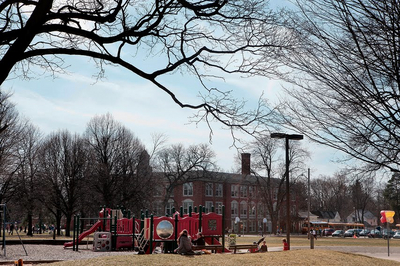
A black doll with a chain around its neck was discovered hanging in a tree on or near the Burns Park Elementary School yard by a small group of 5th-graders in March.
File Photo | AnnArbor.com
What we learned
• The response to the incident was appropriate in handling the initial impact that seeing the doll, or hearing about it, might have had on the children. The group of 5th-graders called the hanging doll to the attention of their principal, who, expressing concern and disappointment that anyone would do this, removed the doll from sight and alerted their parents and teachers about it. She called in the school’s AAPD liaison officer, who made a thorough investigation of the incident and prepared a police report. She asked an AAPS school psychologist to talk with each of the students in the group who saw the doll and to be available for anyone else who wanted to talk about the incident. She asked school custodians to be on the lookout for signs of any other concerning items on the grounds, informed all the school’s teachers, and sent a note home to all the parents. The superintendent’s office was actively involved.
• There was no way to determine what motivated this incident from the existing evidence. Malice or prank? The evidence itself was inconclusive. People wanted more information so they could assess motive/threat for themselves, but there was no more information. Some made assumptions based on their own histories and perspectives.
• There was a polarization of reactions to the incident that appears not to have been expected. This incident set off alarms in the African-American community. Who can forget lynchings from not-that-many years ago? For some, it is clear that racism still exists so comments like “Why is everybody making such a big deal over this?” is an insult. To others, this is a big deal and comes as no surprise. Consequently, as one of our group’s members put it, “The polarized reactions to the incident seem to be more informative than the actual incident and seem to reveal an opportunity for proactive work in building Ann Arbor into a more cohesive and considerate community that considers all as valuable members.” Additional steps that can be taken in the future in handling incidents like this one
• Use extra care in the reporting of the incident. People want all the information they can get -- and tend to create what isn’t provided unless the reporting is clear and follow-up takes place. The comments to the AnnArbor.com article were filled with inaccuracies, which were later picked up by others as if they were facts, sometimes provoking unrealistic arguments in the comment exchange. A follow-up article might help remind people of the details of the story and assure them that it is being given due attention. Content should always be timely and clear to prevent inaccuracies from triggering unwarranted concerns.
• Be aware that the reactions to an incident may, in the long run, be more important than the incident itself. How can you prepare yourself to anticipate what the reactions might be - or learn what they are?
• Educate yourself now by attending some of the many training and dialogue sessions available to help people better understand one another. Check out www.understandingraceproject.org (click on events) and/or sign up for a free 6-week series of conversations on race at race.washtenaw@gmail.com and look for other offerings on diversity.
• Identify and develop resources in your organization and in the community who can help you understand what others are feeling and saying when an incident occurs.
• Use the incident as an opportunity to bring the community together through education and dialogue. Ignoring the situation will not make it go away, and for many, ignoring the situation simply adds to the insult. Fortunately, incidents that result in anger and misunderstanding also create opportunities - brief windows in time when talking and listening can have the deepest impact.
• Contact the Ann Arbor Community Response Group when incidents occur that might be motivated by bias or hate. Our mission is prevention and healing and we can help.
Submitted by Leslie Stambaugh on behalf of the Ann Arbor Community Response Group, comprised of people and organizations representing law enforcement, the schools, advocacy, faith, and human rights groups, and organizations involved in conflict resolution. You may contact the group at AACommunityResponse@gmail.com.
Comments
jcj
Sun, Jun 3, 2012 : 11:27 a.m.
A2.com - How long are you going to leave this old "news"story going?
Cold
Sat, May 26, 2012 : 1:04 p.m.
Someone sees a doll in a tree and "thinks it means" and Liberals demand a litany of actions. Meanwhile New Black Panther Malik Zulu Shabazz has said" we must kill white people" and Liberals are silent. Oh the sweet, sweet hypocrisy.
Javier Martinez
Thu, May 17, 2012 : 8:13 p.m.
This incident is a non incident based on loose and ineffectual "reporting.". Unfortunately it seems as though the moderators are determined to quash that opinion through the over zealous deletion of comments.
A2is over
Thu, May 17, 2012 : 11:55 a.m.
After reading this article again, there's definitely an issue here. Since this incident occurred on the grounds of Burns park School. It seems to imply that this school environment is not fostering an open minded attitude towards diversity. After checking the school's demographics on the AAPS website, it clearly shows Burns Park has one of the lowest percentages of African American students in the district. Increasing this schools diversity would be a huge stride forward towards improving diversity awareness. Considering that during the last major school redistricting effort, major portions of Burns Park were designated to attended Scarlett Middle School, which has the highest percentage of African American students. Suddenly and without notice, Burn Park was quietly re-aligned to attend Slauson.....I see a pattern forming
eastsider2
Wed, May 16, 2012 : 10:20 p.m.
"Use extra care in the reporting of the incident. People want all the information they can get -- and tend to create what isn't provided unless the reporting is clear and follow-up takes place. " And we've seen that in many an online article. Created information. Speculation. Because there is not enough information and follow up is rare. So use care. Do follow ups. Use extra care.
Lili Marlene
Wed, May 16, 2012 : 8:50 p.m.
I am utterly appalled to hear about this incident, and personally appreciate that it has remained in the community consciousness, at least to this extent. I also appreciate learning about AACommunityResponse and their follow-up on the situation. However, that wretched event at Burns Park Elem was clearly attended to, and remediated. I would suggest the AACommunityResponse team now turn to a flagrantly public but entirely unchecked situation: those phony crazies who have been weekly harassing a house of worship on Washtenaw Ave for the past several years. See if you can figure out an "resolution" of that disrespectful, unprovoked and one-sided "conflict."
Macabre Sunset
Wed, May 16, 2012 : 9:05 p.m.
Sorry, Lili, this house of worship is part of an unprotected group, so it is not entitled to sensitivity of any kind. If you would like to throw any toys into the trees surrounding this building, you are entirely safe from the potential of public rebuke.
Macabre Sunset
Wed, May 16, 2012 : 8:33 p.m.
We didn't even rate a visit from Al Sharpton. In other words, even the biggest race-baiter on the entire planet understood this was not a big deal. Stop beating the poor long-deceased equine creature.
vitaltoofor
Wed, May 16, 2012 : 5:31 p.m.
No coincidence this happened at a school with one of the lowest black student-to-white student proportions in the whole A2 school systems. Black history is not taught much passed Martin Luther King and Rosa Parks (pacifists in the civil rights movement). Maybe the Burns Parks school should incorporate some of the teachings of Malcolm X or Fred Hamptom.
smokeblwr
Wed, May 16, 2012 : 4:33 p.m.
It could be as simple as those rich Burns Park kids throwing their toys away. In a tree no less. Daddy will buy another.
demistify
Wed, May 16, 2012 : 4:13 p.m.
"What we learned" The original statements from AAPS and the story in AnnArbor.com had a paucity of detail, leaving gross ambiguity as to what happened. This op-ed does not provide any further facts on that subject. The lack of information is inexcusable from AAPS and reflects poorly on the reportage. The op-ed makes some valid general sociological points about the possible impact of such a story. Unfortunately, it adds nothing to the inadequate knowledge of what actually happened in this specific incident.
eastsider2
Wed, May 16, 2012 : 10:17 p.m.
The report states pretty clearly that "There was no way to determine what motivated this incident from the existing evidence. Malice or prank? The evidence itself was inconclusive. People wanted more information so they could assess motive/threat for themselves, but there was no more information. "
EyeHeartA2
Wed, May 16, 2012 : 4:05 p.m.
There are a couple of tennis shoes hanging up in the power lines by my house. Can we get the PC swat team to come out and dust those for prints. Maybe profile the perp? Thanks.
Walaa Mahmoud
Wed, May 16, 2012 : 3:24 p.m.
Obviously if this was hung around A school, investigation needs to be done for the safety of the children.
Unusual Suspect
Wed, May 16, 2012 : 2:38 p.m.
This is not the first time a group that claims to fight "hate crimes" has blown an incident out of proportion. I recall the fight following disembarking from a bus last year, which involved members of more than one race. CAIR showed up and made a big deal out if, jumping to conclusions, pointing fingers, and then when it's discovered that the reality was not what they proclaimed, they run off without any form of apology, and without learning anything from the experience. As others have pointed out, some information has been left out of this opinion piece, and it's no surprise that it's information that contradicts this group's assumptions about this incident and the direction in which the want to steer the story. They are obviously out there looking for problems to connect to, and are willing to bend the story in order to find a way to latch on to it.
AfterDark
Wed, May 16, 2012 : 2:05 p.m.
The initial reports were very specific about the doll not being in a "hanging" (i.e. lynching) position when found. To leap to conclusions of nefarious behavior when evidence doesn't support it reflects the bias of individual or group.
DNB
Wed, May 16, 2012 : 4:32 p.m.
Yes, I agree with you, AfterDark that words are being used incorrectly in this opinion piece. The headline is infuriating to me with "black-doll hanging incident" being used. "District Spokeswoman Liz Margolis said the doll was stuck in between two high limbs in a tree on the east side of the school's property. She said the position of the doll did not resemble a hanging." This was not a hanging incident. Your choice of words is wrong, to suit your own agenda, Leslie Stambaugh and A2 Community Response Group.
amlive
Wed, May 16, 2012 : 1:58 p.m.
Leslie, I think your fourth bullet point well summarizes the crux of the problem in terms of public response. From the first article - "A black doll with a chain around its neck was discovered hanging from a tree..." This easily conjures up a mental image of a chain intentionally tied around an outstretched branch on one end, with the other end tied around the neck of a black doll in a clearly intended mock lynching. Followed by - "District Spokeswoman Liz Margolis said the doll was stuck in between two high limbs in a tree on the east side of the school's property. She said the position of the doll did not resemble a hanging." - which conjures up an entirely different image of a doll seemingly tossed in the air and stuck in a tree. It leaves one to assume if it was "stuck in between two high limbs" then it obviously wasn't tied up as a hanging, and to wonder where the "chain" figures in to all this. Is it a cheap old necklace found on the ground or discarded light switch pull chain that the doll was loosely tangled in, or tied arbitrarily so some kid could chuck a doll they found in a field like a sling? If it were a chain clearly tied around a doll's neck in a way that could be reasonably interpreted as intended to resemble a hanging, that's one thing, but the information made public (still up through this article) leaves no clear indication whatsoever as to whether this was the case or not. The information is entirely ambiguous, with different sentences creating very different and seemingly contradictory impressions.
amlive
Wed, May 16, 2012 : 2:03 p.m.
Even this Opinion piece, with all due respect, is extraordinarily vague and gives allusions toward this event conclusively being a mock hanging, but without any clear statement of the sort or details provided as to what evidence this is based upon. The word "hanging" appears five times before the end of the article, with Liz Margolis's description of "stuck" not appearing once. Your options of this being either "Malice or prank" offers only two possibilities, both of which infer this to be an intended mock hanging, and seems to rule out the option of this being nothing more than a doll slung in to a tree by an older brother or some kid who found it in a field and felt like throwing it. Now maybe you've seen more of this case than what's available to us and have good reason to come to those conclusions. Your writing seems to very strongly suggest that evidence points toward this likely being a mock hanging, eliminating much chance of it being just a doll chucked up in a tree with no thoughts or intentions beyond that. That's what you seem to be saying anyway, but if so I just really wish that someone could say it clear and plain.
Dog Guy
Wed, May 16, 2012 : 1:41 p.m.
Lacking picture or description of doll or chain or hanging, there is no incident, no story, no possibility of education or dialog, no bias and hate, no insult, no situation, no impact, no threat, no public awareness. If you have enjoyed the non-unfolding of this entire non-story and want more: "• Contact the Ann Arbor Community Response Group when incidents occur that might be motivated by bias or hate. Our mission is prevention and healing and we can help."
Top Cat
Wed, May 16, 2012 : 1:21 p.m.
There is a "lot to learn." A lot of people have too much time on their hands. Some people are always looking to create something out of nothing. Some people are looking for any excuse to express outrage or indignation. People need to get real jobs and get busy.
Unusual Suspect
Wed, May 16, 2012 : 1:15 p.m.
"There was a polarization of reactions to the incident that appears not to have been expected." Wasn't expected? In this day and age when you have to watch everything you say, when it's risky to ever find yourself one-on-one in a room with women you work with, when you're racist because you didn't vote for a certain candidate, and when people are set on a hair trigger waiting for something to offend them so they can go ballistic about it? Who the heck wouldn't expect such a reaction?
hail2thevict0r
Wed, May 16, 2012 : 12:56 p.m.
There is some kid out there laughing his butt off over this. He probably threw his sister's doll in a tree to make her mad and it started a national outrage.
Billy
Wed, May 16, 2012 : 12:34 p.m.
"Who can forget lynchings from not-that-many years ago?" So you remember lynchings then? 1968 was the last "official" lynching. Lynchings as a common place occurrence died out in the 1920s.
Cash
Wed, May 16, 2012 : 7:38 p.m.
Yes I do remember lynchings. I was born in '44. This was a practice in the south. I'm not sure I get your point...... Do you think there are no people who can remember 1968????
alarictoo
Wed, May 16, 2012 : 7:06 p.m.
Oops! Let me clarify. That statistic was for Michigan only.
alarictoo
Wed, May 16, 2012 : 7:05 p.m.
Intrigued by the statistic I did a little googling and found this link: http://law2.umkc.edu/faculty/projects/ftrials/shipp/lynchingsstate.html It shows that between 1882 and 1968 there was only one lynching of a "Black". But, there were seven lynchings of "White"s. Does that mean that the incident would have been more symbolic if the doll were white...? O_o ???
Cash
Wed, May 16, 2012 : 12:04 p.m.
Good article. If something offends some people but doesn't offend YOU, is it truly "NOTHING" because it didn't bother or offend you? Or can we really think beyond SELF and to other viewpoints and other experiences? "You demand respect and you'll get it. First of all, you give respect."
northside
Wed, May 16, 2012 : 1:11 p.m.
Great points Cash.
ahi
Wed, May 16, 2012 : 12:59 p.m.
Some people find empathy to be very taxing.
Craig Lounsbury
Wed, May 16, 2012 : 12:57 p.m.
This rather volatile situation aside, someone out there is offended by almost anything. So its a bit problematic to think we can be sensitive to anything. There are folks offended by ice cream because the cows that produce the milk used in the product are not properly treated in their minds. Do you take note and respect their concerns when you pass the ice cream freezer at the grocery store? Again I am speaking generically to a bigger picture and I realize the sensitive nature of this particular incident.
Craig Lounsbury
Wed, May 16, 2012 : 11:54 a.m.
Isn't there a link to a PDF of a full 675 page report? This is Ann Arbor for crying out loud. Nine bullet points in a half page single spaced is hardly up to the pontification standards we have come to expect from committees.
Pickforddick
Wed, May 16, 2012 : 11:39 a.m.
People are making too much to do about nothing.....find some positive things to do with your lives.
a2cents
Wed, May 16, 2012 : 7:12 p.m.
consider: she/they have, you might
northside
Wed, May 16, 2012 : 4:46 p.m.
LOL Suspect. I'm guilty as charged on that one (though am not in the same league as dick when it comes to frequency of posts).
Unusual Suspect
Wed, May 16, 2012 : 3:22 p.m.
You're not exactly a stranger to the comment section yourself.
northside
Wed, May 16, 2012 : 2:08 p.m.
"Find some positive things to do with your lives." Like commenting 24/7 on a newspaper site?