

Pioneer High School teacher on MTV's 'Made' said show distorted discussion on race
The Pioneer High School teacher featured in an episode of MTV’s "Made" about a white student wanting to become a rapper said she’s a victim of "very negative editing."
Vicki Shields, speaking shortly after the episode aired Thursday, said her students warned her about how the show’s producers would end up presenting the episode if the conversation in her African American Humanities class with Emma Hamstra ended up not going as planned.
Shields said she had talked to "Made" producers before Hamstra met with her and then came into her classroom, and was told to “keep it real.”
The episode showed Shields and her students, who were predominantly black, asking Hamstra a variety of questions about the history of hip-hop and how Hamstra planned to bring her music to that audience.
Shields said Hamstra spoke for 45 minutes about why she wanted to be a rapper before students started asking questions, which was the only thing the show showed.
“I want people to know that this is TV and the way they’re editing it is designed to make it controversial and people shouldn’t make judgments based on a clip,” Shields said.
“The stuff that clarifies the conversation is cut out.”
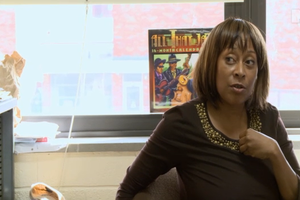
Vicki Shields speaks to Emma Hamstra on MTV's Made
Courtesty of MTV's Made
The episode of Made will re-air on MTV at 10:30 a.m. Saturday.
Shields spoke with AnnArbor.com about one hour after the show aired on MTV and said she was already receiving emails calling her a bully and telling her she shouldn’t be teaching.
Shields said the fliming of "Made" was going on during her class’ conversation on cultural appropriation. She said one of her students had brought up Hamstra’s quest to become a rapper during a discussion, and later Hamstra approached her about speaking in class.
Students in the class warned Shields not to participate in the show because “it takes so long to get to the place where you’re open enough to talk about race and we can’t have a real discussion with her in an hour,” she said.
Shields said her students believed she was being set up by the show.
However, Shields said that if someone comes to her with a question about race, she feels obligated to answer and discuss it.
During the episode, students are shown reading questions from a sheet of paper to Hamstra. Shields said she had provided Hamstra and the show’s producers a copy of the paper with the questions before she came into the classroom so she knew some of the questions to expect.
“To say I was prompting my students, that’s just unfair,” she said.
For more information
Shields said the quote was taken out of context and was used to say that white people can use black culture for profit without understanding the struggles others inside that culture went through to create that music.
She used the example of blues music and said the topic of discussion in her class was “how can a white artist take something from a blues artist and not be concerned about the plight of where that blues music came from.” She said that was a negative aspect of cultural appropriation.
However, others might listen to that same music and expose themselves to a culture they would never otherwise encounter, either because of socioeconomic background or other circumstances, and end up understanding more about others’ world.
Shields said she recognized Hamstra was uncomfortable during the discussion and realized that Hamstra was sensitive about the topic. Shields said she told her class to simply ask questions, let Hamstra answer them and not interrupt or do anything to make her feel uncomfortable.
She said the show was edited to show the few moments when Hamstra was interrupted and to make the discussion seem much more contentious than it originally was.
Another major part of the episode that received some negative reactions from students at the end of the "Made" episode was Hamstra’s reference to “Icky Vicki” in her song, apparently referencing Shields.
Shields said she felt it was unfair to have a shot taken at her when she didn’t want to be involved in the episode in the first place.
Ultimately, Shields said, conversations about race in Ann Arbor can be a no-win situation.
“One thing that gets me is she came to me and if you tell people your opinion and you don’t agree with it and other people don’t agree with it, you’re a negative person,” Shields said.
“You’re damned if you do and damned if you don’t.”
Kyle Feldscher covers K-12 education for AnnArbor.com. He can be reached at kylefeldscher@annarbor.com or you can follow him on Twitter.
Comments
Ella Campbell
Wed, Jun 29, 2011 : 6:27 a.m.
I was a student of Ms. Shields. She is brutally honest, harsh in her criticisms and often times bitter. She has also changed my life, made me thirsty for knowledge and expanded my sincere interest in what I do. I studied with her for two years, and the time I spent with her was some of the most beneficial time I spent at Pioneer. She prepared me for tough questions, questions I now deal with every day and am PREPARED to talk about. Other teachers at Pioneer did not do this, they prepared me for questions on a test, or how to write their essay, without ever getting to know ME. Ms. Shields prepared me for difficult conversations that I now watch my [non-jazz] college professors struggle with. I have forever wanted to be a jazz musician, and always, ALWAYS, felt out of place. I always felt like a "white woman in a black man's world" even before Vicki helped me realize this. I knew since 7th grade that it was weird for me to love this music - she just validated what other people try to ignore. Yes the music has expanded globally, but this music comes from a culture that I was unfamiliar with. I was eager to learn more about it. Ms. Shields took me under her wing and allowed for me to ask, what I felt were "stupid questions." She encouraged me to say "I don't know" when I didn't know, and helped teach me more about the culture I was so curious about and eager to fit into: for the sake of my music. She can be a lot to handle, but I value everything I learned from her very much.
P
Tue, Jun 28, 2011 : 4:14 a.m.
I had no idea that this show was even filming at AAPHS until I saw it air on MTV. Shields is known around AAPHS as a very tough teacher to get along with, among students as well as faculty. She is a difficult, stubborn teacher who does not see past her realm of education, making her class a very narrow spectrum of humanities education. I also think she is acting very inappropriately for an educator as well as a role model for the the African American students in her class, she is showing them that it is alright to be hostile towards other people looking to understand and open their minds to different cultures as well as trying to bridge the gap between these differences. The race card has been coming up a lot in the AAPS system recently and I think we should really look at what the problem is, it is not the white students thinking they are better than African American students... it is the African American faculty thinking that the minority students deserve to have different rights than the caucasian students. Do you all remember the field trip Mr. Madison took with all of his African American students while none of the white students were invited? There was also very little repercussion for this. I am writing this as a former PHS student as well as child of a AAPS faculty worker who has worked both directly with PHS as well as AAPS. I would just like to poll all of the African American rappers and see if their history of African American heritage is up to par with what Shields expects. My guess is that Little Wayne and Ludacris probably would not pass the test.
Kaitlyn
Tue, Jun 28, 2011 : 12:05 a.m.
I commend Emma for saying that all feminist, no matter your race are equal. It just goes to show you she is not Racist. And for "vicki" a TEACHER to tell a student, they can't rap because of there Race, then she might as well be telling that to rappers, like PitBul or Eminem, or any rapper that isnt black. I felt like this teacher was saying everyone is racist, and Emma is right, she cant help what happened back when racism ruled everything. I'm from the South and sure there are racist people, but there are people that love there FRIENDS FOR THE PERSON THEY ARE, NOT THERE SKIN TONE. I also didn't like the fact that "Vicki" said "we get showed no love" because thats not true. I feel like she lets those who are racist could her jugdement. Her made coach P.L was right "rapping is about your life and struggle not matter your race." I feel sorry for this teacher, and I bet she doesnt see that she did anything wrong. But she does not need to be an educater. They are someone that is suppose to inspire you to want to be better, and to show tolerance, and to want to better this world for future generations to come. And watching I saw none of that. I will say I commend Emma for stepping out of her comfort zone and finally standing up to her fears. More importantly she followed her heart and i found a great quote that would fit her "A weidro is somone who follows there hear: I'm definitely werid, ani't nothing wrong with that."
Megan
Mon, Jun 27, 2011 : 11:27 p.m.
People that view themselves on the reality shows in which they are featured take one of two approaches: defend their actions and use editing as an excuse and the other approach is to own their actions which shows self awareness. Vicki (as her high school students referred to her, which was interesting to me in itself) clearly lacks the ability to self reflect as she does not seem to take responsibility for her lack of educating both Emma, the rest of her students and especially herself. Positions in education are quickly being eliminated across the country due to budget cuts and the recession. Gifted, enthuasiastic, passionate educators are losing their jobs and Vicki, who has clearly lost the ability to advocate for students and understand the role of a secondary educator sits comfortably in her position at Pioneer High School. We've all heard the saying "It's not what you say, it's how you say it" and any educator should know and practice meeting a student at his or her level. Vicki expected Emma, clearly a naive 17 year old, but not seemingly close minded, to be at Vicki's own level, which is unreasonable and frankly, ridiculous. It is extremely important for students to learn about different cultures, but there was no evidence of any attempt to teach cultural understanding. I challenge the school district to evaluate not only what the students are taught, but how they are being taught. Any educator who focuses on cultural differences rather than cultural celebration is one that is only a detriment to society. I write this as a non-traditional student who is currently enrolled in a graduate certificate program for Secondary Education. Viewing this episode of "Made" was a great reminder of exactly what kind of educator I never want to become. --
J. A. Pieper
Wed, Jun 29, 2011 : 9:53 p.m.
Megan, well stated, and I commend you for seeing Vickie as an example of the kind of educator that you do not want to be! So glad my kids never had her!
abzjr
Sun, Jun 26, 2011 : 1:51 a.m.
Let's be real. I don't care if it's for an MTV reality show or just out of pure passion, but anybody should be able to pursue their goals, whether that's being a rapper or anything else, regardless of their skin color or background. The Harlem Renaissance in the '20s was all about that, and it brought to light the talents and new flavors of black and other minority artists in the US. That completely transformed the artistic scene. Sure, maybe not everybody who wants to be a rapper will be the next Lil Wayne (or Eminem, as the case may be), but they should certainly be given a fair shot at making their mark on the industry and on the art, instead of being shot down by naysayers who, in their efforts to stand up for a race that has been oppressed throughout history, are, in fact, committing the same crime towards others.
Jack
Sat, Jun 25, 2011 : 9:32 p.m.
I would have liked more substance to this article. We don't watch MTV and this article seems to be based on the premise that everyone has seen this show. It's a fair-sized article with but little substance. The only instance of educating us as to what actually went on was the quote from Ms. Shields which she claimed was taken out of context. But were we provided with the context? Heaven forbid. I often get the feeling reading annarbor.com that very little research effort is made. The writing often barely scratches the surface, even when all that is required to get more information is only a telephone call away. Based on the little information presented, I commend Ms. Hamstra for enduring what she did endure and for pursuing her goal. I think we need more positive mesages about race, not always reguritating negative messages of the past, but focusing more on the positive messages of the present and future. I am not negating the value of the study of black history. It needs to be taught, as history.
kms
Sat, Jun 25, 2011 : 6:51 p.m.
I still would like to hear what the school board and principal Michael White have to say about Ms. Shields' teaching. I realize that MTV looked for and possibly even encouraged a controversial angle to frame this show (and Ms. Shields certainly delivered on that score) but Ms. Shields is still responsible for her comments. "Ya'll don't like us anyway," and "We still ain't got to you yet," said to a shaken and crying Emma seem particularly insensitive and inappropriate if not downright mean. Many, many Pioneer parents are upset...this was a hot topic of conversation at a large neighborhood party...and would like to know if the AAPS administration feels that this is acceptable conduct for teachers it employs.
terriann
Tue, Jun 28, 2011 : 12:34 a.m.
Absolutley! I just watched the re-run and I had to comment. It seems the teacher was being racist herself. Why on earth when this girl approached the classroom, did the teacher not encourage her building a bridge amongst the races? It blows my mind. That's like saying a white guy invented pizza, so if black guy wanted to start his own pizza place, he would have to go ask permission from the white commuity. That's ignorant!
Educator
Sat, Jun 25, 2011 : 3:19 p.m.
As an educator, I am upset by the way Ms. Shields treated the student. I am not siding with Emma b/c of race. I am Latina. I understand where you are coming from personally, b/c you feel that this student did not understand the historical inequities of our American culture. However, she came to you with an interest to explore her thoughts. She openly acknowledged that she didn't know what she didn't know. She was 100% up front. While Emma's comments about subsidized living clearly showed a lack of empathy for people living in the "ghetto", your job as an educator was to use this moment to bridge new understanding. You could have created a dialogue and acted as a connector between the students in your class (who have real life experience with many of the themes you explore in your curriculum) and the student who came to visit. You did not take advantage of the moment that Emma offered you to create a racial dialogue in your school. You took advantage of that fact that a less informed person walked into your territory. It truly became a moment of power and whether you realize that or not is something you now need to reflect upon. You intimidated her into feeling stupid and uneducated. In that moment, you simply reversed the roles of racism and did everything that your "oppressors" did to you when you entered their world. Our job as educators is to educate impartially. Present the facts and let the students make their own opinions. Educators are supposed to equalize through education not intimidate into children into racial divides. Our job as educators is to build others up. Embrace the fact the fact that this student was willing to travel outside of her territory and ask questions. Maybe you could have provided her with "starter literature." Next time you have an opportunity like this, I hope you step into your higher self and not your past hurts and anger.
katie
Sat, Jun 25, 2011 : 4:42 a.m.
I think Ms Shields did a good job with a difficult situation. Good teachers challenge students to see things in new ways. That's what she did. If you look at worldwide statistics, racism, sexism, and classism continue to exist and do tremendous damage. I don't think that sugarcoating this subject matter with a young woman who obviously chooses to deal with it is fair to her. It does her a disservice and it does the other students a disservice. What I saw in the clip was a teacher who taught the subject matter in the way it is usually taught, by helping the student better understand how her own privilege is getting in the way of her deeper understanding. I would expect a poet who wants to use rap in her work to wish to understand it as deeply as possible. We all have blind spots, particularly in areas in which we have been privileged. I don't think it is the role of an instructor to make students feel happy or even good about themselves all the time. This is an erroneous assumption about how self-esteem is built that has hurt our schools. Self-esteem is shaped by meeting tough challenges, by making moral decisions in the face of them. It involves compassion for others and for one's own shortcomings. A good teacher cares enough to guide them in this process. God only knows the upcoming generation will have tough challenges to meet. It is the teacher's role to challenge them to think critically about the world around them, to deal with the hard things. Good teachers, like good parents, are not out to win popularity contests. That's not their job. They deserve our appreciation and respect. Vickie Shields has mine. As does Emma.
Marianna
Sat, Jun 25, 2011 : 5:04 p.m.
You should watch the episode
just a voice
Sat, Jun 25, 2011 : 3:04 a.m.
What I wonder from reading this is; If Rap and Blues are Black Culture, what is white culture?
Still Learning
Fri, Jun 24, 2011 : 11:28 p.m.
How about we turn away from blaming people, and take all of this as more of a learning experience. I'm sure Vicki, the student, and AAPS are all more enlightened about this world after this ordeal. What can we do to learn from this as citizens? Maybe start a conversation with your child about race, support the teachers who have changed your life the way Vicki has changed mine. Negative discussions wont change this situation, so lets move forward and learn from the past.
microtini
Fri, Jun 24, 2011 : 9:44 p.m.
Advertisers will do anything to get their messages to impressionable young people. To this end, MTV's Made is a perfect vehicle. Furthermore, controversy breeds interest; this entire scenario was engineered by Made's producers. AAPS should have nothing to do with this cynical practice.
kms
Fri, Jun 24, 2011 : 10 p.m.
Regardless, this show will air repeatedly on national TV, perhaps even internationally. The behavior of this teacher reflects poorly on the community who employs her and will bring negative attention and criticism to an otherwise fairly good school system. For the school board looking for marketing angles to attract more students to the School of Choice program, this has to be a disaster.
Smitten
Fri, Jun 24, 2011 : 8:23 p.m.
I could not disagree with Midwestern Teacher more. Teachers should be leaders and examples. You have a teacher that invites a student to have an open discussion about a topic that could have been a positive multi-culturalism "teaching moment". Instead, you get a teacher that had ulterior motives and proved to show that Ms. Shield's couldn't get beyond her own personal bias. Her bias was evident in her mannerisms and tone of voice. I was taught in graduate school in education, as a teacher/professor, you facilitate discussions like this. You guide students in having a productive conversation so everyone can learn. The teacher can ask questions, but should NOT have shared her own personal opinions. Regardless of what majority of the population thinks (finds Shield's in the wrong), we know that AAPS won't do anything out of fear of a lawsuit. Having 4 children in AAPS, I know that the students already know which teachers have certain prejudices. If schools let student's choose their teacher, it would weed out the ineffective ones quick, similar to colleges. This is truly one of the pitfalls of AAPS.
Smitten
Fri, Jun 24, 2011 : 8:03 p.m.
"Ultimately, Shields said, conversations about race in Ann Arbor can be a no-win situation." Really? I am a minority that grew up in an all white community that had REAL race issues. I live in Ann Arbor because it is one of the few places in Michigan that diversity is respected. I am insulted by this teacher's attitude and concerned what she is teaching the students. Bottom line: Shield's own statement to AA.com confirms that she does not believe whites should rap because they can't appreciate the meaning behind blues. I feel sorry for someone that is as ignorant as Shields. Regardless what color of skin you have, we all have struggles….. I is obvious by her statement that she hasn't broaden her multi-culturalism beyond African American studies…..
bet
Fri, Jun 24, 2011 : 7:51 p.m.
Let's hear from those who personally know Ms. Shields and have an actual basis from which to comment on her actions and character. Ms Shields is an outstanding and compassionate educator who has influenced the lives of countless young people, including me. I couldn't care less how a station as moronic as MTV edits her words in order to draw in people who generally wouldn't even consider touching the complex issues she deals with each and everyday in the classroom. Vicki, you're awesome. Forget this garbage.
kms
Fri, Jun 24, 2011 : 9:40 p.m.
Yes, comments from Pioneer teachers and students would be most valued. What say you Mr. White? And I'd like to know what Jeff Kass thinks...he was the other teacher featured on the show. I have no doubt that MTV sought a controversial angle to frame this show, but Ms. Shields gave them one on a silver platter. She does her cause no further by whining about how she was portrayed despite giving both verbal and written consent. She still said what she said, and her body language and tone of voice spoke volumes.
paxsolace
Fri, Jun 24, 2011 : 7:49 p.m.
To reach out to another by wanting to enjoy, participate or share in a cultural phenomenon is a compliment of high regards.
nowayjose
Fri, Jun 24, 2011 : 5:42 p.m.
Of course she did something wrong. Teachers should never discourage based on race. Golf was made by a bunch of white guys in scottland. Does that mean Tiger Wods shouldn't play cause he's not white or Scottish?
Marianna
Fri, Jun 24, 2011 : 4:43 p.m.
I don't understand why the student in Ms. Shields' class felt it was necessary to challenge her on becoming a rapper. It's a free country. You can work hard and become whoever you want and do whatever you want.
Macabre Sunset
Fri, Jun 24, 2011 : 4:04 p.m.
There is a double standard here. If a black student were subject to that type of racial abuse from a white teacher, it would be national news and the question wouldn't be whether the teacher should be disciplined, it would be whether the teacher could be fired by the end of this week or by the beginning of next week. Shields doesn't want a frank and open discussion unless it's monochromatic.
Macabre Sunset
Sat, Jun 25, 2011 : 7:39 a.m.
I'm sure she would agree. The bullying remarks in the hallways, and on her social networking sites? Even more fun. I bet she's having a blast. I think there are a lot of people out there who think they experience racism on a daily basis. But life is difficult. Sometimes you don't get what you want, and it has nothing to do with skin color.
Enso
Sat, Jun 25, 2011 : 12:11 a.m.
Was it fair? I don't know. But what I know is that Emma doesn't experience racism on a daily basis. Emma hasn't experienced racism as the defining characteristic of her family's history. In all honesty, this is probably the first time in little Emma's life that she's ever experienced something that could maybe be called 'racism.' And guess what, she's thriving off of it. She's nationally known because of it. Experiencing "Racism" is so far the highlight of Emma's life.
Macabre Sunset
Fri, Jun 24, 2011 : 6:24 p.m.
That should be our goal. Emma experienced racism. Was that fair? Is the appropriate response to an historic injustice to select someone at random in the future and perpetuate a new injustice? Is life a never-ending series of tit-for-tat?
Enso
Fri, Jun 24, 2011 : 5:17 p.m.
It is only a double standard if you assume everything else in society is fair.
aawolve
Fri, Jun 24, 2011 : 3:05 p.m.
"Ya'll don't like us anyway." This person should not be "teaching." Hopefully she'll get the same response a white teacher would, but I'm skeptical.
andys
Fri, Jun 24, 2011 : 3:42 p.m.
Yes, talk about fostering a racial divide! Is this class just indoctrination of a victim mentality related to racial differences? This kind of stuff is not an answer to the racial problems in this country, but part of the problem itself.
rinmem10
Fri, Jun 24, 2011 : 2:19 p.m.
Two things to keep in mind: 1) This was produced by an entertainment network, not a news organization. They are under no obligation to present a balanced story or demonstrate any level of journalistic integrity. 2) Ms. Shields' claim that she didn't want to do the show is negated by the fact that she signed the release to be featured in the show.
Laurel
Fri, Jun 24, 2011 : 2:13 p.m.
If she is serious about her rap career she should expect to get a lot of criticism. It's part of the game! White, black or otherwise part of rapping is proving yourself. In addition, she should be prepared to be questioned! If she continues to rap, it will probably happen again. How powerful would have it have been if she could have actually answered the questions asked of her?? I think that would have left a stronger impression than the one we got of the kind of teacher Shields is.
Marianna
Fri, Jun 24, 2011 : 3:26 p.m.
She isn't a "serious rapper". Yes, she would have left a stronger impression but some people do get nervous.
T'ika
Fri, Jun 24, 2011 : 2 p.m.
Why is it necessary for this girl to have a deep understanding of the history of rap? Yes, it is probably knowledge that would ideally be nice for her to know. However- who is to say she wants to rap about the black man's plight? Why can't she just rap about her own trials and tribulations? Isn't that what black history and (what many are insinuating) rap are all about? I think it is easy for many to forget that ALL RACES have been enslaved at one point in time. Also, who gets to decide who raps? Should by that logic, "white people" challenge all other races who want to break through the country or classical industries? Before contestants appear on American Idol, do you think they are all sat down and given a pop/rock history lesson? If you want to make it in the music industry- I don't think a historical knowledge is imperative. Learning is important, but if any of you have ever taken lessons in ballet, piano, vocal- any class that you are performing the art- rarely does the instructor sit down for the sole purpose of teaching history. I DO think that the artist needs to have a deep feel for the rhythms/sound of the genre they are trying to succeed in. Whatever happened to being able to do something well and enjoying it without all this psycho/social blah, blah, blah? To me, rap is a way to express part of the human experience. We all feel slighted, treated unfairly, have had hard times, etc. It is part of the HUMAN condition, not just the black experience!
a2flow
Fri, Jun 24, 2011 : 1:50 p.m.
When I watch the clip, what I most disagree with is Shield's tone and mannerisms towards the student. It was uncalled for. The student was naive, but apparently the teacher was too. She knew she was being taped and it would end up on tv. You live and you learn. This whole misappropriating of rap thing, I completely disagree. Imagine the situation reversed, and a black student is invited into a class because of his desire to play a "white" sport. The teacher reacts in a harsh tone and mannerism, challenging him to why he wants to play this white sport. He can't possibly understand the sport because he's not white. I think sports are like music, just a medium of expressing oneself. If she wants to rap, why not? If Tiger Woods wants to play golf, it shouldn't matter that this sport originated in the Northern Isles of Europe. A white sport. Today, the vast majority of players in the NBA are black. The inventor of the sport was a white man. Should they also be attacked because they don't understand the origins of the game? Or should they be given the freedom to express themselves in a sport that they enjoy, regardless of the origins? I feel the same way about this that I feel about courageous conversations and Glenn Singleton. Attitudes like this do more to separate than to unify. I object to the stereotype of "white privilege." Not all whites are privileged, and not all blacks are unprivileged. It's a stereotype no matter how you slice it. When people use the word "all" they effectively are guilty of the same crimes that they accuse the other of. I can understand the word institutional advantage, because this would imply that certain people have advantages over others, which I believe to be true. Institutional advantages can be social, money, education, etc. This doesn't mean it is strictly based on skin color. Successful parents are able to pass on this "institutional" advantage to their children. It doesn't h
J. A. Pieper
Fri, Jun 24, 2011 : 11:32 p.m.
There are teachers at Pioneer who questioned my son's presence in their accelerated/AP courses based on race, and treated him like he didn't belong. Posted grades (listed by student number) always indicated that he was # 1 or 2 in the class. Complaints to the district did nothing, and these teachers are still there!
Marianna
Fri, Jun 24, 2011 : 4:59 p.m.
So let's say that I'm an engineer and I'm the only white person working at my job because the rest are Chinese. Does the employer just like Chinese people more than white people? No. Chinese families traditionally take education more seriously than any other culture, therefore making them more susceptible to higher paying, more respectable jobs. I have black friends that got into better colleges than I did. Why? Because the worked harder in Highschool then I did. Their parents stressed education. They studied more. They deserve it. What is white privilege? Nobody gets anything handed to them. You have to earn it. Welcome to life.
Marianna
Fri, Jun 24, 2011 : 4:37 p.m.
"The fact that this company only has 1 African American employee out of 300 lets me know that the culture of the company tends to be biased towards Caucasian males" That doesn't necessarily mean that. I could just mean that the person with the best credentials got the job. You said that you were the only African American in many of your college classes
a2flow
Fri, Jun 24, 2011 : 4:33 p.m.
Michelle, I don't know the culture of your company or the nature of the job. I do know that it's true that black students typically perform worse than their white or Asian counterparts. If this is true, maybe your company hires the best people they can get, regardless of color. It's one thing if you think that blacks are being discriminated against, but quite another if it happens that there are stronger candidates for a position. Last time I checked affirmative action was alive and well. I had to fight and claw to get in when I got my job. There were no social connections and I didn't come with a silver spoon in my mouth. I did have great credentials, a high GPA, and I work hard. I later met the person that was hired over me. They lacked my ability (didn't have the skills or training I had) and work ethic, but were hired because of affirmative action. Is that fair? The irony of your argument is that you and I agree on one thing: how our self-perceptions shape our future career choices and educational outcomes. You mentioned how 9 out of 10 black males believe they will be a rapper. In affluent communities, the successful students almost never view rap as their future hopes/dreams. Their future involves academics and getting into a great school. If it's true that 90% of black males, you are directly acknowledging that it's the black role models and the choices the kids are making rather than any type of institutional advantage that is causing poor future outcomes. People in America need to start working on changing within rather than blaming white privilege. I highly recommend this book by a professor at UC Berkley. <a href="http://www.amazon.com/Losing-Race-Self-Sabotage-Black-America/dp/0684836696" rel='nofollow'>http://www.amazon.com/Losing-Race-Self-Sabotage-Black-America/dp/0684836696</a>
Macabre Sunset
Fri, Jun 24, 2011 : 4:12 p.m.
Michelle, has anyone at your company ever told you that you shouldn't pursue a career in business because of your skin color? Has anyone challenged you to learn more about the history of your field before a team meeting? All these accusations of cultural bias serve to divide, not to unite, and ensure these problems remain in society. The problem at your company is not the numbers, it's people who assume there's a bias. Your company exists to make profit. That is a color- and gender-blind goal. Can you give us a specific example of how you've been subjected to "white privilege" at your company?
Michelle09
Fri, Jun 24, 2011 : 3:59 p.m.
White Privilege does exist and is VERY prevalent in most institutions in this country. Its just that everybody wants to ignore these difficult situations with the belief that, if we don't talk about them, they wont exist. I am always one of maybe 3 African Americans in my job. I have been the sole African American in a great deal of my college classes. A fellow graduate student who works for a very popular company whom I will not mention by name said that at her company, out of 300 employees, there's only one African American man! People don't understand that White Privilege has nothing to do with Caucasians actually hating minorities or anything like that. It has more to do with culture, background, and mentality. The fact that this company only has 1 African American employee out of 300 lets me know that the culture of the company tends to be biased towards Caucasian males. These type of privileges that no one directly tackles is what promotes inequality of the races. At some point the CEO should step in and say, "hey, diversity is lacking in our company and we need to make some changes". But since most people resist change, these companies continue to ignore these types of disproportional hiring practices. Now back to the rap thing. Hip hop is a genre that was created based on African American culture and its affect on African Americans, especially males is very profound. Go to any community where the population is majority Black and 9 out of every 10 males that you run into will probably tell you that they want to be a rapper. Now why is that? Well look on your TV, internet, and magazines. Most of the successful Black males in the media, happen to be rappers (or producers for rappers, djs, etc.). The same for most sports. Now go to any majority Caucasian community and ask the same question; Im sure the answer will vary greatly. Hip hop's influence needs to be explored and Hamstra has the access and tools of MTV to go deeper into this subjec
CincoDeMayo
Fri, Jun 24, 2011 : 3:29 p.m.
Good observations a2 flow. Also, I like using words that are more specifically correct. I think they improve the quality of the conversation immensely.
Marianna
Fri, Jun 24, 2011 : 3:24 p.m.
Very true.
melk
Fri, Jun 24, 2011 : 1:42 p.m.
Why did A2PS allow MTV to do a show at the school. Please tell me where it says you can't be white to rap and you need to know black history. What about Eminen??? I think he's sold the most records of any rapper and has won the most awards. The last time I checked he's white!!! So, I guess with this said all white people can only be country singers. Give me a break. If black rappers are educated in black history than why do they sing about drugs, gang banging and shooting up people??? Emma good for you and don't let Vicki Shields get in your way of your dreams! Go 4 it!
Enso
Fri, Jun 24, 2011 : 1:27 p.m.
Rap is different than hip hop. Anyone can rap, including an uppermiddleclass white girl. Not everyone is hiphop, including this uppermiddleclass white girl.
grye
Fri, Jun 24, 2011 : 1:15 p.m.
"Shields said the quote was taken out of context and was used to say that white people can use black culture for profit without understanding the struggles others inside that culture went through to create that music. She used the example of blues music and said the topic of discussion in her class was "how can a white artist take something from a blues artist and not be concerned about the plight of where that blues music came from." She said that was a negative aspect of cultural appropriation. " Why should there have to be an understanding or appreciation of the roots to anything? If you enjoy it, so be it. To slight an individual for choosing to do something without learning to appreciate where it came from is truly biased. And to be able to profit from it is just the American way. We are a capitalist society. There is nothing wrong with it. Mrs. Shields needs some understanding of others' rights and degrade them for their choices.
Marianna
Fri, Jun 24, 2011 : 3:46 p.m.
You are right Michelle. All that I'm saying is that I wouldn't get anything out of questioning a student the same age as me, just of a different race.
Michelle09
Fri, Jun 24, 2011 : 3:34 p.m.
Of course she should expect people to learn and have respect for this subject, she's a TEACHER for Heaven's sake! She cannot control what her students actually take away from these history lessons and racial based conversations but while they are in her classroom, she has a right to bring up these difficult topics. She's an educator; and educators are supposed to push students to think of these topics in a way they probably never thought about these things before.
Marianna
Fri, Jun 24, 2011 : 3:22 p.m.
Agreed! Vicki knows her history, which is respectable but she can't expect other people to learn it or even care. The kids in her class will learn alot but it probably won't stick with them.
Still Learning
Fri, Jun 24, 2011 : 12:40 p.m.
The fact is Vicky is one of the best teachers I've ever had. She is one of the few educators who is confident enough to bring up these difficult subjects. People who have never sat in her classroom have no place to judge the quality of her teaching. She shouldn't be punished for allowing open conversations in her classroom. Those of us who were not there that day will never be able to see the full context, so all we should do is show our support for educators and promote the difficult yet necessary racial conversations.
Andrew MacKie-Mason
Fri, Jun 24, 2011 : 12:26 p.m.
I haven't seen the episode, and I don't think I plan too. What I do know is that filming a "reality" show at Pioneer, especially one by MTV, was a remarakably stupid idea. What administrator thought this whole project would end up turning out well?
Craig Lounsbury
Fri, Jun 24, 2011 : 12:03 p.m.
I don't think reality TV cameras belong in AAPS classrooms. I think the district should simply ban them. Reality TV isn't in the business of "documenting" they are in the business of generating viewers so they can sell commercial time and turn a profit. Controversy generates viewers. I'm not knocking the business plan I'm just saying it has no place in a classroom.
joe golder
Fri, Jun 24, 2011 : 9:31 p.m.
I hope all school districts take a good look at this story. Everyone involved was a victim. There is no place for kind of exploitation in our public schools. I hear much about bad teachers and parents, Yet tv in my opinion is #1 brain cell destroyer out there.
mrd
Fri, Jun 24, 2011 : 2:22 p.m.
Yeah, security cameras.
Craig Lounsbury
Fri, Jun 24, 2011 : 12:54 p.m.
are you referring to security cameras? I don't have a problem with security cameras. I have a problem with any reality TV show filming in a High School classroom for a reality TV show.
mrd
Fri, Jun 24, 2011 : 12:49 p.m.
Ban the cameras? I wish we could trust and support the sanctity of the classroom. We could get further that way. Sadly, due to the teachers we tolerate, I think we should have cameras in every classroom, 24/7.
Bulldog
Fri, Jun 24, 2011 : 11:47 a.m.
I think an administrator should have been present at the filming in class. It sounds to me like Emma was trying to have a "courageous conversation" and others weren't as willing or did not like the answers.
a2parentof4
Fri, Jun 24, 2011 : 11:45 a.m.
MTV's editing tactics are well known. A Lansing family was filmed for "Real Life" for 6 weeks and was told after filming that they would not appear on TV because the family got along too well and MTV couldn't even edit the footage enough to make it look like they didn't. How is that Real Life? It's not and neither is the edited version of the classroom situation. People did their homework to know about the challenages presented in the class and found it an opportunity for drama. Vicky is tough and challenaging to her students - she took a risk also agreeing to be on camera. Emma, Vicky, and all the Pioneer students should learn some lessons and move on with new knowledge and experience.
anti-thug
Fri, Jun 24, 2011 : 11:16 a.m.
is this about a white trying to be black? or a girl trying to be a white rapper?
Tony Dearing
Fri, Jun 24, 2011 : 11:01 a.m.
Commented has been reopened on this story.
Tony Dearing
Fri, Jun 24, 2011 : 2:20 a.m.
Commenting on this story has been temporarily closed. We will reopen commenting in the morning.
kms
Fri, Jun 24, 2011 : 1:52 a.m.
I find Ms. Shields' objections disingenuous. She had to officially grant permission and sign a formal release to be featured in in this show. (In fact, I had to sign one on behalf of my daughter who appears briefly). Ms. Shields could have gotten her point across without being so rude . Her contempt for Emma was so out of place...the teenager simply wanted to rap a single song in a school talent show. To say that Emma was being disrespectful of black culture and should not rap until she understands West African history is preposterous. Emma wanted to expand her poetry skills to a new genre and communicate her experiences of being bullied by her high school peers. Sadly, because of her treatment by Ms Shields, she will have new material. I think we should expect better of our teachers.
anti-thug
Fri, Jun 24, 2011 : 11:22 a.m.
whites are simple inferior in understanding real issues like poverty and violence ? are only differences is color
a2citizen
Fri, Jun 24, 2011 : 1:11 a.m.
"Shields said the quote was taken out of context and was used to say that white people can use black culture for profit ..." James Naismith, a white guy, invented basketball and there are not a lot of complaints that it is predominantly blacks making a profit. You can go back and forth all do long with this race garbage. If you don't have a patent, a copyright or a trademark then you are SOL.
JS
Tue, Aug 16, 2011 : 11:10 p.m.
You're friends with NC, the best b-baller in the deuce Laurel, I'd say that's a big profit :)
Laurel
Mon, Aug 1, 2011 : 1:48 p.m.
I'm not quite sure how I profit...
a2citizen
Fri, Jun 24, 2011 : 2:45 p.m.
Laurel, While growing up IN Detroit I was actually pulled over several times because of the way I looked. And by several, I mean at least a half dozen times. My friends and I still joke about it, years later. Apparently, you do not have a problem with PROFITTING from James Naismith's idea.
Laurel
Fri, Jun 24, 2011 : 2:06 p.m.
Have you ever been racially profiled? Pulled over because of the way you look? Because your appearance somehow hints you're up to no good??? If you're white, probably not. If you're black and male, it's probably happened at least once in your lifetime. While you call it race garbage, it's REALITY buddy. White's profit, whether financially or otherwise. I'd say not being harassed by the police is a PROFIT. Unfortunately, many Americans don't have that benefit, especially if they live on the wrong side of town. Keep denying the problem, keep saying there's no issue here. As a society, we'll continue to spread the hate and focus on one race after the other... If it's not the Jews, the blacks, Asians, Italians, and Irish as it has been in the past in this country, it'll be the middle easterners, Mexicans and homosexuals. We'll always have someone to hate, but saying there is no problem perpetuates the problem!
Michelle09
Fri, Jun 24, 2011 : 12:44 a.m.
I have taken several African American studies courses in college and one common theme that I continuously noticed in these classes is that the Caucasian students did not like to be challenged when dealing with topics such as racism. I am not sure why that is, I'm guessing because historically and even today, Caucasians were the cause of oppression on African Americans, which makes it uncomfortable to discuss in a diverse classroom environment (shrugs). I applaud Ms. Shields for allowing her students to ask Hamstra questions that hopefully, piqued her interest into learning more about African American's music history. As an educator on this topic, Ms. Shields is probably well aware of the various moments throughout history where Caucasians took claim on music that was created and innovated by African Americans (i.e. Rock n Roll, Blues, Jazz, and of course Hip Hop). It would be careless of her as a teacher of an African American humanities course to not challenge Hamstra and make her aware that there is a deep history behind hip hop, as with all other music in America, and most of it unfortunately consists of deep racial tensions (Remember the Billboard charts labeled "Race Records" for black music?). Ms. Shields wasn't trying to tell Hamstra not to pursue hip hop but to dig deeper, and learn the roots and history of the music so that she would not end up making a mockery of it later. I believe that she did a great job in using this opportunity to try to create discussions among MTV's mostly Caucasian viewers; most of whom probably just listen to rap when they are out with their friends without ever thinking about the struggles that it took for hip hop to get on the mainstream platform. Because believe it or not, there was a time when MTV wouldn't even play a rap record (MTV was founded in 1981 so it was less than 30 years ago). Thank you Ms. Shields for not toning down your discussion; these types of conversations are needed in order to overcome racial bar
Midwestern Teacher
Sat, Jun 25, 2011 : 1:34 a.m.
Re: "I have taken several African American studies courses in college and one common theme that I continuously noticed in these classes is that the Caucasian students did not like to be challenged when dealing with topics such as racism." Part of this discomfort is that there is a false sense of neutrality bound up in whiteness/white privilege that is disrupted when challenges emerge. That neutrality also is bound up in the unspoken assumption that whiteness is the "norm." The norm being a cultural construction which awards cultural privileges to those closest to the center of power (white, male, wealthy, heterosexual, Christian). The closer the conversation gets to the idea that one is unfairly privileged, resistance arises. Discussions of race need to include what it means to be white. That will help people develop the skills needed to have more in depth, productive conversations about race and racism.
Marianna
Fri, Jun 24, 2011 : 2:09 a.m.
I'm pretty sure that everyone is "uncomfortable" with being challenged by racism. I just graduated from highschool and I went to a diverse school where I was friends with all kinds of people. In my opinion, my generation hasn't been raised to be racist. I get tired of teachers having conversations about racism and books involving racism. Having a discussion really isn't going to change the mind of a REAL racist. White privilege, racism, etc. I'm not the cause of it. I didn't choose to be born with a certain skin color. I don't want to be challenged with anything because I didn't do anything wrong. It's RIDICULOUS for a teacher and 20 other students to directly challenge one person to the point where she starts crying. She didn't do anything wrong. She knows as much African American history as black people do. An African American humanities class could be considered "racist" if that's how you look at it. The class is isolating one ethnicity. Were all one race, the human race....
Michelle09
Fri, Jun 24, 2011 : 1:39 a.m.
@genetracy I'm sure in the 1970s however, most of your classes were majority Caucasian, and a few Blacks, am I right? I'm sure that those Black students were just as uncomfortable being the only minority in their classes too (I know they were, my parents went to Texas Tech during the '70s and the Black student population was almost nonexistent). on another note, I can't really speak about the things that your peers were yelling at you during classes but I can say that your instructor had an obligation to teach the truth about America's history in these types of courses and unfortunately, racism in this country will always be an uncomfortable topic to discuss and deal with. I'm sure had you stuck the course out that you would have walked away with a wider perspective of this country's history, and the effect it had on others that are different from yourself. @jhammer These conversations do not continue racism, but avoiding these topics are what allows this mentality to persist. Unfortunately, racism is very prevalent (as is classism, sexism, etc.) in every aspect of our existence (schools, employment, in social gatherings, homes). And despite what you say, most of us have NOT moved past these things, but simply ignore them when they occur in our every day life. I mean come on, look at the people you hang out with, aren't most of them the same color and background as you? Tomorrow, walk into your school or job's cafeteria and observe the different groups at the tables, whom are sitting together? We as humans should explore these patterns, and discuss why they still exist. Why do people feel more comfortable hanging with others that are similar to them? Why do we rely on stereotypes of other people to build generalizations about their culture? These are not easy discussions to have, and yes some feathers will get rattled on all sides, but I'm sure everyone will walk away just a little more enlightened about their peers after the fact.
Jona E. Kessans
Fri, Jun 24, 2011 : 1:31 a.m.
No Vicki's obvious poor attitude and bullying as you saw made that student decline to have any more to do with her or her class and I do not blame her one bit!
jhammer
Fri, Jun 24, 2011 : 12:58 a.m.
These types of conversations are needed only to continue racism by highlighting our differences in terms of anger, rather than celebrating our commonalities and sharing (and blending) our cultures. It is 2011, and most of us have moved on to a more enlightened world. History, while critically important to study, belongs in the past. Not top of mind.
limmy
Fri, Jun 24, 2011 : 12:42 a.m.
I don't see that the teacher did anything wrong here. The girl clearly wasn't prepared for being told that she didn't understand the experiences that black people have. I think she will eventually look back on it as a very unique experience.
Marianna
Fri, Jun 24, 2011 : 12:40 a.m.
She shouldn't have ever let the cameras in her classroom...
Craig Lounsbury
Fri, Jun 24, 2011 : 11:38 a.m.
bingo!
bedrog
Fri, Jun 24, 2011 : 12:39 a.m.
I have some sympathy for the teacher throwing out challenges to someone who is opting into an 'edgy by definition' field of endeavor....although renaissance lute song , baroque harpsichord or bluegrass might be the better choices on so many levels.
Treelover
Fri, Jun 24, 2011 : 12:07 a.m.
How dare Shields play the victim!! Seems like nothing will happen to her just like the improper comments made by the principal awhile back....your tax dollars supporting this!!! What if the rases were reversed??????.....hmmm....
Midwestern Teacher
Fri, Jun 24, 2011 : 12:05 a.m.
I don't perceive Vicki Shields as a negative person and I think she was doing what effective teachers do: challenge students to consider other perspectives and question their own. It's disappointing (but sadly not surprising) that the show's producers chose to sensationalize the classroom visit via selective editing. "Bridging" persistent cultural divisions can't take place until all sides are willing to hear each other. The student spoke passionately about her message but dismissed other messages. That's a monologue, not a dialogue. How can we teach students how to discuss difficult topics when adults have such difficulty interacting rather than blindly reacting? It does feel like a no-win situation but it doesn't have to be. It could be an opportunity to open a much needed discussion about white privilege and the persistence of racism.
kms
Fri, Jun 24, 2011 : 4:01 p.m.
Skilled teachers are able to facilitate discussions on controversial topics with sensitivity and respect. Unfortunately neither was demonstrated by Ms. Shields, who treated Emma with blatant disdain and disapproval.
Marianna
Fri, Jun 24, 2011 : 4 p.m.
Midwest Teacher- I just graduated from Highschool. My AP English Lit teacher was black.We read several pieces of African American literature and we had discussions about them everyday. Every single student in my class was white. Our teacher would tell us about how he would walk across the parking lot and would hear people lock their doors just because he was an African American man. He told us REAL stories about the real world. He talked with us about Obama and Martin Luther King. He never blamed anyone or talked at anyone. He always let it be a discussion where it wasn't just onesided and for that I'm very thankful. I've grown up in a very openminded generation but he did remind me to take a person for who they are not what they are. He was very openminded and loved us all for who we were and we loved him. So yes he did use the approach that you are speaking of.
Midwestern Teacher
Fri, Jun 24, 2011 : 3:36 p.m.
Alan, In an engaged classroom, students are questioned by teachers and challenged to see things from different perspectives. If white teachers use this approach, why not all teachers?
Marianna
Fri, Jun 24, 2011 : 3:31 p.m.
"Black students are questioned by white teachers and challenged to see things from different perspectives; why is it such an issue for a Black teacher to expect the same engagement from a white student?" The difference is that the teacher is an adult and the teacher is challenging the whole class of 30 some students. It's not 30 students and 1 teacher against 1 student. It's not right. No matter what ethnicity you are.
Alan Benard
Fri, Jun 24, 2011 : 1:49 a.m.
It was calling out, and I really thought your thinking would have risen above, "They do it, so I can do it, too." That's lame. You can have your opinion that the structure and moderation of the class -- and the context of the camera's gaze and its effect on the participants -- were appropriate. You're wrong.
Midwestern Teacher
Fri, Jun 24, 2011 : 1:11 a.m.
I understood Shields' motivations as educational in nature. I don't agree that this teacher was "calling out" a student. It looks more like the Socratic method to me. Black students are questioned by white teachers and challenged to see things from different perspectives; why is it such an issue for a Black teacher to expect the same engagement from a white student?
Alan Benard
Fri, Jun 24, 2011 : 12:26 a.m.
If you find it unsurprising, then Ms. Shields has no right to complain, nor to justify her actions by blaming negative editing. She didn't have to let the camera into her classroom. You are correct in stating that bridging must occur. The majority Africian-American class could have learned more about why a white girl wants to rap. The young lady could have learned more about colorblinded racism and sexism. But being so well-informed on the matter, you understand that this kind of interaction must take place in an atmosphere providing the most comfort and protection for everyone involved, in order to be most effective. This is particularly true when the participants are adolescents, being guided by their elders. This was Ms. Shield's responsibility, and she failed to deliver. The correct structure for such a learning experience is not "calling out" the invited guest of the class who is in the minority, racially, in the classroom. And it is inexcusable to do so when the class is being filmed for commercial exploitation. Your complaints and defense of Ms. Shields are, to be charitable, disingenuous. You need to take a hard look at Ms. Shields' motivations for participating in this project. And you consistently ignore the fact that rap is now a facet of a living cultural and political movement -- hip-hop -- which, while based in US urban ghettos (arguably), is now multicultural, and a part of the larger world's artistic heritage.
genetracy
Fri, Jun 24, 2011 : 12:04 a.m.
In true form, A2.com trips over itself apologizing for Shields. I thought they would at least wait until tomorrow. Wait until this hits the national news.
Mercedes
Thu, Jun 23, 2011 : 11:46 p.m.
Im black myself and I commend this girl for wanting to step outside her box and get a messge out there. Black people make more of a deal out of things other races say but black people say what they want about other racist. Stop doing that!!!!
Mercedes
Thu, Jun 23, 2011 : 11:42 p.m.
I think that this teacher shouldnt have said anything. I dont get how you can tell this white girl to do her history on black culture when african american people dont even do they own research they just want to be rappers and these rappers aint putting out no positive messages. She is putting out a positive message she not making a mockery of rap she is putting something positive out there. "What happened to you can be what you want to be" Vicki Shields looked like she teaches her class to be one sided. She looked at her being a rapper instead of looking at the message she wanted to put out there.
Michelle09
Fri, Jun 24, 2011 : 1:51 a.m.
I believe if a rapper like Souljah Boy had've walked in her classroom that she would have given him a similar spiel. If you are pursuing any field seriously, why wouldn't you want to know the history behind it, as well as the effect that it has on your audience. She's just giving the real perspective, unfortunately which nobody wants to talk about. Instead of feeling attacked, Hamstra should have walked away wondering why the teacher was so emotional talking about hip hop. As an African American who fortunately grew up in a diverse environment as well as having taken courses and read several books regarding different aspects of America's history, I can appreciate the challenge that Ms. Shields gave Hamstra. Hopefully one day she will too.
anti-thug
Thu, Jun 23, 2011 : 11:49 p.m.
Who ever said rap had anything to do with black history? The truth rap is changing and your seeing electral beats and it's real has become more like club music. I'm not even going to quote today rappers lol lil wayne? will teach history...
jhammer
Thu, Jun 23, 2011 : 11:28 p.m.
I'll wrap up this story quickly for you. "You did not see what you saw. And I'm the real victim here."
Alan Benard
Thu, Jun 23, 2011 : 11:26 p.m.
The best way to not become the victim of "negative editing" is to not say anything in front of a camera you will regret later. To not know this in 2011 means you are not sufficiently aware of electronic media to participate in it. The fact is that hip-hop has been a multi-cultural, world-wide artistic and political movement for decades. This teacher needs to re-evaluate her approach to her subject area.