

Pittsfield Township beekeeper admits her mistakes led to swarm stinging her
Antoinette Pucillo admits she made two key errors while inspecting her hive of more than 50,000 bees Tuesday.
It was a painful lesson for the amateur beekeeper, who was stung repeatedly by a swarm of bees at her Pittsfield Township home.
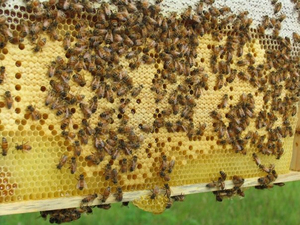
Honey bees
Photo courtesy of Maggie Smith
Pucillo's first mistake was checking on the status of her queen around 7 p.m., when the majority of the bees were returning to the hive. Second, she says she didn’t wear her complete bee suit, opting for a pair of low-cut shoes instead of the leather boots that accompany the suit.Â
She expected it to be a quick inspection, but her presence agitated the hive.
Pucillo, who has two hives in her backyard, wanted to make sure of the queen's position in the hive. The queen likes to move toward higher positions, but a beekeeper wants the queen to remain near the bottom, where she is protected underneath rows of honey to lay eggs.
The bees became defensive with Pucillo's intrusion and swarmed her, forcing her husband, Philip, to call the Pittsfield Township Fire Department for assistance.
“They weren’t aggressive,” she said today. “It was my fault. I bothered them. Lesson learned.”
Firefighters say Pucillo was “stung approximately 50 times on her feet and legs.” She was also stung across her body as some bees found their way through her bee suit.Â
Even her husband, who tried to assist her, was stung several times.
“I saw her walking toward me in this weird fashion, and I could see a cloud of black over her,” Philip Pucillo said. “I said, ‘Hon, are you OK?’ and I could tell in her voice that she was frightened.”
Her husband grabbed a hose to spray water at the swarm. When bees headed for him, he took shelter indoors and called firefighters.
By the time firefighters arrived, Pucillo thought she was in the clear - but they pointed out the large cloud looming overhead. According to their report, it took 750 gallons of water to disperse the bees.
Pucillo has been beekeeping for three years under the tutelage of a friend who has 10 years experience.
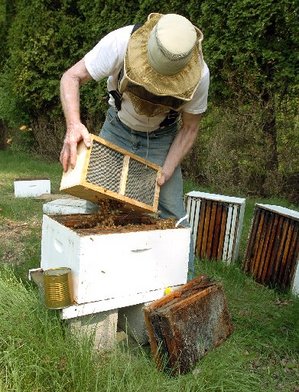
A beekeeper inspects his bee hives.
File photo
Her story stunned local beekeepers Lisa Bashert and Roger Sutherland, president of the Southeastern Michigan Beekeepers Association. Sutherland said the state doesn't have requirements or licensing to become a beekeeper, but he highly recommends taking a class like the one he offers through SEMBA.
“Bees are very gentle unless you rile them up,” Sutherland said.
Bashert, who has been beekeeping since 2005, also teaches classes across Ypsilanti. She maintains five hives at three Ypsilanti locations - the Ypsilanti Food Co-op, The Farm at St. Joseph Hospital and the Growing Hope Center.
Bashert was instrumental in Ypsilanti approving an ordinance allowing two hives on a property. Pittsfield Township allows three hives per property, Antoinette Pucillo said.
“I’ve never seen anything like that happen,” Bashert said. “Honey bees eat nectar and pollen. They are focused on flowers. They are not aggressive.
“They can be defensive when the hive is attacked in some way. I’ve been beekeeping for five years and in and out of a lot of hives and never see bees do something remotely like that.”
Pucillo’s interest in beekeeping began as a way to help nature.
A phenomenon known as colony collapse disorder has biologists puzzled as to why entire hives of bees are disappearing around the world. Fewer bees means agricultural crops have a harder time pollinating.
The U.S. Department of Agriculture says bee pollination is responsible for $15 billion in added crop value. The problem is so dire in China workers pollinate crops by hand.
Pucillo's first year as a beekeeper was a very successful one, producing eight gallons of honey. Last year, her bees’ honey production was down due to poor weather.
But this year, she expects another big honey output.
“It’s a wonderful hobby,” she said.
Brian Vernellis is a reporter for AnnArbor.com. He can be reached at 734-623-4617 or brianvernellis@annarbor.com.
Comments
Dan
Thu, Sep 15, 2011 : 5:48 p.m.
Crazy enough to get stung, sure- Why Not? I would love to have a chance to buzz with some of the Beekeepers in the business- and I'm sure to learn a thing or two if I volunteer to help them tend to their Honey's - I hear the first sting is the best and after that it's like therapy, yes I found the article about bee stings and their venom to be used in a positive way- I need therapy- to my leg could use a sting or two, I'll try it - search for, Traveling Bee Venom Therapist, more information Here: <a href="http://www.beewelltherapy.com/content/Natural-Awakenings-Aug08.pdf" rel='nofollow'>http://www.beewelltherapy.com/content/Natural-Awakenings-Aug08.pdf</a>
rrt911
Mon, Aug 2, 2010 : 11:35 a.m.
Arbor315-I am also allergic to bees. I have gone to the hospital with one bee sting causing problems. I have no problem with requiring a notice of bee keeping-fair enough.
Scot
Fri, Jul 30, 2010 : 2:04 p.m.
oh also, bee hives seem to become accustomed to levels of activity around them. My kids play around the bees and they don't get stung. Now they aren't doing jumping jacks in the rows of the beehives, but the kids aren't afraid of walking in and through them, or playing in proximity of the bee yard.
Scot
Fri, Jul 30, 2010 : 2:01 p.m.
Well having been a beekeeper for 25 years now, I can only imagine the mistakes that were made. I am guessing she forgot to use smoke, which calms the bees quite dramatically. Also the picture of the man "inspecting his bee hives", is actually installing new bees into a hive that appears to be a winter dead-out (the bees died over winter). You can see there are no bees on the combs next to the hive, and htey have a green tinge to them which is a mold that grows on comb when the bees aren't there to maintain them. Nothing to worry about, the bees clean the comb up extremely well and that mold is actually ever present in the beehive and an important part of a healthy bee ecology. I wear short and a t-shirt when keeping bees, so bees are not aggressive, but you need to behave a certain way when inside a beehive. You behave like you belong there, and move gently and handle the hive and bees gently and the bees won't mind you being there much. If you have a hive that seems a little more defensive than you are comfortable with, then a few puff of smoke will calm them down very dramatically as I mentioned. Beekeeping is an amazing hobby, not for everyone, but for everyone that does it, it is something highly cherished.
Dan
Thu, Jul 29, 2010 : 3:33 p.m.
I've had bees in my yard for 15 years, some but not all my neighbors know. I don't advertise the fact 'cuz some people 'freek'. So far of those who know about them I've had 0 complaints and have helped 2 neighbors the start their own hives.
gibby76
Thu, Jul 29, 2010 : 12:52 p.m.
well organic bee honey collected is still a good idea as opposed to contributing to the sugar producing machine which uses cheap labor and other imperialistic methods for keeping up with our sugar addiction. honey is a great natural source or sugar and has other antioxidant benefits as well.
bedrog
Thu, Jul 29, 2010 : 11:22 a.m.
i like pork...but don't much want to live next to a pigfarm. ditto beehives,given small grandkids...and for a person with allergic reactions there's no way they should have to...especially given the info readily available on the spreading aggressive african ( or, more accurately, per 'mike of saline', 'african american') strain. that said, i hope that the regs allowing urban beekeeping are like the chicken coop ones...i.e. permission from immediate neighbors. i know i can find this out for myself...but it might be helpful for someone to post a link on such regs to keep this chat on a level of actuality.
theodynus
Thu, Jul 29, 2010 : 10:33 a.m.
@arbor315: There are a lot of beekeepers out there, but google didn't yield any results when I looked for stories about someone dying because a neighbor's bees went crazy. I don't think you need to worry.
arbor315
Thu, Jul 29, 2010 : 10:27 a.m.
@rrt911: Part of the big deal is that some people, like me, are allergic to bee stings. If I was out in my yard when up to 50,000 bees started swarming next door, there's the chance I'd get caught in it and stung multiple times. While I have only a mild reaction if stung by a single bee, multiple stings could trigger a much stronger reaction. The story makes it clear that someone keeping hives in their backyard needs no education in beekeeping, meaning accidents like this could happen frequently. I'd really like to know if there are hives in my neighborhood - do beekeepers have to register with the city/township at least and can the public access this data?
mike from saline
Thu, Jul 29, 2010 : 10:16 a.m.
bedrog. Since these africanized killer bees have been in this hemisphere for several decades now, wouldn't it be more acurate to refer to them as african americanized killer bees? Just a thought.
A2B2
Thu, Jul 29, 2010 : 9:38 a.m.
Response to "ThaKillaBee". Thank you for considering me a journalism expert. I'm curious how you selected your posting name. Sounds like it could be an interesting story. Could you possibly be the beekeeping mentor of Antoinette Pucillo? Good Job!
rrt911
Thu, Jul 29, 2010 : 9:28 a.m.
Enough, leave this woman alone. So what she's interested in bees and keeps hives. So what she said she made a mistake and lesson learned. Be glad many of you haven't cut off your finger doing household projects or the like and the Ann Arbor News reported it. That's what she pays for living in A2, the use of emergency services. Marshall have you looked in the mirror lately?
rreidannarbor
Thu, Jul 29, 2010 : 8:38 a.m.
I work for a company on the west side of Michigan, Herman Miller, based in the Holland/Zeeland area but live in Ann Arbor. We house over 600,000 honey bees on site at a facility called the Greenhouse. The bees have done nothing but great things for us over there. They were brought in to drive away paper wasps and hornets as opposed to using pesticides. The do a great job of pollinating the surrounding area. When our customers visit we usually give them a bottle of honey. Bees are an essential part of our ecosystem... http://www.hermanmiller.com/discover/tag/honey-bees/
Top Cat
Thu, Jul 29, 2010 : 8:37 a.m.
This is why I built and maintain a frog pond. Frogs are just so much more civilized than bees. They don't sting. They are stoical. They appreciated what you do for them. They sing at night. I still think bees are nasty.
ThaKillaBee
Thu, Jul 29, 2010 : 8:23 a.m.
@A2B2, what are you talking about? I thought the original story was fine, it concerned the community, it's residents and fire department, it made me aware that people can actually have hives in their back yard on purpose, and the comments got me thinking about the world's bee problem. I thought it was a great story. I don't know why people are so hard on AnnArbor.com. Everybody is suddenly a journalism expert. (I know my nickname is ThaKillaBee but I promise it's just coincidence).
bedrog
Thu, Jul 29, 2010 : 8:18 a.m.
im interested in collecting fire ants...can we do that in residential areas too? but seriously folks...read up on expansion of africanized 'killer bees'( dangerous because of their swarming tendencies- not venom) and their hybridization with local honeybees.... and then let's make a bet that this story won't be the last hereabouts.
Marshall Applewhite
Thu, Jul 29, 2010 : 7:37 a.m.
Bee aggressive! Bee bee aggressive!
HENRYK
Thu, Jul 29, 2010 : 6:35 a.m.
I think the Pittsfield Fire Dept. should have a supply of honey in the firehouse for along time to come.
sailhounds2
Thu, Jul 29, 2010 : 2:45 a.m.
Bees are very gentile? There's this thing called spell check that replaced editors.. LMBO at EyeHeartA2 Good material for Jay Leno's Headlines.
redblue
Wed, Jul 28, 2010 : 11:07 p.m.
I thought it was kind of funny...
javajolt1
Wed, Jul 28, 2010 : 10:30 p.m.
Wow. Beekeeping. Think about it....how awesome is that?
needed perspective
Wed, Jul 28, 2010 : 10:10 p.m.
thanks to this story, I am going to explore this dangerous hobby!
needed perspective
Wed, Jul 28, 2010 : 10:08 p.m.
Brian, bee nice!
A2B2
Wed, Jul 28, 2010 : 9:29 p.m.
Thanks Ann Arbor.com for the more fact filled and realistic follow up story. The first story with "flash bang pictures" and "sensational news" written all over it was lets just say a little over the top.I understand the need to make the news but it started to look a lttle bit like a super market tabloid for a minute; a lot of sensation with no factual reporting. If you need some help with facts, there is a group that meets at Matthaie Botanical Gardens once a month called Ann Arbor Backyard Beekeepers. They would love to be your resource for beekeeping fact verification. Just an observation from a concerned reader.
Brian
Wed, Jul 28, 2010 : 8:30 p.m.
"When bees headed for him, he took shelter indoors and called firefighters." So, the husband decided to make a BEE-line into the house. I bet the 911 operator found his story difficult to BEE-lieve. One can only hope that she will BEE more careful in the future. :D
Jim Pryce
Wed, Jul 28, 2010 : 8:29 p.m.
My grandfather had bees for over 50 years & never encountered an issue like that. Did she use a bee smoker? Bees don't like smoke & they allow you to work the hive. You may get stung a bit, but not by the entire swarm. It sounds like she should take a class as Mr. Sutherland suggested.