

University of Michigan Survival Flight crew describes trip to retrieve Haitian patients
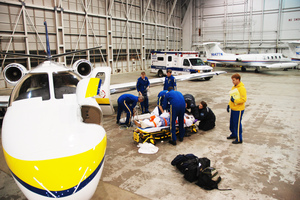
A Survival Flight crew with a Haitian patient is shown in a Willow Run airport hangar on Wednesday evening. Photo courtesy | University of Michigan Health System
Just a few days ago, the earthquake in Haiti was still just a news story to Wilson Bowers, a flight nurse who is part of the University of Michigan Survival Flight crew.
But on Tuesday night, the situation got much more real for Bowers and other crew members when they began a 24-hour journey to the devastated nation to pick up a seriously injured patient. By Wednesday, they were scrambling to treat two injured patients from Haiti on a return trip to Michigan where they could receive medical treatment.
Last week, U-M announced its jet was on standby should it be needed for the rescue efforts in Haiti, and it was considered a preferred provider by the Federal Emergency Management Agency. The fixed-wing aircraft is part of the Survival Flight fleet and is a leased aircraft managed by Pentastar Aviation Inc.
Preparing as best they could for the trip, the crew packed extra relief supplies like baby formula and peanut butter. They also tried to figure out exactly what extra supplies they would need in the jet, which has been described as being an intensive care unit in an airplane.
"We were assuming there might be extremity injuries that might keep us from more standard ways of accessing patients' veins, and we took more IV fluids we'd take on a normal flight because we knew the time would be long," said Jeffrey Pothoff, a chief resident in U-M Emergency Medicine.
The group flew out of Willow Run airport Tuesday evening and headed to Fort Lauderdale, Fla., to get in position. By midday Wednesday, the group was making its final approach toward Port Au Prince, Haiti.
The plane had to abort its landing three times before it was finally able to make it to the ground because the airport doesn't have a radar tower and so many planes are trying to access the runway.
So the plane circled the Haitian city and saw just how bad the situation is on the ground, Bowers said. They looked at the city and saw the aid ships out on the water, including the Navy's hospital ship, the U.S.N.S. Comfort.
"Then coming in on the final approach to the airport, we got a good look at the destruction of the city, and it is just mind boggling," Bowers said. "Port au Prince is a very large metropolitan area... you see two or three blocks of houses that are intact, and then you see blocks that are just sheer rubble."
After the group finally landed, pilot Jason Donaldson of Pentastar Aviation said they found the airport crowded with every kind of aircraft imaginable. It was packed with pallets full of boxes, presumably full of medical or food aid.
They noticed it was intensely hot outside. And in an unusual arrangement, the group was asked to park the jet in the grass to leave room for the larger jets to park on sturdier ground, Donaldson said.
They received their patient quickly, and the flight clinicians got to work asking the doctors already treating the patient for some basic health information. Is the person's body performing basic functions? What is the sodium level? Do you have a X-rays? That's when they learned the full extent of how bad things were on the ground, Bowers said.
"You hear people say it's 'jungle medicine, it's battlefield medicine' down there right now," Bowers said. "They really are just doing basic first aid. They are doing a good job with what they have."
The health system and crew declined to discuss details of the injuries or patients, citing privacy laws.
The Survival Flight crew was on the airport compound for a few hours before they began making the trip back. Taking into account the weight of everything aboard, the pilots determined it was safe to take a second patient on the flight.
After switching for fresh pilots in Florida, the group finally finished the trip about 8 p.m. Wednesday evening at Willow Run Airport. A Survival Flight helicopter and a Huron Valley Ambulance were waiting to whisk the patients back to hospital in Ann Arbor to begin "advanced specialized care."
The university declined to discuss details of how the flight and patient care were being paid for, indicating the details are still being worked out.
On Thursday, health system officials announced to employees they were caring for the two patients.
"The patients have injuries that require complex care that’s available at few medical centers in the country, among them UMHS," the university said in a statement e-mailed to employees. "Due to privacy laws, we are not releasing further details about the patients or their injuries at this time. However, we are proud to play this small role in the world's response to the massive tragedy in Haiti and to offer our air medical transport and our care to these patients."
Part of the job for the crew is to handle some of the worst emergency situations, and Bowers said he's able to put most of them aside. But this is one emergency call he doesn't think he'll ever forget.
"Until you actually experience that that type of thing, I don't know how you prepare for that?" Bowers said. "You just go down there knowing you've got the right equipment, you've got the best people and you do the best you can."
Tina Reed covers health and the environment for AnnArbor.com. You can reach her at tinareed@annarbor.com, call her at 734-623-2535 or find her on Twitter @TreedinAA.
Comments
mermaid72
Sat, Jan 23, 2010 : 1:36 p.m.
It makes me sad to see all the unfeeling & sarcastic comments here about a group of people who tried to help others in need. Yes it was expensive, & no, the patients were not Michiganders, nor Ann Arborites, nor even Americans, but they were in dire need of help. Something I hope none of you naysayers ever need. Try a little compassion once in a while, it might do you some good.
MjC
Fri, Jan 22, 2010 : 5:43 p.m.
The amount of hostility toward the UM is incredible. The hospital provides modern, compassionate medical services - to patients with insurance and without. The students who graduate from the UM are the most sought after employees in the world of law, medicine, business, public health, computer sciences, education and the arts. The UM provides employment to thousands of Michigan residents and is now the second largest employer in the State. The tax dollars I pay to the UM go a lot farther than the tax dollars I'm throwing out to the federal government. Go blue for taking care of business and for stepping up to help the people of Haiti.
tdw
Fri, Jan 22, 2010 : 3:23 p.m.
@JakeC you seem to like to type more than me so maybe you could explain to these fine folks about the diffrence health care and tramma care.No one in the U.S is denied trama care because of lack of insurance
tdw
Fri, Jan 22, 2010 : 3:12 p.m.
@lokal Try to find a hospital that does'nt charge those prices
Jake C
Fri, Jan 22, 2010 : 3:06 p.m.
To all the callously negative commenters: Since U of M is located in Ann Arbor, apparently that means it should only benefit people who live in Ann Arbor? Sorry, but U of M is a truly international institution, with alumni and programs that span the world, and to claim that there are somehow people in Ann Arbor who are in more need than what is currently happening in Haiti, with hundreds of thousands of people dead and millions injured? It's true there are people here who are sick and poor and and who need help, but we thankfully already have programs in place to help, even if they're not perfect.. But to try and compare what's going on in our community to what's happening in Haiti... how selfish are you? Do we truly judge the worth of a humanitarian act on a how much it costs against how much it benefits us personally? So sad...
Lokalisierung
Fri, Jan 22, 2010 : 2:59 p.m.
Maybe if the UofM health system spent less money on this kind of thing they wouldn't charge $10 for asperin.
tdw
Fri, Jan 22, 2010 : 2:59 p.m.
I hate to break this to some people its the University of Michigan not University of ANN ARBOR
Lokalisierung
Fri, Jan 22, 2010 : 2:57 p.m.
"Heaven forbid we do something to help human beings in a DIRE situation." I think we all agree we should. Let's start in new Orleans...remeber that place? yeah it's not all "fixed" now. "If these children were from Ann Arbor, would that make this OK and "worth it"? It would make it more worth it yes. The lives themselves put back to back no, but ehre's this little thing called money and we're kinda hurting for it now. How aboiut raising all this money for Ann Arbor schools so they don't have to be punished with less book learnin'.
letsgoblue
Fri, Jan 22, 2010 : 2:43 p.m.
I am shocked by the negativity of these comments. Heaven forbid we do something to help human beings in a DIRE situation. If these children were from Ann Arbor, would that make this OK and "worth it"? Geez. The world does not revolve around Ann Arbor, the state of Michigan or the US for that matter.
Kara Gavin
Fri, Jan 22, 2010 : 2:39 p.m.
To answer some of the comments: The U-M Health System has a robust charity care policy that guides our care for uninsured patients. Under this policy we provide millions of dollars in care to patients from around the state each year. We also have a dedicated effort to find insurance coverage for people who come to us for advanced care but do not have insurance. As with most major health systems, we absorb millions of dollars each year in the cost of caring for people whose insurance does not fully cover the cost of their care. Both our charity care and uncompensated care totals have been rising steadily in recent years, but we are committed to continuing to provide this care as part of our mission to serve the community. You can find more information on our Community Benefit site: http://www.med.umich.edu/comben/ Kara Gavin UMHS Public Relations
Kazia
Fri, Jan 22, 2010 : 12:43 p.m.
@alfaelan - If I were unfeeling, then I wouldn't care about my family, friends and neighbors who are proud of being part of the Ann Arbor community. Everyone I know here has either been educated or worked at U-M at some point in their lives. All we're asking is that U-M show some concern towards those of us who have supported U-M and taken pride in U-M. Simple as that!
bruceae
Fri, Jan 22, 2010 : 12:19 p.m.
@alfaelan I don't think we are angry and uncaring. The point is U of M pays no taxes so the rest of us in Ann Arbor pay their share, they gets lots of Michigan tax dollars and the get lots of federal Tax dollars. There are hundreds of people in Ann Arbor that don't have health care and we would prefer that U of M takes care of these people first and then worry about people in other countries.
AlfaElan
Fri, Jan 22, 2010 : 12:10 p.m.
Boy I never realized just how angry and unfeeling people in Ann Arbor can be. I guess I am an optimist
Tina Reed
Fri, Jan 22, 2010 : 12:03 p.m.
A point of clarification: As previously reported, the industry group that U-M's Survival Flight is a part of put out a call to its members asking if institutions would be willing to offer any services to help with rescue missions in Haiti. U-M offered its jet to be part of that list and was among organizations in the U.S. asked to come pick up specific patients from a larger list of patients in Haiti who need advanced care. AnnArbor.com requested to speak with the crew members who would be going on this trip and U-M decided to make them available to the media on Thursday after they'd returned.
krc
Fri, Jan 22, 2010 : 11:45 a.m.
I retract. They brought TWO patients.
bruceae
Fri, Jan 22, 2010 : 11:05 a.m.
@Rebba But they got some great pictures that they sent to the newspaper, the flight crew was interviewed on WWJ yesterday and in the paper. This as all just a stunt to get PR
bruceae
Fri, Jan 22, 2010 : 10:13 a.m.
This is exactly the point that the article last week was trying to point out about U of M. They feel the need to educate students from all over the world and deny entrance to MICHIGAN kids. Now we have them flying their jet to Hati while people in Ann Arbor don't have health care. Why are we paying state taxes to support this place? Let's support an institution that will educate MICHIGAN kids and provide medical care to MICHIGAN residents first.
Tom Joad
Fri, Jan 22, 2010 : 9:53 a.m.
One cannot help but think this is a bandwagon attempt at public relations and publicity. The flight alone and staff could be well into tens of thousands and the specialized care which, as we ALL KNOW, could easily reach hundreds of thousand of dollars in short order. There is a fundamental limit to our generosity even in the face of an epic humanitarian disaster, that everyone knows was caused primarily as the result of their desperate living conditions and substandard housing. Heroic medical resources of this magnitude should be reserved for the people of the state of Michigan.
Kazia
Fri, Jan 22, 2010 : 9:15 a.m.
How many tax paying residents of Michigan, who are currently unemployed/under-employed and without insurance, could have been helped with the money spent on this venture? Trying to get good health care without insurance is becoming almost impossible. Too many of us have worked for years to be contributing citizens and are being denied assistance, while UMMC is blithely spending money on the "cause of the month," while ignoring what's happening in their own backyard.
Davidian
Fri, Jan 22, 2010 : 8:37 a.m.
Wonder where they'll send the bill. Of course the have no problem bankrupting AMERICANS that don't have health insurance while they profit hand over fist. This is just a publicity stunt, a ploy, and a hollow one at that. Send humanitarian aid and compassion to Americans.