

Q&A with Ann Arbor Superintendent Pat Green: 'Accountability, continuity are critical'
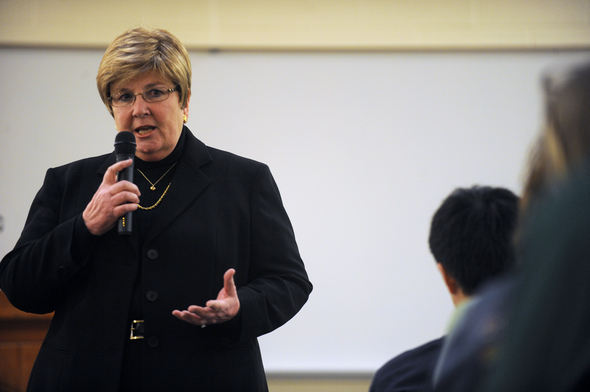
Ann Arbor schools Superintendent Patricia Green says the district has reached the "tipping point," where children and community members are beginning to feel the strain of continual budget cuts.
Angela J. Cesere | AnnArbor.com
After cutting about $50 million from its budget during the past five years, Ann Arbor is again facing a $14-million deficit for the 2012-2013 school year.
After that much cutting and slashing, Green said AAPS has reached its “tipping point,” where children and community members are beginning to feel the strain as well.
AnnArbor.com recently sat down with Green to discuss her goals, the budget, staffing, public opinion and her impressions of the district so far. Here are excerpts from the conversation:
AnnArbor.com: How would you define the Ann Arbor Public Schools district as a whole?
Green: What caught my eye about Ann Arbor was its emphasis on excellence, its emphasis on diversity, the fact that it had an incredible strategic plan and the fact that the strategic plan was intertwined with a technology plan, too.
Ann Arbor is probably one of the few districts I know of … that actually recognizes there is a gap in achievement, has put forward a tremendous effort and has made many strides in improving the achievement of everybody moving up.
The fact that the district needed to close the gap and made it clear that was a goal, was something very significant to me. I think it’s really a sign of a district that knows what it is and where it wants to go when you embrace challenges like that.
It’s an excellent district. There is always the concept of good and getting better, and that’s what I think the people of Ann Arbor school district want. They know they are very good, but they still want to get better.
AnnArbor.com: You mentioned you felt your background aligned with Ann Arbor and it seems like you had a pretty good idea of what you would be getting into. Did any of your first impressions change? What surprised you most about the district?
Green: Between the time that I interviewed and the time that I came, there were a number of changes that took place — some of which had to do with retirements.
When I came in July, there were people who were no longer here. The deputy for instruction had retired. The assistant superintendent for elementary education had been retired and came in last year on an interim basis, so there was nobody in that position. Mr. (Robert) Allen (deputy superintendent of operations) was here for the first two weeks, I think, and then he was on leave for the rest of the summer.
Initially, that was something back in March I was not expecting, that when I came there wouldn’t be the full staff. So I had to do a lot of interviewing during the summer. … It was very difficult to fill some of the positions at that time, so we did spend most of the summer doing that.
One of the things I sensed right away and got involved in right away … are some of the business operations — what do the different departments do and do we have what I call ‘job operations manuals.’ I found that there weren’t any. That said to me there was some work we had to do within the organization.
(In the operations manuals), there are (lists of) functions by person. Because how do we know we’re not duplicating services if it’s not in writing? How do we know there aren’t gaps in services?
There has to be, in my mind, … greater accountability. … There is a template that I developed in terms of goals and objectives that are aligned to each strategy in the strategic plan. Tell me, what is the major goal and the objective of what you are doing and focusing on. How is it aligned to the strategic plan. … If it’s not aligned with it, is it an essential operation? Show me how there’s evidence of measurability. What are the benchmark dates during which this activity will be taking place? And then I’ve added to it what I call mid-year formative data and end-of-year summative data, so that we link what we’re doing to an accountability measure.
AnnArbor.com: Do you feel the district is lacking that accountability or continuity of goals?
Green: I wouldn’t say it’s lacking. … What I try to do is focus more strongly and look at things more specifically … and look at efficiency and efficacy in tandem. No. 1: Are we doing the right things and are we doing the right things right? So I wouldn’t say anything was lacking.
Some of what I did (at my previous district) was taking a business lens and embedding it into an educational institution. I’m not saying that’s all we do, but often times in school districts we look more at the academics and we don’t pay attention to some of these other variables and these other factors. Why I did it (looked at increasing accountability) is because that’s what I do. And I think that we have to pay attention to those things. It’s very essential.
I’ve had tremendous talk with my staff about it. I gave them a while and a time to reflect because what I said to them was, ‘What we put on our goals and objectives has to be measurable, has to be benchmarked and it will be something that I will use in evaluations.’
I think that’s very important because if you don’t measure what you say you’re going to do, how do you really know you’ve done it? So it has to be measurable.
AnnArbor.com: When you say you’re doing that with your staff, is that your upper level staff and then they are doing the same thing within their departments?
Green: I am trying to model for my staff what I expect them to do with the people that report to them. … I’ve asked them to use the same template or a modified version of it, depending upon the nature of who the people are.
My plan here (in Ann Arbor) is a long-term plan, not a short-term plan. Much of my time so far has been assessing infrastructure … and making some suggestions. I’ve shared with the board that I feel communications is critical. I feel that consistency is essential. Accountability undergirds everything. And specificity — making sure we are clear and specific about what we’re going to do — in a systemic approach. Those are not terms you always hear in education. You might hear them more on a business side, but we cannot, especially in times like we’re dealing with right now, negate a business model.
I call it congruence and alignment. Are we congruent and are we aligned in the central offices? And so that’s what I’ve been spending a lot of time on — assessing. Where are we? What are past practices? Where are we going with future practices? And that’s not just done out in the schools.
AnnArbor.com: As you are assessing, what are you discovering as far as the staff itself goes? How effective are they? Is the size of the staff, the number of teachers and administrators, appropriate for the number of children enrolled in the district? Do you foresee anything needing to change as far as the staff is concerned?
Green: Five years of cuts, because of the national economy as well as the Michigan economy as well as the way the state funding streams have been structured, take a toll. In a perfect world, my answer would be no, we need more. That would be in terms of teachers in the classroom. That is the most essential part. Technology only enhances what a gifted teacher can do.
When I look back over the past five years of cuts that have taken place here (in Ann Arbor), they really struck home this year. … People really felt it.
I think you have to be careful that … (school districts) don’t become a paper house of cards … and become so fragile with such massive budget cuts that it’s easy to knock it over and change what has been recognized as something special. And here in Ann Arbor, this is a special school district … and why I am trying to move us into a direction with revenue enhancements, not just cuts.
AnnArbor.com: As you look closely at staffing and the operations manuals you are developing, would you say you are finding more gaps in services than overlaps in services?
Green: This will become something at the end of the year that’s more of a finished product than it is now, because (the operations manuals) are not complete. It’s something that takes a lot of time. … I can’t make total judgments on it at this point in time, but I will at some point when they are finalized.
AnnArbor.com: Do you expect changes in staffing this year or next year? Or when will we feel the results of this?
Green: What I’m hopeful of is the revenue conference coming up in January. … My understanding is, and I think it’s going to be Jan. 13 … where the state, governor’s office and all the state entities, talk about the projections going forward with revenue. Where are they with where they projected to be? All the signs we are getting are very positive right now, extremely positive right now. And we’re keeping our fingers crossed, in relation to your question about staffing, because if you asked me (about) a No. 1 priority … (I would answer) teachers and students in the classroom. … We value all of our employee groups but to make that strategic plan come to life for children and families, it’s classroom by classroom.
So, we’re hopeful. I’m a guarded optimist. … And until we know what (the revenue) is going to do, we are not going to be able to know the rest of the equation.
AnnArbor.com: The district is currently facing a $14-million budget shortfall. What are your ideas about where that money could come from? What types of cuts or additional revenues would you propose to balance the budget?
Green: One of the things that is not my style is I am not going to say, ‘We’re going to do this; we’re going to do this; we’re going to do this.’ One of the things that was important to me is that we started the process early. And it was much earlier this year than in the past by having forums to go out and just start talking with people, putting (the suggestion box) up on the website, to start taking the temperature of the community in terms of this whole issue. It’s a very significant component at this point in time.
Retirement — we don’t know what’s going to happen with the retirement piece yet either. If the Legislature does something to equalize it a little bit and we find out what the projections are going to be, that has a bearing too. So before I start talking about anything with cuts, I think we need to find out: What is the revenue going to be?
And the other thing I’m trying to do with the revenue is ... As we start doing some professional development down the line (to close the achievement and discipline gaps)... what I want to do is push some of our stuff out and say, in a broader arena, ‘We have some wonderful professional development opportunities, would you like to participate with us?’
That’s a revenue enhancement that I don’t think is being tapped yet. … We can do that with our legal services. We can do that with our financial services, with our HR services, because we have the talented people and the know-how to do it. And what we need to do is … look differently at how we can also systemically, perhaps, regionalize things. … We can broker things for Ann Arbor in a different way that will not diminish what we do, but that can also bring funds into us.
AnnArbor.com: You mentioned the public. What is going to be the role of the public as you shape your policies? And how do you balance what the public wants with what you want to accomplish in the district?
Green: Looking at the three disproportionately (disciplined) groups — African Americans, economically disadvantaged as well as special needs — I went to key people and said, ‘I want to sit with you and talk with you. Please join me. I want to hear your thoughts.’ The president of the NAACP (National Association for the Advancement of Colored People), the president of black parents group and the PTOC (Parent-Teacher Organization Council), those different groups said eagerly, ‘Yes, we would like to join you in that regard.’
It’s a balance between getting their input. … I think you have to listen before you can formulate any kind of a decision that needs to be made.
AnnArbor.com: It seems like the public right now is very critical of school officials and is watching with an eagle’s eye everything that goes on in the district. Do you feel that in your position and how much of that criticism is justified, in your opinion? How does it impact what you are trying to accomplish?
Green: I think that anytime you are going to have economic issues that touch people the way the economy has touched people — especially in Michigan, but all across the country — there are criticalities that people are feeling. And you have to be aware, but you still have to make decisions.
I think (you have to have) sensitivities to needs, sensitivities to the fact that we’re all people first. I have a job title … and sometimes job titles get in the way of who we are as people first. If we could all be who we are as persons and not live restricted by what a job title or a job description says we do, we can have tremendous influence as people.
“(In education,) we’re a people business — and that’s children, that’s teachers, that’s all of our employees, that’s consumers in the community. And we have to constantly work with all those kinds of forces and make sure that we’re doing the best. These are difficult times, trying times for everybody, and difficult decisions that have to be made.”
AnnArbor.com: What is morale like within the district, in the schools?
Green: I think anytime you are looking at five years of cuts, that’s a delicate, delicate thing. It’s not easy.
But one of my major projects in the works right now is so people don’t feel so fragmented. … We’ve tried to breath life into (the strategic plan) and to make sure that we stay on track with it.
We have great people; we have great citizens; we have great children, all the children; and great employees. And down the road, we’re going to make certain that we continue to celebrate what they’ve achieved and continue to take the district to the next level.
AnnArbor.com: How do you view the building capacity of Ann Arbor Public Schools? Do you think the district will continue to operate in the same format we are all familiar with? Or do you see that changing?
Green: First of all, what I’m trying to do — like I said about alignment and congruence, and efficiency and efficacy, and systemic types of things — the danger in what I’m trying to do and what I’m trying to prevent is there is a tremendous heritage of excellence here and flexibility. And I think we want to safeguard the flexibility, so that you can have an Ann Arbor Open; you can have a trimester (schedule) at Skyline. But (how I see it is,) we are a district of schools and not really a school district. And what I want to do is to maintain the flavor of each of those wonderful schools, but to make sure we are coming under the umbrella of the strategic plan, under our policies, under our procedures so that it’s not fragmented.
Over the rest of this year, we’re going to talk about a balanced calendar. … We’re exploring the capacity with full-day kindergarten. These are not just things you say, ‘Well, I recommend.’ It has to be based on data.
We are studying bell schedules in terms of what is the best way to offer programs. These are all future issues that you will see and hear evolving.
AnnArbor.com: How would you rate the effectiveness of the school board?
Green: You’d have to talk to the board president. … I cannot get involved with rating a board, that’s a question for the board president. But I have tremendous respect for all of our trustees. I have tremendous respect for the work and professionalism of all of our trustees. I think they truly support the strategic plan and want to see it come to life.
Staff reporter Danielle Arndt covers K-12 education for AnnArbor.com. Follow her on Twitter @DanielleArndt or email her at daniellearndt@annarbor.com.
Comments
schoolsmuse
Mon, Jan 9, 2012 : 9:05 p.m.
As a parent with kids at both Ann Arbor Open and Skyline, I don't like Dr. Green's comparison of the trimester system and the Ann Arbor Open system. Skyline would be the same kind of school if it was on a semester system. It could still have magnets--and it's the magnets that are the appropriate comparison to Ann Arbor Open. And lots of Skyline parents don't get to choose another school, because they are districted to Skyline, unlike Ann Arbor Open, which is solely a magnet. For what it's worth, I don't like the trimester system. Kids who want to take music, AP classes, and sometimes even basic math end up needing to put 1.5 credit hours toward that while students at Pioneer or Huron only need to put 1.0 credit hours toward that. And the end result is that students at Skyline end up with fewer electives. Read more here: <a href="http://a2schoolsmuse.blogspot.com/2010/02/trimesters-can-we-end-experiment-now.html" rel='nofollow'>http://a2schoolsmuse.blogspot.com/2010/02/trimesters-can-we-end-experiment-now.html</a>
say it plain
Tue, Jan 10, 2012 : 2:20 a.m.
I don't understand the comparison point either, except insofar as the two schools are each, perhaps she's hinting, "different" . I worry about the grouping, really, because what *could* she mean by pointing to those two and making reference to "fragmented"?! Like, hmm, the trimesters are an obvious difference for Skyline, I suppose so are the 'magnets' within the school, but those are more like niche-y collections of electives and perhaps translate to some funding/hiring/logistical "priorities' for Skyline from her perspective. Plus, I suppose, there is the open enrollment aspect of Skyline, so that some portion (it's something like 25% isn't it?) of each class comes from outside its districted attendance area. But speaking of the trimesters in the same breathe as Ann Arbor Open makes me wonder if she's not getting us ready to hear how trimesters won't work with a balanced schedule and having a smallish program with K-8 in one building won't work as an idea in the same district as the new UM/AAPS partnership at Scarlett-Mitchell. That this would be too 'fragmented'. Apparently people are claiming that she really likes these two programs, so maybe this is misplaced concern... I'm not sure I like the idea of trimesters either, for different reasons from you @schoolsmuse. I worry more about the end result for Skyline kids of having that 1.0 of credit hours in math or language for instance be for a good bit less instruction time to cover the material than at schools with semester systems and the same length school year.
ralph mcgraw
Mon, Jan 9, 2012 : 7:30 p.m.
The "strain of continual budget cuts"? Well, when the superintendent is paid an obscene amount of money in an era of "continual budget cuts", yeah, that does put a strain on everyone! Your salary is part of the problem, not a solution.
snapshot
Mon, Jan 9, 2012 : 4:42 p.m.
This super is going to have a lot of opposition since she's talking accountability, efficiency, and job descriptions.....whoa that's not going to fly in a straight line. It's a "business" model and we all know how educators feel about business....they hate business as evidenced in the criticism of Snyder's tax equity legislation. I like what this Super has to say and look forward to the war she just started with holding employees accountable, eliminating duplicate efforts, proper utilization and redistribution of resources as necessary. And for A2comments, she didn't blame anybody, she merely stated a fact that the proper manpower was not available because a person was on leave, some retired. Would you have kept that a secret? And why?
Floyd
Mon, Jan 9, 2012 : 11:55 a.m.
I don't think I've had the pleasure of seeing someone use the word "criticalities." Impeticos to thy gratility, Ms. Green.
say it plain
Tue, Jan 10, 2012 : 2:03 a.m.
Oh, now, watch out, the hyper-literati in town are getting all hot under the collar about her style of verbiage lol... It won't be long before she gets run out of Ann Arbor, this bastion of the truly smarty-pantsier than thous :-)
Stephen Lange Ranzini
Mon, Jan 9, 2012 : 10:29 a.m.
@talker: our town, being predominantly a government job town where over 70% of the workers and 9 or 10 of the top 10 employers are units of government of one type or another is very much a 9 to 5 kind of a place. There are relatively few industrial shift workers and while there are some people with the night shift, flex shift and early shift jobs you describe (like my wife- I'm up this early because I just put her and one of our children in the car to go to work and day care, respectively), we are just the exception and not the rule. The children should be educated and organized in a way that benefits them, the vast majority of the parents and society the most and not the few like my family (and maybe yours). Oh, and all the research clearly shows that high school kids should start school later in the morning and that starting before 9am is a very bad idea.
julieswhimsies
Mon, Jan 9, 2012 : 3:32 a.m.
Hmmm. So. What's the plan?
ViSHa
Tue, Jan 10, 2012 : 11:51 a.m.
Is there a step 4: get rid of overlapping jobs or unnecessary Balais jobs and stop the musical chair principal game?
snapshot
Mon, Jan 9, 2012 : 4:48 p.m.
First she's going to figure out who's doing what so she know what kind of resources she has to establish a "plan". So her plan is 1. to document and solidify her resources first...that is a plan. 2. Stage two will be identifying and prioritizing problem areas with input from employees. 3.Stage 3 will be utilizing appropriate resources to work on the problems.
talker
Mon, Jan 9, 2012 : 3:09 a.m.
While Dr. Green didn't answer tough questions as many expected and many think top administrators are gobbling up too much of the district's education funding, there were also some comments from readers that need reviewing. First, the assumption that most parents work from 9 a.m. to 5 p.m. is passe, if it ever was true. There are are kinds of work hours, such as 7 a.m. to 3 p.m., noon to nine p.m., 8 a.m. to 6 a.m. or later, etc. etc.. In fact some parents who work the night shift only get to see children in the afternoon, such as between 4 and 5 p.m.. With diverse work schedules, school hours shouldn't be based on assumptions of when parents work. The current pattern of high schools starting the earliest, middle schools next, and elementary schools after that has been efficient for school buses for decades. Unfortunately, this year some children who should be riding school buses are the scapegoat so that administrators can receive big city salaries. Why would the superintendent of Ann Arbor Public Schools earn as much as the superintendent of Chicago Public Schools? Also, if we can't hire from within the system, what does that say about the system?
kathryn
Mon, Jan 9, 2012 : 2:20 a.m.
Orangecrush said "I think that the district has a good "system," but that there are people in place who mess things up." I would argue that the district does NOT have a good system, or there wouldn't be people in place to mess things up. There are not clear expectations, nor proper evaluation and follow-up of anybody or any program. The place runs as well as it does because there are mostly good and honest people out there doing their best every day. What remains to be seen is if the new administration can devise a "system" that will actually improve matters or if they will break what is working now by messing with something they don't understand. We'll see.
cette
Mon, Jan 9, 2012 : 11:41 a.m.
too true..
KeepingItReal
Sun, Jan 8, 2012 : 10:13 p.m.
"Looking at the disproportionate groups, African Americans, economically disadvantaged as well as special needs , I went to key people and said, I want to sit with you and talk with you..." about what? The NAACP has ceased to be a relevant representative of Blacks since 1965 and you want to sit and talk with them about what?
Danielle Arndt
Sun, Jan 8, 2012 : 8:17 p.m.
To Stephen Lange Ranzini, sh1, AnnArborite, Blerg and others inquiring about the questions readers suggested and the questions we asked, I want to assure you that your questions were of great importance in determining what to ask Superintendent Green. They were weighed heavily as we shaped our own questions and included several of those posted to AnnArbor.com and emailed to myself personally. We tried to ask at least one question in each topic discussed and suggested by readers. The above Q&A represents the best points of our interview with Dr. Green, but is not by any means a complete transcript. Some questions that were asked could not, for a number of reasons, be included in the article. And, admittedly, due to time constraints during the interview, not all of the questions we wanted to ask were able to be asked. Additionally, there were a number of good questions that were suggested by readers that would be more appropriate to ask the board themselves, rather than Superintendent Green. Each question that was posted to the previous article, as well as the additional questions raised here, has been saved and recorded and we will do our best to continue to address these issues in the coming months. Thank you again for all of your input and for the hearty discussions on this topic. We hope to conduct more Q&As with Dr. Green in the future, as well as with the board.
schoolsmuse
Mon, Jan 9, 2012 : 9 p.m.
Danielle, Was this done as in in-person interview, or via email? Because there are lots of . . . and I would appreciate it if you would post the entire interview--since there's no page length limit on the internet.
DonBee
Mon, Jan 9, 2012 : 3:41 a.m.
So you post a softball interview and don't post any of the real questions that people want answers to. Nice puff piece, I guess it should be filed in the pastry section of the index.
boo
Sun, Jan 8, 2012 : 7:46 p.m.
If only teachers would teach, Parents would parent, and leaders would lead, we'd be all good! The problem is all three groups I mention are NOT, as a whole, doing their job. And our children lose every time. sound simple? it really is.
15crown00
Sun, Jan 8, 2012 : 6:21 p.m.
i'd say she better put it in gear and stop talking about it or in 2-3 years she'll be history.
Dog Guy
Sun, Jan 8, 2012 : 5:54 p.m.
AAPS has worked for decades to eliminate the diversity and excellence gaps so that all kids can be equally excellent and homogeneously diverse.
A Voice of Reason
Sun, Jan 8, 2012 : 5:49 p.m.
MEAP RESULTS WERE RELEASE TO THE DISTRICTS BY THE STATE OF MICHIGAN DEC. 2011 (it was Feb. last year)! Why is AnnArbor.com not posting the results? How did we do? Why is AAPS sitting on the results.
DonBee
Mon, Jan 9, 2012 : 3:39 a.m.
Voice of Reason - Yes, the district knows but the public does not. Nothing on the state website, nothing on any other website, nothing posted on the AAPS website. With the change to the "cut" scores, I suspect the school districts are getting time to put "reasoning" together for the new results so they can be ready to answer to the public.
kathryn
Mon, Jan 9, 2012 : 2:15 a.m.
They are not allowed to release the results yet. They are given results ahead of public release in order to review and have them available to help identify students who are struggling. They will release them when the state says "Go."
ViSHa
Sun, Jan 8, 2012 : 5:43 p.m.
When she speaks of meeting with the three disproportionately groups, she doesn't mention meeting with any special needs groups . She implied they were not eager to meet with her, only the NAACP, BPSSG, and PTOC. Did they not want to meet with her or give her input? Is this why special services are stretched so thin?
ViSHa
Sun, Jan 8, 2012 : 10:09 p.m.
Thank you, that is good to know.
AMOC
Sun, Jan 8, 2012 : 6:24 p.m.
ViSHa - Supt. Green has been meeting with the Special Education Parent Advisory Committee (PAC) and has asked for their input to her proposed achievement gap reduction process. She has continued and expanded the Superintendent's participation in the AAPS PAC for Special Ed activities, and has listened (IMO) carefully and intelligently. I'm betting that either the reporter edited out a mention of AAPAC for Special Ed or Dr. Green just didn't mention it.
A Voice of Reason
Sun, Jan 8, 2012 : 5:38 p.m.
Be brave and survey the parents to evaluate their children's teachers-like Iowa is doing. Why are you so afraid of the results if teachers are doing an outstanding job? We are not trying to beat up the teachers but we do expect them to exceed the state standards or we would not throw so much money (more than most communities) toward education. Yes, maybe you need to freshen up your lesson plans every few years and try to engage children in new ways. So many parents do homework with their children at night and send their children to Kumon, etc. I do not think the kids are learning on their own in this town. Text books are 15 years old--no online learning efforts. Ann Arbor is not leading the way.
A Voice of Reason
Sun, Jan 8, 2012 : 5:34 p.m.
Think it is more important to address the horrible MEAP results that we will be experiencing and what the plan is to better educate all children--not just the 10% of children that would succeed if they were taught by a monkey or the bottom 30%. OCCUPY AAPS. We are a numbers town and work better with a plan of action with actual numbers attached. Time for ACTION-not words, theories and promises.
Orangecrush2000
Sun, Jan 8, 2012 : 5:33 p.m.
I think that the district has a good "system," but that there are people in place who mess things up. All good systems require good people with integrity to implement them, no matter how talented (or able at self-preservation) they are. There are teachers, administrators, workers and coaches in the AAPS that really need to be forced out. These individuals are so self-centered, self-absorbed and self-concerned that they end up destroying the integrity of ANY system. The system isn't "broke," It's just that people we trust, at first, end up taking advantage for themselves, or using the system to support their "special interests." I would hope that the new Super would force these self-interested types (and you KNOW who you are) to behave properly through stronger accountability; or force them out. I recall being chastized by one administrator in particular because I had suggested that there was a policy in place to govern a particular topic we were discussing. And, the administrator basically responded by saying, "What policy? There's nothing in writing that tells me what I have to do,..." etc... I felt like the administrator was taunting me and saying, "Can't touch this (me)," like MC Hammer, because there was nothing in writing to hold the administrator accountable. And, it made me realize that the AAPS was virtually 100% political and almost 0% based on principle.
cette
Sun, Jan 8, 2012 : 8:40 p.m.
Who is asking to support Orangecrush2000 statement? If you've dealt with AAPS enough it rings true enough, just the mindset alone is very familiar. But if a system tolerates this kind of performance, it is a system's issue, not an individual issue, because the system doesn't improve or get rid of an individual who is playing games for their own benefit.
Greg Gunner
Sun, Jan 8, 2012 : 5:24 p.m.
Let's see if I have this right. Hire a new superintendent. Underfund the school district by the tune of $14 million dollars. Cut staffing, and cut pay and benefits. Lower morale by expecting employees to bear the brunt of the cuts. Expect better results. What business could survive the same reductions to income, staffing and morale and produce a higher quality product or service? The truth is the business would be declaring bankruptcy. We are taking our public schools toward bankruptcy with this insane idea that we can get more for less. Let's not blame the superintendent, who is trying to keep a multi-million dollar school district alive while being seriously underfunded. Remember, you get what you pay for! Greg
jcj
Sun, Jan 8, 2012 : 8:37 p.m.
"Remember, you get what you pay for!" Not in her case!
DonBee
Sun, Jan 8, 2012 : 7:34 p.m.
Greg - Ford for one. They have about 1/2 the engineers they had, and much higher product ratings. For engineers the raises have been about zero for the last 5 years. On the line people are asked to do 20% more on every vehicle and keep the quality up. Seems Consumer Reports shows they are succeeding. Most private businesses have cut staff, pay, benefits and produced more with less and at a higher quality. That is just the way you survive right now in this economy. Mostly higher productivity = more unpaid overtime for salaried workers.
Stephen Lange Ranzini
Sun, Jan 8, 2012 : 5:18 p.m.
Other than the brief aspirational discussion (much appreciated) that a "balanced schedule" would be an excellent goal, AnnArbor.com didn't really ask ANY of my 5 questions. I'll note that my very long post with these five questions, was the fourth most highly rated comment on the article which challenged us readers to come up with good questions to ask. Why was AnnArbor.com 0 for 5 on the questions I posed and so many of your readers endorsed?
DonBee
Mon, Jan 9, 2012 : 3:36 a.m.
I suspect that to get the interview, Dr Green had a veto on the questions they could ask.
Stephen Lange Ranzini
Sun, Jan 8, 2012 : 5:14 p.m.
When AnnArbor.com asked what questions to ask here is what I wrote (and got 47 votes): President Obama's Secretary of Education says that the traditional long Summer break hurts kids and the data is clear that is does hurt low and moderate income children. Why can't we adopt a balanced calendar so that we can decrease the "failure to graduate rate" materially here in Ann Arbor? Why don't our children go to school 9 a.m. to 5 p.m., the same hours that parents work? This would decrease many of the problems brought on by unsupervised latch key kids and better train children for the work force. Why can't AAPS disclose it's check registers in a timely basis? The "Monthly A/P Check Register" currently only has the information through January 2011. Since the AAPS annual fiscal year ends in June, this means that we cannot compare the budget, the annual audited financial statement and the check registers to see what budget cuts might be possible using the actual data. How much money does AAPS spend each year on internal audit to ensure that the formal policies and procedures of the board and senior management are followed and not violated? Several recent scandals where over a half million dollars was being lost each year by actions in violation of established policies indicate that there is a culture in place that ignores official policy and an ineffective system of controls and checks and balances. Prior to last year, the Ann Arbor Public Schools had 200 supposed employee dependents receiving health care benefits who were in actuality not eligible as legitimate dependents. This was costing the AAPS $766,800 per year. The district discovered the problem last year, and the ineligible dependents were immediately deleted from the district's health insurance plan. What steps has AAPS taken to recoup any of this money and how much has been recouped to date?
Orangecrush2000
Sun, Jan 8, 2012 : 5:44 p.m.
If these payments, as evidenced by them being immediately deleted, were obtained inappropriately, this money should be re-couped. But, again, it requires people with integrity, to do so. And, in my opinion, chances are, if this money should be re-couped, there are administrators who will not make the attempt to re-coup this money because the money went to someone they know, or are part of their "special interest group."
A Voice of Reason
Sun, Jan 8, 2012 : 5:21 p.m.
I meant to say, that the details are not provided to whom checks are paid. Also, I am wondering if the school district has more than one check registry.
A Voice of Reason
Sun, Jan 8, 2012 : 5:19 p.m.
I would love to see credit card statements online too. Also, the check registry does not include paychecks. Also, why not talk about results vs. money?
Floyd
Sun, Jan 8, 2012 : 5:01 p.m.
If Polonius is right, and "brevity is the soul of wit," then this woman is as short on wit as she is full of words. Words, words, words... This interview is like to be a tale told by an idiot, full of sound and fury, signifying... another raise for an administrator!
Dr. I. Emsayin
Sun, Jan 8, 2012 : 5:08 p.m.
I hear from teachers that her opening remarks the first day of school went on far too long. She should spend some time inside the schools visiting teachers' classrooms and seeing what is going on.
Alan Goldsmith
Sun, Jan 8, 2012 : 3:42 p.m.
"For a news organization that loves to beat up on AAPS, I can't believe only softball questions were asked>" Wow, where have YOU been? Lol.
Billy Bob Schwartz
Sun, Jan 8, 2012 : 3:42 p.m.
One of the ways to get ahead in school administration (and many other businesses, too) is to have all the doublespeak jargon firmly in tongue at all times. It's like politics, only worse. Whatever the question, the answer is, well...actually isn't. Did you ever watch a first-rate interview on TV? What do they do? The interviewer asks a good, clear question, and when no real answer comes, they ask it again more clearly, and continue doing so until the interviewee finally gives up and answers the quesion or throws a chair and leaves the set. If Ms Green agrees to the interview, it should not be on the basis of "i can handle this rube." It should be on the basis of "I hate to do this, but it is necessary to lay some cards on the table with the community that has hired me so they will support my efforts." Can we do this again, but do it right? Please.
hank
Sun, Jan 8, 2012 : 3:39 p.m.
Doggone schools they have caused all the problems. Unemployment, failing schools,social ills, high divorce rates,crime you name it its the schools and the people that work there at the bottom of the problems. Now that that's out of the way maybe meaningful conversations can take place,good luck with that though.
jcj
Sun, Jan 8, 2012 : 3:20 p.m.
"Ann Arbor schools Superintendent Patricia Green says the district has reached the "tipping point," where children and community members are beginning to feel the strain of continual budget cuts." One sure thing! She is not feeling the strain of her personal budget being cut!
Mike
Sun, Jan 8, 2012 : 3:20 p.m.
Billions of dollars have been spent since the 1960's at the federal, state, and local levels to promote "diversity" and close the "achievement gap" with little or nothing to show for it. That's the first area I would cut spending on and focus on the core reason for education. Instead of raising the graduation requirements for all students and I expect increasing the dropout rate (I know three white males who have dropped out in the last year) I would focus on teaching the students what they can learn to the best of their ability while still having advanced classes for those who excell at school. Not all of us can be scholars just as not all of us can be quaterbacks for a pro football team. One size does not fit all; even if you'd like it too and are willing to spend every dollar we pay as tax payers to try and proveyour failed thesis..............
KLK
Sun, Jan 8, 2012 : 3:14 p.m.
"But (how I see it is,) we are a district of schools and not really a school district." I love this quote.
cette
Sun, Jan 8, 2012 : 3:08 p.m.
I think Dr.Green said a lot in this piece. I prefer this kind of journalism, clear, calm, with lots to think about. Please do a followup. Dr. Green said she is working on a lot of things that involve metrics...let's see what happens..
cette
Sun, Jan 8, 2012 : 6:07 p.m.
I think a year, given the dysfunction in the system to see what she can start and another year to see what her ideas start to yield.I think voting that late is a bad idea, just like working that late on things is a bad idea.
ViSHa
Sun, Jan 8, 2012 : 5:55 p.m.
Out of curiosity, when you say "let's see what happens", how long are you prepared to give her (and certainly 6 months isn't enough)? Obviously we disagree on a lot concerning aaps, is there a point when the observing needs to be followed by action? Maybe you have an inside track and know what others don't? BTW, too lazy to go back and look, lol, what was your opinion on the 2am vote?
cette
Sun, Jan 8, 2012 : 5:36 p.m.
lol
ViSHa
Sun, Jan 8, 2012 : 5:34 p.m.
of course you did.
antikvetch
Sun, Jan 8, 2012 : 2:15 p.m.
She speaks an excellent doublespeak. Let's give her a raise and a nice bonus.
Basic Bob
Sun, Jan 8, 2012 : 4:32 p.m.
Her bonus is extra compensation for not taking the health insurance. I bet she is covered on a retiree plan. What a crock.
Grumpy
Sun, Jan 8, 2012 : 2:08 p.m.
Can't type fast enough to say what sh1 & AnnArborite already beat me to saying. I agree with @ Kai. Liked the initial approach to one article asking the public for good suggestions before the interview. But then softballs were thrown that were hit out of the park with boring, wordy, political answers containing no information. Missed opportunity by AA.com while they had Green's ear. Will probably be a while before Green grants AA.com more of her time for another interview like this. AA.com, PLEASE PLEASE let Ryan Stanton conduct the interview next time. Throw your best at such an important local issue.
Blerg
Sun, Jan 8, 2012 : 2:01 p.m.
For a news organization that loves to beat up on AAPS, I can't believe only softball questions were asked. I too am scratching my head about why the reader submitted questions, including the highly voted for one I posed about top administrative pay cuts, weren't asked. This is yet another disappointing piece of semi-reporting from AA.com. I've seen better interviews conducted in the local high school papers.
say it plain
Sun, Jan 8, 2012 : 6:47 p.m.
Maybe because this way they generate click-thru revenue when they ask the public to submit questions, then again when they do polls, then again when they finally conduct an interview, then again when they post their next three articles purporting to do the hard-hitting question-asking about how AAPS operates and spends money and how the board has 2am salary-raising votes, then... you get the idea... but we have no choice apparently... because we also, as a community, tend to re-elect board members who do the same things we find annoying over and over.
AnnArborite
Sun, Jan 8, 2012 : 1:52 p.m.
Why did AnnArbor.com ask readers to submit questions and then take a poll on what THEY wanted asked-the actual tough questions that need answers???? This "interview" is one Dr Green could have done all on her own since nothing controversial was asked. I was looking forward to this interview/article and the answers to actual questions -I have already heard all of these answers at a forum. So once again, NOT really news now is it???!!!!
sh1
Sun, Jan 8, 2012 : 1:40 p.m.
In a previous article, AnnArbor.com solicited ideas from readers of questions to ask the superintendent. There was an outpouring of excellent (and tough) questions. Why weren't they asked?
Silly Sally
Sun, Jan 8, 2012 : 1:23 p.m.
"And how do you balance what the public wants with what you want to accomplish in the district?" She is hopelessly fixated upon race. Instead of answering the question and seeing what ALL of the public wanted, she said, "I went to key people..." and then lists the NAACP and black parent groups first, then the PTA a distant third. What about the rest of us? (we pay most of the taxes and are the large majority)
AMOC
Sun, Jan 8, 2012 : 6:15 p.m.
Sally and Cette - Green also acknowledged an achievement gap for "special needs" students, which was very nearly the first public acknowledgement from AAPS that this large and growing achievement gap even exists. And she did it in a much more appropriate and sensitive way than the Skyline HS principal did this fall when she blamed "a single special education student" for her schools' failure to achieve Adequate Yearly Progress".
cette
Sun, Jan 8, 2012 : 3:22 p.m.
Wow, about the whole "she is hopelessly fixated on race" thing, methinks you do protest too much...
Kai Petainen
Sun, Jan 8, 2012 : 1:22 p.m.
i really like this kind of reporting. nicely done!
local
Sun, Jan 8, 2012 : 1:22 p.m.
No real answers to any of the questions. It was like listening to a politician dodge the questions they don't want to answer. Our board did a disservice to the community by hiring someone with zero knowledge of Ann Arbor and someone who is going to sit back quietly and observe what is going on. I think it is time for Dr. Green to step forward with a plan for the district, with specific ideas that she would like to see carried out. And no, I'm not talking about raise packages and behind the scenes hires!
Mick52
Sun, Jan 8, 2012 : 8:27 p.m.
I agree. Sounds like a talker and not a person who will get things done (how to say nothing in 5000 words). All the talk about accountability makes me suspect she is setting people up to take the blame. And is running a school system complicated? Or do you make it complicated?
SonnyDog09
Sun, Jan 8, 2012 : 1:13 p.m.
Her response to the question about the role of the public was simply a list of the special interest groups that she has met with. In the minds of the liberal intelligentsia, "the public" is just a collection of special interest groups.
A2James
Sun, Jan 8, 2012 : 1 p.m.
She acknowledged economically disadvantaged students, not just African American students? Whoa, I almost fell out of my chair! Good for her. For the person who referenced buzzwords and drinking games....just try doing a shot every time Mary Sue Coleman uses the term "diversity" in a speech! Socioeconomic problems > "diversity"
A2James
Mon, Jan 9, 2012 : 1:43 a.m.
Diversity (in public, private, and higher education) traditionally means minorities, and the place importance of being surrounded by different races and cultures. Socioeconomics deals with someone's living environment, and the divides between rich and poor. The distinction is clear and important, because minorities aren't the only groups who might need extra tutoring or assistance. For example, affirmative action is a relatively outdated and overgeneralized program, whereas socioeconomic programs are much more relevant and helpful.
johnnya2
Sun, Jan 8, 2012 : 9:20 p.m.
Socioeconomic is PART of diversity.
squidlover
Sun, Jan 8, 2012 : 12:57 p.m.
I know that Superintendent Green is dealing with a tough situation here, but I can't help but feel that throughout almost the entire interview her responses were filled with a lot of words (tough economy, need to be sensitive, positive signs...) but very little actual answers. I do like aa.com asking a question about the public's criticism of the board, but since her response was pretty anemic, I would have preferred more specific follow up questions addressing: -The huge increase in salary -The controversial 2am vote giving raises -The public's discontent with money given to PEG For the sake of all of our students, I hope things can get on track so we can see these positive signs that Superintendent Green speaks of.
squidlover
Mon, Jan 9, 2012 : 12:06 a.m.
@johnnya2 I wasn't looking for her to publicly blast the board. However, since the public's criticism was brought up in the interview, I think the follow up questions are certainly warranted. As for the responses, how hard is it to say "I can certainly understand the frustration...here is what the board and I are working on....regarding the 2am vote to give raises, I certainly did not intend to mislead the public, but I felt it was important to address immediately because...regarding our past business with PEG in our attempt to close the achievement gap, we are looking at ways to achieve this goal in a less expensive way by..." I don't think that is too much to expect. Perhaps I should have sold these answers to Superintendent Green before posting them.
johnnya2
Sun, Jan 8, 2012 : 9:19 p.m.
You do realize the board is her boss? I wonder if in a public interview you would say of your boss, they are doing a horrible job. What do you really expect her to say? Would you prefer, " I came into a horrible place. The schools are horrible, the board does not know what they are doing, there is no money from the state, our teachers can't teach, the custodians cant clean, we could do this job with 100 million dollars less, and I am thinking about doing it for $25k a year." I wonder how often the CEO of the company you work for makes public proclamations about the performance of people within your organization.
ViSHa
Sun, Jan 8, 2012 : 5:31 p.m.
All that was missing was "in these uncertain times". Or maybe she did say it and I nodded off at that part. Hopefully she got an "at the end of the day" in there. I, too, was not impressed with the generic response about the board, but really, what is she going to say...?
J. A. Pieper
Sun, Jan 8, 2012 : 3:40 p.m.
Unfortunately in the education environment, many administrators, and those "in the know" about every aspect of education, have their own, specialized language, "educationalese" which means they can use a lot of words (notice, it was a long interview), and say nothing specific! This makes it look like they are doing something in their jobs, but they really aren't being specific enough to do what is needed.
Stephen Lange Ranzini
Sun, Jan 8, 2012 : 12:51 p.m.
@A2comments: Actually faced with a completely dysfunctional organization (see my first comment above), a good leader FIRST focuses on getting the right people "on the bus". Once they are on board, then the leadership team figures out how to fix the problems. If you don't believe me, read Jim Collins excellent bestseller "Good To Great". Now having said that, I do agree with you that "hiring people without school board approval" is very problematic and it's going to be harder for a leader to say "follow the written procedures in the operations manual" and hold people accountable if they don't, with mistakes like that.
AMOC
Sun, Jan 8, 2012 : 6:09 p.m.
Having dealt with the district for 13 years and counting, I think that you and Supt. Green are on the same page of that same book, Stephen. The new administrators are some of "the right people", and some of the retirees needed to go before we could get the bus pointed in the right direction. There are a few more administrators who (IMO) need to have it pointed out to them that "This is your bus stop, right here.". Getting procedures in writing and formal goal setting are what it will take to hold them accountable for their performance (or lack of it!) and require them to move on. Further, if there had been an appropriate AAPS HR manual, I very much doubt the error of extending employment offers to individuals who had not been approved by the Board of Ed would have occurred. I think of the push to create procedures as a "corrective action", the need for which was made very obvious to the school board and Dr. Green's subordinates.
AMOC
Sun, Jan 8, 2012 : 5:44 p.m.
Having met some of the new administrators, and having a total of 13 years prior experience with the retirees they have replaced, I think that you and Supt. Green are on the same page. AAPS has some great people on board, now has a few more great people on board, and there are still some who will have to find their stop (or have it pointed out!) and get off the bus. I think we will see noticeable changes within about 2 years, once it's possible to hold principals and central office staff accountable for their performance or lack of it. If AAPS had a procedures manual for either the HR dept or the Superintendent's office, I doubt the error of extending employment offers to candidates before getting School Board approval of the individuals selected would have occurred. As our school board has acknowledged, it's much harder to hold someone accountable for not doing it the way the boss(es) wanted In the absence of a written procedure.
Gloriagirl
Sun, Jan 8, 2012 : 12:40 p.m.
The district has been dysfunctional for a long time as the Supr. has observed, all while the board of education continues to micro manage administration, which means with each new superintendent, the board ups their salary to keep them only to find after a couple of years they crash and burn out from this dysfunctional group and the next one comes in. Think about it isn't that really has happened here from Rossi ray Taylor, to Fornero, to Roberts and now Green. Yet the district keeps pouring money into the most costly positions in the district while claiming there's no money for the classroom, bus drivers or student services such as sports and other student activities. When is the community going to figure out there has been no organization at Balas for the last decade and board members are clueless about this because they have not idea of what accountability is. Green is right to charging forward with operation manuals and job descriptions, inquiry into HR job descriptions have been non existent and this will begin to put some accountability into the process. But it's going to be a tough row to hoe and there will be enormous resistance from within and those who don't want to change the culture will get to specific board members who will try again to undermine another Superintendent. Let see if this one lasts longer than the last few since here salary is comparable to the governors.
cette
Sun, Jan 8, 2012 : 6:32 p.m.
Will she get administrators to work for the school district and the kids and not just for themselves? Will some on this school board throw her under the bus if she doesn't do just what they want, when they want it, for the crowd they are playing to? I don't know.
ViSHa
Sun, Jan 8, 2012 : 5:58 p.m.
I think you pretty much nailed the underlying problem of AAPS. Which doesn't really give me much hope for change.
Basic Bob
Sun, Jan 8, 2012 : 12:28 p.m.
"children and community members are beginning to feel the strain as well" Welcome to Michigan. Home of the single state recession. Home to some of the largest manufacturing job (and income) losses in history. Dr. Green, we have been feeling the strain. All except for those state government employees insulated from corresponding losses by the teachers unions and guaranteed (!) administrator contracts. There are no "step increases" in the real world. We are lucky to make as much as the fellow we replace (because obviously he was more experienced). The common man has been feeling the strain more than school employees, and our morale is shot. I won't be happy until we start seriously cutting the fat. Community High and all its hidden costs is on the top of my list. It has been ever since we opened Skyline, now we have excess capacity. How is this realistic when school age population is declining?
Basic Bob
Sun, Jan 8, 2012 : 11:36 p.m.
"The fact that AAPS allows increases for salaries of administrators, tells me there is money...." Reduction in Janitors and school bus drivers salaries was more than offset by increases in administrator salaries. Had the low end workers been treated fairly, the administration would have had to cut elsewhere or maybe settle for single-digit raises. @Floyd, don't you think Dr. Green is a one-percenter?
johnnya2
Sun, Jan 8, 2012 : 9:13 p.m.
So you are happy with companies making RECORD profits while not increasing the wages of their employees because you believe that is the "real world". The income disparity in this country is 100% attributable to people like you. I don't accept not getting a pay increase ( I am in sales and make money on salary plus commission). Every single October or November I sit down with the president of my company and show him my numbers. I discuss what I need to continue to do my job. If he feels that is too much, then I will take what I know I am worth to another company that is willing to pay me that. I am paid numbers based on my profitability, my departments profitability and the overall company profitability. Public employees do not have the power to increase their "company" revenue. So they get to have automatic pay raises. The fact that AAPS allows increases for salaries of administrators, tells me there is money for the teachers, janitors and any other worker.
say it plain
Sun, Jan 8, 2012 : 5:59 p.m.
CHS is only an 'awesome program' because they have fantastic counseling, a number of great teachers, and a system in place that allows them to really make each child feel party of a small community *while also making use of all the resources that the rest of the AAPS maintains with their larger buildings/programs*. Not to say it should happen, or anything, but if the key aspects of CHS's "awesome program" were utilized so that *everyone* in AAPS could benefit from it, and CHS had to disappear for that to happen, it wouldn't really be a detriment to AAPS, but a huge improvement...
Floyd
Sun, Jan 8, 2012 : 4:55 p.m.
In the real world, our governor slashed education funding by a billion dollars and gave this money to the One Percent living in Michigan. The cost of CHS, an awesome program that rivals the private school the gov sends his girl to, is a pittance in comparison.
Basic Bob
Sun, Jan 8, 2012 : 4:29 p.m.
@Jeff Gaynor, please check your facts. UAW members now start at roughly half what they did, with no guarantees of doubling salary in ten years. Engineers, nurses, and other tech workers have a flat earning curve - without taking on more responsibility, an engineer with 5 yrs makes the same as an engineer with 25 yrs, not even keeping up with inflation. It's always been that way. Teachers are not so different.
Jeff Gaynor
Sun, Jan 8, 2012 : 2:43 p.m.
"There are no 'step increases' in the real world." Normally - except now in the auto industry - employees aren't hired at half pay, as teachers are, with a 10 year time line before they reach standard pay.
Stephen Lange Ranzini
Sun, Jan 8, 2012 : 12:07 p.m.
AnnArbor.com repeated several times in the article an absolute falsehood, that the AAPS budget was cut $50 million a year, as if it were true. Citizens need to understand that this is the same kind of cut as the $500 billion of defense department cuts we hear about, NO spending decreases at all, in fact spending goes up eqch year, but the baseline multi-year budget PROJECTION was cut. A correction needs to be issued!
DonBee
Sun, Jan 8, 2012 : 1:56 p.m.
The reality is that the budget has been constructed each year assuming a 5 percent increase in revenue. Until 2011-2012 the total revenue (all sources) grew, but not at that 5 percent level - hence there were "cuts" in the budget (note the budget is not the actual income to the district). in 2011-2012 there was a decrease in total revenue that the district took in (for the 1st time), so they had to make deeper cuts in the budget. I read budget as "wish list" sometimes. If they really had taken cuts to the total revenue would they have spent $5 million on a locker room for varsity sports (not PE) and $3 million on a varsity weight room (again not for use by PE)?
Stephen Lange Ranzini
Sun, Jan 8, 2012 : 12:03 p.m.
Translation: what Superintendent Green discovered upon her arrival is that there were NO written procedures (hence the need to write all of the operations manuals) and the system of establishing goals and measuring effectiveness of individual employees and adminstrators was in awful shape and needs a complete overhaul That is a symptom of a very dysfunctional organization and explains a lot. I would also note that internal audit cannot be performed in an environment where there are no written procedures as there is nothing to audit activity to. Ouch! I wish her the best of luck getting all of these issues fixed ASAP!
mpeterse
Mon, Jan 9, 2012 : 5:16 a.m.
I agree with Mr. Ranzini's comment. First, Superintendent Green is necessarily going to be careful in her comments at this time. The job is still new, she is still assessing, and it's not a time (right now) to draw lines in the sand. She is taking a corporate, business-like assessment approach and I entirely applaud it. Basically, figure out who does what and who is supposed to do what, and what the "whats" are. THEN you can determine where there is overlap (and then cut the overlap and save $$) and where there are gaps and how to address them. This will likely involve a culture change within the AAPS organization, but if done right with correct bottom line assessments, this approach should help to streamline the organization and point the way to better cost effectiveness. Makes total sense to me and I wish her and the AAPS the best of success.
Stephen Lange Ranzini
Sun, Jan 8, 2012 : 6:24 p.m.
@aamom & @grumpy: please read OrangeCrush2000's most excellent comment way down below. He or she is an AAPS employee whose anecdote pretty conclusively proves my assertion as to the importance of the need for written rules, policies and procedures in a large organization like AAPS. @aamom: sorry I misread your comment! I stand corrected.
aamom
Sun, Jan 8, 2012 : 5:05 p.m.
I am not, nor have I ever been, an aaps teacher. Not sure where you think you read that. I do have kids in the district though. I become frustrated because I don't see them reflected in any of the goals she discusses. The achievement gap and manuals are all I see.
Stephen Lange Ranzini
Sun, Jan 8, 2012 : 4:05 p.m.
@Grumpy: I've never had a verb named after me before. Thanks very much for the compliment. I think my other comments aren't exactly giving anyone at annarbor.com or AAPS "a pass". In fact none of my (five top rated in the voting) comments in response to the invitation for questions for lead up article were asked, since they were too hot to handle, I guess. The fact is, we need good schools or our community and our investment in our homes and our children won't prosper. AAPS have a lot of potential but aren't living up to it yet, unfortunately.
Grumpy
Sun, Jan 8, 2012 : 3:02 p.m.
@Ranzini. I actually had the exact same translation as aamom. I've worked for too many companies that put a 42 page manual together on how to work a stapler that no one will ever bother to read. But when the stapler misfires and the lawyers get involved, 6-sigma trained mgmt can say, "Well it's covered in the manual!" I understand the need for structure which is fine. But then you need to step up and execute. And not offer lousy 6-sigma responses to lousy questions. I'm surprised you are giving Green and and this AA.com reporter such a pass. When I got a couple boring paragraphs into this interview, I stopped and proceeded to the comments expecting to see it "Ranzinied" with good critical comments from you and DonBee.
Stephen Lange Ranzini
Sun, Jan 8, 2012 : 2:48 p.m.
@aamom (in your past comments on other articles you indicated you are a AAPS teacher): your comment speaks volumes about the challenge Superintendent Green will have in getting the roughly one thousand AAPS employees to embrace, value and then follow all the necessary but not yet written rules and procedures. Such things are unfortunate but necessary for an organization that large ($186 million a year in expenditures). "Adminstrators" above should be "Administrators".
aamom
Sun, Jan 8, 2012 : 2:33 p.m.
That's funny. My translation was that she's going to have to hire more administrators to write or rewrite a bunch of manuals. She will then use these manuals to help her determine if she needs to hire more administrators. We all know how often we like to flip through our job manual at work, so this will be time well spent, I'm sure.
A2comments
Sun, Jan 8, 2012 : 11:56 a.m.
Very carefully worded responses... Lots of doublespeak. Issue blaming the interim superintendent for taking leave? Name ONE thing that has been ACCOMPLISHED in the 6 months you've been here. And no, hiring people without school board approval does not count. Is the deficit $14 million or $1.4 million? Both numbers are used...
A2comments
Mon, Jan 9, 2012 : 11:44 a.m.
That should be "is she", not issue.
Alan Goldsmith
Sun, Jan 8, 2012 : 11:35 a.m.
If this were a drinking game and you got to take a shot every time you read a buzz word from our new Superintendent, that in reality mean little other than having the skill to be interviewed and not say anything concrete, I would have to park my car and take a cab home. "And I think we want to safeguard the flexibility, so that you can have an Ann Arbor Open; you can have a trimester (schedule) at Skyline. But (how I see it is,) we are a district of schools and not really a school district. And what I want to do is to maintain the flavor of each of those wonderful schools, but to make sure we are coming under the umbrella of the strategic plan, under our policies, under our procedures so that it's not fragmented." In other words, watch your backs Skyline and Ann Arbor Open. We have to save you all from being 'fragmented', whatever THAT buzzword means.
J. A. Pieper
Sun, Jan 8, 2012 : 3:31 p.m.
Oh, you got it wrong, Alan, we in the district have heard she loves these programs, it seems these are the only ones she has been learning about! After six months, she knows almost nothing about the other schools in her district and what makes them unique!
cette
Sun, Jan 8, 2012 : 3:12 p.m.
Do you think that the fragmented school situation with differing policies and procedure per school is just about Skyline and AAO? You must not be very involved with the district.