

Q&A with Patricia Green: One year on the job as Ann Arbor Public Schools Superintendent
- Previous AnnArbor.com coverage: Q&A with Ann Arbor Superintendent Pat Green: 'Accountability, continuity are critical'
It’s been one year since the Ann Arbor School Board selected Dr. Patricia Green as the new superintendent for the Ann Arbor Public Schools. Lucy Ann Lance and Dean Erskine talked with her on 1290 WLBY to mark the anniversary. The following is an edited version of their conversation. The complete audio interview can be heard on www.LucyAnnLance.com.
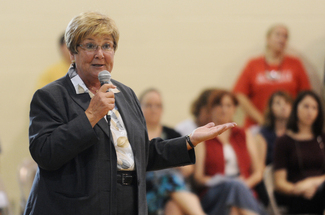
Superintendent Patricia Green
Dr. Green: We’re assessing what will take place as the budget is fully approved. We’re looking at cuts. We’re looking at the fact that there has been five years of cuts here in the district, which concerns me. It’s a state phenomenon and it’s a national phenomenon, but because here in Michigan it has hit us so hard, especially this school year because of the massive reductions that had to take place, it concerns me greatly. It creates a tipping point in terms of at what point does brand recognition of a great district start to dissipate? That is a huge concern.
Lucy Ann: How much has to be cut from the budget?
Dr. Green: We’re looking at the possibility of between $14-$16 million. All-day kindergarten would have added a little more if we had chosen not to implement it, we would have lost more money from the state. By implementing it we will have to incur a little bit more of a deficit, however, it’s less than if we didn’t do it. I also want to look at other options. When I first came to the district trying to look at how we can reduce that deficit, I discovered that Medicaid Reimbursement Funds hadn’t been dispersed to the district in over two years. It took me about four months to find out how much is there and where is it and we were able to get that back to the district. It was over at the WISD with all the other districts because that’s where the money goes through. It was about $1.4 million for the district.
Lucy Ann: How is it that that hadn’t come back to the Ann Arbor Public Schools?
Dr. Green: It was my understanding that it started a couple of years ago with the way the IRS was looking at the record-keeping of it and there had to be some changes and then it just never trickled back to the school district.
Lucy Ann: Is it set now so that it will come on a regular basis?
Dr. Green: Yes, I initiated a letter immediately and I believe there’s still a third year of funding that we may be getting some of that back to our district. We are still trying to determine how much will come. So we’re looking at many pots of money. This district has been traumatized over the years by the continual and incremental cuts that are huge. Over $55 million have been cut in the past and we’re still facing it this year, but we’re working to try to minimize that as much as possible.
Lucy Ann: You made a point a year ago saying once you eliminate programs, they rarely come back.
Dr. Green: It generally takes a generation before you get the momentum and the political will to bring something back once it’s been eliminated. We’re trying to be very prudent. Children first has to be behind my thinking and I always try to say what’s reasonable and what’s prudent. Someone once said to me, well that’s really good to be reasonably prudent, and I said no. It’s not reasonably prudent, it’s what’s reasonable and what’s prudent.
Dean: Do you get to a point where you say we can’t do as many things as we wanted to do and we’re going to go back to the basics?
Dr. Green: Everything is being looked at very carefully. The board has given us direction to take a look at everything. I think you make a very good point. What do the Ann Arbor Public Schools and the community expect and what is our brand recognition. Is it just basics or is it a world-class education for our youngsters?
Dean: Schools of choice?
Dr. Green: Schools of choice is on for discussion with the school board.
Lucy Ann: What about transportation. There had been some talks of doing some sort of collaboration with the AATA. Where do you stand on that?
Dr. Green: We’ve been having regular meetings and we are trying to come up with some consolidation of our routes with AATA routes and then looking toward the future of how we can partner better. Part of my vision is regionalization, not just of transportation, but in general pushing services out, looking at some of our other school districts around us, and finding ways that we may have services here that they don’t have there and perhaps with some of our very skilled people here we can start having them come to us for revenue enhancement for our school district here in Ann Arbor and being able to give them services in return.
Lucy Ann: So that regionalization isn’t just with services, but possibly with education as well?
Dr. Green: Absolutely. That’s part of our technology bond that we’re talking about right now. My vision for the future has to do with virtual proximity for our youngsters to be able to go anywhere in the world in terms of distance learning and connecting with other school districts. I came from a very high-achieving school district and I had some conversations about linking some classrooms there with some classrooms here and having some common experiences. What would happen if you linked one of the top-performing school districts in Pennsylvania with one of the top performing school districts in Michigan? There’s so much potential. The work force of tomorrow is going to be vastly different than the work force of today. They have to be totally prepared for that.
Lucy Ann: There are some people in the community who don’t believe that some of the salaries in the Ann Arbor Public Schools are reasonable or prudent given a time when you are facing this deficit.
Dr. Green: What I’m trying to do is have a broader portfolio of responsibility at the deputy level which was part of my decision-making and discussion with the board prior to any actions that took place. It goes back to what I said about regionalizing what we do. I want to put more responsibility on the shoulders of my staff and push out services so that they have broader responsibilities as we continue to move forward to bring revenue back into the district. We are looking at having a new software system for the entire county for human resource services, for our financial services, and we have some of the top people here in our school district. Once we are on that platform we can push our services out. There are districts that are hurting worse than we are right now with their revenue streams and we can incorporate some of our services once all of our systems can talk together to be able to say we can do your HR, we can do your finance, join with us and we would get a revenue enhancement here. It wasn’t done in a vacuum. The same thing in instruction. I don’t see anybody in Michigan paying attention to what I call the discipline gap. Everything about test scores is driven by curriculum instruction and people aren’t paying attention to the flip-side of that coin which is social and emotional learning for young people, and as we start doing some work in professional development on social and emotional learning, we can push that out and invite our other jurisdictions around us to have some of that professional development. It could become a revenue enhancement for our district because we are the only people really thinking along those lines. So, there was a reason behind doing it and it wasn’t fully understood by the public at the time.
Lucy Ann Lance & Dean Erskine co-own Lance & Erskine Communications, which produces “The Lucy Ann Lance Business Insider” (M-F, 8 a.m.-11 a.m.) and “The Lucy Ann Lance Show” (Saturdays, 9 a.m.-12 p.m.) on 1290 WLBY. The programs are live streamed and podcast on www.lucyannlance.com.
Comments
KeepingItReal
Mon, Mar 12, 2012 : 10:08 p.m.
Cette: I am absolutely in favor of student learning. What I am tired of is one administrator after the other who come into this community with progressive sounding plans, sell the school board on it, get hired and when they leave the situation, if not worst is no better than it was before they arrive. We have spent millions of dollars hiring administrators, on PD, hiring consultants, during al sorts of special activities, putting extreme pressures on teachers, yet we do not have any significant results to show for it. The only individuals who benefit from these initiatives are the administrators, and consultant, yet after all these years, we have refused to deal with the elephant in the room although every research project I have read on student achievement list parent engagement as one of the most significant factors I am surprised at the number of bloggers who had similar thoughts about this matter as I but for some reason, I sounded angry to you.
a2edu
Tue, Mar 13, 2012 : 11:28 p.m.
KeepingitReal - You are exactly correct. We have had a very long list of superintendents who have arrive in Ann Arbor, completely mess things up (at incredible expense), and then then leave with their tails between their legs. I am amazed that the citizens of Ann Arbor put up with this. I'm even more amazed that the poor quality (lack of high quality) school board representation that has occurred over the past couple decades. In any event, my expectations for Ms. Green are exceedingly low, based mostly on her mind-numbing edu-speak that says nothing. We will see.
cette
Mon, Mar 12, 2012 : 11:41 p.m.
So we see..how does the district help the parents? Should the district help the parents? I don't think not trying is an option. I didn't ever like the PEG group, that was pretty unproductive.
Will
Mon, Mar 12, 2012 : 11:17 a.m.
A fine example of bureaucratic rambling double speak. Why be clear when you can obfuscate your agenda with jargon like 'push our services out', 'broader portfolio of responsibility'. I, for one, suggest attention be directed toward addressing issues WITHIN the Ann Arbor school district. Fix the discipline and bullying problem by meeting out real consequences to the offenders. Be fair to the rest of the students in the classroom. Pat's language is not a product of a PhD education, it is more of a hallmark of a politically motivated speaker who wishes not to be fully understood.
a2edu
Tue, Mar 13, 2012 : 11:20 p.m.
Greeen speaks in banal platitudes. Never has an Ann Arbor superintendent spoken so much without saying much of anything.
Mr. Me
Mon, Mar 12, 2012 : 12:56 a.m.
"By implementing it we will have to incur a little bit more of a deficit, however, it's less than if we didn't do it." What?
Stephen Landes
Sun, Mar 11, 2012 : 6:25 p.m.
The AAPS administration, especially the Superintendent, is overpaid and under producing. The School Board is responsible for the high salaries and for not holding the administrators accountable for their performance.
jns131
Mon, Mar 12, 2012 : 4:44 p.m.
I could not agree more. Did you see that article on how much AAPS spends? Kind of scary if you ask me. Cut the fat inside Balias and spend more inside the schools.
cette
Sun, Mar 11, 2012 : 5:10 p.m.
The thing about Pat Green is that she inherited a load of bad problems that she's supposed to have fixed yesterday. She is a good Superintendent, as anyone knows who has dealt with her directly. She fantastic behind the scenes, getting people to work together well, which, given what AAPS is like, is like supplying a missing vitamin to a growing kid. Some people won't vote for the technology millage. So what? People are still holding grudges about decisions she has nothing to do with. Stuff needs to be replaced, I believe that. And so the tech millage request, for me, is a valid request. Cost do keep going up, and the labor contracts stand. We'll see. If you fired every administrator, would that make up the difference? Please. More accountability for administrators is the right answer. That's what I am watching. No one can wave a wand and change things right away, even if Rick Snyder keeps trying to make things change precipitously. The discipline gap is a big problem. It needs to be addressed and not only does there need to PD, it has to quality PD, backed up with accountability for those who don't implement it properly.
cette
Mon, Mar 12, 2012 : 7:16 p.m.
Because you have dismissed out of hand already what Pat Green is saying, based on other's performances, and that's all she wrote for you. Yes, there are issues with parental involvement, but that can be nurtured to be improved, not just evaluated and judged, found lacking and then dismissed. Nurturing a relationship with parents is not something AAPS does well, and I don't read a hint of that in your post. If the child doesn't perform, you seem quite done with that child, and that strikes me as an angry position, not a giving position.
KeepingItReal
Mon, Mar 12, 2012 : 2:36 p.m.
Cette: I would like to know why you think that my comments were "angry form the get go," and that I'm not listening to anyone but "his.herself." Please give me some feedback.
cette
Sun, Mar 11, 2012 : 7:21 p.m.
Your call, your vote. Should she get a pass? I'm watching to see if she holds administration accountable, because that's the real problem in this district.
DonBee
Sun, Mar 11, 2012 : 7:13 p.m.
cette - The athletic department spending happened on her watch. The raises for the Administrators happened on her watch (and by her hand). So she should just get a pass? Right, it is only taxpayer money, there is more out there!
Sallyxyz
Sun, Mar 11, 2012 : 5 p.m.
From DonBee: " This year they spent over $12 million dollars on facilities for Varsity athletics (not physical education for all, but facilities designed for the elite few) that could have been spent on many of the items in the technology bond. If you add in the other poor spending decisions (e.g. the $700,000 that was spent on benefits for people who were not eligible) the total is more than $15,000,000 - 1/3 of the technology bond money they want approved. " I agree with Don. My kids went through AA public schools, and I can tell you about waste, wrong priorities, overpaid administrators, and plenty of staff and teachers who are doing little and collecting huge salaries. There are also some excellent teachers, but until AA public schools get their priorities straight, I'm not voting for any more millages for the schools. I also agree with a2flow: "The high-level admins got nice fat pay raises while staff will be asked to make further cuts and have larger class sizes." Huron has classes of over 35 students crammed into small rooms, where little learning is taking place. All in the name of fat cat raises for administrators.
KeepingItReal
Sun, Mar 11, 2012 : 4:58 p.m.
I've listen to Dr. Green talk about the "Discipline Gap' on several occasions and quite frankly what I see is another new administrator who has their own ideas about what is needed and is determine to force that upon others. Dr. Green. Let me offer another perspective. Every society has some method of teaching their children about respect for authority. Usually it starts with the family and is reinforced by other institutions in the community such as the church, law enforcement and schools. It appears to me that you are leaving out of the most important component in your discipline gap initiative which the responsibility for teaching young people about respect or authority and for others in the community begins with the family (Soc. 101) It is not the schools responsibility to become surrogate parents for these children. The schools responsibility is to teach and the children learn. What I see happening is an initiative by a brand new administrative that will be forced upon teachers and the community until they leave for another high profile position in some other community using their "innovative approach" to help sell their credentials and once they leave the initiative will fall by the wayside and we will discover that it had no lasting effect. Then the cycle starts all over again with a new administrator.. How many achievement gap initiatives have we had over the years all by different administrators with little continuity from one administrator to the other with little success? There is an elephant in the room that no one wants to talk about and that is we must focus more attention on parents. Let's stop making excuses about why parents are involved in the students education and let's holding the parents accountable. The unbelieveable amount of money spent to support these various initiatives has gotten out of hand and it needs to stop or we need to see some results.
jns131
Mon, Mar 12, 2012 : 4:43 p.m.
I just got an article from one of those on line educational places that talked about discipline disparaging. Without getting this post deleted, all I will say is that they showed how the classes are discipline and to what extent. Sad to say it, schools become the disciplinarian because parents are not doing it these days. The bottom line is the fact of which class you come from and to what extent the discipline takes place.
cette
Sun, Mar 11, 2012 : 11:10 p.m.
That's what it sounds goes on. Staff tolerates misbehavior until they can't anymore, send them to the principals, who don't have anything else in their bag of tricks except to suspend them as a behavior modification plan, which makes things worse, because now they aren't in school learning, and are getting a big reward for misbehaving and not doing their work, and the kid's now in a downward spiral. It's kind of pathetic, when you think about it. PBS works,but there's plenty of staff that think it's bunk, making it all the harder.
ViSHa
Sun, Mar 11, 2012 : 10:10 p.m.
Cette, I agree on some of your points, I want those kids to be helped, but at what cost to the other students? How much attention do those that behave have to give up from their teachers until it is too much? As far as paper trails, I have been told (anecdotal, I know, but I find the sources reliable) that there generally is none unless a child goes to the principal, which is highly discouraged. I would love to know that is wrong, maybe some of the posting teachers can set me straight.
cette
Sun, Mar 11, 2012 : 7:01 p.m.
And there absolutely need to be paper trails of who's doing what to what kid, and what that kid actually did. Do you know that Pat Green is asking for no paper trails to manage the discipline problem. I'd ask her yourself if that is what you think.
cette
Sun, Mar 11, 2012 : 6:59 p.m.
What I think is that there needs to be a plan in place that works that gets the kids working in the classroom, and that requires positive behavior support done right. People who dis that in fact just would rather remove the kids, then learn ways to manage the problem. It's not that misbehaving kids are not a problem, it's that the current management of that problem is ineffective.
ViSHa
Sun, Mar 11, 2012 : 6:38 p.m.
cette, you accuse KeepingitReal of having a biased slant, yet your cheerleading of Dr. Green makes it appear as if you have a bit of bias yourself. So are you in agreement with the higher ups that in order to alleviate paper trails, all children should stay in the classroom regardless of behavior or how much of a distraction they are causing to the education of their classmates?
cette
Sun, Mar 11, 2012 : 6:17 p.m.
The problem with not bringing parents in to help with the situation at school is that you can't get strong results. It's how the school talks to families which is just such a huge problem. Look at Keepingitreal post defensive and angry from the get go..not listening to a soul except her/himself.
J. A. Pieper
Sun, Mar 11, 2012 : 5:53 p.m.
Keepingitreal, as teachers, we are specifically told that we are not allowed to bring parents' responsibility, or lack thereof, into this discussion. This is related to academic concerns, parental involvement, and behaviors. There is nor responsibility placed upon the parent in the federal "No Child Left Behind" law, everything is placed upon the shoulders of educators. Why are there so many problems in education today? Because we are not just teachers, we are taking on many of the responsibilities that parent in the pas used to do, so it causes us to waste valuable teaching time.
cette
Sun, Mar 11, 2012 : 5:17 p.m.
Some people just can't learn new ways to manage old problems. They carry their own baggage, and it blinds them to new possibilities.
cette
Sun, Mar 11, 2012 : 5:12 p.m.
Spoken as a school staff member who doesn't believe in PBS!
JRW
Sun, Mar 11, 2012 : 4:49 p.m.
Green: "All-day kindergarten would have added a little more if we had chosen not to implement it, we would have lost more money from the state. By implementing it we will have to incur a little bit more of a deficit, however, it's less than if we didn't do it." Talk about run-on sentences. The first sentence makes no sense. ************** Lucy: "There are some people in the community who don't believe that some of the salaries in the Ann Arbor Public Schools are reasonable or prudent given a time when you are facing this deficit." Good question, Lucy. Unfortunately, the answer Dr. Green provided didn't answer it. Green: "What I'm trying to do is have a broader portfolio of responsibility at the deputy level which was part of my decision-making and discussion with the board prior to any actions that took place. It goes back to what I said about regionalizing what we do." And then there are more and more statements about the new software, districts that are in worse shape than AAPS, the discipline gap, instruction, test scores, professional development, and more hodge podge. The final sentence in this rambling answer is: Green: "It could become a revenue enhancement for our district because we are the only people really thinking along those lines. So, there was a reason behind doing it and it wasn't fully understood by the public at the time." Lucy's question was not answered or even addressed. Typical politics, business as usual for AAPS.
J. A. Pieper
Sun, Mar 11, 2012 : 5:47 p.m.
Dr. Green speaks "Educationalese" very well, after all, she does have a PhD!
aaparent
Sun, Mar 11, 2012 : 3:23 p.m.
@ Lucy Lance - Did you ask if Dr. Green discussed her vision with teachers or gotten input from them? Her ideas comes across as theoretical or abstract, not connected to real observation of what is going on in classrooms at all levels in the districts and for students at all learning levels. Virtual learning does not replace in-class learning or real class visits from Balas administrators to classrooms across the district. So far, my impression of Dr. Green is that she is more of a big picture leader who dodges questions about details either because she does not know enough yet or she does not want to be more transparent until the millage vote passes or fails. At a $300k-plus salary, I want to hear her talk about the big picture and the details at the same time, not her wish list and dreams for a district she does not know well enough yet. For any old timers around, former superintendent Bruce McPherson spoke in similar visionary terms and that did not work out so well for the district. From Green: "My vision for the future has to do with virtual proximity for our youngsters to be able to go anywhere in the world in terms of distance learning and connecting with other school districts. I came from a very high-achieving school district and I had some conversations about linking some classrooms there with some classrooms here and having some common experiences. What would happen if you linked one of the top-performing school districts in Pennsylvania with one of the top performing school districts in Michigan?"
a2edu
Tue, Mar 13, 2012 : 11:12 p.m.
Green is not a hands-on administrator. She hides at Balas. We NEVER see her in the school buildings. When she speaks, it is with a stream of banal platitudes that say nothing. There is no there there. She has come to Ann Arbor - we will pay her an obscene amount of money - she will do damage - she will leave. (Probably with her tail between her legs as with so many of our previous superintendents.
jcj
Sun, Mar 11, 2012 : 1:46 p.m.
Green said : "I came from a very high-achieving school district" We USED to have "a very high-achieving school district"
jns131
Mon, Mar 12, 2012 : 4:39 p.m.
AAPS still is. But parents are also making sure their school is not school choice either. So, the under achieving elementaries are the ones that are getting school choice. Wines says they are capacity but they are not. Go figure. We ended up at one of these low achieving schools which set our child back until she got caught up at one of the achieving middle schools.
J. A. Pieper
Sun, Mar 11, 2012 : 2:23 p.m.
So true, USED to have. The problems EAST of AAPS are coming this way! AAPS is becoming the new D...
blueeyegirl
Sun, Mar 11, 2012 : 1:34 p.m.
I agree with this comment " It creates a tipping point in terms of at what point does brand recognition of a great district start to dissipate? " Umm....Let's think about that for a moment...
a2edu
Tue, Mar 13, 2012 : 11:36 p.m.
We (teachers) can't even listen to her anymore. The edu-speak say-nothing speeches make us want to either medicate ourselves or hit the sauce.
noreaster
Sun, Mar 11, 2012 : 6:52 p.m.
I heard the top school administrator spouting marketing blather. A so-called "educator" more concerned over show than substance. Made me tune out the rest of the article. Did she say anything worthwhile?
Carole
Sun, Mar 11, 2012 : 1:19 p.m.
I have to agree that social and emotional learning has to be a part of the every day school setting incorporated in with the educational aspects of school. Success should not be totally about how high test scores -- but for the over all aspects of teaching in the classroom.
JRW
Sun, Mar 11, 2012 : 4:51 p.m.
a2flow: They have no solution for these students.
J. A. Pieper
Sun, Mar 11, 2012 : 2:21 p.m.
A2flow, the plan is that each and every teacher will be held accountable for not teaching these students. Funny, the dentists of the country can blame the parents for the huge rise in dental decay (parents are lax in making their kids brush their teeth), but in education, we are not allowed to bring parents into the equation at all. Teachers, and only teachers , are held responsible.
SonnyDog09
Sun, Mar 11, 2012 : 2:07 p.m.
By what metric will we measure the success of "social and emotional learning?"
a2flow
Sun, Mar 11, 2012 : 1:37 p.m.
@Carole...absolutely agree. The social and emotional part of learning is huge. Students, like staff, need to be invested in what they are doing. However, my feeling is that 1-5% of the students are not invested in learning at all. They come from chaotic family situations, or parents that let them do whatever they want with no consequences for anything. These are the students that concern me. It isn't that they fail one class, they fail everything. They won't focus, won't try, disrupt, do no classwork, and do no homework. You put them in a small group setting for learning, and oftentimes they don't want to do any work this way, either. I wonder what her plan is for these students?
a2flow
Sun, Mar 11, 2012 : 1:16 p.m.
The discipline gap quote means this...pressure will be put on all buildings to reduce discipline paperwork. So what happens then is, there is no discipline. No, don't write them up, we want to show downtown that we are on board with the new discipline policy. The kids who can't behave will continue to do so, but because of the lack of consequences it will then show other students that they also don't have to behave as well. Teacher gets less and less power, which further decreases the learning environment for all. Throw this into middle school classes over 30 students and high school over 35 students, and we have an environment that makes learning difficult for all. The pd in Ann Arbor is typically crap. Each new superintendent brings a new philosophy that is rammed down the staff's throat. Hardly ever is it worth attending. It never progresses beyond an introduction. The irony of what they tell us and what they do would be comical if I didn't have to experience it. PD is the one day of the school year that an illness is welcome. Please let me stay home! Here's a novel approach: treat the staff like adults, actually listen to their concerns, let them create a plan for professional development, show proof of learning, and do two-minute spot checks to see how people are doing. How about we focus on actually improving our instruction through collaboration? What a concept! We don't because we are always doing the latest and greatest, with staff who are not invested in it, and no clear plan together. And don't get me started on Pacific Educational Group. The high-level admins got nice fat pay raises while staff will be asked to make further cuts and have larger class sizes. We are making less money and with the class size increases, teaching about another half-class of students per day. Thank you for single-handedly torpedoing the tech bond before it even started. It it fails, I do hope that the $100K you and your fellow kings received was worth it.
J. A. Pieper
Sun, Mar 11, 2012 : 5:44 p.m.
Local, and remember that these kids are learning that there are NO consequences for their behavior, and when they get out in society...
local
Sun, Mar 11, 2012 : 3:34 p.m.
You are so correct. My kids come home and say that a few student are always causing problems, both in class and on the bus, yet nothing is done. They still ride the bus. They are still in class, still going to recess and basically making the classroom environment one that isn't set up for learning. We take our kids schooling very seriously, but I am guessing many families don't and our classroom teachers know who they are. What can be done? Nothing, because Dr. Green has basically said not to document those kids constantly in trouble because we don't want a paper trail. But my question is, what about kids who are doing the right thing but are affected because the teacher spends large amounts of time dealing with these handful of students who just don't get it. What she has basically done is set up a system with zero consequences for misbehaving because documentation might be required. Sad state for all involved.
J. A. Pieper
Sun, Mar 11, 2012 : 2:18 p.m.
A2flow, how perfectly stated. Public, be aware that classroom teachers will be totally discouraged from disciplining students of a certain culture, and as stated above, our discipline gap will disappear! It will remain hidden in the classroom, where every other student has to experience it, at the cost of your child's learning!
DonBee
Sun, Mar 11, 2012 : 1:16 p.m.
Funny until this year, the total revenue for the district has always gone up. While there may have been cuts to the budget, the budget is not what the district spent last year, but what they want to spend in the coming year. If you look at year over year revenue, until the 2011-2012 school year, that has always increased when you add it all together. The district has prioritized administrative salaries and Varsity athletics above classroom teachers over and over again. This year they spent over $12 million dollars on facilities for Varsity athletics (not physical education for all, but facilities designed for the elite few) that could have been spent on many of the items in the technology bond. If you add in the other poor spending decisions (e.g. the $700,000 that was spent on benefits for people who were not eligible) the total is more than $15,000,000 - 1/3 of the technology bond money they want approved. Until I see reform in spending habits, I am not voting for new bond money. I voted for and vocally supported the special education millage. This one I will not support.
jns131
Mon, Mar 12, 2012 : 4:35 p.m.
That new facility for the football stadium was gear toward varsity and I am not what they called it but was told they could not use it for anything but. I wish AAPS would get their priorities straight and use the bond money for classrooms and other stuff instead of the varsity sports. Although there is one thing, parents do pay for varsity sports now and it is not cheap either.
DonBee
Sun, Mar 11, 2012 : 4:27 p.m.
skgrl - You did what you were supposed to do, but the high priced HR people did not. The result - an external audit was required. More money wasted. I bet neither the district nor the auditors have attempted to recover the $700,000 in taxpayer money that was lost because of this screw up and no one got any reprimands either. After all it is just tax money, there is always more where that came from. Right?
skigrl
Sun, Mar 11, 2012 : 2:34 p.m.
DonBee- you can't blame the district for all of the ineligible people that were receiving health insurance benefits. I cancelled my ex spouse when he was no longer eligible. HR also cancelled him, I have copies of their paperwork to the insurance carrier. The insurance carrier did not do their job, that is why I was quite pleased when the district had the fore thought to have the insurance audit. So with how many other employees did this occur?
local
Sun, Mar 11, 2012 : 1:09 p.m.
I struggle to take in anything that Dr. Green talks about. She talks about having regional resources, but she is assuming people from outside of Ann Arbor care about what she thinks. Other districts don't want our services, if they did, we would have more schools feeding into WISD bussing. I think Dr. Green needs to stop worrying about regional issues and start thinking about Ann Arbor and the taxpayers who pay her high end salary. She has yet to show the community a plan for cutting this year. All I have heard from teacher friends is that they are being told class sizes will increase significantly next year. Expect 30-32 in upper elem. and 25-27 in lower elementary and since Dr. Green hasn't said anything else on the budget issue, I am assume this is probably the case. Speak up Dr. Green, the Ann Arbor community is waiting to hear your master plan that deals with ANN ARBOR, not the county as a whole.
EyeHeartA2
Sun, Mar 11, 2012 : 12:59 p.m.
"There are some people in the community who don't believe that some of the salaries in the Ann Arbor Public Schools are reasonable or prudent given a time when you are facing this deficit." She didn't pick up what your were layin' down, Lucy. SPECIFICALLY, PAT, your salary is out of line. WAY out of line. It is a disgrace.
ViSHa
Sun, Mar 11, 2012 : 12:50 p.m.
I am confused by what she is saying about the "discipline gap". Is she saying by concentrating and being well-versed in this, it will increase revenue by training other districts? So our kids are basically being guinea pigs for this new revenue strategy?
J. A. Pieper
Sun, Mar 11, 2012 : 2:13 p.m.
The AAPS has a huge problem with this discipline issue. She has identified the "Discipline Gap" as one of the important issues she is going to fix. What it boils down to is that AAPS is disciplining too many students of a certain culture, and so now that is going to be very limited. Once she fixes this problem, AAPS will become a role model for other districts!
Silly Sally
Sun, Mar 11, 2012 : 12:10 p.m.
She is quite right about different learning styles and such, " social and emotional learning for young people" If students do not understand the importance of school, they will not be motivated. If they do not find it somewhat fun, at least some of the time, they will tune out. Learning can be fun, not all drudgery. "...if you linked one of the top-performing school districts in Pennsylvania with one of the top performing school districts in Michigan? There's so much potential" This is K-12, not a gratuate school. Please worry about those who cannot read well, or add fractions, not another big dig for the AAPS. I know many students at UM who do quite well and never linked up with schools in Penn while in middle school.
Silly Sally
Sun, Mar 11, 2012 : 1:28 p.m.
@A2comments - No coffee yet - it was still brewing! I clearly needed it. Thanks.
A2comments
Sun, Mar 11, 2012 : 1:03 p.m.
graduate....