

Ann Arbor area schools brace for senior pranks as graduations approach
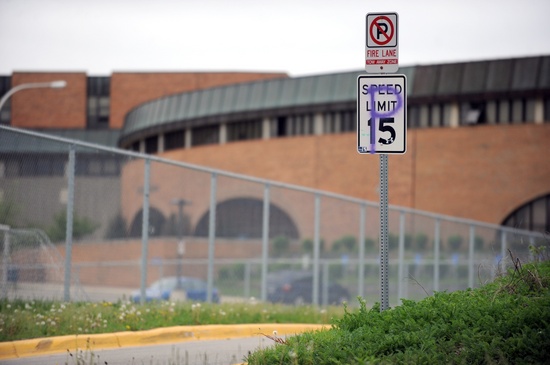
A purple letter "P" is seen on this speed limit sign at Huron High School on Tuesday afternoon.
Melanie Maxwell | AnnArbor.com
As 31 of Ann Arbor’s Pioneer High School students found out this month, the punishments when pranks get out of line — in this case a scavenger hunt that included some destruction of school property and defecating on athletic fields at Huron and Skyline High Schools — can be serious.
All 31 students were suspended for five days, required to perform 10 hours of community service and prevented from attending the all-night senior party - but allowed to walk in graduation - according to district officials. About 250 students participated in the traditional senior scavenger hunt.
The situation at Pioneer showed the potential for senior pranks to take a serious turn, prompting increased attention in area schools and across the community as graduation approaches.
A collaborative effort?
High school principals from around Washtenaw County say senior pranks have been a long-time rite of passage as graduation approaches. They are prepared for these sorts of activities and sometimes even help plan a safe and fun prank.
“We expect something, but nothing with vandalism and maliciousness,” said William “Kit” Moran, principal of Dexter High School.
Moran said he and other school officials begin holding meetings with the senior class near the end of March to let them know that “graduation is not a requirement," meaning that walking in commencement is a privilege that can be rescinded.
He said he’s been asked by students for permission to do senior pranks, but will refuse to give it if there’s a possibility of vandalism.
“If it’s not vandalism, doesn’t hurt anybody and doesn’t cost the district any money (then they can do it). If it costs money to clean up, it’s not OK,” he said.
Moran said one of the senior pranks that worked in his district was when students rode bikes around the school building and, when they decided it was too cold and rainy to continue riding outside, they moved the ride into the building. Moran said they tracked in water, but returned once the prank was over and mopped up the mess and even bought a bouquet of flowers for a custodian as an apology.
At some schools around the county, students have made it a practice to let administrators know what they have planned for a prank.
Julie Deppner, principal at Chelsea High School, said a few of the best senior pranks at the school were planned with the permission of administration. She pointed to students welding a car around a light pole in the school’s parking lot as an example.
Whitmore Lake High School principal Tom DeKeyser said he's been contacted by students on different occasions either seeking permission to perform a prank or to let him know that a prank has occurred.
DeKeyser said last year students asked if they could bring in squirt guns to the school and he said no. However, students did have a water balloon fight in the parking lot - and DeKeyser was pleased that by the time he heard about it and went out to see what had been done, all of the balloon pieces were gone.
He said students know that he and other school officials take a pride in the school building and won't stand for damage being done to the school.
“If there’s vandalism then it’s not a prank, I consider it vandalism,” he said. “The whole notion of pulling a prank is lost on me if there’s damage.”
Students say they’re unlikely to pull a prank
Some Ann Arbor students have seen the repercussions of what happened because of the scavenger hunt at Pioneer and believe senior pranks, while they might see them as funny, might just not be worth getting caught.
Isabella Ramos, a freshman at Community High School, said she didn’t believe pulling off a senior prank on the level of some of the things on the list of the scavenger hunt would be possible at Community.
“It’s such a small school that it would be around really fast and people would hear about it,” she said, adding that after seeing what happened to Pioneer students she wouldn't want to be involved in a prank when she's a senior.
Senior pranks have been a tradition for generations, but in Ann Arbor schools, this is the second straight year some high school students have performed a destructive prank.
In May 2010, charges were filed against five Huron High School students after they vandalized a police car by smashing out the rear windows and tail lights, placing a recliner on the roof of the car and leaving feces on the roof. Two teens eventually pleaded guilty to malicious destruction of property charges.
The teens were identified using surveillance camera footage, which is similar to how school officials identified some of the 31 suspended students in this year's scavenger hunt.
Ann Arbor schools spokesperson Liz Margolis said last week that no other senior pranks have come to the attention of administrators for this year. She said the scavenger hunt has been around in some form or another for a long time.
"The scavenger hunt has been around for quite a few years," she said. "Some years it's appropriate and other years it's not."
Poom Boonsin , a junior at Community, said he thought some of the things that were on the scavenger hunt done by students were funny, but didn’t think performing acts of vandalism were right.
Another student said he believed Ann Arbor officials are imposing strong disciplinary measures to keep younger students from participating in future pranks.
Chris Upham, another Community junior, said the suspensions represent an effort by the district to discourage these types of senior pranks from happening.
“There’s been a crackdown on this sort of stuff,” he said.
Giving an early warning
One of the more important ways to possibly prevent a senior prank, at least one that causes damage, is to be proactive and let students know the potential punishments, said DeKeyser.
He said he tries to communicate the potential repercussions, but not in terms of suspensions because some seniors might see that as a free break before the end of the school year. DeKeyser said he tells students to keep their grades up, reminds them of the potential of losing the privilege of walking in graduation and being involved in any end of the year activities.
“It’s a nice, respectful relationship that we have right now,” he said. “We’re protecting the building because it’s so important to our community.”
Some schools have extra security measures, which they hope will act as a deterrent against the uptick in destructive pranks.
Moran said his school now uses surveillance cameras as an added security measure in case “someone does something really stupid we’ve got a pretty good record.”
Boonsin agreed that increased security at some of the schools — like cameras in the parking lot — make it more risky for students to do any sort of senior prank that could result in them getting trouble.
“It’s harder to pull off, just with all the cameras and stuff,” he said. “That’s how two of my friends got caught.”
In Milan, school officials look to promote school pride as a reason to keep students from targeting the building or school grounds for a prank.
Ryan McMahon, principal at Milan High School, said the school builds relationships with students to feel a sense of pride and community, which would hopefully deter any desire to pull a prank.
He echoed many of the other principals that said participation in the graduation ceremony could be taken off the table if rules were violated.
“Our preparation for any type of prank occurs on a daily basis throughout the school year,” McMahon said. “We handle discipline in a firm, fair and consistent manner.”
Perhaps one of the more effective ways to keep a senior prank from happening is to simply keep seniors busy until school is over.
Deppner said the seniors at Chelsea attend school up until the Friday before the Sunday commencement ceremonies, so they’re often still busy with schoolwork. However, if a prank gets out of line, she said the school is ready to punish them.
“Participating in unacceptable activities that result in damage to students or property will result in a loss of participating in commencement activities,” she said, “as well as other disciplinary consequences or police referrals.”
Kyle Feldscher covers K-12 education for AnnArbor.com. He can be reached at kylefeldscher@annarbor.com or you can follow him on Twitter.
Comments
Davidian
Fri, May 20, 2011 : 12:30 a.m.
I think the pranks played "back in the day" were much worse. People are much more sensitive these days. Spray paint, prank calls, poop, come on....none of this is original. And these stories in the press just make it worse.
paulczar
Thu, May 19, 2011 : 7:39 p.m.
Heres something interesting... I read the link in this story that cited a May 2010 cases where Huron High students faced legal punishment for their prank that involved pour feces on a police car. One of the names mentioned in that story was Dillon Pearce.... Name sound familiar? Same guy who (allegedly) ran over those ducks in his Hummer. Just thought I'd share my discovery in case no one put the two together.... I think its worth mentioning.
Moonmaiden
Thu, May 19, 2011 : 6:09 p.m.
There are several comments about recognizing positive achievements of graduating seniors. Howz about recognizing the most creative senior pranks that are non-destructive and non-defamatory!
Moonmaiden
Thu, May 19, 2011 : 6 p.m.
When I was in high school the principal worked behind the scenes with the class leaders and "approved" the pranks. They had to obviously be non-destructive, maybe PG-13 (G-rated preferred) and couldn't defame people or groups of people. The cool thing was that most people didn't even know he was involved. We had fun but didn't get into trouble.
BhavanaJagat
Thu, May 19, 2011 : 4:55 p.m.
If I can offer a suggestion, the School District may institute a trophy and hold a competition between the students of all Senior Classes and award it to the School which gets the highest score in events like singing, dancing, comedy/entertainment show, painting and other creative acts. I like a prank that is creative, original, has a sense of humor and is something to remember until the next year.
DeeDee
Thu, May 19, 2011 : 4:48 p.m.
Maybe there would be less of this stuff if we all recognized, and transmitted to the students, that graduating from high school is no longer a big deal. It used to be that after HS lots of kids went straight to work, married their high school sweethearts, were really independent adults, and this was it - the big end of childhood. For most people today, it's now just a way station on the way to at least two years of junior college or technical training. So, why treat it as a big deal?? It's so last century. While I appreciate very little of what Rick Snyder is doing as governor, he does have one thing right - we all need to think about school as K-16, not K-12 which means that school graduation now is about as important as 8th grade graduation.
xmo
Thu, May 19, 2011 : 3:13 p.m.
I think the ones that get caught should be punished but this is Ann Arbor, we have creative kids who need to express themselves in different ways! Look At Bill Ayers, Barry Obama, Tom Hayden they were wild when they were young now these types run the country!
Moscow On The Huron
Thu, May 19, 2011 : 9:08 p.m.
Spelling. You forgot the "i" in "ruin."
Tanzor
Thu, May 19, 2011 : 1:22 p.m.
Maybe it would be a good idea to place a couple of rolls of toilet paper at the various athletic fields around town just in case the Pioneer "31" return
Hmm
Thu, May 19, 2011 : 12:39 p.m.
Isn't this article about 3 weeks late now?
zip the cat
Thu, May 19, 2011 : 12:36 p.m.
They do it every year because they know nothing or next to nothing is going to happen to them. Kids will be kids is bull. Hold there feet to the fire when you catch them and let it be known that destroying school property will not be tollerated and it will end. Or keep slapping them on the wrist and doing next to nothing and it goes on every year.
jns131
Thu, May 19, 2011 : 12:21 p.m.
I remember a food fight at Scarlet a few years back. This cancelled all 8th grade activities for the end of the year. That was in the paper. Our child came home yesterday with dire warnings and this is middle school mind you, the principal told all the students if caught after so many minutes after the bell? Suspension. On property grounds after what ever time? Suspension. I told our child not to worry if the after school bus is late. They can't suspend you for that one. I hope. Yes, all the schools are cracking down. I was in Salem High School a few weeks back in Canton. There were signs everywhere saying you must leave the building within 30 minutes of the bell. If caught? Suspension. I am on the side of the principals with this one. It has gotten out of hand. Otherwise per mayhem. I don't see any pranks as long as the admin are top of things. At our childs middle school? Be afraid of that principal. They do crack down.
a2grateful
Thu, May 19, 2011 : 12:05 p.m.
As an interesting footnote to the prank stories: Some of the "P" spray paintings on area signs predate the recent prank by a year. Not everything is as it appears . . . or is as reported . . .
jcj
Thu, May 19, 2011 : 11:25 a.m.
I am done commenting and voting on any rehash of this subject. And I NEVER pay attention to any of the advertisers on a2.com. I never even notice who they are. I will say I agree with a2grateful that it is time to focus on some of the bright students we have in this town!
Moonmaiden
Thu, May 19, 2011 : 6:03 p.m.
Time for you to find something less upsetting to you to focus on :)
InterestedReader
Thu, May 19, 2011 : 11:25 a.m.
"In May 2010, charges were filed against five Huron High School students after they vandalized a police car by smashing out the rear windows and tail lights, placing a recliner on the roof of the car and leaving feces on the roof. Two teens eventually pleaded guilty to malicious destruction of property charges." Follow the link to: "The other three 17-year-olds charged - Miles Staton, Stephen Bakarich, and Dillon Pearce - are scheduled to appear for preliminary hearings June 9. They each face two felony charges of malicious destruction of police property." There is not more information after this. These 2 were charged with the lesser offense. The other 3 with felonies yet there was not a story about that outcome. Were the charges dropped?
quetzalcoatl
Thu, May 19, 2011 : 11:11 a.m.
I forgot about Ypsilanti. Any use of the word "Ypsilanti" sends shivers through annarbor.com commenters. Yes, kids, juvenile misbeavior is THAT bad.
Moonmaiden
Thu, May 19, 2011 : 6:10 p.m.
Why is that wild? Ypsilanti is not a bad place.
jns131
Thu, May 19, 2011 : 12:25 p.m.
Actually Ann Arbor has had the bad behavior in the past. Not Ypsilanti. Wild isn't it?
quetzalcoatl
Thu, May 19, 2011 : 11:08 a.m.
We have a chance, for a change, to be proactive ahead of this impending tsunami of juvenile misbehavior, so we should lay down the law now before it is too late. Juvenile behavior, even by juveniles, annoys annarbor.com readers almost as much as aggressive panhandlers, medical marijuana dispensaries, Obamacare and fully unfettered access to the firearm of ones' choice. So, high school seniors should beware. And they can't say they weren't warned.
jns131
Thu, May 19, 2011 : 12:25 p.m.
Obamacare has nothing to do with this article. It is the pranksters who have out shined our positive graduates who have done great things in our community and now? The court system is going to spotlight bad behavior. I agree, we need to spotlight here, the winning graduates of 2011. Good luck. This is a nutty world we live in.
a2grateful
Thu, May 19, 2011 : 10:27 a.m.
Too bad the "spotlight" is lost on the positives of our local shining-star grads. This is the third story of the same prank. The Ann Arbor News used to devote an entire print section to our outstanding graduates. We were able to learn of achievements of our kids from all of the areas mentioned above. I miss this! We could be reading about academic achievement . . . honors affiliation . . . scholarship awards . . . college attendance . . . community service . . . future plans . . . Instead we have negative focus on foolishness . . . Our kids have it tough . . . expensive college . . . terrible funding options . . . increasing tuition, room, and board expenses . . . pressures of perfection . . . general state of the world once they graduate . . . Let's focus our attention on celebrating and encouraging the good kids here! There are many. They deserve our support.
Paula Gardner
Thu, May 19, 2011 : 3:40 p.m.
Here are 2 items from yesterday that show some activities in AAPS buildings: <a href="http://www.annarbor.com/news/students-at-ann-arbors-scarlett-middle-school-get-a-look-at-the-professional-world-at-portfolio-day/">http://www.annarbor.com/news/students-at-ann-arbors-scarlett-middle-school-get-a-look-at-the-professional-world-at-portfolio-day/</a> <a href="http://www.annarbor.com/news/students-at-ann-arbors-haisley-elementary-school-raise-thousands-at-annual-walk-a-thon/">http://www.annarbor.com/news/students-at-ann-arbors-haisley-elementary-school-raise-thousands-at-annual-walk-a-thon/</a>
DBH
Thu, May 19, 2011 : 10:47 a.m.
Yes.......I.......miss.......the.......Ann......Arbor......News......special.......section.......on...... outstanding.......graduates.......as......well.......................................................................