

Sheriff to Ann Arbor officials: Merger of 911 dispatch operations saving money
A new report shows Ann Arbor taxpayers are paying less than half the price per 911 call now that the city has merged police dispatch operations with the Washtenaw County Sheriff's Office.
During a report on the first six months since the merger of the city and county dispatch centers, Sheriff Jerry Clayton told Ann Arbor City Council members Tuesday night the city's costs per 911 call have dropped from $39.63 to $15.81, while overall Metro Dispatch costs per call are $17.94.
Dispatch duties are being handled by a new and leaner staff, and city officials agreed with the sheriff it seems to be working out as they hoped.
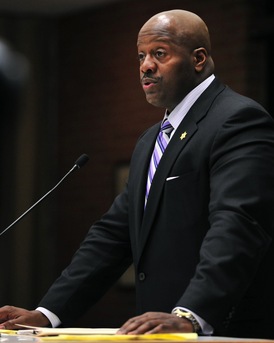
Sheriff Jerry Clayton
Ryan J. Stanton | AnnArbor.com file photo
It's been projected the city will save at least $400,000 annually from the agreement, and Clayton indicated Tuesday night the new dispatch operation is hitting its financial targets.
Clayton said the staff includes one manager, three supervisors, 20 full-time dispatchers and eight part-time call takers.
He said there are nine more dispatcher positions to fill (five now in training) and eight part-time call taker positions to fill (two now in training).
The county has made a significant investment in hiring the right people and providing them with the best training available, Clayton said.
New hires receive 196 hours of academy classroom training and a minimum of 10 weeks of on-the-job training. The average time to fully train new employees is five to six months.
Added up, Clayton said, training-related costs over the past year total more than $280,000, while other hiring-related costs come to more than $123,000.
Clayton offered a review of the dispatch budget for calendar year 2012, showing actual costs are expected to come in under $3.2 million after more than $3.6 million was budgeted.
Dispatch employees clocked a total of 6,749 hours of overtime for 2012, which represented 11.3 percent of all hours worked.
The Sheriff's Office assumed full responsibility for Ann Arbor police dispatch services in July. Statistics for the first six months of operation show there was a total of 88,277 emergency 911 calls to Metro Dispatch, including 24,010 dispatched to the Ann Arbor Police Department.
For Ann Arbor's purposes, that's almost exactly the same number of 911 calls as the 24,251 reported for the same six-month period in 2011.
About 86 percent of emergency calls were answered by dispatchers within 10 seconds, while another 11 percent were answered within 20 seconds. The national standard is that 95 percent of all 911 calls should be answered within four rings or 20 seconds, so the standard is being met.
Reports show there were 31,598 total incidents dispatched to AAPD from July to December, including non-emergencies, and the average dispatch time was 11.17 minutes.
Ambulance requests took 3.13 minutes on average, burglary alarms took 2.87 minutes, disorderly conduct incidents took 5.16 minutes, domestic violence incidents took 4.51 minutes, fights took 2.11 minutes, robberies took 2.2 minutes and traffic accidents with injuries took 4.02 minutes.
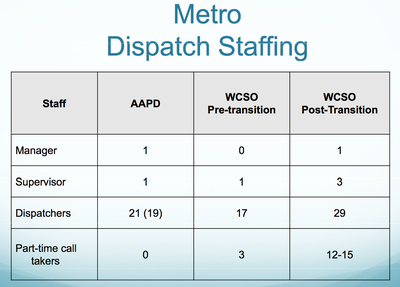
A look at how staffing is changing with the new merged dispatch operation.
Metro Dispatch
There were 78 reported complaints about how calls were handled during the first six months, and 47 of those were found to have merit.
The complaints had to do with everything from data entry errors to notifying the wrong wrecker company requested for a tow to not sending the closest police car to a call.
Clayton said any complaint about service is one too many, but he's pleased with where the numbers are for now and he expects them to trend downward.
"We achieved these numbers in the midst of a full integration — training, hiring folks, people coming over from Ann Arbor, staying, not staying, bringing in new people," he noted. "We have a significant number of dispatchers and call takers who have never done the job."
Clayton said nobody was capturing the kind of data about dispatch operations like the county is doing now, so there are no comparable metrics. He said the first six months worth of operational data establishes a good benchmark going forward.
Spring Tremaine, a former AAPD lieutenant who oversaw the city's dispatch center, has moved into a managerial role in the county-run dispatch center.
Council Member Stephen Kunselman, D-3rd Ward, asked what's happening from a dispatch perspective when someone calls 911 while on the University of Michigan campus.
"We're improving on this all the time," Tremaine said, noting more than half the dispatch staff is brand-new and they don't know the campus boundaries very well yet.
"We are in a constant state of trying to train them," she said. "We've had some problems where we show up at calls that are not ours and that type of thing."
Tremaine said dispatch staff has met with the information technology department to try to improve the mapping so call takers can easily determine if a call is coming from U-M property.
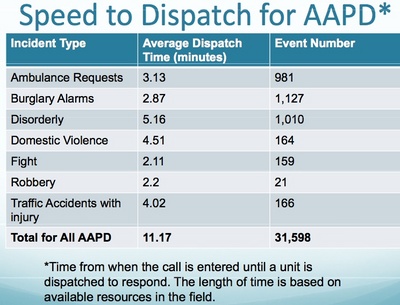
The speed at which calls are being dispatched.
Metro Dispatch
"We knew this was going to be a tremendous challenge for a variety of reasons," Clayton said. "Although they were under the same roof, they were two separate operations, two separate cultures, two separate sets of policies, beliefs — a number of things that were challenges."
Council members offered thanks to Clayton for a job well done. Mayor John Hieftje recalled there was a process in the late 1990s that would have done exactly what the city and county are doing now.
"And that went on for three or four years, then the plug was pulled on that process … with some hard feelings at different agencies," he said. "It's taken a while to get where we are."
Ryan J. Stanton covers government and politics for AnnArbor.com. Reach him at ryanstanton@annarbor.com or 734-623-2529. You also can follow him on Twitter or subscribe to AnnArbor.com's email newsletters.
Comments
Tru2Blu76
Sun, Feb 17, 2013 : 7:33 a.m.
No one had better say that 911 dispatching is an easy job. But I also doubt that the times given are actual from the time of call (by a caller who may be in dire need) to the time of actual arrival of police assistance. Like others commenting here, I had one experience which highlights the problem with "county-wide dispatch." I happened to spot a young man crouching in an alley and counting out "marble size" plastic pouches which clearly held a white powder. Thinking he might be handling drugs (reasonable, I think) I also was mindful he might be armed. So I moved off half a block and dialed 911. Even though I told 911 dispatch which well-known building on Main Street where the alley was - the dispatcher still asked me for the address, including which city I was calling about. I lingered in the area 10 min.- well after the suspect had disappeared - and no police cars were visible anywhere in the area. So basically, I count that 911 call as a brush-off of a citizen-witness to suspicious activity. Frankly, I think most of us citizens don't care about saving $25 per 911 call, if that's what the sheriff is claiming. Ya know - WE WANT IT TO WORK, even if it costs taxpayers (us) $50 per call. Related: I've repeatedly recommended that people carry and use cell phones to report threatening situations which MIGHT require someone to use their sidearm in self defense. That's IN PREFERENCE TO using the gun first, IF there's time to make such a call. Implicitly - we are being told this is a futile idea. Our new "econo-dispatchers" aren't going to even come close to getting police assistance on the scene in time to help any defender AVOID having to shoot an attacker. Hoping all the prosecutors, the judges, the juries and all the LEOs out there keep in mind that such self defense shootings are forced by the degradation of 911 service. That includes: those who say only police can shoot an attacker.
Dan Cain
Thu, Jan 24, 2013 : 3:20 a.m.
Just want to commend both municipalities for stepping outside the box and being willing to enter into an arrangement like this. Hopefully someone will take the lead and guide the local fire service into a some kind of joint venture. It takes time to work out the kinks but in the end it offers as good or better service with the potential for saving dollars for all involved.
Trouble
Wed, Jan 23, 2013 : 10:50 p.m.
Excuse me please.... why does it take over 4 minutes to dispatch emergency assistance to an accident with injuries? "Reports show there were 31,598 total incidents dispatched to AAPD from July to December, including non-emergencies, and the average dispatch time was 11.17 minutes. Ambulance requests took 3.13 minutes on average, burglary alarms took 2.87 minutes, disorderly conduct incidents took 5.16 minutes, domestic violence incidents took 4.51 minutes, fights took 2.11 minutes, robberies took 2.2 minutes and traffic accidents with injuries took 4.02 minutes."
Youwhine
Thu, Jan 24, 2013 : 7:26 p.m.
Probably because, if there are injuries, they put the priority on sending medical help (fire and HVA). This means they get some basic info then transfer the call to a totally different agency which dispatches fire and ambulance services. They may listen in on the call to get the info needed to send AAPD. However, high call volume (and lack of proper staffing) often requires them to move on to the next call. Then the fire/ambulance dispatch will call police dispatch back with the pertinent info. Also, there may be other calls going on, other traffic on the radio, or no police cars available to send to a crash. When you have 3 major police agencies on one channel, it is harder to get calls dispatched as fast. If you think Ann Arbor's 911 dispatch is a quiet room full of people with nothing to do waiting to take your call, you are sadly mistaken.
Justice4all
Thu, Jan 24, 2013 : 4:36 a.m.
I'm guessing what they really mean is it takes 4 minutes for a car to arrive on scene. I'm sure it does not take 4 minutes to dispatch/send a car.
Youwhine
Wed, Jan 23, 2013 : 6:17 p.m.
It is interesting that there is no word from the troopers, deputies, and officers from multiple agencies who have all been lumped onto ONE channel. I've been told that sometimes there is so much radio traffic that they can't even get on the radio to say that they are stopping a vehicle or checking on suspicious subjects. Also noticably absent is the fact that the many job openings result in dispatchers consistently being ordered to work back-to-back double shifts. This leads to burnout, more job openings, new employees being put into positions they are not trained for and ... more burnout. It is a repetitve cycle and somebody should look into why they can't keep these jobs filled. Lastly, 78 complaints may not seem like a lot, but that is only the "official" number of recorded complaints. This is significant as the officers on the road are not actually given a means to lodge complaints. Therefore, only the squeakiest of wheels is being recorded - which actually makes 78 sound like a lot. Especially when you are talking about complaints such as sending police to a wrong address.
justcurious
Wed, Jan 23, 2013 : 6:12 p.m.
As a frequent listener on the scanner I can honestly say that everyone is professional, prompt, to the point and courteous. When the dispatchers call an officer, the officer answers almost immediately. No one ever grouses over any request for service and all calls are acted on promptly. No one gets sarcastic or sounds like they don't want to do what's asked. Some of these men and women work 12 hour shifts and still sound awake and alive at the end of them. I am in awe. Thanks to all that take calls, dispatch them and then act on them. I never worked in a situation that was that good in my 50 years of working.
ahi
Wed, Jan 23, 2013 : 4:25 p.m.
I understand the economics make consolidation necessary, but the one time I needed to call 911 I was not impressed. I was reporting a domestic violence/kidnapping situation maybe a hundred yards from the Ypsilanti Police Department. After giving the dispatcher the address he still didn't have a clue where I was. I probably could have run to the police station faster than the dispatcher figured things out.
Fat Bill
Thu, Jan 24, 2013 : 4:27 a.m.
Ron, the police are dispatched by Metro (County), AAFD is dispatched by HVA...
Ron
Wed, Jan 23, 2013 : 6:33 p.m.
Don't quote me on this but I think the city police and fire are dispatched either from the county dispatch center or through HVA dispatch. They no longer have their own dispatch center. SO when you made your call, the call taker you were talking to may not have known the area for one thing, and then it also has to include that where the patrol cars are at when dispatched. ou can try to explain where you are talking about but they cross check with a mapping system they have and the Dispatchers are giving that info out, not the call takers.
Ricebrnr
Wed, Jan 23, 2013 : 5 p.m.
Out of curiosity, did you call from a land line or a cell phone? If from a cell did you update your emergency address notification to your actual current location? That can and does cause delays on occasion and if you were to tour the dispatch center or talk to any of those officers, that would be the first recommendation they would give as soon as you walked in the door.
locallady
Wed, Jan 23, 2013 : 4:22 p.m.
I suspect fuzzy math. Too bad none of these people do the job
Youwhine
Wed, Jan 23, 2013 : 6:42 p.m.
Like the way that before the consolidation, Ann Arbor dispatchers were already fielding large numbers of cals for the county and Ypsilanti... Making it disingenuous to suggest cost savings when Ann Arbor taxpayers were already paying for the county's 911 service well before the merger.
Dog Guy
Wed, Jan 23, 2013 : 3:18 p.m.
"Ann Arbor taxpayers are paying less than half the price per 911 call now ." Sheriff Jerry Clayton doesn't seem to realize that alpha politicians hereabouts glory in wasting huge sums of our money on ugly, noxious, pointless special-interest projects. I appreciate Clayton's work, but he just doesn't fit the local political ethos.
justcurious
Wed, Jan 23, 2013 : 6:14 p.m.
It took me a while to "get" your comment. But I finally did after the third reading. Good comment.
Ricebrnr
Wed, Jan 23, 2013 : 1:52 p.m.
"Ambulance requests took 3.13 minutes on average, burglary alarms took 2.87 minutes, disorderly conduct incidents took 5.16 minutes, domestic violence incidents took 4.51 minutes, fights took 2.11 minutes, robberies took 2.2 minutes and traffic accidents with injuries took 4.02 minutes." With all due respect to Sheriff Clayton and our fine LEOs, take a stop watch and see just how long those times are. Try holding your breath for that long... imagine you're fighting for your life and/or waiting for rescue for that long...There's a reason that boxing and mixed martial art rounds are only about 3 minutes. There are no teleporters that instantly send help yet, thankfully no pre-crime or thought police to prevent crimes yet either. So do you have a plan, any plan at all for that time?
Trouble
Wed, Jan 23, 2013 : 10:53 p.m.
Ricebrnr is right on. It does NOT take over 4 minutes to push a transmit button and tell " anyone " there is an injury accident at so and so intersection. Hello !
Ricebrnr
Wed, Jan 23, 2013 : 3:55 p.m.
Nope you're looking at it from the wrong perspective. This is not a rant against response times or our fine safety officers doing the best they can with the resources they are given. The point is in this age of instant gratification, people take it for granted that help is moments away. Even with the best response times of which the above are not bad, YOU the person requiring assistance will need to DO YOUR PART until that aid arrives. Have you taken a first aid course? Can you stop or mitigate bleeding? Do you know CPR? can you cut your seat belt or break the glass to escape your vehicle? Have a flashlight? Have a fire extinguisher? Have a plan, any plan for the emergencies you might encounter?
Craig Lounsbury
Wed, Jan 23, 2013 : 3:25 p.m.
"Try holding your breath for that long... imagine you're fighting for your life and/or waiting for rescue for that long..." whats your point? That emergency response should be within the average time a citizen can hold his breath?
Basic Bob
Wed, Jan 23, 2013 : 1:45 p.m.
Now imagine if this system was countywide instead of having two dispatch operations. One for 300,000 people and one for 30,000 right in the middle.
Fat Bill
Thu, Jan 24, 2013 : 4:23 a.m.
Don't forget Pittsfield, Chelsea, Saline, and Milan!