

Six Democrats from Washtenaw County vying for 54th District state House seat on Aug. 3
Three Democrats and one independent candidate hoping to become eastern Washtenaw County's next representative in the state Legislature laid out their ideas for turning around Michigan's economy Sunday night during a debate in Ypsilanti.
The forum featured a cordial back-and-forth exchange between Lonnie Scott, who highlighted his experience working on state budgets as a legislative aide to state Rep. Alma Wheeler Smith, and David Rutledge, who suggested his decades of public service in local government trumped Scott's shorter experience.
Meanwhile, fellow Democrat Michael White, a corporate trainer with AT&T, billed himself as the fresh new voice the 54th District needs. David Palmer's message was much the same, but he encouraged voters to stray from partisanship and elect an independent.
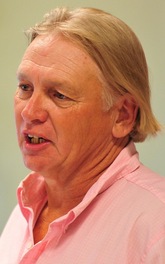
Bill Riney
Six candidates are competing in the Aug. 3 Democratic primary for a chance to replace Smith in the 54th District. Smith, a Democrat hailing from Washtenaw County's Salem Township, is term-limited and is stepping down from public office.
Sunday's debate was hosted by the Eastern Washtenaw Democratic Club and started with a surprise speech by Bill Riney, one of the six Democrats running.
Riney, a Ypsilanti Township businessman, stood before the crowd and said he could not in good conscience take part in the club's debate because he believed some of its members were racist.
"I will not lower myself to that standard," he said, tossing on his ball cap and walking out.
Two other candidates seeking the Democratic nomination, Dave Franklin and Edison Hubert, did not attend the debate.
The 54th District includes the city of Ypsilanti and Augusta, Salem, Superior and Ypsilanti townships in Washtenaw County. Click here for a map of the district.
The winner of the Democratic primary faces off in November against either Richard Deitering or Rodney Nanney, who are running in the Republican primary in three weeks. Palmer will appear on the November ballot as an independent.
Much of the attention in the 54th District race to date has focused around two candidates: Scott, who has lived in Ypsilanti Township most of his life, and Rutledge, who serves on the Washtenaw County Road Commission and Washtenaw Community College Board of Trustees.
Scott made waves recently by going on the offensive against Rutledge, criticizing him for taking part in a $4,000 dinner for the WCC Board of Trustees.

David Rutledge
Soon after Scott's attack, college President Larry Whitworth announced he would personally pick up the tab for the dinner, calling the bill excessive and shocking. But Rutledge defended the expenses in May, saying it was part of a retreat that provided an opportunity for long-term visioning for the college.
The issue didn't resurface Sunday night as Scott and Rutledge remained mostly cordial during the debate.
Scott said his experience in Rep. Smith's office makes him uniquely qualified for the job.
"I consider my experience in Lansing to be what sets me apart from any of the other candidates," Scott said. "I've spent my time working with Rep. Smith. I've worked on four of the state's largest budgets through the three most difficult budget times since the Great Depression, and I think that that experience is something that will allow me to hit the ground running once elected."
Rutledge, a former Superior Township supervisor, suggested he has the more relevant experience, having been on the receiving end of state budget problems.
"Sometimes I think that what may be wrong with Lansing is there are too many people who work there, and work in budgets and other things, and they haven't lived them," Rutledge said. "I have lived budgets. I've had to deal with them at the township level. I've had to put together a township budget. Try doing that."
White spoke of his experiences in the U.S. Army and as a factory worker, a U.S. postal service employee, and bus driver and summer school teacher for Kalamazoo Public Schools, where he was vice president of his union.
"We have a lot of work to do here in Michigan. When elected to office, I plan to bring all the experiences that I have with the different positions that I've held," he said. "I've been on the labor side, I've been on management's side."
Each of the candidates agreed there are structural problems to address with the state's budget and reforms that may be necessary.
White said he wants to make sure small businesses have an opportunity to function properly and employ people. He called the Michigan Business Tax a "job killer."
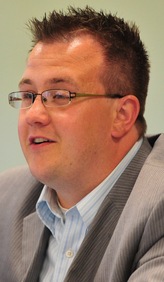
Lonnie Scott
"We need restructuring in our tax structures. It's absolutely crippling these small businesses," he said, adding the state also needs to consider its options with a graduated income tax and extending sales tax to services.
Scott and Rutledge also supported a graduated income tax and said the MBT isn't working well.
"On top of the Michigan Business Tax, they've also tacked on a 20 percent surcharge. These are the kinds of things that we have to change," Rutledge said.
"We have to get rid of the MBT surcharge and make doing business here easier for businesses," Scott agreed. "But the part that I think gets missed most often is the public side of job creation and that's investing in the things like infrastructure, roads and bridges, and schools and our education system."
Scott spoke openly about his desire to raise state revenue. Even with the poor economic conditions, Scott said, Michigan is currently $9 billion under the Headlee limit — the state's tax capacity — which he argued means that the state's tax structure is not set up properly. Scott said a graduated income tax would hold most citizens harmless from paying more taxes, while many actually would see a tax cut.
"Which should tell us that the lower-income people in our society right now are paying more than their fair share of those taxes," he said.
Palmer, who agreed the MBT doesn't work, said the state has a lot of serious funding questions to answer. He said a graduated income tax is one way to raise revenue, and if it's determined that it's needed, "then I think we need to go that route."
Rutledge is the owner and president of Esourceful LLC, an environmental services company located in Ypsilanti. He previously worked as deputy director of the research staff for the Michigan House Democratic Caucus. He said he's most proud of having served the state under three different governors.
"All of these experiences come together in me," he said. "I look at it like the people have made an investment in me, and it is time for that investment pay off. And that's why I'm running, to have that investment pay off in solving the issues in Lansing."
Scott said his candidacy is not a "culmination of things that I have done."
"This race is about what we can do together in getting the state of Michigan back on track. We are in the fight of our lives in Michigan right now," he said.
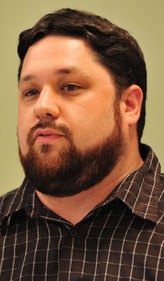
David Palmer
Palmer graduated from Eastern Michigan University with a bachelor's degree in political science and a graduate certificate in nonprofit management. Today he's a business manager for a high-tech company in downtown Ypsilanti.
He spoke of the need to develop the state's high-speed transit infrastructure and combat losses in population and property values.
"Another issue that's very important to me this election is doing something substantive to solve the structural funding problems we have in this state," he said. "We've lost well over 500,000 people since 2002 from the state of Michigan. Those folks who left the state had an opportunity to get jobs somewhere else and pack up their things and move. They are no longer a part of our tax structure."
To create jobs, he said the state needs to focus on entrepreneurial development and creating a level playing field.
"One fundamental thing I would like to do when serving in Lansing would be to help change the dialogue and to be able to step away from party leadership and the constant drum of arguments that occur," Palmer said, "and try to bridge conversations between the Democrats and the Republicans. I think in a lot of cases, a simple filter to be able to run ideas through helps people step away and be able to look at things completely different."
White spoke of taking advantage of the state's strengths in tourism, agriculture and manufacturing, and retraining workers for the "new green jobs" of tomorrow.
"We have to remember that legislators don't actually create jobs, they create legislation to help create jobs," he added. "But what we do have is an opportunity for entrepreneurism here right in our community to start developing young people."
White acknowledged he hasn't worked on budget problems in Lansing.
"But I've been a recipient of those actions," he said. "So being that, I have a wealth of experience. I've worked in different sectors. I've worked in private, I've worked in public. I've seen the different communities. I've seen the different socio-economic backgrounds."
Candidates agreed the state is allocating too much money for prisons while its education system is lacking funding. White said there are too many people being locked up and state prison guards are compensated too highly.
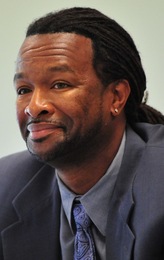
Michael White
"We need to start investing more in education because when people drop out of education, they drop into incarceration," White said. "It's a system, it's cyclic. We need to really take a look at that, cutting that fund and reinvesting that money in education, at least pre-K."
Rutledge said there's room for cuts to prisons.
"It's a $2 billion operation and it's second only to community health and it is out of line with prison systems, not just in the country but in the Great Lakes," he said. "Our prison system spends about $90 a day on a prisoner, when our neighbor Ohio spends like $64 and there are reasons why we're out of kilter. The first is the salary range."
Rutledge cited figures that starting prison guards in Michigan earn $50,000, while the average in the Great Lakes area is $44,000.
"Somehow we have to bring that into line," he said. "The legacy cost for the pension system is really ballooning. I'm not sure what could happen there because we're locked in for 15 more years based on labor agreements."
Rutledge said the state should invest more into prisoner reentry programs and get parole boards more comfortable about allowing prisoners out at the minimum sentence.
"We do need to make cuts to corrections, but I can guarantee you that my first step as the next representative from the 54th District is not to go in and cut people's wages," Scott said. "I am not going to stand by and watch us be in a race to the bottom."
Next to prisons, Rutledge cited a second area of the budget to cut.
"There is a $36 billion piece called incentives and tax breaks," he said. "I would look at that area as another area to capture some dollars back because we don't do proper oversight in terms of the incentives that are set up."
Palmer said the state has been tightening its belt for a long time. Before it starts cutting again, he said, it needs to look at a constitutional convention.
The funding interplay problems between Proposal A and Headlee can be solved if a constitutional convention moves forward, he said.
"We can focus on cuts and we can also look at raising revenues," he said. "I know that's not a terribly popular thing, but in one of the most conservative states in the country, Arizona, they managed to agree to raise their sales tax to be able to pay for basic services."
Rutledge said if the state is going to create jobs, it must have a well-trained work force. He said the K-12 education system needs to match with "real jobs that are out there."
He said infrastructure also is important as it relates to quality of life. He said the county has about 110 bridges, a third of which "you wouldn't want to cross."
"Five bridges are closed in one township," Rutledge said. "We have permitted our infrastructure to fall in this level of disrepair. It is unconscionable."
Scott said he's running because he wants his 4-month-old son to be able to have a quality education and eventually a good-paying job in Michigan someday.
"And to do that, we have to budget to our priorities in the state of Michigan," he said. "We have to pay for and fund education, infrastructure. We have to make our business climate more accessible so that businesses will want to locate here.
"One of my top priorities would be to make sure that we have prioritized our budget so that we never leave dollars in Washington," he added. "It is ridiculous to me that for every dollar that we send to Washington for roads, we get approximately 80 cents back. West Virginia gets $1.26, so that's where our 20 cents is going, plus someone else's 6 cents."
Ryan J. Stanton covers government and politics for AnnArbor.com. Reach him at ryanstanton@annarbor.com or 734-623-2529.
Comments
xmo
Mon, May 21, 2012 : 10:52 p.m.
Is there really any difference between these candidates? They all are Democrats therefore they want to take your freedom away so that government can provide a solution. But it is fun to watch these guys try to pretend they really care about you!
David
Wed, Jul 14, 2010 : 2:12 p.m.
I was unable to attended due to a family emergency. Family members who attempt suicide are far more important than any forum/debate.
ypsineighbor
Mon, Jul 12, 2010 : 6:20 p.m.
Who exactly is the "Eastern Washtenaw Democratic Club"? Nothing on google. Never heard of them.
pseudo
Mon, Jul 12, 2010 : 3:58 p.m.
word in our house is this: our state rep isn't supposed to make us change, he's supposed to REPRESENT us in Lansing. That may or may not be in agreement with the rest of the state. So far, Lonnie's got it going on. His experience in Lansing, living here with us, I am hearing him say what I want to hear about what public service and representation really is. He's got budget and public policy experience. It was never more clear than last night. Done - he's got our vote.
treetowncartel
Mon, Jul 12, 2010 : 10:53 a.m.
Good to see Riney come down out of his tree and call his fellow Democrats out. I know I'm in a sense wasting my vote, but I'm voting Republican this time around.
tdw
Mon, Jul 12, 2010 : 8:46 a.m.
@Ryan I keep seeing Riney owns a small business but nothing as to what it is.Is being flaky a business these days?
Ryan J. Stanton
Mon, Jul 12, 2010 : 8:32 a.m.
Here's a sidebar story from my chat with Riney before the debate: http://www.annarbor.com/elections/bill-riney-aka-the-free-hot-dog-man-campaigns-in-his-own-unusual-way-for-state-representative/
Rod Johnson
Mon, Jul 12, 2010 : 8:29 a.m.
Nice trolling on the Lord's Day thing. Riney is living up to his reputation as a loose cannon. It would be nice to hear more about what he was talking about.
Jeremy
Mon, Jul 12, 2010 : 7:31 a.m.
Wholly unsurprising that Dave "DINO" Franklin didn't show up. Perhaps he accidentally drove to the debate between the Libertarians and Republicans who are obviously more of his kind. It is too bad that he can't even show his face in front of the democratic base constituency. Seems as if he's got something to hide if he's not willing to participate - or maybe he just got tired of repeatedly trying to fend off every good natured inquiry in to his background and conservative republicanist tendencies by calling them "ad hominem". We're not attacking you personally, sir. We are questioning your politics. Know your latin. Mr. Franklin - get your Tea Party out of my Democratic Party.
Do not taunt Happy Fun Ball
Mon, Jul 12, 2010 : 6:46 a.m.
Franklin is the only Democrat who will bring a Change to this district. The others are simply "same old same old."
InsideTheHall
Mon, Jul 12, 2010 : 5:33 a.m.
Holding a political debate on the Lord's Day. The secular DEMS need a little diversity training!