

State Legislature yanks capital projects funding from EMU, WCC at last minute
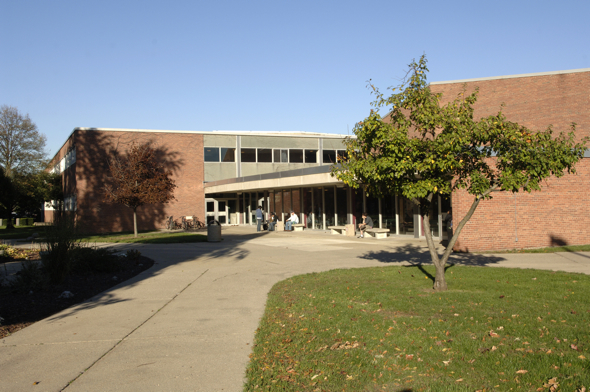 Eastern Michigan University had asked the state for $28.5 million to renovate Strong Hall on its Ypsilanti campus.
Photo courtesy of Eastern Michigan University.
Late-night deal making by a lame-duck Legislature has cost Eastern Michigan University nearly $30 million in state funds to renovate Strong Hall and Washtenaw Community College $3 million for renovations in the Morris Lawrence Building and the Student Center.
“I was surprised that they were so blatantly political,” said WCC President Larry Whitworth. “We were hoping, we had done our work, but it didn’t get done.”
The move came in the wee hours of last Thursday night as the Legislature rushed to wrap up its business with a flurry of activity, including votes on the capital aid budget for the state’s community colleges, colleges and universities.
“What concerns me and a number of colleagues is the message this sends to us after what we did to hold the line on tuition for working families,” said EMU Regent Jim Stapleton, who is the chairman of the regents’ finance committee. “Everyone (in Lansing) said they would remember what we did with the zero, zero, zero (a zero percent increase in tuition, fees and room and board for this school year) when it came to the capital outlay.”
Mike Boulus, the executive director of the Presidents Council, State Universities of Michigan, said those schools who got left out, which also included Western Michigan University, had the right to be angry about the process.
“This is not about projects and value,” he said. “They were looking for 56 votes to get the bill passed and that’s what they got. It was a lame-duck (Legislature) that was looking to go home. It’s a very sloppy process.”
The process started earlier in the fall. EMU regents’ approved asking the state for 75 percent of the $38 million cost to renovate Strong Hall in late October.
The building was built in 1957 and has not had any significant renovations since then, university officials have said.
Under the normal procedure, the state would cover 75 percent of the cost and the university would cover the rest if the state decides to fund it.
Plans call for modernizing classrooms and lab spaces and adding new technology, along with updating the fire suppression systems and replacing structural, mechanical and electrical systems.
The request was sent off to the Legislature, joining requests from a variety of other universities.
Eastern’s request won approval at the committee level and in early versions of bills in both the state House and the state Senate, as did WCC’s request. After both the House and Senate approved the bills, the two chambers got together to iron out the differences.
Somewhere late Thursday, that ironing smoothed EMU and WCC right out of the money.
“It was a Republican-controlled process,” Whitworth said. “The Senate called the shots on it and we have Democratic (legislators). It was purely political.”
As the night wore on, state Rep. Alma Wheeler-Smith, D-Salem Township, introduced an amendment on the floor of the House to add Eastern’s funding back into the bill. State Rep. Rebekah Warren, D-Ann Arbor, did the same for WCC.
Both failed. However, the University of Michigan's Ann Arbor campus got $30 million towards the $64 million cost of renovating the G.G. Brown Memorial Laboratories.
“It got to a point where it was fitting money available to projects,” Wheeler-Smith said. “It was a matter of fighting. Then a decision was made by who got projects funded recently and Eastern Michigan University had gotten funding in 2008 (for Pray-Harrold).”
WCC also got funding in 2008, the last capital outlay bill, Whitworth said.
The bill passed the House and the Senate and is expected to be signed into law.
The last-second yanking of the money has Eastern officials seeing red.
“The Legislature for years has called on universities to hold the line on tuition,” said Leigh Greden, EMU’s executive director of government and community relations.
Greden said the Legislature passed up a chance to reward universities who kept tuition down, which might have provided an incentive for other universities to follow suit.
“When we don’t raise tuition, clearly there are fewer resources available for things, including infrastructure improvements."
Wheeler-Smith said she had long conversations with lawmakers about Eastern’s tuition increase freeze.
“Yes, Eastern held the line, but that wasn’t enough to sway enough votes,” she said.
Greden said he didn’t expect there to be any long-term fallout.
“We’re doing great things at Eastern and making sure (legislators) know about it.”
David Jesse covers higher education for AnnArbor.com. He can be reached at davidjesse@annarbor.com or at 734-623-2534.
Comments
michaywe
Mon, Dec 13, 2010 : 7:31 p.m.
I was surprised that they were so blatantly political, said WCC President Larry Whitworth. We were hoping, we had done our work, but it didnt get done. Yes, Larry you did your work. Your building projects, so blatantly manipulated so award was to appear 'union friendly', cost taxpayers thousands more than necessary! Good luck in your next career. take some trustees with you. I can't wait for the new Republican Gov. and Legislature to consolidate the duplication of effort in higher ed.! Does MI really need more medical, dental and law schools? Or course we do, as long as they're in Ypsilanti or Ann Arbor, Right? Oh, Hell no!!!
SW40
Sun, Dec 12, 2010 : 10:43 a.m.
I find it funny that people get upset when our governemnt doesn't fund the projects that "we" want however none of us want our taxes raised or entitlements cut. I'm all for EMU remodelling a building and I have an idea how our state can fund it, cut section 8 housing, start mandatory drug testing for all individuals receiving bridge cards, welfare funds or any governemnt assistance for that matter. Until, as a state we realize that the government is funding a permanent underclass who have no ambition of approving their lot in life then I guess our colleges don't get 30 million dollars to fix up an old classroom.
Ralph
Sat, Dec 11, 2010 : 3:44 p.m.
This is really too bad. Eastern has been doing a great job sprucing up campus. Strong Hall has had nothing done to it except paint since it was built. While it's still a serviceable building it needs to be gutted and cleaned up. Now it will continue to deteriorate. The University just connected Strong to Mark Jefferson, which is getting a $90,000,000 addition and facelift.
Deborah
Sat, Dec 11, 2010 : 2:49 p.m.
a rebublican led effort stalled educational investment. That is not news! The republicans are a collection of businessmen interested only in preserving their power and profits at the expense of our countries future. They think we are dumb and an education will only make us more difficult to govern(trick/manipulate) nothing new here just more corruption on a massive scale all wrapped up in a nice pretty package with a bow too. Merry Christmas sayeth the legislature. vote em all out next time.
Cash
Sat, Dec 11, 2010 : 7:31 a.m.
bhall, Clearly not every adult is capable of educating children. Clearly.
AlphaAlpha
Sat, Dec 11, 2010 : 7:28 a.m.
"The bill passed the House and the Senate and is expected to be signed into law." Does this suggest that the 'Democratic' House and Governor support this measure?
Soothslayer
Fri, Dec 10, 2010 : 7:49 p.m.
Democracy: we are led to think we actually have a voice and that our elected representatives will act in our best interests but this and Senate GOP antics regarding DADT are strong evidence otherwise.
julieswhimsies
Fri, Dec 10, 2010 : 4:05 p.m.
This is how it's going to be now, folks.
Cash
Fri, Dec 10, 2010 : 3:01 p.m.
bhall, Yes, let's just be a state full of illiterates. that will make the economy improve. Private schools are unaffordable for the middle class. Ever price them? Thus if there were only private schools only the very wealthy could get an education. Then we would be no different than a third world country. People came to America because there was an equal chance if they worked hard they could get ahead. They had a CHANCE to get an education. If all do not have the chance for an education, then all are indeed NOT equal. As I recall, that's kind of what this country is all about......
bhall
Fri, Dec 10, 2010 : 2:17 p.m.
Whatever happened to personal responsibility? Why do we need a nanny state to build school buildings for us. That's just stupid. I'm sick of the people on this site clamoring for more big government! People, figure out how to take classes and keep the government out of our lives!
zip the cat
Fri, Dec 10, 2010 : 1:19 p.m.
Just the tip of whats to come. Spend some of what they have laying around. Like the u/m 10 billion endowment and still getting 350 million in state aid. Total bull
Karen
Fri, Dec 10, 2010 : 1:14 p.m.
So, Dingle gets Ann Arbor millions for the Stadium Bridge, which should have been funded by the Ann Arbor City Council budgeting it into the property taxes for the last 10 years. But Ypsilanti, Kalamazoo, etc get screwed by the state legislature. Business as ususal. BTW - I believe the representatives voting on this were "lame duck"? If so they might not have the political will to ok anything at this point. Recommend send letters to Dingle or other recently elected officials asking why every city except Ann Arbor is being cut...I mean, someone out there actually voted the guy back in for the umpteenth time so perhaps he could do some work on this.
Olive
Fri, Dec 10, 2010 : 1:04 p.m.
I'm also with Cash on this. Ridiculous.
deb
Fri, Dec 10, 2010 : 12:58 p.m.
How can you give a school with such a huge endowment fund that much state funding?????? Eastern should have gotten this money because (i dont have anything that supports this, but common sense makes it seem to be true) graduates from that university are more likely to stay in state and help the economy then graduates of the U
leaguebus
Fri, Dec 10, 2010 : 11:04 a.m.
The Ghost is totally correct, who in their right mind, having to cut more out of the budget would also cut taxes for business. Businesses are making record profits right now and still not creating jobs, do they need $1.5 B more in profit, of course not. Cutting a third from the State budget will definitely be one step closer to Michigan being number 50 in everything in this country.
Nacho
Fri, Dec 10, 2010 : 10:30 a.m.
This is horrible. As a student who had both my classes this semester in Strong Hall, I can honestly tell you that none of the opponents of this money ever stepped foot in Strong otherwise they wouldn't have voted so foolishly. I applaud EMU for keeping tuition where it is, however I am a little surprised that Mr. Greden doesn't believe there will be any "long term fallout." Let's see...Pray-Harrold was funded in 2008 and might be completed in 2011, so if Strong is funded this next year..(unlikely from info in previous comments), it will be 2014 before it is finished? I would say that has long term effects. Three more years for students and professors in a substandard building. Let's just hope they cram as many classes into Mark Jefferson as they can. Glad I get to pay $4000 next semester to student teach, maybe I can earmark it for Strong.
matt
Fri, Dec 10, 2010 : 9:07 a.m.
I have to agree with Cash on this.
Alan Benard
Fri, Dec 10, 2010 : 9:05 a.m.
Where is the Michigan state government's commitment to education? Our politicians talk a good game, but fail us consistently. Community colleges and smaller state universities especially will be the backbone of retraining workers for future technologies -- they must be fully funded. The federal government understands this, but can only get traction with cooperation from our legislators. We will remember these votes and we will support only the deserving next election time.
Cash
Fri, Dec 10, 2010 : 8:05 a.m.
An absolute slap in the face to EMU. The administration did what NO OTHER school did....held the line to 0%,0%,0% and how did the state of Michigan legislature reward their stringent budgeting? By slapping them in the face and denying their request to renovate a building....and instead rewarding U of M where money is no object. Unbelievable! This is the message the Republican controlled legistlature sent to State of Michigan institutions of Higher Education: Do NOT hold the line! Raise tuition as though all taxpayers were wealthy and to hell with the middle class.
MWH
Fri, Dec 10, 2010 : 8:05 a.m.
I'm so proud of our state government. And its only going to get better... Not!