

Michigan approves $2 million in tax assistance for Packard Square project in Ann Arbor
The Michigan Economic Growth Authority today approved a plan to capture $2 million in local and school taxes for the redevelopment of the former Georgetown Mall property in Ann Arbor.
The MEGA board's approval comes following approvals by the Ann Arbor City Council and the Washtenaw County Board of Commissioners of a brownfield plan for the Packard Square project that includes $5.8 million in tax-increment financing assistance for the developer on the nearly $49 million, mixed-use project.
A brownfield property is one in which site conditions present an obstacle to redevelopment. In Michigan, that can include properties that are environmentally contaminated, blighted or functionally obsolete, and the developer of Packard Square claims all three conditions exist.
Under the local brownfield plan, $5.8 million in taxes are expected to be captured over a 14-year period to help finance the project. Of the total eligible brownfield activities, $3.6 million would be directly reimbursable to the developer, plus another $717,236 in interest.
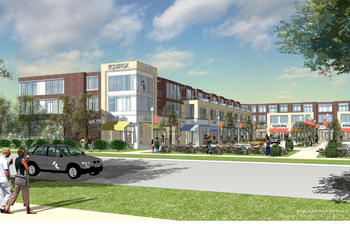
A look at the Packard Square project that was approved by the Ann Arbor City Council. The developer hopes to break ground later this year.
From The Harbor Companies LLC
Brett Lenart, who oversees the county's brownfield redevelopment program, said the $2 million figure referenced by MEGA is only a portion of the $3.6 million being reimbursed to the developer. The remaining portion of developer-reimbursed activities will be considered by the Michigan Department of Environmental Quality, which has not rendered a decision yet, he said. He added that each state entity has jurisdiction over different portions of the eligible activities.
According to a memo from the Michigan Economic Development Corp. to the MEGA board, the Packard Square project is expected to be constructed to meet LEED Silver qualifications and designed to increase walkability in the area (download the memo).
It also is expected to create 45 new full-time jobs paying an average hourly wage of $28, with a total capital investment about $49 million, according to the MEDC.
"This underutilized property will be transformed into a mixed-use retail and residential destination creating increased foot traffic, expansion of local economy through new retailers, and additional revenue to taxing jurisdictions once eligible activities have been reimbursed," reads the memo signed by Deborah Stuart and Katharine Czarnecki.
"Contaminated soil created from a dry cleaner will be removed as part of the project and the site will be cleaned to applicable state of Michigan criteria," the memo continues. "Depending on soil conditions after source removal, a sub-slab vapor barrier with passive venting system under the building may also be necessary for the development."
According to the MEDC, the buildings on the site are considered functionally obsolete due to age, structural condition and "inability to economically upgrade and modify the structures to serve commercial markets at general accepted market rates." It's expected more than $3 million in environmental response activities are needed to alleviate brownfield site conditions.
The county has applied for $1 million in DEQ grant funds to pay for certain eligible activities on the site, including soil removal, the vapor barrier and a portion of the building demolition. The developer is seeking DEQ approval of another $1.18 million for eligible activities.
Of the $2 million in tax captures approved by MEGA today, the amount of school taxes captured for the project is estimated at $886,680.
In addition to the Packard Square project, the MEGA board today approved three other brownfield redevelopment projects and other incentives for projects throughout the state that are estimated to generate more than $198.2 million in new investment and create 1,142 jobs, according to a press release from the MEDC.
“Today’s actions will help transform blighted, contaminated or functionally obsolete properties into new centers of economic growth and activity," Michael Finney, president and CEO of the MEDC, said in a statement. “At the same time, our economic gardening strategy is working to help companies grow and increase job opportunities in Michigan.”
The state's MEGA board, created in 1995, is empowered under statute to award brownfield redevelopment tax credits to support new business expansion projects on property that is contaminated, blighted or functionally obsolete. The MEDC serves as staff to the MEGA board and administers the activities and programs to promote economic growth.
Ryan J. Stanton covers government and politics for AnnArbor.com. Reach him at ryanstanton@annarbor.com or 734-623-2529. You also can follow him on Twitter or subscribe to AnnArbor.com's e-mail newsletters.
Comments
Tom Teague
Wed, Jul 20, 2011 : 2:36 p.m.
My issue is that we don't get full explanations of the funding and tax abatements in annarbor.com stories. Typically, the reporting on municipal funding practices and business incentives seems to assume that the readers have a deep knowledge of those; that's not a good assumption . Not every explanation has to sound like a word problem in fifth-grade math, either. You could develop a table showing what the developer is paying now in taxes, what he will pay after the development, and what the impact is to the existing tax base. Throw in an explanation of the Brownfield credits. You'd only have to create it once and you could include a link each time. That might help the visual learners among your readers. Here's an orange to compare to this story's apple, but it's a point to remember: Harrisburg PA is in deep financial trouble over funding for a municipal incinerator. A NYT story this morning said that one contributing cause to the debacle was "a lack of critical local news media . . ." Critical doesn't mean anti-everything, it just means that media should provide information we need to give informed support or opposition to various projects. All that said, thanks to other commenters for the clarifications and links which helped connect the dots. I'm a neighbor of Georgetown and support incentives for redevelopment, but would like clearer explanations than I've seen so far.
Veracity
Wed, Jul 20, 2011 : 1:05 p.m.
From another recent Ryan Stanton article: "Through tax-increment financing, no existing taxes are abated. However, the incremental increases in tax revenues that result from improvements to a property are channeled back to the developer to help cover costs and provide an incentive for development." <a href="http://www.annarbor.com/news/ann-arbor-city-council-gives-ok-to-482m-redevelopment-of-blighted-georgetown-mall-property/">http://www.annarbor.com/news/ann-arbor-city-council-gives-ok-to-482m-redevelopment-of-blighted-georgetown-mall-property/</a> So taxpayers will be subsidizing Craig Schubiner's development but municipalities will not benefit from increased taxation for 14 years because the TIF dollars will be returned to the Packard Square owners. This gift of taxpayer monies is a ruse to finance site development, reducing the overall cost of financing by the developer. Unfortunately, other benefits from building Packard Square, that is new employment, will likely be short-lived as the expensive leases will deter occupants. Thus, Packard Square will not be profitable and likely end up bankrupt. Such a scenario will be reminiscent of the recent Ashley Terrace bankruptcy which resulted from an attempt initially to sell and then to rent condos at excessive leasing rates due to the high cost of construction. Interestingly, commercial retail space in Ashley Terrace has not been rented reflecting the excess commercial retail space available throughout Ann Arbor. In this down economic environment, Craig Schubiner wants to add 21,000 square feet of additional commercial space. Bruce Madej: The government provided "loans" to the auto companies and we are being paid back in full and with interest. With Packard Square, the developer is being gifted money for site development that will not be paid back to the taxpayers. Can you recognize a big difference here? Rob: If Packard Square fails financially only the developer will profit.
Brad
Wed, Jul 20, 2011 : 2:10 p.m.
"Unfortunately, other benefits from building Packard Square, that is new employment, will likely be short-lived as the expensive leases will deter occupants. Thus, Packard Square will not be profitable and likely end up bankrupt. " You know how much the retail will lease for? And you know this how?
Sparty
Wed, Jul 20, 2011 : 2:03 p.m.
Oh, taxes won't increase on a new development vs an environmental toxic dump? New retail businesses, new rental units, new construction jobs won't generate any income (and thus tax) over what is currently there? Can YOU recognize the difference?
Sparty
Wed, Jul 20, 2011 : 1:59 p.m.
Except that Chrysler has paid back it's loans EARLY, continues to employ millions directly and thru their supplier and distribution networks, pays taxes, as do their employees and the employees of these associated businesses, etc. What a shame that some are so short-sighted! I guess some must have a crystal ball predicting this same level of disaster for Packard Square.
eagleman
Wed, Jul 20, 2011 : 1:31 p.m.
If you recall this is the second time we have bailed out Chrysler. What fool gives such people a second chance? Oh, that's right, our politicians. Chrysler should have died 30 years ago. It seems to me that bailing out Chrysler is infinitely more foolish than this venture.
Mike
Wed, Jul 20, 2011 : 12:13 p.m.
The same people who cry about tax dollars being used to redevelop an eyesore are the same ones who want to use tax dollars to buy vacant land (green belt) around the city of AA. Your either for spending tax dollars like a drunken sailor or your not. They are also the same people who say we need affordable housing while artificially reducing the land available to build on thereby increasing the cost of remaining land not owned by the government (basic supply and demand). The government is broke and they should start selling off some of that land to raise money to pay of the trillions in debt in just about every city and state in America.
Sparty
Wed, Jul 20, 2011 : 2:08 p.m.
And how will environmentally toxic property in the midst of residential areas get cleaned up then? Do you propose the government absorb 100% of the cost or just provide some incentive as is the case here?
Sparty
Wed, Jul 20, 2011 : 3:55 a.m.
My understanding is that back taxes had to be repaid before proceeding, that toxic environmental issues will be fixed, that businesses will generate new tax income, that new rental residents will generate income, a city eye sore will be eliminated, and that as a result over time school taxes will actually increase from a nearly non-existent current base. Does nobody here have any long-term vision for our community? It looks like these boards are just riddled with bitter people who jump to conclusions without having all of the facts or at least seeking them out before venting their venom.
Bob Bethune
Wed, Jul 20, 2011 : 12:49 a.m.
So, here's Commercial Real Estate 101, Ann Arbor style. Run a development. Egregiously neglect it while trying to jack up the rents on the tenants until they all leave. Continue to neglect the property, which is now an eyesore. Having done this, ask the city for millions of dollars so that you can build a new development on the site. Be rewarded for your mismanagement of the property when the city and state obligingly agree. Next step: I can only suppose that having done it once, it will be time to do it again. I'm disgusted.
eastsider2
Wed, Jul 20, 2011 : 3:13 a.m.
I agree completely! Did I miss something, or is the developer still Schubiner, the man whose company owns this property? If he is, A2com, quit portraying this guy as "a developer" and show him as he really is: "the longtime owner who ran what was a decent little shopping center into the ground and still owes back taxes on it". There is a big difference between some new group coming in to save the day and the same ol' same ol' in shiny new clothing.
Mr Blue
Tue, Jul 19, 2011 : 10:39 p.m.
"Michael Finney, president and CEO of the MEDC, said in a statement. "At the same time, our economic gardening strategy is working to help companies grow and increase job opportunities in Michigan." Does mr Finney have any independently verified examples to back up his claim? And how many tax dollars did each job "cost"? Or will he continue to dazzle us with buzzwords and party line soundbites?
glacialerratic
Tue, Jul 19, 2011 : 10:18 p.m.
What is the intended audience of this article? The general readership in the Ann Arbor region? Or urban planners, tax specialists, real estate developers and investors? The writing is filled with specialized jargon. While none of the underlying concepts are particularly complex or difficult to understand, for the average reader they lie hidden in the fog of specialized prose. And this keeps the general reader from fully understanding the important political and policy trade-offs that are at stake in local and state decisions to provide public subsidy to this private project. Please--more light, less fog.
Bruce Madej
Tue, Jul 19, 2011 : 9:36 p.m.
From the comments I have read so far, these would be the same people who would have said 'NO' to the government giving our auto companies the loans to restructure. This is what government should be doing. Instead of looking at short term fixes, the subsidy for the plan will allow more small businesses and individuals a chance to live and work in Ann Arbor--And yes, pay taxes that will help Ann Arbor grow in the long run. Congratulations on the decision to spend the money wisely.
Gasmaskted
Tue, Jul 19, 2011 : 9:34 p.m.
So, Crazymad, you're crazy mad that school taxes are being sacrificed to promote a development that will clean up a toxic and empty retail site (the cleanup grant being apparently more than the sacrificed school taxes), and mad that it will add a bunch of expensive apartments and retail space to something that is currently not being used for either? You realize adding housing stock will tend to push down prices by creating more vacancies, right? Do you just want there to be empty toxic retail sites for the homeless to live in? (On the other hand, where's the parking? The painting doesn't seem like it has a good idea of where that will be...)
Tom Teague
Tue, Jul 19, 2011 : 9:14 p.m.
@Ryan - I'm hoping you can provide some detail on the source for the captured taxes: Is that captured by reducing the amount of property tax that the owner/developer would pay on the improved property over 14 years?
Linda Peck
Tue, Jul 19, 2011 : 9:02 p.m.
I am disgusted by this taxpayer subsidy of private business.
Crazymad
Tue, Jul 19, 2011 : 8:39 p.m.
How wonderful, give money to a rich investor using our school taxes ($886,680) which could be used on our schools instead. He is going to build commercial property in an area overflowing with empty building which could be reinvented to serve many purposes. How great, he is going to build even more expensive housing when there is a shortage of low income housing, people staying in cars, tents, sleeping wherever they can and you want to build more over the top housing. The state has cut money to seniors, schools, and limited welfare for even children after 4 years for a lifetime. I wish all the people affected by this type of stuff would go and protest because soon if you don't, we will all be slaves of the mighty rich.
eagleman
Wed, Jul 20, 2011 : 1:24 p.m.
There is no shortage of low income housing. A short trip to Ypsilanti will reveal many such places. Ann Arbor has never been for the lower class. You know that, but yet you still employ demagoguery. Why? If you are so concerned about the poor, either donate most of your earning to charities that serve the poor or start a business and put these people to work. Failing that you should keep your sanctimonious hectoring to yourself.
Brad
Tue, Jul 19, 2011 : 11:15 p.m.
This isn't "expensive" or "over the top" housing at all. It will be moderately priced apartments. And as a resident of the nearby neighborhood, I'll be very glad to see the dilapidated mall gone and a new addition to the already diverse area, so I will be "affected" in a positive way.