

Timeline of events in University of Michigan child porn case
- Related story: U-M President Mary Sue Coleman calls 6-month delay in reporting child porn 'serious failure'
Editor's note: The University of Michigan released this timeline of events Friday regarding the discovery of child pornography on a thumb drive left in a university computer. The timeline is reproduced here in its entirety.
The chronology is based on interviews the Office of University Audits conducted. Dates and events are outlined according to the best recollections of those interviewed.
5/23/11 - Monday
- Late in the evening, a female pediatric resident (Female Resident) discovers a USB thumb drive left in a computer in a medical residents’ lounge. In an attempt to identify the owner so that she can return the drive, she opens files on the USB thumb drive and sees the name of a male medicine-pediatric resident (Male Resident) on a document in one of the files. Another file contains a picture of adult pornography; a third contains a photo that she believes may be child pornography. She panics, closes the files, and leaves the residents’ lounge, leaving the USB thumb drive. She goes home for the night.
5/24/11 - Tuesday
- The Female Resident returns to work in the morning and goes back to the residents’ lounge to retrieve the USB thumb drive, but it is gone.
- The Female Resident reports what she saw to the Attending Physician on the same service. The Attending Physician consults with the Chair of the Medical School Department Compliance Officers (Compliance Chair)
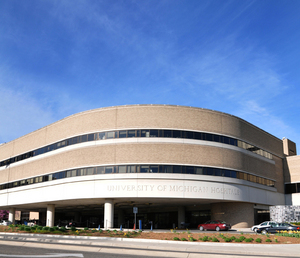
University of Michigan Hospital.
University of Michigan Health System photo
- The Compliance Chair contacts the Health System Chief Compliance Officer (Chief Compliance Officer). The Chief Compliance Officer arranges for the Compliance Chair to make a report to the Office of General Counsel (Health System Legal Office), and Hospitals and Health Centers Security and Entrance Services (HHC-Security).
- The Compliance Chair speaks with an attorney from the Health System Legal Office and an HHC-Security Supervisor, and relates the Female Resident’s allegations.
- Within the Health System Legal Office, the attorney assigned to medical staff affairs assumes the lead role in the case (Lead Attorney). The attorney who took the original report continues to assist the Lead Attorney throughout the Health System Legal Office investigation (Assisting Attorney).
- The Attending Physician and the Compliance Chair arrange for the Female Resident to meet with HHC-Security. The Female Resident recounts the information described above (5/23) to the HHC-Security Supervisor and an HHC-Security Officer.
- After the meeting, the Female Resident and the HHC-Security officers go to the residents’ lounge to look at the computer in question.
- The HHC-Security Supervisor contacts a Data Security Analyst in MCIT (Medical Center Information Technology) and requests assistance in analyzing what information can be gathered from the computer hard drive.
- The HHC-Security Supervisor leaves a voicemail for a Department of Public Safety (DPS) Police Sergeant asking whether DPS could provide some forensic assistance with images viewed on a computer from a USB thumb drive. (The phone message to DPS was never returned.).
- The Assisting Attorney sends an e-mail to the Data Security Analyst and the HHC-Security Supervisor. They are advised that their work is confidential and under attorney client privilege. The text of the e-mail can be found in Addendum II.
- The attorneys follow up with a confirming call to the HHC-Security Supervisor.
- The HHC-Security Supervisor told University Audits he did not complete a report to the police because of the e-mail (Addendum II) from the Health System Legal Office that he believed meant he should stop.
- The Data Security Analyst begins providing the attorneys with the May 23/24, 2011, computer records that confirm that the Male Resident in question logged into the computer before and after the reporting Female Resident. There were no other intervening log-ins during that time frame.
5/26/11 - Thursday
- The Health System Legal Office requests a meeting with the Female Resident. Due to scheduling conflicts, the meeting is set for 5/31, and then rescheduled to 6/2.
6/2/11 - Thursday
- The Lead Attorney interviews the Female Resident; the Assisting Attorney could not be there due to scheduling conflicts. The Female Resident leaves the interview crying.
- The Lead Attorney tells the Assisting Attorney that the Female Resident was unsure of her story and what she saw.
On or about 6/2/11
- The attorneys call the Health System Chief Compliance Officer and relay that there is not sufficient evidence to move forward, that the Health System Legal Office’s assessment was that the Female Resident’s story was shaky. The Lead Attorney reports to the Associate Vice President and Deputy General Counsel (Health System Affairs) that there was no evidence and that the case would be closed. The Female Resident texts the Attending Physician to tell her the meeting did not go well. She says the attorney told her the investigation is complete and the claims are unfounded. There was no evidence of child pornography on the computer. The Attending Physician tells the Female Resident she wants to follow up with the attorney, but the Female Resident asks her not to.
6/9/11 - Thursday
- The last day of employment of the Lead Attorney. The attorney’s departure is unrelated to the case.
11/11/11 - Friday evening
- One of the original reporting physicians (Attending Physician) contacts (via phone call) the Risk Management Top Executive who is part of the Office of Clinical Affairs in the Health System. Two recent events caused the Attending Physician to come forward to raise questions about the case:
- She learned that the attorney who had investigated the case in May (Lead Attorney) had left the University.
- The Penn State incident occurred. The Attending Physician expressed concern about the treatment of the Female Resident and the outcome of the May case. The Risk Management Top Executive tells her this is the first time he had heard of the allegations.
11/12/11 - Saturday
- The Risk Management Top Executive meets with the Female Resident who originally found the USB thumb drive.
- The Risk Management Top Executive briefs the Chief Medical Officer for the Health System about the Attending Physician’s phone call and the meeting with the Female Resident.
11/14/11 - Monday
- The Risk Management Top Executive contacts the Deputy General Counsel (Health System Affairs) and shares the Female Resident’s account of the May incident and the Health System Legal Office meeting. The Chief Medical Officer confers with Chair of the Department of Pediatrics and Communicable Diseases (Pediatric Chair), and confirms that the Male Resident will be carefully supervised until appropriate action including precautionary suspension under the Medical Staff Bylaws can take place.
- Efforts were made to schedule a meeting with the Female Resident. It took several days to bring everyone together.
11/17/11 - Thursday
- The Chief Medical Officer, the Director of Pediatric Education, and a Health System Legal Office attorney meet with the Female Resident. She speaks in detail about what she saw on the drive, and they find her account convincing.
11/18/11 - Friday
- The Office of Clinical Affairs and Health System Legal Office make a report to HHC-Security, with the understanding that they will immediately make a report to the Department of Public Safety (University Police-DPS). HHC-Security reports allegations to DPS.
- DPS advises the Office of Clinical Affairs and Health System Legal Office that they will send a detective to begin investigation but then determine that no detective was available until Monday, 11/21/2011.
- DPS conducts investigation: interviewing numerous witnesses, obtaining forensic evidence, and reviewing the case with the Prosecuting Attorney (11/21 - 12/16). Clinical Affairs and others aware of the allegations are asked by DPS not to contact the Male Resident or tell others. They are told not to remove him from service as it would alert him and evidence could be destroyed.
- The Chief Medical Officer reviews the Male Resident’s files, and notes no performance issues or patient complaints. The Chief Medical Officer and department leadership continue active monitoring of the Male Resident.
12/2/11 - Friday
- A warrant to search the Male Resident’s home is issued and executed.
- Chief Medical Officer and Chair of Internal Medicine issues precautionary suspension of the Male Resident’s patient care responsibilities, pending the outcome of the investigation. (Male Resident is a clinical trainee in a joint internal medicine/pediatrics program.)
- President Coleman is notified.
12/3/11 - Saturday
- President Coleman asks the Executive Director of University Audits to conduct an internal review, to determine the underlying control failures that caused the delay, and recommend changes.
- Executive Director of University Audits notifies Regent White, Chair of the Finance, Audit, and Investment Committee of the Board of Regents.
12/16/2011 - Friday
- The Male Resident is arrested by DPS officers. The Executive Committee on Clinical Affairs unanimously voted to summarily suspend the Male Resident’s appointment as a clinical program trainee effective immediately. The University of Michigan Graduate Medical Education Office discharged the Male Resident from his Medicine-Pediatrics residency-training program effective 12/16/2011.
12/17/11 - Saturday
- The Male Resident is arraigned on charges of possession of child pornography.
Comments
Carole
Sat, Feb 11, 2012 : 1:38 p.m.
obviouscomment, totally agree with you. I wish we had some real reporters who went out and got some good, honest newsworthy stories. When there is a conclusion to this issue, maybe a good, honest story to end it would be awesome.
miscreant32
Sat, Feb 11, 2012 : 2:55 a.m.
It is obvious that the main blame falls on the general counsel as the audit and statements make clear. It is unfortunate that for whatever reason (we will probably never know) a call was never made back to Hospital Security in regards to the request for assistance with the images, if it had been it appears this could possibly have been addressed rather quickly. These were serious charges, career ending and reputation ruining accusations towards the doctor which did turn out to be true and thank god he is no longer there, but I can understand wanting to investigate given the circumstances in which the first picture was discovered, and that is not an attack on the resident who found the picture, I give her all the respect in the world as it sounds from the report that she went through the ringer but again, it looks like if UM police had assisted back in May maybe they could have determined as quickly as they did six months later and it would not have allowed what took place to take place but that is a moot point now I guess And after reading that email sent from the counsel office, I would have also taken that as notice to shut up or we will make you wish you were never born. As I have seen in some other comments and from the report, bringing in an outside expert to make the hospital security and UM police feel good and love eachother sounds like a good idea in theory but does that ever really work is that really the answer? An unfortunate chain of events all around
miscreant32
Sat, Feb 11, 2012 : 5:11 a.m.
@sesame45, mmmm, love the family guy reference, quality show. It would probably have as good of a result as Mr. Bruce. You want to change the culture, fine, that it is a good goal but it has to be changed to a culture of mutual respect and inclusion, trust and understanding. That is not going to happen from a outside consultant nor from an artificial timeline. It will take time to change all those things that if determined by a calendar date will only set it up for failure.
Sesame45
Sat, Feb 11, 2012 : 3:37 a.m.
I can't help but imagine this Outside Expert as Bruce from "Family Guy."
pu2um
Sat, Feb 11, 2012 : 12:13 a.m.
Female Resident went to Attending Physician, who went to Chair of Medical School Compliance Committee, aka Associate Dean of Medical School Hutchinson, who bypassed his boss Dean of Medicine Wooliscroft, and went directly up the chain to Chief Compliance Officer Strickland. What did Wooliscroft know? Both Strickland and Wolliscroft report directly to Pescovitz. <a href="http://www.med.umich.edu/exec/orgcharts/presceo.pdf" rel='nofollow'>http://www.med.umich.edu/exec/orgcharts/presceo.pdf</a> It was CCO Strickland who advised Dean Hutchinson to bounce it down to the Hospital Legal Office and Hospital Security. CCO Strickland called for the involvement of the Health Service Legal Team, which took quick control. <a href="http://www.ogc.umich.edu/healthsystems_office.html" rel='nofollow'>http://www.ogc.umich.edu/healthsystems_office.html</a> HS Attorneys' first action was to subdue security, despite confirmation from MCIT as to computer use by Offending Resident. Their second action was to interview Female Resident who left crying, later to be discredited as unsure of her story. It is inconceivable that Dean Hutchinson bypassed Deputy General Counsel Marchak, straight to HS legal office underlings on May 25th. And, are we to believe that the underlings failed to immediately report to Marchak? Would Marchak not advise Scarnecchia? Why wouldn't Chief Compliance Officer Strickland immediately notify lateral counterparts: Strong and Scarnecchia? Why bump it down several levels? Why didn't Chief Compliance Office Strickland immediately call the DPS, instead of calling a clean-up team?
Kai Petainen
Sat, Feb 11, 2012 : 12:21 a.m.
this is starting to read like a soap opera. can someone make a nice flowchart?
anotheruofm
Fri, Feb 10, 2012 : 9:54 p.m.
Is this the official or unofficial timeline? So this is a different timeline than that of the police because the Office of University Audits did this one. Who are we to believe, the police timeline or Audits timeline? Why didn't Audits release names of these top individuals that knew about this back in May? Oh, that right..... they are covering those top chairpeople. Like the Compliance Chair, Health System Chief Compliance Officer (Chief Compliance Officer), Office of General Counsel (Health System Legal Office), and Hospitals and Health Centers Security and Entrance Services (HHC-Security). Mary Sue, you expect us(the public) to believe that all these top echelon people knew about this and no one had the forethought to call the police back in May? And now Audits is throwing DPS under the bus? Who is next?
miscreant32
Sat, Feb 11, 2012 : 3:41 a.m.
The truth probably lies with a combination of both and if an external review gets done I am sure these new tidbits will get addressed even more.
anotheruofm
Fri, Feb 10, 2012 : 9:46 p.m.
The hospital spin doctors at work. Now it is DPS's fault for not doing anything on May 25th? That is new news. Was that in the police report. This is the first I have heard of DPS knowing about this. Has anyone reached out to the new police chief for his statement on this new information?
Sesame45
Sat, Feb 11, 2012 : 1:55 a.m.
All this outrage is over the 6 month delay. I think a police investigation would have begun immediately if DPS just called hospital security back and said, "You heard there was WHAT on a thumb drive?" I'm not going to say "This one particular police sergeant is to blame and nobody else!" But, that sergeant's negligence is one of the many factors that lead to the delay. It is one of the earlier missteps.
pu2um
Fri, Feb 10, 2012 : 9:33 p.m.
@Sesame45 Leaving a voicemail request for DPS forensic assistance is one of the most unbelievable aspects of the story. Sounds like casual CYA. If it's not written, it didn't happen. After receiving the May 25th email from the assistant attorney, which advised that the porn case was confidential and under attorney-client privilege, Security Supervisor also received phone calls from both lead and assistant attorneys. What more was said on the phone that wasn't expressed in the email? Following the conversations with Attorneys, Security Supervisor decided not to follow up with a report to Police. Did the HHS Attorneys tell Security Supervisor not to report the matter to police? Did Security Supervisor also not tell his/her direct supervisors: Peterson, Denton and Strong? <a href="http://www.med.umich.edu/1busi/pdf/OperationsSupportServices.pdf" rel='nofollow'>http://www.med.umich.edu/1busi/pdf/OperationsSupportServices.pdf</a> I think not! Confidentiality and privilege (if appropriate) would not preclude informing one's boss (unless advised not to by Attorneys). It is highly unlikely that Security Supervisor would not tell Peterson, who undoubtedly would not fail to tell boss Denton, who is an attorney. Would COO Denton not advise CEO Strong? Also concerned about Nov 18 report to DPS. At this point, why didn't Chief Medical Officer/ Office of Clinical Affairs, and Deputy General Counsel, contact the police directly? Why bounce it back to Security Supervisor? Why did DPS wait 3 days to begin an investigation? Didn't consider the porn case a priority? Why commit a detective, then change their mind? The case may have been six months cold, but professional police officers would know that suddenly increased scrutiny would require their involvement sooner rather than later, as evidence is of utmost importance. Finding it too hard to believe it is appropriate to wait 3 days to begin an investigation. Something is wrong if a detective can't be available. How busy are they? Are the police being thrown under the bus? Or are the problems bigger than we realize?
Sesame45
Sat, Feb 11, 2012 : 4:01 a.m.
Miscreant, I agree. What's with the new timeline information? Why were they protecting it before?
miscreant32
Sat, Feb 11, 2012 : 3:46 a.m.
I highly doubt that the audit and timeline would have mentioned this new information if they did not have some kind of evidence to back it up. It will be interesting to see if there is a response from UM on that.
Sesame45
Fri, Feb 10, 2012 : 11:20 p.m.
I don't think the police are being thrown under the bus; there is zero doubt that hospital security is occupying that particular position. I don't think I can get on board with "If it's not written, it didn't happen." I'd like to think that if I called a particular police supervisor's line and left a message about a possible crime, I'd get a call back. What constitutes a "report" to the police, anyway? Does there have to be a piece of paper titled "Possible Child Porn Police Report" for it to be considered "reported"? And yes, the 3 day delay in getting the ball rolling is also odd. They have moved much, much quicker on far less pressing things in the past. This is all such a mess. Everybody has to pick and choose which segments of the audit to believe or not believe, which makes the audit fairly useless to us all. An external investigation needs to happen.
trespass
Fri, Feb 10, 2012 : 4:54 p.m.
Risk management is primarily about protecting the hospital from malpractice suits. This is an indication that the hospital viewed this more as a liability issue than a crime.
trespass
Sat, Feb 11, 2012 : 12:54 a.m.
No the lawyers are in the General Counsel's office. There are actually two parts to risk management. One part is in the Clinical Affairs Office and that Director is a lawyer but the other part is part of the compliance office and those are generally administrative positions.
5c0++ H4d13y
Fri, Feb 10, 2012 : 6:01 p.m.
I'm not sure you can conclude that. They probably went to risk management because that's where the lawyer are.
trespass
Fri, Feb 10, 2012 : 4:53 p.m.
The forgot to mention on 11/30/2011 Police Chief Greg O'dell resigns without notice to return to EMU. What did he think about this case? Was he free to investigate? Was he frustrated by any interference? I wish he was still here to tell us more.
lynel
Fri, Feb 10, 2012 : 3:35 p.m.
I don't expect the name of the Female Resident to be reported, but who are the rest of these people? Their names not just their titles.
Sesame45
Fri, Feb 10, 2012 : 2:45 p.m.
Wait, wait, wait. . . . On 5/25, "The HHC-Security Supervisor leaves a voicemail for a Department of Public Safety (DPS) Police Sergeant asking whether DPS could provide some forensic assistance with images viewed on a computer from a USB thumb drive. (The phone message to DPS was never returned.)." What's that about? If the police responded to the voice mail, there wouldn't have been this six month delay? Why didn't the police respond?
Kai Petainen
Sat, Feb 11, 2012 : 12:17 a.m.
good question. from my understanding, it wasn't until much later that DPS found out about it. but this line item in the timeline is fascinating.
a2citizen
Fri, Feb 10, 2012 : 2:38 p.m.
Compliance Office? Great...isn't that what got the football team into trouble.
Bricc
Fri, Feb 10, 2012 : 9:57 p.m.
nope
obviouscomment
Fri, Feb 10, 2012 : 2:30 p.m.
ok i'm officially not reading anymore articles about this because i think aa.com has milked it for far more than it's worth. what happened is terrible. it was handled terribly. now it's getting taken care of. and hopefully/probably this has scared u of m enough to never let it happen again on their campus. it's too bad things like this will probably still go on in secret at other establishments.