

U-M President Mary Sue Coleman calls 6-month delay in reporting child porn 'serious failure'
University of Michigan President Mary Sue Coleman called the university's 6-month delay in reporting child porn to police "a serious failure" as the university released an internal review of the case Friday morning.
At least eight people, including the Deputy General Counsel (Health System Affairs) knew about the alleged crime by June 2, records show, but the child porn wasn't reported to police until November. No one has been fired, university spokesman Rick Fitzgerald said, noting that the report calls for corrective action for employees involved.
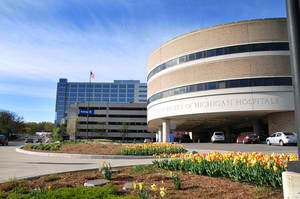
University of Michigan Hospital
"This was a serious failure on the part of our institution - there is simply no other way to describe it," Coleman said. "Findings indicate that an attorney in the Health Legal Office acted improperly when the incident was reported to her. A university attorney must not assume the lead role in investigating a potential crime of this nature. This is solely the responsibility of the police."
Records show university officials waited months to tell police after a resident physician found child porn May 23 on a thumb drive left in a locked lounge residents use in the Pediatric Emergency Department at U-M Hospital.
The internal review, completed by the U-M Office of University Audits, was released roughly a week after the Joint Commission, a hospital accreditation agency, confirmed it was investigating a complaint about the matter. The U.S. Department of Education also is looking into the case to determine whether there were violations of the federal Clery Act that requires universities to warn the campus community if a crime poses a threat.
To download a PDF of the internal review, click here.
Members of the Senate Advisory Committee on University Affairs said Monday that they wanted to see the internal review before deciding whether to recommend that the university ask for an external review.
In response to the review's findings, hospital management said that they will retain at least one "outside" expert by April 1 to "assess our safety and security culture and help us achieve needed change."
Comprehensive AnnArbor.com coverage
- Security or police? Unclear role at University of Michigan hospital contributed to child porn reporting delay
- U-M faculty members say child porn discovery 'fell through the cracks,' stop short of calling for external review
- U.S. Department of Education 'looking into' six-month lapse in reporting child porn at University of Michigan
- Hospital accreditation agency investigating complaint about U-M Health System's 6-month delay in reporting child porn
- University of Michigan faculty to discuss lapse in reporting child porn
- Timeline in University of Michigan child porn case
- University of Michigan regent calls six-month lapse in reporting child porn 'extraordinarily disappointing'
- Counsel who reviewed initial report of resident possessing child porn no longer employed by U-M
- University of Michigan officials weren't required by law to report child porn to state
- Internal review into U-M Hospital's handling of child porn case to be done in weeks
- U-M Health System CEO calls delay in reporting child porn 'painful moment in our history'
- University of Michigan officials didn't report child porn to police for 6 months
In her statement, Coleman said the attorney in charge of the case, whose name hasn't been released, was employed roughly three-and-a-half months, ending June 10. That attorney doesn't work for the university anymore, but her leaving didn't have to do with the child porn incident, Coleman said.
Coleman said the internal review revealed a "significant breakdown across a number of units responsible for the safety, security and well being of people on our campus."
"The review also shows poor judgment on the part of several employees who could have done more in May. And, there were some who thought they had correctly reported a potential crime, and confusion among others about the process for reporting potential criminal activity. There can be no delay in reporting wrongdoing. All of this is unacceptable, and we will address it immediately."
AnnArbor.com broke the news last week that university officials waited 6 months to report the child porn to university police. A resident physician found child porn on a thumb drive left in a hospital computer, suspected the drive belonged to another resident physician and told her supervisors, hospital security officials and the Office of the General Counsel, court records say.
The Office of the General Counsel took over the case, and the crime wasn't reported to police until a hospital security official came forward six months later. Another resident physician, 36-year-old Stephen Jenson, who worked at the hospital until late December, was charged with four counts of possessing child sexually abusive material and is scheduled to return to court Feb. 16 for a preliminary hearing.
The university acknowledged that the case wasn't handled properly and said Coleman requested the internal review on Dec. 3.
The report, which has been distributed to the Board of Regents and top university officials, says university management "accepts responsibility for the delay in reporting the crime" and the case should have been forwarded to police in May.
"We conclude that the assertion of improper control of the investigation by the attorney and reliance on her conclusions by others were the root cause" for the delay and improper handling of the report.
"Individual corrective action will be taken with the involved current employees to ensure greater clarity of their respective roles and the importance of vigilance when handling complaints of possible criminal activity or risk to patient safety," the report says. "This corrective action will be documented in the employees' personnel files and those employees will be held accountable for improvement through the established performance review process."
University timeline offers new details in case
In addition to a statement from Coleman and the 16-page report, the university released a timeline of the case Friday.
It offers new details about what transpired since a resident physician saw a photograph in May of a “nude adult lying” on a young child whose arms "were bound" and appeared to be tied to a bed frame, court records show.
A physician who knew about the child porn came forward last fall to risk management officials, in part, because of the Penn State University football child sex abuse scandal.
In addition, the timeline shows that a hospital security supervisor left a voicemail for a university police sergeant in May, two days after the child porn was found, asking whether police could provide "forensic assistance with images viewed on a computer from a USB thumb drive." That message wasn't returned.
The security supervisor told auditors he didn't complete a report to police after receiving an email from a health system attorney that "he believed meant he should stop" investigating.
The timeline also touches on a meeting June 2 between the lead attorney on the case and the resident physician who found the image. The report says that lead attorney had "significant experience investigating and prosecuting health care professionals" and asserted control over the investigation. An attorney who was assisting in the case couldn't make the meeting.
"The female resident leaves the interview crying," the timeline says. "The lead attorney tells the assisting attorney that the female resident was unsure of her story and what she saw."
"The attorneys call the Health System Chief Compliance Officer and relay that there is not sufficient evidence to move forward, that the Health System's Legal Office's assessment was that the female resident's story was shaky," the timeline says.
The lead attorney reported to the associate vice president and deputy general counsel "that there was no evidence and that the case would be closed," the timeline says. The resident physician texted another physician that the meeting didn't go well and the attorney told her "the investigation is complete and the claims are unfounded."
For months, nothing happened.
A physician comes forward
On Nov. 11, in the wake of the Penn State scandal, a physician who knew about the child porn called the Risk Management Top Executive who is part of the Office of Clinical Affairs in the health system and raised questions about the case, the timeline says. When she came forward, she knew the attorney who was in charge of the child porn case had left the university.
"The attending physician expressed concern about the treatment of the female resident and the outcome of the May case," the timeline says. "The Risk Management Top Executive tells her this is the first time he has heard of the allegations."
After meetings and discussions during the next week involving hospital officials and the resident physician who found the child porn, officials with the Office of Clinical Affairs and Health System Legal Office made a report to security, the timeline says. When they made the report Nov. 18, they were told security would report the case to police. Security called police and a formal police investigation was underway three days later.
Fitzgerald declined to identify the people referred to in the timeline who knew about the child porn and didn't tell police.
In her statement, Coleman apologized to the resident physician for "not properly investigating the allegations in May."
In responding to the auditors' review, hospital management said it accepts the recommendation to "to bring in external expertise" for a "full assessment of the working relationship and operational issues with HHC-Security, DPS, and the units with whom they interact regularly, in order to address significant cultural and management issues that have arisen in the course of this internal review."
U-M Health System CEO Ora Pescovitz wrote Friday on her blog "Medicine That Speaks" that the health system has "quite a bit of work to do to make sure our people, structures and processes are at their best."
"As an institution, we failed to make sure that this resident's concerns were investigated in a thorough and timely manner," she wrote. "We are committed to turning this failure into a lesson, and turning that lesson into actions that ensure that when someone does the right thing and reports a suspicion, we have a safeguarded system and appropriately trained personnel in place to make sure the matter is handled in a judicious and correct manner."
She wrote that the health system is cooperating with the Joint Commission's investigation into a complaint about the case.
"We are working diligently, along with campus leadership, to correct the shortcomings brought to light by this serious lapse. It is important to remember that it is both our individual and collective responsibility to make certain that the University of Michigan Health System promotes an environment of safety. We must never be complacent in this effort, and this means feeling safe to speak up and report concerns. It is up to all of us to ask why and seek a second opinion when something doesn't appear or feel right."
Lee Higgins is a reporter for AnnArbor.com. He can be reached by phone at (734) 623-2527 and email at leehiggins@annarbor.com.
Comments
Goober
Sun, Feb 12, 2012 : 8:42 a.m.
Duh!!! And she's paid how much?
Sesame45
Sun, Feb 12, 2012 : 7:55 a.m.
The Michigan Daily seems to have a different take on things than AnnArbor.com. Interesting. <a href="http://www.michigandaily.com/blog/umhs-releases-internal-report-regarding-delay-child-porn-incident" rel='nofollow'>http://www.michigandaily.com/blog/umhs-releases-internal-report-regarding-delay-child-porn-incident</a>
Hemenway
Sun, Feb 12, 2012 : 3:52 a.m.
I'm not feeling the truth here.
Ron Granger
Sat, Feb 11, 2012 : 5:59 p.m.
So University officials have a history of issuing permanent "no tresspass" orders, with no chance to appeal, for fairly minor things, to large numbers of people. Those orders cover large areas within Ann Arbor. And yet they allowed someone who allegedly had child porn at the hospital to remain for six months, and continue working with children. And they don't think this needs outside investigation. It would be interesting to know about more minor incidents at the hospital that were dealt with promptly and much more harshly. I suspect they would confirm what many of us believe - that this didn't just slip through the cracks by accident.
Silly Sally
Sat, Feb 11, 2012 : 4:40 p.m.
Hey, she is about the right age, so she probably once shouted a version of this: (Nixon, LBJ, Vietnam?) Hey, HEY, ho, HO, Mary Sue has got to GO. .
enemyofthepeople
Sat, Feb 11, 2012 : 2:56 p.m.
The rape of a little boy tied to a bed is a monstrous crime. Perhaps if UM officials had not covered up the evidence of that crime, that child and other victims might have been saved.
Jim Osborn
Sat, Feb 11, 2012 : 2:07 p.m.
"One of the reasons the original-reporting physician looked into the status of the case was the heightened awareness of child protection issues following the Penn State incident." This quote is by UM, from the link that Kai Petainen provided, not from Kai Petainen herself. This reinforces my statement that it is not "solid leadership" but is leading from behind, after being forced to by a groundswell of angry public opinion. UM also said at this site that "The other reason was that the physician learned that the attorney who had initially investigated the allegations had left the University." After this lawyer left UM, this doctor felt that she had another opportunity to try again to make her case that this other doctor was a menace, backed up by the Penn State publicity. If both had not happened, he still most likely would be examining children at Mott Children's Hospital. Lovely. Leadership by Mary Sue Coleman?? AWOL Others have done a great job in explaining how the culture at UM contributed to this.
Silly Sally
Sat, Feb 11, 2012 : 5:55 p.m.
Hey, she is about the right age, so she probably once shouted a version of this: (Nixon, LBJ, Vietnam?) Hey, HEY, ho, HO, Mary Sue has got to GO.
Kai Petainen
Sat, Feb 11, 2012 : 3:33 p.m.
here's the link (it also provides other Q&A answers) <a href="http://vpcomm.umich.edu/pa/key/qanda.html" rel='nofollow'>http://vpcomm.umich.edu/pa/key/qanda.html</a>
annarbor28
Sat, Feb 11, 2012 : 1:52 a.m.
The people involved in not reporting child porn need to be culpable, and their names made public. The poor children who were victimized deserve accountability, and as long as adults cover-up, or don't take this type of horrible exploitation seriously, then it will continue. Anyone involved in this cover-up needs to be fired. I am not a lawyer, but I do wonder if not reporting child porn, can lead to disbarment of an attorney or proseution? This is very very serious, for attorneys and for police officers, as it can be seen as compliance with the crime of child porn.
Kai Petainen
Sat, Feb 11, 2012 : 1:29 a.m.
Ann Arbor news... just to re-iterate... I'm glad that you are serving the community. I'll read the other newspapers too, for other opinions/news, but I'm glad you're here. These articles serve a 'higher calling' in this city and that is appreciated. Someone over there deserves some journalism award and some good citizen award. The work that you're doing makes up for the complaints that I (and others) have given you. You know full well as to when I started complaining about the work, but over the last few years, I see that you are leaping ahead and delivering fantastic coverage. You'll still get the occassional complaint from me, but know that I am thankful and I am happy that you are a part of Ann Arbor. You'll probably still get the 'big whopper' awards from time to time, but as long as you take it in stride and improve... you'll be spectacular.
Kai Petainen
Sat, Feb 11, 2012 : 3:30 p.m.
ah... you saw the penn state quote. yup, it wasn't me who said it, it's on the UofM website that states it. for those who missed it, here is the link and the quote. based on this quote, i think it is fair to say that penn state had some influence. <a href="http://vpcomm.umich.edu/pa/key/qanda.html" rel='nofollow'>http://vpcomm.umich.edu/pa/key/qanda.html</a> "Did the University reopen this case after the Penn State revelations? Yes. One of the reasons the original-reporting physician looked into the status of the case was the heightened awareness of child protection issues following the Penn State incident. The other reason was that the physician learned that the attorney who had initially investigated the allegations had left the University."
Jim Osborn
Sat, Feb 11, 2012 : 2:05 p.m.
Yes, with out the Penn State example and AnnArbor.com turning up the heat via its publicity, this sad case never would have seen the light of day. If it were a UM student paper, its ink supply would have been cut off, or the building locks changed, long ago.
theoracle
Sat, Feb 11, 2012 : 1:26 a.m.
Let me get this straight. In a previous article UM tosses out some names of those in security. Now, they say the attorney in the corporate council office acted improperly, but they won't release her name. Nor will they release the names of any others who were in the know. My guess, this goes higher than an attorney at the corporate council's office.
justcurious
Fri, Feb 10, 2012 : 11:14 p.m.
I still have to wonder what would have happened if the female resident Doctor had taken the thumb drive directly to the police. When I worked at the U of M Medical Center we were told to only make calls regarding emergencies to the Hospital Security Office, not the Ann Arbor Police. This was in effect whether you were reporting a criminal incident or a fire. I never felt comfortable with this and knew that if I saw a fire I would call 911 on my cell. Cut to the chase. Get it reported. Don't go through endless levels to get it reported. Their policy seemed dangerous to me.
UtrespassM
Sat, Feb 11, 2012 : 9:56 p.m.
We are all told to talk to the administrator not the security, not the police, never the Ann Arbor police.
bunicula
Fri, Feb 10, 2012 : 9:28 p.m.
The reason all their apologies are unsatisfactory is because all the self-flagellation and mea culpas cannot hide the simple fact: they are all protecting their behinds and their seats until all this subsides, and people forget about it...
justcurious
Fri, Feb 10, 2012 : 10:08 p.m.
You hit the nail on the head. It will all just go away....
sHa
Fri, Feb 10, 2012 : 7:24 p.m.
Of course the Regents will probably insist on an outside investigation of this incident, in order to restore the UM's good name (You know: the Michigan Difference). Even the most uninformed/uneducated members of the public know that any internal investigation by the UM's employees (their own auditors) would be biased in favor of, and protective of, their employer. Seems like at outside, unbiased investigation would be the #1 request of the UM Administrators. Why wouldn't they want an outside investigation? After all, the UM has nothing to hide, does it?
RJA
Fri, Feb 10, 2012 : 7:20 p.m.
I am just so OVER this UM thing.
kms
Fri, Feb 10, 2012 : 6:36 p.m.
We're still waiting to hear from the regents on this issue. They had time to meet and discuss hockey at the Big House. I think most would agree that this is a more pressing situation.
Ron Granger
Fri, Feb 10, 2012 : 6 p.m.
This is all just lip-service that means nothing. Coleman sets a terrible example for the students and the "honor code" (I'll admit I just threw up a little bit when I typed that). When did the CEO of the hospital know? When did Coleman know?
The Black Stallion3
Fri, Feb 10, 2012 : 5:09 p.m.
I consider this post to be the best of the day and agree with it. JustMyOpinion at 10:19 AM on February 10, 2012 Accountability and change HAS to begin at the top. Coleman and Pescovitz must resign or be fired. They failed in epic proportions here. That they cannot see this indicates just how great that failure continues to be.
JustMyOpinion
Sat, Feb 11, 2012 : 2:31 a.m.
This is exactly the issue bedrog - when one runs large complex organizations, it is impossible to monitor every action of every department. Therefore, one MUST concentrate on setting policy and agenda, rules and expectation in the broader sense, demand compliance and accountability. This means that ones subordinate managers know exactly what your priorities are and that they must in turn perform and meet your expectations or suffer consequences. In order to lead properly, however, you must be as accountable as you demand from your people. When your people fail, it can also be your own failure as a leader. In this case, the failure is exacerbated by poor original policy and unclear expectations on a subject which, arguably should have been crystal clear. It ranks with similar subjects that one must always put on the top of the list; personal crime, sex crimes, crimes against defenseless people or children, assault, rape, intimidation and sexual harassment. (The failure to deal properly with may result in legal liabilities as well as the act being morally abhorrent itself) The people who are truly responsible for this are always at the top. How do you know when its their failure? It's not measured by violation occurrence, but by how swiftly and clearly infractions are dealt with. If violations lag in being dealt with, then you clearly have a management failure. I think similar organizations which recognize this remove the responsible management immediately. In the military - the managers even have the character to remove themselves most often. Otherwise, you have lots of excuses and continuing bad behavior as there are no consequences.
The Black Stallion3
Fri, Feb 10, 2012 : 10:42 p.m.
And you bedrog would just like to sweep it under a rug somewhere? No, I think someone needs to pay a price for this fiasco and it should start at the top.
bedrog
Fri, Feb 10, 2012 : 7:31 p.m.
... and how happy you seem to be at this situation. Do you have any comprehension as to the difficulties in running as complex a place as the UM and trying to do the right thing when , as is inevitable, problems happen? no response required, as i know the answer.
trespass
Fri, Feb 10, 2012 : 4:27 p.m.
"We call upon President Coleman and the Board of Regents to demand an independent investigation of the failure to report child pornography at the University of Michigan Medical Center" Please come and sign this petition to President Coleman and the Board of Regents at <a href="http://www.professorkauffmanforregent.com" rel='nofollow'>www.professorkauffmanforregent.com</a>
aaparent
Fri, Feb 10, 2012 : 6:15 p.m.
I support the idea of an independent investigation. But I think that Professor Kauffman should be more transparent and disclose that he was involved in a legal battle with the U-M himself. If that is somewhere on his website, I apologize, but I did not see that reference. <a href="http://www.michigandaily.com/content/embattled-profs-classes-cut" rel='nofollow'>http://www.michigandaily.com/content/embattled-profs-classes-cut</a>
trespass
Fri, Feb 10, 2012 : 3:51 p.m.
Notice that in the email to the security officials the attorney warns them that the matter is subject to attorney client privilege. They were undoubtedly worried that they could be fired for violating privilege. Note also that the headers that would tell you who recieved copies of that email are deleted from the report.
Stephen Haas
Fri, Feb 10, 2012 : 3:34 p.m.
I read the entire report and am very familiar with the UMHS. No surprises here. The majority of blame is placed on a lady no longer employed who left for other reasons. The management still in place (re:security) gets 'letters in their personel records' and there needs to be a 'change in culture between agencies'. This reminds me of the polictician forming the blue-ribbon commitee when the stuff hits the fans and waits for time to lesson the wounds of whatever happened. Coleman should have released a statement simply saying that, "We're pretending to listen to your concerns, and will be paying you lip service until another more pressing problem arises."
The Black Stallion3
Fri, Feb 10, 2012 : 3:24 p.m.
According to the report this happened: "The HHC-Security Supervisor leaves a voicemail for a Department of Public Safety (DPS) Police Sergeant asking whether DPS could provide some forensic assistance with images viewed on a computer from a USB thumb drive. (The phone message to DPS was never returned.)." You mean this was not important enough to call the DPS again when the message left was not returned? It is my opinion Someone is not telling the truth here.
Sesame45
Sat, Feb 11, 2012 : 1:58 a.m.
I think a police investigation would have begun immediately if DPS just called hospital security back and said, "You heard there was WHAT on a thumb drive?" I'm not going to say "This one particular police sergeant is to blame and nobody else!" But, that sergeant's negligence is one of the many factors that lead to the delay. It is one of the earlier missteps. That sergeant needs to answer as much as anybody else does.
Sesame45
Fri, Feb 10, 2012 : 3:37 p.m.
It clearly wasn't important enough to DPS to return the call. Who knows?
The Black Stallion3
Fri, Feb 10, 2012 : 3:30 p.m.
Exactly my point.....I believe the U of M is lying and They absolutely should lose their jobs and we need to demand that they do.
anotheruofm
Fri, Feb 10, 2012 : 3:24 p.m.
It is situations like this, where UofM tries to cover up bad things and then when the police find out it gets exposed. This is why they don't want police officers in the hospital, the TRUTH gets out. Shame on Mary Sue for her response to sham. After reviewing the timeline, there were a lot of "department chairs" that knew about this a long time ago and did nothing. And now Mary Sue is doing nothing. Time to go Mary Sue, even you are not out of reach
trespass
Fri, Feb 10, 2012 : 3:04 p.m.
Who knew what when? We do not have an answer to that yet because the Office of University Audits does not have the expertise to investigate a potential crime of obstruction of justice. This should be referred to the State Police for investigation. Why did she leave the room crying? Once again the University blames the whistle blower. President Coleman's apology is not enough. She needs to offer her resignation to the Board for lack of leadership.
Silly Sally
Sat, Feb 11, 2012 : 4:42 p.m.
Hey, she is about the right age, so she probably once shouted a version of this: (Nixon, LBJ, Vietnam?) Hey, HEY, ho, HO, Mary Sue has got to GO.
UtrespassM
Fri, Feb 10, 2012 : 4:12 p.m.
Please don't blame Coleman too much. The things happen here in the medical school and the health system. You know the culture hear, not all the "people" listen what Coleman and her office says.
thecompound
Fri, Feb 10, 2012 : 3:15 p.m.
And since one of the attorneys didn't make the meeting, does that mean it was just the lead attorney and the resident, no one else in attendance? And is there a papertrail of that meeting since the lead attorney no longer works for UM?
ViSHa
Fri, Feb 10, 2012 : 2:58 p.m.
She can call it whatever she wants-------actions speak louder than words.
Sesame45
Fri, Feb 10, 2012 : 2:51 p.m.
I just read the timeline again. It says on 5/25, "The HHC-Security Supervisor leaves a voicemail for a Department of Public Safety (DPS) Police Sergeant asking whether DPS could provide some forensic assistance with images viewed on a computer from a USB thumb drive. (The phone message to DPS was never returned.)." What's that about? Security contacted the police about the images in May, and they never responded? Was there is a six-month delay because the police didn't check their phone messages? I'm confused.
UtrespassM
Sat, Feb 11, 2012 : 9:46 p.m.
Very likely, The DPS was not ready to get involved because the hospital and the department administrator did not call them.
justcurious
Fri, Feb 10, 2012 : 10:05 p.m.
Too many levels to scale. I would like to know who those eight people were, especially the attorney who left.
a2citizen
Fri, Feb 10, 2012 : 2:30 p.m.
"...The review also shows poor judgment on the part of several employees who could have done more in May..." Why the reluctance to publicly identify the attorney who decided this should not be forwarded to the police? Who were the several other employees who showed poor judgement? Will they be punished? This is not about enquiring minds wanting to know. This is about identifying public sector workers in a children's hospital that covered up a serious incident. None of them are in the Athletic Department so they won't lose their jobs. But a serious dose of public shaming might do some good.
JustMyOpinion
Fri, Feb 10, 2012 : 3:19 p.m.
Accountability and change HAS to begin at the top. Coleman and Pescovitz must resign or be fired. They failed in epic proportions here. That they cannot see this indicates just how great that failure continues to be.
The Black Stallion3
Fri, Feb 10, 2012 : 2:36 p.m.
They absolutely should lose their jobs and we need to demand that they do.
JMA2Y
Fri, Feb 10, 2012 : 2:23 p.m.
Have I missed the link to the actual report or is A2.com not reprinting it or linking to a UM site? Where are the details?
Tony Dearing
Fri, Feb 10, 2012 : 2:50 p.m.
We've just uploaded a PDF of the report. Please see the link in the story.
Silly Sally
Fri, Feb 10, 2012 : 2:19 p.m.
Mary Sue Coleman is several weeks, or months, too late with her "leadership" about this serious lapse, and all she can say is that "... her leaving didn't have to do with the child porn incident...". How convenient. Blame the little guys who have left, and not her institutional systems that are still in place. It looks as if we need a joint statement from the regents.
The Black Stallion3
Fri, Feb 10, 2012 : 2:07 p.m.
So as usual the higher ups that are responsible are allowed to keep their jobs and the little guy (Lady) takes the fall. This is exactly why this country is headed in the wrong direction. Shame on you Mary Sue for not taking the appropriate action.
Zach B
Fri, Feb 10, 2012 : 1:58 p.m.
This pretty clearly points toward a set of policies and individuals within the hospital that led to a crime not getting reported to the police. It's well known across the University that the hospital has always had an isolationist culture. It looks like once the crime was properly passed on to the police it was dealt with expediently and efficiently.
UtrespassM
Fri, Feb 10, 2012 : 4:02 p.m.
It is not matter report or not report to the DPS. The DPS is a tool of the administration. UM police works for administrators, not the students, workers and the patients.
Sesame45
Fri, Feb 10, 2012 : 3:23 p.m.
I see that too, A2. It sounds like the hospital security supervisor tried to get the ball rolling with the police in May. How did it get dropped?
a2citizen
Fri, Feb 10, 2012 : 2:35 p.m.
If you read the article: "...The timeline also shows that a hospital security supervisor left a voicemail for a university police sergeant two days after the child porn was found, asking whether police could provide "forensic assistance with images viewed on a computer from a USB thumb drive." The message wasn't returned..."
JustMyOpinion
Fri, Feb 10, 2012 : 1:49 p.m.
The entire report release sounds like a lot of hot air blowing around to avoid anything of consequence. It is not sufficient to point out institutional flaws that are this serious. It must be accompanied by concrete steps that permanently correct the problem and some consequences for those who were responsible. Had Mary Sue Coleman's statement been accompanied by the resignations of the executives who managed the failed areas, including Ms Coleman, then it would have some meaning, As it is, its simply PR, which is insufficient and must lead people to conclude that the matter is not being treated appropriately.
yua
Sat, Feb 11, 2012 : 5:59 p.m.
FWIW, it was right around that time (early November) that Coleman herself released a message to all U of M employees, in response to the Penn State scandal, urging employees to come forward whenever they think they may be witnesses to improper or criminal activity. I couldn't be certain, but the physician who re-reported the incident may have been motivated by that very email. I agree a lot more could be done at an institutional level in response to this event, but I wouldn't be so quick to demand the university president's resignation. She may be the agent of change here. Though I wish I could remember the exact date of the email.
JustMyOpinion
Sat, Feb 11, 2012 : 2:07 a.m.
@MjC: I find your take away to be incredible. Really. When in the world did a formal salutation become disrespectful? One does not address as "President" people have the title and run companies or schools. The one exception has been within the insular community of academia, and then only by those who serve that hierarchy. Needless to say, I do not operate within those confines. Had I wanted to be to disrespectful, I would have written 'Mary Sue' or some foul description. I did not, therefore I used the accepted English salutation. What is interesting is that you (and apparently several others) find that this salutation is the crux of your issue here. It seems as misguided as the executives at the U, which I assume you work for, given your demand for Ms Coleman's title.
justcurious
Fri, Feb 10, 2012 : 10:02 p.m.
I see nothing wrong with using Ms. Coleman. She is not my President.
The Black Stallion3
Fri, Feb 10, 2012 : 5:05 p.m.
I think it was Ms Coleman who showed disrespect by trying to slip this off on someone else. This University should be accountable for their lack of action on something like this. I give her no excuses, this would still be a secret if not for the Ann Arbor News.
MjC
Fri, Feb 10, 2012 : 4:12 p.m.
It's difficult for me to consider your viewpoint when you show disrespect by writing President Mary Sue Coleman's name down as "Ms. Coleman." It's just rude and uncalled for. This entire incident is very disturbing, right from the moment when that thumb drive was left in the computer instead of being taken straight to authorities. I'm just thankful this creep was caught and I can only hope that the children in those photos can be saved from further abuse somehow. All of us need to be on the alert and to do the right thing whenever we can.
JustMyOpinion
Fri, Feb 10, 2012 : 2:19 p.m.
Yes, which is why the failure is in leadership and accountability. The report does not outline new steps, new measures of accountability or most of all anyone actually being held for the failures in following their policies. At the end of it all, it comes down to people - whose accountability must be demanded, that their successors may likewise demand accountability of others going forward. Without that, it is no correction, simply avoidance and a way to keep ones job protected by being quiet. Other institutions where lives are at stake run more accountable organizations with known consequences for failure to meet expectations. The consequences start at the top and are carried out without mercy - keeping all executives on their toes and clearly communicating expectations to all their reports.
Zach B
Fri, Feb 10, 2012 : 2:08 p.m.
You can have the most perfect policy in the world, but it breaks down if people don't follow it properly. They had a reporting policy in place, but it doesn't look like this attorney at the hospital followed it properly.
Kai Petainen
Fri, Feb 10, 2012 : 1:41 p.m.
this is a step in the right direction. it's good to see that. it shows solid leadership and that's good to see. it's also good to see that the resident who reported it was thanked and an apology was given .... it's important to thank them. if they are criticized then it'll discourage others from saying anything in the future.
Hemenway
Sun, Feb 12, 2012 : 4:01 a.m.
This is solid leadership? "Fitzgerald declined to identify the people referred to in the timeline who knew about the child porn and didn't tell police."
Jim Osborn
Sat, Feb 11, 2012 : 2 p.m.
"One of the reasons the original-reporting physician looked into the status of the case was the heightened awareness of child protection issues following the Penn State incident." This quote is by UM, from the link that Kai Petainen provided, not from Kai Petainen herself. This reinforces my statement that it is not "solid leadership" but is leading from behind, after being forced to by a groundswell of angry public opinion. UM also said at this site that "The other reason was that the physician learned that the attorney who had initially investigated the allegations had left the University." After this lawyer left UM, this doctor felt that she had another opportunity to try again to make her case that this other doctor was a menace, backed up by the Penn State publicity. If both had not happened, he still most likely would be examining children at Mott Children's Hospital. Lovely. Leadership by Mary Sue Coleman?? AWOL Others have done a great job in explaining how the culture at UM contributed to this.
Kai Petainen
Sat, Feb 11, 2012 : midnight
the University spoke about Penn State, here <a href="http://vpcomm.umich.edu/pa/key/qanda.html" rel='nofollow'>http://vpcomm.umich.edu/pa/key/qanda.html</a> Did the University reopen this case after the Penn State revelations? Yes. One of the reasons the original-reporting physician looked into the status of the case was the heightened awareness of child protection issues following the Penn State incident. The other reason was that the physician learned that the attorney who had initially investigated the allegations had left the University.
Jim Osborn
Fri, Feb 10, 2012 : 3:27 p.m.
"solid leadership" Where was she weeks ago? It was the systems under her watch that were responsible for this. If not for Penn State, this would still be hidden. She is leading from behind.
trespass
Fri, Feb 10, 2012 : 3:05 p.m.
If this were an isolated incident an apology might suffice but this is a culture where blaming the whistle blower is the norm.