

Top 9 fast facts about Michigan's medical marijuana program
A little more than a year ago, voters in Michigan approved a measure allowing the use of marijuana for medical purposes. Since then, the state has been given the job of developing a program to oversee its distribution and use.
The Michigan Medical Marihauna Program took effect earlier this year and raised questions about the legality of even taking advantage of the program since federal law made no such allowances. (However, in October it was widely reported that U.S. Attorney General Eric Holder told federal prosecutors not to prioritize medical marijuana cases.)
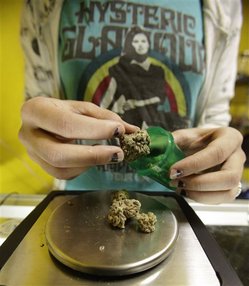
An employee places marijuana in a container for a client at the La Brea Collective medical marijuana dispensary in Los Angeles.
Associated Press
The lack of clarity hasn't stopped the popularity of the program among some Michigan residents, including those who have begun registering as patients and caregivers in Ann Arbor.Â
1. Applications received by the state in the 8 months ending Nov. 30 reached nearly 10,400, and on average, 66 new applications are received every day.
2. In Michigan, 5,873 patients are registered to use medical marijuana.
3. A total of 2,440 people are registered as caregivers, meaning they can distribute medical marijuana to registered patients.
4. More than 1,800 applications have been denied. The bulk were rejected due to incomplete paperwork, the state says.
5. Those eligible to become registered as patients and receive marijuana through the program must suffer from a debilitating condition that includes: cancer, glaucoma, HIV, AIDS, hepatitis C, amyotrophic lateral sclerosis, Crohn's disease, agitation of Alzheimers disease, nail patella or a medical condition that produces wasting syndrome, severe and chronic pain, severe nausea, seizures or severe and persistent muscle spasms.
6. The cost for applying as a patient is $100 - unless a patient can show eligibility in the Medicaid Health plan or receives Social Security payments. Those patients have an application cost of $25. It's not likely any insurers cover medical marijuana.
7. Registered caregivers must be older than 21, but no minimum age exists for registered patients. Those younger than 18 must get parent or guardian consent. The parent or guardian must be the registered caregiver for the minor.
8. There is no official state referral list of people who want to find a caregiver. If patients decide to change caregivers, it is their job to notify their caregiver they're no longer protected under the law.
9. Registered patients and caregivers can grow medical marijuana, but there is no provision that allows the program to provide seeds or starter plants and marijuana. The state does not define any legal provisions for acquiring the plants in the first place. State law doesn't protect registered caregivers and patients from being prosecuted at the federal level.
Tina Reed covers health and the environment for AnnArbor.com. You can reach her at tinareed@annarbor.com, call her at 734-623-2535 or find her on Twitter @TreedinAA.
Comments
sarah
Sun, Jan 13, 2013 : 7:21 p.m.
Marihauna oil is bet for me. I only need a tiny amount just to be able to move my joints and simple activities. I cannot get the oil because the places that sell the Marihauna bake everthing to get more money. so I say if the point is helping the chronic suffering vs money; so far I see a money making scheme. plus if you are diabetic, everything edible is full of sugar. I have a legal card to buy but I just want pain relief. I told the sellers, no hash or any other combinations. they gave me some strong stuff. I thought I was going to die. It does make me pull back and just do my best with Vicodin and deal in other ways because of the dishonest dealer's.
Blue Marker
Mon, Dec 14, 2009 : 3:23 p.m.
djm12652...I'm not a doctor and I don't even play one on TV. However, it's my understanding that the additives in cigarettes and not the tobacco it's self that do all the harm. I agree with you that it should be under the same rules as alcohol.
djm12652
Fri, Dec 11, 2009 : 3:17 p.m.
@treetowncartel-according to you Barry Bahama isn't enforcing "drug laws" but really isn't doing much of anything to enforce any laws...but sure can spend money that isn't his, kinda like my ex-brother-in-law...!
djm12652
Fri, Dec 11, 2009 : 3:11 p.m.
I don't get it...everyone is up in arms about cigarette smoke in bars...but isn't the smoke from marijuana bad as well? Please someone {not stoned} explain it to me...legalize it like booze is fine with me as long as anyone under the influence recieves the same treatment as a drunk driver. And if legal, would they be allow to smoke in a bar with a drink?
Arboriginal
Thu, Dec 10, 2009 : 6:39 a.m.
I have heard that RJ Reynolds has sought copyright protection on all of the common street names for pot. Once the tobacco lobby is ready....LOOK OUT!
ffej440
Wed, Dec 9, 2009 : 5:38 p.m.
You can pass all these laws that you want,the locals will restrict growing and treatment centers through zoning rules just like they are doing in California. I always thought as baby boomers aged things would change, but sadly the prohibition goes on.
Blue Marker
Wed, Dec 9, 2009 : 2:33 p.m.
Legalize it! I loved the comment about Pfizer, it's so true. If pot had a lobby it would be legal. The goverment dosen't mind you taking drugs as long as you're taking their drugs! Put a tax stamp on it and let's move on.
treetowncartel
Wed, Dec 9, 2009 : 1:43 p.m.
tdw, Obama and Holder are not enforcing federal laws with respect to people in states using medicinal marijuana. The same can not be said about Shrub and Ashcroft/Gonzales. If you recall, they were going after the dispensaries in California.
Marvin Face
Wed, Dec 9, 2009 : 1:35 p.m.
@LRF: Did you just say "I fail to understand why we can't think clearly and logically about marijuana laws in this country."? On an article about Marijuana? Hilarious! That's just awesome.
tdw
Wed, Dec 9, 2009 : 1:11 p.m.
what do Republicans have to do with it?AS far as I know its been illeagl under Democrats as well as Republicans for a long,long time
treetowncartel
Wed, Dec 9, 2009 : 12:39 p.m.
"Life, libert and the pursuit of happiness" I think the use is covered by the last two truths we as americans hold so dearly. people in the industry should be cautious though. Once the pendelum switches in Washington to a Republican administration they will probably start enforcing federal laws. Patient's and care givers are required to keep a detailed inventory of their hemp production and use under Michigan law, which will be exhibit number 1 in the federal prosecution. people in the wholesale and retail end of it will also face some conspiracy and other related charges for assisitng those growing and using it. What a shame it is, i highly doubt our founding fathers intended for hemp to be illegal for either smoking or as a textile.
tdw
Wed, Dec 9, 2009 : 12:12 p.m.
David Briegel Ok I'll agree with you this one time
actionjackson
Wed, Dec 9, 2009 : 12:06 p.m.
By the people, for the people... The citizens have voted Right?
David Briegel
Wed, Dec 9, 2009 : 12:01 p.m.
If Pfizer had a patent on it, it would be legal. Legalization would cut into the sales of Big Pharma's "legal" mood enhancers. Billy Tauzin would not like that one bit! tdw, if we were only "free"!
tdw
Wed, Dec 9, 2009 : 11:27 a.m.
Ok right wing haters be prepared for a shock.I too think many Marijuana laws are are pertty stupid.Marijuna across the board causes much less problems than alcohol.So I don't know why the gov'nt( who loves to tax ) does'nt just tax it,treat it like alcohol,make a ton of money and elimiate the illegal dealers
Blklight
Wed, Dec 9, 2009 : 10:49 a.m.
The first sentence in the #6 bullet point is incorrect as well
Anonymous Due to Bigotry
Wed, Dec 9, 2009 : 10:42 a.m.
1 marijuana seller for every 2 patients? LOL Yea right! This whole thing is silly. Not because there's something wrong with the idea of medical marijuana but because a huge amount of the medical marijuana is obviously going to go to general rather than medical use and everyone knows it. I'm feeling a little depressed.... Can it use it to treat depression? Why is it so hard to legalize this stuff? It's safer than alcohol. If what I've heard was true, it was originally made illegal because it was mostly smoked by black people and white people at the time thought it would cause black men to go around raping all the white women or something stupid like that. In the meantime we'll probably have more shootouts over in duplexes off of Plymouth road as more scumbags try to rob some guy who's got a massive wad of cash sitting under the bed from selling the stuff.
LRF
Wed, Dec 9, 2009 : 10:21 a.m.
The government wants to control everything else in our lives why haven't they jumped on this goldmine?
David Briegel
Wed, Dec 9, 2009 : 10:19 a.m.
Good posts Billy and Zollar. The "war on drugs" is just another defeat for our nation and a complete fraud and waste! The victims are a select few who are singled out for enforcement. A ten man swat team to terrorize an MS patient is foolish and borderline criminal! (this happened to a friend right here in progressive A2) There shouldn't even be the need for this bureaucracy. De-criminalize. Legalize!
LRF
Wed, Dec 9, 2009 : 10:17 a.m.
I fail to understand why we can't think clearly and logically about marijuana laws in this country. Here we are on the verge of financial collapse in this country and the legalization and control with taxation could remedy the financial problems practically overnight. It would also transfer the huge profits from the hands of illegal street dealers to the government thusly solving yet another huge problem. I just don't get it!!! Why don't our lawmakers wake up and smell the cannabis??
linuxtuxguy
Wed, Dec 9, 2009 : 9:29 a.m.
"seizures or sever and persistent muscle spasms." Forgot an "e" "sever" should be "severe"
zollar
Wed, Dec 9, 2009 : 9:27 a.m.
Perhaps its not the safest, but surely is less dangerous than many other legal/illegal drugs.(including alcohol)
wacky_walrus
Wed, Dec 9, 2009 : 8:50 a.m.
"Marijuana is the safest medicine ever in the history of mankind." I beg to differ.
billy
Wed, Dec 9, 2009 : 7:31 a.m.
An affirmative defense is also allowed by law. Marijuana is the safest medicine ever in the history of mankind. Side effects include happiness, lower blood pressure, an elevated sense of well being, increased appetite and a longer life span. The last three United States Presidents have used marijuana. End Marijuana prohibition now!!!!