

Traffic calming projects successful in Ann Arbor, but lack of funding has slowed program
More than a year after the city of Ann Arbor completed traffic-calming projects on four residential streets, the program has been successful in reducing speeds and winning the approval of residents, according to a new study.
But a lack of funding is slowing the program, according to Patrick Cawley, the city's engineer and project manager for traffic-calming projects.
Cawley said the city has about seven traffic-calming projects, which can include features like speed bumps, raised intersections and lane narrowing, in the works right now. But their implementation could be delayed because funding for the program has been reduced due to city budget cutbacks.
The city was able to take on a number of traffic-calming projects last year, but it had to tap both the 2008-09 and the 2009-10 fiscal year budgets to do so. The budget for traffic calming projects has since shrunk from about $50,000 to $21,900.
With a backlog of projects to complete, the city has stopped accepting applications from residents for traffic calming-projects in neighborhoods for now, Cawley said.
"We may need to fund them in a different way because I think the demand is still there," he said. "We still get calls on a regular basis about residential speeding problems."
Traffic-calming projects are initiated by a petition of residents in a particular neighborhood and require support from 60 percent of residents before a project can move forward.
Cawley said the city may start asking residents to pay a share or the whole of costs for future projects — possibly through a special assessment — as other communities have done.
Last year, the city undertook four traffic-calming projects on Maplewood Avenue, Devonshire Road, Gladstone Avenue and Jewett Avenue.
The results of a recent traffic study indicate speed reductions of 6 to 9 mph — to levels below the anticipated 30 mph (25 mph speed limit plus 5 mph).
The Maplewood project, between Packard and Oakwood, included three speed bumps and one raised intersection at a cost of $18,809. That reduced speeds from 30 mph to 22 mph.
The Devonshire project, between Londonderry and Arlington, included two speed bumps at a cost of $4,177. That reduced speeds from 31 mph to 25 mph.
The Gladstone project, between Packard and Independence, included one raised intersection at cost of $9,690. That reduced speeds from 31 mph to 25 mph.
The Jewett project, between Packard and South Industrial, included four speed bumps and one raised intersection at a cost of $16,720. That reduced speeds from 31 mph to 22 mph.
In addition to the speed study, city officials surveyed the residents in the project areas to find out how satisfied they were with the improvements. The Maplewood project received a 53 percent approval rating, while 35 percent of responders were dissatisfied. "Besides slowing down drivers, there’s a lot less traffic cutting through," one person wrote. "Humps not big enough. People still drive through too quickly," another wrote.
The Devonshire project also received a 53 percent approval rating, while 35 percent of responders were dissatisfied. "Need more speed humps. At least 3 more to prevent speed up after momentary slowing," one person wrote.
"They are a real nuisance when driving to & from work. Please remove. The cars do not drive any slower," another person wrote.
The Gladstone project received a 56 approval rating, while 41 percent of responders were dissatisfied. "It was a watered-down compromise that accomplished little. I think the city would’ve been better off not doing anything and saving the money," one person wrote.
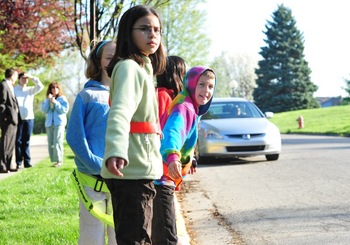
Crossing guards at King Elementary School wait for a gap in traffic before letting fellow students cross Waldenwood Drive earlier this year. Parents have been concerned about traffic issues in the area, but the city has not agreed it's a major problem.
Ryan J. Stanton | AnnArbor.com
"Raised platform is very low and does not slow cars very well," another person wrote. However, another concluded: "Major improvement."
The Jewett project received a 78 percent approval rating, while 22 percent of responders were dissatisfied. "The 'bumps' have been very effective. Thank you!" one person wrote. "I can get to my mailbox without getting run over," said another. Another called it a "waste of money."
Ann Arbor resident Susan Evett recently wrote the city to express her opinion on the improvements on Gladstone Avenue, which she called "completely unnecessary and a waste of government funds." She said a large percentage of her neighborhood showed up to discuss the project and there was "mostly anti-bump" sentiment.
"The city has FAR better things to work on (like simple road repairs) than attending ... the wants of a very few people on a 3-block street that is in no measure a 'cut-through' from anywhere to anywhere else," she wrote in her e-mail.
A list on the City of Ann Arbor's website, which appears not completely up to date, shows 17 traffic calming projects that are either completed or in progress.
Among the requirements for the city to undertake a traffic-calming project is that the average daily traffic must be at least 200 vehicles and no more than 4,000. Also, 85 percent of drivers on the street must be traveling at least 5 mph over the posted speed limit, and the street must not be a designated truck route or a primary emergency route.
Ryan J. Stanton covers government and politics for AnnArbor.com. Reach him at ryanstanton@annarbor.com or 734-623-2529.
Comments
just a citizen
Sat, Dec 11, 2010 : 11:18 a.m.
RE: Traffic calming goals (@ Ryan J. Stanton): "Prevent crime?" "Enhance urban redevelopment? Oh, please! Aren't we reaching a bit here? And "Reduce cut-through traffic?" Streets serve a purpose. They allow people to get from point A to point B. People seem to like that benefit. But apparently some residents really don't want cars on their streets. People - you can't have it both ways. If you are going to have streets, people are going to drive on them. Sorry, but that is the purpose of streets.
Ryan J. Stanton
Fri, Dec 10, 2010 : 11:07 a.m.
The goals of traffic calming are to: Apply physical, engineered measures to compel drivers to slow down and to decrease traffic volumes; Implement self-enforcing rather than regulatory measures; Reduce cut-through traffic; Increase the safety of children, pedestrians, bicyclists, and motorists; Maximize street life and pedestrian activity; Prevent crime; and Enhance urban redevelopment. http://www.fhwa.dot.gov/environment/sidewalk2/sidewalks209.htm
Plubius
Fri, Dec 10, 2010 : 10:55 a.m.
This story is a perfect example of getting that which is being measured. Anyone with two firing neurons would have been able to properly predict that the changes made to these streets would result in a reduction is speed. However, the speed at which vehicles travel these streets is completely immaterial. What matters is reduction in accidents, reduction in accident severity, etc. If, prior to these projects, there had been no accidents, then these projects were a total waste of money. If there had been accidents, then we should be told about the projects' effectiveness in reducing them. And, opinion polls are not data. To the AnnArbor.com reporters: Your job is to ask hard questions, not simply parrot your sources. Please start doing your jobs more effectively.
larjo
Fri, Dec 10, 2010 : 10:06 a.m.
I personally think that the calming methods are annoying and merely convert one street's problems elsewhere. However, if the majority of residents on a street wish to proceed in this direction and wish to pay the construction costs, I have no objections. I don't however feel that it is my responsibility (through taxes) to solve the problems of people that have voluntarily bought homes in an area where they have subsequently found some problems.
Mike
Fri, Dec 10, 2010 : 9:14 a.m.
Another example of wasteful spending. Takes money from needs and spends it on wants. And we wonder why we have a fiscal crisis. If I hear one more person say "it's only a small part of the budget " I'm going to explode.....
LarryJ
Fri, Dec 10, 2010 : 8:40 a.m.
These projects are done at the request of people who live on a particular street, usually a semi-major thru-street, but they work AGAINST THE INTEREST of Everybody Else who want to get from A to B, and against the interest of people on nearby streets who get more traffic instead. The project on Brooks, for example, was a waste of money that interferes; with proper flow of traffic. Any future projects of this type should require approval of Everybody Else, not just the people on that street.
Basic Bob
Fri, Dec 10, 2010 : 6:08 a.m.
For those that think you can drive over those monstrous humps at 25mph, well you should try it in an older car with worn-out shocks. It is a very harsh experience for both the vehicle and the people inside. Of course the city engineer drives a brand new SUV provided by the city so he wouldn't know. A better option would be to put one of those speed indicators along the side of the road so people realize how fast they are going. They put one up on my street for a few weeks and it made a difference.
just a citizen
Fri, Dec 10, 2010 : 12:18 a.m.
"Traffic Calming," like "Airport Security" is an opiate to make us THINK we are safer when we are really not. It is also a highly flawed, non-democratic, non-collaborative, non-neutral process, that can be initiated by as few as 30% of a neighborhood. It is a program where the city works closely with a "neighborhood liaison" (who is by definition a proponent), communicating with them regularly and by phone and email, encouraging, supporting and advising them in their efforts, but makes no effort to ensure that the "neighborhood liaison" is representing all views in the neighborhood. The city provides no open neutral public forum for neighbors to meet and collaborate with each other and city representatives to discuss problems and plan solutions. Traffic calming is a process where the solution is determined BEFORE the problems are even identified. It is a program that the city clearly wants to see implemented citywide, but doesn't have the guts to go tho the taxpayers and ask for money to carry it out. The process has clearly been designed to ensure that once initiated, IT WILL BE IMPLEMENTED, in some form, no matter how watered down. It is a process that even if rejected by the residents of the neighborhood, has a "second chance" built into the process to be sure that some form of "traffic calming" will be implemented. In effect, once 3 out of 10 of your neighbors initiate the process, you are going to have bumps in your street. And finally, Traffic Calming makes the highly questionable assumption that all neighborhood traffic safety issues are caused by speed. It the report cited in the article, even many of those who were satisfied with the program also said that it wasn't addressing all of their concerns, many of which were unrelated to speed. Does it make neighborhoods safer? Let me ask you this: Do you feel safer knowing that when a 5000 lb. SUV driven by a person talking on their cell phone and juggling a cup of coffee strikes your child, that they will be going at a nice safe 25 mph?
CynicA2
Thu, Dec 9, 2010 : 11:35 p.m.
"I personally think it's all a not-so-secret plot by our car-hating mayor. I honestly believe he would love it if Ann Arbor was "autofrei";-)" I agree! I wonder if the mayor even knows how to drive, or even has a license? Maybe when not riding his bikie his wife has to drive him around. He might be one of those folks that just can't get the hang of it - you know those folks who drive 5-10 mph UNDER the speed limit, or turn on their right turn signal, and then turn left across three lanes of traffic, leaving chaos in their wake, like Mr. Magoo. Ahhhh, Magoo, you've done it again!.
Dog Guy
Thu, Dec 9, 2010 : 10:52 p.m.
Traffic calming now means painting lines to smoosh two lanes into one--Ashley, Seventh, Stadium. Drivers brake for congestion and hazards--now declared another successful project. The city hall gang will vote itself another raise for a job well done. Ann Arbor considers common sense as too common for the highly degreed to consider.
AAJoker
Thu, Dec 9, 2010 : 9:35 p.m.
These projects are funny as: 1. They have very little effect on trucks and SUVs 2. They force the traffic onto other streets, that now will also petition for these measures. 3. They could be avoided with some activity from the AAPD, however it appears our traffic cops have completely checked out. 4. Ann Arbor has no clear plan for actually managing the traffic around the area. The lack of a structure light system on major roads makes it fast for people to shortcut and speed through neighborhood streets. I watch people speed the wrong way down a short section of one way road near Stadium and Packard all the time... but alas I have YET to see a cop in the area! (even when the traffic engineers set up a study)
Vivienne Armentrout
Thu, Dec 9, 2010 : 9:05 p.m.
"If you mean the speed bump between Miller and Hiscock then I like to take it at 35 -40 MPH." If that comment is serious, obviously the speed bumps didn't work, since the speed limit is 25 mph. Actually, I come to a full stop for that particular bump because it has a big pothole on its south side, which could take out an axle, or at least the suspension. The most obnoxious thing about the calming on Brooks is that ridiculous bump-out at Pearl. Some drivers understand it but for others one simply has to stop and wait until they have passed.
cibachrome
Thu, Dec 9, 2010 : 8:35 p.m.
How about getting som UofM students together and designing a special set of rumble strips that 'talk'? "Slow Down", or "Too Fast", or "Watch Out" or "Right Turn Only" etc. messages would be real Kool Aid for the calming crowd.
ToddAustin
Thu, Dec 9, 2010 : 8:20 p.m.
Not mentioned here is the Easy Street project, completed somewhat earlier. That work has been highly effective in reducing speed down this long straight residential street. The same outfit installed traffic calming measures on Ryan Drive in Dexter, which have been less effective. While drivers sometimes slow a bit near the park, they nevertheless speed down or up the hill, often back-cutting the roundabout and/or squealing through the corner at high speed. It's a continuing nightmare for those who live in this area. We need more efforts at traffic calming, not fewer.
rulieg
Thu, Dec 9, 2010 : 8:07 p.m.
"Clearly none of the complainers here live on residential streets where cars frequently exceed the speed limit by 20mph or more." actually, Ghost, I do. I live on a 3-block-long street that runs between Stadium and Pauline. snce Stadium's been under construction for what seems like most of this century, we get hundreds of cars on our street. and I'm still against these lame projects.
C6
Thu, Dec 9, 2010 : 7:59 p.m.
When there's nothing interesting to watch on late, late night television, I like to take my rusty, noisy old pickup with all the loose junk in the bed and drive a few laps over the humps at the posted limit of 25 miles per hour. Jewett to Packard, Rosewood to South Industrial, and then around again. Five or six laps is good fun, if I don't break a rear spring on the truck or a tooth first, and so much the better if it's a warm summer night when all the residents who asked for these calming humps have their windows open to be woke up and hear me having my fun. A load of a couple dozen broken concrete blocks makes a lot of noise as they stop being airborne after the truck has dropped down off the back side of a hump, but I've found that doesn't come close to comparing with the racket if I can find a load of old iron sewer pipe to give the truck ballast. Yee haw! And you know, if I make a complete stop at the stop signs and never exceed 25, it's all perfectly legal. It's usually pretty quiet at 2:30 in the morning in that neighborhood, but not always...
yohan
Thu, Dec 9, 2010 : 7:14 p.m.
BobbyJohn... Felch does not intersect Brooks. If you mean the speed bump between Miller and Hiscock then I like to take it at 35 -40 MPH. you hardly feel it. Yes there are people who come to almost a complete stop for such a timid bump, they are the same ones who vote a straight democratic ticket
rulieg
Thu, Dec 9, 2010 : 7:03 p.m.
"traffic calming" = "making it even more impossible to drive through Ann Arbor" in my opinion. is what they just did on Stadium traffic calming? they made a major 4-lane roadway into a 2-lane street with a turn lane. I can't wait for football Saturdays. and how about that boneheaded redesign by Busch's on Ann Arbor-Saline and Main? instead of leaving the lane so people could turn left into the shopping center, they took it out and put in a right-turn only lane where people can turn RIGHT into Busch's...which was never a problem. so now you have 20 cars lined up at rush hour because one guy forgot to pick up a loaf of bread on the way home. I personally think it's all a not-so-secret plot by our car-hating mayor. I honestly believe he would love it if Ann Arbor was "autofrei";-)
a2susan
Thu, Dec 9, 2010 : 6 p.m.
I think the speed bump at the stop sign on Independence and Gladstone is a joke. Instead of stopping, people just slow down to go over the bump. And contrary to what resident Susan Evett says, this resident thinks that our neighborhood is a huge cut-through from Washtenaw to Packard.
golfer
Thu, Dec 9, 2010 : 5:39 p.m.
yup you have to go slower when you put bike paths in. stadium went to a mess. you have to go slow so you know when it turns into one lane. the person should be fired for messing it up. you allowed enough room for two bikes side by side. i will bet you will see them outside the bike path. ann arbor changes so much for the few and lets the majority pay for dumb stuff.
BlueNever!
Thu, Dec 9, 2010 : 5:29 p.m.
Agree with @Brad, the Jewett project was a complete waste of money. The road surface was so poor and potholes so numerous, driving on Jewett required very slow traffic. The speed bumps actually improved the surface.
Z-man
Thu, Dec 9, 2010 : 5:21 p.m.
When our speed humps were installed, there were angry letters to the editor of Ann Arbor News complaining about how we must be connected to city hall on our street to have gotten these humps, since it just diverted more traffic to neighboring streets. While the traffic on our street is indeed slower than it was, I never considered speed to be a problem in the past. Now, noise is increased as drivers brake for the humps and then accelerate to the next one. Energy consumption is increased, and the increase in driving time, while minor, is a constant irritation. The effect on my car's suspension and shocks, however, is not minor. The raised intersection at the end of our block is sheer stupidity, since folks have to slow down anyway because of the stop sign there. Also, our humps had to be installed twice. The first time they were made too high, so they were ripped out and done over, doubling the cost. I seem to recall that our humps and raised intersection only cost the taxpayers about $20,000 each time they were put in.
a2grateful
Thu, Dec 9, 2010 : 5:12 p.m.
Pot holes... nature's way of calming traffic... the more bumps, the merrier...
Mumbambu, Esq.
Thu, Dec 9, 2010 : 4:47 p.m.
People do not stop at newly engineered speedbumps, save the hyperbole. We're not talking about the speed bumps on the Tyner lot. Just drive over the new ones at 25...you'll be amazed that it's not bumpy at all.
DrBob
Thu, Dec 9, 2010 : 4:46 p.m.
What a complete annoyance and waste these things are. They were installed on our street without ever polling all the residents affected. We really did not have a problem before; now we have people in near-collisions because they're not anticipating the person in front of them suddenly stopping mid-street for the bump, and occasionally you can see people who don't drive SUVs bottoming their cars on the bumps despite driving well below the speed limit. Anyone up for a class action suit for cumulative auto damage?
sbbuilder
Thu, Dec 9, 2010 : 4:37 p.m.
Let's see..... Why not penalize all drivers with ridiculous speed bumps, regardless if they are good drivers or not. Perfect example of lowest common denominator thinking. At the rate we're going, half the streets in this town are going to have 'calming' features on them. Enforce the doggone speed limit, and leave the rest alone.
David Cahill
Thu, Dec 9, 2010 : 4:20 p.m.
We got traffic calming on Broadway several years ago, and it has made a tremendous difference! It used to be common to have cars go 45 mph on our street, which has a 25 mph limit. Now traffic is much calmer. There was significant staff resistance to the whole concept of traffic calming, and they tried to rig the vote so that our particular project would not reach the vote threshold. It took the personal intervention Council member Bob Johnson to get an honest count.
foobar417
Thu, Dec 9, 2010 : 3:57 p.m.
@Bertha: The city FY2011-2016 Capital Improvements Plan, found here: http://www.a2gov.org/government/publicservices/systems_planning/capitalimprovements/Pages/CapitalImprovementsPlan.aspx, suggests it will be done in FY2012 - FY 2013. --Eric
CynicA2
Thu, Dec 9, 2010 : 3:36 p.m.
Complete waste of time and money. We need projects that make traffic flow more smoothly and efficiently - like well-coordinated signals, not impediments to traffic that only create more congestion, waste energy, and destroy taxpayers cars. Wake-up!
Hmm
Thu, Dec 9, 2010 : 3:36 p.m.
Amen to that Bertha great post!
mibadger
Thu, Dec 9, 2010 : 3:34 p.m.
@ BobbyJohn: The same can be said for the speed bumps on King George. Whoever designed those did not use a car in the simulation. Many people stop altogether before going over the speed bumps, and there is no way you can drive over them at 25 mph. This also applies to the ones on Jewett.
Bertha Venation
Thu, Dec 9, 2010 : 3:19 p.m.
Hey, is Ann Arbor EVER going to resurface Dexter Ave., between Huron and Maple? It's been in terrible shape for at least 20 years!! There's enough traffic that I think it warrants it. Let our fine Mayor drive in his car (NOT his bike) and see how his tires hold out.
a2grateful
Thu, Dec 9, 2010 : 3:14 p.m.
Radar guns, lasers, and traffic cam evidence for red lights and stop signs still seems to work, though... Maybe the mayor and council could cross train; )
BobbyJohn
Thu, Dec 9, 2010 : 3:12 p.m.
The speed bump on Brooks street between Miller and Felch is ridiculous. One has to slow to 5 MPH to not risk damage to ones car. I pointed this out years ago to Haymoun Pirooz (City traffic engineer) and he denied it saying one could go over it at 25 MPH. Some people even come to a complete stop. What a waste of energy and it creates extra pollution when speeding back up to 20-25 MPH. Money needs to be spent on fixing roads.
Brad
Thu, Dec 9, 2010 : 3:04 p.m.
You gotta love the "Jewett project". The speed bumps are far and away the smoothest part of the entire length of the street. And now that Jewett and Rosewood and King George are all "calmed", people just go down Pine Valley instead.