

Security or police? Unclear role at University of Michigan hospital contributed to child porn reporting delay
Their logos look similar to police badges, they've been known to tell people they're law enforcement —in fact, their website says they are— they conduct baseline criminal investigations and select 911 calls are routed to their headquarters.
Yet despite appearances, University of Michigan hospital security workers are not members of the school's Department of Public Safety.
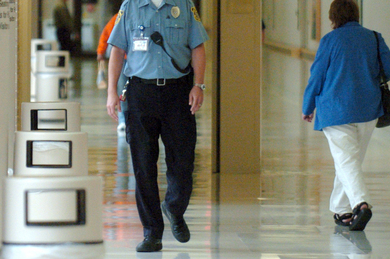
A hospital security official walks through a University Hospital corridor.
AnnArbor.com file photo
"To any observer it looks as if they’re part of the same organization," says U-M DPS Oversight Committee chair Richard D. Friedman, also a professor at the law school.
Confusion regarding hospital security's role and responsibility at the U-M Health System is pervasive, university officials say. That murkiness is one factor that led to a six-month reporting lapse in child pornography found in an employee area of University Hospital, a preliminary U-M review found.
"There was confusion about the roles of Hospital Security and DPS," the preliminary review states. "Hospital employees that reported the incident thought they were talking to police when they were talking with Hospital Security."
A medical resident who found a thumb drive containing child pornography and documents with 36-year-old pediatrician Stephen Jenson's name on them reported the discovery to security officials on May 24. Yet the thumb drive was not reported to police until six months later on Nov. 18. Jenson was charged with four counts of possessing child pornography on Dec. 17.
Although the university recently admitted that "confusion about the roles" contributed to the incident, hospital security's website continues to claim that it is a division of DPS.
"We are a full-service, 24-hour public safety department," the website says. "We are one of three divisions of the University of Michigan Department of Public Safety."
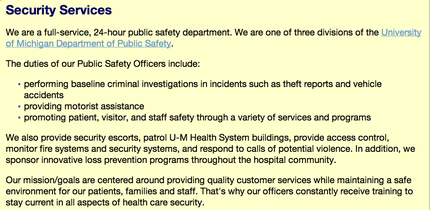
U-M Hospital Security website as of noon Tuesday.
Yet DPS spokeswoman Diane Brown says that security is not a part of DPS and staff is required to report all criminal activity to university police.
"They are a partner with us, but their reporting relationship is with the hospital and health center's administration," Brown said. "Crime is to be reported to the police."
University police investigate criminal activity at the health system and have the lone institutional authority to make arrests there. The school also reports crimes that occur at UMHS in its daily and yearly logs.
Comprehensive AnnArbor.com coverage
- U-M faculty members say child porn discovery 'fell through the cracks,' stop short of calling for external review
- U.S. Department of Education 'looking into' six-month lapse in reporting child porn at University of Michigan
- Hospital accreditation agency investigating complaint about U-M Health System's 6-month delay in reporting child porn
- University of Michigan faculty to discuss lapse in reporting child porn
- Timeline in University of Michigan child porn case
- University of Michigan regent calls six-month lapse in reporting child porn 'extraordinarily disappointing'
- Counsel who reviewed initial report of resident possessing child porn no longer employed by U-M
- Internal review into U-M Hospital's handling of child porn case to be done in weeks
- U-M Health System CEO calls delay in reporting child porn 'painful moment in our history'
- University of Michigan officials didn't report child porn to police for 6 months
- University of Michigan officials weren't required by law to report child porn to state
The unclear role of hospital security is further highlighted by the fact that 911 calls placed on UMHS grounds go directly to security headquarters and not university, city or county police. The university claims those calls are routed to hospital security because a large number deal with medical, not criminal, emergencies.
Brown says DPS is aware that people often confuse hospital security with DPS.
"We hear that quite frequently," she said.
Friedman agreed.
"It's often confused. Although on their website (hospital security) say they’re a part of DPS and DPS says 'Oh no they’re not,' " he said, noting that current security logos look similar to police logos. "It's unfortunate that there’s as much confusion as there is."
Since hospital security is not overseen by DPS, security is not subject to the oversight of an independent advisory board such as the DPS Oversight Committee, Friedman said.
U-M spokesman Rick Fitzgerald declined to comment why hospital security are often confused with university police, saying breakdowns in communication will become more clear when the university releases the results of an internal investigation. Fitzgerald did say that security officials are not deputized and do not carry deadly weapons.
"I don’t think that’s something I can answer for you," Fitzgerald said. "There are a lot of questions that are specific to the internal review."
Fitzgerald said he did not know the length and types of training security officials undergo.
Complete findings of U-M's preliminary review of the six-month child pornography lapse:
- There was not a clear line of responsibility for investigating the case. The Office of the General Counsel for the Health System ultimately took ownership of the case and determined that there was not enough evidence to continue the investigation.
- Hospital Security did not log the case in the system shared with the Department of Public Safety. If that had been done, DPS would have seen that there was a possible crime to investigate.
- MCIT (Medical Center Information Technology) reviewed the computer internal logs where the thumb drive had been seen and was able to determine who had accessed the computer. However, MCIT does not have the technology or training to do forensic investigation of electronic devices and, therefore, was not able to retrieve other relevant information such as thumb drive access.
- There was confusion about the roles of Hospital Security and DPS. Hospital employees that reported the incident thought they were talking to police when they were talking with Hospital Security.
Kellie Woodhouse covers higher education for AnnArbor.com. Reach her at kelliewoodhouse@annarbor.com or 734-623-4602 and follow her on twitter.
Comments
julieswhimsies
Wed, Feb 8, 2012 : 8:23 p.m.
It seems to me what it is going to take her is the equivalent of a military bomb-sniffing dog to straighten this mess out. The people with the PhDs, and the the quasi private police officers at the U and the blind and over-paid administrators can't see their hands in front of their faces. Call out the dogs!
BhavanaJagat
Wed, Feb 8, 2012 : 7:43 p.m.
Hospital Security is not the Problem: There is a justified need for University of Michigan Hospital System to have its own internal security system and protect its property, visitors, pateints, and staff. The DPS or AAPD must enter these buildings when contacted by Hospital Security Staff for specific reasons at specific locations. Any investigation by DPS/AAPD needs assistance from Hospital Security Staff who provide the necessary access to the site without impacting the welfare and well-being of others in the building. It is no surprise to note that Hospital Security employees earn more money as compared to the DPS employees. Hospital is a specialized Institution and we have to properly recognize its complex nature before letting Police to intervene in any matter that pertains to the Hospital. To my mind, the Hospital has responded properly and the action to close the case six months ago was proper and rational as no evidence of child abuse was witnessed by any person. If a doctor has a viewed an image using Hospital computer, the Security must be called to take possession of the flash drive immediately while it remained attached to that computer. The female resident made an illegal discovery and hence caused a problem in the disposal of this incident at that time. If an article is lost, if the ownership of an article is not known, do not open it and do not investiagate its contents. The Right thing to do is to notify the Hospital Security and ask them to take over the item and deal with the owner. Since the incident was not properly handled, the case got twisted and is getting undue attention. There is no need to fix the Hospital Security. If a thing is not broken, it is unwise to fix it.
julieswhimsies
Wed, Feb 8, 2012 : 10:19 p.m.
B. Jagat You make a fairly good point...albeit a bit wordy. However, I disagree strongly. Hospital "security" IS broken. U of M policies and procedures are broken. It is like a great big giant puzzle that has all the pieces, but they don't fit. Hire outside external investigators to to find out what heads should roll, and outside consultants to fix the puzzle.
sHa
Wed, Feb 8, 2012 : 8:10 p.m.
"Hospital is a specialized Institution and we have to properly recognize its complex nature before letting Police to intervene in any matter that pertains to the Hospital" So the police are called only if the Hospital's attorneys decide it is necessary to call them?
TaxPayer
Wed, Feb 8, 2012 : 6:15 p.m.
Agreed that it is not Hospital Security Officer's job to make a determination as to whether or not to pursue an investigation. This decision would be made by a supervisor within the department and the officer would be following orders. Also agreed that MCOLES determines who has arrest powers. Understand though that many of the Hospital Security Officers have the police training. There are officers who were MCOLES certified but because it is not a "police" job, lose the certification. Finally, Agreed that U of M DPS snubs their nose at hospital security. Security officers routinely have opportunities to make a lateral or promotional move to DPS. This never happens due to the "My Stick is Bigger Than Your Stick" mentality. I think it is funny timing that this was swept under a rug until after the new Motts opened. Now we are down to finger pointing. Shameful.
rinmem10
Wed, Feb 8, 2012 : 4:13 p.m.
All that is well and good and the confusion needs to be addressed and resolved, but the bottom line is this: The right thing was not done, period. UofM can spin this seven ways to Sunday, but they messed up. Acknowledge it, find a solution to fix it.
Trouble
Wed, Feb 8, 2012 : 3:29 p.m.
" Yada, Yada, Yada "... Just use some Common Sense!
newsboy
Wed, Feb 8, 2012 : 2:49 p.m.
Newspaper or .com? Their press pass looks like a real newspaper, and they've been known to tell people they are real journalists?
say it plain
Wed, Feb 8, 2012 : 7:19 p.m.
lol
lumdum15
Wed, Feb 8, 2012 : 2:27 p.m.
Kellie, Great job! How about researching and describing the proper course of action when a person suspects a child is being abused or neglected? The professional does not go to their supervisor, campus security, campus cop, A2 DPS. The person must report directly to CPS who is charged with this investigation. This report insures protection for the reporter's professional license and they will sleep well. Their employment maybe jeopardized. It takes conscience and courage. Courage and conscience like your job requires for instance.
Lee Higgins
Wed, Feb 8, 2012 : 2:33 p.m.
Hi lumdum, In this particular case, state officials said the resident physician wasn't required to report the incident to Children's Protective Services. Here's a link to the story we wrote on that: <a href="http://annarbor.com/news/crime/university-of-michigan-officials-werent-required-by-law-to-report-child-porn-to-state-1/">http://annarbor.com/news/crime/university-of-michigan-officials-werent-required-by-law-to-report-child-porn-to-state-1/</a>
Bricc
Wed, Feb 8, 2012 : 1:45 p.m.
I love how everyone runs for cover and leaves Security hanging out to dry. What poor leadership on the part of campus to distance themselves from an organization that provides many of the same needs as a police force.Seems like they would be on the same team. I guess you have to carry a gun to be effective. Maybe we can get Hospital Security charged with the Kennedy assassination. I also thought I read somewhere that the thumb drive was not located and they simply had a statement? Seems like that should be included in any article written about this....but that doesn't generate hits now does it Kellie?
Bricc
Wed, Feb 8, 2012 : 3:17 p.m.
I agree, it is not the Hospital Security officers job to decide what is pursued and what isn't.
sHa
Wed, Feb 8, 2012 : 3:01 p.m.
UM's attorneys had the statement of a Resident Doctor, thumb drive in hand or not, in May. They said "case closed". Six month later the very same statement of the Resident Doctor (still no thumb drive in hand) was enough for a search warrant. Ultimately, the General Counsel's office must answer for this delay.
Bricc
Wed, Feb 8, 2012 : 2:04 p.m.
Yeah i think it was found 6 months later, and then since they had some actual evidence it was pursued
sHa
Wed, Feb 8, 2012 : 1:53 p.m.
Wasn't an incriminating thumb drive actually found six months later in the doctor's work bag?
Carole
Wed, Feb 8, 2012 : 11:37 a.m.
Even though this is a very important situation, do we have to read about it every other day with not that much more information being added to the article. Sorry.
SW40
Wed, Feb 8, 2012 : 8:39 a.m.
I don't understand all the anger and disrespect being shown toward the UofM Hospital Security. As a police officer I've seen first hand the outstanding service the security officers at UofM and St. Josephs Hospitals provide. The blame here should be placed on General Counsel as well as the University of Michigan administrators who allowed this incident and incidents like this in the past. One of the issues here is that some believe security personnel from the housing and hospital security were pretending to be law enforcement this isn't the case; however many of the security officers at UofM have been allowed to serve in the investigations unit of the Police Department over the years and that is problematic. Trepass has continually mentioned a security officer who used the title "detective sergeant", I imagine he was a sergeant in the security department assigned to UofM Police's detective bureau, therefore he wasn't impersonating a police officer but he was definately misleading the public. It is important to realize that in law enforcement circles in Washtenaw County St. Joes security and UofM security are greatly respected and appreciated, that being said it is also widely known that UofM police were allowing civilian employees (security officers) to investigate crimes, this is a problem. Now i'm sure there were times where security officers did a fine job on investigations but the bottom line is they should have never been tasked with investigating criminal offenses. If anyone is hired as a security officer and one of their jobs is to investigate then obviously the officer is going to do his job, bottom line is UofM should have never told civilian employees to investigate anything. Stop blaming the security officers, the blame must fall on UofM administration and General Counsel. keep your eye on the ball people.
Arborcomment
Fri, Feb 10, 2012 : 1:47 a.m.
Sesame, The majority of our job was like that of any beat officer, the dented camry, lean cuisine stuff. Throw in the occasional altercation (hospitals are high stress areas), access control, writing incident reports (some of the last could also be considered "investigations" and you have the bulk of the shift you worked. I agree, there should be no reason why this should not continue. What's missing here is the occasional, and frankly, very rare major crime and/or felony investigation. We were not equipped or trained for it and as it has been exposed in this story, still had another issue with whom to report to or through. So, I agree baby and bathwater should not be tossed. How about a clear set of guidelines for when hospital security is out of their league (so to speak) and an initial report must be taken by UMPD and run through DPS and not Hospital Admin? Line drawn at Major Felonies? How about assigning ONE UMPD officer in the Hospital Security Office? How about doing away with consultations with hospital GC until after a determination that a warrant will or will not be requested? Lots of options need to be considered. As a previous article has used the "cracks" excuse, let's get them exposed and re-surfaced so this will not happen again.
Sesame45
Thu, Feb 9, 2012 : 11:43 a.m.
Arborcomment, since you seem to be an insider, I'm sure you know that hospital security handles more incidents than "somebody dented my Camry," but you seem determined to paint a certain picture. But then again, if door dings and stolen Lean Cuisines are the biggest problem at UMHS, they clearly don't need the police that badly. Excellent. This frees up the campus police to do the hardcore stuff, like patrolling the dark, gritty hallways of Angell Hall and handling out Minor In Possession tickets.
Arborcomment
Thu, Feb 9, 2012 : 2:54 a.m.
Seasame, there is a marked difference in handling investigations involving a scraped car in the parking structure or petty larceny compared to a major felony. As pointed out on the web page, they do "baseline investigations" and an explanation of what constitutes "baseline" needs to be fully explained - does it mean the first for all? - or does it mean "simple" like the examples provided? Also worth getting an explanation, is the disciplinary procedure for residents -is that where the reporting chain broke? Did OGC take the matter because it was a resident charged? Is there a difference in reporting requirements or procedures for residents and doctors compared to maintenance or foodservice employees?
Sesame45
Wed, Feb 8, 2012 : 10:49 p.m.
Hospital security should not stop doing investigations. There is no reason why a civilian can't use their available resources to gather information about an incident. Think of loss prevention departments all over the country. When a jewelry store employee is stealing from the vault, should the store's loss prevention department say "We're not police so we have no right to look into this"? Any civilian can gather information. And hospital security is good at that. They know the cameras, buildings, patients and their visitors, employees and their comings-and-goings, what areas have problems, what stuff tends to go missing, who always happens to be in the area when something goes wrong, who has been in trouble before, and a zillion other useful things that the police simply don't know because the police aren't in that environment 40 hours a week. They've had a lot of success. They make it easy for the police. Stopping hospital security investigations would be throwing out the baby with the bathwater, and making the police's job much more time-consuming and difficult.
Bricc
Wed, Feb 8, 2012 : 3:23 p.m.
No one is trying to impersonate anything, they are there to help, and that is it. The uniform is designed to be a recognizable source of help and to establish a visual presence to deter problems.
Matt Cooper
Wed, Feb 8, 2012 : 2:04 p.m.
In a previous post I offered you the California statue that specifically states what constitutes a charge of 'impersonating a police officer'. Although I couldn't find Michigan's, I'm sure it is very similar. Calling ones self, in the context of their job, "Captain", "Lieutenant", "Sergent, "Corporal", "Major" or any other military ranking is not in fact a criminal offense and is not in any way 'impersonating an officer' unless one commits specifict acts in order to convince someone that they are specifically a law enforcement officer. Claiming over and over again that this is a crime (absent significant other actions) doesn't make it true. Please study up on the laws before thinking you know what you're talking about. I worked as a security professional for years, both in a hospital and other areas, and know very well and firsthand what I'm talking about.
trespass
Wed, Feb 8, 2012 : 11:35 a.m.
What is the difference between misleading the public and impersonating a police officer? If a member of the public is purposefully mislead into believing you are a police officer, you are impersonating a police officer. It is no different than the guy who has police lights in his car and pulls you over and says I am officer so and so. The problem with hospital security is that they do whatever they are told by their bosses and are not responsible for protecting the rights of the public. Unfortunately, that is also sometimes the problem with campus police.
coxie1
Wed, Feb 8, 2012 : 7:57 a.m.
"Yet DPS spokeswoman Diane Brown says that security is not a part of DPS and staff is required to report all criminal activity to university police." Diane Brown (and Annarbor.com) - Where are you getting this information? Have you looked at your website ever? Below is the exact text taken from the University of Michigan Police Department website, the very first paragraph on the 'About the Department' page: "The University of Michigan Department of Public Safety (DPS) is a full service law enforcement agency. DPS Police Officers are licensed by the Michigan Commission on Law Enforcement Standards (MCOLES) and have the authority and responsibility to investigate, search, arrest and use reasonable force as necessary to protect persons and property and to enforce the laws of the State of Michigan and the Ordinance of the Regents of the University of Michigan. To provide comprehensive parking enforcement and crime prevention, DPS also employs Parking Enforcement Officers, Communications Officers, and Public Safety Officers who are not licensed to have the powers of arrest, but who do have specialty training in their areas of responsibility as well as first aid, CPR and the use of Automatic External Defibrillators (AED). University Police and Public Safety Officers patrol campus buildings and grounds, Housing Security officers specifically patrol residential facilities and Hospital Security Officers specifically patrol Hospital facilities." The last sentence of the first paragraph clearly states that PSO's are part of the DPS department. The next sentence identifies Hospital Security as Public Safety Officers. So, are the campus police ignorant toward the different divisions of their department, or was there an overnight restructuring of the department and campus police forgot to inform their employees?
Matt Cooper
Wed, Feb 8, 2012 : 1:53 p.m.
Nowhere on the website say they are the same department, nor does it claim they are in any way a law enforcement entity. Did you read the article? Or see the website image as posted with it? It specifically says "We are one of three divisions..." of the department of public safety.
trespass
Wed, Feb 8, 2012 : 11:38 a.m.
Actually, it is the website that is misleading. If you are the same department, you would have the same chain of command but the chain of command for the hospital security is throught the CEO of the Hospital, Doug Strong.
miscreant32
Wed, Feb 8, 2012 : 8:06 a.m.
I'll take ignorant for a thousand Alex.
miscreant32
Wed, Feb 8, 2012 : 7:09 a.m.
PA 330, see the following for a link, <a href="http://www.legislature.mi.gov/(S(3tovbs55b1jkdqnhmalz4y2x))/mileg.aspx?page=getObject&objectName=mcl-338-1080" rel='nofollow'>http://www.legislature.mi.gov/(S(3tovbs55b1jkdqnhmalz4y2x))/mileg.aspx?page=getObject&objectName=mcl-338-1080</a> would be beneficial here. The officers that are there are college educated, trained and professional and could easily handle these additional responsibilities even without the need for any weapons so why has this been blocked everytime that it has come up in the past? Off the top of my head, I believe Sparrow Health system has this act and I am pretty sure DMC has it to some extent if I am not mistaken so why can't the UM Health System. There is a stigma attached to the security industry in general, I saw it firsthand but the only difference between the security at the health system and the cops I know is being sworn and receiving different, not better, types of training specific to the unique challenges, do you really want police tazering or laying out your loved on with dementia or a loved one with a psychiatric issue because they refused to "comply." I think that would provoke a lot of nasty annarbor.com comments.
Tru2Blu76
Wed, Feb 8, 2012 : 3:41 a.m.
The "security force" to those who know the distinction, is never "the police." Never! Problem is: the confusion is caused (as the article points out) by the poor thinking of those who create such "security forces" wherever and whenever they exist. The proper role of a "security officer" is just to observe and report - either to superiors up "the chain of command" or directly to: real police departments. Direct observation over a long period showed me: people can openly disregard a 'security officer' and be completely "legal" and within their rights. OTH: such disregard can create risks to others and to oneself. So those officers can and will report any such incidents (particularly the smart ones who don't want to end up the subject of a pre-emptive "citizens' complaint." ) If someone calls 911 to report a fire extinguisher missing from its place: that indeed will be handed over to available "security officers" for "baseline investigation." The usual report coming back will be: "Yep, its missing." That U of M maintains its own "security force" is not the usual way: this scheme actually provokes the employer (U of M) to try to inflate the role of such officers. Often those "officers" are provided by an outside contractor. Even the federal government uses outside contractors - even at the atomic test site in Nevada. (Now try to imagine such officers riding around in a machine gun equipped Jeep in the desert.) Short version: U of M isn't handling this right.
Kai Petainen
Wed, Feb 8, 2012 : 3:34 a.m.
a couple years ago, i remember visiting the hospital and looking for the hospital security. i found them and tried asking about an incident. they knew about the incident. as i was about to get more information, a senior security person walked into the room and quickly broke the conversation and told me that i had to speak to the DPS about it. they weren't willing to tell me any more info. a while would pass, and dps was kind enough to organize a meeting with me, and a bunch of directors at the UofM. in that meeting, most would listen to what my concerns were. i was thankful of the dps for organizing that meeting, and for the person who arranged it. now, i have a lot of respect for some in that room (especially the one who organized it). one of the folks even thanked me for telling my story and gave a business card -- that person demonstrated true professionalism. however -- one person quickly left the meeting without saying bye or listening to what i had to say. the person who stormed out of the meeting, was a person who was representing the hospital. they got mad and quickly walked out. it reminded me of a child pouting out a door. in otherwords, that person from the hospital lacked a skill in commnication. they wouldn't listen to my concern and they left. from that point onward, i started paying a bit more attention to the hospital, as they had demonstrated unprofessional conduct in listening to concerns. the others who were in that meeting would listen, and i think they actually implemented some of the concerns that i had. so when people talk about the hospital communication problem.... i don't know how problematic it is, but from my (one sample) experience, the hospital did not reflect themselves in a good manner at that meeting. it was a serious matter, but from their reaction, they could have cared less.
Sallyxyz
Wed, Feb 8, 2012 : 3:31 a.m.
Look, in the end, this whole matter will be swept under the table, in usual fashion. Do you really think a large institution like UMHS will actually admit culpability in a case like this? It's no different than Penn State in that regard. UMHS and their elites and PR machinery will spin this as a failure of the "process." No heads will roll.
sHa
Wed, Feb 8, 2012 : 7:09 p.m.
@Bricc - Since you seem to have the inside information, whose head in the General Counsel's office was that? And what was the real reason for that person's leaving the General Counsel's office? In other words, why is the attorney who first reviewed the incident no longer there? Did he mess up? Was he/she working alone? Were his/her supervisors in on it? Is he/she the scapegoat for the General Counsel's office? I think there are more than a few of us who would like to know the real reason that that attorney is no longer there.
Bricc
Wed, Feb 8, 2012 : 6:51 p.m.
a head already rolled, you should be satisfied now
trespass
Wed, Feb 8, 2012 : 11:51 a.m.
Only because the Board of Regents allows them to get away with this stuff. The Board is elected and we keep re-electing incumbents no matter how poorly they do their job. Maybe this is why the two incumbents decided to "spend more time with their family" this time around.
Sallyxyz
Wed, Feb 8, 2012 : 3:27 a.m.
How ludicrous is this "confusion"? Here you have a world class health facility that can't sort out the reporting structure for their security department, its relation to the Department of Public Safety and the university police. ************* Although the university recently admitted that "confusion about the roles" contributed to the incident, hospital security's website continues to claim that it is a division of DPS. "We are a full-service, 24-hour public safety department," the website says. "We are one of three divisions of the University of Michigan Department of Public Safety." Yet DPS spokeswoman Diane Brown says that security is not a part of DPS and staff is required to report all criminal activity to university police. ********* Sure hope they are better at sorting out how to do heart transplants than they are at sorting out their security reporting and accountability issues.
say it plain
Wed, Feb 8, 2012 : 2:51 a.m.
This is a little bit of a red herring, isn't it?! I mean, the critical thing is almost totally contained in the sentences about how "the Hospital General Counsel's Office ultimately took ownership of the case". It was wrong for that Office to not report it to police. It is just too convenient a story that the person who allegedly 'closed it' no longer works for the U.
nunya
Wed, Feb 8, 2012 : 2:34 a.m.
Every hospital I have seen has security. Not sworn law enforcement personnel. The hospital, most of which are private independent organizations, bears the cost and responsibility of providing a safe environment. This usually includes some level of security. It would be inappropriate for a private business to be afforded the protection of dedicated law enforcement staff. We'd all be up in arms over the cost to tax payers if the police staffed every establishment that might have a need (think of every bar in the county). So, why should U of M hospital be any different? This same story could apply to any business. An employee reports possible illegal activity and the employer investigates. Or, the employee reports it to the police and the police investigate. In this case, the employee reported it to her employer. Who is suppose to report a crime to the police? We know that hospital security could have but didn't. We know that hospital legal staff could have but didn't. We know hospital IT staff could have but didn't. We know the resident who found it could have but didn't. I don't expect the investigation will strive to find who to hang from the flag pole. It should serve to establish a strict protocol for any of these types of events. Something that is clearly lacking in the hospital policy (and possibly the entire University). I'll close in recognizing that U of M hospital security is an award winning organization. They have excellent staff that is well respected in the security industry. Many employees are former law enforcement officers. Others have advanced training and certification. They specialize in the unique and challenging hospital environment. I have no doubt that they do a superior job or providing a safe place for visitors and staff.
Sesame45
Wed, Feb 8, 2012 : 3:48 a.m.
Public Act 330 would be a nice answer to this.
Kai Petainen
Wed, Feb 8, 2012 : 3:21 a.m.
i don't think all of them have to be real cops -- but, at least one person... the supervisor, should be. the hospital could easily afford that.
trespass
Wed, Feb 8, 2012 : 2:51 a.m.
But they still have a boss and they do what the boss tells them to. That is why they are not a profession but rather skilled labor.
Ron Granger
Wed, Feb 8, 2012 : 2:26 a.m.
So they think they are the "secret police", with similar powers but none of the formal accountability. How interesting.
UtrespassM
Wed, Feb 8, 2012 : 1:52 a.m.
This is very true, the health system is a very unique city with a very unique population governed by the ELITES who believe that only them are valuable. Patients, they are not much different as the mice in the lab.
Tom Joad
Wed, Feb 8, 2012 : 1:32 a.m.
The resident physician who discovered the thumb drive had every obligation to report having discovered evidence of child pornography to the UM Police. As reported she discovered the the graphic child pornographic image/s and a document with the owner's name. Why did she leave it in the computer and not immediately report the find? Stephen Jenson then recovered the drive and spirited it home, possibly not knowing that it had been accessed? As I understand it a physician is under legal obligation to report any child abuse to authorities in the performance of his/her medical work. It would seem that the look-the-other-way mentality started very early in this case.
trespass
Wed, Feb 8, 2012 : 12:20 a.m.
The employee right to know act says the following; 423.509 Investigation of criminal activity by employer; separate file of information; notice to employee; destruction or notation of final disposition of file and copies; prohibited use of information. Sec. 9. (1) If an employer has reasonable cause to believe that an employee is engaged in criminal activity which may result in loss or damage to the employer's property or disruption of the employer's business operation, and the employer is engaged in an investigation, then the employer may keep a separate file of information relating to the investigation. Upon completion of the investigation or after 2 years, whichever comes first, the employee shall be notified that an investigation was or is being conducted of the suspected criminal activity described in this section. Upon completion of the investigation, if disciplinary action is not taken, the investigative file and all copies of the material in it shall be destroyed. Thus, if the General Counsel was conducting a criminal investigation and decided that there was not enough evidence they would be required to tell Dr. Jensen about the investigation and destroy all copies of evidence it collected. Obviously we are glad they did not destroy their file but this points to the fact that the General Counsel did not really treat this as a criminal investigation. Does the fact that they did not follow this law affect whether or not the search warrant is valid?
Joe Kidd
Wed, Feb 8, 2012 : 12:01 a.m.
My guess is that once the final report is made they will recommend training for Hospital Security and maybe UMPD too. Whenever there is some issue involving police, they always need training whether or not they are the problem or not.
a2citizen
Wed, Feb 8, 2012 : 2:13 a.m.
Joe, The UMPD training should include instructions to call the general counsel daily to see if any child porn was discovered on a hospital computer.
Spyker
Tue, Feb 7, 2012 : 11:17 p.m.
The hypocrisy is astounding! JoPa reported hearsay evidence to both his Administrator and the Head of Campus Security within 24 hours after receiving a sanitized version of events witnessed by another person. He is then crucified in the Press and public comments because he did not report it to the Police also, and because he had the audacity to assume the responsible parties to whom he did relate the information would act appropriately. Here we have a situation where physical evidence is discovered, the situation is not reported for six months, and yet somehow this is OK because Hospital Administrators were "confused" as to which agency should be contacted?
Kai Petainen
Tue, Feb 7, 2012 : 11:10 p.m.
So the hospital has "mall cops" who have poor communication skills. Is this not a disturbing symbol with regards to public health and safety? Especially at a world class hospital? I expect better. I am a huge fan of UofM and I want to see it improve and lead each day. How do you market a world class hospital and tell everyone that you have mall cops? It sends the wrong message. This past weekend I was in Sault Ste. Marie, Ontario. I was visiting their new hospital. It's not as big as UofM and it didn't cost as much, but it is new. Do you know what is located directly beside the hospital? A real police station. And if I stop to think, then it's quite common to have a police station located near a hospital. This happens in a lot of towns. It's a symbol of health and safety. But, if public safety is supposed to be symbolized by a police station and that symbolizes priorities.... ... then where did UofM place their police station? Beside the football field. When most cities place their police by city halls and hospitals, UofM has it by a football field. Look... if the hospital wants to improve it's image, then it needs to concentrate on public safety. If it builds a parking lot beside the river and destroys a park, if it cannot solve the oil/(acid?) spill that ran through its territory, if it declines to have an external review... Have an external review, concentrate on public safety, fix the poor communication (I complained about this long time ago and so I'm sad to see that this wasn't fixed) , get a real police officer (DPS or city), stop the fuller parking lot and solve that spill.
Sesame45
Wed, Feb 8, 2012 : 2:39 a.m.
Hospital security staff handle a lot of weird and scary situations that you will never see at The Gap. The "Mall Cop" comparison isn't accurate, but then again, it is usually intended as an insult and not an actual comparison. I think it is usually made by cops or cop-groupies. As far as I can tell, the gist is, "Ha ha, they can't shoot or arrest anybody and the 'real police' can." Police only respect police. I've found that it doesn't matter if it's security in an embassy, a mall, an airport, a missile silo, a bank, wherever, or how much specialized training the security's had- almost any cop will immediately (and wrongly) assume that their 12-15 weeks in academy automatically trumps security's specialized training and experience in any environment.
Kai Petainen
Wed, Feb 8, 2012 : 12:34 a.m.
good point. My apologies on the word choice. I know some mall cops too. Im not in security, but I know well enough to call911 and not wait 6 months.
Joe Kidd
Wed, Feb 8, 2012 : 12:05 a.m.
And I mean demeaning to people who work in security at malls too
Joe Kidd
Wed, Feb 8, 2012 : 12:04 a.m.
I have to disagree with you on this. I have been to the hospital numerous times, had lots of interactions with Hosp Sec and overall they do not fit the description you put up here. "Mall cops?" That sounds a little demeaning to me.
justcurious
Tue, Feb 7, 2012 : 10:26 p.m.
"That murkiness is one factor that led to a six-month reporting lapse in child pornography found in an employee area of University Hospital, a preliminary U-M review found." This is not the cause of the incident not being reported. The problem was that the Office of the General Counsel decided it did not merit investigation or reporting to law officials. The attorney that was dismissed is used as a scapegoat because they would not have been the only one in that office to have known about it. They would have checked with a superior. Who was that superior? MyOpinion has it right, though I don't recall that the person who left was a paralegal.
trespass
Wed, Feb 8, 2012 : 12:53 a.m.
The only one who can force them is the Board of Regents. There is an election this fall. Make the candidates promise to get to the bottom of this if it has not been done by the time they take office.
sHa
Tue, Feb 7, 2012 : 10:59 p.m.
When is the UM going to talk about the General Counsel's involvement ? Probably not going to happen, unless they are forced to. Easier just to blame it on "procedural confusion"...
mohomed
Tue, Feb 7, 2012 : 10:01 p.m.
The UM Michigan Police greatly dislike UM Hospital Security and vice verse. It's always been a major power struggle. Ask any UM Police Officer about having to be the "Charles" unit (Covers the hospital on patrol) or brass within UM Police. The UM police are extremely well paid and can't stand Security Guards who all have bachelor degrees or higher and are basically just as qualified as them in every aspect of the criminal justice system. UM hospital supervisors make a lot of money too (the hospital security director makes well over 6 figures and she doesn't have to take orders from DPS either). Hospital Security has been trying for years to get PA330 so hospital security can get arrest powers at the hospital but DPS is strictly against this and stops it every time they try. That puts peoples lives (and child porn reporting) in jeopardy having to wait for UM Police who hate hospital security to respond to many incidents in the hospital. UM Police will use this opportunity to throw the Security Guards under the bus. UM police don't understand that the real police in Washtenaw are the Ann Arbor PD and Washtenaw Sheriff in Ann Arbor (Ann Arbor PD and UM Police don't like each other either). I don't know how the top out rate for a UM regular Police officer is about $80,000 a year.
Matt Cooper
Wed, Feb 8, 2012 : 4:23 a.m.
Ummmm...MCOLES regulates who in the state of michigan has the power to arrest, at least in terms of Michigan police officers. Not the U of M DPS. In order to have legal power to arrest you must be an MCOLES certification.
mohomed
Wed, Feb 8, 2012 : 1:45 a.m.
I'm using generalization Mr. Joe Kidd. As for facts, I worked for years at the hospital and know my generalizations to be fact. Sorry there is no quantitative or qualitative published research data to support my "blatant accusations" though.
miscreant32
Wed, Feb 8, 2012 : 1:39 a.m.
Agreed, hate is a strong word, following the status quo is probably more accurate. UM police will never be in "charge" of security of the health system, it will not happen period. This is not a knock against the police but the unique population and the expectations of that unique population (patients, staff, visitors, etc.) require a different level and type of training that police just do not recieve nor would they be used to handling. It is strictly about wanting the money from the hospital budget. If Security were to be totally separate and not report to UM police but only Washtenaw and AAPD. UM police's call volume and report volume would shrink significantly to the point that jobs over there would be in jeopardy.
Joe Kidd
Tue, Feb 7, 2012 : 11:58 p.m.
It was not always that way. If you are implying the issue is with upper management at one dept or the other or both you may be on to something. I think it not appropriate to lump the entire PD as "hate hospital security." Also, I suggest you do not make blatant accusations like this without putting up some specific facts. I am not saying there is not a problem but to put up such strong accusations you should put up some proofs.
average joe
Tue, Feb 7, 2012 : 11:06 p.m.
It would appear by what you say that the two departments at the U/M put the public at risk in this case, and maybe it is time to get rid of all this petty bickering & go back to only one Police dept within the city limits, with city police monitoring the hospital too.
a2citizen
Tue, Feb 7, 2012 : 9:58 p.m.
I'm still waiting for the general counsel who decided "there wasn't enough evidence" to be publicly identified.
MyOpinion
Wed, Feb 8, 2012 : 2:09 a.m.
Earlier report said that person no longer works at the university - left in June 2011. However, I can't believe this unusual case didn't percolate in the GC office. That lowly attorney is not the only one in the GC office who knew of this.
Mick52
Tue, Feb 7, 2012 : 9:51 p.m.
Nope, I do not buy this, sounds like a whitewash to me. It does not matter anyway this argument does not make sense. I can't imagine that people at the hospital do not know that hospital security is just that a security agency. Sure they have uniforms and badges but no firearms. When you call do they say "hospital police," "DPS," no, they say, " Hospital Security." The person who found the thumb drive might be a new employee and not clear on the distinctions, but I find it hard to believe that the other people who became immediately aware of this incident soon after also are blurry on the set up of hospital security and DPS. Another reason I cannot buy this is that the issue arrived at the attorney's office and that is where the final decision was made to not forward this to DPS. That is a big question here, why and how did end up in the attorney's office? And the excuse, "There was not a clear line of responsibility for investigating the case. The Office of the General Counsel for the Health System ultimately took ownership of the case and determined that there was not enough evidence to continue the investigation," makes absolutely no sense at all. That implies that the GC does not know that use of the computer before the drive was discovered cannot be determined? Nonsense. Also that is not the GC's decision to make. And the info on MCIT looking into it? Well that appears to be evidence in an of itself to continue the investigation. But it ends because MCIT can't do forensics. Balderdash. I can't believe MCIT does not know DPS can do that. The question to be answered is, Why didn't Hosp Security report this to DPS? I do not see that here. If this is preliminary report findings they better withdraw it and start over with someone who knows how to investigate an incident.
trespass
Wed, Feb 8, 2012 : 12:47 a.m.
If you look at the organizational chart for the security services, it does not go through the General Counsel's Office. The Director of Hospital Security reports to the Associate Director for Operations and Support Services who reports to the Hospital COO who reports to the Hospital CEO who reports to Ora Pescovitz who says this is a painful moment in our history. I hope it is a painful moment in her history
average joe
Tue, Feb 7, 2012 : 10:56 p.m.
"....Also that is not the GC's decision to make." And most importantly, the GC absolutely knew that they were not the one's to make that decision, but for some reason chose to to anyway.
RJA
Tue, Feb 7, 2012 : 9:40 p.m.
You certainly can't blame the Police Department for what security does/does not do for the hospital. UM needs to hire trained police officers, when a crime is committed, you always call for POLICE not security. Hospital staff should call the police on a timely basis also.
nickcarraweigh
Tue, Feb 7, 2012 : 9:31 p.m.
Many people lust to exercise authority over others, which is one reason there are so many law enforcement organizations in the first place. Surely, there is room for one more. Given the tight confines of the hospital itself, however, with its miles of narrow hallways and often dicey cellphone reception, some allowances must be made. Arm them with shotguns loaded with slugs, rather than pellets, and give the parking structure police high-powered tasers to lessen the chance of damage to the doctors' Mercedes. Also, confine the waterboarding, clinical surgery trials and other special interrogation tools to the basement.
miscreant32
Tue, Feb 7, 2012 : 9:28 p.m.
Having read a lot of these articles and comments and with working hospital security in the past, I just wanted to stick up for the rank and file who I am sure are having a hard time dealing with this and who are no doubt getting grief. The security officers were a member of the same union as UM police and the UM housing officers, my understanding is that all three constituted the Department of Public safety (as the article states) with UM police being the only sworn officers. How the chain of command worked on the senior management side and how the specifics of the umbrella worked I can't honestly tell you. I think a lot of people think that because they are security that they are dumb high school dropouts or if they are a lucky they have a GED. This is not the case, when I was there and which I am assuming is still the case, the overwhelming majority had Bachelor degrees or higher and the amount of training received was intense. It was a good paying job with great benefits that opened the door for people like myself to move on to other agencies and departments Does UM police want the security jobs, I am assuming not, I do not think they would want to do what we did at least when I was there, though I did believe and still do that they want the hospital budget and numbers to justify hiring more officers and paying the salaries that their officers are fortunate enough to get. Yes, the health system is like a small city but it is a very unique city with a very unique population. I am not sure what happened here as I don't think all of the facts and who knew what when have been released and maybe they never will but if they are I would not be surprised if some more bombshells come.
Matt Cooper
Thu, Feb 9, 2012 : 2:08 a.m.
You apparantly didn't read the statute trespass. Either that or you're simply cherry picking your information. The statute I gave you says nothing, not a word, about using 'detective' or 'sergent', or of the use of these titles to be a crime. Matter of fact, there is no statute anywhere that does, and if you're so convinces it is a crime to use them, cite me a law. The Cali. statue says: (a) Any person other than one who by law is given the authority of a peace officer, who willfully wears, exhibits, or uses the authorized uniform, insignia, emblem, device, label, certificate, card, or writing, of a peace officer, with the intent of fraudulently impersonating a peace officer, or of fraudulently inducing the belief that he or she is a peace officer, is guilty of a misdemeanor. Sectiond B, C and D go on to mention uniforms, badges, etc. without a single word banning the use by civilians of titles. Don't believe me? Fine. Go to the Ann Arbor police info. desk. Ask them. Go to the WCSD info. desk. Ask them. Fact remains: You are wrong.
Kevin McNulty
Wed, Feb 8, 2012 : 6:32 p.m.
Having worked at UM DPS for 28 years I have to support the statements made by Miscreant32 and Arborcomment. I do not know if either of them knew me, but I worked with UM Hosp for all those years and I had no issues with them and got along well many of them. That is how you get things done, good relationships. I do know one thing, they do a very tough job. Many serious incidents have occurred at the hospital including murder, and one kidnapping of a baby from Mott Hospital. They also assist with patients who are combative, patients in the hospital who have people who want to do them harm, drug abuse, a high rate of theft and so on. They have to work with the police but they perform a lot of tasks that assist with safety and security. I myself as a detective handled many major cases and had no interference from Hosp Security or the hosp administration. But that was then, I certainly cannot speak for this incident. Trespass is just plain off the mark and I think a little insulting with his claim of impersonating a police officer. I am sure I know who the detective is he is referring to and that detective/officer, call him whatever you wish, did a great job. In Michigan impersonating an officer requires you falsely identify a police officer while performing a task only a police officer can do by statute, and that was never the case with this work. Saying you are a detective sergeant is not impersonating a police officer unless you do something only a police officer can do by law.
trespass
Wed, Feb 8, 2012 : 12:01 p.m.
@Matt Cooper- You couldn't be more wrong. The California law that you provided states; "or of fraudulently inducing the belief that he or she is a peace officer". That is exacty what Detective Seargent so and so did.
Matt Cooper
Wed, Feb 8, 2012 : 4:18 a.m.
trespass, you couldn't be more wrong. Private security companies and other paramilitary companies use military style rankings all the time. I myself, years ago, was a hospital security supervisor at Beyer hospital in Ypsi (now a bariatric treatment center) and my official company title was Lieutenant. Secondly, the crime of 'impersonating a police officer' has nothing whatever to do with what a security officer's ranking is. If you care to open your mind a little, check out <a href="http://law.onecle.com/california/penal/538d.html" rel='nofollow'>http://law.onecle.com/california/penal/538d.html</a> for more information as to exactly what "impersonating a police officer" really is.
Sesame45
Wed, Feb 8, 2012 : 2:05 a.m.
The website calls hospital security staff "public safety officers", which is different from "guards". I think a "guard" is a different type of job classification.
trespass
Wed, Feb 8, 2012 : 12:35 a.m.
@miscreant32- You may not have known him but there was a security guard who worked with the DPS detectives who introduced himself as "Detective Seargent" for years. DPS knows about this and they role their eyes when I mention him but no one ever took him to task for impersonating a police officer. Security guards cannot use ranks that are usually reserved for law enforcement.
miscreant32
Wed, Feb 8, 2012 : 12:20 a.m.
In regards to the union comment, the point was that security is part of the Department of Public Safety. Again, I don't know what all "reporting" procedures are but the patches for security said Department of Public Safety for years so I am not buying the whole "oh know they are not" comment. They had no problem taking credit for work we did when it suited their own interests and as other people have said, no one I knew ever claimed to be police or or have arrest powers or anything along those lines.
Arborcomment
Wed, Feb 8, 2012 : 12:03 a.m.
Miscreant32, I too worked in UM hospital security for three years. The group I worked with were very capable on basic functions of keeping the hospital safe. My comments have been geared towards a flawed organizational structure and reporting authorities and not the individual security officers. As noted, this case would have still remained buried if not for the courage of one officer to "re-report". The crux of the problem is organizational and an improper span of control. It shouldn't require courage to report.
a2citizen
Tue, Feb 7, 2012 : 11:05 p.m.
@justcurious: Exactly. A lawyer has no excuse for not knowing the law.
justcurious
Tue, Feb 7, 2012 : 10:32 p.m.
This whole "who is a cop" issue is another smokescreen put up by the U of M. It is obvious that the Office of General Counsel is the culprit here. I don't believe you were a "rent-a-cop" and probably did a good job.
Ricardo Queso
Tue, Feb 7, 2012 : 10:13 p.m.
You lost me at "members of the same union".
Mick52
Tue, Feb 7, 2012 : 9:53 p.m.
I agree with you completely. I do not believe the "issue" was with either of the departments.
shutthefrtdoor
Tue, Feb 7, 2012 : 9:14 p.m.
uh boy...now Kellie...why did you have to go ahead and burst their bubble? OH...the humanity!!! LOL : )
aa1940
Tue, Feb 7, 2012 : 9:11 p.m.
In other words the right hand doesn't know what the left hand is doing. This is sounding more and more like a white wash of the events that occured. Didn't all of this happen about the time the Children's Hosp. was being promoted ?
MyOpinion
Tue, Feb 7, 2012 : 9:09 p.m.
The main problem is that the Office of General Counsel for the hospital got the report and decided it amounted to nothing. Don't they know that it really isn't their decision to make? And, the lawyer or paralegal who examined the case no longer works there. Still looks like some explaining needs to be done. Don't blame the security force. Blame the cover-up.
trespass
Wed, Feb 8, 2012 : 12:28 a.m.
The lawyers in the General Counsel's Office know that the evidence required for a search warrant is only "probable cause". If they did not have enough evidence to convict, they certainly had enough for a search warrant since one was issued six months later.
ViSHa
Tue, Feb 7, 2012 : 11:43 p.m.
Seems pretty convenient the person no longer works there. Do exiting employees have to sign a confidentiality clause?
sHa
Tue, Feb 7, 2012 : 9:57 p.m.
The Office of General Counsel, being that they are attorneys, knew that the police had not been notified. Since they are the legal counsel for the hospital, they most certainly know that hospital security personnel are not the police. The UM's attorneys made a decision not to contact the police. It seems everyone down the ladder acquiesced to their authority; everyone that is until someone in hospital security felt the need to come forward and do the right thing. Probably after President's Coleman's memo following Penn State's incident...
Mark
Tue, Feb 7, 2012 : 9 p.m.
So, basically, UM Hospital Security personnel are the equivalent of mall cops? Time to fix that, I think. There are scarier things in a hospital than an armed police officer.
Arborcomment
Tue, Feb 7, 2012 : 8:51 p.m.
When the UM powers that be decided to establish their own police force, there was discussion about rolling in the hospital security force in whole, or part, into that body. Hospital security was always seperate from DPS. The discussion was short-lived. Cost, fiefdom, and concerns of having armed officers interfering with the "ambiance" (lack of a better word) of a hospital won out. Indicative of the fiefdom/control is the fact that while the UM hospital complex has more visitors than anyplace in A2 save the stadium on Saturdays, no UM Police officer was assigned INSIDE the hospital complex. Thus, the lanes of control and authority remained separate with disparate Police powers - a situation waiting to happen. It would also be interesting to know what exactly the procedures were (up to the incident) for major crimes and why the hospital administration (through their GC office) would be justified to have any part in the criminal investigation or determining next steps. It would also be interesting to learn what instructions were given (written or verbal) to hospital security officers about the interaction and handling of incidents concerning residents or faculty compared to the "regular" folk.
kraiford12
Tue, Feb 7, 2012 : 8:50 p.m.
"they've been known to tell people they're law enforcement —in fact, their website says they are— they conduct baseline criminal investigations and select 911 calls are routed to their headquarters." I did not see anywhere on the security website that claims hospital security is "Law Enforcement". Nor does your quote (above) say that. Conducting a baseline investigation (criminal or not) and having SELECT 911 calls routed to their headquarters does not make them Law Enforcement. Just to double check, I looked on the Michigan Commission on Law Enforcement Standards (Michigan) website. No where does it state "conducting baseline investigations" or "having 911 calls routed..." makes you a Law Enforcement entity. Seems like a poor attempt to "connect-the-dots" in my opinion.
snapshot
Wed, Feb 8, 2012 : 6:07 a.m.
All this mumbo jumbo about specific wording and rank designations doesn't explain why hospital employees thought they were talking to police and those security guards didn't call the police, and where the heck is the general council now. You guys are splitting hairs and defending what I consider to be "purposeful deception".
Matt Cooper
Wed, Feb 8, 2012 : 4:09 a.m.
trespass: I worked as a security supervisor for a uniformed security company at the old Beyer hospital in Ypsilanti many years ago. I worked and attained the rank in our company of lieutenant. This title is not a legal title that only MCOLES certified officers are allowed to carry. As a hospital security officer and supervisor I often identified myself as Lieutenant Cooper when dealing with other security personnel, law enforcement personnel, hospital administration, patients, familes, etc. This is not a criminal offence. Nor is it a violation of any professional ethics or codes of conduct. It is only a criminal offense if one identifies him or herself as a police officer (among other conditions) and tried to get another person to believe he is actually a law enforcement officer. Simply identifying ones self as "Detective Sergent" is not a crime.
kraiford12
Wed, Feb 8, 2012 : 3:17 a.m.
I must add. The point of my initial comment was not to call into question the authority of rank. I was upset at Kellie Woodhouse's initial paragraph connection the security department and the police department. She claims "in fact, their website says they are" even though there is no claim on the hospital security site that they are Sworn Law Enforcement officers. Along with the quote of "they've 'been know' to tell people they're law enforcement" I've been known to tell people certain things about AA.com... but if I let it "be known" it gets deleted. It violates guidelines. Apparently.. Ms./Mrs. Woodhouse's statements do not. The double standard is rather disturbing.
kraiford12
Wed, Feb 8, 2012 : 3:08 a.m.
The rank of "Sergeant" does NOT imply a sworn Law Enforcement officer. There are plenty of Security and Military companies that have employees with the rank of sergeant. All of these positions are, obviously, not sworn Law Enforcement positions. Take for example, your initial sentence... "I know of a particular security OFFICER..." Security personnel are often referred to as officer... this does not imply a sworn Law Enforcement officer. You follow with "He did so in front of sworn DPS officer who did not correct him...". This just goes to show the acceptance of ranking between sworn Law Enforcement officers and security officers. I doubt that particular "Detective Sergeant" would go as far to say "I am just as important/influential/trained/authoritative as a sworn Law Enforcement officer." It is not the fault of the department if the uninformed (or you) do not "get" the reasoning behind ranking. Even if that ranking exists beyond the Law Enforcement community. Other "off the top of my head" examples of rank (that are not Law Enforcement) include: Jobs (Manager/Owner/shift supervisor), Sports (owners/managers/captains), Boy scouts, Teaching (principal, vice principal, teacher, substitute), America (president, vice president, etc), Military... on and on. I'm sorry, trespass, that you mistook and completely accepted the concept of Rank solely for Law Enforcement.
trespass
Wed, Feb 8, 2012 : 12:24 a.m.
I know of a particular security officer who introduced himself as "Detective Seargent". He did so in front of sworn DPS officers who did not correct him, which would be an indication of acceptance. How is that not impersonating a police officer?
A2comments
Tue, Feb 7, 2012 : 8:32 p.m.
So on their website they make false claims and Mary Sue is ok with that?
Mick52
Wed, Feb 8, 2012 : 6:08 p.m.
Trespass, no it's not. They are two different departments but it has been set up with affiliation. Perhaps "division" is a little misleading. A source told me recently the relationship is poor. That might have to be looked into. Also I think the vehicles all have Dept of Public Safety on them with additional markings for Housing and Hospital, an effort show some unity. Still I would not call it a false claim, and A2Comments wrote "claims" not sure what the others are, and I do not think anything is intentionally false at all.
Matt Cooper
Wed, Feb 8, 2012 : 3:51 a.m.
In many municipalities the fire and police departments are all divisions of the local city Department of Public Safety, and don't necessarily answer to the same bosses or follow the same chain of command or do anywhere near the same job, but they do in fact reside in the same department as seperate divisions.
trespass
Wed, Feb 8, 2012 : 12:22 a.m.
@Mick52- When the security service claims that they are a "division of DPS" is that not false. They have a separate Director who reports through the chain of command at the hospital and has nothing to do with the Police Chief or his chain of command. How is that a division of DPS.
Mick52
Tue, Feb 7, 2012 : 9:59 p.m.
There are no false claims on their website.