

University of Michigan faculty to discuss lapse in reporting child porn
The recent revelation of a six-month lapse in reporting child pornography found on a thumb drive in a University Hospital employee computer has not gone unnoticed by University of Michigan staff.
Faculty members plan to discuss it at an upcoming meeting of the Faculty Senate Advisory Committee on University Affairs.
Comprehensive AnnArbor.com coverage
- Hospital accreditation agency investigating complaint about U-M Health System's 6-month delay in reporting child porn
- University of Michigan faculty to discuss lapse in reporting child porn
- Timeline in University of Michigan child porn case
- University of Michigan regent calls six-month lapse in reporting child porn 'extraordinarily disappointing'
- Counsel who reviewed initial report of resident possessing child porn no longer employed by U-M
- Internal review into U-M Hospital's handling of child porn case to be done in weeks
- U-M Health System CEO calls delay in reporting child porn 'painful moment in our history'
- University of Michigan officials didn't report child porn to police for 6 months
- University of Michigan officials weren't required by law to report child porn to state
The meeting is open to the public and will be held at 3:15 p.m. Monday, Feb. 6 in Fleming Administration Building's Regents Room.
Stephen Jenson, 36, a fourth-year medical resident specializing in internal medicine and pediatrics, was charged in December with four counts of possessing child pornography. In May, a fellow resident found a thumb drive containing child pornography and documents with Jenson's name. That resident told her supervisor who informed hospital security. The university's General Counsel Office took ownership of the case and, instead of reporting the incident to campus police, let it drop.
According to university records and statements, the case was not brought up again until Nov. 18 when a hospital security official told the school's Department of Public Safety about the May incident.
Since then top university administrators have admitted university-wide communication problems, lamented a lack of existing procedures to ensure successful crime reporting, and launched an internal investigation of factors that led to the botched reporting.
Kate Barald, chair of SACUA, said the board is pleased with the university's current course of action, including the internal investigation that is under way by the university's audit office.
"Although we, too, as undoubtedly do all U of M faculty and administrators, wish that an investigation had begun earlier," Barald said in an email, "and the house officer concerned (had been) identified and suspended from contact with children as soon as that person was identified through tracing of the thumb drive."
She added that staff should have been "concentrating on protecting children from contact with someone who could potentially harm them."
Michael Lanham, president of the U-M House Officers Association, the bargaining unit for medical residents, said in an email that "there were several problems with how the initial reporting of the allegation was handled" but added that he was "optimistic that the University (sic) will continue to be transparent about their review and the changes to be made."
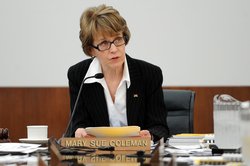
"Although we hope that similar incidents could not be possible at the University of Michigan, we are concerned about the conditions that apparently allowed these alleged crimes to be both perpetrated in the first place and hidden from public view for so long," the resolution states.
SACUA, in the resolution, noted Penn State's "culture of silence and/or minimization in order to save public face" and its "problematic linkages between... university public safety officers, university administration and external law enforcement agents."
Coleman's administration and the Board of Regents received information on the child pornography and the six-month reporting lapse by late November, but Coleman did not disclose the situation to SACUA during the Dec. 5 meeting. At the time of the meeting, Jenson was suspended from clinical duties but not criminally charged.
At the meeting Coleman said "there are multiple, multiple ways" U-M could be at risk for unreported criminal activity and admitted that the university needed to revamp its "policies and procedures for recording and identifying abuse."
She also announced the establishment of a committee tasked with drafting new university crime reporting and prevention policies.
"What are the gaps in our policies and procedures and how might we address those gaps?" Coleman asked the board.
University spokesperson Rick Fitzgerald this week echoed Coleman when he attributed the six-month lapse to the absence of existing procedures.
"It’s safe to say that there were gaps in procedures,” Fitzgerald said.
Twenty days before visiting SACUA, Coleman sent an email to the university community urging them to take the lessons of Penn State to heart.
"At Michigan, we are devoted to the highest ethical standards; we expect honesty and integrity from every member of our faculty, staff, and student body," Coleman wrote in a Nov. 15 email. "It is important for us to act immediately in suspected cases of abuse or other crimes, or in a circumstance where you find yourself either a victim or a witness to questionable activity."
Three days later a hospital security guard notified university police of the child pornography originally discovered in May.
Kellie Woodhouse covers higher education for AnnArbor.com. Reach her at kelliewoodhouse@annarbor.com or 734-623-4602 and follow her on twitter.
Comments
Lily'sMom
Sat, Feb 4, 2012 : 9:39 p.m.
@trespass--Sorry, I should have been more clear. I was referring to the 'general response' policy which is supposed to be the same everywhere. I wasn't referring to policy at U-M and that 'nothing' has changed at the U.
Wolf's Bane
Sat, Feb 4, 2012 : 1:32 p.m.
The events at Penn State (which did constitute an attempted cover-up) and the current Stephen Jenson case are different. I really believe that in the case of the University of Michigan it was ineptitude and lack of training that lead to the 6 month delay. While Stephen Jenson's actions were totally irresponsible and disturbing, no one was abused (that we know of) and the only victim here is the University of Michigan Hospital system's reputation which, I'm sorry to say, has taken quite a beating; I doubt I'll ever seek care there again or at least for a long, long while. Thank goodness for St. Joe's! The University has no real choice but to make an example out Stephen Jenson and anyone else within the system's food chain that dropped the ball. Keeping anyone on the payroll that had any sort direct involvement with this deplorable situation will only further erode the battered reputation of the University of Michigan's Health systems.
snapshot
Sun, Feb 5, 2012 : 3:08 a.m.
So ineptness, incompetence, and poor management resulting in further endangerment of children is OK in your book and no punitive consequences are in order?
snapshot
Sat, Feb 4, 2012 : 1:44 a.m.
That Casey women was found not guilty in her child"s death and the legislature responded by passing a law making it a crime not to report a child missing within 24 hours Gee, why haven't they passed a law making it a crime (felony) for a university not to report a child molestation within 24 hours? Could it be a "protect our own" attitude as opposed to keeping those "ordinary" citizens in check?
shepard145
Fri, Feb 3, 2012 : 5:30 p.m.
I would not defend these creeps but all this hysteria over some downloaded images is nutty and the comparison to the sexual assaults at Penn State are insulting to those victims. There is little logic in laws that put a person in prison because they have been exposed to deviant pictures we don't like, but never touched anyone. In fact, there are communities in Michigan where convicted rapists serve less time than some dude in the suburbs who downloaded photos to his laptop. This is as close to a "thought crime" as we have in the United States and more about trivial politics than anything that will help child victims. We are coming to an end of the era when we can afford to let weepy eyed legislators conger up hysterical laws that throw people in prison for crimes that are more virtual or philosophical then real, but make them "feel better about themsleves".
shepard145
Sat, Feb 4, 2012 : 2:31 p.m.
I'm strayed from the story because I think the wider law is more interesting. This UMHS problem is just pathetic management. Political correctness come full circle - my guess is they were paralyzed over HIS privacy and rights after discovering he has a rather thorny behavioral problem. As a university that basically tries to follow the ACLU's version of the law, they probably viewed this as something that requires nurturing counseling in the arms of loving administrative process rather then calling the fuzz. ..another words no leadership and common sense is their enemy. This is the University health system that asks every women patient if they are getting beat up by their husbands!
sHa
Sat, Feb 4, 2012 : 1:51 p.m.
Really, sheperd? You don't think that the accused had an opportunity to touch children in his position as a UM-Resident-Pediatrician? Seems like it would be the perfect setting for someone like that. What makes you an expert in pedophilia?
shepard145
Sat, Feb 4, 2012 : 5:05 a.m.
I would suggest that some of us are sheep willing to be governed more every day then others. So some loser downloads illegal photos, they are identified on his computer. Then he goes to prison and spends a decade or so on the sexual predator list without ever touching a child. What do I have wrong? Others seem to think the crime is in the economics while some think the creeps may do something in the future so need to go to prison now just in case (see Stalin). This is a classic "thought crime", more virtual then real.
justcurious
Fri, Feb 3, 2012 : 6:07 p.m.
I would suggest that some of us need to educate ourselves on exactly what child pornography is and why society despises it.
BhavanaJagat
Fri, Feb 3, 2012 : 3:07 p.m.
Give a Penny and take a Penny : All this concern about reporting a crime does not need any intellectual effort to understand. I will give my penny for all this effort. The University is trying to pay you back in kind. Your concern is worth a penny and you get it back through all these investigations and meetings and discussions. We will move on with our penny's worth of accomplishment. If public is only interested about reporting crime on time, the University will only concern itself about procedures to ensure timely reporting. When will we talk about preventing crime?
15crown00
Fri, Feb 3, 2012 : 1:31 p.m.
Maybe the Medical School needs to be reigned in BIG TIME M.S. Coleman.
15crown00
Fri, Feb 3, 2012 : 1:28 p.m.
if their kids,neighbors,or doctors were involved they wouldn't be discussing it.they'd be hiring lawyers and suing. why is it i see more coverup coming. instead of being PC be PROACTIVE.
Lily'sMom
Fri, Feb 3, 2012 : 7:01 a.m.
In my training, everything was 'cut and dried', simple, and everyone knew their role. If there was a suspicion of child abuse, it was to be reported to authorities immediately. My job done. Period. Authorities responded by investigating and following through. Nothing has changed. What was so difficult about this???
trespass
Fri, Feb 3, 2012 : 12:44 p.m.
What has changed? The autocratic rule of President Coleman. In an open, transparent governance model, no one in the administration would think that they could get away with stopping the investigation of child porn but the present administration is used to being able to conduct its business in secrecy. If not for Lee Higgins' clever scrutiny of the search warrant, she might have gotten away with this in secrecy as well.
sHa
Fri, Feb 3, 2012 : 12:27 p.m.
"He is a doctor and doctor are gods in this country. Had it been a nurse or orderly or technician than 911 would have been dialed in seconds; the person arrested and fired." That pretty much sums it up.
snapshot
Fri, Feb 3, 2012 : 4:46 a.m.
There was a union involved? Why?
Hemenway
Fri, Feb 3, 2012 : 4:05 a.m.
No one has been fired or put on administrative leave? Sounds like a lame response to me. Same on you Mary Sue and all the other high priced help at lofty UofM. Most likely the public will never know the truth.
Lucy Van Pelt
Fri, Feb 3, 2012 : 3:55 a.m.
Excellent job deflecting! First, you blame 'procedures'. No, it was A PERSON that buried this, not the procedures. I don't believe the procedures recommend delaying this for six months. Then, you refer to Penn State and try to draw them in. Bottom line... this dude was a pediatric doctor found with child porn. scary. You knew about it when you addressed the SACUA on Dec. 5th. How dare you are so arrogant you think you can whitewash this? shame on you.
Scott
Fri, Feb 3, 2012 : 3:44 a.m.
He is a doctor and doctor are gods in this country. Had it been a nurse or orderly or technician than 911 would have been dialed in seconds; the person arrested and fired. It's not about procedures and policies it's about power.
Arborcomment
Fri, Feb 3, 2012 : 1:46 a.m.
It was a very busy December for Mary Sue. Keeping up with the investigation and probably receiving word that the President of the United States wanted to come to the UM for a "non-campaign" event after the State Of the Union address. Presidential visits typically take at least a month to coordinate. Can you imagine if this hit the press less than a week or so before his visit?
Arborcomment
Fri, Feb 3, 2012 : 2:58 a.m.
Mt, I think you missed the underlying meaning and irony in the post. I agree, see comments in the "timeline" article on this topic.
mtlaurel
Fri, Feb 3, 2012 : 2:47 a.m.
I don't think people are wringing their hands about Ms Coleman's obligations.She has a full staff to assist her in any way she needs or desires. Now the "investigation" is the clever distraction... Let's not forget the real issue: child pornography was displayed and failed to be reported properly. We are waiting to hear the facts-it's better to be alarmed about child porn rather than University officials busy schedules.
Kai Petainen
Fri, Feb 3, 2012 : 1:20 a.m.
6 month lapse <a href="http://www.thestar.com/news/article/1125154--60-arrested-in-child-porn-investigation?bn=1" rel='nofollow'>http://www.thestar.com/news/article/1125154--60-arrested-in-child-porn-investigation?bn=1</a> read that....
JustMyOpinion
Fri, Feb 3, 2012 : 12:21 a.m.
What bothers me is the lack of consequences for people who are paid enormous amounts of money for leading this institution. While they did not commit the crime, they failed at their jobs. Enormously. These are basic responsibilities. The failures begin with the lack of reporting structures in place to begin with, lack of clearly communicated expectations in such matters and a culture where concern for ones job or the Company exist in such as state as to over ride the demands of law. It's a problem and a serious one. My own opinion is that one has to look to well executed and sustaining models of accountability for guidance. The best example I can find is the military. Failure of command is the worst dereliction possible, since it effects any mission after that. In such a case, the command structure pays the price of their failure, since they accept (and the organization demands) that this is their chief function as a leader. No less should be expected or exacted from the much more well compensated leadership here. At least the military officers don't try to shirk off responsibility and generally resign. I firmly believe that the entire executive level responsible for overseeing the areas involved should be financially penalized, demoted or fired.
anotheruofm
Fri, Feb 3, 2012 : 12:03 a.m.
Shame on you Mary Sue, for knowing the story and hoping for glory, but all you have now is a front page story. One of a failure and shame, hopefully we will soon find out all the names. The names of those who failed to act, and let this pediatrician and administrators cover their tracks. Soon this will come to an end we are so tired but hopefully the administrators responsible will be FIRED. I am hoping the next headline reads "COVER UP" at the might might "U"
Richard Johnson
Thu, Feb 2, 2012 : 11:22 p.m.
1st rule to a 'inhouse scandel' - cover it up. If that doesn't work get someone to - cover it up. That way your 'inhouse scandel' doesn't become a - out of house scandel... I think we all know what outhouses look, smell like... This is you now U of M.
Michigan Man
Thu, Feb 2, 2012 : 10:40 p.m.
I am reluctant to ask this question - I am not close at all to the U of M or any of the people involved in any way + here we go. Are people suggesting the death of Mr. O'Dell and this Child Porn matter at the U of M are somehow possibly connected? It does seem that dates of events tend to coincide - perhaps totally by chance. I am not a conspiracy type at all + I hope all of these tragic events are unrelated.
Jim Osborn
Fri, Feb 3, 2012 : 12:44 p.m.
Chief O'Dell was unhappy at UM and chose to leave and return to EMU at a substantial pay cut just as this thumb-drive porn case cover-up was breaking. He knew about how the hospital has its own security that contributed to this situation, and many other facts that we are not privy to. Yes, it is possible that this is why he left UM. I will not speculate about his other tragic actions.
Michigan Man
Fri, Feb 3, 2012 : 1:48 a.m.
Thank you kindly for all of the fine, sensitive and thoughtful comments! Just asking and, of course, personal matters are none of my business.
Kai Petainen
Fri, Feb 3, 2012 : 12:29 a.m.
from what i've seen/heard... O'Dell has been held in very high regard. a lot of people are sad that he is gone and he is viewed as a hero. in the search to 'understand' his passing..... we don't know if the 2 are connected, but the question must be asked. he had incredible ethics and a great work ethic. he was a hero to many and for that... i and many others are thankful. but if any of this sad stuff, had any negative impact on him... then there should be strong reprecussions.
trespass
Thu, Feb 2, 2012 : 10:54 p.m.
I think the linkage that is being suggested is only between this case and why he chose to leave UM suddenly and without notice. From all reports he was very sad about the job not working out but no direct linkage is made to this case with his death.
trespass
Thu, Feb 2, 2012 : 10:52 p.m.
The death of O'dell is still under investigation by the Sheriff's Office but it has been unusual in that AA police and UM have not been very cooperative and that instead of the detectives being allowed to do their own investigation and then report it to their superiors, one of the high officials in the Sheriff's department is telling them who and who not they can interview. They were told not to insist on interviewing President Coleman.
Ellen
Thu, Feb 2, 2012 : 10:46 p.m.
I think it's been speculated by commenters. However, I hope we can all remember to be sensitive to Chief O'Dell's loved ones during this very difficult time.
David Cahill
Thu, Feb 2, 2012 : 9:45 p.m.
I would have expected a more vigorous statement from the SACUA chair.
trespass
Thu, Feb 2, 2012 : 10:24 p.m.
Half the salary of whoever is the Chair of SACUA is paid by the Provost's Office. SACUA tried to get that budget line transferred to their budget but the Provost refused. Kate Barald's predecessor as Chair was Ed Rothman. He was Director of the Center for Statitical Consultation and Research but shortly after he supported the faculty and opposed Provost Hanlon on the issue of tenure he was dismissed from Directorship.
Michigan Man
Thu, Feb 2, 2012 : 10:16 p.m.
If the public and average Joe six-pack were not demanding such, SACUA and other U of M Administrators/executives would just blow this off - This entire matter is just a minor inconvenience to be disposed of in their righteous pursuit of academic freedom and academic elitism.
sHa
Thu, Feb 2, 2012 : 10:05 p.m.
Remember, the SACUA chair is employed by the University, so she probably cannot say what she really would like to.
UtrespassM
Thu, Feb 2, 2012 : 9:43 p.m.
Theis is what people think around the medical campus at UM: You are ruring someone's profession, life...if you report a crime, or report a scientific misconduct. You will be hated by so many here. They want to fire you to see you fired.
The Black Stallion3
Thu, Feb 2, 2012 : 9:43 p.m.
I don't agree, there has been a huge cover up here and it is like the cover up at Penn State. If the outcome is any different then there is a major problem at the U of M.
leaguebus
Thu, Feb 2, 2012 : 9:32 p.m.
At this point, this situation cannot be compared to the Penn State case. The U is doing what they need to do to make sure this will not happen again. Flame on...
Scott
Fri, Feb 3, 2012 : 3:48 a.m.
too late. the thing to do is dial 911 the day it happens not enable the guy cause he is one of the sacred brotherhood- doctors.
Daniel
Fri, Feb 3, 2012 : 2:29 a.m.
The only things you have about PSU were from the media that scorched them with a flamethrower. Let's be realistic, as additional discussion occurs regarding that situation there are lots of details the media weren't aware of but wanted to sell themselves. Be happy this hasn't hit the national media with a figure to blame as prominent as Paterno. As the fact emerge from State College, there is not much different. Just ask Phil Knight!!
Dave
Thu, Feb 2, 2012 : 10:44 p.m.
So is Penn State.
trespass
Thu, Feb 2, 2012 : 9:42 p.m.
With Greg O'dell gone, I don't share your confidence. We had better find a new Police Chief with great integrity. O'dell's predecessor resigned in less than two years under a cloud.
trespass
Thu, Feb 2, 2012 : 9:28 p.m.
Greg O'dell was the police chief when this was finally reported. He apparently did a professional job of investigating. However, on November 20 he decided to return to EMU even though he took a $50,000 pay cut to do so. He hated the UM job. Why?
lugemachine
Fri, Feb 3, 2012 : 1:32 p.m.
@ trespass: Have you considered that there may have been more going on in Chief O'Dell's life than simply job dissatisfaction? You have repeatedly and reliably made it exceptionally clear that you have a very large axe to grind when it comes to the University... nobody doubts where you stand (e.g. University bad.. we get it). Greg O'Dell was a wonderful man who was far more troubled than any of us knew. You may wish to keep your speculation to yourself.
trespass
Thu, Feb 2, 2012 : 10:30 p.m.
@Kai- He told them the same day he left. No notice.
Kai Petainen
Thu, Feb 2, 2012 : 10:06 p.m.
2 week notice?
trespass
Thu, Feb 2, 2012 : 9:40 p.m.
Oops, he resigned on November 30.
UtrespassM
Thu, Feb 2, 2012 : 9:21 p.m.
At UM, specially in the Medical school and ...., there are some times the leaders don't listen what Mary Sue Coleman and her office says.
trespass
Thu, Feb 2, 2012 : 9:20 p.m.
How would an internal investigation deal with a situation where the highest official of the University participated in the decision? How would an internal investigation deal with a situation where there was criminal interference with the investigation? That is why the University should handle this like they did with the NCAA investigation and hire a law firm that has handled investigations before and they should release all of the results of the investigation.
Mick52
Fri, Feb 3, 2012 : 7:25 p.m.
You know in the federal system, they do have to get approval from the AG's office before they go forward on an investigation. But in that system everyone is in the CJ business.
Mick52
Fri, Feb 3, 2012 : 7:23 p.m.
Speculation gets you nowhere. Who is complaining that the UM police lacks independence? If the NYT article named UM, then I would question them too. So, are you speculating that UM police has to get administrative approval of certain cases before they send them to the prosecutor's office? That is exactly what Clery is supposed to address. Maybe Clery is not strong enough. EMU's fine was the highest assessed but was only in the $300k range. Schools with multi million dollar budgets may figure it is worth it to cover up some cases in the hope the info won't come up rather than have people think the campus is not safe. But I believe EMU PD never intended for that case to be totally covered up. The suspect was identified and arrested once the forensic evidence was processed. Had they reported it openly as a murder he might have fled.
Daniel
Fri, Feb 3, 2012 : 2:21 a.m.
Kinda like when when U of M hired a law firm in the investigation of Martin and found nothing wrong. Realy???
trespass
Thu, Feb 2, 2012 : 10:29 p.m.
The moderator won't let me speculate much but what if a superior was unhappy that he started a criminal investigation without "permission" from the administration? One of the complaints about the UM police department is that they lack independence. There was a NY Times article that was about how campus police departments tended to lack independence from the University administration.
Mick52
Thu, Feb 2, 2012 : 10:12 p.m.
"How would an internal investigation deal with a situation where there was criminal interference with the investigation?" What criminal interference?
The Black Stallion3
Thu, Feb 2, 2012 : 9:05 p.m.
The U of M needs to dispose of members and the chairman of the general council. This is no different than what happened at Penn State. At least Penn State acted like adults and corrected the situation. It seems like the U of M is trying to find a scape goat and not face the music.....shame on them...this will not look good for them and it is wrong.
Jaime
Thu, Feb 2, 2012 : 8:54 p.m.
We all screamed at Penn State and Joe Paterno for failing to report what they new to the authorities. I don't see how this is really any different.
trespass
Thu, Feb 2, 2012 : 9:39 p.m.
@John- The only reason it did not last years was that a security guard went outside his chain of command and reported it to DPS six months later and the new police chief had the integrity to investigate it even though it might be embarrassing to the University. Imagine what would have happened if Dr. Jensen had finished his residency and been arrested later for similar crimes. Then the resident who found the child porn would tell the media "yes I reported him to the University years ago but they did nothing".
John
Thu, Feb 2, 2012 : 9:32 p.m.
Not different in principle, and definitely despicable... but let's not get too carried away by forgetting the details. For one, there is no evidence that the accused was actually physically involved in molesting children, and secondly the lapse didn't last *years* after being initially reported. Still no excuse, but for the sake of integrity I think it is important to point out the obvious differences.
trespass
Thu, Feb 2, 2012 : 8:46 p.m.
It is important to look at the dates. President Coleman knew that there was a 6 month lapse in this case by at least November 21. She asked for the internal investigation on December 2. She spoke to SACUA on December 5 but she did not tell them about this case. Why not? They may never have known about the case if not for reporting from AA.com.
Jim Osborn
Fri, Feb 3, 2012 : 12:36 p.m.
"''. President Coleman knew that there was a 6 month lapse in this case by at least November 21.." If true, then this is very similar to the Penn State case and the UM Regents need to ask some very hard, public questions of their highly paid president about her lapse in judgment. Even after finding out, and taking a few weeks even to learn more, she still kept it under the rug and hid it from all. I can understand a busy president not being certain of what to do with vague information of a long past event, but she still hid it once she learned more.
justcurious
Thu, Feb 2, 2012 : 8:34 p.m.
I know! Let's appoint another committee! Let's do a few more studies. Lets just figure out a way to make ourselves look like we care.
knotch
Thu, Feb 2, 2012 : 8:17 p.m.
Glory be....their going to discuss it... How about report IT.... Hell I love the University of Michigan...come on, we all know it's a bastion of Liberalism. For sakes alive. Discuss it....
Roadman
Thu, Feb 2, 2012 : 8:16 p.m.
The more public discussion on this matter the better.
The Black Stallion3
Thu, Feb 2, 2012 : 9:08 p.m.
This has been discussed for a long time behind closed doors, it is time to start finding out who is behind this cover-up and get rid of them all......just like Penn State did.
cinnabar7071
Thu, Feb 2, 2012 : 8:35 p.m.
More public discussion? This is a very simple matter of right and wrong, if you dont already get it, all the discussion in the world will not help. Lets see a show of hands from the people who dont get this, and you will get an invite. More public discussion, LOL!