

Fighting floods: Ann Arbor officials lay out plans for stormwater upgrades, residents balk at costs
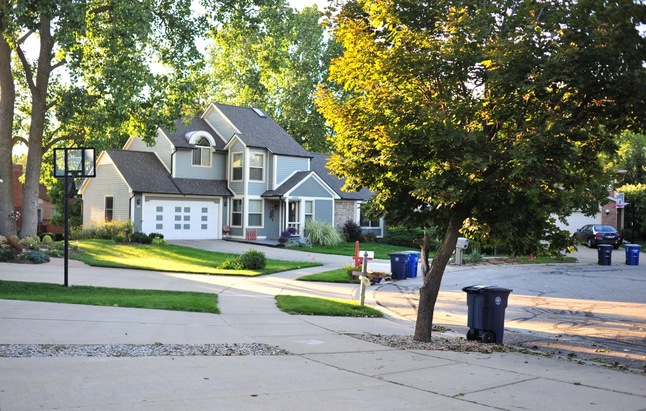
There have been reports about flooding issues in the Village Oaks subdivision on Ann Arbor's southwest side since it was built in the 1980s.
Ryan J. Stanton | AnnArbor.com
"It's been at least once or twice a year," she said of the floods, estimating it's cost her tens of thousands of dollars in damages and payments to contractors to try to engineer solutions.
"The big events just totally did me in," she said, recalling times when she and her family worked frantically through the night to fight back against the water pouring into their basement.
"My house was the retaining basin for the entire hillside of houses above me and part of the neighboring property. For whatever reason, the way the water flowed was into my basement."
Three burned-out sump pumps and countless headaches later, Uche now keeps many of her belongings in her basement elevated in bins.
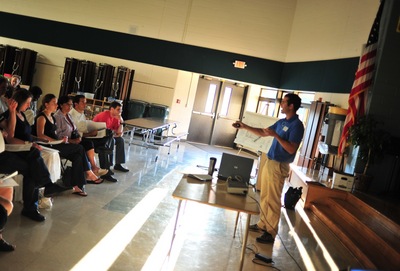
Troy Baughman, the city's senior project engineer in the systems planning unit, did not receive a warm welcome from Village Oaks residents when he told them recently at a meeting at Lawton Elementary School they would need to pay special assessments to bring their subdivision into compliance with the city's stormwater standards and codes.
Ryan J. Stanton | AnnArbor.com
After two years of study, Ann Arbor officials say they may have found at least a partial solution for some of the flooding problems plaguing the area.
But it's going to cost residents thousands of dollars, and many of them — Uche included — aren't happy about that.
At a series of recent meetings with residents in three neighboring condominium communities — Village Oaks, The Meadows and Country Place — city officials laid out plans for constructing a so-called regional detention basin to address deficiencies in the area's stormwater system.
The regional solution to stormwater storage, an idea city officials had last year and are now rolling out to residents, is estimated to cost anywhere from $279,500 to $394,900, with affected homeowners picking up the tab through special assessments on their properties.
Troy Baughman, the city's senior project engineer, said the costs are rough estimates and include acquisition of vacant land just north of Village Oaks where the basin would go.
AnnArbor.com attended the most recent meeting at Lawton Elementary School where city officials presented the plan to Village Oaks residents.
The meeting was attended by more than two dozen people and many complained they shouldn't be on the hook financially for a lack of capacity in the city's stormwater system.
"This is not our fault. Why should we have to pay if it's not our fault?" said Mary Gliedt, a Village Oaks resident.
"As a taxpayer, maybe I'm naive, but my understanding is I pay the city taxes and part of that is to help take care of sewage and drainage and all of these things that the city is responsible for," said Village Oaks resident Audrey Imbur, questioning the proposed assessment.
"To go to every resident on the street and expect us to pay for a water problem that essentially is not our water problem — it's a water problem with the city, and we're taking in all this water from other streets — it just blows my mind," she said. "I don't see how that's reasonable at all."
Imbur received a round of applause from the crowd, which included Lansdowne neighborhood residents who crashed the meeting to voice their own concerns.
The new basin would be upstream from Village Oaks, a 13-unit subdivision just off Ann Arbor Saline Road on Village Oaks Court. Country Place and The Meadows are to the north.
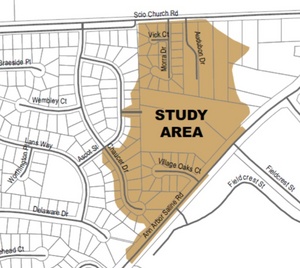
Village Oaks, The Meadows and Country Place are all condo communities located within an area the city has been studying since 2010 with the help of engineering firm Wade Trim. The study found the three developments, which trace back to the 1980s, are not in compliance with the city's stormwater standards and codes.
Courtesy of Wade Trim
Village Oaks residents could be asked to pay $78,900 to $106,100, costing each of the 13 condo units there $6,069 to $8,161.
Country Place could be asked to pay $45,000 to $64,800, costing each of the 14 condo units there $3,214 to $4,628.
The Meadows could be asked to pay $155,600 to $224,000, costing each of the 22 condo units there $7,072 to $10,181.
If residents choose not to participate in the regional basin project, the city is going to make each area individually take responsibility for addressing their own stormwater deficiencies. Baughman said the three communities are not in compliance with the city's codes.
The city has determined 14,061 cubic feet of stormwater storage is required onsite at Village Oaks, but the subdivision's existing detention basin has capacity for only 10,600 cubic feet.
The deficiencies are even more pronounced in the other areas. The Meadows has 8,900 of its required 27,832 cubic feet and Country Place has 4,900 of its required 10,379 cubic feet.
For Village Oaks, increasing the capacity of the subdivision's existing basin to meet code would require an estimated $74,000 worth of upgrades, costing each unit about $5,692.
For Country Place, an onsite solution could cost about $6,000 — or $429 per unit. For The Meadows, it could cost about $21,000 — or $955 per unit.
AnnArbor.com is awaiting an explanation from city officials as to why it would cost Village Oaks significantly more money than the other two communities.
Baughman told Village Oaks residents one of the benefits of going with the regional basin, which would cost more, is they don't have to disturb their own backyard.
Craig Hupy, the city's interim public services administrator, explained the origins of the regional basin concept. It came out of a study completed by engineering firm Wade Trim, which was hired by the city in 2010 to perform a drainage area study and recommend stormwater improvements to the area to mitigate flooding. The firm released its final report to the city in early July.
"When the study was done, there was a recognition that there is some water coming off of the vacant lot that isn't controlled that needs to be controlled, and that was the beginning of the concept of the regional basin — to deal with the water that was coming at Village Oaks from outside the subdivision from that vacant parcel," Hupy said, referring to the property to the north.
The report from Wade Trim notes heavy rains have caused extensive and frequent backyard flooding in the Village Oaks and Chaucer Court area, leading to basement flooding.
Reports of flooding in the area date back to the 1980s. The city constructed a relief sewer in 1991 to address some of the issues on Chaucer Court, but the problems have persisted.
Wade Trim notes in its report that residents have reported substantive overland flow in the area even during more-frequent, less-intense rain events.
Residents said it's particularly bad because water comes rushing into the Village Oaks subdivision from adjacent areas, as well as Ann Arbor-Saline Road, when it storms.
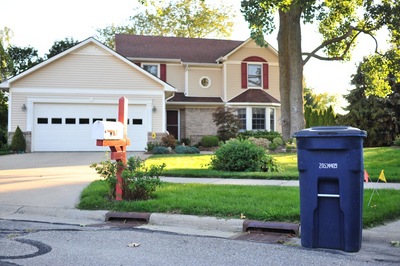
Two small storm drains at the end of Village Oaks Court catch stormwater that residents say rushes down the street, some coming in from Ann Arbor-Saline Road, when it storms.
Ryan J. Stanton | AnnArbor.com
Village Oaks is in a different situation than Country Place and The Meadows, which are official condominium associations with their own governing boards. City officials said Village Oaks, a platted subdivision, would have to band together and form an association of its own to join in the regional basin solution.
The association then would have to petition the city's Zoning Board of Appeals to ask for a variance from city code to allow some of its stormwater detention needs to be met upstream.
"When we move it up off the site, upstream, it does require a waiver of the existing ordinances," Hupy said. "We think it's a well worthwhile tradeoff to have happen, but technically we have to go through the ZBA. It's not something staff or anybody in the city is allowed to grant."
The city still has a copy of the original development agreement for Village Oaks. Baughman said it's clear the responsibility for the subdivision's stormwater detention falls on Village Oaks.
"It's a private system," he said. "It's not a city-owned facility."
And so, he said, it's up to Village Oaks, not the city, to keep the detention basin on the property maintained and functioning.
Village Oaks residents complain the city is asking them to take responsibility for the detention basin when city officials readily admit they have no record of it ever being built to standard or being properly inspected by the city after it was built. Residents said they shouldn't have to pay to bring it into compliance when there's no record it ever was in compliance.
"If you're trying to pass the cost on to us, you've got a lot more work to do and I'm keeping my checkbook in my pocket," Village Oaks resident Stefan Young told city officials.

Paula Uche says she's experienced eight years of nonstop flooding problems since she moved into the Village Oaks condominium subdivision on Ann Arbor's southwest side.
Ryan J. Stanton | AnnArbor.com
Her basement flooded again during a March 15 storm, she said, and she had a contractor come through her house afterward. She said the contractor found someone, possibly the original builder, had "faked it" and ran a drainage pipe "that went to nowhere" into the ground.
She said that has caused "enormous aggravation and trouble to me personally and to my home." She now wonders if other corners were cut elsewhere in her subdivision.
Cresson Slotten, the city's systems planning manager, said he hasn't heard any such reports, but he's not going to say the kind of situation Uche described doesn't happen.
The city still has the original plans for Village Oaks from Feb. 13, 1985. They were completed for Joseph Grammatico of Master Key Northern Inc., the developer of the subdivision.
Grammatico, who developed about 14 subdivisions in Ann Arbor throughout the 1980s, said he's aware of the flooding issues that persist today. He blames the city for allowing more development to occur in the area after Village Oaks, which was built partially in a floodplain.
"They did all the inspections," he said. "We even put drains in and everything. That was part of the deal. That was a floodplain down there and they knew it at the time."
Grammatico said he doesn't recall much about requirements for stormwater detention, and he's not even sure he remembers any kind of sizable basin being built back then.
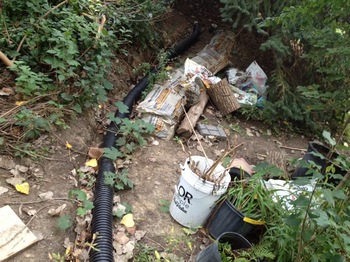
Uche has installed a series of pipes in her backyard in an attempt to divert stormwater flows away from her home's basement egress windows. She also has planted a bunch of vegetation and had a contractor completely reconfigure her roof drain spouts.
Ryan J. Stanton | AnnArbor.com
Baughman said the city could break ground on the regional basin project next spring, and its size depends on the level of participation from the three communities.
The city would have to petition the county water resources commissioner to undertake the project since it involves property not within the city limits.
Uche said she's skeptical of forming a homeowners association. She thinks that just creates a legal entity that the city can then hold accountable for deficiencies in the stormwater system.
"That's why none of us will ever support that," she said. "This will set a terrible precedent for other neighborhoods if we are expected to pay, because then the city — in tough economic times — will simply shift the burden of paying and solving their problems that taxes should pay for by just billing us as individuals, and that is insane."
Baughman said another option is for the city to go the traditional engineering route and upsize the underground sewer pipes in the area, but he said that's not a sustainable solution. He said it would just push the problem downstream and negatively impact Malletts Creek.
Irvin Mermelstein, a local attorney who lives in Lansdowne, said he doesn't like how the city is dividing up neighborhoods and bringing piecemeal solutions to the flooding problems. He said Lansdowne residents are going to try to be at every meeting going forward.
"The city has to stop Balkanizing the neighborhoods. I don't pay my taxes to the duchy of Lansdowne. I pay my taxes to the city of Ann Arbor," he said. "It's got to be a citywide solution."
Ryan J. Stanton covers government and politics for AnnArbor.com. Reach him at ryanstanton@annarbor.com or 734-623-2529. You also can follow him on Twitter or subscribe to AnnArbor.com's email newsletters.
Comments
snapshot
Wed, Sep 26, 2012 : 2:55 a.m.
for all the hype about how important it is to have competent labor, collective bargaining, living wages, and high taxes in order to ensure citizen safety and services....Michigan sure has a lot of issues as a result of people not doing their job. Why is that?
Mike
Tue, Sep 25, 2012 : 2:40 p.m.
Even if this is the city's fault for not planning properly (and it may be), there is no money to do the repairs. Asking your neighbors who don't live there (i.e. taxpayers) to foot the bill is not reasonable. The cost the city is proposing seens less expensive than the continuing anxiety and heart ache of continued flooding if you ask me. I would look at it as a cost of homeownership like replacing your roof and just get it done. Complaining about it and expecting your neighbors to pay for it isn't right.
jns131
Mon, Sep 24, 2012 : 10:13 p.m.
YUCA is also refusing to address flooding nd lack of fire hydrant safety as well. This was brought up during our neighborhood watch meeting. One neighbor said the fire dept refused to go in because the hydrant did not work. So her father burnt to death. Other neighbors are complaining as well and not is getting done either. So for now? Glad things are getting done on your end. Nothing here so far.
Steve Hendel
Mon, Sep 24, 2012 : 9:16 p.m.
"As a taxpayer, maybe I'm naive, but my understanding is I pay the city taxes and part of that is to help take care of sewage and drainage and all of these things that the city is responsible for," said Village Oaks resident Audrey Imbur, questioning the proposed assessment." Au contraire, water and sanitary sewer and storm sewer are Utility funds supported primarily by user charges, NOT taxes-so the debate is really about who should pay to remedy flooding; just the property owners involved, or all of the Utility's customers. The analogy which comes to mind is this: if the water main in the street out in front of your house breaks, would the City try to charge you directly for repairing it? I think not.
GoNavy
Mon, Sep 24, 2012 : 6:58 p.m.
All I can say to the residents is this: If you don't think that "this is your fault" (and I'm not saying that it is), then it certainly isn't MY fault either.
BobbyJohn
Mon, Sep 24, 2012 : 6:09 p.m.
Folks, this why when you buy a home you hire a totally independent home inspector to truly look at your home and environs. And Independent means NOT a referral from your realtor nor your builder.
justcurious
Mon, Sep 24, 2012 : 5:04 p.m.
So the developer was allowed to get by (and get rich), and the City allowed it. And now it is the homeowners who will pay one way or another. They can't sell a house with these problems, but if they stay they will have to pay.
Mike
Tue, Sep 25, 2012 : 2:44 p.m.
You know for sure the developer got rich? He would not have been allowed to do anything contrary to the city approved plans. He also would have had to hire an engineer to design the site plan and the city would have ahd to sign off on it. Get the problem fixed and then you can sell the house or continue to complain about it and get out a mop every time it rains. No taxpayer bailouts............
Basic Bob
Mon, Sep 24, 2012 : 8:32 p.m.
It's not the city's job to permit or deny your purchase. Clearly the developer had no problem selling the units.
Donald Wilson
Mon, Sep 24, 2012 : 4:25 p.m.
The problem isn't even that this was BUILT on a floodplain, but that people BOUGHT on said floodplain. Whether you own a house or a condo, if your property is on a floodplain, this is disclosed to you at closing, in the closing documents. Also: Why should they pay? Because it's THEIR property, and THEIR government, and special assessments are how projects like this are funded, just like sidewalks. If they had septic systems and a sewer was going in, there would be a special assessment for that. It's not the governments fault that the citizens don't like the way the citizens told the government to operate. If the residents don't want this kind of special assessment on future projects, then all they have to do is put forth an extra millage to address it. To the people in the area balking, you have a choice: wet feet, or extra tax.
Indymama
Tue, Sep 25, 2012 : 3:57 a.m.
The problem with an extra tax...it would probably mean everyone in the City would be taxed to fix their problem!!!
Greg
Mon, Sep 24, 2012 : 2:17 p.m.
Yes, seems priorities are wacked, at best. Things like sewers and enforcing speed limits and stop signs take a back seat to funding art projects, what is this mayor thinking???
Indymama
Tue, Sep 25, 2012 : 3:54 a.m.
"....what is this mayor thinking???" Just what he has always been thinking...."You (the public) are not smart enough to know what is best for yourselves, so "we" (City Council) need to tell you what you can and can't do!! Then make them (you and me) pay for it!! It's a Democrat thing!! Just like Michelle telling us we have to eat certain foods, and the schools have to serve certain food, which the kids don't like, so they take it and then throw it away! What a waste. Don't you think it is time for a change of faces and names in our local and National Government??
Ricebrnr
Mon, Sep 24, 2012 : 4:20 p.m.
that where he lives there aren't any problems...
swcornell
Mon, Sep 24, 2012 : 1:48 p.m.
This is typical Ann Arbor issue. Developers come in create a neighborhood in open land that used to collect and drain rain. They bring in fill to build up the area to prevent it from flooding. Then the water has no where to go but the roads. A year later after much citizen complaints they have to redo the roads and drainage to solve the problem. This is what they did several years ago at the Nixon/Dhu Varen/Green Rd. intersection when they built all those condos. And what about the flooding at Huron Parkway and Geddes just north of the river across from Huron High. That's been flooding for the 25 years I've lived here and they have yet to fix it, try as they might!
justcurious
Mon, Sep 24, 2012 : 5:06 p.m.
What is the city's responsibility in your scenario? Didn't they approve the developer's plans?
Charles
Mon, Sep 24, 2012 : 1:26 p.m.
I think the issues causing the backups and flooding are from multiple issues. The city has poorly designed storm water system. They have added well beyond the capacity of the system based on the poorly designed waste water system. The footing drains for years ran through the waste water system (and most the city still does), and developers got the flow measurements back in 80's and showed that there was plenty of room for their projects. Nobody at the time was concerned with the max capacity. So projects go on and the waste water system get near its max and the city requires on site detentions to deal with it. Now we get the issue with sewage plants getting over taxed during rain events, so the solution is to take footing drains out of the system. The brilliant government we continue to re-elect over and over never bothers to figure the impact of the footing drain water added to a storm water system already to close to max capacity, and then mother nature decides to show she is more powerful than man and gives us some big rain events. The footing drain system removal to the sump pumps is a mess. The city gets to force you to do it when they want it, they get to pick the contractor, and they do the inspections, no better than mob. . I personally had a sink trench that they did not fix and there was never the final inspection on the project to insure things were restored. That whole project was a mess since they did not have the funds to do it and now has been put on hold (they say to re-evaluate flooding, or was it because it was mismanaged?). Next issue is no longer leaf pick ups, so all the leaves that fall on road end up where? In the sewer! I know in my area they used to pick up leaves and then sweep streets. In last few years, the sweepers have not come through until spring. I bet if anyone looked at maintenance, they may find the city pumps may have been clogged adding to flooding. The leaves will reduce sewer flow at min. Dont trust city info any longer
jcj
Tue, Sep 25, 2012 : 1:44 a.m.
Brad Did the republicans take away your leaf pickup?
jcj
Mon, Sep 24, 2012 : 5:14 p.m.
Those voting down on my comment must be my neighbors that NEVER rake a leaf!
Brad
Mon, Sep 24, 2012 : 1:44 p.m.
Sounds like a great reason to restart the leaf pickups. Of course that might eat into the bad art budget so it'll never happen.
jcj
Mon, Sep 24, 2012 : 1:30 p.m.
It would help if only 25% of resident would get off their duff and pick up their leaves! Street sweeper came down my street today on the west side.
MRunner73
Mon, Sep 24, 2012 : 1:24 p.m.
This property is located by an adjacent wetland and drainage creek. Changes in urbanization outpaces adjustments in engineering, ie drainage capacity. Extreme precipitation events will always occur. City engineers need to do more than add drainage tie-ins to the already overcapacitized strom drains. If not, more flooding events to these residents will occur.
brimble
Mon, Sep 24, 2012 : 1:23 p.m.
Challenges with stormwater management exist across the city. This is only a single example of a larger problem, which is that historically, developers have done only what the contemporary code required, and the City has failed to face up to the problem holistically. The past, however, is the past, and the question going forward is what the City can do to mitigate existing problems and to prevent new ones from developing. What is the long-term plan for comprehensive stormwater management?
jcj
Mon, Sep 24, 2012 : 1:23 p.m.
I wonder which party all these residents voted for?
jcj
Mon, Sep 24, 2012 : 8 p.m.
Brad lets compare apples to apples! Ridiculous to bring up Katrina.
Brad
Mon, Sep 24, 2012 : 7:27 p.m.
Well everyone saw how the Repubicans handled the Katrina situation, so their record with flooding isn't exactly stellar.
jcj
Mon, Sep 24, 2012 : 5:17 p.m.
Who are the residents complaining to? Who is their complaint with? The Governor? I think not!
Barb
Mon, Sep 24, 2012 : 2:03 p.m.
So helpful - fwiw, this isn't a Dem or GOP issue.
Ron Granger
Mon, Sep 24, 2012 : 1:16 p.m.
If you expect other taxpayers to pay for your flooding condo, you're going to have a bad time. I had flooding in the 80's near Michigan Stadium, and learned many lessons. Many home owners have not taken even the most basic preventative measures.
Brad
Mon, Sep 24, 2012 : 1:10 p.m.
Bigger pipes that will take the flow aren't "sustainable"? Now why would that be? And you're saying that would "negatively impact Mallett's Creek"? Now correct me if I'm wrong, but isn't the entire purpose of that creek to carry stormwater? And after just spending however many millions on the creek we're saying that it couldn't handle the additional water from this fairly small number of homes? Then why did we spend all that money there? Just to get rid of the "non-native" foliage??
Yael Ganet
Mon, Sep 24, 2012 : 12:58 p.m.
Geez whiz! Where have all the (qualified, accountable, paid for with our taxes) inspectors gone? .... long time passing; Where did all the (sewer and runoff) taxes gone?....long time ago. Right On with the Duchy Dig...or shall I have my escrow make mine payable to Duchy of Martin Acres? Yikes.
G-Man
Mon, Sep 24, 2012 : 12:27 p.m.
So, the City approved the original development as satisfactory for the original developers. Now that it has become evident the plans were faulty and the original developers are long gone, the City now expects the individual property owners to pick up the tab for something deficient that they (the City) approved in the first place? Smell anything?
Basic Bob
Mon, Sep 24, 2012 : 4:12 p.m.
Approval of the drawings does not constitute liability. There are assumptions that are made in every case, and if they turn out to be wrong, it is to be expected that the developer or owner fix the problem for their own benefit. Unless some negligence can be proven, the current owners bought the property as-is.
jcj
Mon, Sep 24, 2012 : 1:26 p.m.
G-Man Your point is well taken. Obviously the city planners and building officials at the time made a mistake. Why should we now think they will make the right correction?
a2roots
Mon, Sep 24, 2012 : 1:15 p.m.
@g-man...reread the article. One of the developers is around and I am pretty sure so are the others. The developments met code at the time. BOCA code and our local standards have changed over time. The city is probably more a fault than anyone because they keep on trying to fix things and their solutions tend to cause more problems.
jmac
Mon, Sep 24, 2012 : 12:23 p.m.
The recent torrential rains have made some of us realize that: 1) Washtenaw county is basically a giant wetland, and 2) The city, township, and county drain commissions are largely incompetent and ineffective. This has resulted in a lose-lose situation for many, many homeowners. Not sure what the solution is but agree with Mr. Mermelstein that this is not simply a neighborhood problem but a more systemic that needs a systemic resolution.
a2grateful
Mon, Sep 24, 2012 : 11:46 a.m.
Sidebar: Few 1980 building and drainage codes meet current code. Furthermore, projects that met code in ANY given prior decade likely fail to not meet current code. There is little reason to blame residents, the developer, or the city for evolution and improvement of these codes.
walker101
Mon, Sep 24, 2012 : 11:30 a.m.
The city was supposed to do an environmental study impact prior to the buildings going up to determine that constructing buildings on that property should be free from basic issues such as water flow, landslides, unstable soil, etc.. I guess so much for any reports for notifying any of the issues that they currently have, the city may of known that it had problems but failed to notify or disclose the problems when they approved the area for constructing homes, and now they want residents to pick the tab? Sounds like a good deal.
Hactin
Mon, Sep 24, 2012 : 11:22 a.m.
I see that Village Oak residents are looking for alternatives. If it's true that : "it's clear the responsibility for the subdivision's stormwater detention falls on Village Oaks. "It's a private system," he said. "It's not a city-owned facility." Then, the residents may need to negotiate with the Contractor's attorney. I didn't buy anything out there, why should I share their costs? It's the same question that the Village Oak residents are asking.
Hot Sam
Mon, Sep 24, 2012 : 11:28 a.m.
You make some good points...however, I guarantee that the "contractors attorney" is long gone. While the article names Mr Grammatico as the "developer", I would be willing to bet that it was done as a "company" which is long gone...
deputydwag
Mon, Sep 24, 2012 : 10:40 a.m.
And we allowed building in the floodplain why? If the city approved the development using their review processes, then the city should rectify the decision they made since they knew it was a flood plain. I assume that city officials know that the definition of a floodplain is an area near a river or a stream which floods when the water level reaches flood stage. Hmmmm, and development was allowed why??
Hot Sam
Mon, Sep 24, 2012 : 11:21 a.m.
This is an ongoing problem with "site condominiums"...the municipality and builders pass the "ownership" on to the community, and then take no responsibility for future problems.
a2grateful
Mon, Sep 24, 2012 : 10:35 a.m.
And, just a hunch: Is there any correlation between a) the city's reconfiguring storm lines in the stadium boulevard reconstruction b) the city's storm water improvement project at a2 Pi Hi c) the city's storm water management project at West Park and exacerbated problems in nearby neighborhoods?
A2comments
Mon, Sep 24, 2012 : 10:34 a.m.
Picture caption says "contract", s.b. "contractor".
Ryan J. Stanton
Mon, Sep 24, 2012 : 12:37 p.m.
Thanks. It's fixed.
a2grateful
Mon, Sep 24, 2012 : 10:15 a.m.
Maybe the city should just spend some illegally appropriated folly art bucket money to help these residents. We actually have a choice. We could improve the quality of life for many city residents, or purchase folly fountains and designer chandeliers for city hall. Which makes most sense?
ribs1
Mon, Sep 24, 2012 : 12:06 p.m.
I think it makes more sense to purchase million dollar fountains, designer led lamp posts, and more art. LOL