

Ann Arbor launches citywide analysis of stormwater system in response to neighborhood flooding

Mark TenBroek, vice president of engineering firm CDM Smith, answers questions from Ann Arbor residents during a public forum at the Pittsfield Branch Library Wednesday night.
Ryan J. Stanton | AnnArbor.com
Craig Hupy, the city's public services administrator, gave an update on those efforts Wednesday night during a meeting with about 30 residents at the Pittsfield Branch Library.
"What we have heard very strongly from folks is, 'You're dealing with the sanitary issues, but you're not dealing with the stormwater issues.' We hear that," Hupy said. "We also know that from the past events that there were issues in the Village Oaks/Chaucer Court area. We've looked at that as a separate study."
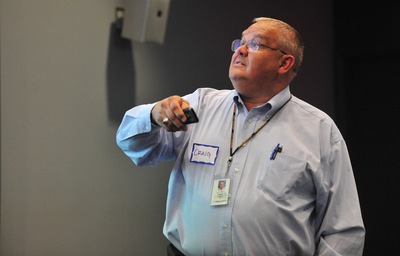
Craig Hupy said there are two main problems, both triggered by heavy rains. First, there's street and basement flooding that has to do with the city's storm drainage system, and then there are basement sewage backups and sewer surcharging that have to do with the sanitary sewer system.
Ryan J. Stanton | AnnArbor.com
The main area of concern, which is the subject of special focus, is a triangle-shaped section bound by Scio Church Road to the north, Interstate-94 to the west and Ann Arbor-Saline Road to the east.
Hupy said the city already has a set of recommendations for the Village Oaks/Chaucer Court area of the Lansdowne neighborhood, including a better high-flow drainage pathway, maintaining upstream stormwater basins and additional stormwater detention capacity.
As part of the larger stormwater analysis, Hupy said, the city will be developing a computer model, doing flow monitoring and evaluating system capacity to identify deficiencies. That will culminate with a recommended list of capital improvements to hopefully address neighborhood flooding problems.
Multiple residents in Ann Arbor have spoken out since a March 15 storm, which spawned a tornado in the Dexter area, caused their neighborhood streets to flood, which in turn flooded some of their basements.
They've blamed city officials for inefficient capacity in the city's stormwater drainage system to handle the heavy rain that fell, and they've questioned whether the city's footing drain disconnection program — which forces more water into the system — is only exacerbating the problem.
The City Council took action on June 18. to approve an $822,700 contract with CDM Michigan Inc. to complete the citywide stormwater analysis. The city actually got started on the project in 2007, but with limited funding available, it hired CDM to complete only the first two phases at the time.
The latest contract is expected to cover completion of the last three phases, including calibration of the city's stormwater hydraulic model and gathering and analyzing comprehensive rain and flow data. Hupy said the city has long desired to have a mathematical model of its stormwater system.
"We have used the opportunity of this more recent storm event to take it back to them," Hupy said of getting the City Council's approval to complete the project. "It has passed and we are now embarking on a multi-month project to build the model of the stormwater system."
The scope of services for the project specifically makes reference to "known surface flooding areas such as Churchill Downs, Lansdowne, Pauline/Dartmoor, and Orchard Hills."
The debate over footing drains
Concerns about the city's footing drain disconnection program were raised again Wednesday night by several residents, including Jack Eaton, who recently lost a race for City Council against 4th Ward incumbent Margie Teall. Eaton said he talked with many residents about the issue while going door to door.
"I think a couple of the neighbors have identified the problem, which is that they're really being experimented upon," Eaton said. "There are significant problems in trying to take water out of the wastewater system and putting it into the stormwater system when the stormwater system is beyond capacity."
Footing drains are small 4-inch-diameter pipes located near the foundations of houses and are intended to keep rainwater from building up along the foundation or basement walls.
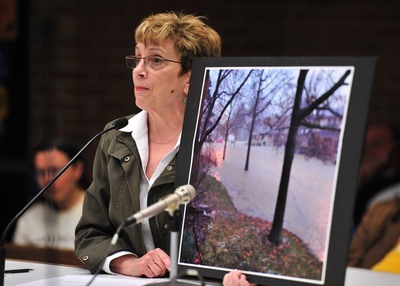
In this photo from April, Ellen Fisher shows Ann Arbor City Council members a photograph of the flooding that occurred in front of her home on March 15. She said she was mandated to participate in the city's footing drain disconnection program, resulting in more water being added to an already inadequate storm sewer system. "We were flooded again just a year later," she said.
Ryan J. Stanton | AnnArbor.com
But the city became concerned several years ago that was causing the sanitary sewer system to become overwhelmed during storms, leading to sewage backups in home basements.
And so the city started a program of disconnecting footing drains and installing sump pumps to channel water into the city's stormwater drainage system instead of the sanitary sewer system.
The consultants who've been helping the city with the program for the past several years, including Mark TenBroek of CDM, were in attendance Wednesday night to tout its benefits.
TenBroek, who was involved in the study of basement sewage backups in Ann Arbor more than a decade ago, said the task force that looked into the problem found doing footing drain disconnects and installing sump pumps was less expensive and less disruptive than increasing sewer capacity.
A lot of communities have sewer capacity issues, TenBroek said, and a majority of them have switched to bigger pipes to address the problem. But more and more are moving toward footing drain disconnections, he said, pointing to Lansing, Grand Rapids, Auburn Hills and Downriver communities as examples.
"If you put in big pipes, you're passing larger flows downstream," he said. "You can have unintended problems of having too much flow in other locations in the city."
Without the many footing drain disconnections done over the last several years, TenBroek said, many more homes in Ann Arbor would be at risk of having basement sewage backups during storms.
The FDD program also has helped avoid overflows of partially treated sewage to the Huron River, a problem the city had been fined for in the past, TenBroek said.
But many residents still question the logic behind using sump pumps to send more water to what they consider an already overburdened stormwater drainage system.
Several in attendance Wednesday night called for more capacity and bigger pipes, and many applauded when a woman in the audience declared the FDD program simply isn't working. One man called city officials "tone deaf" for pushing ahead with the FDD program despite the many concerns raised by residents.
"We have evermore extreme weather events happening on a more regular basis that further overburdens the whole system," Eaton said. "And what the neighborhood wants is for the city to stop for a minute, get good data, and improve the infrastructure so that the stormwater has a place to go before they force this sump pump routine on every homeowner, and I think that's a reasonable response."
TenBroek said about 2,200 homes in Ann Arbor have had FDD work completed over the last several years, and there are about another 300 homes working through the process right now.
Since the program began in 2001, TenBroek said, the average cost for the in-home FDD work and discharge line running to the street is about $4,118 per home. The homeowner contracts directly with the plumbing contractor, he said, but payment for the work is entirely covered by the city.
The city selectively chooses the neighborhoods where it wants to enforce the program and then gives homeowners notice of the steps they must take. For homeowners who want to opt out of the program, there's a $100-a-month charge tacked onto their city water and sewer bill.
Eaton called the process "pretty draconian."
"I think the city has a real public relations problem with the manner in which they're enforcing the ordinance, and that's coupled with the poor quality of the program in general, so I'm really concerned," he said. "If you don't comply with the ordinance, they charge you $100 a month, and at this meeting they're calling that an opt-out option. But I don't think that's an option. I think that's a coercive penalty and it's offensive."
Courtesy of CDM Smith
Landing in Lansdowne
TenBroek said Wednesday's meeting was intended mainly for a grouping of 60 homes in the Lansdowne neighborhood that were brought into in the FDD program back in March. That includes homes along Wembley Court, Chaucer Drive, Ascot Road, Lans Way and Lambeth Drive.
"We've tried to bring these groups of homes together in a logical neighborhood-basis so that homeowners can have the work done in a group," he said. "It makes it more efficient for the program overall."

Ann Arbor attorney Irvin Mermelstein, who lives on Ascot Road in the Lansdowne neighborhood, said he intends to fight hammer and tongs to avoid installing a sump pump in his basement.
Ryan J. Stanton | AnnArbor.com
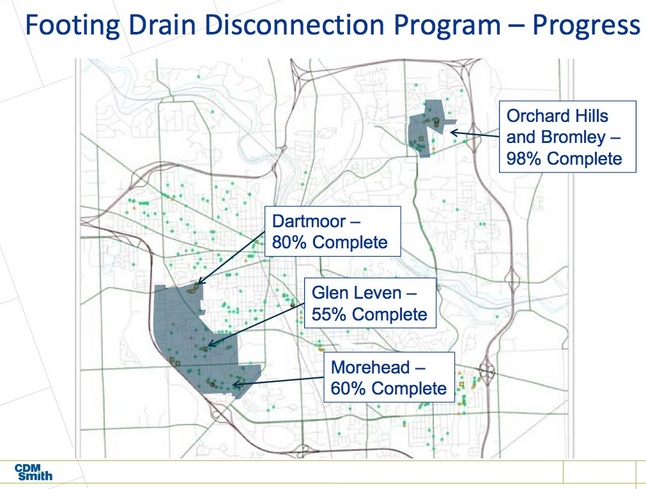
About 98 percent of homes in Orchard Hills and Bromley have completed footing drain disconnects. Dartmoor is now 80 percent complete, Glen Leven is 55 percent complete and Morehead is 60 percent complete.
Hupy said the intention has been to eventually expand the FDD program throughout the entire city, but city officials will be evaluating the need for that as they go along.
"Along the way, we will be evaluating the effectiveness of the program as we get into areas that have less of a problem," he said. "And I think realistically, at some point, there is going to be less payback for doing the work, and it's likely we won't drive it to 100 percent. Where that point will be, I can't tell you."
Ann Arbor attorney Irvin Mermelstein, who lives on Ascot Road in the Lansdowne neighborhood, said he intends to fight hammer and tongs to avoid installing a sump pump in his basement. He compared the sump pumps residents are being asked to install to the man-eating plant from the film "Little Shop of Horrors."
"The way this program works is they come in, they put an underpowered system in your basement, and then they hang a sign on it that says 'feed me,' and you have to feed and care for that thing for the rest of your life," he said. "There is no dollar limit on how much you have to spend. There is no time limit."
Mermelstein said he's been looking into the FDD program and tried communicating with his 4th Ward council representatives, Margie Teall and Marcia Higgins, but that led to a restraining order issued by the city attorney's office prohibiting him from speaking to them. Higgins and Teall were not in attendance Wednesday night.
"I cannot speak at this meeting because, according to the city attorney's office, I would be using this meeting to simply have a dialogue with city officials, so I can't talk to anybody right now," Mermelstein told AnnArbor.com before Wednesday's meeting started.
Abigail Elias of the city attorney's office said Mermelstein was asked to comply with the Michigan rules of professional conduct for attorneys, which state: "In representing a client, a lawyer shall not communicate about the subject of the representation with a party whom the lawyer knows to be represented in the matter by another lawyer, unless the lawyer has the consent of the other lawyer or is authorized by law to do so."
Mermelstein said he's not officially representing any residents yet, but he acknowledged he's been in talks with a number of people who are talking about suing the city over the footing drain disconnection program. He said he'd prefer to see the city work out a settlement with residents instead.
"Under United States Supreme Court precedence, they have to pay when they come into people's houses and leave a permanent installation," he said. "That's what the United States Supreme Court says, and they say it in very clear terms. The city owes many, many millions of dollars to people because these are takings."
Mermelstein's wife, Lauren Mermelstein, spoke out at Wednesday's meeting and said the same, posing a direct question to city officials: "Do we have to sue you to get you to stop?"
"I have an art studio in the basement and my son has a music studio in the basement," she said. "We will not be able to use those. We will have these sump pumps beating away and bleeping forever."
Steve Kennel, who also lives on Ascot Road in the Lansdowne neighborhood, said he's had two sump pumps installed in his basement and he's still experiencing problems. He said the pumps are ineffective when they're trying to push water out to an already overburdened stormwater system.
"If I were you, and you don't have a sump pump already, I would not put one in," he cautioned other residents Wednesday night. "I have two pumps with plenty of flow. I just need someplace to put it."
The City Council earlier this month directed city staff to negotiate an agreement with the Washtenaw County water resources commissioner to evaluate and identify opportunities for stormwater improvements in the Churchill Downs and Lansdowne areas of the Malletts Creek Drainage District.
According to the resolution, that could include detention, pipe upsizing or green infrastructure to improve downstream water quality and quantity. Staff was asked to bring an agreement back by Oct. 1.
Hupy said he and Water Resources Commissioner Janis Bobrin have put their heads together since the March 15 storm to ask: Is there anything more we could be doing in Lansdowne?
"And while we might have some wild ideas of what potentially could be done, they've clearly not been thought out or engineered," he told residents Wednesday night. "We are in the process of going through the contract with the drain office for them to do some studies — a study to look at what are the options."
Ryan J. Stanton covers government and politics for AnnArbor.com. Reach him at ryanstanton@annarbor.com or 734-623-2529. You also can follow him on Twitter or subscribe to AnnArbor.com's email newsletters.
Comments
snapshot
Sat, Aug 25, 2012 : 4:44 a.m.
Sounds like the "cure" is worse than the "disease", at least for residents but contractors are making a killing. And city coucil wants no part of actually listening to the people instead of their so called experts who stand to profit from their decisions. Great city representation we have here. I smell another millage.
Alan Goldsmith
Fri, Aug 24, 2012 : 7:25 p.m.
Ryan, have you emailed 4th Ward Council members for their comments, especially since they were too busy to show up and are usually impossible to reach for most ward residents?
Alan Goldsmith
Mon, Aug 27, 2012 : 11:02 a.m.
Ryan, they may have been asked not to attend the meeting but does that mean they are both completely out of the loop for the next several years (assuming there is a lawsuit) with any and all city wide flooding issues? They couldn't show up as observers? Who asked them both to not attend?
Ryan J. Stanton
Sat, Aug 25, 2012 : 3:51 a.m.
Margie Teall said she and Marcia Higgins were asked not to attend the meeting by the FDDCAC (taskforce) which was represented at the meeting by Bob White.
Sparty
Fri, Aug 24, 2012 : 8:51 p.m.
Yes, Ryan, we would love to know why Margie miss the last meeting of the Council AGAIN and Marcia left early AGAIN. The 4th Ward is usually left unrepresented fully at the Council Meetings, constituent emails and phone calls are not returned, and even when our Representatives do show up, they are not following the wishes of the majority of their Constituents - they are NOT listening. Would they listen to you or at least respond to an inquiry from you?
Alan Goldsmith
Fri, Aug 24, 2012 : 12:47 p.m.
No need for a restraining order when our two fourth ward Council reps are invisible. Residents of my neighborhood are ready to put Higgins and Teall's pictures on a milk carton.
Sam S Smith
Fri, Aug 24, 2012 : 2:54 p.m.
Please tell, why are they still representing the fourth ward?
Alan Goldsmith
Fri, Aug 24, 2012 : 12:37 p.m.
"The city actually got started on the project in 2007, but with limited funding available, it hired CDM to complete only the first two phases at the time." Yeah, perhaps because of money skimmed off the top of water projects to pay for the failed and pathetic and ugly City Center Waterless Fountain. "Higgins and Teall were not in attendance Wednesday night." If this is how my 4th Ward representatives are doing their jobs, they both need to resign. And, where is the Mayor? As always, pushing his way to the cameras when it's taking credit, invisible when it comes to solving real city problems. immediately.
Sam S Smith
Fri, Aug 24, 2012 : 2:53 p.m.
And of course CDM is going to promote their lost cause. Maybe CDM should offer to help pay for the flood clean ups and restoration of these homes.
A A Resident
Fri, Aug 24, 2012 : 12:31 p.m.
So our nearly foolproof and maintenance-free footing drain systems, powered by gravity, are being replaced by high-maintenance systems powered by electricity (if electricity doesn't fail and the pumps don't fail). Brilliant engineering move. If I remember correctly, the problem of sewer backups was caused by hooking new subdivisions to the existing sewer system without increasing capacity. Another brilliant move. I hope suits against the city are successful at stopping this program. Ryan, would you consider doing a story on how many basements have flooded with the new system? I talked to one of the owners of Stadium Hardware after a heavy rain, and he said that they had sold out their entire inventory of 60 replacement sump pumps before noon, the day after the rain.
BobbyJohn
Fri, Aug 24, 2012 : 6:47 p.m.
AA, you captured the entire picture!
Sam S Smith
Fri, Aug 24, 2012 : 2:50 p.m.
So much for being green! Let's increase our use of electricity and play monopoly!
A2comments
Fri, Aug 24, 2012 : 11:38 a.m.
It is amazing that using the sanitary sewers happened in the first place. Then you pay to build treatment facilities to clean sump pump water...
Rod Johnson
Mon, Sep 24, 2012 : 2:45 p.m.
That was pretty standard 50 years ago, and is one of the big problems for a lot of sanitary sewer systems. Several municipalities along the Clinton River in Oakland and Macomb counties had big problems (and big bills) because of that a decade or two ago. It seems dumb looking back, but at the time it probably seemed like genius--"I know! We'll handle storm system overflow by diverting it into the sanitary sewers!"
lynel
Fri, Aug 24, 2012 : 12:14 a.m.
Ryan, I do want to know if there will be other public meetings about the stormwater problems in AA. Not sure how others knew of the meeting.
Ryan J. Stanton
Fri, Aug 24, 2012 : 2:41 a.m.
I think there will be other meetings coming up. There's a public input component to the stormwater analysis project. Additionally, it seems like the city is holding these focused forums in neighborhoods where it is bringing homes into the FDD program. As the story notes, Wednesday's meeting was intended mainly for a grouping of 60 homes in the Lansdowne neighborhood that were brought into in the FDD program back in March.
George
Thu, Aug 23, 2012 : 9:23 p.m.
The FDD program seems focused on individual homeowners. What is being done about rental property owners who own units that flooded? There are residents who were flooded out of McKinley's Park Place Apartments in March that remain homeless and report having experienced multiple floods at this location. That area is not in a flood zone.
Sam S Smith
Thu, Aug 23, 2012 : 9:14 p.m.
2,500 homes x $4000.00 a pop = $10,000,000 what a racket! For that amount the city could have repaired the system or built something to deal with this. There's no guarantee a sump pump works and it costs the homeowner mega big bucks! The opt out charge is extortion. I support Mr. Mermelstein!
Sam S Smith
Fri, Aug 24, 2012 : 2:49 p.m.
Support your statement please. Sounds like we need to expand the sanitary sewer lines now anyway.
Epengar
Fri, Aug 24, 2012 : 2:37 p.m.
Not a racket. Expanding the sanitary sewer lines to handle all the rain water that these basement links dump into them would have cost much much more.
Sam S Smith
Thu, Aug 23, 2012 : 9:21 p.m.
And by building something to deal with this, I don't mean destroying woodlands, wetlands, etc. I wish I were an Engineer to develop something safe for this.
Ron Granger
Thu, Aug 23, 2012 : 7:14 p.m.
Would it help the test if we all flushed our toilets simultaneously?
lynel
Thu, Aug 23, 2012 : 11:46 p.m.
Ron, you obviously aren't affected by the FDD, or you wouldn't find this funny.
lynel
Thu, Aug 23, 2012 : 7:01 p.m.
"The city selectively chooses the neighborhoods where it wants to enforce the program..." In 2003 my home was one of those selectively chosen for the FDD program. Yes our taxes paid for the installation, however I was responsible for a backup system and battery. Every time we lose power it runs on the backup battery. Oh, and when we lose power for any length of time, guess what, the battery goes dead. Three times I have had to lug the 55 pound battery to Murray's to get it recharged. It takes an hour for the recharging if I happen to be the first one in line. Meanwhile my sump pump is not working! The City sends me a postcard every year reminding me to have a plumber inspect my Whole House Check Valve, there's another $200.00. Are there any more meetings scheduled to address residents' dissatisfaction? I would pay anything to get reconnected!
A2comments
Fri, Aug 24, 2012 : 11:36 a.m.
You could buy a battery charger for around $30, if you desired. No defense of the city, just an option. http://m.sears.com/subCategory.do?subCatName=Battery+Chargers&catName=Battery+Accessories&verticalName=Automotive
lynel
Thu, Aug 23, 2012 : 10:55 p.m.
Veracity, I live on Avondale, off of Greenview. My sump runs often, however with the lack of rain recently it seldom runs. In the spring or during rainy times it will run every 5 minutes. If the sumps in your neighbor rarely become active, I would question why the city put one in your house. I did opt for the water backup system which is run off a battery which runs out of juice.
Veracity
Thu, Aug 23, 2012 : 10:41 p.m.
Where do you live that you have so much water backing up? Orchard Hills was one of the first neighborhoods involved with FDD and only a few houses experienced flooding. Apparently the project has eliminated most basement backups although we have not had the intense rain that we had previously. My sump pump and those of my neighbors rarely become active. I worried about loss of electricity during storms which would likely cause flooding so I elected to have the more expensive water backup system. That may have been unnecessary since my sump pump has never been required to operate and similarly for my neighbors.
RUKiddingMe
Thu, Aug 23, 2012 : 4:54 p.m.
Add to a2grateful's post the fact that they raised the water/sewer rates, close to the time of the whole ridiculous shameful insult of the Rog Mahal and corresponding nonfunctioning insanely overpriced art.
Vince Caruso
Thu, Aug 23, 2012 : 4:34 p.m.
The FDD program was a plan to fix basement flooding in west and north side neighborhoods. The ruling party and consultants at the time had a "Preferred Plan" to put in football field sized SEWAGE TANKS in many woodland areas to hold the rainwater/sewer water to drain out later, (cutting down many woodlands in the process!). The ACWG with many others fought this "Preferred Plan" hard and it changed to the current FDD. We pushed for sump pumps like virtually all communities use. The revised FDD program also cost the city much less! The original developers of these homes saved a $100 bucks by having the city allow them to use the sanitary sewer for footer drains and avoid putting in sump pumps. Now some years later we pay $Ms to fix this mess or the homeowner with repeated basement flooding would have gone to court, and I felt they had a good case. Is anyone minding the store?!! Now this is a state standard for footer to sanitary sewer removal for basement flood prevention. I don't think it is flooding again in these basements, when they were getting flooding on a regular basis. Sewage and stormwater in basements is very bad for homeowner and the community!! Sorry to say they connect the sump pumps, mainly, directly into the storm drain, which is not good. We could have had it directed to the homeowners yards like 99.9999% of other communities. We tried to get alternatives but with very little success. Long term I think this was the best thing to do in a very bad situation.
a2grateful
Thu, Aug 23, 2012 : 4:15 p.m.
Gee. . . Anyone wonder if the city could have used $2 million of dedicated water/sewer millage funds to help rectify the decade-known problems of under capacity? Except a chunk of that money was used for Heiftje's folly fountain instead. The rest is sitting in purview of his office, awaiting direction for more folly art purchases. "Qu'ils mangent de la brioche". . .
Alan Goldsmith
Fri, Aug 24, 2012 : 12:45 p.m.
The paying for the Mayor's Giant Urinal and ignoring city infrastructure was what critics of the Fountain have been saying since day one. The Mayor and his buddies kept making it an anti-art issue when the real issue was stealing water and sewage dollars and allowing this fiasco to happen. If you find the Mayor to comment maybe you can ask him if this too, like the flooding in West Park, was the result of 'global warming' (he really said this...) or more like incompetency and mismanagement.
Itchy
Thu, Aug 23, 2012 : 9:26 p.m.
Yep! And....we let them do this to us by voting them into office time-and-time again. I would place the first level of blame on the majority of AA voters that keep this crowd in office. If this does not work, then join the minority and find other ways to get the actions we seek.
Ryan J. Stanton
Thu, Aug 23, 2012 : 3:45 p.m.
Just received an email from Abigail Elias of the city attorney's office. She said Irvin Mermelstein was asked to comply with Rule 4.2 of the Michigan Rules of Professional Conduct for attorneys – which provides as follows: RULE 4.2 COMMUNICATION WITH A PERSON REPRESENTED BY COUNSEL In representing a client, a lawyer shall not communicate about the subject of the representation with a party whom the lawyer knows to be represented in the matter by another lawyer, unless the lawyer has the consent of the other lawyer or is authorized by law to do so.
Ryan J. Stanton
Thu, Aug 23, 2012 : 3:48 p.m.
At the time, Elias said, Mermelstein "clearly was representing one or more clients; one of his clients and he, as her attorney, had just met with some City staff and me." The email Elias sent him on August 6th read: "It has come to my attention that you are contacting members of City Council in an effort to discuss with them legal issues you raised and are raising relative to the City's footing drain disconnect program. "As you know from our meeting the other day, I represent the City, which includes the City Council, regarding those disputed issues that you have raised on behalf of your client. Your efforts to contact members of City Council to discuss those issues directly are improper and must stop. All your communications with the City regarding these matters, whether with the Mayor, members of City Council, City Administrator or staff, must be directed to me."
Brad
Thu, Aug 23, 2012 : 3:30 p.m.
"tried communicating with his 4th Ward council representatives, Margie Teall and Marcia Higgins, but that led to a restraining order " You can't make this stuff up, people!
Rod Johnson
Mon, Sep 24, 2012 : 2:41 p.m.
Really. I wouldn't go so far as to say Ryan buried the lede, but this facet of the story deserves to be more widely heard. Democracy in action!
Alan Goldsmith
Fri, Aug 24, 2012 : 12:38 p.m.
The vote, so far by a razor-thin 18, isn't final until the recount is completed in Ms. Teall's case.
Itchy
Thu, Aug 23, 2012 : 9:24 p.m.
The majority keeps voting them in!
Ron Granger
Thu, Aug 23, 2012 : 7:13 p.m.
Do you think this means that Margie Teall and Marcia Higgins were actually present for something? Or was the restraining order in absentia - like their status at most city council meetings?