

Washtenaw County leads the state in number of closed bridges
Washtenaw County has the dubious distinction of having the most closed bridges in the state with five on its local roads, according to County Road Association of Michigan annual bridge findings released today.
Four of those closed bridges are in Lima Township and one is in Sharon Township, which are all western Washtenaw communities. This is the first time the association has compiled such a list.
“One-third of our bridges are structurally deficient, which is definitely a pretty high percentage,” said Roy Townsend, county highway engineer.
- Read the bridge report here.
Macomb and Lapeer counties are next on the list, with three closed bridges each.
Overall, the report showed that of the 8,633 local bridges in the state, close to 16 percent or 1,362 are structurally deficient; 1,146 or about 13 percent have posted weight restrictions; while 77 or 0.89 percent across the state are closed.
In Washtenaw County, there are 46 bridges on primary roads and 17 are considered structurally deficient, while 10 have posted weight restrictions. In addition, there are 63 bridges on local roads and 19 are considered structurally deficient. Ten have weight restrictions and five are closed.
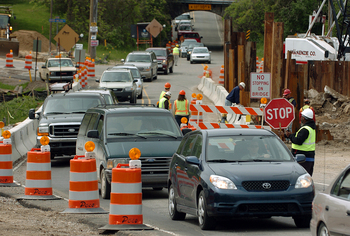
The 2008 reconstruction of the Main Street Bridge in Dexter is one of only a few bridge replacement projects funded in Washtenaw County in recent years.
File photo
There is good news, however, as three of the five closed bridges are slated for replacement this fall — two in Lima Township and one in Sharon Township.
The Road Commission has also applied for funding for five additional bridges, including the remaining closed bridge in Lima Township. But there is no guarantee any of them will be chosen. On the Road Commission list are three bridges in Saline Township, and one each in Dexter Township and Lima Township for the 2014 fiscal year.
They are the Austin Road bridge over the Saline River, the Austin Road bridge over the Bauer Drain, the Feldcamp Road bridge in Saline Township, the Liberty Road Bridge over the Mill Creek in Lima Township and the McGregor Road bridge over the Portage Lake Outlet in Dexter Township.
All five bridges are slated for replacement. The Austin Road bridge over the Saline River has an estimated replacement cost of $1.125 million; the Austin Road bridge over the Bauer Drain has an estimated replacement cost of $755,000, while the cost for replacing the Feldcamp Road bridge is estimated at $1.235 million.
Townsend said the county continues to evaluate all of its bridges every two years and monitors conditions while applying for funding.
“It hasn’t changed much from last year,” Townsend said. “Overall, across the state, it continues to get worse.”
According to a previous report by the Washtenaw County Road Commission, of the 111 total county bridges, there are 43 in good condition, 30 in fair condition, 22 in poor condition and 16 in critical condition.
But the Road Commissions must rely on state and federal funding to fix the crumbling structures, but neither the state nor the federal government is letting loose with enough money to fund all the projects.
Funding comes from a percentage of the state’s gas tax, and gas tax revenues have decreased by more than $100 million since 1997 — the last time the gas tax was increased.
In 1992, the state program to replace local bridges was funded with $38 million, and about 150 bridges were replaced, Townsend said.
That same level of funding is expected for 2012, and about 27 bridges and 13 rehabilitation projects will be funded.
“So, that’s about 40 bridges across the state,” Townsend said, noting that costs have more than doubled since 1992.
In 2010, the Dexter-Pinckney Road Bridge in Dexter Township was replaced. Before that, the Plymouth Road Bridge in Superior Township was replaced in 2009, the East Delhi Bridge was rehabilitated in 2008-2009, and in 2007-2008, the Dexter Main Street Bridge was replaced.
Lisa Allmendinger is a regional reporter for AnnArbor.com. She can be reached at lisaallmendinger@annarbor.com.
Comments
CobraII
Tue, Jun 7, 2011 : 4:31 p.m.
<a href="http://www.heritage.com/articles/2010/05/09/chelsea_standard/news/doc4be5882155b0b875515292.txt" rel='nofollow'>http://www.heritage.com/articles/2010/05/09/chelsea_standard/news/doc4be5882155b0b875515292.txt</a>
CobraII
Tue, Jun 7, 2011 : 4:28 p.m.
Why doesn't the Klinger Rd bridge make the list any more? Oh yea only farmers used it anyway!
Silly Sally
Tue, Jun 7, 2011 : 12:06 p.m.
Its a shame that the Wash Cty Road Com does not have its priorities straight. Before building traffic circles, it should repair bridges and fix potholes. Bridges can be simple, not expensive ones such as the one over the Huron River and the RR tracks at Dixburo. (They could have simply added a second 2 lane over the river next to the existing 2 lane bridge, and had a conventional RR crossing) They repaved Ellsworth by the airport last summer, even though it was fine and had been repaved 10 years ago.
leaguebus
Tue, Jun 7, 2011 : 3:04 a.m.
Rather than raise gas taxes let's just let the bridges fall down, the property values will fall and we can then add the properties to the green belt program for pennies on the dollar!
northside
Mon, Jun 6, 2011 : 10:48 p.m.
As long as cars remain our primary form of transportation we'll be hit with routine and costly infrastructure upgrades. We've got, what, 4 million miles of roads?
DonBee
Tue, Jun 7, 2011 : 2:25 a.m.
Northside, the Germans, who are also in the frost/thaw zone, long ago changed the standards for road construction. It costs roughly 3 times as much to build a German road, but they typically need little or no maintenance for 12 to 15 years. We know how to build better roads. We just choose not to. A road that can last for a decade with little or no maintenance, even at 3 times the cost per mile would be overall cheaper.
xmo
Mon, Jun 6, 2011 : 10:24 p.m.
What happen to President Obama's Shovel Ready projects stimulus package of two years ago? Their is plenty of money left unspent, Why is it not being used for these projects?
Dog Guy
Mon, Jun 6, 2011 : 10:02 p.m.
The politicians who pretend to represent us are beyond shame.
C. S. Gass
Mon, Jun 6, 2011 : 9:13 p.m.
And yet, the Big House, down the street, gets all the money it needs. Priorities people. Football never won a war or built a nation. Roads do that, and have, since the time of Rome. Increasing gas taxes is not the answer, getting more money out of the entities that use the roads, in the case of Stadium St., U of M, is the answer. What is the use of your Colosseum if no one can get to it? And no, not a football fan, and that's not a crime.
David Briegel
Mon, Jun 6, 2011 : 7:33 p.m.
We're Number One, We're Number One! Better cut those taxes even more.
DonBee
Tue, Jun 7, 2011 : 2:22 a.m.
The "Gas Tax" is the fixed amount per gallon. The state also levies a sales tax on gasoline and Diesel fuel that is not counted in this $100 million reported reduction. In 1997 (according to eia.gov) the average price per gallon was $1.23 - so the sales tax was roughly 8 cents per gallon. Last week gas was running roughly $4 a gallon, so the sales tax per gallon was roughly 24 cents per gallon. While the fixed portion has not changed, the actual state tax paid per gallon is up and the total amount of tax paid on road fuel is up as well. Too bad the sales tax goes anywhere but roads.
northside
Tue, Jun 7, 2011 : 12:34 a.m.
Based on the article Michigan drivers are paying $100 million less than 14 years ago. And paying less to keep up the same (or increased) miles of roads. That makes it a de facto tax cut, even though the usage-based rate has remained the same. (The article didn't mention whether the $100 mil difference was raw numbers or inflation adjusted)
Basic Bob
Tue, Jun 7, 2011 : 12:12 a.m.
So the tax RATE has been exactly the same for 14 years. Explain how this is a tax cut. Fuel usage has decreased, meaning either less miles traveled or lower vehicle weight, and yet the roads continue to deteriorate. I think a tax increase is a great idea, just call it a shovel.
northside
Mon, Jun 6, 2011 : 11:36 p.m.
"Funding comes from a percentage of the state's gas tax, and gas tax revenues have decreased by more than $100 million since 1997 — the last time the gas tax was increased." (See above)
David Briegel
Mon, Jun 6, 2011 : 10:32 p.m.
Starve The Beast?
Basic Bob
Mon, Jun 6, 2011 : 7:48 p.m.
Which taxes were cut? Gasoline taxes?
mojo
Mon, Jun 6, 2011 : 7:13 p.m.
Thank you, Road Commission.
81wolverine
Mon, Jun 6, 2011 : 7:11 p.m.
Yet more evidence that Washtenaw County roads are sub-standard compared to most other counties in this state and the region. Plus, the article doesn't even mention the Stadium Blvd. bridges which is a mystery to me as to how they are considered safe enough to drive over. Also, I've never lived anywhere else that has so many heavily-travelled gravel or dirt roads. There's definitely a price to be paid for living in this area in additional gas costs from rougher roads or driving miles out of your way to avoid closed bridges/bad roads, added tire and car damage, and loss of business.