

Washtenaw County school officials prepare for special education millage renewal campaign
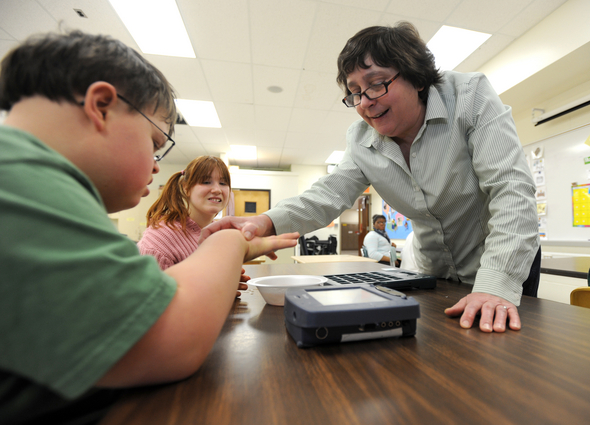
Carol Smith, special education teacher at Scarlett Middle School in Ann Arbor, works with student Donald Armstrong, 15, on a science problem, Wednesday morning at the school. A countywide special education millage comes up for renewal in May.
Lon Horwedel | AnnArbor.com
The failure of the Saline Area Schools bond proposal on Feb. 22 has put a spotlight on the renewal of the countywide special education millage coming up in May.
School officials from around the county are preparing for the campaign with the knowledge that voters are wary of opening their wallets for taxes. However, most leaders are optimistic past support for special education will continues in the spring vote.
Voters in Saline turned down an extension of the school bond renewal with a vote of 2,563 to 2,040.
The Washtenaw County Intermediate School District is asking voters to approve a .985 mill renewal on May 3, which will go to schools to help with the added cost of special education services. The millage will cost the owner of a home with a taxable value of $100,000 about $98.50 annually and will last until 2017.
Richard Leyshock, interim superintendent of the WISD, said it’s essential that school officials communicate the need for the renewal, which helps provide funding for about 7,000 students around the county who receive special education services in local school districts and public school academies.
“For more than 35 years, special education has been making a difference in the lives of students in Washtenaw County,” he said. “Because Washtenaw County voters have a history of supporting children with special needs, we remain optimistic in their continued support.”
About $14 million is at risk in the May vote, school officials said. The federal government mandates special education services be provided, so if the millage is turned down school districts will need to fund the services out of their general fund.
At a glance
Here are some facts about special education services in Washtenaw County:
- About 7,000 students around the county receive special education services.
- Local schools are required to provide special education services for students with mental, physical or emotional disabilities until age 26.
- The special education millage up for vote on May 3 provides about $14 million annually to schools countywide.
- The WISD operates six local-based K-12 classrooms, seven young adult classrooms around the county and eight classrooms at High Point School on the WISD's campus, serving about 240 students.
- State and federal government require special education services in public schools, but only provide about 34 percent of the funding for services.
- For more information, visit the WISD's website
Leyshock said the .985-mill tax rate the WISD is asking to be renewed is less than the 1-mill tax rate voters approved in 2004.
In the days and weeks before the Feb. 22 vote for the Saline bond — which would have gone mainly toward infrastructure — school district officials faced an organized opposition from both Saline residents and outside groups.
One of the outside groups that made calls to encourage Saline residents to vote against the school bond issue was Americans For Prosperity.
Jake Davison, a spokesman for AFP’s Michigan chapter, said the group would help out in providing an opposition to the special education millage if local members asked it to.
“There’s no plans right now to get involved, but if we’re asked again by local members we will get involved,” Davison said.
Saline superintendent Scot Graden said much of the opposition his district’s bond issue faced was directed at the debt nature of the bond. The bond, which would have continued the 7-mill tax rate, was poised to add $22 million in new debt to the current $124 million bond by extending repayment from 2025 to 2031.
He said eight of 15 bond proposals around Michigan passed on Feb. 22, giving a bond close to a 50 percent chance of passing on that day.
Graden said he didn’t see a real connection between the Saine bond and the county special education millage.
“With more than 35 years of community support and the leadership at the WISD, Washtenaw County has been a leader in providing quality special education services for our students,” he said.
Ann Arbor school board Trustee Glenn Nelson, who is heavily involved in special education issues with the WISD, said he assumed the millage renewal will come up against a similar opposition as the election draws closer.
“I have no way of really knowing, but it seems like to me it’s the right thing for us to assume as we think about making the case for passing the special education millage,” he said. “It will be in the context of a similar type of opposition and we shouldn’t act surprised.”
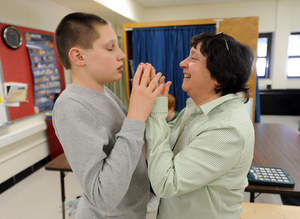
Carol Smith, special education teacher at Scarlett Middle School in Ann Arbor, interacts with autistic student Jon Reed, 13, Wednesday morning at the school. A countywide special education millage comes up for renewal in May.
Lon Horwedel | AnnArbor.com
Deb Mexicotte, president of the Ann Arbor school board, has a child who utilizes special education services, and said she hopes voters in the county show they were willing to support their schools in the vote.
She said she understood why voters in Saline would turn down the bond issue, but money for needs such as facility improvements or special education services has to come from somewhere.
“If we, in this county, are not willing to step up and take the reins of the educational future for our children, we can expect that our quality of life is going to erode,” she said. “That’s not being an alarmist, that’s being a realist. … There’s going to be things that have to be done, and they’re going to come from the general fund.”
If county voters turn down the millage, it could have a major effect on Ann Arbor Public Schools, the county’s largest district.
Interim Superintendent Robert Allen said the district has about $6 million on the line in the May vote. The district is reimbursed for special education services to the tune of $20 million annually.
With the district staring at losing about $7.7 million in cuts from Gov. Rick Snyder’s proposed budget, along with about $1.7 million in increased retirement costs, the loss of the special education funding would have a big effect on the district’s general fund. AAPS’ approved operating budget for the 2010-11 school year is about $182.95 million.
Mexicotte said about 2,000 of the district’s approximately 16,500 students receive special education services.
She said the cuts in funding from Lansing have already caused the district to start “nibbling” around classrooms in ways not previously considered.
“It would be a nightmare from the standpoint of my feelings for the children and young people in Washtenaw County,” Nelson said of the situation if the millage renewal failed and Snyder’s budget cuts went through as proposed.
“I haven’t even contemplated what that would mean, but it would be massive (cuts) rather than trimming.”
Allen said the lesson he took from voters in Saline turning down the school bond was that voters are concerned about economic realities in Michigan.
He said it’s important for school officials during the campaign to show where the taxpayers’ money would go and explain various districts processes and programs to show why it’s important to keep funding special education, even during tough times.
“We have to continue to work hard to inform the public of what the impact of this millage will be,” he said. “When you factor in the current economic climate, I don’t think we’ve faced anything like what we’ve faced over the last couple of years, so the local economy and state economy is in a different place, so I’m not sure if the prior 35 years are going to be relevant.”
Kyle Feldscher covers K-12 education for AnnArbor.com. He can be reached at kylefeldscher@annarbor.com.
Comments
snapshot
Sat, Mar 5, 2011 : 2:25 a.m.
According to the article the 14 million would be taken from the general fund to support this program if the milliage fails. So this program will not be affected. I think administrtors should be educating the public as to the specifics of this program and what mainstream programs they would have to shut down if it fails. I would like to have quantifiable data with dollar specifics and a breakdown of costs. To say it's not a new tax or say it's a renewal and a good thing to do isn't enough for me, and many others anymore. We have an obligation to scrutinize the use of our public dollars. If officials won't do it, we'll do it for them.
bluetonguedlizard
Fri, Mar 4, 2011 : 10:05 p.m.
Hey Annarbor.com can you tell me why the "most popular"comments have far fewer votes than some of the others? For example there is a comment from Susan Montgomery that has 60 votes and yet it is not included in the "most popular". Thanks.
Tony Dearing
Fri, Mar 4, 2011 : 11:22 p.m.
Thank you for pointing this out. We'll look into this and correct it.
RayA2
Fri, Mar 4, 2011 : 5:15 p.m.
Please vote for this millage. Our economic future is at stake. Without an educated population, there is no hope.
Tom Bower
Fri, Mar 4, 2011 : 3:35 p.m.
This is NOT a tax increase. It is a request to approve a renewal of the existing millage. It deserves our support. Property tax assessment notices have already been mailed in many areas. Our taxable assessment is down another six percent this year. That means our property taxes are going to decrease by about $212. Therefore, the amount of taxes we will pay for this millage renewal will be less than they were last year. If this millage request is not approved, each local school district (the ten traditional school districts) as well as public school academies in Washtenaw County that contract for special education services from WISD will end up having to pay for those services out of the school district's general funds. This will further reduce the amount of money available in districts for the general education student population. Lastly, remember, Governor Snyder's proposed budget is calling for a reduction in per pupil funding of about $300. His proposed reduction in per pupil funding plus the non-renewal of the WISD special education millage would be a severe blow to public education students in Washtenaw County. We are voting YES on this millage renewal and urge others to do the same. Tom, Karen and Allison Bower
Lisa Starrfield
Thu, Mar 3, 2011 : 10:21 p.m.
I am concerned by people telling others that it is okay to vote No for this millage because these kids will have to be served anyways and it will just be cuts to the general education budget. Please keep in mind that our Governor's new budget will cut about $700 per pupil from AAPS general funding on top of the money that was cut last year, and the year before and so on. The budget cuts mean that we are already going to have to cut teaching positions for next year... after we eliminated positions last year and years before. Yes, special education services must be provided by law but instead of getting speech or occupational therapy twice a week, students may only get it once a week. Instead of seeing a special education teacher for an hour a day, it might be for an hour a week... if that. Self contained classrooms might see larger class sizes or fewer T.A.s. All of these will have a significant negative impact on our special education students and yes, it will force additional cuts on our general education population as well. We can't keep losing additional funding year after year without significant program changes. We have tried to protect students as much as we can but there will come a time, quite soon, when we simply will be forced to close schools, to increase class sizes well above 30, to cut electives (yet again!) at all levels, to close our school libraries, to get rid of busing, and more if we as a state don't start funding schools appropriately. This death by a thousand cuts has to end.
Tom Bower
Fri, Mar 4, 2011 : 5:31 p.m.
stunhsif, In 1994 I left the private sector and transitioned to the public sector. I was a senior level banking executive with stock options, a 401K with a three percent corporate match, and a pension plan. After twenty-three years I had three weeks of paid vacation time. My compensation has never approached 2/3 of what I had while employed in the private sector. Guess I left it for the riches of the public sector. Stop with all this hyperbole regarding gold platted healthcare and pensions. The most recent report shows that in Michigan public workers total compensation is less than private sector employees when comparisons include like levels of education. If a person wants to make big bucks, the private sector is the place to be. Just look at the salaries of the Wall Street investment bankers. Before you condemn those who work in classrooms for being paid too lavishly, try walking in their shoes. If you haven't already done so, volunteer for a semester in a public education classroom. It may give you some new insights.
DonBee
Fri, Mar 4, 2011 : 2:13 a.m.
No one knows if the Governor's budget will pass or not. Cuts last year ended up being partially restored. Mandatory contributions by teachers to the retiree programs have been ruled illegal and probably will be returned to the teachers who had the money taken. Just because someone says they want to do something, you cannot assume it will happen and if it happens it does not mean it will stick. Sorry Lisa, we don't know what will happen yet. So I am not taking the sky is falling talk to heart yet. I note in your "We will cut" that sports is not included, not in AAPS. Since more than 80 percent of the spending for the school system is in salaries and the only people who were willing to do give backs did that last year, what will really happen is there will be layoffs - that is where the money is.
stunhsif
Fri, Mar 4, 2011 : 1:51 a.m.
Give up your ten sick days, your "professional days", your personal days, pay an equal percentage for your healthcare to match the private sector, have your copays match the private sector and fund your pensions to a much higher degree or roll them over to 401K's. Then we will vote yes on these millages. Till then, the money the schools need will never be approved by the taxpayers. Is it fair and reasonable that we who pay for your grand lifestyles have no where near the gold plated benefits ? I have no problem with your income at all, it is your gold plated healthcare and pensions that are bancrupting darn near every state in the union. Good Day No Luck Needed
dotdash
Fri, Mar 4, 2011 : 1:30 a.m.
(If you meant me) I was not at all saying it was okay to vote no because it would just come out of the general budget. Those who are just as happy to have no special ed services should know that voting no will not stop money from going to special ed, but rather hurt all kids.
YpsiLivin
Thu, Mar 3, 2011 : 9:06 p.m.
Of course, you all realize that the millage that's up for renewal is the ADDITIONAL special education millage that gets collected on top of the "charter" special education millage that funds special education in Washtenaw County, don't you? (Special education and EXTRA special education? Perhaps others can, but I don't think my household can afford this double-dip anymore.) <a href="http://www.wash.k12.mi.us/files/speced-millage/12QAs2011.pdf" rel='nofollow'>http://www.wash.k12.mi.us/files/speced-millage/12QAs2011.pdf</a> For those who are worried about what happens to special education in WISD if this doesn't pass.... same source: "What will happen if it isn't renewed? If the special education millage is not renewed, an additional $14 million per year will have to come from the general fund budgets of local public schools, bringing the total funding up to $34 million that would have to come from the funding for general education programs for all students."
YpsiLivin
Fri, Mar 4, 2011 : 8:57 p.m.
Thanks for spending my money for me (have you ever considered a career in politics?), but I was planning on using my newfound wealth to offset the rising cost of gasoline, which some predict will hit $5 per gallon by the end of the year. The term "offset" applies only when household income increases, remains flat or declines less than the value of the property does. None of these are true in our case. I'm sorry, but it's time to stop denying that we're all in serious financial trouble. Things just aren't the same as they were in 2004, and they're not likely to get better in the immediate future. You may be able to afford two special education millages; good for you. I can't.
Tom Bower
Fri, Mar 4, 2011 : 5:33 p.m.
And, your declining property value and declining property tax bill will help offset the renewal of the special education millage.
Tom Bower
Fri, Mar 4, 2011 : 4 p.m.
That's the point. If this millage is not renewed, the money will come from the general funds of the traditional school districts in Washtenaw County. This is money those districts do not have.
sbbuilder
Thu, Mar 3, 2011 : 8:31 p.m.
Why is there no middle position even being talked about? Why all or nothing? On another of today's articles, it is pointed out that over half of our property taxes goes to education. That's huge. We've shown a willingness as a community to ante up when asked to fund education. That's great. But we no longer live in the milk and honey of the nineties. That sucks. We should be having this debate while standing in the foreclosure courtroom. That's reality.
Tom Bower
Fri, Mar 4, 2011 : 4:50 p.m.
Lisa, You are correct. The funding system for public education in Michigan must be reformed. And, many are doing well in the current economy. They should be paying more than 4.25% of their taxable income in state income tax. And, why don't we tax services. Instead, the proposed budget is going to reduce business taxes and increase taxes for retired persons and low income people. I'm sure the businesses will hire more people and lower their prices once their tax decreases kick-in. No, that won't happen. Just more corporate welfare, bigger profits and a higher return for shareholders. Children coming from economically disadvantaged families will suffer the most as a result of higher classroom sizes. This will all help to enhance not only the achievement gap, but also the income gap. I agree with Diane Ravitch. Public education is under attack today, and the attack threatens to destroy it, to the disadvantage of the working class. We are voting YES on this millage renewal.
Lisa Starrfield
Thu, Mar 3, 2011 : 11:25 p.m.
Because much of that money leaves the community due to Proposal A. When that went through, the state made a promise to continue to fund schools adequately. They have failed that promise.. year after year. Oh and please keep in mind that many in Michigan have done just fine through this recession... many have prospered.
dotdash
Thu, Mar 3, 2011 : 7:25 p.m.
If the millage doesn't supply the money, the school system still has a legal obligation to provide the services. As I understand it, that means less money for non-special education students. The losers, if the millage fails, would then be the school system as a whole. Am I wrong here?
Tom Bower
Fri, Mar 4, 2011 : 4:35 p.m.
Basic Bob, Teachers will suffer financially. Districts will have to use general education money to pay for special education. Some teachers will lose their jobs. Those who remain will see increased class sizes. Larger class sizes may not have a great deal of impact in economically advantaged school districts, but they will have a devastating impact on children in school districts with a high percentage of students from low income families. Having 35-40 of these students in a classroom negatively impacts their education. If you don't think so, just visit classrooms in any of the following school districts: Willow Run, Ypsilanti, and Lincoln.
Lisa Starrfield
Thu, Mar 3, 2011 : 11:23 p.m.
Special education services will be cut because services are mandated, the level and amount of time is not. So yes, the special education students and the general education students will suffer.
Basic Bob
Thu, Mar 3, 2011 : 9:24 p.m.
Administrators will not suffer. They must get double-digit raises to be 'retained', and if they fail to do their jobs, they will get the platinum parachute - a year or more salary without having to show up to work and lifetime benefits. Teachers will not suffer financially, although their classes may become a bit larger. But the children! I can hear the fear uncertainty and doubt already.
bs
Thu, Mar 3, 2011 : 8:02 p.m.
"The losers, if the millage fails, would then be the school system as a whole. Am I wrong here?" No, the "losers" will be the children. People really want to avoid taking responsibility for that, don't they? What is this "school system" everyone wants to punish? What the heck is that about? Chop funding to education, take something away from the kids we're trying to educate... Say that... Tell your kids, "sorry honey, no sports after school, oh, and you'll need to walk tomorrow, I didn't want to pay for the buses, and, you'll need to walk home for lunch 'cuz that kitchen was too expensive to fund. But... Don't worry, it won't make any difference in the long run, because you won't be able to get into college anyway after we drive all the experienced teachers away..." :)
ypsilistener
Thu, Mar 3, 2011 : 7:41 p.m.
You are correct. No question about it.
Top Cat
Thu, Mar 3, 2011 : 6:54 p.m.
I voted for this in 2004 without hesitation. Whether it is a new tax or renewal is irrelevant. Over the last few years my income has dropped. My home insurance just went up 9%. I blanched when I filled my gas tank today. I know that many others have the same situation or much worse. My confidence in the public education system has plummeted. I'm having a real hard time with this.
Lisa Starrfield
Sat, Mar 5, 2011 : 1:43 a.m.
Don, Since I don' t know which story you are referring to I don' t know which strategies you are referring to so I can't answer whether those methods would be better or not because we may already be doing them or doing something very similar or something with better outcomes. However, having said that, just because YOU don't hear these conversations doesn't mean we aren't having them. We spend a year or more evaluating curriculum every time we adopt new curriculum focusing on best practices. In Ann Arbor, our math instruction is problem based and our science instruction is inquiry based... both are considered best practices. We are constantly trying to improve our performance. The achievement gap is a near obsession at the district and it is smaller than it was but still not where it should be. We are still working on it. I also have to ask, who was touting these strategies? Where is the research? For how long has it been in practice and where? Was it peer reviewed? Or do we have a few Harvard grads who taught for two years, quit because it was beneath them and now claim to be experts? Unfortunately, there are a lot of people who profit from pushing the latest, best magical solution to all our problems. And I really don't understand how anyone can possibly expect BETTER or even the same outcomes with less resources.
Tom Bower
Fri, Mar 4, 2011 : 4:27 p.m.
To Cat, Home insurance went up, even though property values are going down? You may want to get some other quotes. Look on the bright side: with declining property values, your property taxes will be going down, even if this millage renewal is approved.
Will Warner
Fri, Mar 4, 2011 : 12:20 p.m.
People probably get tired of reading this, but my kids got an outstanding education in Saline. In a combined 20 years of attending school there, they never had a bad teacher, and many exceptionally good ones. My kids were well prepared for college and life. Don't misread this as support for teachers unions, however.
DonBee
Fri, Mar 4, 2011 : 2:07 a.m.
Lisa - Nice to see you commenting again. I don't see anything here about lazy teachers. I did however notice that we still have an achievement gap and no one has offered any new ideas on how to close it. I listened to NPR last night and heard a suggestion that the education system is broken, that we should be teaching children differently, then I listened today to stories about how to do science and math differently to really engage children. I note that nothing like these comments has been floated in AAPS. What say you? Should we change how we teach children?
Lisa Starrfield
Thu, Mar 3, 2011 : 11:22 p.m.
Your confidence in the public education system has plummeted? WHy? Because you hear lie after lie about how greedy and lazy teachers are, how stupid our students are, how bad the schools are... all from groups who actively working to destroy public education.
drewk
Thu, Mar 3, 2011 : 6:37 p.m.
It is a RENEWAL people, not a new tax
Cash
Thu, Mar 3, 2011 : 6:59 p.m.
That is understood. A MAJOR tax increase is proposed for the elderly and poor as part of Snyder's budget. Therefore, the wallet is empty.
bs
Thu, Mar 3, 2011 : 4:59 p.m.
Each time I see the same people touting the same party line with no eye to the facts, the reality, or any consideration as to what is right or wrong, I am thankful for the concept of Karma, because, some day, this will all come back to bite them where it hurts. But, heck yeah...let's turn this millage down, lets shut down a few special education programs (after all, those kids don't have enough clout to take us out of office, and their parents are too busy trying to cope with devastating disabilities to get out and make trouble for us! It's always safe to lay the problem on the backs of those that are most disenfranchised, the poor, the disabled, the old. God forbid we ask the rich, or the corporations to step forward and contribute more (or, for that matter, even contribute a fair amount!), they've got folks to lobby against us, they are they ones that contribute to the campaigns, don't rile that hornet's nest. I read a quote the other day (for those that are still spouting that "take it away from the teachers and cops, and public employees, take it away from the schools" line) "Why is it when we propose a 3% tax hike on the rich and on corporations it's called "socialism", but when we propose a 14% pay cut on the middle class it's called "doing your share?" Folks, it's your community, vote in a manner that makes you proud of what our priorities are here.
Tom Bower
Fri, Mar 4, 2011 : 4:19 p.m.
Cash, The 100 percent state tax increase is not a done deal. The governor's budget is only a proposed one at this state. He may want to be a one term governor, but legislators, even Republicans, may want to be re-elected. His proposed budget amounts to corporate welfare at the expense of those least able to afford higher taxes. I'm sure businesses will hire more workers and reduce prices for consumers once they being paying lower taxes. Meanwhile, those with six and seven figure incomes will pay the same 4.25 percent of their taxable income as those making far less.
DonBee
Fri, Mar 4, 2011 : 2:03 a.m.
None - It will not be the special education students that suffer, it will instead be the rest of the school system. By law the schools cannot reduce the services they provide for special education. So football, basketball, science, and other non-special ed programs will suffer. Well, maybe not football and basketball, since the school always finds a way to fund sports. But science surely will. There are a lot of opportunities to make the schools more efficient, but instead the schools will cut teachers, because that is what will cause an uproar in the community. But, maybe the new very well compensated superintendent will do something different. Cash - Do you not have any positive proposals for how to fix what is broken? Inquiring minds would like to know? Right now it looks like the State House and Senate will pass little or none of Gov. Snyder's budget, so you have nothing to worry about, how about some positive thought about how to get Michigan out of the ditch?
Cash
Thu, Mar 3, 2011 : 7:03 p.m.
"Folks, it's your community, vote in a manner that makes you proud of what our priorities are here." For many elderly and poor their priority will be to buy food, pay utilities, pay home expenses, car expenses, basic clothing, medicine and medical care. Now a new 100%+ increase in state tax. There's nothing left.
John Spelling
Thu, Mar 3, 2011 : 4:19 p.m.
I am no less passionate about the disabled than the next guy but, come on, this millage is not about whether we continue to provide services to students with disabilities. The school districts are under legal mandate to provide these services, regardless of whether the millage passes or not. This millage we are being asked to renew is one of the few loopholes the state allows for a local school district to increase income (by reducing an expense obligation). This is simply accounting - nothing more, nothing less. By moving what was once a line item expense on the local schools books to this millage, the schools have additional money to fund salary raises, retirement and golden health care policies of local district teachers, staff and administrators. Enough then of the passionate plea for the disabled. This is not what this millage is about. Demand that the ISD and school districts be honest on this point.
ViSHa
Thu, Mar 3, 2011 : 3:53 p.m.
I have friends that are always complaining that they have to fight tooth and nail to get services for their special needs children. Some staff are floated between buildings to cut costs. So where is this money going?
snoopdog
Thu, Mar 3, 2011 : 3:26 p.m.
I will be voting no. I am still trying to figure out how I am going to come up with the money to pay my summer taxes. I suggest the schools do away with MESSA, the teachers start paying more of their healthcare and pension costs and they get rid of the 12 sick days a year they get. There are millions of dollars there to be had that can be turned toward the kids. If I have to choose between more taxes and putting food in my stomach, I will choose the food.
Tom Bower
Fri, Mar 4, 2011 : 3:52 p.m.
Teachers in many school districts in Washtenaw County and other Michigan districts have already given up pay increases and are paying more towards their health insurance. In Washtenaw County, for example, talk with teachers in the Ypsilanti Public Schools. Ypsilanti School District teachers and staff are working six unpaid days this year. Continuing reductions in the taxable value of real estate in Washtenaw County means declining revenues for local school districts, even though the millage rates are static. Non-labor costs for the schools have also increased: fuel, electricity, natural gas, etc. just as they have for everyone. Schools are doing more with fewer people. Teachers have larger class sizes and work with students before and after normal school hours.
Lisa Starrfield
Fri, Mar 4, 2011 : 11:45 a.m.
My children's daycare provides sick days for their teachers. Engineers, doctors, lawyers, nurses, fireman, policeman... all get sick leave My mother who worked as a bank teller had sick days until she retired two days ago. Salaried workers get sick days (sometimes its called PTO and is combined with vacation). Many hourly workers do as well. How much instruction do you think will be done when you have a teacher leaving the classroom to be sick every 15 minutes, or who can't speak because she's lost her voice?
stunhsif
Fri, Mar 4, 2011 : 1:28 a.m.
Lisa, Most all of us in the private sector stay home sick without pay, that is the way it is. So like the rest of us can stay home sick without pay as well. This will save Washtenaw County at least several million dollars per year which can go toward the children. Also, you pay a pitance toward your healthcare and pension costs compared to the private sector and you know it. Raising the percentages for Washtenaw County teachers would again save Washtenaw County several million dollars. Combine these monies saved and you have many millions more to spend on the kids.
Lisa Starrfield
Thu, Mar 3, 2011 : 11:19 p.m.
Oh and we do fund our pension. 6% of our paycheck is taken out for our pension and another 3% for retiree health care we are told we can't expect. Clearly you do not know of which you speak.
Lisa Starrfield
Thu, Mar 3, 2011 : 11:18 p.m.
We have a choice between several plans and those of us who choose Messa (or any but the cheapest option) pay the difference between what the district pays for the cheapest plan and the cost of our selected plan. Why do you have a problem with us have choice? And no, we don't get 12 sick days. We get 10. Do you really want your son or daughter's teacher coming to school vomiting, with diarrhea, strep throat or any other illness that your kid will catch?
Cash
Thu, Mar 3, 2011 : 2:44 p.m.
I think a lot of people fail to realize that this is a whole new ballgame. Snyder is proposing significant tax increases for the elderly and the poor of Michigan. This is new. And it will definitely impact what happens to millage votes, and tax continuation votes and increase votes locally. The elderly vote at a much higher percentage rate than any other group. Some elderly will be taxes 100% more than before and yet their income will not change foe the rest of their life. They do not have the money now to pay for their bills. Where do they get the money to pay the new state tax? and any other tax? For the working poor, some who might have children in a special program or not, their taxes will increase even more in many cases. The proposed changes in state tax structure will have ripple effects all over the state. Elderly people cannot borrow money to pay taxes because their income will not change, they could not pay it back. The only voice they have is in the voting booth. The working poor, hit by the tax increase from Snyder are already in bad shape. There is no money left. The only voice they have is at the voting booth. And this doesn't even consider the unemployed and underemployed. This will be the first of many requests for money. There will be many more to come, for sure. As the state money to cities, counties, schools, etc is cut, those entities will come to the voters.
zip the cat
Thu, Mar 3, 2011 : 1:53 p.m.
The reason the saline millage failed was the sneaky under the table cram it down our throats way graden tried to force it thru. What part of we are broke don't you people understand. When I see a $65.000 dollar raise being given in tough times I will vote NO
Tom Bower
Fri, Mar 4, 2011 : 4:10 p.m.
zip the cat, Your comments about Mr. Graden are off base. The Saline Bond extension proposal was not "sneaky" or "under the table." That election is history. Let's stop the name calling and focus on the issues at hand concerning the special education millage renewal.
Annie Zirkel
Thu, Mar 3, 2011 : 1:50 p.m.
As the mother of a child with significant disabilities, I am always concerned when things like this come up. Because while often extra supports and services do help these children reach higher potentials - in my son's case he isn't ever going to be an economically-wise investment. So it will come down to compassion and whether people feel morally- or socially-compelled to do it anyway. Obviously I hope people vote for this renewal and am encouraged by the comments here and by the knowledge that historically people in this area are willing to support these kinds of needs. But these days, between the harsh realities that families and communities are facing - and the hardening of so many public conversations - all it might take is some cold, angry money to turn sentiments against this millage. Knowing that there is a group ready - if asked - to do just that, doesn't help.
sbbuilder
Thu, Mar 3, 2011 : 8:21 p.m.
I had three of my kids go to Haisley at some point. They do an outstanding job with special needs children. One of my daughters spent every free period with the special needs children. Those kids, however, receive around 26-28k worth of care each year. Everything has a price. We are now being forced to decide, with a much more limited budget, how those monies are to be spent. We just can't fund everything to the max anymore. Perhaps there is a compromise somewhere.
sbbuilder
Thu, Mar 3, 2011 : 8:17 p.m.
Ms Zirkel First, I would refer you to the comments posted by Cash and DoNotTaunt... above. People are living with their backs to the wall. For many there is no more wiggle room. I'm sure many would not bat an eye at supporting a millage of this kind in the past. It's really not an us against them type of mentality. I don't see this millage as a dividing point. We all want our kids to have an excellent education. We're not divided on that.
Hallmark
Thu, Mar 3, 2011 : 1:36 p.m.
I'm currently in the process of moving to Washtenaw county. The main reason I focused on moving here was because my kids are coming up on school age and I wanted to live where the best schools were. This is one of the biggest attractions for places like A2, Dexter, Chelsea and Saline and keep home values up people. Take a look at the surrounding counties. You think your home values have taken a hit, look at home prices in all the surrounding counties. I could have bought twice the house in one of them.
DonBee
Thu, Mar 3, 2011 : 1:28 p.m.
While I am known for my dislike of millages and taxes, as well as the WASTE that is included in the local school districts, I cannot advocate turning this millage down. The vast majority of the millage goes to student services. If the school districts want an easier passage they would do the following: 1) Provide a clear breakdown of how many students use these services and how much is spent directly in the classrooms 2) Bring their financial data on-line up to date, most the WISD districts have promised transparency and then stopped providing that very thing to the voters 3) Provide a clear list of where locally funded tax money is being spent (e.g. where is the sinking fund being used, special education, etc). People would feel better about voting yes for these millages if it did not seem like the districts were hiding things. But to repeat my statement above, I will vote and I will vote yes on this millage. I would not vote yes on an "enhancement" or a "sinking fund" or a "bond" issue right now - too much is unknown about how those funds were spent, but this one I would vote yes.
DonBee
Sun, Mar 13, 2011 : 12:13 a.m.
My comment was discussed at the strategy meeting this week. I find it interesting that a meeting was called by the WISD that included the various teacher's union reps, reps from the state union and the various school administrations. The teacher's union is raising funds to pass the millage. The mention of this comment was made as an indicator that there would be NO organized opposition to the millage. In the next breath, the speaker said they would not provide the transparency that I asked for in the comment. These kinds of meetings and comments are making me re-think my opposition. Even more so was the "tug on the heart strings" plan to use sibling students in radio and print ads about not making teachers choose who's needs they serve. Talk about pandering!
Tom Bower
Fri, Mar 4, 2011 : 4:03 p.m.
YES!
cinnabar7071
Thu, Mar 3, 2011 : 1 p.m.
Hey look I just found $2.3 million and didn't even leave my house. <a href="http://www.annarbor.com/news/ann-arbor-school-board-approves-construction-projects-for-pioneer-high-school-athletic-facilities/">http://www.annarbor.com/news/ann-arbor-school-board-approves-construction-projects-for-pioneer-high-school-athletic-facilities/</a> Good luck with the millage with this kind of spending.
Tom Bower
Fri, Mar 4, 2011 : 5 p.m.
Wake up soccer moms and dads. Get out and deliver the YES vote. If this millage renewal is defeated, pay to play costs will increase, if there are any teams at all. Students will be negatively impacted in every school district in Washtenaw County.
chapmaja
Fri, Mar 4, 2011 : 5:31 a.m.
You are aware that the funding for building things like athletic facilities and operations of the district don't come from the same money don't you. The building of facilities comes from one set of money and operations comes from a different set of money. I have no problem with PiHi building athletic facilities as several of them are honestly dumps and certainly are not close to the level of teams that PiHi puts out on the field/court/ect. I have seen a lot of athletic facilities working as an official and honestly PiHi's generally rank among the worst for Class A high schools that I have seen outside inner cities. The only PiHi facility that is at the level of the teams competing in it is the pool.
macjont
Thu, Mar 3, 2011 : 3:13 p.m.
Want to confuse issues? You've succeeded.
Do not taunt Happy Fun Ball
Thu, Mar 3, 2011 : 12:58 p.m.
We all care. We do. Really. Special needs kids -DS- are close to my heart. And this debate will certainly be all over the board. But the tax base has been crippled (year 8 now.) I think if every school district could be funded to 1,000,000 dollars per student that would be great . But the cash is simply not there - Jobs have been lost - good jobs have been lost and replaced with weaker jobs - the MI average salary is down by about 10K - Private homes are at risk. Those not in foreclosure are facing neighborhoods where homes are down 30-40% in value, if not more. Commercial properties are being foreclosed on and entire developments are bankrupt and lost. People are just not moving into the state (The Basic Problem) and that means Zero growth and that means most business folks futures are now based on grabbing market share from neighbors. Some folks are doing well, the U, some others - good for them. But 70% of voters have been hit hard, even in this county. This is Michigan - this is 14% unemployment, the highest foreclosure rates, the highest bankruptcies, the fewest new job 'created', a state that has Lost nearly One Million jobs in the last eight years - under the last administration. You can always ask for more debt burden - the cause is certainly just - but there is no money left in the taxpayer till. In any case, ISD - Please use what funding you have very very carefully to complete your mission. I am a taxpayer and I am broke.
a2trader
Thu, Mar 3, 2011 : 12:44 p.m.
@ Kyle Feldscher. It would be helpful if you add information about this being a "renewal." As a property owner, did I pay for this millage in 2010, and now I will just keep paying the same (or maybe less since the millage amount is slightly smaller) in 2011 if I vote YES? That is what I think of as a renewal. We all know the schools are going to get squeezed by the governor. Not passing this "renewal" will only make the school funding worse. I think it would be helpful for people to know whether their property taxes from last year to this year will go up because of this renewal, or if taxes will essentially be unchanged - the governor's proposed tax structure not withstanding.
Tom Bower
Fri, Mar 4, 2011 : 5:03 p.m.
Check your property tax assessment notice that will be arriving soon in the mail. It's likely that the taxable value of your property has declined. That means, your property taxes will be less. This is a millage renewal in a declining property value environment. Passage will NOT increase your taxes. Passage may help stem the decline in your property's value, however.
A2Since74
Thu, Mar 3, 2011 : 1:37 p.m.
I am also confused regarding the millage rate. My house has a taxable value of $146, 960 and per 2010 summer taxes the millage rate per $1,000 was 3.87610 so I paid $569.63 for WISD Spec Ed. If the special millage is not renewed, then what will my millage rate be?
KJMClark
Thu, Mar 3, 2011 : 12:24 p.m.
"If we, in this county, are not willing to step up and take the reins of the educational future for our children, we can expect that our quality of life is going to erode" - Ms. Mexicotte. That is painfully out of touch. Isn't she aware that for most people, in the past few years their quality of life has already painfully eroded? I hope people will approve the renewal, but I suspect it's going to be close if it passes. It would help if our leaders were more sensitive to the situation out there.
Cash
Thu, Mar 3, 2011 : 12:15 p.m.
Any millage is going to be difficult to pass now. This has nothing to do with the deserving nature of the millage...it has everything to do with the financial burden of Snyder's tax increases on the poor and the elderly. If people cannot afford to pay any more in taxes, they will vote "no" regardless of the reason for the millage. In the case of elderly, they can't get "more money" to pay an increased tax as their income will never increase. If there is no money left, they cannot take on more expense. The tragedy is that some of the neediest causes will suffer because some people will just not have any money left to pay local taxes by the time they are done paying state tax that is earmarked to go to big business in Michigan.
Lisa Starrfield
Thu, Mar 3, 2011 : 11:13 p.m.
They aren't paying more. This is a renewal.
Cash
Thu, Mar 3, 2011 : 2:15 p.m.
sbbuilder I can completely understand that. For the elderly more taxes just will break many. I'm lucky so personally I'm okay. But I know many who flat out will not have the money to pay any more taxes. And so they will understandably vote down every single millage that comes by their way....it wouldn't matter if the momey was for themselves...they just do not have it. And the elderly vote.
sbbuilder
Thu, Mar 3, 2011 : 1:39 p.m.
Cash I will agree with you on this one. Except for the big business part. I have a 'small' business, and have been taxed twice every year. My profits are taxed, and my personal income is taxed. I'll be glad to see the business part go away, or lessen.
breadman
Thu, Mar 3, 2011 : 11:53 a.m.
I will support it all the way. Reminder in the millage vote! No Child left behind!!! And there are lots of work on getting these students moving.
Susan Montgomery
Thu, Mar 3, 2011 : 11:39 a.m.
Wonderful photos as always, Lon. You know how to make the inside shine on the outside... As for the lower caption, editing remnants were not removed in the caption for the second photo between the two full sentences...
Jen Eyer
Thu, Mar 3, 2011 : 12:14 p.m.
Thank you, Susan, for pointing this out. It's been corrected.
Susan Montgomery
Thu, Mar 3, 2011 : 11:36 a.m.
I encourage folks to support this millage. These students need our support. Even strictly from an economic perspective the more we invest in their education the more self-sufficient they will be in the long term, saving government expense in the long term. As for those who will argue that these programs will be funded regardless and cuts will have to come from elsewhere, funds have already been cut, middle schools going from 7 periods to 6,, class sizes getting larger, less flexibility in class schedules at the high school level because classes are so full...
YpsiLivin
Fri, Mar 4, 2011 : 2:45 p.m.
Lisa said: "Special education services ARE mandated by law... but the quantity and quality is not. " The MDE Web site has both the Federal and State Special Education requirements. Let's just say that your FUD is showing, Lisa. 340.1738 Severe cognitive impairment program. (Also known as Rule 38) Mandates a specific number of teachers and aides in a classroom; limits the number of students in a classroom to 12; provides an exception to the limit ONLY if another aide is added; mandates the number of days of instruction; mandates the number of hours of instruction; restricts breaks in between instructional periods. 340.1739 Programs for students with moderate cognitive impairment. (Rule 39) Mandates the number of teachers and aides in a classroom; limits the class size to 15; provides an exception to class size only if additional aides are added. R 340.1740 Programs for students with mild cognitive impairment.(Rule 40) Mandates the number of teachers in an elementary classroom; limits the class size to 12; requires the addition of an aide to allow the class size to move to 15; limits the class size for secondary students to 15; limits the number of students one teacher may manage to 15. 340.1741 Programs for students with emotional impairment. (Rule 41) Limits the class size to 10; limits the total number of students a teacher can manage to 15. 340.1742 Programs for students with hearing impairment. (Rule 42) Limits the class size to 7 per teacher; requires classroom modifications; 340.1743 Programs for students with visual impairment. (Rule 43) Limits class size to 8 students per teacher; limits total student management to 10. The list goes on through Rule 58, and includes very specific State mandates for SE programs, services, teacher and aide requirements, instructional hours, physical space, non-academic year services, etc. <a href="http://www.michigan.gov/documents/mde/MARSE-April09_274156_7.pdf" rel='nofollow'>http://www.michigan.gov/documents/mde/MARSE-April09_274156_7.pdf</a>
YpsiLivin
Fri, Mar 4, 2011 : 4:32 a.m.
Lisa, From: <a href="http://news.a2schools.org/?p=3873" rel='nofollow'>http://news.a2schools.org/?p=3873</a> Quoting WISD Interim Superintendent Richard Leyshock - "Seven years ago voters approved this millage," he said. "We're seeking the renewal because the demand for special education continues. And, without adequate special education millage, local districts will be required to take increasing dollar amounts from their general operating funds to provide special education programs that are required by state and federal law."" You assert that reductions "could" happen, and "maybe" student "might" be affected, but that's not at all what the ISD is saying. Given that the majority of special education funding is preserved through the charter special education millage, state and federal sources, the impact of a millage failure will be seen in the general education classrooms, not the special education programs. Given your position, the Chicken Little routine is predictable; union fear-mongering and FUD about who's really going to be affected, on the other hand, are what's really despicable.
Lisa Starrfield
Thu, Mar 3, 2011 : 11:12 p.m.
YpsiLivin, Special education services ARE mandated by law... but the quantity and quality is not. There is no law that mandates how much hours a speech a child should get or how many minutes of TC time or how many students can share an aid. An autistic child could lose his TA The special education classroom could lose their TA or be combined with another class. The child currently speech or OT two to three times a week could see their services cut in half. The child who gets daily time with a special education teacher might see that cut to once a week. They will still be served but not to the level they were. You are actively encouraging people to vote against this by telling them special education services won't be harmed. That's dishonest and despicable frankly. Special education services will have to be cut if this millage fails to go through. Based upon Snyder's budget, special education services may have to be cut even if this millage RENEWAL passes. $700 per pupil can't just come out of the air... especially since we have had year after year of cuts.
YpsiLivin
Thu, Mar 3, 2011 : 2:12 p.m.
The fact that cuts have already been made to general education budgets of the local districts doesn't change the fact that special education already receives the vast majority of its funding through the state and federal governments. It also doesn't change the fact that special education services are MANDATED BY LAW and WILL be paid for, by hook or by crook. Not one special education service will be cut if the millage fails and not one special education service will be added or preserved if it passes. This proposal is designed to deliver benefits to the general education classrooms by eliminating the diversion of funds from general ed classrooms in order to meet the districts' special education obligations. It's the general education classrooms that will be cut if the millage fails. Special education will remain untouched, as required by law. The fact that the ISD has REDUCED the amount of the millage renewal says to me that they're well aware that the millage collects a lot of cash. They're voluntarily throwing a .015 percent bone back to the taxpayers. For the entire term of the millage, that doesn't even amount to one trip to McDonald's for my family. I live in a district where I pay more to retire the school debt than I do to operate the school system, and the revenues collected from this millage account for more than 20% of the total taxes I've paid for K-12 education since 2004. The revenues I pay for this millage (to serve 138 SE students) are 60% of what I pay to operate my district (with 3,800 students). What's wrong with this picture? Public education is the last of the great welfare queens. It's high time Her Majesty made her way to the table.