

Whooping cough cases still at record numbers in Washtenaw County
Cluster of cases reported in Saline
Washtenaw County residents continue to contract whooping cough in record numbers, said Laura Bauman, an epidemiologist with the Washtenaw County Department of Public Health.
So far this year, the county has had 37 confirmed cases, far surpassing the 20 cases reported in a typical year. Last year, the county had 81 cases of of whooping cough, the highest number reported since the county started keeping electronic records in 1992.
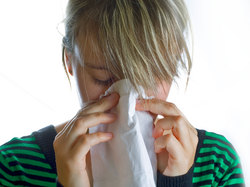
The Saline area alone has had 10 cases of whooping cough, known medically as pertussis, this year, Bauman said. The Saline school district e-mailed parents and guardians earlier this week, urging them to have children with a lingering or severe cough evaluated by a doctor.
Superintendent Scot Graden said a student at Heritage Elementary School was recently ill with pertussis.
Bauman said health officials aren't sure what has caused the record-high number of cases. Officials have more accurate testing measures, so it could be that many people who went undiagnosed before are being tested and having their illness confirmed.
"We also have some areas of the county that are under-immunized," she said.
Some of the worst cases have been in adults, she said. Adolescents and adults immunized as children need a pertussis booster, and many people aren't aware of that, she said. The booster recommendation is a change from previous practices, when the last dose of pertussis vaccine was given to children before they entered kindergarten. Adolescents and adults getting a tetanus booster should ask their doctor about getting a combined tetanus-pertussis booster, she said.
Proper vaccination is particularly important for new parents or others who will be caring for newborns or young infants. "We're trying to reach new moms and new parents becase the babies are very vulnerable, and they don't get good coverage until they've had three doses of the vaccine," Bauman said. "We've had a number of cases of parents or grandparents bringing the illness home," she said.
Whooping cough is highly contagious and is spread through the airborne droplets from coughing. It starts with cold-like symptoms and then fairly rapidly progresses to a severe cough. Some people cough so hard they vomit, Bauman said. Fever can also accompany the illness. Anyone who has had a severe persistent cough for more than a week should be evaluated for pertussis, she said.
Antibiotics will kill the bacteria that causes pertussis, but a toxin released by the bacteria can irritate the lungs for weeks, causing a lingering cough even after treatment. Treatment is important though to kill the bacteria and prevent the spread of the illness to others. Without treatment, pertussis can be contagious for a month.
Comments
another kathy
Sat, May 29, 2010 : 10:38 a.m.
My sister & I had whooping cough at the same time as children. I remember lots of coughing, vomiting & being in bed several days. In 2002 my husband began with a hacking cough that lasted almost 8 weeks. 6 weeks after his cough began I got it. He lost consciousness 3 times and had two trips to the ER. This was in addition to several trips to our family doctor, then to specialists. Sleep in bed was impossible; our recliner chairs became our beds. It was not until 2003 that we read in the Ann Arbor News of the increasing cases of pertussis that we realized that must have been what we had the previous year. It was the worst health experience of our adult lives. Spread the word - booster shots are needed.
Slick
Fri, May 28, 2010 : 8:08 p.m.
My nine year old son was vaccinated and still got it. He was miserable for months. Trying to play basketball but everytime he started running he would cough like mad. Not fun.
JMA2Y
Fri, May 28, 2010 : 6:32 p.m.
Why doesn't AnnArbor.com write a fuller story? Where's whether or not the kids were vaccinated? Where's the history of the disease? You make it sound as if the worse thing that will happen is that someone may vomit from coughing. How about the fact that your lungs shut down and that's why people die. Or how about that 6000 kids, mostly under five, died each year until two women doctors invented the vaccine in 1938 and then created the DPT vaccine. The vaccine virtually eliminated the disease. I'm mad at A2.com for making this illness seem simple; I'm even angrier at parents who refuse to have children vaccinated; and I'm angrier even more at the State of MI and local schools who do not require vaccinations-or let parents get away with not vaccinating even if required.
JMA2Y
Fri, May 28, 2010 : 6:30 p.m.
Why doesn't AnnArbor.com write a fuller story? Where's whether or not the kids were vaccinated? Where's the history of the disease? You make it sound as if the worse thing that will happen is that someone may vomit from coughing. How about the fact that your lungs shut down and that's why people die. Or how about that 6000 kids, mostly under five, died each year until two women doctors invented the vaccine in 1938 and then created the DPT vaccine. The vaccine virtually eliminated the disease. I'm mad at A2.com for making this illness seem simple; I'm even angrier at parents who refuse to have children vaccinated; and I'm angrier even more at the State of MI and local schools who do not require vaccinations-or let parents get away with not vaccinating even if required.
Alice Ralph
Fri, May 28, 2010 : 5:20 p.m.
My thanks, also to Cindy Heflin for the report. As a candidate for the Washtenaw County Board of Commissioners (District 11) I appreciate media coverage about issues particularly related to county services. The Washtenaw County Dept of Public Health is an amazing organization for which monitoring diseases like whooping cough is but one of the many important services they provide. Check out the link provided in the article!
Barb
Fri, May 28, 2010 : 3:18 p.m.
Vaccinations are not the perfect cure - you can still catch the illness although in most cases, it's much less severe. But IMHO, it's 'way better for your entire community to vaccinate your children. And those who don't, rely on those of us who do to keep the illness away from their children.
tracyann
Fri, May 28, 2010 : 1:45 p.m.
Funny this article is on here today. My daughter is vaccinated but had to have blood drawn just a couple of hours ago to test for Whooping Cough. She's had a cough since April which her Dr. kept insisting was due to allergies. Just saw the allergist this mornng and, while she does have allergies, he doesn't think it's because of that. Nor does he think it's from her asthma. Apparantly, those who are vaccinated can still get it; they just don't have the 'whoop' sound that generally comes from the cughing.
Wolverine3660
Fri, May 28, 2010 : 12:07 p.m.
I think that the anti-vaccine hysteria i s going to abate soon. The British equivalent o f the AMA just pulled the license of the British physician, who got famous claiming that Autism was caused by vaccines.
yaah
Fri, May 28, 2010 : noon
Unfortunately, profiteers and scaremongers continue to frighten parents away from vaccination, and outbreaks like this are going to continue to happen. One factor is the lack of respect for diseases like this - because vaccines have been so successful people think the disease is less risky than the vaccine - nothing could be further from the truth! The other factor is the exploding anti-vaccine industry in this country, which ironically gets a lot of traction by telling people that vaccine manufacturers and doctors are financially benefitting from the use of vaccines (when in actuality it is the anti-vaccine people who benefit far far more by scaring people). Finally, there has been an explosion of pseudoscience and anecdotal reports linking vaccines to diseases like autism - these anecdotal reports were very important to investigate when they first arose, but investigations have soundly shown that there is no link to vaccines. Unfortunately, in the internet age, conspiracy theories like this are only going to be perpetuated. And it is the children who will suffer the most.
Ricebrnr
Fri, May 28, 2010 : 11:02 a.m.
It would've been nice to know if the children who have caught this were vaccinated or not. I wonder if those parents feel differently about this now. The Frontline report can also be had as an audio podcast and I also highly reccommend watching or listening to the report. Also of note Dr. Andrew Wakefield, whose study began all this anti vaccination non-sense and has since been resoundingly denounced was recently banned from practicing medicine in the UK. Of course he still has a practice here in America. cnn.com/2010/HEALTH/05/24/autism.vaccine.doctor.banned/index.html
notinypsi
Fri, May 28, 2010 : 8:55 a.m.
Thanks for the link Kevin, very informative. To others out there reading, please, please, please strongly consider vaccinating your children. When my son was born a few years back, I was very fearful of vaccinating, but after I did my homework, I decided that it was best for my family's well being to vaccinate. I'm just scared now of the other children who are not vaccinated in my community are endangering my child's life. My child and family is and has been needlessly suffering from bouts whooping cough/pertussis for the past two plus years. I've a sneaking suspicion that there are a lot of parents in the area that have not had their children vaccinated. Im fearful the repercussions of failing to vaccinate are just starting to surface and we could see a very scary health crisis as a result.
Rork Kuick
Fri, May 28, 2010 : 8:44 a.m.
Good job making people aware. Thanks Cindy Heflin. Docs are known to say that nothing will make you want to get vaccinated more than seeing pertusis cases, like Kevin is saying. It can be more than just suffering and hospitalizations - deaths occur, mostly in the very young (< 2 months), whose immune responses are not as good as in older kids even if they've been vaccinated. So it's up to the rest of us to solve that problem.
cmotdibbler
Fri, May 28, 2010 : 8:40 a.m.
You don't want to catch this! Had what I thought was mild cold around Easter. It was unusual that the coughing was so bad that I saw stars and managed to tear up some ligaments in my chest. The coughing as slowly faded but ribs still hurt 6 weeks later. I was vaccinated for this long ago, maybe it wore off or the bacteria is presenting a new antigen.
Barb
Fri, May 28, 2010 : 8:19 a.m.
@Kevin - I second that. Very informative. This sort of suffering is so needless in this day and age.
Kevin Bolon
Fri, May 28, 2010 : 8 a.m.
I strongly recommend to anyone interested in this that you watch the Frontline documentary "The Vaccine War". In it, they specifically cite the threat of whooping cough in under-immunized communities, and warn of the risk of some diseases returning that we previously thought were eradicated. It's not easy to watch though - there's a heartbreaking clip of an infant stricken with whooping cough. You can view it online at http://www.pbs.org/wgbh/pages/frontline/view/