

Ypsilanti school board approves joining countywide busing system
Ypsilanti Public Schools plans to join a proposed countywide busing system run by the Washtenaw Intermediate School District.
The school board approved the plan Monday night by a vote of 5-2, over the objections of roughly 150 community members, transportation staff and teachers in attendance for the special meeting.
WISD originally hoped all 10 traditional districts would join the busing entity, but officials now say they only expect five will do so. Willow Run has already approved participating, and Ann Arbor will vote on Wednesday.
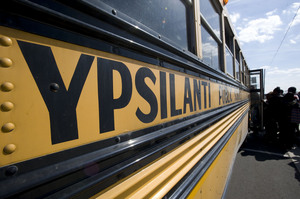
The Ypsilanti school board agreed to join a countywide transportation system.
WISD officials said at the board’s May 24 meeting that the consolidation plan will save the district an estimated $1.25 million annually. That accounts for roughly 34 percent of its $3.5 million in transportation expenditures.
The district is attempting to make $6.4 million in cuts before next year.
But transportation employees and their union leadership argued the salary cuts are too deep. The proposed plan would reduce the average Ypsilanti bus driver’s wages by 17 percent - from $18.16 per hour to $14.96 per hour. Drivers would make no less than $13 an hour, and no more than $16 an hour.
Mechanics and aides would face similar pay cuts.
In addition, transportation employees are expected to begin paying a 30-percent health insurance premium and would see their annual deductible rise from $400 to $2,000 for an individual.
Ypsilanti Support Staff Association President Kevin Fortune said he understands the district’s needs to save money, but he's angry the board approved this particular consolidation plan.
“It’s not like we’re out here asking for a raise, but when you’re putting your community in poverty, something is wrong,” he said. “They’re barely making it now; they aren’t going to be able to make it with this plan.”
Under the plan, employees will be laid off by the district, then hired by the WISD transportation entity.
Beyond reductions in personnel costs, savings are anticipated through economy of scale, centralizing administration and optimization of routes. Officials say eliminating “deadhead miles,” a term used to describe miles driven when no kids are on the bus, would account for a large portion of the savings in optimizing routes.
Routes will largely stay the same next year for general education students, then will be determined by WISD officials the following school year. Routes for special education students will likely change next school year.
Several community members said they were alarmed about a provision in the plan requiring students who live within 1.5 miles of their school to walk. Students also could be required to walk up to a half mile to their bus stop.
Several board members and administrators said the district has the option to shorten that distance at an extra cost, and all indicated they would be in favor of doing so. They also expressed interest in continuing to have kindergarten students dropped off at their front doors, as they are now.
The emotionally-charged, two-hour meeting brought several sharp exchanges. It concluded with audience members shouting at the board while exiting the high school auditorium.
Trustees Kira Berman and Andy Fanta voted against the proposal. Berman said she is in favor of consolidation, but feels the plan is unfair to transportation employees.
She pointed out the district’s deficit elimination plan called for a 25-percent cut in transportation costs, while this option reaches roughly 35-percent.
“I think there is another way to go,” she said. “We can do better. We can get a just consolidation plan.”
Fanta also said he wanted a “fair” consolidation plan. He explained his work as a bankruptcy lawyer influenced how he looked at the proposal. He then laid out the math of the monthly income and expenses of a hypothetical single mother of two living off $13 per hour.
He contended a person with two kids couldn't live off an estimated gross income of roughly $21,100 annually - assuming the bus driver works 10 months - and asked the other board members to “take a step into the real world with me.”
“This is a human tragedy unfolding, and this is the real world,” he said.
Board President David Bates called the decision “heart-wrenching,” but said the cuts had to be made.
“If we don’t make this part of the plan, I don’t see how we’re not going to be making worse cuts of a different nature in another place,” he said.
Trustee Floyd Brumfield said the intensity at which board members objected to the plan was a “shock.” “We’ve all known for some time what was coming,” he said.
He added he's heard no alternative to making cuts.
“I know of no other way to get this done,” he said. “If you have a good idea, bring it forward.”
Fanta replied that other options, such as significant cuts to administrators' salaries, have never been on the table.
“When we vote to do this, and I have suspicion we will vote 5-2, the values of all of us are going to be very, very clear,” he said before the vote. “And I, for one, am proud of my voice on this and I think this is wrong, wrong, wrong.”
After the meeting, Superintendent Dedrick Martin said cutting anyone’s salary is difficult.
“We are impacting quality employees, but we have to move forward and create a financially viable district where kids can continue to learn,” he said.
Tom Perkins is a freelance writer for AnnArbor.com. Reach the news desk at news@annarbor.com or 734-623-2530.
Comments
AnneB
Fri, Jun 11, 2010 : 3:14 p.m.
Why make cuts beyond what is needed at the expense of hourly workers. I am suspicious of someone who writes "most of us...." Usually, that person is speaking alone and trying to seem like a representative of group. And further, shouldn't we all be outraged at the continuous cutting of wages of benefits to the middle, working and impoverished classes? Direct your outrage at the system of taxation and earnings that continues to move money from the pockets of hardworking, honest people and dumps at the top with lying, cheating CEO's who repeatedly escape consequences. We're only pawns in the game. We pawns should stick together.
Kimi
Thu, Jun 10, 2010 : 9:33 a.m.
I think it's a sad day when you have to deduct the salaries of those who do the hardest work and receive the lowest pay in the company. These loyal workers have families and households that can not afford a financial decrease. Start decrease's from the top of the companies highest paid employee's and work your way down. And can anybody tell the public where the Michigan Lottery money is going? Because it sure doesn't seem to be helping our school districts. Where's the $MONEY$?...
Monica
Thu, Jun 10, 2010 : 12:22 a.m.
If YHS is at the bottom 5% of the state, then it would be wise to look at most of the school district. The teachers are doing their job (I believe for the most part) but what about most of everyone else....i.e.-most of the school board, the administration. If what I saw at the graduation ceremony is a reflection of what the rules are for students, then this administration has a LONG way to go and the bus drivers should not be the lamb at the altar. What has happened to the days that students were required to dress at least, business causal, for graduation? Instead, I saw flip flops, short-skirts, sagging jeans, gym shoes of all colors...ummm...hello, this was a graduation ceremony...not graduation practice, for Gosh Sakes. The new Tech High School might be a good idea but, many ideas that are good, do not need to be adopted. How much money is being spend there, instead of ensuring children do not have to walk a mile and half to the bus stop? During winter, no less...remember, we have snow and cold in Michigan? I am confused on why this "tech" school could not be incorporated into the current high school building, thus...saving money and maybe, just maybe...some bus drivers jobs. To me, this "tech" school is the latest in a plan of marketing ideas to draw children in from other school districts. I thought YPSD have already tried this...one more than one occasion in the past five to six years. Has it worked yet? What guarantee that this one will? It is sad to see a shadow of a great school district I attended in the late 1980's. Something needs to be done and quick...to turn the situation around before it is too late. And, to late may be coming soon, as Van Buren Public Schools new Belleville High School, will be completed around 2011. With "Schools of Choice" as the word of the day, will be the marketing idea, then?
MGoYpsi
Wed, Jun 9, 2010 : 8 a.m.
Ditto, Edward R., welcome to the real world people. Most of us have to pay into healthcare and have taken pay cuts in these times.
Edward R Murrow's Ghost
Wed, Jun 9, 2010 : 5:59 a.m.
stunshif wrote: "Welcome to the real world Ypsi bus drivers. I pay $4200.00 dollars copay per year for family healthcare and I don't have a pension! Life for MEA members will never be the same, just like what has happened over the past 5 years for us in the private sector. "It is what it is", get used to it, we have! You just drive old cars and if you eat out you go to the diner rather than the Gandy Dancer!" So many points of departure on this bloviation that I don't know where to start. 1) There are far better places to eat in the Ann Arbor area than the Gandy Dancer. It's overpriced and not very good. 2) That stunhsif believes that bus drivers earn enough money to eat regularly at the Gandy Dancer shows that he has no clue about the economic status of those people 3) My wife, a public employee, pays almost $5,000/ year for our family's health care. As stunhsif is on this equality kick--since we all must suffer together and suffer equally--I'm certain he'll be willing to pay $800 more for his health care or, in the alternative, to have his taxes raised so that all public employees who pay more than $4200/year can have their costs dropped to equal his. Naaaah. 4) Stunhsif, in other posts, claims to be a libertarian, but his desire to level everything looks like communism in reverse--rather than "spreading the wealth" across all classes (which I am quite certain stunhsif would oppose) he wants to spread the pain across all classes. He's had a bad year or two or ten, so everyone should suffer just as much as he has. Good Night and Good Luck
stunhsif
Tue, Jun 8, 2010 : 11:40 p.m.
Welcome to the real world Ypsi bus drivers. I pay $4200.00 dollars copay per year for family healthcare and I don't have a pension! Life for MEA members will never be the same, just like what has happened over the past 5 years for us in the private sector. "It is what it is", get used to it, we have! You just drive old cars and if you eat out you go to the diner rather than the Gandy Dancer!
melissa t
Tue, Jun 8, 2010 : 11:17 p.m.
I am a driver for ypsi schools, i have to say that this is a very sad day for me and my fellow co workers. I know that i have not slept in nearly 24 hours, im sure the board slept well last night. I mean why wouldnt they? They loose nothing. In fact our new superintendent gets a brand new administration building. How many of you know that Mr. Martin is having that building built with a grant the the district got for a new transportation faculity? How many of you know this we pay a former transportation supervisor a very large amount of money to be a energy consultant? It's true folks, we pay a former management employee to turn lights on and off, he is not employed by the district he is an "independant contractor". He now makes more money than he did as a transportation supervisor! Here is another thing i bet no one knew. The Ypsilanti school district is paying for Mr. Martins degree ( he does not even have the qualifications or degree to be in the position he is in) the district also pays for his car, his housing, his cell phone, they even pay for his dry cleaning! I doubt you know this either. The school district has hired a new assistant supreintendant who im sure will be aking a six figure salary. Bus drivers are being left unemployed, children are being put in danger while administration lives like kings and queens. The list above should tell everyone that administration has a HUGE spending problem! Can anyone tell me why im loosing my job and this spending is still going on even as we speak? Anyone ever heard of sins of the father? District spending has been out of control for YEARS, this is nothing new. The "father" aka our administration has been spending what we have not had for years and now "the children" aka ypsilanti suport staff are paying for their bad behavior. The continue to eat steak while the children eat hot dogs. I'm afraid at the rate they are going. A child is just not safe walking even a half of a mile to school. Come on we have all been to the south side, they are tring to justify this with dollars and sence. Also lets remember that kids take two bus rides a day. we are talking about children possibly walking 3 miles a day to bus stops with the mile and a half guide lines. They are so worried about test scores at the high school, but you tell me how a child is supposed to have all the focus and energy they need at school after walking a mile to a mile in a half first thing in the morning. What about a child with athsma, how is that even safe, or legal? In closing i just have to add this. I used to work for a consolidated school district. It seems to me that consolidation means not only a consolidation of transportation, but a consolidation of all schools and all school services. One of the board members stated last night that there had to be a better way. Why did none of the Powers that be think of this. Consolidate everything, bussing support staff one transportation dept combined, one school district name, and 1 superintendant for the whole consolidated district? I guess i already know the answer to that. It's because then all the high up people like the superintendants, Human recources directors, and dept supervisors would loose their jobs. Can you imagine all the money it would save to only have one set of administrators?? But it's easier to pick on the little guy. Our familys and our well being nust not be as important as theirs. I have to say to all the kids and parents of the turtle bus, i will miss these kids so much. They have had a big impact on my life. It's been an honor watching them grow up. And to my high school and west kids, its been great watching you go from chidren to young adults! Congrats to the graduates this year....You did it, i am so proud of you all!
sad day
Tue, Jun 8, 2010 : 4:28 p.m.
The support staff in any district is a very small portion of the budget, that is why there has never been a cash incentive to retire. In most cases salaries are max out after 2 years, so a 2 year employee makes the same amount of money as a 30 year employee. There average salary is less then 22,000.00 per year. That is already at a poverty level. I do believe that the district needs to make cuts, but their focus should be at the higher salaries. I also think they made the wrong decisions on what buildings to close, and that the consolidation of services, should start at central administration. The quality of education should be the top priority, instead we will be losing alot of students to neighboring school of choice. Everyone should step back and look at the ramifications their decisions are going to cause. Go to the top of the Administration list and go down with cuts, not the other way around. I was told that if they change the health insurance from Blue Cross to Mea they could save 1.5 million. Whats up with that.
happy day
Tue, Jun 8, 2010 : 4:07 p.m.
That's right! Thank you eyeloveypsi for reminding us all of Fanta's brilliant legal plan to sue the state. Remind me where that got us? I can't seem to remember. How much money did that save us? Also, as a rich lawyer how can he even begin to understand what it feels like to be a part of the working poor -as he attempted to do last night? I found that insulting. Can anyone remind me how long Fanta's been on this board? If anyone is responsible for making bad decisions it's him because he's had over a decade to see this problem coming and to do something to stop it. Enough of his ridiculous speeches. It's time for him to take some action. I'm with eyeloveypsi. What has he (and his sidekick Berman) suggested? I am another who would like to hear how it could be done better.
missypsi
Tue, Jun 8, 2010 : 3:54 p.m.
Ummm... here's an idea "eyeloveypsi", why not increase your revenue. How, you say? By attracting students to the district. How do you do that? By offering safe, high quality schools, WITH equally safe transportation services. All this administration can do is cut, cut, cut... As any (successful) business owner understands, balanced budgets are about more than reducing costs. If you want to balance your budget you also need to increase revenue, and the only way to do that in this situation is by increasing enrollments. Cutting core services is no way to increase enrollments, and I know plenty of parents who are so disgusted with this administration and the "rubber stamp" that is this board, that they are leaving the district. Guess what that means: less revenue.
eyeloveypsi
Tue, Jun 8, 2010 : 3:38 p.m.
sad day - Mr. Fanta has really been a leader. Instead of making necessary cuts a few years ago, he led the charge to "sue the state". He's actually a lawyer and should have known that that was a slim or none proposition. Soooo, minimal cuts were made and now there is no choice but to cut 6 million. None of the options are good, this is really not a referendum on which board members have hearts. all you complainers and defenders of not making specific cuts - what are your suggestions? I and others would really like to hear how you can do better than this board.
glimmertwin
Tue, Jun 8, 2010 : 3:14 p.m.
The unfortunate part of the "backbone of education" is that it is easily replaced at a lower cost. If that were not true, none of this would be happening.
localvoice
Tue, Jun 8, 2010 : 2:59 p.m.
The Ypsilanti School Board again shows itself as a complete three ring circus! In March, closing 2 schools was the "most heart wrenching and painful decision" some had to make. Another shared how she "stays up late crying every night" the decisions are so devastating, then rallies the crowd to march on Lansing. Another is always "shocked" by the situations at hand. Well, here we are again, over two months later. Closing schools has not fixed the problem, as mentioned previously. Board members are now on to the next "most heart wrenching" decision. Another is still "crying herself to sleep" every night. One is still confused and surprised. The president still uses his poor tone and unprofessional delivery. The new Superintendent just sits covering his mouth and facial expressions. Next, they will move in to YHS and create a charter! All they have accomplished is that I as a taxpayer cannot have any trust in their leadership. Our family just decided on Monday evening that we will take our children to a neighboring school district. We will miss our teachers and truly wish them the best. It is apparently evident that they will need it!
happy day
Tue, Jun 8, 2010 : 2:29 p.m.
@sad day, kudos to Fanta and Berman? Seriously? I was thinking about starting a recall against them! Tell me one thing they have done to help balance the budget? If the votes went their way, then we'd have an even bigger deficit than we have now. How is that good for the students of YPS? Kudos to the 5 board members who had the guts to do what needed to be done.
sad day
Tue, Jun 8, 2010 : 1:32 p.m.
Kudos to Fanta and Berman....try running the district without the support staff also known as the YSSA.The districts cuts are not being made furthest away from education, but on the the backbone of education. Try running this or any district without the bus drivers who get the children to school, the custodians for cleaning up puke and urine, opening up buildings, removing snow, cutting grass taking care of breakfast and lunch programs, setting up for activities, securing buildings and the general operations of each building. The secretary that meets the public with a smiling face, answers phones, hands out medication,notifies parents when children are ill or hurt and does the financial records of each building. The food service worker that ensures the students are offered a nutritional breakfast and lunch. The para-educator that gives students additional one on one instruction. These workers are the backbone of education....Shame on all of you,especially you Floyd Brumfield. Would your voting be the same way if your wife was still employed for the district? I say recall the entire board except Fanta and Berman and take another look at who is making these decisions in central administration.
ironyinthesky2
Tue, Jun 8, 2010 : 11:34 a.m.
Just one more comment on contracted employees: Yes, they get their salary and retirement. They also have to pay self-employment tax on top of their regular taxes. It's not a wash, but they are also giving up higher retirement pay a few years later - sort of like getting social security at 62 or waiting until 65 and getting more. But this isn't the key side of the argument as it affects the school districts. Contracted employees do not get benefits and the district does not pay retirement for them. This amounts to a savings of at least $15,000, usually over $20,000 a year for the district. Now, explain how this is not a good thing for the district? Yes, I have a friend who is a contracted employee (not in Ypsi) who explained all this to me, but I just don't understand why this isn't a good thing for the district. Congratulations Ypsi, once all your contracted employees are history you get to pay upwards of $20,000 a year more for their replacements. Gotta love that fiscal responsibility! I'm finally done!
ironyinthesky2
Tue, Jun 8, 2010 : 11:06 a.m.
Tom Dodd - Do you have specific ideas for where to cut at the top? They have made some cuts of people and salaries, your expertise might be helpful.
SPK
Tue, Jun 8, 2010 : 10:50 a.m.
@ironyinthesky2, your comments are perfect. The grandstanding by Fanta and Berman last night made me embarrassed I voted for them in the past. I was at the meeting last night and Fanta said he wanted administrators to take cuts. Does anyone else find that interesting considering he JUST voted to support hiring a new assistant superintendent making six figures??? Where are the cuts there? Seems pretty hypocritical to me. Berman kept talking about justice but I don't see how not voting to support any cuts is justice to the students. Do they serve the parents or are kids? I voted for them to serve my daughter. I was also amazed at the rudeness of most of the audience members to the people on the stage. I support bus drivers because they take my daughter to East everyday, but their comments were rude last night and so was both the union leadership. What has the YEA done to help fix the problem? How dare she stand up and yell at board members and administration when their group has done nothing. @AlainDanielou, we are getting rid of a principal that everyone loves but it was news to me last night to hear that YHS is in bottom 5% of state. Why is it good to keep someone that hasn't gotten us out of that hole? I don't know new principal but can it get any worse than it sounds like it is? I applaud Horne for speaking her mind on the high school last night (and shame on everyone for boo-ing her) but I am still worried for my daughter to start YHS in a year.
jns131
Tue, Jun 8, 2010 : 9:33 a.m.
Proud parent? If you have points higher then 15? You can't ever drive a school bus. Kind of scary to think that the one who wants to drive a school bus? May be the one they hire who has nearly maxed out their points. I agree, I just can't see them hiring 300 drivers in under 2 months. Will be fun. Thanks for the kind words.
proudparent
Tue, Jun 8, 2010 : 9:21 a.m.
This is so sad. I hope the drivers still have a job come september. In the last article, it wasnt gauranteed that they would even be rehired. Way to go districts, nice looking out for the ones who have been there supporting the kids! I hope these districts are left high and dry, just like they are doing to these people! Good luck on find over 300 drivers in 2 months who have the qualifications and endorsements it takes to drive a bus, not to mention not having any points on your license in the past 10 years!
jns131
Tue, Jun 8, 2010 : 9:18 a.m.
There is no more money to be had. It is time to go after the teachers and administration. The teachers make the most and so does the administration. But they don't want to upset parents and the union so they go and pick on someone who they know they can cut off the appendage to appease the teachers and administration. Ann Arbor is planning the same thing. No matter whether we submit a counter bid or not. Washtenaw county will see a lay off nearly 300 people with no guarantee they will be rehired. With Ypsilanti falling in line it is only a matter of time before everyone else does and they bring in hired help from outside the state. As I said before, how can someone come up with a $2000 deductible if they aren't making more then $14 an hour? Michigan is heading into a welfare state and Granholm is to blame when she said she would not touch education. Good luck to the drivers and monitors in finding another job that makes what you were making.
Dante Marcos
Tue, Jun 8, 2010 : 8:51 a.m.
We're closing Chapelle and East Middle School. We're allowing a corporation called "New Tech" to come in and suck some $ from our school district. We're letting go a principal everyone loves, and replacing him with one of the superintendent's old pals. Now Bates, Brumfield, & Co., LLC, are giving their stamp of approval to consolidated bussing, and lowering already-low wages for transportation workers. What's next? How about elementary school students do janitorial work free of charge. Also, let's get rid of school lunches and close the playgrounds. Maybe Chapelle can be repurposed as a WalMart, middle school students can detail administration SUVs, and...
glimmertwin
Tue, Jun 8, 2010 : 8:15 a.m.
This painful story is being played out all over the state and country. As sad as it is, driving a bus is not as important as running a school district, and salaries reflect that. Even if you replaced all administrators with minimum-wage employees, the deficits would still be overwhelming. Prepare for the worst. It won't be long and there will be no transportation or any "extras" at public schools at all. With the current costs and the rate of their escalation there is no way any of this can be sustained.
In Question
Tue, Jun 8, 2010 : 7:31 a.m.
Brilliant thinking about starting the cuts at the top.
In Question
Tue, Jun 8, 2010 : 6:49 a.m.
My praise goes to Mr.Fanta for thinking like a human being with a soul. Contracted employees are drawing their full retirement benefits plus the salary of their current jobs. Double the $$$$$$$$. They are hitting the people that lose three months a year pay and have a yearly salary that is considered low income. Did they take into consideration that these people rarely ever get an eight hour day, usually are tied up 10 to 11 hours a day to get 7 hours pay, if they are lucky, and have to work extra runs, field trips and any run they can get to just try and get close to a 40 hour week? The main reason transportation costs are so out of hand is because administrators not wanting to deal with anything or anyone unpleasant have said yes to everything coming across in front of them and have told transportation, "You will do this" regardless of the impact or the cost. Transportation used to be pretty much a self ran department that no one really thought about. When administration came in and decided that they were going to change things is when it went to ____ in a handbag. The more they tried to FIX it, the more it cost and the more it got out of hand. How can there be any justice in cutting people barely making a living, and leaving all the six figure salaries alone? Where is the justice in cutting teachers, instruction and services when they are hiring six figure people to created positions that have never been needed before and spending a fortune to re-vamp the administration building?
ypsilistener
Tue, Jun 8, 2010 : 6:48 a.m.
Trustee Fanta gave the problem a personal face by telling his story about the working poor woman, which I can appreciate. He spelled out how this person was already in the hole, budgetarily, and how much worse it will be if her pay and benefits are cut. All true. But then Vice President Horne pointedly asked, Have you calculated her budget if she is laid off? In other words, one of these things is going to happen. Which is worse? Lousy options, no two ways around it. One thing I dont get is how Trustee Fanta cannot transfer the concept of his hypothetical bus driver to the school district. Our school district is operating exactly the same way. We dont have enough money to pay the bills each month, and the problem is worsening. We can debate which items in the budget are unnecessary--Do the districts administrators get paid too much? Does the bus drivers family really need cable and internet @$65/month?--and we should, but the bottom line is, how do we avoid state takeover (district) or becoming homeless (woman)? It was wrong and unfair of Trustee Fanta to indicate that his and Trustee Bermans votes are a reflection of their moral superiority, and that everyone else on the board is cold and unfeeling. I believe that all seven members of the board care deeply about this school district. This decision was not made lightly by anyone. Lastly, in what may seem to be a contradictory statement, I definitely agree with Trustee Bermans assessment that we can do better, and I wish this plan had been sent back to the WISD. I am very skeptical that this plan will deliver what has been promised, and by the time this comes to pass, the damage will be irreversible.
Tom Dodd
Tue, Jun 8, 2010 : 6:03 a.m.
Start the cuts at the top and see how quickly the crisis is resolved.
ironyinthesky2
Tue, Jun 8, 2010 : 5:44 a.m.
Interesting that Mr. Fanta wants significant cuts in administrator salaries, but doesn't want to keep any of the contracted employees. Contracted employees are not paid benefits, but their replacements are, and this costs the district significant money. Mr. Brumfield is correct: they all knew this was coming and we really don't need the grandstanding from Mr. Fanta and his sidekick, Ms. Berman. Explain why you don't like it but have to vote for it and move on. Please.