

Ypsilanti Township places moratorium on Smart Meters, but DTE could continue installation program
The Ypsilanti Township Board of Trustees has voted to place a township-wide moratorium on the installation of DTE Energy’s new 'smart meters' while their safety and impact on privacy are examined by the state.
That doesn’t mean DTE will discontinue installing the meters. A representative from the utility company told the Board of Trustees at the May 14 meeting that DTE has continued to install the meters other municipalities, like Sterling Heights, where local governments have imposed moratoriums.
“DTE can ignore that request as they have in other communities, but you have made your position public,” Township Attorney Doug Winters replied when asked whether the board should vote on a moratorium.
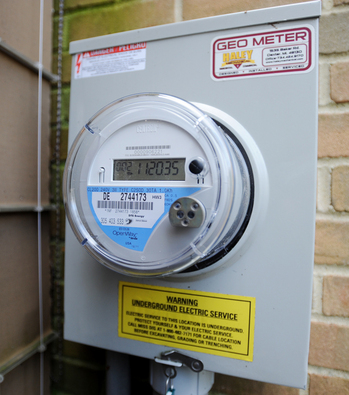
A DTE smart meter installed at a local residence.
File photo | AnnArbor.com
DTE officials say the meters will cut costs and are safe, while residents have voiced a litany of concerns. Chief among them:
- Fears that the radio frequency emissions from the meters are carcinogenic.
- Worries that the meters can read which appliances are being used and transmit sensitive personal information.
- Concerns that the meters can easily be hacked.
- Concern that, so far, DTE has forced residents to use the meters and there is no “opt out” program.
- Concern that the opt out program will be costly to residents and DTE will use it to increase profits.
Warren said Washtenaw and Macomb Counties are first in the state to receive smart meters. There are 120,000 planned for installation in Washtenaw County and 2.6 million statewide, of which Bob Sitkauskas, a DTE representative who spoke at the meeting, said 760,000 had already been installed. There are 34,000 that have been installed in Washtenaw County, and the City of Ann Arbor is considering a similar moratorium.
Bob Sitkauskas addresses the Ypsilanti Township Board of Trustees on May 14.
Tom Perkins | For AnnArbor.com
Township officials have received numerous complaints about the meters in recent weeks, and Supervisor Brenda Stumbo repeatedly asked why DTE couldn’t wait until the Public Service Commission’s ruling before continuing the installation program.
She said that if the Public Service Commission rules that the meters are a danger to residents than DTE is going to have to pay to replace all the new meters, so continued installation didn’t make since from a business perspective. She said it made even less sense given the public's concern over the meters.
“Until there’s some sort of determination (by the Public Service Commission) made in the next month, can't there be a moratorium?” she asked Sitkauskas. “Is there an urgency not to wait?
“You could spend a lot of money putting them in and then you might have to take them out. It seems a little backwards.”
Sitkauskas said DTE has only received 1,000 complaints out of 760,000 installations and said there has been misinformation about the meters.
“We do believe there are no merits to the concerns,” he said.
The meters transmit information from a home to DTE twice a day, eliminating the need to read the meter at residents' home. Sitkauskas said the only information transmitted is total power usage in the home and no specific information about what appliance is used or what a person is looking at online is collected.
He also said no personal information like Social Security numbers are transmitted, and the data is encrypted.
Opponents of the smart meter program contend that there is consensus in the scientific community that radio frequencies emitted by smart meters are carcinogenic.
Ypsilanti Township resident Timothy King cited American Academy of Environmental Medicine literature which stated that that the radio frequencies are carcinogenic. Other residents said the World Health Organization has warned against the meters and countries like Italy have banned them altogether.
Shelby Township resident John Holton said DTE admitted in documents submitted to the Public Service Commission that there could be a negative impact on health.
Sitkauskas contended that cell phones emit 3.3 to 1,000 times more radio frequency than smart meters and said the term “smart meters” are not mentioned in literature about the radio frequency being carcinogenic.
Several residents also complained that there is no opt out program and they were forced to accept the meters against their will.
Sitkauskas said an opt out program is being developed. When questioned by Trustee Mike Martin over the cost of an opt out program, Sitkauskas said the cost would be determined by the Public Service Commission.
But, he said, the opt out cost in California was $75 to pull out the meter plus an additional $15 each time a meter was read once a month. That means a California resident who wants to opt out of the program is paying an additional $255 the first year and $180 each additional year.
When asked if the DTE’s savings from the new meters would be passed on to customers, Sitkauskas replied that savings would be found inside the company and that would “essentially effect a lower cost for the company and customer”, which drew scoffs and jeers from the audience.
The Board of Trustees will hear a presentation from a group of residents opposed to the meters at the next meeting.
Comments
My Name
Thu, May 17, 2012 : 1:31 p.m.
Or another good link which further links up to informative http://www.hans.org/169-emf-smart-meter-warning-letternews.
My Name
Thu, May 17, 2012 : 1:21 p.m.
Watch this video for some up-to-date information. http://www.youtube.com/watch?v=8JNFr_j6kdI
dogon
Wed, May 16, 2012 : 10:52 p.m.
ALL I care about is getting straight information on how much these things are going to cost me and are they accurate. Neither DTE nor any group or news organization (ESPECIALLY annarbor.com) is offering any facts on any of this. Until DTE lets us in on what the ramifications are for the consumer and this has been independently verified the padlock is staying on my dumb meter.
greg, too
Wed, May 16, 2012 : 6:19 p.m.
I guess the bigger question, outside of the meters themselves, is what good is a board vote if DTE will just keep installing em? Sure, its nice to go on record saying they dont like them, but if they are just going to install em anyway, who cares? If DTE can march right through them, why would anyone else pay attention to them?
My Name
Thu, May 17, 2012 : 1:25 p.m.
Corporate power grab?
lisasimpson
Wed, May 16, 2012 : 2:54 a.m.
Bah, think of the people of Cincinnati in the 1930s, when WLW was broadcasting at 500KW!!!! It was intended to cover the east half of the United States. Your gutters would receive it, your light bulbs would pulse, and the station was said to be heard in both Europe and Australia!! We've been playing with radio frequencies for a LONG time.
treetowncartel
Wed, May 16, 2012 : 2:15 a.m.
15 bucks for approximately 1-2 minutes on piece of property in a densley populated neighborhood amounts to $15 * 30 = one heckuva well paying job for a monopoly, for those that cant do the math it is $450 an hour for a meter reader.
brad
Wed, May 16, 2012 : 2:14 a.m.
These things operate on the same frequency bands as and with power levels comparable to either your home Wi-Fi router/all things Bluetooth or newer baby monitors/cordless phones/etc. I'm more concerned about them knocking out streaming Netflix when my daughter is trying to watch "Yo Gabba Gabba."
DJBudSonic
Wed, May 16, 2012 : 2:11 a.m.
I am told that the reason they want smart meters is to apply a tiered rate for billing, but looking at the DTE handout on the various rates; and the tiered pricing, which comes with the meters, is 2-3 times more costly per kwh than the current pricing. Which seems like a money grab. I'll see soon enough, against our wishes a meter was installed at our house, even though our neighbors on either side don't have one...? Does this speak to the inefficiency of DTE or should I get one of those tin foil hats? Also, why did I see the meter reader reading it this week anyway???
Rob Henderson
Wed, May 16, 2012 : 10:30 a.m.
If the route has fewer than 80% of the meters converted, they're still sending us out to read the whole route. I did a route two weeks ago that was 74% converted, and no, I wasn't any happier about that than the customers were. Also note that the gas meters (yeah, we read those too) are being converted separately. I've done one route where all the the electric meters were switched, but none of the gas meters were, so I still had to go to every house.
martini man
Wed, May 16, 2012 : 1:43 a.m.
I live in a condo complex ..My building has 24 units ..all 24 electric meters are located in a single laundry room. Anyone using that laundry room will be exposed to 24 smart meters rather than to just one, as in a single family dwelling. I am worried that 24 times the radiation or whatever they call it could be a threat. Would it compromise pacemakers or A-Fib implants ? Just a question for DTE . Are 24 meters, all aimed at a person more dangerous than just one single meter??? Just wondering .
Justavoice
Wed, May 16, 2012 : 12:26 a.m.
The sky is falling! The sky is falling! I stubbed my toe and it's the meters fault because someone told me so.
zigziggityzoo
Wed, May 16, 2012 : 12:16 a.m.
What's with all the conspiracy theory crud on a2.com these days? Don't we do any fact-based reporting anymore?
slave2work
Tue, May 15, 2012 : 10:10 p.m.
Has there been anything researched on the effects the frequency might have on say. pacemakers. or any medical devices people use?. I don't understand installing with the state still not sure to let them.. although DTE is all powerful.. just try to get them to help or prorate your bill.. HAHAHAHAHA. or fix a mistake.. i was told" it will all even out with the next reading".
David Cahill
Tue, May 15, 2012 : 10:05 p.m.
I think the Township should be passing out aluminum foil hats. 8-)
YpsiLivin
Wed, May 16, 2012 : 11:21 a.m.
That's the difference between a township and a city. Our taxes are low in the township, so the township doesn't have money for tin foil hats unless the voters pass a tin foil hat millage. City taxes are higher, and cities can probably afford to pass out tin foil hats for free. Heck, they might even mail them to your house. (But leave the envelope outside; it probably has an RFID tag in it. And who knows what that's reporting...)
Brad
Tue, May 15, 2012 : 8:55 p.m.
What - nobody is interviewing the astrologers and phrenologists this week to get their expert opinions on smart meters?
u812
Tue, May 15, 2012 : 9:18 p.m.
it appears everyone's bill increases after these meters are installed(thru out the country)
YpsiVeteran
Tue, May 15, 2012 : 8:18 p.m.
Sellers has a good point. Several times in the last 10 years my meter has been misread, resulting in bills that were hugely inaccurate. I was able to check the meter myself and compare the reading to the mistaken one. What happens when the meter transmits incorrect info, or it turns out the meters are impacted by some interference we are not even aware of yet, or some other such annoyances? What will the customer be able to use to dispute possible errors? DTE can barely keep the power on now in many parts of Wayne County. I have zero faith in their ability to competently and accurately manage a gigantic "smart" meter system.
YpsiLivin
Wed, May 16, 2012 : 11:18 a.m.
Yeah, I got a $400 gas bill in June one year. I called DTE and gave them a new reading on the gas meter and they rebilled me for the correct amount. Since the smart meter transmits usage data back to the utility every hour (or whatever), the likelihood of one bad report knocking your monthly bill off kilter is probably next to none.
justcurious
Tue, May 15, 2012 : 8:08 p.m.
All I care is that the meter readers don't have to come to the house anymore. That means I WANT a smart meter. Hopefully my township won't mess that up before I get one.
u812
Tue, May 15, 2012 : 9:16 p.m.
no meter readers= less jobs,what going on around your house?
sellers
Tue, May 15, 2012 : 7:31 p.m.
I'll all for the meters if I'm allowed to jack into them and audit the data reported back. Basically, I want to see what they see. It would also be nice to have the option for a second meter customer side that is where I can verify the information being sent is correct and also monitor my own power.
Red Floyd
Tue, May 15, 2012 : 8:43 p.m.
Yeah, but you know that'll NEVER be allowed!
Red Floyd
Tue, May 15, 2012 : 5:48 p.m.
Smokeblwr...I agree with you that it is impossible for the smart meters to know which appliances are running inside the house. However, what I'm learning from my own research, is that eventually all appliances will be "smart" appliances, and will have radio frequency devices that will be able to communicate with the smart meter. With this set-up, the smart meter will then, in theory, have the ability to communicate with, and turn off or turn on power to smart appliances. I also think that this sounds like total crazy conspiracy theory stuff, but I suppose it's possible, and perhaps arguably, a logical next step. I've read websites that say the radio frequency waves are gonna kill us all, and I've read websites that say it's a tiny fraction of what we're already exposed to each day. It's hard to know which sites are closer to the truth though. I'm actually excited about the ability to monitor my energy usage on a daily, and even hourly basis. However, I'm skeptical and cynical enough that I find it hard to believe there isn't some way DTE is going to make a lot of money on this, and we the people will be on the losing end once again. I find it implausible that they are forging ahead to replace all the old meters, ignoring moratoriums, simply to help us better manage our energy usage.
Red Floyd
Tue, May 15, 2012 : 8:42 p.m.
I don't like the idea of my future appliances communicating with a smart meter, which in turn, is controlled by DTE. That means that DTE can then control my appliances. I also agree with you about cable and internet being monitored. I'm assuming you've read the various articles out there about google tracking and the information that is supposedly assembled about all of us. There are famous stories about how Target collects information, and based on various data points, they have like an 80% accuracy rate for predicting when a woman is pregnant. You can probably add smartphones to that list as well. Your phone company knows exactly where you are at all times, who you call, what you text, etc. Even cell phone photos have GPS and time info imbedded in them. The big argument I've read regarding smart appliances is that DTE could essentially ration power at various times. If the grid gets overloaded (because instead of improving upon the grid infrastructure, they're spending time and money installing smart meters), they could essentially turn off various major appliances during peak hours to ease the strain on the grid.
sellers
Tue, May 15, 2012 : 7:36 p.m.
Comcast/Dish/etc are not essential utilities. Electrical power is second to water (sometimes first for those on well). Television comes way down after gas and phone (wireless or wired) services. It may be neck and neck with internet service.
smokeblwr
Tue, May 15, 2012 : 5:58 p.m.
Interesting about the smart appliances, I suppose you are right about that. However, if I were a secretive person I'd be more concerned about Comcast tracking my internet usage and DirecTV tracking the shows I watch which is all possible given the current technology now. THOSE habits will probably give them much more insight into a customer than what time they run their washing machine.
xmo
Tue, May 15, 2012 : 5:36 p.m.
This is a great way to save the planet, reduce your freedom, and spend more money! This is a great day!
packman
Tue, May 15, 2012 : 5:36 p.m.
Seems to me there are three issues 1. The health issue...probably bogus. 2. The opt out cost...still an unknown in Michigan. 3. The opt in cost...can we now be charged more for watts used during peak hours? Will this be some kind of electricity use behavior modification plan? Anecdotal information, repeat...anecdotal...seems to indicate that bills tend to go up after they install the meters.
YpsiVeteran
Tue, May 15, 2012 : 8:12 p.m.
DTE applied for a $34 million rate hike related to the meters, which was slapped down in court, BEFORE they even started installing them. They can't even keep their own story straight. Smart meters may reduce their costs, eventually, but not a penny of that savings will ever be seen by the public, and they will continue to apply for any and all rate hikes they can manufacture excuses for. Any money they save will go toward maximizing their profits and stockholder dividends.
SonnyDog09
Tue, May 15, 2012 : 5:26 p.m.
I think that you said it all by your mis-tagging of each of the "claims" about the smart meters with "&bull:" The claims are bullhockey.
Julie Baker
Tue, May 15, 2012 : 5:32 p.m.
We fixed that coding issue. Thanks for pointing it out.
smokeblwr
Tue, May 15, 2012 : 5:13 p.m.
How the heck is the meter going to know which appliances are running beyond perhaps the air conditioner (if it is on a different line)? It would need access inside the breaker box to monitor each circuit, and it doesn't have that.
My Name
Thu, May 17, 2012 : 1:24 p.m.
Big Brother Smart Meters! You are naive.
sellers
Tue, May 15, 2012 : 7:33 p.m.
yeah - that concern is merely just an ignorance issue that education can address. I think the more pressing concern is that it will know when power is used and charge more granular rates or rates based on peers (e.g. your neighbor is using 20% less, so we are charging you 20% as a hog). This fear probably comes out of the broadband charging rates that are going on with cable and wireless providers. Is unlimited really unlimited?