

Food banks face challenges as state cuts assistance to poor residents
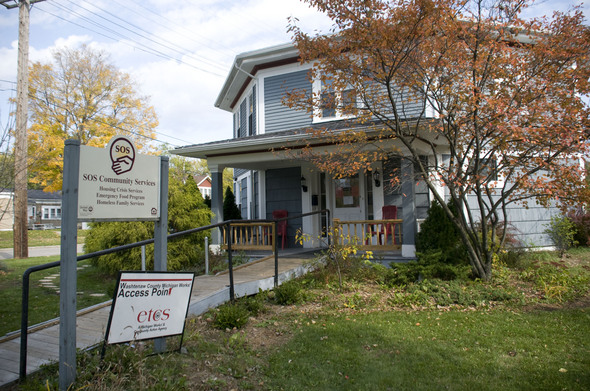
The SOS Community Center on River Street in Ypsilanti.
Tom Perkins | For AnnArbor.com
Gerald Pietrzack is employed, but he filed for chapter 13 bankruptcy last December after recovering from a serious illness. Through 2014, he will have a significant portion of his paycheck garnished.
Pietrzack lives with his wife in a one-income home and estimates they survive off roughly $300 a week. After his bills, including a car payment and mortgage, he has next to no money with which he can buy food.
He says his household is financially strained, and he has come to rely on the groceries offered at the Hope Clinic's food bank. Once a month, he goes there to get a bag of food and personal hygiene products. He said he expects to rebound once his wages are no longer garnished, but added Hope Clinic's food bank is essential in the meantime.
“I’m not running away from my obligations, it’s just that times are tough,” Pietrzack said. “Hope Clinic helps us get food and keeps us just above ground. This way we’re not out there totally hungry or starving.”
But as sweeping cuts are made to social assistance programs at the state level that were offered to poor residents, directors at food banks like Hope Clinic and the nearby SOS Community Center already are seeing an increase in the number of people coming through their doors.
Advocates for the state’s poor and homeless have decried the cuts that have occurred since Gov. Rick Snyder took office. Among the changes are a tightening of food stamp eligibility, cuts to the cash assistance program, cuts to programs that provide assistance to those who can’t afford heating bills in the winter and elimination of the earned income tax credit for the working poor.
Not only are recent cuts affecting residents who have no other options for help, food banks are fearful their resources could soon be strained as they cope with and prepare for an influx of consumers.
Melissa Burkhart, food programs director at Hope, said the clinic there offers appointments where up to 75 families pick up a bag of groceries weekly, but the bank also offers emergency service to anyone who comes in. If a person is hungry and has no other means, the clinic will not turn them away.
It’s the latter type of consumer Hope is now serving more.
“I’ve seen a larger number of emergency requests, particularly for food, and heard clients say that they were not prepared for the cuts,” Burkhart said. “I hear from people that they went to see if the food stamps were on their food card yet and they found out they just weren’t getting them anymore.”
Changes to food stamp - or Bridge Card - eligibility were made over the summer after it was revealed a man who won $2 million playing the lottery and a significant amount of college students were receiving benefits they didn’t necessarily need.
No figures are yet available for how many people that affected, but about 40,000 Washtenaw County residents receive food stamps. Joel Skene, director of the SOS food bank on River Street in Ypsilanti, said he is already seeing unintended consequences of the tightened eligibility.
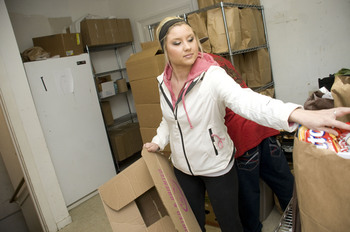
Volunteers pack grocery bags at SOS.
Tom Perkins | For AnnArbor.com
The first residents to be kicked off cash assistance lost their benefits starting on Oct. 1, which the State’s Department of Human Services expects will affect about 11,000 families and 41,000 individuals statewide. Locally, around 3,000 residents receive welfare assistance in Washtenaw County, and some are losing their assistance as they hit the 48-month state or 60-month federal limit.
"It is a challenge for SOS to respond to the needs of consumers when cuts happen, but it’s an even greater challenge for the people who are in need of help," Skene said. "They are the ones who feel the direct impact and the ones who have to figure out ways to survive when there are fewer and fewer resources."
Skene said he is seeing the first consumers affected by that cut trickle in. On a recent Tuesday afternoon, dozens of people filed in and out of the SOS Food Bank to pick up a bag of free groceries for their household.
The bags’ contents are prepared and predetermined by SOS staff, and on Tuesday they included corn, cabbage, potatoes, pasta, Doritos, a variety of canned goods, breakfast food and snacks.
An average of 80 low-income families pick up food at SOS each Tuesday, and more than 1,280 people were fed with groceries from the food bank in August.
SOS’s “consumers” have a variety of financial situations. In August, the agency served 193 people who were classified as “recently unemployed”, meaning they had lost job in the last three years. About 50 individuals were outright homeless, but Skene said many who utilize the program are there for the first time after falling behind.
He estimates over 80 percent of the agency’s consumers are from Ypsilanti or Ypsilanti Township, while the rest are mostly from Ann Arbor or western Wayne County.
Consumers are limited to four trips to SOS annually, and the agency also has a Thanksgiving turkey giveaway. SOS purchases canned goods from Food Gatherers for a relatively cheap price, and meat, produce and bread is delivered for free as it’s available.
Skene tries to balance the bags nutritionally, though he’s at the mercy of whatever is donated to Food Gatherers from local grocery stores. Food Gatherer’s deliveries arrive each Monday, and about 100 bags are pre-prepared by the volunteers and staff. When consumers arrive on Tuesday, they must provide an ID card and answer a list of questions about their personal situation.
Aside from supplying SOS’s groceries, Food Gatherers also offers grants, which accounts for part of SOS’s funding, along with donations and Federal Emergency Management Agency dollars.
But SOS is concurrently taking a hit from the other end as it receives less money following cuts to FEMA’s emergency food and shelter funding that is a main avenue of federal dollars to local food banks and shelters. Skene said he doesn't yet know what that will mean for the agency's bottom line, but they are already looking for new funding sources.
The SOS “offices” on River Street are actually a cramped home converted into a resource center for low or no-income residents. SOS also uses the home as a resource center for residents facing some degree of a housing crisis or homelessness.
On a recent Tuesday, about a dozen volunteers helped out in the home and Skene was the lone staff member managing the operation. The lack of space, time and manpower are also limiting factors, and they aren’t likely to improve as funding continues to dry up, Skene says.
Still, he says the food bank operations have been streamlined as much as possible and the program is efficient despite the constraints.
“I feel very proud of the amount of people we are able to help given our capacity, but the amount of space and time available right now doesn’t allow us to help as many people as we would like to help,” he said.
How a steady increase in the number of consumers will eventually impact SOS and Hope remains to be seen, though Burkhart and Skene are not optimistic and questioned making cuts to assistance while the economy still falters.
“These cuts are being made to people who are barely making it as is with the assistance, so once the assistance is gone it almost feels hopeless to them,” Burkhart said. "This is the last place that should receive cuts.”
Skene had similar thoughts.
"I think budgets are moral documents, and I think that they show us what our priorities are," he said. "I want to live in society where our priority is to take care of the neediest among us."
Pietrzack doesn’t rely on any state assistance, but he said he needs the assistance from Hope until he can back on his feet and praised them for their efforts.
“The clinic is a great place and I cannot say enough about it,” he said. “They welcome everyone with open arms and they’re really helping us get over that hump.”
Comments
lori clark
Sun, Nov 27, 2011 : 6:12 p.m.
I work three job and after I pay my rent $919.00, car insurance $88.00, DTE, $124.00, water $54.00, cell phone $39.00 and gas $200.00 a month there is nothing left for food. I do not get any help from the government, because they say that I make to much money. It is sad that I have to choose gas for work over food. Lori Clark
Denise Heberle
Mon, Nov 21, 2011 : 11:07 p.m.
Once again, budgets are balanced on the backs of the poor. This is absolutely disgraceful and legitimately laid at the feet of the governor. He will have the blood of the people on his hands.
clownfish
Mon, Nov 21, 2011 : 2:06 p.m.
More possible need: <a href="http://tinyurl.com/c8bnoms" rel='nofollow'>http://tinyurl.com/c8bnoms</a>
clownfish
Mon, Nov 21, 2011 : 2:04 p.m.
We are constantly told that the govt should be out of the welfare business, time for the private sector charities to step up, and for those that want the govt out of the welfare business to fund those charities. That is what they say works best, time for them to put up.
information please
Mon, Nov 21, 2011 : 1:32 p.m.
In addition to the cuts cited in the article, the Michigan tax credit for donors to food banks and homeless shelters will also be eliminated this year. Here's a description of the program: <a href="http://www.fbcmich.org/site/PageServer?pagename=donate_index" rel='nofollow'>http://www.fbcmich.org/site/PageServer?pagename=donate_index</a> This is likely to reduce donations from individuals and corporations when non-profits serving the hungry are already struggling to meet the demand. This will also have a chilling effect on community foundations and public libraries, which also provide critical services to those in need in their local communities. "The clock is ticking for individual or husband-and-wife donors to get the state credit, which applies to contributions to community foundations; public entities, such as state universities, public libraries and the state museum; homeless shelters; food banks; or vehicle donations." More from Mlive.com here: <a href="http://www.mlive.com/news/index.ssf/2011/06/michigan_income_tax_credits_fo.html" rel='nofollow'>http://www.mlive.com/news/index.ssf/2011/06/michigan_income_tax_credits_fo.html</a>
RTFM
Mon, Nov 21, 2011 : 3:51 a.m.
How is a millionare lottery winner poor while using EBT? How is someone using EBT able to shop at Wholefoods with the EBT and get by on the monthly benefit? Helping people who actually need it are welcomed. People gaming the system to take a free ride are not.
Mike
Mon, Nov 21, 2011 : 2:57 a.m.
I think the governors plan is to starve the poor and then he will reduce the demand on social services..................Where is Governor Granholm when we need her, she did such a wonderful job with the state.
RTFM
Mon, Nov 21, 2011 : 3:42 a.m.
Ha!
melrayne
Mon, Nov 21, 2011 : 2:47 a.m.
@CherylWeber - You are misunderstanding the situation. The aforementioned person is in Chapter 13 Bankruptcy, which means a great deal of his paycheck goes to his bankruptcy payment every check. That usually covers your mortgage and any outstanding debt you have. You are then required to pay your remaining bills (food, gas, telephone, car insurance, electricity, water, etc) out of what is left. We are in the same situation. My husbands job pays our bankruptcy payment (which covers our mortgage and car payment, among other debt we had accrued). He has to work overtime to pay our other bills. We are usually lucky to meet our $500 in other bills a month. There have been some months we are short and have to borrow to make ends meet. We have four children and I am a full time student finishing up my degree next semester. We also had to go through credit and financial counseling before we could file bankruptcy, so I am sure the man mentioned above is versed on how to manage his money in bankruptcy. We make too much money to qualify for food stamps, even before the cuts, and he also gets child support taken out of his check and benefits for our medical care. If it wasn't for overtime at his work, we wouldn't be able to make it at all. Thankfully, we probably have less than a year left, and my car was paid off during the bankruptcy so we should get a large refund on that at the end.
melrayne
Thu, Nov 24, 2011 : 11:45 a.m.
There was also a much better financial situation when my children were born. They are ages 12 -7. We did not foresee the housing crisis and shady mortgage practices that caused us to have to file bankruptcy in the first place ... And we did the more responsible Chapter 13 opposed to the Chapter 7.
melrayne
Thu, Nov 24, 2011 : 11:38 a.m.
I have medical issues that resulted in birth control not working. I am the less that 1% it doesn't work on. Surgery was my only fix and no one would do it until after my fourth. Love my kids to death, but I would have waited if I had, had the choice.
justcurious
Mon, Nov 21, 2011 : 3:29 p.m.
It takes a lot of money to raise 4 kids. That's why family planning was created. Maybe you should have put off college in order to get a job and feed the family?
mkogrady
Mon, Nov 21, 2011 : 12:03 a.m.
Create State Run Commissaries that can use the EBT cards as debit cards for the needy and SELL GOODS AT WHOLESALE RATES. Most Retail Establishments operate at a reasonable profit margin, but the State run Commissaries would not be focused on making a profit for shareholders. Rather the stores are there to provide the needy access to the goods and services they require to survive until such time they are able to stand on their own. Typical profit margins for goods and services Clothing Markups: 100-350% Shoe Markups: 100-500% Cell Phone Markups: 8-10% Furniture Markups: 200-400% Grocery Markups: 5-25% Produce and Vegetable Markups - 10-70% Whole grains, bulk dried foods – not listed Cosmetics Markups: 60-80% Prescription Medicine Markups: 200-5,600% Eyeglasses Markups: 800-1,000% New Car Markups: 8-10% Profit per gallon of gas - 6% Source: Modern Marketing Magazine
Mike
Mon, Nov 21, 2011 : 2:55 a.m.
Excellent idea Komrade. That would take away any incentive for greedy business owners to start a business in the first place and we could all soon work for the government. It will also be much nicer because then the government could tell us what we have the aptitude for and assign us a job. I never dreamed life could be so simple; all choices taken away and all ambitions quashed....excellent......
alphamare
Mon, Nov 21, 2011 : 2:09 a.m.
Outstanding idea. I hate seeing someone with a EBT card buying crab legs and ribeyes and knowing that my below poverty level and highly taxed wages pay for it.
Berda Green
Sun, Nov 20, 2011 : 11:45 p.m.
they have helped so many ppl in the county and they helped me wheni was living in ypsi hope it gets better for them good ppl
snapshot
Sun, Nov 20, 2011 : 11:01 p.m.
49 million people living in poverty out of 306 million, another 14 million unemployed, another 12 million or so under employed, Don't know how many without health insurance. What if they all get angry, hungry, and desperate? You have Detroit cops walking off the job just because of a potential 10% cut in pay, what do you think people might do when you take everything away, and they're cold, hungry, pissed, and probably armed. It's a scary thought if a third of the population goes on a rampage.
Sparty
Sun, Nov 20, 2011 : 10:22 p.m.
The Governor campaigned on creating jobs --- not on eliminating services to the poor, cutting education, radical far right-wing social engineering that has made Michigan a laughing stock, raising taxes on the poor and middle class, etc. All of these were bonuses for the nut jobs I guess.
justaposter
Sun, Nov 20, 2011 : 10:18 p.m.
@Cheryl Weber - $300 a week is a salary of $15,000 a year. I don't know very many people who would be able to handle a mortgage, car payment, utilties and still buy food on that salary. Either you misread the article, or you and your husband are working for pennies if you don't make $300 a week between you. The article does not say he has $300 a week AFTER paying bills.
Cheryl Weber
Sun, Nov 20, 2011 : 9:46 p.m.
Both of us work in our house. We do not have $300 a week to work with! We have plenty of food, pay our bills, mortgage, and car payment. We have a modest house, nice car, and eat out once a week. We do not carry credit card debt. It is paid in full every month. We also help our niece and nephew, and make charitable donations. We also make retirement savings. We do not have cable or "smart" phones. We are fully insured too. Actually we do this with a little over $300 a month after our bills are paid. Is this miswritten? Gerald may need some financial guidance. That being said, there are many people, in our community who are in need. The cuts are mean. Our governor brags that the year is ending with a surplus of funds; while citizens, workers, are losing their homes, and essential municipal services are cut. (more jobs lost) This path is not sustainable!
Cossur
Mon, Nov 21, 2011 : 2:27 p.m.
You misread the article--maybe it was poorly punctuated. The meaning was that the $300./weekly had to INCLUDE his mortgage, etc.
a2baggagehandler
Sun, Nov 20, 2011 : 7:51 p.m.
Love me some Doritos.
Life in Ypsi
Sun, Nov 20, 2011 : 7:44 p.m.
Too bad SOS doesn't care about their employees the same way as their clients. They pay poverty wages which leave staff (except administrative level staff) no choice but to get Medicaid and Food Stamps to get by.
Sweetness
Sun, Nov 20, 2011 : 7:15 p.m.
I believe the "Regime," as you call it, in the White House, was left with two unfunded wars and a large deficit caused by tax cuts. The results of those decisions have directly impacted the fiscal stability of many states, including Michigan. As for this governor, it's clear where his priorities are and, unfortunately, helping those who have the least isn't one of them. Leave aside whether or not his decisions have been smart policy, where is the human aspect? Hard decisions have to be made, but when your state has one of the highest unemployment rates in the country, shouldn't you strengthen the safety net knowing that there simply aren't enough jobs? You use the word "pray," yet as you excuse the Governor for his cruel and heartless decisions, I can't help wondering if you've read Matthew 25:34-36.
David Briegel
Sun, Nov 20, 2011 : 7:04 p.m.
John B, excellent vocabulary! Great choice of words!! Gee guys, I didn't know it was the poor and the hungry that ruined our economy. That job creator Scrooge just isn't allowing any of that promised trickle down!
cinnabar7071
Sun, Nov 20, 2011 : 11:37 p.m.
Michigan Man I like your attempt at comedy.
Michigan Man
Sun, Nov 20, 2011 : 7:28 p.m.
Briegel - Put your money where your mouth is - dig deep and help them out a little bit.
xmo
Sun, Nov 20, 2011 : 6:11 p.m.
I like the way the Mr. Perkins (the writer of the story) bashes the Governor. It is not his fault he was left a State in peril and a very bad economy. If you don't have the money you cannot help people! So lets all pray that we can get over this Regime in the White House!
clownfish
Mon, Nov 21, 2011 : 2 p.m.
So, Snyder is only working with what was left him, but Obama was dealt four aces? Maybe you missed the report, a country wide deep recession started in 2007, long before Mr Obama was sworn in . Since then he has a congress that says "no" to ideas they proposed before he did.
johnnya2
Sun, Nov 20, 2011 : 6:37 p.m.
The current governor showed what his priorities were when he gave his business friends the largest corporate tax cut in the history of the state. I guess people starving is what we need to allow those poor businesses to survive.