

Mackinac Center: Ypsilanti Public Schools among top 10 districts in the state for per-pupil spending
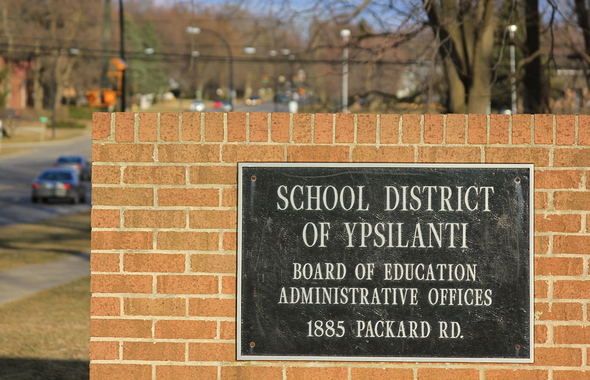
Ypsilanti Public Schools made the Mackinac Center's list of the top 10 highest-spending school districts based on per-pupil operational expenses in 2011.
AnnArbor.com file photo
District officials acknowledged Ypsilanti's operating expenses are high, but said they are working to control spending. Fixed costs and declining enrollment make it challenging to bring down the per-pupil figure, they said.
The Mackinac Center for Public Policy issued a study last week that highlights the discrepancies in per-pupil spending in districts throughout the state. It also found that taxpayers supplied a total of $19.5 billion — $13,405 per pupil (more than ever before) — to Michigan schools via federal, state and local revenues in 2011.
“This highlights an important point: When districts have fiscal problems, it is almost always a spending problem, not a revenue problem,” said Michael Van Beek, director of education policy at the Mackinac Center.

Michael Van Beek
From the Mackinac Center
Joining Ypsilanti on the list of top-10 highest-spending school districts were six others that also had budget deficits in 2011. Ypsilanti was ranked 10th on the list, while Highland Park School District in Wayne County was first, spending $19,634 per pupil. Highland Park was appointed a state emergency manager earlier this year.
The lowest-spending district in the state was Bendle Public Schools in Genesee County at $6,331. Ann Arbor Public Schools sat mid-range with operating expenses of $12,500 per pupil.
In total, according to the Mackinac Center, Michigan’s 41 school districts with a deficit spent 22 percent more than the state average last year.
Sharon Irvine, executive director of human resources for Ypsilanti Public Schools, said while the per-pupil figure the Center has reported for Ypsilanti “seems high,” she is not surprised to see a number of deficit districts on the highest-spending list.
She described operating on a deficit as a slippery slope.
“Once you have hit a point where you’ve crossed over into the red, the cost of operating is greater,” Irvine said. “It’s like a personal credit card. You pay interest on what you charge… (For school districts,) it costs more to borrow, and you need to borrow more and more to make payroll.”
Irvine also said declining enrollment and the student exodus to local charter schools have been major factors in Ypsilanti’s struggle to decrease operational expenses. Fewer students left the district with more staffing resources than they needed and less revenue coming in.
Ypsilanti experienced a net loss of 642 students during the 2010-11 academic year. Of the 1,795 students that opted out of the district, about 45 percent of those students transferred to one of the area’s public academies.
Van Beek said in an interview with AnnArbor.com that the challenge for districts losing students at rapid rates is reducing their infrastructure quickly enough to keep up with not only less students, but less revenue. “It can be really difficult to do.”
“The proliferation of charter schools around has been one of the biggest hits for us, for sure,” Irvine said.
With the closure of Victory Academy earlier this month and a new charter school set to open in the fall, there are four charter schools in the Ypsilanti area.
A large population of special education and academically at-risk students also has contributed to Ypsilanti’s financial struggles, Irvine said.
“At the root of a lot of (these students’) success is lowering staff and student ratios, which is more expensive,” she said.
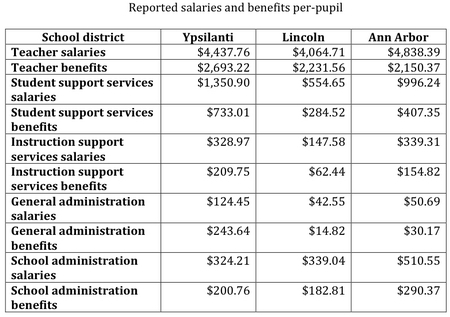
According to the Mackinac Center’s database, Ypsilanti spent about $4,438 per pupil on teacher salaries last year. This was comparable to Ann Arbor and Lincoln schools.
But Ypsilanti spent more than those districts in teacher benefits, student support services and general administration.
Source: Mackinac Center for Public Policy
But she said the district is working diligently to reduce its expenses. This year, Ypsilanti cut nearly $11 million from its budget and reduced the number of employee positions by 104. The teachers union also stepped up “in a phenomenal way” and agreed to a 10 percent pay cut, a 12.3 percent reduction to their salary scale, and a $13,000 hard cap of all benefits, Irvine said.
Van Beek said the reality is, statewide, schools need to change how they compensate employees.
"School districts are often locked in (via union contracts) to a certain level of compensation to employees over a two- to three-year period," he said. "That makes it difficult for districts to be flexible when they need to be, as far as reducing staff or reducing pay when they experience a sudden loss of students. ... Many times they're locked in to increasing pay."
He said it is hard to make any sort of across-the-board statement about compensation levels for districts in Michigan, but he does think the current one-size-fits-all method of teachers being paid on seniority and degree credentials is a poor model.

Christine Stead
Ann Arbor school board Vice President Christine Stead recently published a blog post in response to claims that local school districts have an overspending problem. She said in her blog that the Consumer Price Index (CPI) has increased at an average rate of 2.49 percent annually since 1994. However, the district's per-pupil foundation allowance has increased, on average, with two recent major deductions, 0.95 percent since 1994.
Had the foundation allowance been allowed to keep up with inflation, the district would have received an additional $3,308.45 per pupil for 2012-13, Stead wrote.
“This is context,” she said. “…My take away is that the AAPS is not overspending, rather the state of Michigan is significantly defunding public education. And as a result, the AAPS has had to adjust our general operating budget to absorb cuts in revenue and increased costs from the state.”
- Read Stead's education blog here.
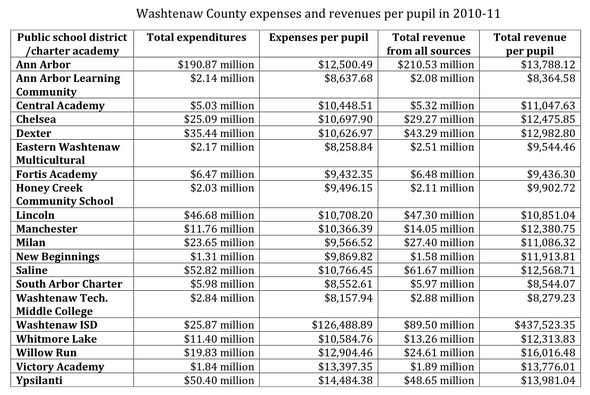
- Compare how Washtenaw County school districts spend their money using the Mackinac Center's database.
Source: Mackinac Center for Public Policy
Staff reporter Danielle Arndt covers K-12 education for AnnArbor.com. Follow her on Twitter @DanielleArndt or email her at daniellearndt@annarbor.com.
Comments
chelle
Thu, Jul 26, 2012 : 2:54 a.m.
Does it mention the number of high risk/free and reduced lunch students most of the schools at the top of this list have. Of course schools like Saline and Ann Arbor pay less, they don't have to feed them as well as educate them
ypsi 1
Wed, Jul 25, 2012 : 6:26 p.m.
Former Superintendents did Ypsi Public Schools no favors. Ron Zuhlke created strife and labor problems and Jim Hawkins did nothing whatsoever but collect his $$$. Dedrick Martin is making progress that should have been addressed years ago but this hole is deep.
Aquarius
Wed, Jul 25, 2012 : 5:45 p.m.
Anything that comes out of the Mackinac Center for Public Propaganda needs to be kept in perspective. Don't let these Rethuglican shills brainwash you with their talking points. Michael Van Beek is nothing more than a fiction writer in charge of working towards the privitization of K-12 education and enriching CEO's on the backs of taxpayers through charter schools. Welcome to the Mississippi of the north.
DonBee
Sun, Jul 8, 2012 : 8:17 p.m.
The Economist Magazine had an excellent article on Charter Schools in the US and the UK. It pointed to the fact that charters work best in areas with very poor public schools. It also pointed out that measurement of teachers and students on a frequent basis was very important. They also pointed out that it was easy to close a failing charters and harder to close failing public schools - and also to replace poor teachers in charters. It was a well considered and written article. I highly recommend it. Bottom line - charters in Ypsi, Detroit or Flint = Good. Charters in Ann Arbor, Plymouth or Birmingham = Bad. But they also point out that the education establishment has set such low expectations for students from poor homes that they have effectively "quit" trying.
1959Viking
Fri, Jul 6, 2012 : 1:48 a.m.
Maybe more people should study Lincoln schools and find out how they did such a great job holding down general administration costs.
Danielle Arndt
Thu, Jul 5, 2012 : 4 p.m.
For anyone who would like to view the same data from a different source, you may download the "district financial comparison tool" or the "budget transparency reports file" from the state of Michigan's Center for Performance and Information website here: http://www.michigan.gov/cepi/0,4546,7-113-21423_35782_49874---,00.html. The data is the same, however, the comparison tool does not have 2010-11 information. The reports file does contain last year's data, but does not break it down per pupil. You are free to form your own analysis.
northside
Fri, Jul 6, 2012 : 1:53 p.m.
Think tanks don't just crunch numbers and put their own spin on the data, they draw our attention toward certain issues. The Mackinaw Center generates a constant stream of reports intended to convince people that public sector spending and labor unions are the sources of our economic problems. You won't find reports from the Center on economic inequality, deindustrialization benefiting ownership, or the impact of the richest 1% having 40% of the nation's wealth. The Center is funded by the 1% to steer us away from thinking about those issues, and towards ones that are more beneficial for them. When a media source does an article on a Center report but presents it as an objective source of information, the Center has achieved two victories. It has us talking about the issues it wants us to focus on and it does so under the guise of a fair, unbiased source.
drew_blows
Thu, Jul 5, 2012 : 10:04 p.m.
Ms Arndt: Your "byline" says that you cover k-12 education? If so, why not develop your own information/article about the topic that you are supposed to specialize in.
drew_blows
Thu, Jul 5, 2012 : 10 p.m.
Ms Arndt, If the information is out there independent of the Whackinac Center why didnt you write an article about these statistics and not include a "study" by an organization with its own agenda. Your article has now become an article about the Whackinac Center and has probably lost some of its intention that you were hoping for. Give us the facts and lets make our decisions; the Whackinac Center doesnt do that. By including such a controversial organization in an article I am now forced to assume that you and AnnArbor.com are a supporter of the Whackinac Center and its beliefs. If my assumptions are correct that means I will not shop at any businesses that advertise with AnnArbor.com or visit this website
AAPS Student
Thu, Jul 5, 2012 : 3:34 p.m.
I find it interesting that we pay the most of general admin salaries... if they took a pay cut and got the same amount as the teachers, that would be a way to reduce the deficit.
northside
Thu, Jul 5, 2012 : 12:21 p.m.
The Mackinac Center is a conservative think tank that would like to dismantle and privatize public education. The center's political leanings and goals should be identified in this article. It is not a neutral, objective source of information as this article makes it sound.
genetracy
Thu, Jul 5, 2012 : 1:09 a.m.
Alot of people on this forum seem to think the numbers presented by the Mackinac Center for Public Policy are wrong because as a group of radical right wingers, they have nothing better to do than scewer numbers when it comes to spending for public education. How about we just delude ourselves and all feel warm and fuzzy. Let us just say the spending on students in the Ypsi School District is 2K per student and all students score 100% on tests. There, problem solved.
timjbd
Thu, Jul 5, 2012 : 6:10 p.m.
Not wrong, just selective. They cherry pick numbers and present them in a way that seems to further their agenda, which is- the privatization of the public schools and the gathering of the budget dollars set aside for public education.
Will Warner
Thu, Jul 5, 2012 : 1:05 a.m.
I'm sure the point of publishing the results of the study is to illustrate that high spending on education does not correlate with high achievement. Personally, I don't need to be persuaded of that. The contribution of parents, or lack thereof, swamps all other factors, or so my gut tells me. However, I will observe that this data does not tell us how much poorer the poor performance would have been without the increased spending per pupil. Because a school system is stuck with the parents it gets, possibly the only mitigation for uninvolved parents available to a school system is high-spending per learner. That said, I would completely privatize education. We can still pay for it publicly -- with vouchers.
Alpha Alpha
Wed, Jul 4, 2012 : 11:42 p.m.
The key issue, which remains largely unaddressed, is this: the average total compensation level of most public employees is too high. Widely-sourced data, posted repeatedly on this site, clearly show that job for job, the average public sector employee receives approximately twice the total compensation as does the average private sector employee. Put another way, our public employees are now earning upper class wages for jobs historically considered worthy of middle class wages. The fiscal realities of the new Age of Austerity are such that all virtually public employees will be earning less total compensation in the near future than they have in the recent past, just as nearly all private sector employees already do, 1% notwithstanding. It is sad, but it is true. And it is irrespective of political affiliation. Let the debate now become how to effect the changes in the least unpalatable way.
Dirtgrain
Thu, Jul 5, 2012 : 8:39 p.m.
Basic Bob, it appear that you are sliding down the boundaries of what qualifies as middle class in order to suit your stance. With such a tactic, you could claim that the middle class will never disappear. I don't think this tactic is standard practice.
timjbd
Thu, Jul 5, 2012 : 6:07 p.m.
No, that's not the key issue. That's the key issue for Rush Limbaugh, Fox News and the people who get told what to think by them. But not for thinking people.
Basic Bob
Thu, Jul 5, 2012 : 12:53 a.m.
@Dirtgrain, The middle class has not kept up with inflation. In the last 15 years, skilled trades, engineers, accountants, and production managers have taken a real beating. Still middle class, but we gave up our foreign luxury cars, lake houses, and European vacations. Public employees have had to face reductions in number, but those still employed have been spared from 20-30% salary cuts (and then no raises) typical in the private sector. To receive any raise, even one that is less than inflation, moves you well up the scale.
Dirtgrain
Thu, Jul 5, 2012 : 12:36 a.m.
"Widely-sourced data, posted repeatedly on this site, clearly show that job for job, the average public sector employee receives approximately twice the total compensation as does the average private sector employee. " Back this up with data please. "our public employees are now earning upper class wages for jobs historically considered worthy of middle class wages." Upper class wages? Have you factored in inflation? Over the last fifteen years, I teacher contracts haven't outpaced inflation. So how then could teacher salaries have jumped from middle class level to upper class?
Andy Price
Wed, Jul 4, 2012 : 11:18 p.m.
Can the Mackinac Center really be trusted?
bobslowson
Thu, Jul 5, 2012 : 1:34 p.m.
No.
genetracy
Thu, Jul 5, 2012 : 1:12 a.m.
Let's find some government funded far left organization and let them conduct a study on public school spending in Michigan. Of course their findings will be 100% true.
JRW
Wed, Jul 4, 2012 : 11:01 p.m.
I picked up one line from the above table: PER pupil spending at WISD is $ 437,523??? Can this be correct?
Danielle Arndt
Thu, Jul 5, 2012 : 3:40 p.m.
JRW, the $437,523 was the total revenue broken down per pupil. So that figure is what the WISD brought in last year per pupil. The WISD spends at a rate of $126,488.89 per pupil, according to the Mackinac Center's database.
Arborcomment
Wed, Jul 4, 2012 : 3:32 p.m.
Shoot (or taint) messenger syndrome seems well fed on A2.com today. Why examine what to do when you can poke on the connections of the data source rather than the data.
Arborcomment
Thu, Jul 5, 2012 : 1:25 a.m.
Bus, I'm diligently searching, can't seem to find any of my posts on "greedy teachers", unless you were referring to the President of the Teachers Union in DC? While I look for that reference, why don't you peruse the chart above and get back to us why general admin salaries and benefits are more than double/triple to five times the amount for Lincoln and A2?
leaguebus
Wed, Jul 4, 2012 : 8:27 p.m.
It has been pointed out that districts with more low income parents have a higher cost per pupil. I guess this doesn't fit your idea that it's greedy teachers and poorly administered districts that are the problem. If competition and a select student cohort was what made schools better, the MEAPs for the charters should be sky high, but they aren't. They are lower across the board. Just Google MEAP scores and you can see every school in the state.
Arborcomment
Wed, Jul 4, 2012 : 6:14 p.m.
Then "critically" speaking - dispute the data on spending per pupil and get back to us.
sh1
Wed, Jul 4, 2012 : 5:35 p.m.
It's called critical thinking to examine the source of opinions. You would say the same if a left-wing think tank were quoted.
braggslaw
Wed, Jul 4, 2012 : 3:18 p.m.
Public education has become a public works project for unions It is time to free parents and students from a failing monopoly
DonBee
Sun, Jul 8, 2012 : 8:11 p.m.
Mr Ivorsen - I would suggest you read this week's Economist Magazine.
Ivor Ivorsen
Wed, Jul 4, 2012 : 6:42 p.m.
Okay, which is it? The schools are bad because of unfavorable demographics? Or big bad teacher unions? It seems that when schools do great, there are sorts of other explanations. When they fail it is because of unions and greedy teachers.
DonBee
Wed, Jul 4, 2012 : 5:47 p.m.
Mr Ivorsen - Please, please provide me with a reasonable source of your comment. I have looked at 14 flawed studies funded by one side or the other of this debate. Non of them can draw that conclusion reasonably. So please cite your sources.
sh1
Wed, Jul 4, 2012 : 5:34 p.m.
Certainly you can explain your first sentence with some citation, braggslaw. You act like teachers' unions have power but show no evidence.
ILJ
Wed, Jul 4, 2012 : 5:21 p.m.
And Pioneer, Huron and Saline all have an enviable student demographic: lots of middle class and upper middle class kids from families with married, college-educated parents. Those districts don't have to spend a lot of time and money dealing with the effects of poverty, addiction, domestic violence and other social ills in those schools before they can even begin to educate the children.
Ivor Ivorsen
Wed, Jul 4, 2012 : 4:58 p.m.
Again, data-free talking points from the anti-public education crowd. Your reasoning seems to run something likes this: "Ypsilanti is an under-performing school district; Ypsilanti is a public school district, therefore public schools are failing. Oh and it's the unions' fault" The reality is that public schools (with unions) consistently out perform charter schools in most studies. Area public high schools like Saline, Pioneer, and Huron rank as some of the best in the state (and in Saline's case, the nation). All have unions. All are public.
jns131
Wed, Jul 4, 2012 : 4:25 p.m.
Why do you think they call them charter schools? Parents are done with the unions and its failing system. This is why parents are fleeing from schools who are not doing their job.
timjbd
Wed, Jul 4, 2012 : 2:58 p.m.
Notice the complete lack of skepticism on the part of this "journalist." Any school would see a rise in per pupil spending if the pupils are being siphoned away by other schools. That is obviously part of the plan. The new higher per-pupil rates will now be the standard to which the charter "education" industry will hold themselves and their pet politicians will march in lock step support. Break out the champagne! If you spend $100,000 a year to operate a school that educates 100 students, the cost per pupil is $1000. Now if you remove 25 students, the per student cost is $1333 and so on. The same with teachers salaries, bus services, etc, if your measurement is per-pupil spending. This is how you drive the salaries of a profession down, among other things. Eventually the skill levels will be driven down with them. News Corp is signing contracts all over the US to implement their education software system- which will eventually eliminate teachers entirely. It's already been pointed out who is behind this report and what their agenda is. It would be great if the home town "newspaper" could also point those things out.
DonBee
Wed, Jul 4, 2012 : 5:45 p.m.
timjbd - The numbers are on the state website. There is no news in the numbers - they are reported by the districts. You can cut the numbers your own way, but the numbers are the numbers. As to the people who did the report, I have no comment. The same kinds of numbers were reported here about two years ago for each building in AAPS - that was eye opening. But AAPS has since pulled all of that information off the website.
Arborcomment
Wed, Jul 4, 2012 : 3:55 p.m.
Nice math, let's add reality. "you" don't "remove" students from failing schools, concerned parents do. When they do so, your math works. Provide a fix that makes public schools work, without the usual throwing more money at it (though if demonstrated that additional money acutally works - then do it), and you will end the migration of concerned parents and their students. You also ignore the fact that there will be competition within the charters, both in cost reduction and results. Parents will have a choice to go to those that are successful. Washington DC spends more per-pupil than any other district in the country. The charter program there is vibrant and producing results. It even survived a blatant attempt by the Obama administration to kill it when it encroached on the domain of the teacher's union (the one where the president of the teacher's union was convicted of buying fur coats, vacations, and gambling with union funds). It survived by the outcry of the parents (with exposure in the press and Congressional help) most poor, who have seen and experienced a better way.
brucef
Wed, Jul 4, 2012 : 2:58 p.m.
Reading the comments, I'm always amazed at the number of people so quick to attack the source of the information rather than engage the real issue. Real issues: 1. How much is going to benefits. Are costs out of control? 2. How much is going to administration - just wow! 3. Where the sources of funding are coming from - look at Detroit and you see most of the money coming from state and federal sources. Perhaps necessary, but Detroit is really, really broken. Something is really broken and attacking the Mackinac Center is not going to help fix it. Engage the issues, people!
Lovaduck
Thu, Jul 5, 2012 : 12:20 a.m.
Yes, attacking the source is a logical fallacy if you discount the arguments ONLY because of the source, but pointing out that those presenting these facts suppress a lot of perspective and complexity, just puts things out in the open. THEN the arguments can be more carefully evaluated.
Dog Guy
Wed, Jul 4, 2012 : 2:57 p.m.
Those darn right-wingers have no right to state the facts. By the way, what are the revenue-per-pupil numbers for local private/parochial schools? Ypsi spends about $2k more per pupil than AAPS, which sounds like a pitch for a new AAPS millage next spring. As a teacher at the tax trough, I delight in our wonderful education system.
Lovaduck
Thu, Jul 5, 2012 : 12:18 a.m.
It's one thing to state "facts"--it's the agenda of those presenting them, and INTERPRETATION of those facts that needs the light of day.
Lac Court Orilles
Wed, Jul 4, 2012 : 2:45 p.m.
Consider the source: "MACKINAC CENTER" who's sole purpose is to villify all public school teachers, and ruin public schools so their wealthy contributors can get their dirty hands on tax payers' money via creating charter and cyber charter schools. Amazing how sick these people are . . .
PattyinYpsi
Wed, Jul 4, 2012 : 2:22 p.m.
It is unconscionable that AA.com would describe this report as "a new analysis" by "a Michigan-based think tank" without bothering to mention that this group is funded by and adheres to the policies of the radical right. Among its major supporters are the Devos and Dow families, the Koch brothers, and Eric Prince, the founder of Blackwater. These people are not conservatives--they are radical right-wingers, and anything that issues from the Mackinac Center has to be viewed in that context. It is your job to describe your sources for your readers. Data can be analyzed from any viewpoint you like, and the results will be different, depending upon who's doing the analysis.
genetracy
Thu, Jul 5, 2012 : 12:36 a.m.
The radical left think anyone to the right of them is the radical right.
Basic Bob
Thu, Jul 5, 2012 : midnight
Unconscionable is the idea that we should discard the report simply because YOU disagree with the authors. I think it reveals some pertinent information, mostly the savings that can be gained by stabilizing the school population and consolidating some administration. I'm disappointed that some people are so concerned about maintaining union jobs that they will allow an entire generation to suffer without the benefit of education.
a2citizen
Wed, Jul 4, 2012 : 8:12 p.m.
"It is your job to describe your sources for your readers. " Who are you to decide what their job is?
L'chaim
Wed, Jul 4, 2012 : 6:25 p.m.
You are so right. I hope the editors are paying attention. Shame on them!
Dirtgrain
Wed, Jul 4, 2012 : 2:11 p.m.
Spot on JB1. School choice and charter schools have created waste. They were promoted as cost-saving concepts and as solutions to perceived problems with public schools. But how does building more and more schools, while shrinking other districts and closing schools, save us money? It's wasteful and inefficient (we're losing money because of it). As for improving education, charter schools have been shown not to be any better than public schools, overall.
DonBee
Sun, Jul 8, 2012 : 8:09 p.m.
I would suggest you all read the article in this week's economist magazine on charter schools.
ViSHa
Wed, Jul 4, 2012 : 9:03 p.m.
**there, not their.
ViSHa
Wed, Jul 4, 2012 : 5:21 p.m.
Charter schools "generally" don't need to recruit students, their is usually a waiting list. I don't think you can necessarily say they "cherry-pick". Usually those looking at charter schools are those who have had problems with the public school in addressing discipline issues in that the public school's hands are tied with discipline issues (bullying) whereas a charter school's aren't. Add the public schools having to deal with the "behavior gap"(i.e. don't do anything so the numbers go down) and the larger class sizes (budget problems) and you have a recipe for parents seeking alternative education. I feel for the public school teachers, they have so many exterior things to deal with instead of just TEACHING. And personally I think this new superintendent is just adding more to the problems the teachers face. my two cents.
Dirtgrain
Wed, Jul 4, 2012 : 4:27 p.m.
FredMax, are you in favor of outsourcing our students to other countries? Who is paying for all of these new charter school buildings? How is it not wasteful?
Townie
Wed, Jul 4, 2012 : 3:19 p.m.
FredMax: it's called 'cherry picking' - the charter schools make sure they don't recruit any problem students (behavioral or educational) and leave the expensive students to the public schools. Then they claim success by pointing to how much better their students perform. Standard practice in private-public situations -- health insurance, etc. Same old story over and over. And when there the comparison is adjusted for the cherry picking the privatizations 'success' stats melt away like snow in hell.
FredMax
Wed, Jul 4, 2012 : 3:03 p.m.
Time and again it has been proven that competition only leads to waste and inefficiency. For example, look at the story of Apple entering the cellphone market.
JB1
Wed, Jul 4, 2012 : 1:39 p.m.
I've said it before, and I'll say it again. Take Ypsi's student population (much higher percentage of low-income, ESL, parents without college degrees, etc.), and put them all in 1 or 2 of Ann Arbor's schools. You'd have the same problems. Why do you think it costs more for professional support for per-pupil spending in Ypsi schools? Perhaps because they NEED a much higher support level. Its MUCH easier to educate children coming from stable homes, with 2 college-educated parents. I'm so darn tired of everyone assuming that kids in these high-poverty districts should be able to "get by" with the same services that others have, while EXPECTING the same results (high proficiency levels). We label Ypsi schools as "bad" because they are "underperforming" and Ann Arbor schools as "excellent." In reality Ypsi schools are only underperforming because they have a high-poverty student population. Ann Arbor schools are only great because they have a high percentage of middle class students. Look at the breakdowns people--Ann Arbor schools do little to no better in educating those that Ypsi schools have a high population of. If its so "easy" let's swap students--put Ann Arbor kids in the Ypsi system with the same teachers, schools, etc--see what happens. Betcha Ypsi's test scores suddenly look a whole lot better!
Krista Boyer
Wed, Jul 25, 2012 : 9:03 p.m.
I have said this so many times, my colleagues are some of THE hardest working people that I have ever met, and I have been in other districts. Their creativity and resolve to reach even the most reluctant learner is a testimony to their dedication.
anotherannarborite
Thu, Jul 5, 2012 : 4:05 a.m.
The true measure of a great school is how the typicially under performing student groups do. Ann Arbor doesn't look that great when you take that into consideration. A rural district near where I"m from had 85% college bound and nearly as high AP course takers and test passers. It also had very high free and reduced lunch numbers and very low college educated parents. Very impressive.
DonBee
Wed, Jul 4, 2012 : 5:40 p.m.
JB1 - If only it was true - The college educated parents want every advantage for their child, so services for speech, writing and other issues all go up. IEPs are the way to get your child special help - a leg up and educated parents know how to ask. Disinterested parents do not or don't care. The president of the board ran for the board, because she was unhappy with special education services in Ann Arbor. Don't think that just because parents are educated, the cost to a district of their child is cheaper - it is only a different set of problems.
J. A. Pieper
Wed, Jul 4, 2012 : 4:01 p.m.
JB1 - I agree with some of your points. I do teach in AAPS, and my building has a population similar to Ypsilanti schools. I would love to see some other schools in AAPS trade populations with us, or have their excellent teachers come teach at my school. It takes special people to work with students who have more challenges, and those of who do, we love these kids. Both districts have achievement gap students, and many districts nationwide struggle to educate these students to their highest potential. Our students do need additional services, while many students in AAPS would never need the school social worker, etc.
apples
Wed, Jul 4, 2012 : 1:25 p.m.
The financial guy has left Yp.si schools. He was at Willow Run before Ypsi.
jns131
Wed, Jul 4, 2012 : 4:22 p.m.
Now all he has to do is come to Ann Arbor and we are at full circle. WR is closing its hi school. Can't wait to see what else is coming down the pike.
Dusky
Wed, Jul 4, 2012 : 3:16 p.m.
I don't believe Ypsilantii schools are known for "cutting pay".....check out the salaries and benefits before writing!
Basic Bob
Wed, Jul 4, 2012 : 2:02 p.m.
That's what happens when you cut employee pay. People with skills leave.
Ron Granger
Wed, Jul 4, 2012 : 1:21 p.m.
Part of the problem is that Ypsi is a sinking ship. What great professional would want to choose to attach themselves to a sinking ship?
Pickforddick
Wed, Jul 4, 2012 : 1:10 p.m.
Again for you educated ones.............. Amazing how these so called "Educated Ones" can not manage a budget.
bobslowson
Thu, Jul 5, 2012 : 8:24 p.m.
Whether it be on this story or some other...what's with the repetitive comments Pick?
Lovaduck
Thu, Jul 5, 2012 : 12:14 a.m.
Posting the same comment twice doesn't make it any more true or false.
Ron Granger
Wed, Jul 4, 2012 : 12:55 p.m.
'"Once you have hit a point where you've crossed over into the red, the cost of operating is greater," Irvine said.' Can anyone confirm that this is really the crux of the Ypsi school spending problem? Is that what is driving the high cost?
jns131
Wed, Jul 4, 2012 : 4:21 p.m.
Ann Arbor has Balias. Ypsilanti has administration and BOE costs. So, once you figure out who is getting the bigger piece? Reduce it. O wait, you can't if you are the superintendent.
Basic Bob
Wed, Jul 4, 2012 : 1:59 p.m.
They are free to analyze the data in any way they see fit. In the end it does not reveal the cause of the problem. It would be impossible to run a deficit without spending more money than you take in. But the real problem is the schools suck and students are leaving at a phenomenal rate. There is no way the district can cut fixed expenses (administration, building maintenance, utilities, debt) fast enough. Parents in the district are left with a hard choice: live with bad schools, charter schools, or moving. Now the administration and teachers must pull a rabbit out of the hat, making the schools good again with under-performing students. Then students will return.
SpamBot1
Wed, Jul 4, 2012 : 12:49 p.m.
@DanielleArndt The Mackinac Center saying that schools are overfunded is NEWS? Bashing public education is their hobby, not news. Why don't you do a story on the money that is going to charter schools? Where is that money going to? Why can't we get salary information on those publicly funded schools? How are those charter schools really doing?
L'chaim
Wed, Jul 4, 2012 : 6:22 p.m.
You're 100% right. The story here is about the MC's attempts to influence public policy by spinning data. But this story uses it as a jumping-off point to "analyze" education spending. The analysis suffers severely as a result.
antikvetch
Wed, Jul 4, 2012 : 3:31 p.m.
There's a fine line between being "enlightened" and being a "denier"...
cinnabar7071
Wed, Jul 4, 2012 : 1:05 p.m.
So now the truth is "bashing"? I bet you're one of the people who thinks, if only they had more money.
snoopdog
Wed, Jul 4, 2012 : 12:35 p.m.
Top 10 in spending, bottom 10 in performance. The "poster school" for proving that more spending does not equate to better performance. Good Day
catfishrisin
Thu, Jul 5, 2012 : 4:14 p.m.
Surely he doesn't
sh1
Wed, Jul 4, 2012 : 5:30 p.m.
Surely you know it's more complex than that.
Floyd
Wed, Jul 4, 2012 : 12:12 p.m.
Notice where this report is coming from: The Mackinac Center, which is about as right wing and partisan as any "think tank" you can think of. I've never seen one of their "findings" that didn't justify their far-right agenda of dismantling public education and turning it over to their patrons in the One Percent. These guys are partisan attack dogs and their "research" is propaganda paid for by the Center for Shrinking the Middle Class.
drew_blows
Thu, Jul 5, 2012 : 2:06 p.m.
Sparky, Can you disprove anything Floyd said in this post. It seems you are taking what the Mackinac Center (ie Wanna Be Funded by the Koch Bros Center) is saying at face value which is essentially what you are accusing Floyd of doing. You do know what they say about statistics right?
sparky
Wed, Jul 4, 2012 : 6:54 p.m.
Can you point to any factual inaccuracy? The Mackinac Center should not be maligned for simply presenting the facts of this matter. Perhaps you should offer a counter rather than pointing out who paid for the research.
Chip Reed
Wed, Jul 4, 2012 : 11:46 a.m.
Perhaps it would be more accurate to describe the Mackinac Center as a "public policy agenda tank". There doesn't seem to be a whole look of thinking going on up there. People who don't even believe in geology do not have any standing to opine about our educational system challenges.
Barzoom
Wed, Jul 4, 2012 : 11:28 a.m.
This just goes to show that education spending does not equate to the quality of the results.
cinnabar7071
Wed, Jul 4, 2012 : 1:01 p.m.
Thats not what the educaters are saying.
Pickforddick
Wed, Jul 4, 2012 : 11:21 a.m.
Amazing how these so called "Educated Ones" can not manage a budget.