

Michigan Suburbs Alliance propose climate action plan for Ypsilanti
The Michigan Suburbs Alliance has put together a climate action plan for the city of Ypsilanti in hopes of creating a strategic and sustainable plan to reduce greenhouse gas emissions.
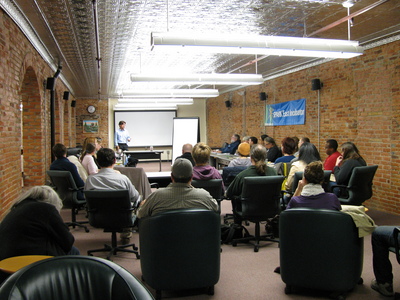
Richard Murphy speaking during a public engagement meeting at SPARK East regarding the Climate Action Plan.
Courtesy photo
The alliance kicked off the Ypsilanti project-planning phase in 2011 after receiving a $47,600 grant from the Michigan Department of Environmental Quality and Community Pollution Prevention Program to develop the plan.
The Suburbs Alliance worked with Ypsilanti, Southgate and Hazel Park to receive the grant funding.
Richard Murphy, director of place programs for the Suburbs Alliance, said Ypsilanti became part of the plan after the alliance approached a number of area communities that were already doing some energy-related work.
“There was a lot of interest in Ypsilanti between things like the Solar Ypsi Project and community gardening groups working on energy-related issues,” Murphy said. “We knew that there was an increasing interest so we approached them with a way to take the next step.”
In 2011, Ypsilanti joined the Millennial Mayors Congress, a collaborative body of civic leaders focused on developing a sustainable Detroit region. In December 2009, the Congress adopted an Energy Savings Protocol, setting a goal of reducing government uses of energy from non-renewable sources to 25 percent below 2005 levels by 2015.
Ypsilanti is seeking to go beyond that 2015 goal.
For more than 15 months, Ypsilanti and its consultants, Michigan Suburbs Alliance and WARM Training Center, collected available energy usage data. Data was collected primarily from city departments, DTE Energy, the Southeast Michigan Council of Governments and the U.S. Census.
Their research shows the Ypsilanti community emitted 302,710 metric tons of greenhouse gas emissions in 2008. This number is equivalent to 15 metric tons per capita for the city.
While the Ypsilanti city government contributed 3,387 metric tons of emissions, the commercial sector in Ypsilanti was the greatest contributor to GHG emissions, with 9.5 percent of the total emissions, plus 23 percent additional commercial emissions from Eastern Michigan University, for a total of 32.5 percent.
The industrial sector followed close behind at 31 percent and residential properties were third, with 20 percent of the total emissions.
Murphy said the city has already begun projects to reduce those numbers.
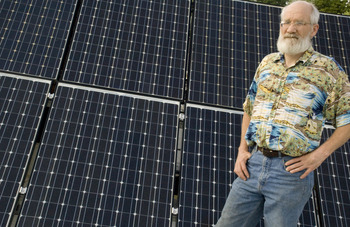
Solar Ypsi founder Dave Strenski
Tom Perkins | For AnnArbor.com
Ypsilanti’s City Hall installed a 2.5 kW photovoltaic array in 2010. Using roughly $27,000 out of a $36,000 state grant awarded to the Ypsilanti Food Co-op in May 2008, Solar Ypsi founder Dave Strenski and a team of volunteers installed 12 panels on city hall’s south side roof in April of 2010.
The Solar Ypsi initiative has initiated and supported several solar photovoltaic installations around Ypsilanti, Murphy said.
Solar energy generation may include solar photovoltaic, which generates electricity and solar thermal, which heats water. It can also include hybrid, “water-cooled” systems and photovoltaic panels that generate hot water as a byproduct.
Estimates show that a commercial-building-scaled 20 kW photovoltaic/thermal hybrid system costs approximately $200,000 to install.
A solar system will likely take decades to recoup savings that equal the initial cost. With a combination of currently available incentives, however, payback can be yielded in periods of less than 10 years.
In 2011, a project on West Cross used 28 LED fixtures in the new streetlights. This is expected to save the city over $3,500 a year in energy and maintenance costs.
A typical streetlight upgrade costs $600-$700 per fixture, including hardware and installation. Replacing all DTE-maintained streetlights at this rate would cost a total of $1.1 million.
If Ypsilanti’s entire inventory of street lighting were upgraded, the city could save $160,000 annually.
Murphy pointed out that EMU, which occupies a quarter of the city’s total land area and 40 percent of the city’s total daytime population, has incorporated energy efficiency measures into its recent capital projects.
The various energy-related improvements the university made while renovating its Mark Jefferson Science Building is expected to save nearly $400,000 in annual operating costs and eliminate more than 3,000 metric tons of carbon dioxide.
By doing things like this and implementing energy efficient devices such as lighting retrofits and promoting building lighting sensors, Murphy believes the city can reduce costs and its carbon footprint.
Lighting retrofits are often in the range of $60 per 1,000 square feet of buildings depending on the technology used.
Retrofits can bring energy savings of 15 percent or more.
If 5 percent of the city’s commercial and industrial properties undertake lighting upgrades annually, reductions of 4,000 metric tons of carbon dioxide, or CO2e, could be achieved by 2020, officials said.
In addition to retrofits, building light sensors can lead to almost a 35 percent reduction in electricity usage in commercial buildings, with payback of installation costs in less than a year.
Murphy said he is aware that some of these energy efficient devices and installations can be costly but the benefits far outweigh the costs.
“We know that all of these communities have very compelling financial needs and addressing global climate change is not (even) concern No. 200 for any of these communities on their list of priorities,” he said.
Murphy said the goal is to help communities reduce the amount of energy usage while lowering costs.
“The intent is to help and prioritize instead of chasing everything at once,” he said. “We have to figure out where to focus attention strategically.”
Murphy said he has received a lot of feedback from the community—including city officials.
“Some of the recommendations we’re presenting in the drafted plan come directly from suggestions that city council members and planning commission members had early in the process,” he said. “We’ve spent a lot of time working in the community have gotten a lot of interest and positive engagement.”
Murphy presented the plan to city council at its June 5 meeting. Council may choose to adopt the plan during its next meeting on July 17. To view the proposed climate action plan in its entirety, click here.
Katrease Stafford covers the city of Ypsilanti for AnnArbor.com. Reach her at KatreaseStafford@annarbor.com. You can also follow her on Twitter.
Comments
xmo
Wed, Jun 27, 2012 : 2:39 p.m.
This is what Dr. lovelace the "founder of Global Climate change wrote! "Lovelock blasted greens for treating global warming like a religion. "It just so happens that the green religion is now taking over from the Christian religion," Lovelock observed. "I don't think people have noticed that, but it's got all the sort of terms that religions use … The greens use guilt. That just shows how religious greens are. You can't win people round by saying they are guilty for putting (carbon dioxide) in the air." "
Bob Krzewinski
Wed, Jun 27, 2012 : 2:23 p.m.
To all the critics (especially the ones who don't even want to give their real name)... Fine, lets have Ypsilanti drop out of the Michigan Suburbs Alliance and have the money Ypsi would have received for this program go to some other Michigan city that could use the funds for energy-saving programs that actually can save taxpayers money in the long run. Besides, we don't have any climate problem do we? Just no real rain for the past week and temperatures forecast to be 109 degrees Thursday when the normal high is supposed to be 80.
SEC Fan
Wed, Jun 27, 2012 : 4:48 p.m.
@Bob. IN regards to your statement about no rain this past week, Mr. Orwell is correct. Correlation does not equal Causation! For example, The current record high for the 28th (Thursday) is 104F. This was set in 1934. (normal high is 83). Additionally, the year in which June has the lowest monthly precipitation total was 1895 (0.55 inches). We've had just over an inch of rain so far this month. FYI, the Record Highs for 29th and 30th of June were set in 1933, 1931 respectively.
G. Orwell
Wed, Jun 27, 2012 : 3:53 p.m.
@Mr. Krziwinski "Just no real rain for the past week and temperatures forecast to be 109 degrees Thursday when the normal high is supposed to be 80." That is called fluctuation. Temperatures do fluctuate. Also, what are the strings that are attached to the funds? If not this time, next time. The strings that are attached will benefit those giving you the money at the expense of the residents of Ypsilanti. It's bait and switch.
Alan Goldsmith
Wed, Jun 27, 2012 : 2:44 p.m.
Maybe the County can get Conan Smith to repay the travel funds he ripped off and then those could be used for light bulbs in Ypsilanti?
Alan Goldsmith
Wed, Jun 27, 2012 : 2:41 p.m.
How much money does Ypsilanti pay into being a member of this group? What about the County? What about sending these funds directly to Ypsilanti and not have six figure 'managers' and coordinators take their cut off the top first (like Conan Smith)? Where does the MSA funding come from? There are scores of duplicated and costly programs that would be more effectively used for making sure Ypsi has green light bulbs. But groups like SPARK, MSA and others are just make work projects for political hacks. The response to climate change is important--but in Ann Arbor you get people like our Mayor who blames global warming at the cause for neighborhood flooding-not for a failure to plan and replace infrastructure. Ypsilanti DOES have more pressing issues but it's sad that you are happy to accept crumbs from someone (MSA/Conan Smith) who are lining their pockets and trying to use these dollars to further their political goals of higher elected offices.
G. Orwell
Wed, Jun 27, 2012 : 1:37 p.m.
Anyone supporting this rediculous global warming agenda is working against the working class in manufacturing and should be thrown out of office. That is because the bogus fight against CO2 emissions is designed to shut down manufacturing in the U.S. Why doesn't the environmental groups and Al Gore attack China for all the real pollution they emit and massive amounts of CO2. That is because these same people have invested in China. Shut down manufacturing in the U.S. through increased regulations and ship the jobs to China. I believe China is building a new coal powered plant every week or two to keep up with energy demand and Obama wants to shut them down here in the U.S.
Roy Munson
Wed, Jun 27, 2012 : 12:58 p.m.
Doesn't Ypsilanti have much bigger problems than this made up "threat" of global warming?
Alan Goldsmith
Wed, Jun 27, 2012 : 1:17 p.m.
You might want to ask Conan Smith who runs this organization.
Jeffersonian Liberal
Wed, Jun 27, 2012 : 12:42 p.m.
How much longer do you fools intend to piss away tax payer revenue on this fraud?
G. Orwell
Wed, Jun 27, 2012 : 12:36 p.m.
I, like many people, are fully supportive of energy conservation and renewable energies as long as they are not boondoggles (Solyndra). However, don't let this hyped "sustainability" movement get out of hand. The whole "sustainability" movement is based on a Big Lie. More people are coming to realize, based on science, that the whole global warming hysteria was manufactured to scare the public into giving up our hard earned money for carbon taxes. To enrich the wealthiest people in the world at the expense of the average people. The temperature data shows NO global warming. Thus, no danger of mass ice melt. Thus, no 20 feet sea level rises (Al Gore's prediction) and no fear of entire cities flooding. This was a scare tactic. Don't let them fool you.
SEC Fan
Thu, Jun 28, 2012 : 11:53 a.m.
@Mr. Orwell. You are absolutely wrong. check out the NASA link I posted above. Clearly shows an increase the world's average temps over the past 100 years. Where are you getting your "data" from?
G. Orwell
Wed, Jun 27, 2012 : 7:12 p.m.
@Macabre Some parts of the world are warming for a period of time. I agree. However, other parts of the world are cooling during a given time. Europe went through one of the coldest winters. The chennels of Venice froze over during the past winter. Even last month, parts of southern Europe was unseasonably cold. If you look at the average around the entire world, no noticeable change in global temp.
SEC Fan
Wed, Jun 27, 2012 : 7:10 p.m.
@Macabre. It's the heat down South that makes it so dry :-)
Macabre Sunset
Wed, Jun 27, 2012 : 5:23 p.m.
Orwell, people have to be careful not to sound like the East Anglians themselves, or they will be dismissed just as easily. SEC Fan is right (though his brand of football is rather dry) that many areas are getting warmer and this will cause population shifts and resource issues. We need to study this issue, and, in some cases, plan for the future. Especially when it comes to fresh water problems. However, solar panels? A nice idea, but horribly inefficient and wasteful so far. We shouldn't encourage the sale of inefficient products - development should continue until there's something viable.
SEC Fan
Wed, Jun 27, 2012 : 4:21 p.m.
I'm familiar with UN21. My comment is in reference to implying that global warming and "sustainability" are both based on fiction. You can argue who or what is causing the earth to warm and whether or not it is normal (the NASA link I posted above shows you the global temps going back to 1890). I don't think the complete scientific data is conclusive one way or the other. But if your position is that the increase in global population will have no impact on the Earth and that we need do nothing, well...
G. Orwell
Wed, Jun 27, 2012 : 2:43 p.m.
@sec Sustainability and global warming, now called climate change since the earth is not warming (did you catch the transition) beyond the normal range comes from the same organization. The UN put out the UN Agenda 21 and this is where the sustainability and global warming junk science comes from. Google "UN Agenda 21"and educate yourself.
SEC Fan
Wed, Jun 27, 2012 : 1:47 p.m.
The "Sustainability" movement is not synonymous with the Global Warming group. Sustainability is more directed at addressing the issues due to increasing global population and the related strain on fixed resources (e.g., clean water to drink). obviously the effects of global warming impact this, but that is not the driving force. By 2030, conservative estimates indicate: - there will be over 8 Billion people on Earth. - 60% of the these people will live in cities - 2 Billion cars will be on the road - All of this will require a 40% increase in primary energy usage. Additionally, global water consumption is estimated to DOUBLE by 2025. So, whether you agree with man-influenced global warming or not, we have some serious challenges in the very near future that need to be addressed. Also, just to clarify, no scientist disagrees that the world is experiencing a warming trend (http://science.nasa.gov/science-news/science-at-nasa/2000/ast20oct_1/). The argument is whether Man is making it warm up faster.
Alan Goldsmith
Wed, Jun 27, 2012 : 11:04 a.m.
Michigan Suburbs Alliance? You fail to give credit to the organization's leader, Washtenaw County Commission head Conan Smith, who still owes taxpayers for the travel expenses he took improperly and hasn't yet repaid.