

In bowhunting, learn to scout the signs, and you could get a big buck
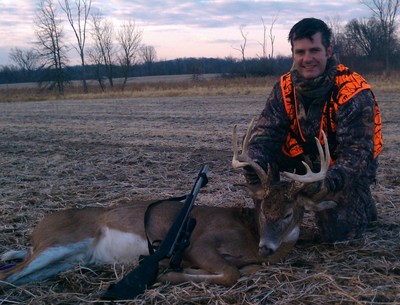
Proper scouting led to this successful hunt and plenty of meat in the freezer.
Rick Taylor | Contributor
The 54-degree weather on Labor Day certainly reminded us that autumn is soon upon us. It’s hard to believe that the harvest season is right around the corner. Soybeans will be harvested during the first weeks of October and corn soon after that. The leaves too, will show off their illustrious brilliance that we all love so much this time of year.
But, like all good things the leaves will eventually fade and the once-thick forests will be bare again.
There’s an unmistakable loneliness in nature when cooler weather prevails, yet it’s a feeling many of us openly embrace.
The natural kingdom also knows that fall is a season of change. Squirrels gather their nuts and prepare for winter. Ducks and geese migrate down south to a warmer climate.
Whitetail deer also prepare for the fall and winter seasons by going through a number of biological changes. Testosterone rages through bucks all the way through the “rut”. The “rut” can best be described as the timeframe of the sexual reproduction period during the fall and early winter months.
Bucks have been growing their antlers since the spring for a number of reasons. Antlers are used as a weapon to fight other bucks which can injure and even kill other bucks. Smaller racked bucks can be scared off just by the larger size of another buck's rack.
Bucks prepare for fighting each other by “rubbing” a series of trees with their antlers in order to strengthen their neck muscles. These trees that have been “rubbed” can be easily distinguished by missing bark starting about 18 inches off the ground to about three feet off the ground.
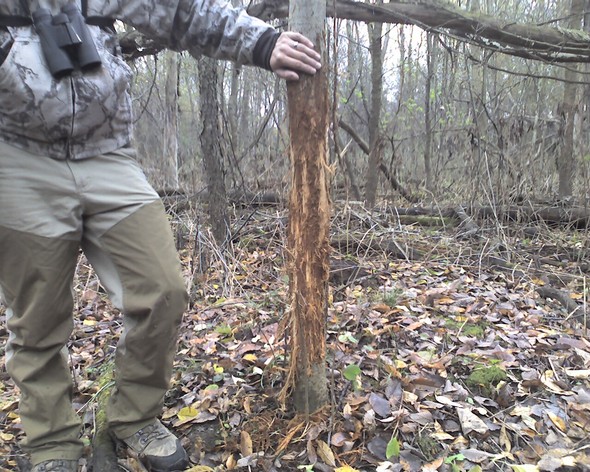
Author Rick Taylor found this "Buck Rub" while scouting in the Washtenaw county woods.
Finding “rubs” is an important scouting tool in the hunt for finding big bucks. Know this: all sized bucks can rub small trees but only large-antler bucks can rub big trees. Find a big tree that has been rubbed, and you’ll find a big buck in that area.
Bucks will also use their hooves to remove leaves and mark an area of ground, called a “scrape,” about three feet in diameter. The bucks will typically remove the leaves with their hooves, tear up the dirt and then urinate over the entire area.
Furthermore, these “scrapes” are created just under an overhanging branch called a “licking branch”. Bucks will lick the overhanging branch and smear glandular oils which originate from glands near their eyes. Whew… I haven’t even begun to talk about tarsal glands and a dozen other things that deer do to prepare for the fall season.
Does also go into estrus in early to mid-November. Estrus is the only time a doe can conceive a fawn. Bucks can smell this biological change by sniffing the rump of a doe and/or her urine. That’s why you’ll see bucks chasing does this time of year. They’re trying to see if that doe is ready to mate.
Bucks put down their guard this time of year because they’re so preoccupied with mating. It’s this reason why the “rut” is the best time for hunters to hunt.
Be sure to have your hunting spots picked out for this season for they can change depending on the property owner.
Also remember to do your scouting! An educated hunter will always increase their odds by doing their homework. The fall turkey season starts the same day as the small game season if you were lucky enough to draw a tag.
The early goose season is on right now, with the youth deer season quickly approaching and regular archery deer season beginning on Oct. 1.
Good luck, be safe and shoot straight.
I’ll be doing a story on the fall turkey hunt since I didn’t harvest one this spring. I was lucky enough to draw a fall tag, so wish me luck.
Your story ideas and comments are warmly welcomed. Rick can be reached at 734-223-5656 or by email at rtaylor@reinhartrealtors.com.
Comments
Jim Pryce
Fri, Sep 16, 2011 : 11:44 p.m.
I just got home from Meijer. I took the coupon from last Sunday's ad & my Daughter Sarah got her FREE Jr. Combo Hunting license. So, If you have a Junior Hunter ages 10-15 who has completed the Hunter Safety program, & you still have last Sunday's Meijer ad, you can get the coupon, & get the FREE Jr. License yet tonight or tomorrow. The Coupon expires after tomorrow. It is great to see stories about the Outdoors in AA.com. Keep up the good work Rick. As an Outdoorsman & Hunter Ed. Instructor I appreciate it
Steve Sommers
Fri, Sep 16, 2011 : 6:41 p.m.
Don't give away all the secrets Rick.
Rork Kuick
Fri, Sep 16, 2011 : 12:12 p.m.
How is it that once October starts, I can easily manage to get up at 5 AM? And walk and climb trees in the dark. At least if my cranky left shoulder holds up.
treetowncartel
Fri, Sep 16, 2011 : 11:50 a.m.
Bow seasons opens on the 1st of October, right? What other hunting is allowed in October? I like taking trips down the two tracks up north in the fall andI am just curious as to why others might be in the woods.
tdw
Fri, Sep 16, 2011 : 11:05 p.m.
Go anywhere they sell licenses get a hunting/trapping guide at the counter.Free from the DNR
Rick Taylor
Fri, Sep 16, 2011 : 2:28 a.m.
Hi Readers! Thank you for your comments, its nice to know there fans of the outdoors who read my column. I plan to write a lot more this fall and hope you might let Annarbor.com how you feel about my column. I'll keep writing them so long as my real estate business doesn't suffer. Thanks again, Rick Taylor
tim
Fri, Sep 16, 2011 : 2:18 a.m.
If you live up in Barton all you have to do is plant a group of hostas and you'll have deer all day long-- just step your back door and fill the freezer.
treetowncartel
Fri, Sep 16, 2011 : 1:54 a.m.
The biggest buck I ever saw was in the middle of the night at corner of Jackson and Wagner roads in the early 90's. We rolled up on that daddy in our car and he just stood there like a statue., it was a night like tonight and you coud see his breath rolling from his nostrils. Most memorable sighting was an 8 Point in Gene Butmans used car lot.
treetowncartel
Fri, Sep 16, 2011 : 1:55 a.m.
I'm sorry, I meant Dexter and Wagner, standing in the daycare yard.
tdw
Fri, Sep 16, 2011 : 12:45 a.m.
Hmmmmm...........venison backstraps Yummmy........
KJMClark
Fri, Sep 16, 2011 : 12:05 a.m.
Hunting season has started already! Private land antlerless deer hunting started today.
dasheek
Thu, Sep 15, 2011 : 11:44 p.m.
Nice to see more hunting stories on annarbor.com. The buck fever is starting to set in. Can't wait for the season to start.