

Pondcast 25: Phantoms dominate
Week 25 was a significant week for this pondcast project. For after this week, I will never again be accompanied by my 3-year-old son, Jameson. No longer will we hear the sweet voice of this 3-year-old. He left for a week to visit his grandparents and by the end of week 26, he will have turned 4. So for the rest of the year, we’ll be delighted by a sophisticated, worldly tyke.
Week 25 found Black Pond filled with typical early summer organisms. Green frogs were calling. A tadpole or two were observed, as were a few water boatmen and backswimmers. Thousands of tiny flatworms or possibly nematodes floated in the water, easily overlooked since they are only 2-3 millimeters long and as thin as a hair. Plus a few tiny zooplankton, daphnia (water fleas) and ostracods (seed shrimp) were collected.
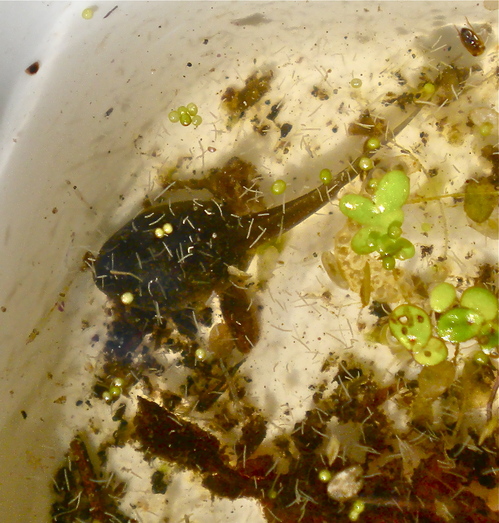
A tadpole and flatworms (possibly nematodes) at Black Pond on June 25.
Phantom midge larvae were the dominant insect species near the floating boardwalk. Jameson was still fascinated by these 1-centimeter-long, clear tube-shaped insect babies that spend most of their time floating horizontally in the water. On both the front and back ends, phantom midge larvae possess a pair of air sacs that help keep them horizontal in the water.
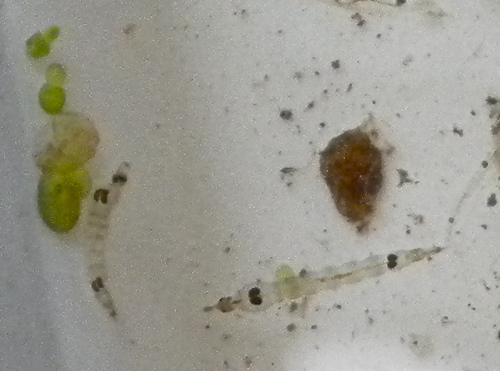
Phantom midge larvae (about 1cm long) from Black Pond on June 25.
To move about, phantom midge larvae have hair-like projections in the shape of a fan on their tail end, which act as a flipper for swimming. By bending their bodies in half or otherwise contorting themselves, they propel themselves when they straighten out.
As larvae, phantom midges possess modified antennae, which help collect food - zooplankton, such as daphnia. Apparently they may eat small mosquito larvae and other small aquatic organisms. Male adult midges have huge, feather-shaped antennae to collect female pheromones in order to help them find each other for mating purposes.
Midges can be found in the pond almost all-year long. A single phantom midge larva was observed under the ice of Black Pond way back in early February in the Pondcast week 6. Adult midges were seen on the snow-covered trails a week or two later. In the pond, phantom midge larvae have disappeared and then reappeared for a few weeks twice since the pond thawed. In the space of a few short months, we’ve seen several generations of these organisms.
Earlier this spring, other species of non-biting midge larvae (Family: Chironomidae) were observed. Unlike the phantom midge larvae, which are clear colored, the non-biting midge larvae are red due to an analog of hemoglobin. They are similar in appearance to aquatic earthworms, but are slightly thicker, do not extend their length, and move about vertically (higher and lower) in the water. For added confusion to their identification, these red, non-biting midge larvae are commonly known as “bloodworms.”
Phantom midge larvae are flies in the insect Order Diptera. Yet they are classified into the Family Chaoboridae. In some parts of the world, such as Scotland, Ireland, and parts of North America, biting midges (Family Ceratopogonidae) are pest species to humans, similar to mosquitoes (who are also dipterans) in their feeding habits. Biting midges are commonly known as no-see-ums, punkies, or sand flies.
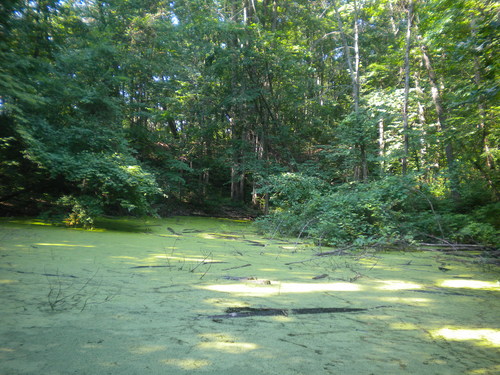
Black Pond on June 25.
You can see all the Pondcast videos by visiting the YouTube channel of Stefan Szumko, AKA slugwhisperer at http://www.youtube.com/user/slugwhisperer.
Stefan Szumko is a middle school science teacher by trade, an outdoor environmental educator by calling, and a homedaddy by choice. He can be reached at slugwhisperer@gmail.com.