

Play is a crucial part of a pet's life, but researchers say not all types of interaction are equal
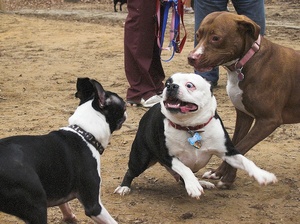
Flickr photo by TimothyJ
With that in mind, it's helpful to turn the tables and be mindful of how beneficial it is for our pets.
As ethologists have learned from discoveries in their research, play isn't just a fun thing to do — it's vital.
You see, as humans, during the process of play we learn, grow, think, reason, step outside of our comfort zone and acquire new skills in the process. We know from research that's been done that this is the case with animals, too.
Click here to read more about how play is integral in brain development and enhancement.
And, as Jaak Panksepp, Ph.D. — an author and researcher — indicates, depriving young animals of play puts them at a disadvantage: it affects the maturation of the brain. His research showed evidence that the simple act of play increased brain-derived neurotrophic factor, or BDNF, a protein linked to brain maturation.
It's easy to engage in play with puppies and kittens because they so willingly initiate it. But it's equally important to keep the ball rolling as a pet ages.
There are all sorts of games for dogs that are easy, inexpensive, fun and beneficial to play, and options are limitless, just as they are when thinking of the needs of cats.
Identifying your pet's play preferences can be helpful, as they can vary from not only species, but from pet to pet.
Some dogs are chewers, others love to hunt for things and still some others love to problem solve or even play with puzzle toys.You might even consider activities like nose work or agility for your pooch to give them a healthy outlet.
Cats have play preferences like birding, stalking or hide-and-seek.
Even birds like to — no, need to — play.
Human-pet play is an invaluable source of enrichment for a pet, and as I always remind when thinking about enrichment for your pet, "Spend half as much money, and twice as much time."
This type of play is different than self-directed play or interaction between other animals. One difference is that we use language to communicate during a fun activity, using repetitive phrases and gestures. But as Julie Hecht, a canine behavioral researcher notes in a recent article in Scientific American — there are other factors to suggest human-pet interaction is different that other kinds of play.
Hecht, who also manages the Horowitz Dog Cognition Lab at New York City's Barnard College, has put out the call to dog owners to submit videos of themselves engaged in fun activities in an effort to help catalog the ways that people play with their dogs in a study called Project: Play With Your Dog.
Click here to learn more how you can be a part of the project.
Lorrie Shaw leads the pets section for AnnArbor.com and is a professional pet sitter. Connect with her on Google + or e-mail her directly.
Comments
Tru2Blu76
Sat, Jan 26, 2013 : 3:40 p.m.
About: "— there are other factors to suggest humsn-prs." .... What is a "humsn-prs"?? ;-) Dogs: I've found over the years that all dogs are body-language oriented. Make one gesture suggesting the beginning of a play period and the dog stops what it's doing and joins in. Parakeets & parrots: I've had 2 parakeets in series over the years: both seemed to delight in locating sticks of butter left on the table - and then wading through the length of the softened butter stick. (can't tell you whether if was because they knew they'd immediately be given a gentle bath). Both 'keets on their own (w/o any prompting) also invented a way to get my attention: laboriously dragging any pen they found across the table top and dropping it over the edge. Never anything else but my pens. The object was to get me to bend down, pick up the pen and place it back on the table - so they could repeat the action (without end, if allowed).
Ann Dwyer
Fri, Jan 25, 2013 : 2:33 p.m.
I don't know how much play Scruff got as a puppy since he was a rescue and he wasn't into traditional play activities. However, over time we found activities he loves. And though they are quite specific (he only likes one size and brand of rawhides), we've found those activities have brought him out of his shell. Even taking him outdoors turns him into a different dog. It's fun to see his transformation from polite, eager-to-please companion to leader of the wolf pack.