

Big Ten debates divisional alignments in expansion
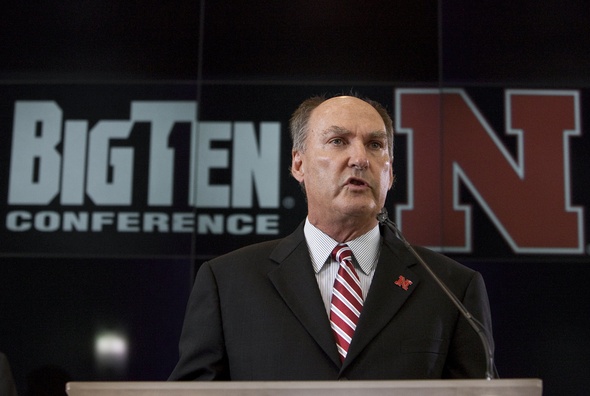
Big Ten commissioner Jim Delany speaks in Lincoln, Neb., Friday, June 11, 2010, in front of a Big Ten and a Nebraska backdrop. Nebraska made it official Friday and applied for membership in the Big Ten Conference, a potentially crippling blow to the Big 12.
AP photo
Big Ten football will have a different look when Nebraska begins play in 2011.
There’ll be a championship game, one that generates lots of money and keeps the league relevant into early December. And the conference will split into two six-team divisions, with the potential for those divisions to grow should the Big Ten decide to expand again.
Big Ten commissioner Jim Delany said the league will adhere to three principles when it sets its divisions, likely sometime later this summer.
“First priority’s competitive fairness to me,” Delany said last week. “Second priority is maintenance of rivalries, some of them are very important. They’re part of who we are and they’re not treated lightly. And then I think the third is what factor, if any, does geography play?”
While university presidents will ultimately decide how the Big Ten aligns, Delany said associate commissioner Mark Rudner will outline a handful of divisional options for school athletic directors in the coming weeks.
During the Big Ten Network’s expansion coverage on Friday, analyst Gerry DiNardo laid out three possibilities. Two involved splitting the conference geographically (along north-south and east-west lines), while the third sought to split up traditional football powers Michigan, Ohio State, Penn State and Nebraska into “Bo” and “Woody” divisions.
DiNardo’s suggestions:
• Using the state of Indiana as a dividing line, Michigan would play in the East Division along with Penn State, Ohio State, Michigan State, Indiana and Purdue. The West would be: Nebraska, Iowa, Wisconsin, Minnesota, Illinois and Northwestern.
• In a north-south split, the North Division would feature Michigan, Nebraska, Wisconsin, Michigan State, Minnesota and Northwestern. The South: Ohio State, Penn State, Iowa, Indiana, Illinois and Purdue.
• Under the Bo and Woody plan, Michigan headlines the “Bo” Division, named after former Wolverines coach Bo Schembechler, along with Nebraska, Michigan State, Minnesota, Iowa and Illinois. The “Woody” Division (after former Buckeyes coach Woody Hayes) includes Ohio State, Penn State, Wisconsin, Purdue, Indiana and Northwestern.
“I would say forget about geography, make it as equal as possible, keep your rivalries, take your four historic powers” and split them into two divisions, DiNardo said.
Delany, appearing a few minutes later, said, “I sort of agree with Coach. I think it’s really important to work on the competitive fairness. That’s a great initial principle.”
There are issues to debate with each plan, but all three appear viable.
With an east-west alignment, the Big Ten risks being too unbalanced, like the old Big 12, with its traditional football and basketball powers consolidated mostly in the East. In the north-south and Bo-Woody plans, travel is more cumbersome, especially for non-revenue sports, and rivals like Michigan and Ohio State are in opposite divisions.
Delany said most rivalries (i.e., Michigan-Ohio State and Michigan-Michigan State) will be protected, though he admitted on the Big Ten Network “not all rivalries are equal.”
He also said he expects to have a 2011 schedule in place sometime later this summer.
“This is not going to the moon, this is creating some football and basketball schedules and some championship formats and selling some media rights,” he said. “I think it’s a challenge, but eminently doable."
Dave Birkett covers University of Michigan football for AnnArbor.com. He can be reached by phone at 734-623-2552 or by e-mail at davidbirkett@annarbor.com. Follow him on Twitter @davebirkett.
Comments
the_ketch
Wed, Jul 14, 2010 : 2:30 p.m.
the_Ketch's Big 10 Divisions plus 1 rival plan Div 1 Div 2 (rival is listed opposite each team) Michigan Ohio State Nebraska Penn State Iowa Wisconsin Indiana Purdue Michigan State Minnesota Illinois Northwestern Teams play division (5) plus one designated rival (1) and (2) of the other division rivals per year. Thats (8) league contests. Division winners play in title game. The haves play each other more often, creating maximum interest o Michigan vs. Nebraska, Ohio State and Iowa o Ohio State vs. Michigan, Penn St and Wisconsin o Penn State vs. Ohio State, Nebraska, and Wisconsin o Nebraska vs. Michigan, Iowa and Penn State All top rivalries are kept except Iowa/Minnesota No travel advantage (moving Penn St. to west is not fair) Balance with each division having 2 bigs, 1 near big
imjnoir
Tue, Jun 15, 2010 : 9:39 p.m.
Consider variable divisions. For example, east-west on year A, north-south on year B, etc. Meanwhile, retain rivalries.
PortageLkBlu
Tue, Jun 15, 2010 : 4:41 p.m.
A lot of great ideas here,it's great to see everyone talking enthusiastically about things and not stuck on RR and our penalties. These blogs were starting to sound insane according to Einstein's theory repeating the same things over and over. I think Nebraska will be a nice infusion of life in some areas, the whole future just seems to have gotten brighter. It seems odd becuase this addition is no pussycat that anyone is just going to roll over every year. I think the reason everyone is excited is that the level of competition just got a whole lot more exciting and I think our big 10 is going to become the new power house conference. Also, I like those folks in general in Nebraska I grew up in a farming community in Michigan and I like the relative comparison the whole thing just makes sense.
John
Tue, Jun 15, 2010 : 4:07 p.m.
Why do there have to be divisions at all? Take the top 2 teams, and some formula if teams are tied for 2nd (i.e. BCS ranking) and have them play for the championship. Also, just because you have divisions in one sport, does not mean you have to have the same divisions in other sports, does it?
bluemax79
Tue, Jun 15, 2010 : 1:12 p.m.
Michigan, OSU, Penn State, Nebraska at the 4 main football schools only 2 per division or else 1 division gets top heavy. then you have Iowa and Wisky in the next group, the remaining 6 just divide up since they rarely threaten the top teams for a title. obviously this is a football alignment since this is all about football. the remaining sports have to deal with whatever travel comes out of it.
Rodney
Tue, Jun 15, 2010 : 12:38 p.m.
My proposal for the division split in the new Big 12 (old Big Ten): South- Ohio State Penn State Iowa Illinois Purdue Indiana North- Michigan Nebraska Wisconsin Michigan State Northwestern Minnesota Besides the five mandated division opponents each season, there would be two permanent seasonal opponents from the opposite division and one alternating opponent from that division. The permanent opponents: Ohio State: Michigan, Nebraska Penn State: Michigan, Michigan State Iowa: Wisconsin, Minnesota Illinois: Minnesota, Wisconsin Purdue: Nebraska, Northwestern Indiana: Michigan State, Minnesota Michigan: Ohio State, Penn State Nebraska: Ohio State, Purdue Wisconsin: Iowa, Illinois Michigan State: Penn State, Indiana Northwestern: Illinois, Purdue Minnesota: Iowa, Indiana The Big 12 championship would be held EVERY year at Solider Field, Chicago. No domes for these men.
GoBlue2009
Tue, Jun 15, 2010 : 11:25 a.m.
If anybody complains about the names of the divisions (Bo and Woody: I'm looking at you, MSU), just remember that the CCHA Tournament Title is called the Ron Mason Cup. Which is ironic, because the guy won in the 1980's when he had no opposition, and Michigan has won more championships than MSU now.
Veracity
Tue, Jun 15, 2010 : 9:24 a.m.
The two division format that will be forced upon the Big Ten with the addition of Nebraska and possibly other teams presents a number of problems and will never be ideal. In order to maintain rivalries like Michigan-Ohio State and Michigan-Michigan State, these three teams will have to be permanent members of the same division. Otherwise the only time that these match-ups will occur is in the final championship game and only if each team wins its division. If Michigan and Ohio State were in different divisions the last two years then they will not have played each other. What an unhappy situation that will have been! Creating balance among divisions will be impossible because the performances of each team can not be accurately predicted each year ahead of the season. Could Michigan's poor performances the past two seasons be predicted? Then again what influence should equalization of travel have on scheduling? The other concern which has not been considered yet is how will team schedules be filled out after determining when each team in a division plays the other teams in the division? Seven games may not involve division teams. Should three or four of these games be against other division opponents? How can that scheduling be fairly distributed among the teams so one team does not have an easier schedule than another team? One interesting arrangement could be that every division team play every team in its division twice during the season, with home and away games (like the NFL). Of course that setup will mean that each team will only have two non-conference (or in this case non-divisional) games presumably as preparatory games at the beginning of each season. Other problems that can be anticipated is that the second place team in one division could be much better than the first place team of the other division but will not have a chance to play of the conference championship. Also I wonder how the two division format will influence national rankings and BCS consideration. When the NCAA expanded the football season to 12 games I was hoping that each Big Ten team would then be able to play every other team. Two non-conference preparatory games at the beginning of the season is enough. I wanted to see a true conference champion at the end of the season without questioning how the standings might have turned out if the first place team had also played the two teams off its schedule that year. Since it is done I hope that my concerns about the two division format prove baseless. Go Blue!
chapmaja
Tue, Jun 15, 2010 : 8:34 a.m.
Here are my proposed divisions and scheduling structure. Big Ten North: Michigan, MSU, Minnesota, Wisconsin, Iowa and Northwestern Big Ten South: Ohio State, Penn St, Nebraska, Purdue, Indiana and Illinois. The schedule would include 4 non-divisional games, one rivalry game (such as Michigan-OSU, Northwestern-Illinois) plus 3 rotating divisional games that rotate every 2 years. Another possiblity is: Big Ten East: Penn St, Ohio St, Michigan, MSU, Indiana and Purdue Big Ten West: Nebraska, Iowa, Illinois, Northwestern, Wisconsin and Minnesota This does a better job of keeping traditional rivals together. Under this schedule an 8 game conference schedule would work. Teams would play 5 divisional games, 3 non-divisional games. Each team would play 4 home and 4 away games. The inportant factor in this is all sports. While it may look unbalanced comeptitively but the west division actually is pretty solid. Of those teams, all of them have played on New Years Day recently in football. More importantly it will keep travel costs down for sports other than football. If people think travel costs are not an issue for Big Ten schools you would be wrong. Travel is still an important consideration in scheduling. The majority of the Big Ten has the advantage of schools wanting to come play them which helps for non-conference scheduling, but in conference the schedule is a big deal.
SonnyDog09
Tue, Jun 15, 2010 : 8:32 a.m.
Even more fun than the conference alignment is what name will they call the conference now? Today, the Big 10 has twelve schools, and the Big 12 has ten schools. I also like the idea of naming the divisions after people and not simply geography.
PortageLkBlu
Mon, Jun 14, 2010 : 9:57 p.m.
Very surreal talking about the big10 and including Nebraska in the mix. I'll bet they'll be some kind of football pools of sorts wagering on the divisions in the 10. Anyways, I like the idea that this thing will happen next yr. and ya have to remember it's not just about football, I love track and field, wrestling, hockey and I get into big 10 womens baseball. I actually like this fit better than Notre Dame in part becuase the Nebraska people are thrilled to join the10 and Notre Dame front office doesn't seem to want to join us. Does anyone know how the Notre Dame fans feel about joining the big10? I think the 10 will be in more big time bowls consistantly which is where the money is and I like this 12 team package seems tight and healthy. We play Notre Dame every year anyway so I don't really care I do hope we don't start begging them.
bryan smith
Mon, Jun 14, 2010 : 8:55 p.m.
I think two divisions with rotating members would be a good approach. An example would be: 2011 - DIV A: Team A, Team B, Team C, Team D, Team E & Team F; DIV B: Team G, Team H, Team I, Team J, Team K & Team L. 2012 - DIV A: Team L, Team A, Team B, Team C, Team D & Team E; DIV B: Team F, Team G, Team H, Team I, Team J & Team K. You might even want to consider moving two teams from each Division each year. This would serve to keep rivalries alive, strenghten sense of conference affilitation and broaden conference familiarity/solidarity. **** And here is another idea from someone named Crayton at bleacherreport.com Rotating only 1 is not optimal for any desired affect. But rotating 2 would be. This is sometimes called the 3-division model: geographic example: Group A: Minn/Iowa/Neb/Wisc Group B: Ill/N'west/Ind/Purdue Group C: Mich/MSt/PSt/OSt A pair from each Group is placed in each division, usually based on regular season final games. Each year one of the Groups switches its two pairs to different divisions. Therefore teams play their rivals in their group every year and the other teams 5 times every 8 years. This setup is useful after a merger when 4 teams are closer to each other than to others. It is also helpful to balance divisions when a geographic split might be unbalanced competitively. The Pac-10 might consider this if adding only Utah or Texas. The three Groups would be Northwest, Southwest, and California. The ACC split their teams this way but do not rotate teams and do not form complete groups (ie the 4 NC schools don't all play each other every year). The Big Ten does not split obviously in this manner. Actually, the conference which might have best been setup with this rotation might have been the Big Eight when they added Texas, A&M, Tech, and Baylor. The Big 12 South never would have out-recruited the North and the Nebraska-Oklahoma rivalry never would have ended.
FlintMaize
Mon, Jun 14, 2010 : 7:37 p.m.
I like these divisions, but I do not what they would be called. JoPa has to be pacified and instead of putting him with all of the western most schools, this should work for him and Penn State, the Big Ten's 11th member. Michigan Michigan State Nebraska Iowa Illinois Minnesota Ohio State Penn State Wisconsin Northwestern Indiana Purdue
D21
Mon, Jun 14, 2010 : 6:54 p.m.
With the pressure RR is facing, I strongly doubt RR will be around after another poor season unless he wins 7 or more including key victories over OSU and the little green brothers.
PortageLkBlu
Mon, Jun 14, 2010 : 6:48 p.m.
blueiniowa, it's good to read what you had to say and it's good to hear from someone with a positive attitude and you are right, you guys especially with your location are going to have a lot of fun playing Nebraska. We've got a lot of negative attitude on these blogs about Mich. right now just becuase they've been down for awhile means little to me becuase schools like Iowa and Mich. don't stay down forever although some would prefer that. blueiniowa don't try to reason with the complainers becuase actually they are not complaining they are happy that Mich. is down that in actuality is the agenda. When RR gets Mich. back to prominence these complainers will disappear into the woodwork and reappear on other sites with differant names. You will know who these folks are becuase if you read them you'll see that they really say a lot of nothing anyways, glad to see that Iowa is back on top, we'll get back I have no doubt and lots of faith in our Wolves.
D21
Mon, Jun 14, 2010 : 6:43 p.m.
PortageLkBlue, Gimme a list of complainers and idiots and maybe we can find an aptly named division for them, ha. Thks for the compliments...GO BLUE!
aarox
Mon, Jun 14, 2010 : 6:40 p.m.
I like the creampuffs and champions idea. But unfortunately that puts Michigan and Indiana in the same division. Maybe we can convince some folks in the Big Ten that our storied past is more important than our performance?
PortageLkBlu
Mon, Jun 14, 2010 : 5:34 p.m.
As long as the beer and hot dogs taste the same I could care less. Actually though I like D21's idea, since the Wolves no longer count as much to the complainers let's put them in the, what is it cream puff division hey Tater and Robbie what do ya think? The complainers say Mich. is irrevelent and they want to put Mich. in the easiest division. I like the idea of the, "Big Boys" beating the hell out of each other before they play Michigan good idea D21 why don't you come up with some more brainstorms man I love you guys your real smart. Now that we've got that resolved let's form one more division for the idiots and complainers.
blueiniowa
Mon, Jun 14, 2010 : 2:24 p.m.
"Geography is totally relevant because this is not just a FOOTBALL alignment, its a conference alignment!" No it's not relevant becaue yes this IS just about football. Since Day 1 of expansion talk it's all about football. NE was chosen why? Because of their killer bball program? No. Because this IS all about football. You couldn't have picked a better poster-child of "it's all about football" than NE. PSU UM NE O$U IA MSU Wisc Purdue Ill Indiana Minnesota NW 5 bowls 4 bowls :# of 2009 appearences Living in Des Moines, I am expecting a raucous rivalry between the hawks and huskers. It's going to be a good time.
D21
Mon, Jun 14, 2010 : 2:02 p.m.
NoBowl4Blue, How about this? June 17, 2010...Big 10 finally jettison MSU (with Izzo gone to Cadavers) and replace MSU with a true "home run" team in CMU Chippewas. This 2011 actual conference split into 2 divisions scenario which will see a new UM head coach with RR long gone by then.
NoBowl4Blue
Mon, Jun 14, 2010 : 1:33 p.m.
D21 if you go on the last two years U of M would be in creampuff division/
lumberg48108
Mon, Jun 14, 2010 : 1:28 p.m.
Geography is totally relevant because this is not just a FOOTBALL alignment, its a conference alignment! This means travel woes for all sports, sans football! Michigan only travels 5 games a year folks? And sometimes its to Lansing or South Bend or Columbus -- basically no travel at all! But for all the other sports and schools geography is relevant!
michboy40
Mon, Jun 14, 2010 : 12:51 p.m.
We need to forget about goegraphy here because it would create unfair comepetition...but I see a situation where OSU v UM will be the final game on the Big Ten East schedule. The winner goes to the conference Championship game (most likely)
D21
Mon, Jun 14, 2010 : 12:31 p.m.
Hmm, how about this one? Bo & Woody Division: 1) Michigan 2) Penn State 3) Nebraska 4) Wisconsin 5) Iowa 6) Ohio State Creampuffs & Cupcakes Division 1) Purdue 2) Indiana 3) Northwestern 4) Illini 5) Minnesota 6) Michigan St