

Brady Hoke says Michigan's 'aggressive' drug policy is primarily for the safety of players
Earlier this month, a published report investigated the punishments doled out by schools in the Southeastern Conference with regard to marijuana testing.
At one school, Ole Miss, the investigation found that a second positive marijuana test only resulted in a possible forfeiture of free family tickets.
And, in most cases, the report found that players repeatedly got three to five chances to fail a drug test before being removed from the team.
Inside the Michigan football program, things are quite a bit different.
They test. A lot. And punish plenty.
It's a practice Wolverines coach Brady Hoke says is more about the well being of the student-athletes than anything else.
"You want to help kids," Hoke said earlier this month. Kids make bad decisions, they're 18 to 23. ... I'm 53, and once in a while, I'll make a bad decision.
"We've got an aggressive policy, we've got an athletic department that takes it very seriously and whatever we can do to help our kids is what it's all about."
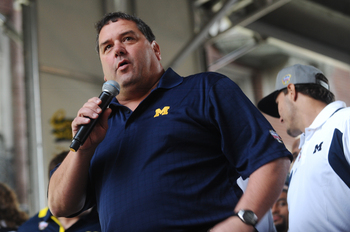
Michigan's aggressive drug policy, which results in lost playing time for a first offense, seems to reinforce coach Brady Hoke's constant message to his players to "make good decisions."
Melanie Maxwell | AnnArbor.com
Michigan athletic director Dave Brandon has been very vocal about a department-wide initiative to curb marijuana -- and other drug use -- inside its programs.
The department's new policy offers no free passes, and immediate punishments for anyone failing a test.
The first offense results in a 10-percent forfeiture of one's season. The second is 33 percent of the year and the third means the player will miss the entire season.
Michigan also tests very frequently, something Brandon said prohibits student-athletes from playing "Russian roulette" and taking their chances.
"The last year, I would put our results up against anybody in the country," Brandon said recently.
Hoke says he has no problem with the threat of lost playing time for failed drug testing, no matter who the player is.
He insists there can't be a double standard, and everyone needs to play by the rules.
"There's the old saying, 'one way you discipline guys is to take away playing time, the other is to take away food,'" Hoke quipped. "That'd be a problem for me if they took away the food part."
Michigan's aggressive drug policy seems to reinforce Hoke's constant message to his current and future players to "make good decisions." Whether it be on the field, in the classroom or in social situations, Hoke's concern for player welfare remains high.
At the end of the day, he's responsible for everyone who sets foot inside Schembechler Hall.
On the field, and off.
"You're in charge of the decisions that you make, you're in charge of where you go and you're in charge of who you are," Hoke said last week at the Sound Mind, Sound Body football camp in Southfield. "Because I had the opportunity to work with young men, and because I had coaches and (because I was around) people who really cared about young men, I decided to go into coaching -- because I had a college coach who helped me save the direction I was going.
"I made a ton of bad decisions, a ton. And if it weren't for a coach who cared for me as a person, I can promise you I wouldn't be in front of you today."
Nick Baumgardner covers Michigan sports for AnnArbor.com. He can be reached at 734-623-2514, by email at nickbaumgardner@annarbor.com and followed on Twitter @nickbaumgardner.
Comments
David Paris
Tue, Jun 19, 2012 : 3:29 a.m.
THIS is The Michigan Difference! Go Brady! Go Blue!
jen777
Mon, Jun 18, 2012 : 10:46 p.m.
i don't know what folks are complaining about - mj is illegal, players are told the standards they need to uphold to be on the team and to get scholarship.. - i have no problem with more frequent testing .. as for suspensions, i believe hagerup was suspended last year for this reason (or so i heard)..
jen777
Mon, Jun 18, 2012 : 10:50 p.m.
http://www.ncaa.org/wps/wcm/connect/public/NCAA/Health+and+Safety/Drug+Testing/Resources/NCAA+banned+drugs+list
jen777
Mon, Jun 18, 2012 : 10:48 p.m.
and i also believe NCAA lists it as banned drug
Hailmary
Mon, Jun 18, 2012 : 9:26 p.m.
No tolerance policies for all drugs and yes, alcohol is also a dangerous drug, ask Will. Drugs are an epidemic plague on our society, being allowed to compete in competitive sports is a privilege not a right. Every pot or alcohol abuser out there can tell stories of close calls while driving under the influence of either let alone other drugs pharmacy or otherwise. Want to use, no problem you just can't play organized ball. Good job Coach Hoke.
Major
Mon, Jun 18, 2012 : 8:12 p.m.
Since no one else has brought up the obvious, I will...What about the deadly drug that kills more than all others combined...alcohol? Illegal to all under 21..comprising most if not all players. Do they test for that? No, they promote it...go figure!
Hailmary
Mon, Jun 18, 2012 : 9:28 p.m.
Nice looking Shepherd Major, I raise Shepherds.
Terry Star21
Mon, Jun 18, 2012 : 8:11 p.m.
I agree with the Michigan policy and I am very happy having Ad Dave Brandon and Coach Brady Hoke in charge. (Brandon) "The last year, I would put our results up against anybody in the country,". Now, if we could just get some kind of punishment for the idiots, mostly 'outsiders', for constantly berating, attempting to show their frustration, fear and intelligent level toward the Michigan football program on this site. Now that would be nice. MgoBlueForTiM.......Leaders and best.
Wally the Wolverine
Wed, Jun 20, 2012 : 5:12 p.m.
Yeah, Terry, because we would never berate, etc. whenever the subject of osu comes up.
SEC Fan
Tue, Jun 19, 2012 : 2:13 p.m.
@Blue. That's probably true. But the question is still the same. How many UM players were suspended (for "violating team rules)? If they truly punish "plenty" we should be seeing players missing games for whatever reason. Eliminate the obvious ones (in the news for DUI/Vandalism, etc.) and there should be a pool of suspended players. Statistically speaking, 26.7% admit to using which would equate to 35 UM players. OK, so let's say UM has significantly less than the national average. If they are testing as they say, then we should be seeing, what, 6 or so players (5%) suspended annually? I say, release the numbers! If Mr. Brandon would "put our results up against anybody in the country," then release the data...we don't need to see names. And what's with the odd wording of the penalties (not just UM)? "10% of "one's" season"? 33 % of the season? Why not say how many games. 10/33% of 12 games, 13 (if there's a bowl), 14 if you count the spring scrimmage? these aren't even numbers. 10% of 12 is 1.2. Does this mean they get suspend for 1 game or 2? or are they super exact and suspend for 1 entire game and 12 minutes of the second one? 33% of 12 is 3.96. Is this a 3 or 4 game suspension? Why not just give the number games...
Blue Marker
Tue, Jun 19, 2012 : 11:16 a.m.
SEC, The university doesn't always come out and say what a player is being suspended for. I believe it's listed as a violation of team rules in many cases.
SEC Fan
Tue, Jun 19, 2012 : 2:06 a.m.
blah blah blah. What absolute rubbish. Really Terry? Seriously? Let's see, what did the article say about UM's drug testing policy? Oh yeah, "they test. A lot. And punish plenty". Really? So, how many UM players were suspended last year? Where are the FACTS to back up the same old tired Wolverine rhetoric? Go ahead, keep on singing that fight song and prove Mr. Brandon right.
Tally10
Mon, Jun 18, 2012 : 8:02 p.m.
My apologies AA.com for violating the rules, I had a Tosh.O moment.
leo
Mon, Jun 18, 2012 : 6:38 p.m.
those are the rules, i suspect most recruits are told about the level of enforcement during the process, and they still decide to sign up. personally, outside of the munchies and laziness, pot is less harmful than most other substances (including nicotine and booze). but until they change the laws, it is what it is...
Tally10
Mon, Jun 18, 2012 : 6:19 p.m.
Oh...I thought the coaches used marijuana to help players with weight gain ( THE MUNCHIES! ) :-)
redwingshero
Mon, Jun 18, 2012 : 6:28 p.m.
If that's the case, why is Hoke trying to gain weight?
redwingshero
Mon, Jun 18, 2012 : 5:07 p.m.
Wait, parents of players get free tickets to games? Is that just in the SEC? Policy is a joke. Painkillers given to players are much more dangerous than pot. Someone should randomly test Hoke's cholesterol during the year. I hear the new Cardiovascular Center is a great facility....
Hailmary
Tue, Jun 19, 2012 : 9:50 p.m.
Earth to redwingshero, your clear to land.
SEC Fan
Mon, Jun 18, 2012 : 7:20 p.m.
aww...who would vote down free cookies?
SEC Fan
Mon, Jun 18, 2012 : 6:28 p.m.
and yet another advantage to being in the SEC :-) We also get free ice cream and cookies...
Huron 74
Mon, Jun 18, 2012 : 1:36 p.m.
I can't beleive some of the comments on here. Hello, marijuana is still illegal, whether you like it or not (I personally don't agree with it, but it's still a fact.). I think Hoke is trying to teach these guys that, if you want to play sports on a stage the size of Michigan's, you need to keep your nose clean. That's part of his job. If you think marijuana should be legalized, for crying out loud, don't blame Brady Hoke for it!
towncryer
Tue, Jun 19, 2012 : 2:31 a.m.
I agree with you but underage drinking is also illegal. Have you been to Rick's and other places lately? And i'm not gonna argue whether the drinking age should be 18, 19, 21...currently...21 is the law.
Hmm
Mon, Jun 18, 2012 : 6:54 p.m.
When I first started reading your comment I was going to thumb you down on GP but by the time I read all of itI have to say that I came agree with you. It's not right the current situation re: cannabis but you're right it is still against the law (federally) and if someone wants to play at U of M then he has to keep his nose clean and abide by the rules (even the unjust ones). Good comment sir/madam
Billy Bob Schwartz
Mon, Jun 18, 2012 : 6:27 p.m.
TB...Are you comparing laws against marijuana use with Jim Crow laws and the hatred and violent prejudices against African Americans (e.g., sitting at the rear of the bus)? I think that's waaaay over the top, don't you? Rosa Parks risking her freedom and her body to stand up to a vicious bigotry in the Old South vs. Fred Zonka sucking weed because he likes it more than he fears the punishment under law, if any? Yikes!
SEC Fan
Mon, Jun 18, 2012 : 5:07 p.m.
I don't think it really matters. The point of my post above is that 26.7% of football players indicate they smoke marijuana. For Div 1 FBS, that's about 4,100 players (of approx. 15,400 total players) admitting to using. Most schools (even some SEC) have mandatory suspensions for coming up positive. Yet, how often do we hear about a player being suspended? Heck, if only 1% are caught, that be 41 a year. methinks something is amiss here. Either players aren't using like they say, the drug testing isn't very effective, or someone is looking the other way.
Terrin Bell
Mon, Jun 18, 2012 : 4:56 p.m.
It used to be illegal for some people to sit in the front of the bus. Being illegal doesn't necessarily make it right. Further, there is also such a thing as trust. Trust your players to do the right thing. Treating them as being guilty by forcing testing is Big Brother mentality.
Robert Granville
Mon, Jun 18, 2012 : 2:39 p.m.
Who blamed Brady Hoke? I just don't think he's the guy you go to for this article for exactly the reasons you stated. Marijuana is illegal. Brady Hoke is raising Michigan Men. Part of wearing that block M is representing the university. You reflect poorly on the university if you get arrested for pot. It's about reputation. That was my point. Brady Hoke is my idol.
SEC Fan
Mon, Jun 18, 2012 : 12:56 p.m.
Odd. I honestly don't recall ever having heard of a football player being suspended for games for this...from ANY conference. Anyone know of any details (from any conference) about how many players actually receive a suspension for using? Almost 27% of players admit to smoking...they don't all play at Ole Miss!. We should be hearing about a lot of suspensions...
Hailmary
Tue, Jun 19, 2012 : 9:43 p.m.
Yes Terry, sec sounds like a broken record and then some. I have never heard one Mich. fan say that the sec fields lousy teams. I have never heard one Mich. fan say that Alabama will not be the toughest game of 2012 most likely. sec cannot say anything good about the big 10 because it is where he comes from and he enjoys slamming his background, weird huh ? It takes all kinds of weirdo's to keep the site lively and sec loves to hear himself create controversy which probably consumes his life anyway.
Terry Star21
Mon, Jun 18, 2012 : 8:18 p.m.
SEC Fan.....seriously? Every time you write a sentence on our site, it is laced with sarcasm lack of knowledge, frustration, fear and jealousy for the greatest college football team in America. I have no pleasure in your constant suffering, you however, bring the most damage to yourself by letting it get to you. Good job.
SEC Fan
Mon, Jun 18, 2012 : 6:37 p.m.
@leo. Good point. It'd be interesting if that data could be correlated.
leo
Mon, Jun 18, 2012 : 6:35 p.m.
i think it's those cases were players are suspended for "violating team rules". they never really state the cause, i suspect many times it could be failed drug tests.
SEC Fan
Mon, Jun 18, 2012 : 6:22 p.m.
@Those. I apologize, but I think I am not understanding your point. What does class recruiting size have to do with this topic? Recruiting sizes vary for a myriad of reasons (you stated one). Other things affecting class size are: - players losing scholarships, - # scholarship players graduating (varies by year) - how many non-scholarship players are recruited, - players failing/dropping out, etc. - schools entering/leaving NCAA sanctions But, as you say, of course the SEC will have larger recruiting class sizes...we have better teams and our players go on to the next level. But please explain why this is bad? Isn't the point of college to put you in a position to make a better living? If it isn't, then what's the point of those "athletic" scholarships? They should de-emphasize the athletic abilities requirement, shouldn't they? Oh, but you guys at UM don't care about having good players do you? All you want are academes. Hmmm...but then, why is the graduation rate of your football team lower than the rest of the university?????? Shouldn't the academic standards for your football players be equal to that of the rest of the student body? Seems a bit hypocritical. Also, since you mention it, please explain your comment about Michigan's numbers being inflated by RichRod's hiring? How many players did UM lose due to RichRod's hiring? Michigan recruited 24 players in 2008 (RichRod's 1st year) and 22 in 2009 ( Rich Rod's 2nd year). 23 is right there in the middle (the average). Is this the "EXTREME INFLATION" you reference due to "half the team" leaving upon his hiring? Again, I don't understand your "data analysis"?
ThoseWhoStayUofM
Mon, Jun 18, 2012 : 5 p.m.
Here is the average number of recruits per class for the past four years for the following schools: SEC Auburn: 30 per class Miss St: 28 per class Alabama: 28 per class LSU: 26.25 per class Florida: 23.25 per class Arkansas: 27.25 per class Ole Miss: 28.75 per class Big 10 Michigan: 23.25 per class Ohio State: 19.5 per class Michigan State: 22 per class Wisconsin: 22.25 per class Penn State: 20.5 per class Iowa: 22 per class Northwestern: 18.5 per class And before you start talking smack about how MIchigan's recruiting numbers are similar to Florida's, understand that Michigan's numbers are EXTREMELY INFLATED due to massive attrition during the Rich Rod era. When he was hired, half the team left which freed up a tun of cap room.
SEC Fan
Mon, Jun 18, 2012 : 2:56 p.m.
the insecurity level of Michigan"Men" is absolutely amazing. Your insecurity and jealousy is truly unbecoming. You stated no "facts". What "fact" did you state? No one from Michigan ever states "facts"! Ya'll just throw out opinions and tell everyone they must believe you. Show me some data!
Robert Granville
Mon, Jun 18, 2012 : 2:37 p.m.
I have issues? All I did was state facts. SEC teams recruit too many players and cut the dead weight. SEC schools are lax on education and discipline. SEC coaches often put the needs of the institution above that of the student athlete. This is not new information.
SEC Fan
Mon, Jun 18, 2012 : 1:41 p.m.
@Robert. You have serious issues.
Robert Granville
Mon, Jun 18, 2012 : 1:04 p.m.
It has absolutely happened. I know you'll find it yourself so I'm not going to operate Google for you. Hint: Florida. You're not really trying to argue for the SEC though are you? The whole country knows how things go down there. Players are there to win games or GTFO. Nothing else matters. Teams recruit enough players to fill 5 Big Ten team recruiting classes in 4 years, dropping the excess players as dead weight. Injured HS recruits lose promised scholarships. Fully committed depth players get greyshirted (offered to pay their own way for a year) that were originally promised full scholarships. It's a cess pool. The marijuana stuff is the least of the SEC's problems.
Robert Granville
Mon, Jun 18, 2012 : 12:49 p.m.
No disrespect but Hoke is a dinosaur. He's exactly the kind of guy you want coaching your football team and molding cocky boys into upstanding gentlemen. He's not the kind of guy you ask about the safety of marijuana. He'll tell you its dangerous right up to the day he's diagnosed with liver and cardiovascular disease from his own lifestyle.... Let's be real here folks. The NCAA marijuana policy has nothing to do with safety and everything to do with reputation and control.
fishjamaica
Mon, Jun 18, 2012 : 12:21 p.m.
Garbage.
saintd
Mon, Jun 18, 2012 : 10:48 a.m.
they test for pot but when they are all beat to hell from football do they test them for pain killers? prescription drugs kill people not pot. this has more to do with discipline than safty in my view.