

Former Michigan WR Junior Hemingway rises into middle-round projections of NFL Draft
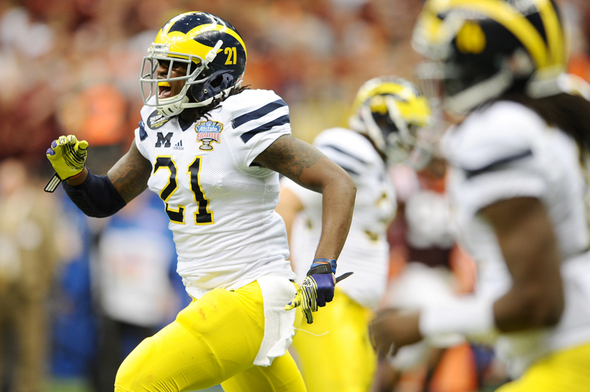
Junior Hemingway celebrates one of his two touchdown receptions during Michigan's win over Virginia Tech at the Sugar Bowl.
Melanie Maxwell I AnnArbor.com
Junior Hemingway concluded a trying five-year Michigan football career on a Superdome podium, where he accepted his Sugar Bowl MVP trophy before a national TV audience.
With tears welling in his eyes, his two touchdowns the difference in the Wolverines' overtime victory, he exclaimed to the word that "Man, I'm telling you, it feels too good, man. Too good."
And yet, things have gotten even better for the Wolverines' top receiver.
ESPN's Mel Kiper Jr., one of the preeminent voices on the NFL Draft, originally projected Hemingway as, at best, a seventh-round pick for this week's NFL Draft. There even was a chance he'd slip out of it entirely.
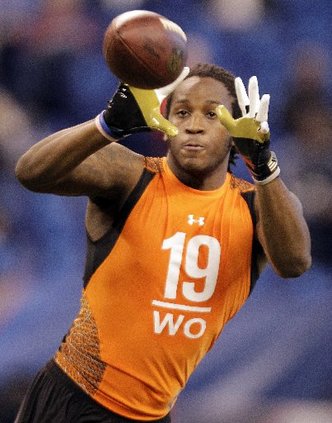
A strong showing at the NFL Combine helped to improve Junior Hemingway's stock.
AP Photo
"Junior Hemingway is a very underrated receiver," Kiper said.
And why is that?
"Probably would have gone higher if he had a little bit more productivity," he offered.
Therein lies the biggest reason Hemingway entered the offseason as a castaway on most draft boards.
His first four seasons out of Conway, S.C., were littered with injury and illness, which shredded any chance for him to put up big-time numbers. He also played in three offensive systems.
He says he prefers to look at that as a positive, though.
"I don’t think it really hurt me, being that I played in three different offenses," Hemingway said during a recent interview. "I think it’s pretty good, because I was able to learn three (systems). ... That might help me out on the learning curve at the next level."
It could help him adapt quickly to an NFL offense -- particularly after Michigan introduced pro-style elements last season -- but it likely hurt his numbers in the college game.
So did playing for three years in former coach Rich Rodriguez's spread-option offense, which focused on the run. When Michigan did pass, it preferred short to intermediary routes.
Quarterback Denard Robinson, who has struggled with his consistency in the passing game, also hurt Hemingway's stock.
"Keep in mind, Denard Robinson is not going to be a quarterback in the NFL -- he's going to be probably a receiver or return man," Kiper said. "That's what hurts Junior Hemingway. ... Denard Robinson is a great college quarterback, but his throwing ability is very questionable."
Hemingway had a lot of forces weighing down his stock. But in the past year, he's turned things around.
First, there was the hiring of coordinator Al Borges for his senior year, and with it an infusion of pro-style elements to the offensive scheme. The system was still run-oriented, but it stretched the passing game vertically.
Hemingway is most effective down field, as the Wolverines soon discovered. He is a big-bodied wideout at 6-foot-1, 222 pounds, and flourished in one-on-one matchups downfield.
He ranked third in the country in yards per catch (20.6) last year, and became Michigan's go-to receiver. He finished with 34 catches for 699 yards and four touchdowns, all career highs.
His teammates nicknamed him "Big Play Hemingway."
"Hemingway, when the ball is in the air, he's so competitive, times his jumps well, and I think he does a really good job in that facet of the game," ESPN draft analyst Todd McShay said during a recent teleconference.
"Obviously, he doesn't have the speed, and getting in and out of breaks and a lot of the little things that you look for in wide receivers, but I do think he's going to catch on."
Speed has always been the biggest knock on Hemingway's game, but he showed at the combine in February he has made tremendous strides. He still is not a blazer -- his 4.53-second 40-yard dash was 19th among receivers at the combine -- but his quickness is far better than most anticipated.
He finished first among receivers in the three-cone drill and 20-yard shuttle, as well as second in the 60-yard shuttle. Those are terrific times, considering his 6-1, 222-pound frame.
And as those times dropped, his stock rose. He's now squarely in the draft, according to the major draft analysts and sites, and has erased many of the doubts that lingered about whether he will make it at the next level.
"I just think that he catches the ball well enough and has instincts as a receiver and a route runner that he's going to wind up, I think, outplaying his draft spot," McShay said.
Kyle Meinke covers Michigan football for AnnArbor.com. He can be reached at 734-623-2588, by email at kylemeinke@annarbor.com and followed on Twitter @kmeinke.
Comments
Tom
Sun, Apr 29, 2012 : 5:18 a.m.
The Michigan offense put up 173 yards of total offense in the Splenda Bowl...more than 100 fewer yards than Appalachian State gained against the same defense. Fewer yards gained than by Duke, BC, Arkansas State. Congrats to Junior for leading the way with a Splenda Bowl leading 2 receptions for Michigan. Gallon and Roundtree combined for 2 catches and 10 yards. The long snapper caught one pass for 11 yards. The offense averaged 1.6 yards per carry. And you guys expect this team to contend in the BIG in 2012? Funny.... Where's the threat?
TheWay
Tue, May 1, 2012 : 6:23 a.m.
Where's the threat, you ask? Take a gander at your highly-rated recruits for this year and next... Oh, my bad, you don't have any. Hope you enjoyed it while it lasted, little guy.
Steve McQueen
Wed, Apr 25, 2012 : 8:49 p.m.
Hey Kyle...can you write at least one article about Michigan football, where you do not mention Denard's "lack of consistency"?
TheWay
Tue, May 1, 2012 : 6:28 a.m.
"Key point", anybody who thinks we'd be better served to move Denard to WR and insert yet another first-year QB is somewhere right below mouth-breather in terms of football IQ.
RWBill
Sat, Apr 28, 2012 : 4:08 p.m.
He has, when about defensive players. It would be reckless and shoddy journalism when writing about a Michigan receiver not to relate it to the QBs and systems he's played with. Besides, do you dispute Denard's raging inconsistency and poor form? Highly relevant and will be a key factor in the success or lack of it this coming season. Key point, Denard is the player, not Devon, who should be working in as a receiver in the deuce formations.
edjasbord
Wed, Apr 25, 2012 : 10:45 p.m.
Um, I would say he cannot when the article's focus is on wide receiver production at UM. This comment would be better placed in articles that neither concern Denard's performance nor the performance of UM's WRs.
Steve McQueen
Wed, Apr 25, 2012 : 8:46 p.m.
Junior is big, fast and has great hands. He was hampered very much by having to play in that goofy system for most of his career. He will be a very good NFL receiver. By comparison, he is better at every measurable than Jason Avant was...and Avant is a good player and has had a nice career.
TheWay
Tue, May 1, 2012 : 6:26 a.m.
"goofy system"? You mean the spread? You mean the system being run by several NFL teams?
Macabre Sunset
Wed, Apr 25, 2012 : 7:54 p.m.
I don't normally rave about players pre-draft, but I think this guy is going to be a solid X in the NFL, and well worth a 3rd-round pick.
Macabre Sunset
Thu, Apr 26, 2012 : 2:47 a.m.
I doubt it. I have never rescued anyone from a burning skyscraper.
Steve McQueen
Wed, Apr 25, 2012 : 8:48 p.m.
"I dont normally rave about NFL prospects...but when I do...I rave about Junior Hemingway." You must be the most interesting man on this website... :)
edjasbord
Wed, Apr 25, 2012 : 6:03 p.m.
Love this guy, one of my favorite Michigan players of all time - not only for his big play ability, his dependability, but also for his passion and emotion: http://youtu.be/6hhut3i1pmw