

Michigan coach Rich Rodriguez's response: Lots of blame to go around
When the NCAA served Michigan with a Notice of Allegations in February, one charge stood out as the most serious: Michigan coach Rich Rodriguez was accused of failing to promote an atmosphere of compliance within his football program and failing to monitor his support staff.
Rodriguez and the university disputed the first half of that charge in their formal responses released Monday, and whether the NCAA agrees ultimately could determine if college sports' ruling body accepts Michigan’s self-imposed penalties or not.
Michigan placed itself on two years probation, issued letters of reprimand to Rodriguez and six others, cut 130 hours of practice time over the next two years and reduced its quality-control staff from five to three.
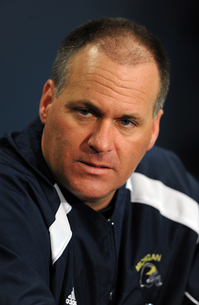
Michigan football coach Rich Rodriguez
AnnArbor.com file photo
In his response, crafted with the help of personal attorney Scott Tompsett, Rodriguez took issue with the NCAA’s ambiguous rules and pointed to breakdowns throughout the athletic and compliance departments as central factors in Michigan’s violations.
The university admitted to multiple instances of exceeding NCAA limits on staff size and practice time, as well as failing to monitor its football program.
“Violations went undetected because several Michigan staff members, including Rodriguez, were not paying close enough attention,” Rodriguez’s response said. “In short, there was a collective failure that resulted in the violations in this case.”
Michigan athletic director Dave Brandon said late Monday night that collective failure led the university to conclude “that Rich should not be found to be guilty of fostering an environment or an atmosphere of non-compliance.”
“There were failures down the chain of command,” Brandon said. “We believe in looking at all of those circumstances that although there were things that could have been done better - and Rich would be the first to admit that mistakes were made - those mistakes were shared mistakes across the entire department and involve several people. To apply more or less blame to any one person in our judgment would be inappropriate.”
Quality-control staff
Rodriguez acknowledged that his quality-control assistants - administrative helpers who don’t have actual coaching duties - overstepped their duties on several occasions.
They sat in on film sessions they weren’t supposed to. They attended coaches meetings that were off limits. And they took part in summer skill-development workouts that were restricted to non-sport specific strength coaches, trainers who work with multiple athletic teams.
But Rodriguez disputed charges that his quality-control staff improperly took part in winter workouts, an allegation Michigan accepted as fact.
In his response, Rodriguez argued that his quality-control assistants doubled as part-time strength coaches, something his filing says the NCAA allows and “Michigan’s chief compliance officer” - associate athletic director Judy Van Horn - “told the enforcement staff” may be “permissible.”
Michigan’s compliance department, according to the filing, asked for job descriptions for Rodriguez’s quality-control assistants in August of 2008, shortly after Rodriguez circulated one at a coaching retreat that included “assist strength coach with skill development” as part of each quality-control staffer’s duties.
In early September, assistant athletic director for compliance Ann Vollano asked assistant athletic director for football Scott Draper for the description again, but the filing indicates no description was provided until Aug. 28, 2009.
In his response, Rodriguez said he’s to blame for “not understanding that quality control could not participate in summer workouts” but “very disappointed that his administrators failed to provide the job descriptions on multiple occasions and … that the compliance staff never brought their failure to his attention.”
Rodriguez also argued that the NCAA too broadly defined “coaching activities” and that workouts where taped towels and mini basketballs were used to simulate footballs should be lumped in the “skill-development” category instead.
Countable hours
Michigan admitted to exceeding NCAA rules on practice time by 65 hours in Rodriguez’s first two seasons - 24 during winter conditioning, 32 in summer workouts and nine in season.
Rodriguez said in his response that 57 of those hours were due to misinterpreting what was or was not a Countable Athletically Related Activity (CARA).
“The strength staff mistakenly believed that certain warm-up activities did not count toward the CARA limits,” Rodriguez’s response said. “The strength staff communicated with the compliance staff to confirm its understanding, but those communications did not correct the strength staff’s misunderstanding.”
According to the filing, Michigan strength coach Mike Barwis said Vollano “told the entire football staff and team at the start of the 2009 season that warm-up, stretching and cool-down do not count toward the CARA limits” of four hours a day and 20 hours a week in season, and two hours a day and eight hours a week out of season.
Vollano, according to the filing, thought the activities “were done individually and not as a coordinated group.”
Along with Rodriguez, Michigan issued letters of reprimand to Barwis, Vollano, Draper, Van Horn, senior associate athletic director Joe Parker and director of football operations Brad Labadie as part of its self-imposed penalties.
According to Rodriguez's response, Labadie was responsible for completing and submitting CARA forms, a self-reporting mechanism that Michigan failed to file in Rodriguez's first season. The forms also were filed late during the 2007 season, before Rodriguez arrived at Michigan, his response said.
Brandon said changes already have been made to Michigan’s compliance process to ensure violations like this don’t happen again.
“Everybody learned a hard lesson through this,” he said. “And hopefully everybody will come out of it stronger, better and sharper in terms of how they’re going to engage in their jobs and mange their work going forward.”
Dave Birkett covers University of Michigan football for AnnArbor.com. He can be reached by phone at 734-623-2552 or by e-mail at davidbirkett@annarbor.com. Follow him on Twitter @davebirkett.
Comments
Robbie Webb
Fri, May 28, 2010 : 9:17 p.m.
And another thing, the secondary lost even more of what they had in 08 with the exception with I believe just Warren, Stevie Brown went to linebacker. The story has been secondary. Thankfully in terms of depth and experience, some of that has been fixed. This team cannot be compared to 08 and 09. Coaching is not the issue. If Brandon, who played for Bo and knows about Michigan football and our traditions, thought that Rodriguez was a bad coach and wasn't what Michigan needs then he would have got rid of him a long time ago apon the handing out of the violations.
Robbie Webb
Fri, May 28, 2010 : 8:53 p.m.
not at linebacker* And again, Morgan Trent was aweful! And alot of the others were just young.
Robbie Webb
Fri, May 28, 2010 : 8:50 p.m.
I very much know what I'm talking about and I'm still waiting for someone to prove me wrong. In 2008 there was not much experience on either side of the ball, hence the record. There was talent, but not much experience. There were only a handful of people you named with experience, and most of them were on the line and at linebacker, which was not a real problem. It was the secondary, same story as last year as well.
GoblueinNE_PA
Fri, May 28, 2010 : 5:54 p.m.
Robbie Those people I listed were not only relevant in 2008, they were your starters in 2008. Please make an attempt to know what your talking about first, ok?
Robbie Webb
Fri, May 28, 2010 : 2:25 p.m.
The defensive line was never the issue. It was the backfield.
Robbie Webb
Fri, May 28, 2010 : 2:23 p.m.
There are only a handful of people you named who were relevant in 2008, and those relevant now were young back then. Coaching was not an issue. Coaching made mistakes, but that happens everywhere. Trust me, the defense will be leaps and bounds better this year. Mark my words.
GoblueinNE_PA
Fri, May 28, 2010 : 11:58 a.m.
Robbie You are blind to what's in front of you. There were 6, count them SIX, starting seniors on that defense. And 2 juniors that had started the previous year. That team had upperclassmen all over the place on defense. Last time I checked, 8 was greater than 3, but I'm sure you'll spin that some how in your favor. If you can't admit to facts about the past, why should anyone believe your predictions for the future? You keep saying "present the facts", but you ignore them when they don't fit your world view.
Robbie Webb
Thu, May 27, 2010 : 9:56 p.m.
Morgan Trent was horrible, Warren, Ezeh, Mouton were all sophmores like I said when I said it was full of freshman and sophmores (youth) and very little veteran leadership and experience. So you just proved my point.
GoblueinNE_PA
Thu, May 27, 2010 : 9:35 p.m.
Robbie, wishing what I said to not be true isn't going to make it so. For those who really remember the way it was, they remember that we came into that first year of RR w/9 returning starters and we all were expecting the defense to have to carry the offense. Saying that they were young and inexperienced across the board is, well, a flat out fabrication. Were we going to by inexperienced at some key spots (QB, RB, and LT)? Sure. But had we plenty of returning starters. Here's the defense: DE's - Tim Jamison & Brandon Graham DT - Terrance Taylor & Will Johnson LB - Obi Ezeh, John Thompson, Jonas Mouton S - Brandon Harrison, Stevie Brown CB - Morgan Trent, Donovan Warren Other than LB, that was a very experienced group. No way to debate it. You keep asking for facts, here they are.
Joan Homyak
Thu, May 27, 2010 : 7:45 a.m.
Shame on you Rich Rodriguez! As head coach, IF you didn't know what was going on, you should have! U of M deserves a head coach who knows what's going on in the football program.
Robbie Webb
Wed, May 26, 2010 : 5:43 p.m.
If you look at the roster the majority reads freshman and sophmores. Most of the upperclass players (which was very little) were not producers in the first place. We're talking back when Donovan Warren and Woolfolk were sophmores. Nobody was at safety. The defense was anything but stacked.
Robbie Webb
Wed, May 26, 2010 : 5:38 p.m.
The defense was not stacked in 08 or 09. Mallett talked about leaving before Rordriguez was even a thought. Rich Rod is a great coach. Don't lose faith. Michigan is back! GO BLUE!!!
GoblueinNE_PA
Wed, May 26, 2010 : 10:02 a.m.
Robbie Come on man, you're rewriting history to fit your own needs. You need to go back and look at that team that RR inherited. That defense was loaded w/upper classmen. I believe they returned 9 starters from the previous year. We also had a kid at QB that would have been a So. w/starting experience. The offensive line, w/Boren, would have had 3 returning starters. If I remember right, we also had another kid just quit football altogether who had started on the Oline the previous year, Cuillar I think, who had had eligibility. The team that RR walked into lost it's QB, starting RB, and big LT, but it was not w/o talent, at least not after that Florida game. What showed up for training camp the next fall was much different than what came out of that final game the year before. RR was the difference.
Robbie Webb
Wed, May 26, 2010 : 9:07 a.m.
Redceder, what freshman quarterback is starting this year? Not Gardner. Forcier or Robinson will get that job. And by Forcier's game experience, I put my bets on him. Although Denard will be on the field more this season.
PortageLkBlu
Wed, May 26, 2010 : 7:51 a.m.
Why stop the cleansing with RR let's fire everybody. Let's fire the University President, let's not stop there let's let all the assist. coaches go cause they must have known, let's make sure RR never works again and can't feed his family, let's put uniform police in every corner on campus to monitor our prestigious college, let's go after Les Miles for not taking the job in the first place which would have avoided all this. Listen you complainers if your so naive that you think Mich. has never broken rules then I've got desert land to sell you wake up they got caught just like Alabama and a bunch of others that are still on probation. I could care less as long as they start winning. I'm not so stupid that I don't think Mich. has violated rules in the past or that the real problem here is the win loss column. According to Desmond Howard on the Big Ten network and the staff that did a survey of Mich. fans the real anger at RR is the win loss record and start winning and the boo, boo goes away. I have always been a loyal person to friends and authority unless I thought they were Intentionally wrong and I do not think RR was intentionally wrong so therefore I will support him until I think otherwise. I play to my own tune and I'm not a follower so you complainers can say what you like I will support RR and his team and if the University decides to let him go I will support the new coach unless I feel he is intentionally sabotaging the program.
Edward R Murrow's Ghost
Wed, May 26, 2010 : 6:36 a.m.
Only the Kool-Aid drinkers think that the U will have a winning record this season: an offense that can move 40 yards in one play when it needs to run out the clock but that can't get one yard when it needs it; a defense that was porous last year and that lost its rock to the NFL. These are not the recipes for success in the Big 10. This has been a disaster from the start. It's time to cut our losses. Fire RichRod NOW and use the upcoming season to begin the road back. Good Night and Good Luck
Robbie Webb
Tue, May 25, 2010 : 10:56 p.m.
Bornin, the cupboard had very little veteran leadership and experience. Michigan is young, that is no secret. And I don't know where you are getting your information, but Rich Rodriguez is not pointing the finger constantly like you are claiming.
PortageLkBlu
Tue, May 25, 2010 : 10:55 p.m.
Okay RR it's a general consensus that your a bum, lazy, a BS-er, can't coach, you dragged our University and team into the depths of hell and beyond and your a complainer etc.,etc.. Maybe the complainers can add to that if possible. Now that we've fallen into the abyss of college hell let's blow all the habitual complainers a kiss and get this season on track as I know you can, "just win baby".
BornInA2
Tue, May 25, 2010 : 10:27 p.m.
I think RR is a no-account chump. Since he arrived he has consistently blamed others for his messes, from breaking his contract at WVU, to the real estate deals, the "empty cupboard" BS, blaming the players for losses, and on and on. I'm glad to finally see some other folks noticing this and speaking up. Regardless of wins and losses, he isn't and never will be a Michigan Man.
Sean T.
Tue, May 25, 2010 : 7:12 p.m.
HEARTBREAKm, Very well said my friend. There's no way that any Michigan Fan should except RR as the leader of our great university. They should stop with the excuses and admit that he doesn't fit!
CountyKate
Tue, May 25, 2010 : 6:52 p.m.
@heartbreakM, you just said everything I was thinking. I, too, don't care whether the team wins or loses. We have lost something important that was part of the pride of U-M - integrity. While Rodriquez is at U-M, our team will always have this scandal following them. Even if they do win it all, there will be people whispering behind their hands, "Yeah, but what were they doing that they haven't been caught on yet?" Not fair to the team, in my opinion, but there it is. The taint is going to last for awhile, whether we win or lose. And that may be the saddest part of this whole mess.
heartbreakM
Tue, May 25, 2010 : 4:53 p.m.
RR says "let's share the blame (paraphrase)". RR says "I want this behind me so you all can ask me about the QB (paraphrase)" RR says lots of things, but he does not seem to get what some of you have said--take responsibility, be a head coach, and stop pointing blame at everyone else. Those who say it's all about wins and losses are missing the point. Michigan football is historically about wins, sure, but it's about leadership. It's about setting the pace (largest stadium, first Nike contract, biggest Adidas contract, best band (arguable), no advertising, biggest alumni base, etc). Since RR, it's about probation; controversy, lawsuits, losses, crying, pointing fingers, having his own lawyer draft documents, losses, and no leadership. I don't care what his record is next year or whenever. He has shown me enough to know that I don't think he can EVER be a true Michigan coach. Not my vision, anyway. (And I don't care where he went to school).
sandi
Tue, May 25, 2010 : 3:29 p.m.
the only way rich rod can shut people up is to win get to a bowl game and win that. then they will move on to some other poor school. go blue we will be ok...............
Yelmonian
Tue, May 25, 2010 : 1:28 p.m.
Webb, As an MSU alumni/fan... I just have to tell you... you need to grow some thick skin. Those are the Walmart Wolverines we love to hassle you about. They also have a Miami Hurricane hat, USC hat, Florida hat... no real vested interest. With brain surgeons like Tater out there, MSU alumni have grown used to what you now are complaining about. I've enjoyed the two years of ribbing I've been able to give UM over RR... but it's time for UM to be competitive again... for the sake of the Big Ten's reputation. Really tired of hearing PAC 10 fans. And I really would like for MSU to beat a good UM ball club. MSU is working towards their end of the deal... now UM needs to. Being an outsider looking in, I just question RR's ability to handle a football program of UMs stature. From day one, I don't think he realized the tradition and magnitude of UM's program. I mean... everyone know's that the "1" jersey goes to a wide receiver. RR didn't. I sort of see this as Nebraska when they handed over the reigns to Bill Callahan. The people on the outside thought, what the heck are they thinking. The fans were split... with more and more becoming resentful as the seasons wore on.
Robbie Webb
Tue, May 25, 2010 : 1:01 p.m.
I am not just talking about commenters on here, I have read elsewhere that there are Michigan ''Fans'' hoping they lose just so Rich Rod is fired. ''Fans'' saying they are cheering teams like MSU and OSU just for ther dislike for the coach. It makes me sick to know that there are people out there like that. And Rich Rod knows part of it is his fault, but again, it's not all of his fault, and the blame rightfully so should not be placed all on him.
Yelmonian
Tue, May 25, 2010 : 12:51 p.m.
Webb, The funny part is... I haven't heard any bad mouthing of "The Team". I think most people want the "Team" to do well. All the bad mouthing is of RR. Heck... most people would have even accepted RR if he had said... I'm the head coach, and this is on me. He didn't. Even if RR wins all his games this year, wins a national title, and is crowned "God's Gift to Coaching" this year... He still is the coach that had the worst Big Ten record at UM, had two Big Ten losing seasons, lost to OSU, ND, and MSU in a season for only the second time ever, lost to a MAC team for the first time in UM history, coached the team that allowed the single highest yardage by an individual (Juice Williams) in the history of Michigan Statdium, missed two Bowl Games in a row for the first time in umpteen years... and got UM put on Probabtion. I don't care if he was fielding a pee wee football team... that is quite a list of accomplishments that RR has reached in two years. You will never convince me that the talent at ND/MSU/the MAC/Illinois, etc was that much better than UM. A little inspired coaching should have stopped any one of those items. So maybe people do understand RR, the talent, and his coaching. Maybe the infractions were enough to push them over the edge.
Robbie Webb
Tue, May 25, 2010 : 12:33 p.m.
GoblueinNE_PA, while I respect and actually agree with what you have to say, I am going to quote a movie and say, ''The night is darkest just before the dawn.'' Yes, until now, Michigan football was known for following the rules, but let's not kid ourselves. It was bound to happen sooner or later, especially when you have the top football program in the country. You can't expect perfection from everybody. Rich Rod has clearly made mistakes, but not all of the blame should go on him. Rich Rod has an 8-16 for the pure fact that there was no veteran leadership and experience on the field. We have a small senior class this year and Rich Rod's oldest players are now juniors. I am not at all happy with how things have gone on and off the field. But what upsets me the most are the people who call themselves Michigan fans. I completely understand frustration and disdain for the coach. It's the ones who think it's all his fault and that it's very easy to just get a new coach and start winning again. Rich Rodriguez will be our coach this year, so if you don't like the coach right now, fine. That's your perogative as a fan. But why not support ''THE TEAM''? Why not hope the best for them? This is not the University of Rich Rodriguez. We are still Michigan, history hasn't changed. THAT is my biggest complaint. You don't have to be in love with our coach, but fans aren't doing the team any favors by whining and complaining. He's not going anywhere this year, so crying about it wont do any fan any good. I have defended Rodriguez because I, unlike the people who hate Rich Rod and have yet to make a good point, understand why our record is the way it is, and Mr. Brandon knows that, otherwise he would have let him go. I can't wait for football season to start, it can't come soon enough. I'm ready for this negativity to be over.
GoblueinNE_PA
Tue, May 25, 2010 : 12:16 p.m.
It's not a good day to be a Wolverine. Unfortunately, today is the day that all detractors of Rich Rod knew was coming and all supporters of the coach, if they were honest, feared would happen. While it pains me to see this blight hit my alma mater, I have to say it doesn't surprise me in the least. It was just a matter of time before RR did something to get us in hot water, I guess we should feel lucky it was only something like this and not a situation as bad as what happened under Fisher. I just have to ask those that support RichRod, how can you possibly ask us to ignore THIS??? You want us to cut him slack over his 8-16 record? I think the record is horrible, but OK, he was completely changing the Offense. You want us to ignore the talent drain that happened after he was hired? OK, these are kids we're talking about and they may or may not make the best decisions (even if RR should have tried to sway some opinions). You want us to give him a pass on poor game management? Tough, but OK, he's still trying to install his system. But, to have brought NCAA violations down on the university is inexcuseable. I don't care that "everyone else does it", RR got caught. Period. I can not turn a blind eye to this and I think any true fan of UofM can not either. The man has taken away one of things that made us different, frankly made us special. The rest of the NCAA community is laughing at us.
Robbie Webb
Tue, May 25, 2010 : 11:05 a.m.
I agree, Trigg! cough*
trigg7
Tue, May 25, 2010 : 10:55 a.m.
Robbie Ignorance is no defence of the law.
Steve Hendel
Tue, May 25, 2010 : 10:50 a.m.
Notice-Brandon blames people "at the lower end of the chain of command" an RR blames everybody but himself. I'll bet you could add up the salaries of all those "lower end" people and they wouldn't equal what RR is being paid, especially if you count the over $4 million the U.M. paid to WVU and the IRS on RR's behalf to settle that lawsuit. These guys sound like the BP executives.
Yelmonian
Tue, May 25, 2010 : 10:37 a.m.
What bothers me about RR's response of it's my fault and not my fault, is that in the end... he's the head coach. I would have respected the man much more if he said... hey, I'm the head coach, I hired these people, I put them in certain positions to do a job, I rely on them to do their job, and if I didn't put them in a position to succeed at their job, then I failed at my job. The blame is mine. An answer like that doesn't say, he intentionally tried to lie. It doesn't hang the people under him. It states that he does rely on lots of people, but ultimately the buck stops with him. He didn't do that. He said he didn't know some of the rules, he didn't realize his people were doing stuf, etc. RR did not respond like someone in charge. And in the end, I thought to myself... if he doesn't know the rules or what his people are doing, and if the Administration thinks RR is taking care of this stuff, and the people he hired weren't following the rules... well isn't that what "lack of institutional control" boils down to? A bunch of people thinking someone else is taking care of business...
azwolverine
Tue, May 25, 2010 : 10:36 a.m.
By the way fans, if I'm wrong about anything I say on here, it's partially my fault but moreso the fault of other commenters on here and some things that may have been written or said that I was unaware of and therefore did unintentionally. There may be 60 or 77 things that I'm trying to respond to which makes it difficult to fully understand everything that is going on around me. For that we are sorry.
Robbie Webb
Tue, May 25, 2010 : 10:29 a.m.
Trigg, blind fans? I think not.
azwolverine
Tue, May 25, 2010 : 10:23 a.m.
Doug, The fact that UM has placed itself on two years probation validates the fact that this was not a made up story with no validity. Get your head out of the sand...you're starting to sound like RR.
lumberg48108
Tue, May 25, 2010 : 9:47 a.m.
go50Blue if only U-M Kool Aid drinkers were allowed to post there would be no comments that are critical of U-M... in fact, there would be no sanctions, no violations and no story and Jim Harbough would be a traitor... one has to be outside something to truly see inside!
Doug D
Tue, May 25, 2010 : 9:37 a.m.
Hey Azwolverine....Did you even bother to read the release of Um's response reguarding the FREEP's story? "I find it interesting that both the NCAA and now UM have validated the Freep's story (4 MAJOR VIOLATIONS!!!) while head in the sand RR supporters continue to chastise the Freep for making things up. You guys were wrong, the Freep got it right. Moving forward, the program can only truly put this mess behind them by hiring a new coach that was not involved in creating it." If you had read the release I'm sure you would not have made this STUPID statement.....Might I suggest you go and read the introduction of the response and foot note #1, there is nothing there that even remotely indicates that UM validates the FREEP story.
UMfaninNC
Tue, May 25, 2010 : 9:33 a.m.
@tim wild I am glad you noticed that... many of the people who "dropped the ball" were a part of Lloyds staff as well, so I wonder if these things were going on during his regime as well, but never were brought to light. As I have been saying for so long, if the team was winning this would not be as big of an issue as it is now... WINNING MAKES THE BAD THINGS GO AWAY 9-3 this season
Tim Wild
Tue, May 25, 2010 : 9:13 a.m.
Wait - the late CARA reports began under Lloyd Carr's watch? Gentlemen like Ron English were on staff when the improper reporting began? Someone better run to Ypsi and make sure they are properly logging their stretching time.
A2frank
Tue, May 25, 2010 : 8:40 a.m.
It started at the top and should end at the top!
grad63
Tue, May 25, 2010 : 8:39 a.m.
My thought is that the adminstration higher up can not admit their mistake. Maybe a decent man, but too much turmoil for the program with the most class of any to be dragged through this. I still feel Les Miles would have been the coach is personalities on the staff had not interfered.
azwolverine
Tue, May 25, 2010 : 8:36 a.m.
I find it interesting that both the NCAA and now UM have validated the Freep's story (4 MAJOR VIOLATIONS!!!) while head in the sand RR supporters continue to chastise the Freep for making things up. You guys were wrong, the Freep got it right. Moving forward, the program can only truly put this mess behind them by hiring a new coach that was not involved in creating it. And, FYI goblue50, a position in favor of getting rid of RR is, imo, in full support of Michigan whereas the position of keeping him is just the opposite. You go ahead and continue to support the guy who is dragging the program down, I will continue to support the program itself and pull for the hiring of a new coach who will move the program forward with the type of integrity that the "Leaders and the Best" are (were) known for.
micholemiss
Tue, May 25, 2010 : 8:26 a.m.
Rich Rod claims to not know alot of things other coaches across the nation are aware of and at WVU they were found to be in compliance with the items Rich Rod is found guilty of. Did the WVU watch Rich Rod and keep him out of trouble or did he just think the rules changed when he came to Michigan? The guys accepts no blame, it is his players fault we lose games, his staffs fault we do not follow NCAA rules and WVU presidents fault that we paid millions to that school to hire hime for Michigan. Cut he lose so the madness stiops now!!!
Dennis
Tue, May 25, 2010 : 8:26 a.m.
Hey Rich! You are the HEAD Coach. For goodness sake act like one and shoulder the responsibility. No, all you do is complain...the cupboards were bare, no one knows my offense, no one follows my direction. Good grief.
go50blue
Tue, May 25, 2010 : 8:23 a.m.
What I find really interesting is the same posters showing up to make anti Michigan comments on every story about Michigan! Here's a suggestion: go to your own teams stories and comment away...if you actually went to college!
trigg7
Tue, May 25, 2010 : 7:51 a.m.
Sound like more than,"It was only stretching." Maybe you BLIND fans will shut up now. I'm sure you will justify it some how.
lumberg48108
Tue, May 25, 2010 : 7:37 a.m.
When the allegations first came to light, there was a charge that a grad assistant called a player while he was IN CLASS and told him to ditch class and attend an off-season non-mandatory practice session! Ditch class for practice ---- think about that! Does anyone think the grad student made that call on their own? That charge alone (if true) means the coaches just dont get it and care only about winning and could care less for its players! I have not heard about that allegation lately but i would like someone, a coach or U-M administrator to address that specific charge as that is the one that bothers me the most.
NoBowl4Blue
Tue, May 25, 2010 : 7:04 a.m.
If youwant to find what the fault lies look in the mirror. You don't nothing positive since you got here and brought nothing positive with you RR.
PortageLkBlu
Tue, May 25, 2010 : 7:03 a.m.
Okay RR let's put this thing to bed and get ready to play some football. I'm not going to psychoanalyze this thing any further it is not productive, the season is around the corner and I can't wait, new chapter. I'm glad I'm the first one on site so I don't have to read the complainers.
Tex Treeder
Tue, May 25, 2010 : 7:01 a.m.
Overpaid, poor record, passes the buck. One more losing season and maybe it's "So long, Rich."