

Michigan football team's Mike Martin says intensified film study is behind third-down success rate
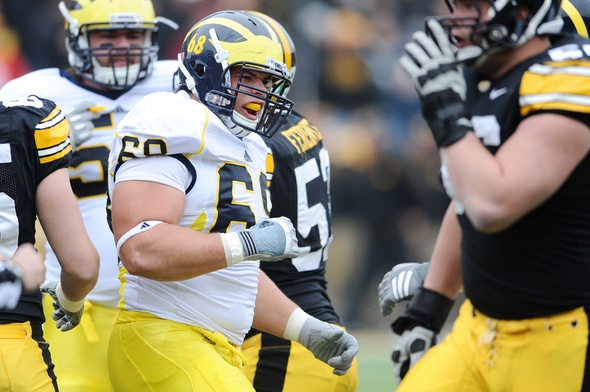
Michigan senior Mike Martin celebrates a play during the first quarter at Iowa.
Melanie Maxwell I AnnArbor.com
The Michigan football team's defense has been tremendous this season.
Its work in third-and-short situations might be most impressive of all.
The Wolverines are stopping opponents 60 percent of the time this season on third downs of 3 yards or fewer. They've been even better in Big Ten play, getting stops at a prodigious 68-percent clip.
They've also gotten stops on six-of-eight short-yardage fourth downs, a 75-percent clip, and delivered three goal-line stands.
Quite a feat.
Why has Michigan been so successful in these situations? Most significantly, it is a function of the improved overall play of the defensive line, especially seniors Mike Martin and Ryan Van Bergen.
But Martin credits a renewed emphasis on film study for pushing them over the edge.
"These coaches did a great job of coming in and stressing the importance of watching film and really teaching us what to look for," Martin said. "Not just the formations, but the little things -- the splits, the pressure keys, how offensive linemen are leaning when they want to pull or down-block.
"This is by far the most film I’ve ever watched in a season."
Martin said he watches about 3.5 to 4 hours of film per day during the week. About 2 hours of that is under the direction of coaches. The rest either is done in Schembechler Hall with teammates, or in his apartment on a laptop.
"We usually go on four- or five-game breakdowns," coach Brady Hoke said of the film used to prep for short-yardage situations. "They’ll go back and look at every other tape you have -- it might be from the year before -- and they’ll see what people have tried to do, and I think we’ve responded to it."
Martin said after doing his nightly homework this week, he's watched film for Saturday's game against No. 17 Nebraska (noon, ESPN) before going to bed.
That kind of diligence has helped players anticipate what's coming from the offense, especially up front. For example, one of the most effective tactics employed by the front four in their dismantling of Illinois last week were various stunts and games played by Martin and Van Bergen.
But defensive coordinator Greg Mattison wasn't the one who initially called them. Rather, it was Van Bergen, just a second-and-a-half before the ball was snapped because of something he recognized in the offense. The move worked, so Mattison told them to keep with the games.
They confounded the Illini's offensive line.
That extended to third downs, where Illinois missed on its first eight tries and was 2-of-6 on short-yardage third downs. The Illini didn't convert a third down of any variety until late in the third quarter.
"That’s all Coach Mattions’s thing," Martin said. "He’s going to find some way to attack them and together, we’re going to watch film to see what’s going to be the best way to attack them up front."
It's paying off, as Michigan's numbers in short-yardage situations are dramatically better than in the past two years. According to MGoBlog, the Wolverines got stops on third- and fourth-and-1 31.2 percent of the time in 2009 and 28.6 percent last year.
This season, that clip has jumped to 55.6 percent, meaning opponents needing only a yard for a first down aren't getting it more than half the time.
"Third-and-1, that's one of my favorite downs," Van Bergen said. "I love it."
Hoke said the credit for the short-yardage success rests on the players for executing the game plan, but preparation from coaches also has been key. That goes all the way back to fall camp, when the defense would conclude practices with goal-line situations.
"There were consequences for winning and losing," Van Bergen said recently of the drills. "I'm not going to get into details, but you didn't want to be on the losing end of that in camp.
"The defense really kind of gelled and came around that as one of the places to really hang your hat. We can stop the run. That's why we've been successful at it, and that's why we'll continue to be successful at it."
Kyle Meinke covers Michigan football for AnnArbor.com. He can be reached at 734-623-2588, by email at kylemeinke@annarbor.com and followed on Twitter @kmeinke.
Comments
Theo's Brother
Fri, Nov 18, 2011 : 2:30 a.m.
Improvement! Love it! Keep it up boys, GO BLUE!! P.S. Brother Theo, mom wants to know if Lorain and Tater are coming to Thanksgiving dinner next week so she can set places for them at the table.
#58ontheroster
Thu, Nov 17, 2011 : 9:09 p.m.
I meant to say that we had an average "offense."
#58ontheroster
Thu, Nov 17, 2011 : 8:56 p.m.
By the way, Theo, in 1997 we had the number 1 defense in the country and an average defense. We won the national championship. Perhaps you'd be happier cheering for Indiana. They can score points, but can't stop anyone from scoring. That ought to satisfy your longing for RichRod.
MRunner73
Thu, Nov 17, 2011 : 4:15 p.m.
These Maize and Blue players are HUNGRY. They will have even more success. I am impressed. GO BLUE!!!
DonAZ
Thu, Nov 17, 2011 : 7:37 p.m.
And it's not *just* the prospect of victory. Hoke is establishing a foundation of something deeper and more important. Victories flow from that.
Theo212
Thu, Nov 17, 2011 : 3:18 p.m.
We tried that whole "defense" nonsense, remember? Did we win The Crystal? Let's move on from this and not be fixated on the past.
DonAZ
Thu, Nov 17, 2011 : 7:37 p.m.
@Larry -- "gentle troll" -- LOL ... yeah, as much I disagree with my dear friend Theo I have to chuckle at times. He's dead wrong, of course (I know this because I'm always right :-) ... but he's *just* goofy enough to make me smile at times. Other times I spit coffee on my computer screen. But that's rare.
MRunner73
Thu, Nov 17, 2011 : 4:14 p.m.
Can you say: t r a n s i t i o n? Forget "The Crystal". Forget it next year. One step at a time. Step out of the 1997-98 time warp and get real.
Larry Weisenthal
Thu, Nov 17, 2011 : 4:10 p.m.
You are really sort of a gentle troll. It's hard to get overly riled up over a caricature - I'm increasingly convinced that you are a RR fan in the same way Steve Colbert is a faux conservative. Your remarks trigger a chuckle. Keep them coming; it's good to have others in on the joke. It's fun to read the outrage from those who take you seriously. Good show!
shrewdrealist
Thu, Nov 17, 2011 : 2:56 p.m.
I hope those kids stay humble.
DonAZ
Thu, Nov 17, 2011 : 7:34 p.m.
Van Bergen made some less-than-humble comments recently. Hoke gently rebuked him in a press conference. My guess is there was stronger words said to Van Bergen and the rest this week about not getting cocky.